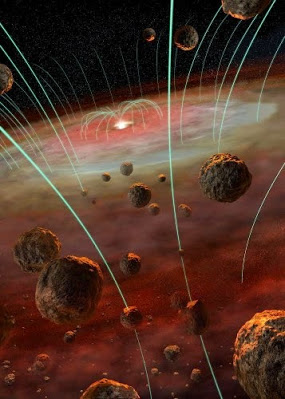
By analyzing a meteorite that crash-landed in India eight decades ago, researchers have discovered the first experimental evidence suggesting that our solar system’s protoplanetary disk was shaped by an intense magnetic field which propelled massive amounts of gas into the sun over the course of just a few million years.
In the study, MIT graduate student Roger Fu and colleagues from Cambridge University, Arizona State University and elsewhere studied a space rock known as a Semarkona, which fell to Earth in northern India back in 1940 and is said to be one of the most pristine relics of the early solar system. They extracted individual pellets known as chondrules from a small sample of the meteorite and measured the magnetic orientations of each grain.
As the study authors reported Friday in the journal Science, they found that the meteorite had not been altered since its formation. With that established, they then measured the magnetic strength of each chondrule and calculated the original magnetic field in which those grains were created. Their calculations revealed the early solar system’s magnetic field was between five and 54 microteslas, or up to 100,000 times stronger than what currently exists in interstellar space.
While astronomers have long observed the process of protoplanetary disk evolution throughout the galaxy, the mechanism by which planetary disks evolved has remained a mystery to scientists for several decades, the researchers said. Based on their measurements, however, the researchers believe that the magnetic field would likely have played a major role in the formation of the solar system and of Earth-like planets.
Image Caption: Magnetic field lines (green) weave through the cloud of dusty gas surrounding the newborn Sun. In the foreground are asteroids and chondrules, the building blocks of chondritic meteorites. While solar magnetic fields dominate the region near the Sun, out where the asteroids orbit, chondrules preserve a record of varying local magnetic fields. Credit: Science
More information available here: http://b4in.org/rBiN
 Hālau 'Aha Hui Lānākila