This blog honors the metaphysical use of sacred sound while distinguishing spiritual tradition, emerging frequency research, and established music-therapy evidence.
There are moments when sound seems to do more than simply enter the ears.
A chant heard inside a cathedral can alter the atmosphere of the room. A singing bowl can make the body seem unusually still. A single sustained tone can quiet the mind more quickly than words. A beloved piece of music may release grief that has been carried silently for years.
Human beings have intuitively understood this mysterious relationship between sound, consciousness, emotion, and the body for thousands of years.
Among the modern expressions of sacred sound practice are what have come to be called the Solfeggio frequencies: a group of specific sound frequencies used in meditation, energy work, spiritual practice, relaxation, and contemporary sound healing.
Their advocates sometimes describe them as ancient healing tones capable of restoring the body’s energetic architecture, awakening consciousness, or even repairing DNA.
The reality is both more complicated and, in some respects, more interesting.
Science does provide growing evidence that music and structured sound can influence stress physiology, emotion, autonomic nervous system activity, pain perception, and psychological well-being. What science has not established is that each individual Solfeggio frequency possesses the precise miraculous biological property commonly attributed to it.
Understanding that distinction allows us to explore Solfeggio frequencies without either dismissing their spiritual value or exaggerating what has been scientifically demonstrated.
What Is a Frequency?
Everything we hear as sound begins with vibration.
When something vibrates, it creates pressure waves that travel through a medium such as air. The number of vibrations occurring each second is measured in hertz, abbreviated Hz.
A tone of 528 Hz, for example, vibrates approximately 528 times each second.
Lower frequencies are perceived as deeper sounds. Higher frequencies are perceived as higher pitches.
The human auditory system transforms those vibrations into electrical and chemical signals that travel through the nervous system and are interpreted by the brain. Sound therefore does not merely remain outside the body. Once perceived, it becomes part of a complex neurological experience involving attention, emotion, memory, expectation, movement, and autonomic regulation.
This is one reason sound has such extraordinary power.
We do not merely hear music.
We respond to it.
What Are the Solfeggio Frequencies?
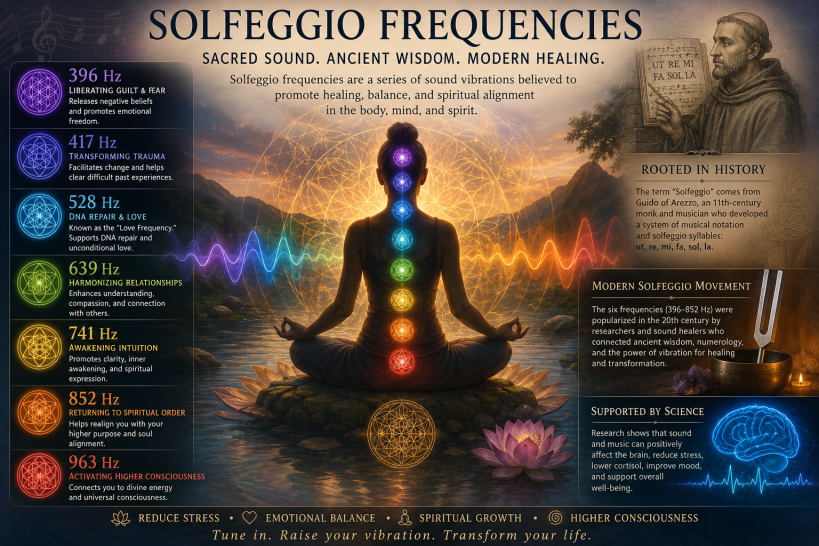
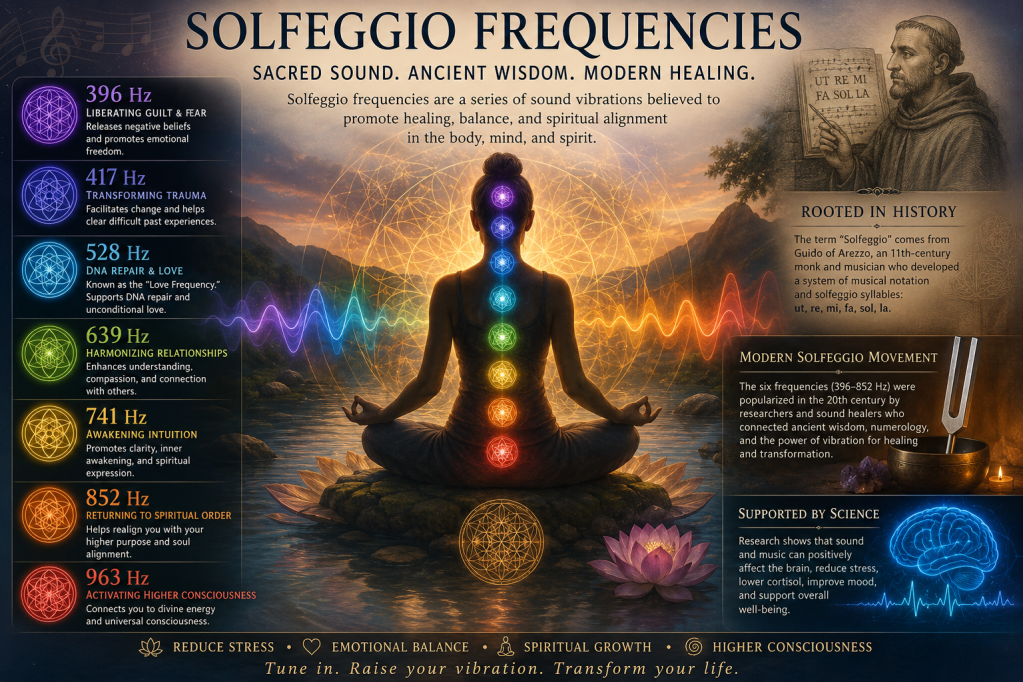
The contemporary Solfeggio system generally contains nine frequencies:
| Frequency | Common Contemporary Spiritual Ass’n |
| 174 Hz | Grounding, security, physical comfort |
| 285 Hz | Restoration, energetic renewal |
| 396 Hz | Releasing fear, guilt, and limitation |
| 417 Hz | Change, transition, clearing old patterns |
| 528 Hz | Transformation, love, restoration |
| 639 Hz | Relationships, compassion, reconciliation |
| 741 Hz | Expression, purification, intuitive clarity |
| 852 Hz | Spiritual awareness and inner perception |
| 963 Hz | Unity consciousness and connection with the Divine |
These interpretations are widely used within modern sound-healing communities, but they should be understood primarily as contemporary metaphysical correspondences rather than medically established functions.
The original modern core usually consisted of six frequencies:
396, 417, 528, 639, 741, and 852 Hz.
The additional tones—174, 285, and 963 Hz—became incorporated into the expanded system later.
Are the Solfeggio Frequencies Ancient?
This is where history requires some clarification.
There genuinely is an ancient and medieval history behind the word solfeggio.
In the eleventh century, the Benedictine music theorist Guido of Arezzo developed an influential method for teaching singers musical intervals. The syllables were:
Ut — Re — Mi — Fa — Sol — La
They were derived from the opening syllables of lines from a Latin hymn associated with Saint John the Baptist.
This system eventually developed into the familiar:
Do — Re — Mi — Fa — Sol — La — Ti.
Historical musicology confirms Guido’s importance in the development of Western musical education and solmization. (Library of Congress Blogs)
What historical evidence does not demonstrate is that medieval monks were deliberately singing the modern fixed frequencies of 396, 417, 528, 639, 741, and 852 Hz for healing purposes.
Guido’s syllables represented musical relationships and intervals rather than the modern set of fixed hertz values.
The contemporary healing-frequency system emerged much later and became especially popular through twentieth-century metaphysical and alternative-healing literature.
So there are really two histories that are frequently blended together:
Historical solfeggio is a genuine medieval system of musical education.
Solfeggio healing frequencies are a modern system of spiritual and therapeutic sound correspondences inspired in part by that older tradition.
Recognizing this distinction does not invalidate meditation with these tones. It simply places the practice in its proper historical setting.
Can Sound Actually Affect the Human Body?
Absolutely.
This is where the scientific conversation becomes particularly fascinating.
Sound is processed through neurological systems interconnected with regions involved in emotion, memory, attention, arousal, and autonomic regulation.
Relaxing music can therefore influence the relationship between the two primary branches of the autonomic nervous system:
the sympathetic nervous system, associated with mobilization and the stress response,
and the parasympathetic nervous system, associated with restoration, digestion, relaxation, and recovery.
A 2026 systematic review and meta-analysis examined 24 randomized controlled trials involving 1,295 participants and found that music interventions produced measurable changes in heart-rate-variability parameters associated with autonomic regulation. Particularly noticeable effects appeared among people experiencing stress, anxiety, fear, or sleep difficulties. Short interventions of thirty minutes or less were often effective, and personally selected music sometimes performed better than standardized selections. (Frontiers)
Music listening has also been associated with changes in stress-related physiology.
An everyday-life study found that listening to music for relaxation was associated with lower perceived stress and lower cortisol concentrations. (PubMed)
Broader reviews of music-based interventions have similarly reported effects on psychological stress and, in some studies, heart rate, blood pressure, and stress-related hormones. (Frontiers)
The important point is this:
Sound does interact with physiology.
The question still being investigated is whether particular isolated frequencies possess uniquely specific healing effects beyond the wider effects of music, rhythm, expectation, breathing, emotional meaning, and relaxation.
What About 528 Hz—the So-Called “Love Frequency”?
No Solfeggio tone has received more attention than 528 Hz.
Within modern metaphysical literature it has been called the:
Love Frequency
Miracle Tone
Transformation Frequency
and sometimes the DNA Repair Frequency.
The DNA-repair claim is especially important to approach cautiously.
At present, listening to 528 Hz has not been established as a medical technique capable of repairing human DNA.
There is, however, some intriguing emerging research concerning physiological responses to music organized around 528 Hz.
A small 2018 study involving only nine participants compared music associated with 528 Hz with conventionally tuned music. Researchers observed changes including decreased cortisol, increased oxytocin, and reductions in reported tension after the 528-Hz condition. The extremely small sample means the findings should be considered preliminary rather than proof of a unique healing mechanism. (CiNii Research)
More recently, a 2026 randomized controlled trial involving 162 healthy university students compared twenty minutes of 528-Hz music, 432-Hz music, and no music during examination-related stress.
Researchers found differences in several salivary biomarkers. The 528-Hz group demonstrated increases in salivary BDNF and CREB compared with controls. However, there were no significant differences in cognitive performance on the Stroop test. The researchers therefore described biological responses to frequency-based music rather than evidence of miraculous healing. (PubMed)
These studies make 528 Hz scientifically interesting.
They do not yet establish that 528 Hz repairs DNA, cures illness, or possesses a universal biological effect unique to that exact numerical frequency.
Much more controlled replication is necessary.
Then How Might Solfeggio Frequencies Support Healing?
A better way to understand sound healing may be through several interacting layers.
1. Regulation of the Nervous System
Slow, predictable, nonthreatening sound may encourage the nervous system to shift away from states of hyperarousal.
Breathing slows.
Muscular tension may decrease.
Attention becomes less scattered.
The body receives fewer signals requiring immediate action.
Under appropriate conditions, this can support the physiological environment associated with rest and recovery.
Healing frequently begins not because sound directly “fixes” tissue, but because a chronically activated organism finally enters a state in which restoration can occur.
2. Stress Reduction
Chronic stress places extraordinary demands upon the body.
Stress influences sleep, cardiovascular activity, endocrine function, digestion, immune regulation, pain perception, and emotional health.
If music or sound reduces stress, its effects may therefore ripple across several bodily systems.
This is considerably different from claiming that one frequency cures a disease.
Yet reducing physiological stress can itself be therapeutically meaningful.
3. Emotional Release
Music possesses an unusual ability to bypass intellectual defenses.
A person may understand intellectually that grief exists within them while remaining incapable of feeling it.
Then a particular sound appears.
Suddenly the grief moves.
Tears come.
Memories surface.
The emotional body opens.
Sound can become a doorway through which previously inaccessible psychological material enters awareness.
In spiritual healing traditions, this is sometimes described as energetic release.
Psychology might describe aspects of the same experience through emotional processing, memory activation, regulation, and meaning-making.
The vocabulary differs.
The human experience may be remarkably similar.
Sound and the Human Energy Field
Esoteric traditions approach sound from another perspective.
Within many metaphysical systems, creation itself is understood as fundamentally vibratory.
The ancient Indian tradition speaks of Nāda, sacred sound.
The Vedic Om represents primordial vibration.
Hebrew and Qabalistic mysticism places extraordinary importance upon sacred letters, Divine Names, and spoken vibration.
Christian mystical traditions developed chant.
Islamic spirituality cultivated sacred recitation and remembrance.
Tibetan traditions employ mantra, horns, bells, and resonant instruments.
Western ceremonial magic uses the vibration of Divine Names as a fundamental technique.
Across remarkably different cultures appears a recurring intuition:
consciousness can be changed through sacred sound.
From an esoteric perspective, sound may organize consciousness because vibration acts as an intermediary between subtle and material worlds.
Whether one interprets the subtle body literally, symbolically, psychologically, or spiritually, chanting and sustained tones can profoundly alter subjective states.
And subjective states matter.
They influence perception, emotion, behavior, relationship, and spiritual experience.
Do Frequencies “Raise Your Vibration”?
This popular expression can be useful metaphysically, but it should not be confused with the scientific meaning of frequency.
Someone experiencing compassion does not literally begin vibrating at 639 Hz.
Nor does enlightenment mean that the cells suddenly oscillate at 963 Hz.
In spiritual language, raising vibration usually describes a qualitative change in consciousness:
from fear toward trust,
from agitation toward stillness,
from fragmentation toward integration,
from resentment toward compassion,
from unconsciousness toward awareness.
Used that way, frequency becomes both sound and symbol.
The tone becomes a contemplative anchor around which consciousness is organized.
The Spiritual Power May Not Be in the Number Alone
This may ultimately be one of the most important insights regarding Solfeggio work.
A healing session consists of much more than frequency.
It includes:
sound,
rhythm,
breathing,
attention,
intention,
expectation,
environment,
memory,
symbolism,
silence,
and consciousness.
If someone enters a sacred space, lights a candle, breathes deliberately, invokes the Divine, listens deeply to a sustained tone, allows difficult emotions to surface, and remains in meditation for twenty minutes, an altered psychophysiological state may develop.
It would be simplistic to attribute the entire experience solely to the number 528.
But it would be equally simplistic to dismiss the experience because 528 Hz itself has not been proven miraculous.
Ritual works through relationships among many factors.
Sound can become the organizing center of those relationships.
A Simple Solfeggio Meditation Practice
Choose a frequency according to the spiritual quality you wish to contemplate.
For example:
396 Hz — release fear.
417 Hz — welcome change.
528 Hz — cultivate love and restoration.
639 Hz — contemplate relationship and reconciliation.
741 Hz — seek clarity.
852 Hz — enter inner silence.
Sit comfortably and allow the body to settle.
Before beginning the recording, establish an intention—not a demand, but an orientation.
You might inwardly say:
May this period of sound bring my body, mind, and spirit into greater harmony.
Begin breathing slowly.
Rather than concentrating aggressively upon the tone, allow yourself to receive it.
Notice where the sound seems to be felt.
Perhaps it appears in the chest.
Perhaps the head.
Perhaps nowhere physically at all.
Do not force an experience.
After several minutes, gently vocalize a comfortable vowel or hum along with the sound if desired.
The vibration of one’s own voice introduces another dimension because vocalization engages respiration, resonance, attention, and bodily sensation simultaneously.
After approximately fifteen to thirty minutes, turn the sound off.
Then remain in silence.
This final silence is important.
The tone prepares the field.
Silence reveals what has changed.
Notice your breathing, emotional state, bodily sensations, imagery, memories, or intuitive impressions.
A journal can be particularly valuable for recording what repeatedly emerges during work with different frequencies.
Which Frequency Should You Use?
There is no scientific evidence requiring a person to use a specific Solfeggio tone for a particular condition.
The traditional modern correspondences can instead function as meditative keys.
Use them intentionally.
For grounding, experiment with 174 or 396 Hz.
For periods of transition, work with 417 Hz.
For heart-centered meditation, experiment with 528 or 639 Hz.
For contemplation and intuitive work, explore 741 or 852 Hz.
For mystical meditation upon unity or Divine consciousness, some practitioners prefer 963 Hz.
But pay attention to your own response.
A 2026 review of music and autonomic regulation found that personally selected music could sometimes produce stronger responses than standardized selections. In other words, what genuinely speaks to the individual nervous system may be just as important as any prescribed frequency. (Frontiers)
Sound Healing Is Best Understood as Complementary Healing
There is now substantial evidence that music can have meaningful therapeutic effects.
A recent systematic review of music therapy for anxiety found an overall moderate benefit across psychological anxiety outcomes, although physiological effects were smaller and statistically uncertain. (PubMed)
Cochrane evidence examining people with cancer has also found that music interventions may improve outcomes including anxiety, depression, hope, pain, and fatigue, while emphasizing limitations in study quality and the need for further research. (Cochrane Library)
This gives us a sensible middle path.
Sound healing should neither be dismissed as meaningless nor promoted as a substitute for medicine.
It is better understood as a complementary practice capable of supporting relaxation, emotional regulation, contemplative awareness, spiritual practice, and potentially certain aspects of physiological well-being.
Anyone experiencing illness should continue appropriate medical evaluation and treatment rather than attempting to replace necessary healthcare with frequency recordings.
Sound can accompany healing.
It should not be promised as a cure.
The Mystery of Resonance
Perhaps the deepest principle behind sacred sound is not frequency but resonance.
Two instruments tuned sympathetically can respond to one another even when only one is struck.
Something similar happens metaphorically within human beings.
A sound enters us.
Something answers.
A memory.
An emotion.
A prayer.
A forgotten grief.
An image.
A sensation of peace.
A sudden realization.
The sound has not placed something foreign within us.
It has awakened something that was already capable of responding.
This may be one of the most profound ways to understand spiritual sound healing.
The healer is not necessarily the frequency.
The frequency may be the key.
The instrument being tuned is consciousness itself.
Sound as a Bridge Between Body and Spirit
The scientific study of therapeutic sound is still developing, and research specifically concerning Solfeggio frequencies remains much smaller than research concerning music therapy in general.
We should therefore be careful with extraordinary claims.
We cannot presently say that 528 Hz repairs DNA, that 639 Hz biologically heals relationships, or that 963 Hz scientifically activates enlightenment.
But neither must we conclude that sacred sound possesses no value.
We know that music can influence emotion.
We know that sound can affect attention.
We know that music can modify aspects of stress physiology and autonomic regulation.
We know that chanting, prayer, music, and sacred recitation have been used across civilizations to enter contemplative states.
And we know from human experience that certain sounds can reach places within consciousness that ordinary language cannot.
The Solfeggio frequencies may therefore be most fruitfully approached not as magical prescriptions but as contemplative technologies of resonance.
They invite the practitioner to listen.
To breathe.
To become still.
To allow the nervous system to soften.
To observe the interior world.
And perhaps, through sound, to remember a more fundamental harmony.
For beneath all the discussions of hertz, nervous systems, cortisol, chakras, meditation, and consciousness lies a very ancient spiritual intuition:
Before there was music, there was vibration.
Before there was speech, there was sound.
And before the human being could explain the mystery of existence, we were already listening for it.
I can also develop a matching annotated bibliography for this article that separates peer-reviewed sound/music research, historical solfeggio scholarship, and modern metaphysical sources.
Following is an annotated bibliography in a Chicago-style format. The three sections deliberately distinguish scientific evidence from medieval music history and from modern metaphysical literature, so readers can see exactly what kind of authority each source carries.
Annotated Bibliography
Solfeggio Frequencies, Sound Healing, and the Human Body and Spirit
A Note on the Sources
The literature surrounding Solfeggio frequencies belongs to three substantially different categories, and they should not be treated as interchangeable.
The first category consists of peer-reviewed biomedical, psychological, and music-therapy research. This literature provides evidence that music and sound can influence anxiety, stress perception, autonomic regulation, hormonal biomarkers, pain, and other physiological or psychological outcomes. A much smaller subset investigates specific frequencies such as 528 Hz or 432 Hz.
The second category consists of historical and musicological scholarship concerning Guido of Arezzo, medieval solmization, the hexachord, chant, and the syllables ut–re–mi–fa–sol–la. These sources establish the genuine medieval history behind the word solfeggio. They do not, however, document the modern sequence 396–417–528–639–741–852 Hz as an ancient medieval healing scale.
The third category contains modern metaphysical and sound-healing sources. These are important for understanding the development, symbolism, spiritual interpretation, and contemporary practice of the frequencies, but they should be regarded as primary sources for modern Solfeggio doctrine rather than as scientific proof of medical efficacy.
I. Peer-Reviewed Sound, Music, and Physiological Research
Akimoto, Kaho, Ailing Hu, Takuji Yamaguchi, and Hiroyuki Kobayashi. “Effect of 528 Hz Music on the Endocrine System and Autonomic Nervous System.” Health 10, no. 9 (2018): 1159–1170. https://doi.org/10.4236/health.2018.109088.
This exploratory study is one of the most frequently cited scientific investigations specifically involving 528-Hz music. Nine healthy adults listened on separate occasions to music associated with 528-Hz and 440-Hz tuning. The researchers measured cortisol, chromogranin A, oxytocin, autonomic nervous-system activity, and mood.
Following the 528-Hz condition, cortisol decreased, oxytocin increased, and some measures of tension and mood disturbance improved. The sample, however, consisted of only nine people, making the study far too small to demonstrate that 528 Hz possesses a unique universal healing property. It should therefore be presented as preliminary evidence warranting further investigation, not as proof of claims such as DNA repair or disease treatment. (CiNii Research)
Use in the blog: Excellent for demonstrating that 528 Hz has received genuine scientific investigation while simultaneously explaining the limits of the available evidence.
Bozok, Ümmü Gülşen, et al. “Acute Music-Frequency Exposure Modulates Salivary Stress and Neurotrophic Markers in Young Adults: A Randomized Controlled Trial.” Brain and Behavior 16 (2026): e71452. https://doi.org/10.1002/brb3.71452.
This 2026 randomized controlled trial substantially expands the human evidence concerning frequency-based music. A total of 162 university students were randomly assigned to listen to 528-Hz music, 432-Hz music, or no music for twenty minutes during an examination-related stress period.
The investigators measured salivary BDNF, CREB, and GRP78. The 528-Hz group demonstrated significantly higher BDNF and CREB levels than the control group, while 432-Hz music produced a different biomarker pattern. No significant difference appeared between groups in Stroop cognitive-performance scores.
The study is especially valuable because of its larger randomized design. Even so, it demonstrates short-term biomarker differences, not miraculous healing, DNA reconstruction, or long-term medical outcomes. Replication and mechanistic investigation remain necessary. (Wiley Online Library)
Use in the blog: One of the strongest current sources for stating that particular musical tuning conditions may produce measurable biological differences without overstating what those differences mean clinically.
Babayi Daylari, T., G. H. Riazi, Sh. Pooyan, E. Fathi, and F. Hedayati Katouli. “Influence of Various Intensities of 528 Hz Sound-Wave in Production of Testosterone in Rat’s Brain and Analysis of Behavioral Changes.” Genes & Genomics 41, no. 2 (2019): 201–211. https://doi.org/10.1007/s13258-018-0753-6.
This animal study investigated direct exposure to a 528-Hz sound wave rather than simply listening to musical compositions tuned around that frequency. Researchers reported changes involving testosterone production, expression of steroidogenic regulatory pathways, reactive oxygen species, and anxiety-related behavior in rats.
The research is scientifically interesting because it suggests that audible acoustic stimulation can have measurable biological consequences. It cannot, however, be directly extrapolated to human spiritual or clinical healing. The experimental intensity—particularly the reported 100-dB condition—is also quite different from ordinary meditation listening. (PubMed)
Use in the blog: Helpful when discussing the emerging field of sonobiology and the possibility that acoustic vibration can interact with living biological systems.
Aravena, Pedro Christian, Camila Almonacid, and Marcelo Ignacio Mancilla. “Effect of Music at 432 Hz and 440 Hz on Dental Anxiety and Salivary Cortisol Levels in Patients Undergoing Tooth Extraction: A Randomized Clinical Trial.” Journal of Applied Oral Science 28 (2020): e20190601. https://doi.org/10.1590/1678-7757-2019-0601.
Although 432 Hz is not one of the canonical Solfeggio frequencies, this randomized clinical trial is important to the larger question of whether musical tuning frequency itself may influence physiological responses.
Forty-two patients undergoing tooth extraction were assigned to 432-Hz music, 440-Hz music, or no music. Both musical groups demonstrated lower anxiety than controls, while the 432-Hz group demonstrated significantly lower salivary cortisol than either the 440-Hz or control groups.
The study suggests that tuning differences deserve further investigation. It does not demonstrate a universal superiority of 432 Hz or establish that single frequencies independently cause the observed effects. (PubMed)
Use in the blog: Useful for placing Solfeggio research within the broader scientific investigation of tuning, pitch reference, music, stress, and physiology.
Flater, Bettina, Are Brean, and Daniel S. Quintana. “Music Therapy and Vagally Mediated Heart Rate Variability: A Systematic Review and Narrative Synthesis.” International Journal of Psychophysiology 219 (2026): 113288. https://doi.org/10.1016/j.ijpsycho.2025.113288.
This systematic review examined 28 studies evaluating music therapy and vagally mediated heart-rate variability, an indicator associated with parasympathetic cardiac regulation.
The reviewed literature generally suggested increased cardiac parasympathetic activity during music therapy, but the authors emphasized substantial heterogeneity, methodological differences, small sample sizes, and a high overall risk of bias.
This source is particularly important because it supports a scientifically plausible pathway through which sound practices may affect bodily state: autonomic regulation. At the same time, it demonstrates why broad claims about specific healing frequencies should remain cautious. (ScienceDirect)
Use in the blog: Strong support for explaining how soothing sound may influence the sympathetic–parasympathetic balance without requiring an unproven “energy frequency” mechanism.
Zhang, E., et al. “Effect of Music Intervention on Heart Rate Variability: A Systematic Review and Meta-Analysis of Randomized Controlled Trials.” Frontiers in Psychology 17 (2026). https://doi.org/10.3389/fpsyg.2026.1750786.
This systematic review and meta-analysis examined randomized clinical trials of music interventions and heart-rate variability. The research addresses whether listening to music can measurably affect autonomic nervous-system regulation.
The analysis supports the broader view that musical interventions can influence HRV parameters, although effects depend upon variables such as tempo, duration, musical selection, participant population, and study design. (Frontiers)
Use in the blog: Particularly useful for explaining why relaxation produced during Solfeggio meditation may involve more than the numerical frequency itself. Tempo, musical structure, preference, breathing, expectation, and emotional state may all contribute.
Wong, Melanie Mitsui, Talha Tahir, Michael Mitsui Wong, Annilee Baron, and Rachael Finnerty. “Biomarkers of Stress in Music Interventions: A Systematic Review.” Journal of Music Therapy 58, no. 3 (2021): 241–277. https://doi.org/10.1093/jmt/thab003.
This systematic review examined biological stress markers in randomized music-intervention research. Fourteen trials investigated eighteen different biomarkers, with cortisol and salivary alpha-amylase among the most frequently measured.
The authors found evidence suggesting that music interventions can reduce both psychological stress and stress-related biomarkers in some acute situations, but the diversity of methods makes it difficult to calculate one universal physiological effect. (PubMed)
Use in the blog: An excellent scientific foundation for the statement that music may affect endocrine and stress physiology even when the exact mechanisms associated with particular Solfeggio frequencies remain uncertain.
de Witte, Martina, Sonja Aalbers, Annemieke Vink, et al. “Music Therapy for the Treatment of Anxiety: A Systematic Review with Multilevel Meta-Analyses.” eClinicalMedicine 84 (2025): 103293. https://doi.org/10.1016/j.eclinm.2025.103293.
This major systematic review analyzed 51 studies and 93 effect sizes concerning music therapy and anxiety. The researchers found an overall moderate benefit for anxiety outcomes, particularly self-reported anxiety. Physiological outcomes showed a smaller and statistically uncertain effect.
The study is important because it demonstrates that music-based therapeutic practice has genuine clinical research behind it while also distinguishing psychological improvements from stronger biological claims. (PubMed)
Use in the blog: Supports discussion of sound as a complementary method for emotional regulation, anxiety reduction, and psychological well-being.
Bradt, Joke, Cheryl Dileo, Katherine Myers-Coffman, and Joachim Biondo. “Music Interventions for Improving Psychological and Physical Outcomes in People with Cancer.” Cochrane Database of Systematic Reviews, no. 10 (2021): CD006911. https://doi.org/10.1002/14651858.CD006911.pub4.
This extensive Cochrane review incorporated 81 studies involving 5,576 participants. Music interventions were associated with potential benefits for anxiety, depression, hope, pain, fatigue, heart rate, and blood pressure among adults with cancer.
The authors also emphasized that much of the evidence was of low or very low certainty and that many trials carried a substantial risk of bias.
This review is especially useful for drawing the line between legitimate complementary therapy and claims that sound itself cures disease. Music may support people undergoing treatment; it should not be presented as a replacement for medical care. (Cochrane)
Use in the blog: Strong evidence for describing therapeutic music as complementary healing rather than a substitute for conventional medicine.
II. Historical Solfeggio, Guido of Arezzo, and Medieval Music Scholarship
Guido of Arezzo. Micrologus. In Hucbald, Guido, and John on Music: Three Medieval Treatises. Translated by Warren Babb. Edited by Claude V. Palisca. New Haven: Yale University Press, 1978.
This is one of the most important primary texts for understanding medieval Western music theory. Guido of Arezzo was among the most influential music theorists of the eleventh century and helped systematize pedagogical methods that made chant easier to learn and transmit.
His musical teaching is directly relevant to the development of solmization, but the historical material concerns interval relationships, chant pedagogy, notation, and singing—not a series of fixed healing frequencies expressed in modern hertz values. (WorldCat)
Use in the blog: A crucial primary source for separating authentic Guidonian music theory from modern legends concerning “ancient Solfeggio frequencies.”
Guido of Arezzo. Guido d’Arezzo’s Regule Rithmice, Prologus in Antiphonarium, and Epistola ad Michahelem: A Critical Text and Translation. Edited and translated by Dolores Pesce. Ottawa: Institute of Mediaeval Music, 1999.
Pesce’s critical edition and translation makes several of Guido’s important writings available with extensive scholarly commentary, manuscript inventories, annotation, and historical apparatus.
These writings help reconstruct what Guido actually taught about music, interval recognition, chant, notation, and musical education. They are particularly useful for testing later claims attributed to him against surviving medieval textual evidence. (WorldCat)
Use in the blog: Among the best scholarly sources for demonstrating that historical claims concerning Guido should be based on his actual surviving writings rather than modern sound-healing lore.
Grier, James. “Guido of Arezzo.” Oxford Bibliographies in Music. Oxford University Press, 2018. https://doi.org/10.1093/obo/9780199757824-0248.
Grier provides a modern scholarly overview of Guido’s life, writings, historical setting, and enormous contribution to medieval musical pedagogy. He identifies solmization and staff notation with clefs as central developments associated with Guido’s work. (OUP Academic)
The entry is especially valuable as an orientation to the larger scholarly literature on Guidonian music theory.
Use in the blog: Recommended as an authoritative secondary reference for readers wishing to investigate the historical Guido beyond popular internet accounts.
Haines, John. “The Origins of the Musical Staff.” The Musical Quarterly 91, nos. 3–4 (2008): 327–378. https://doi.org/10.1093/musqtl/gdp002.
Haines examines the development of Western staff notation and critically addresses the tendency to reduce complicated historical developments to simplistic stories about individual “inventors,” including Guido of Arezzo.
The study demonstrates why the history of medieval music requires careful contextual scholarship rather than retroactively projecting modern concepts into the Middle Ages. (OUP Academic)
Use in the blog: Useful for correcting overly simplified claims that a single medieval figure suddenly created the complete system of Western notation—or the modern Solfeggio healing-frequency system.
Herissone, Rebecca. Music Theory in Seventeenth-Century England. Oxford: Oxford University Press, 2000.
Herissone’s discussion of pitch structure explains how the medieval hexachordal tradition continued to shape musical education into the early modern period. The system organized notes into six-note collections corresponding to ut, re, mi, fa, sol, and la, with the intervallic structure tone–tone–semitone–tone–tone.
The syllables derive from the hymn associated with Saint John the Baptist and served primarily as a means of teaching singers interval relationships. (OUP Academic)
Use in the blog: Particularly valuable for showing what historical “solmization” actually meant: a movable pedagogical system of intervals rather than six immutable frequencies measured in Hz.
III. Modern Metaphysical and Solfeggio-Frequency Sources
Horowitz, Leonard G., and Joseph Puleo. Healing Codes for the Biological Apocalypse. Sandpoint, ID: Tetrahedron Publishing Group, 1999.
This book is one of the most important primary sources for the modern Solfeggio-frequency movement. Library records confirm its publication by Tetrahedron Publishing Group in 1999. (WorldCat)
Horowitz and Puleo connect a sequence of numbers derived through numerological treatment of biblical passages with ideas concerning vibration, healing, spirituality, and biology. Their work helped popularize the six-number sequence:
396 — 417 — 528 — 639 — 741 — 852.
The book is historically significant for understanding modern Solfeggio doctrine, but its biomedical and historical claims should not be treated as equivalent to peer-reviewed medical or musicological scholarship.
Use in the blog: Essential for explaining where the recognizable modern six-frequency system actually enters contemporary metaphysical literature.
Goldman, Jonathan. Healing Sounds: The Power of Harmonics. Rev. ed. Shaftesbury, Dorset: Element, 1996.
Goldman is one of the major figures in contemporary sound-healing culture. Healing Sounds explores vocal harmonics, overtone chanting, resonance, intentionality, sacred sound, and the use of the human voice in transformative practice. Library catalog records identify the revised edition as published by Element in 1996, following an earlier edition from 1992. (WorldCat)
Although the work should not be considered clinical evidence for frequency-specific medical treatment, it is highly useful for understanding the philosophical framework of modern sound healing: consciousness, intention, resonance, harmonics, and the experiential effects of vocal vibration.
Use in the blog: Excellent for developing the spiritual concept that healing sound involves more than numerical frequency alone; consciousness and intention form part of the practice.
Goldman, Jonathan. “Healing Codes Sacred Sounds.” Recording and explanatory notes, 2020–2021.
Goldman’s own account is extremely valuable for tracing the evolution of the modern nine-frequency system. He states that he developed tuning forks using the six numbers presented by Horowitz and Puleo and subsequently added three more numbers, producing the extended nine-frequency sequence that became widely associated with contemporary Solfeggio practice. (YouTube)
This testimony is particularly significant because it helps explain why modern lists often include:
174 — 285 — 396 — 417 — 528 — 639 — 741 — 852 — 963 Hz
rather than the earlier six-frequency sequence.
Use in the blog: One of the most useful primary sources for documenting the transition from the original modern six-number system to the now-common nine-frequency system.
“How Were Solfeggio Frequencies Discovered?” SolfeggioFrequencies.org. Accessed August 2026.
This contemporary popular source illustrates how the modern Solfeggio narrative is currently presented within the sound-healing community. It explicitly connects Joseph Puleo’s work to the biblical Book of Numbers and describes the use of numerical reduction in deriving the six-frequency sequence. (Solfeggio Frequencies)
Its value is primarily ethnographic and doctrinal rather than historical or medical: it shows what contemporary practitioners believe and teach.
It should therefore be read alongside primary modern texts such as Horowitz and Puleo and contrasted with medieval musicological scholarship on Guido of Arezzo.
Use in the blog: Helpful for demonstrating the difference between the internal history told by the modern Solfeggio movement and the conclusions supported by academic music history.
IV. What the Combined Bibliography Tells Us
Taken together, these sources reveal a much more nuanced history of Solfeggio frequencies than is usually presented online.
There is indeed an authentic medieval tradition behind the term solfeggio. Guido of Arezzo and later musicians employed syllables such as ut, re, mi, fa, sol, and la as tools for teaching singers interval relationships. Medieval and early-modern scholarship supports this history. (OUP Academic)
There is not, however, equivalent historical evidence demonstrating that medieval monks possessed or intentionally employed the modern fixed sequence:
396 Hz
417 Hz
528 Hz
639 Hz
741 Hz
852 Hz
as a secret healing scale.
That numerical system belongs to a much more recent metaphysical history associated particularly with the work of Joseph Puleo and Leonard Horowitz, with later sound-healing practitioners expanding and popularizing the system. (WorldCat)
Scientific research, meanwhile, supports a third and distinct conclusion.
Music and structured sound can affect human beings.
They can influence anxiety, emotion, stress responses, autonomic nervous-system activity, heart-rate variability, cortisol and other biomarkers, and in some clinical settings pain and quality of life. (PubMed)
There is also a small but growing body of research examining specific tuning frequencies, including 528 Hz. Some studies have reported intriguing biological effects, including changes in salivary biomarkers and autonomic or neuroendocrine measures. (CiNii Research)
What has not been scientifically established is that:
- 396 Hz specifically removes guilt,
- 417 Hz clears trauma,
- 528 Hz repairs human DNA,
- 639 Hz heals relationships,
- 741 Hz detoxifies cells,
- 852 Hz activates intuition, or
- 963 Hz produces enlightenment.
Those are modern metaphysical correspondences, not established biomedical findings.
This distinction does not require us to abandon spiritual interpretations of sound.
Instead, it gives us a more intellectually responsible model.
The historian can study Guido and medieval solmization.
The scientist can investigate sound, neurobiology, stress, acoustic stimulation, and music therapy.
The metaphysician can work with frequency as symbol, intention, resonance, meditation, and sacred correspondence.
These three approaches can speak to one another without being confused with one another.
That may ultimately be the most productive way to approach the Solfeggio frequencies: not as a lost medical technology whose every modern claim has already been proven, but as a contemporary form of sacred sound practice situated at the intersection of music, physiology, symbolism, contemplative consciousness, and the ancient human intuition that vibration possesses transformative power.
This bibliography makes a clean distinction between what is historically documented, what is experimentally suggestive, and what belongs specifically to modern esoteric interpretation.