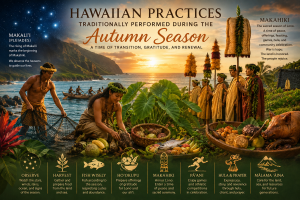
Hawaiian Practices Traditionally Performed During the Autumn Season From the Last Months of Kau to the Sacred Season of Makahiki | Victoria Generao, PhD

When people in Europe or North America speak of autumn, the imagination naturally turns toward falling leaves, shortening days, harvest fields, and preparations for winter. In Hawaiʻi, however, the seasonal story is different. The islands do not traditionally organize the year according to the familiar four-season cycle of spring, summer, autumn, and winter.

For Native Hawaiians, time was read through the movements of the heavens, the phases of the Moon, the appearance of stars, rainfall, winds, ocean conditions, the flowering and fruiting of plants, the migrations and spawning of fish, and countless other signs within the living environment.

Traditionally, the Hawaiian year was broadly understood through two great seasonal movements: Kau, the warmer and generally drier season, and Hoʻoilo, the cooler and wetter season. Historical Hawaiian accounts describe six lunar months belonging to each. The transition into Hoʻoilo occurred around what the Western calendar calls late autumn. (University of Hawaii)

Therefore, when we ask what Hawaiian people traditionally practiced during “autumn,” we are really asking about something more interesting:

What happened during the closing months of Kau, the preparation for Hoʻoilo, and the approach and opening of Makahiki?

The answer reveals a season concerned with observation, harvesting, food preservation, redistribution, gratitude, ritual offering, peace, physical competition, communal celebration, and the renewal of the relationship between humanity, the ʻāina, the sea, the ancestors, and the akua.


Autumn in Hawaiʻi Was a Time of Transition

The Gregorian months of approximately September through November overlap several traditional lunar months, although the correspondence is never exact because the Hawaiian calendar follows lunar and environmental observations rather than fixed Gregorian dates.

Older Hawaiian calendrical traditions identify the latter portion of Kau with months such as Mahoe Hope and ʻIkuwā, followed by Welehu, which marks the transition toward Hoʻoilo. David Malo’s nineteenth-century account describes ʻIkuwā as the final month of Kau and Welehu as the first month of Hoʻoilo. (University of Hawaii at Hilo)

The University of Hawaiʻi’s Hawaiian lunar-calendar resources similarly present ʻIkuwā as a period of increasing rain, thunder, wind, environmental change, and preparation for Makahiki, while Welehu opens the wetter season. (University of Hawaii)

This transitional quality is important.

Traditional Hawaiian seasonal activity was not governed by a printed date announcing that “autumn has begun.” A knowledgeable observer watched the world.

The sky announced the season.

The ocean announced the season.

The plants announced the season.

The winds announced the season.

The behavior of animals announced the season.

And eventually, Makaliʻi—the Pleiades—announced one of the most sacred transitions of the year.


Watching the Heavens: The Rising of Makaliʻi

Among the most important autumn practices was simply one of the most profound: observation.

The night sky served as calendar, clock, navigational map, agricultural guide, and ceremonial indicator.

The star cluster known in Hawaiian as Makaliʻi, commonly identified with the Pleiades, became especially significant as the year approached the season of Makahiki.

According to the National Park Service, Makahiki traditionally began when Makaliʻi became visible rising on the eastern horizon after sunset, generally around late October or early November, although timing and practice varied between islands and communities. (National Park Service)

This was not casual stargazing.

It was kilo—careful observation of natural phenomena.

Celestial and environmental signs helped knowledgeable practitioners determine the resetting of the lunar and ritual calendar. At Puʻuhonua o Hōnaunau, the National Park Service describes Kau Makaliʻi as a period during which traditional practitioners observed astronomical and environmental signs associated with the annual cycle of ritual. (National Park Service)

The autumn sky therefore became a sacred text.

Instead of reading the changing season from a calendar hanging upon a wall, one could read it in the stars.


Harvesting and Preparing Food

The months immediately preceding Makahiki were closely connected with the harvesting and securing of resources.

Fishing, gathering, farming, drying, salting, and storing foods were not merely economic activities. They formed part of a sophisticated system in which human consumption was coordinated with ecological cycles.

Traditional Hawaiian lunar knowledge connected particular phases and months with appropriate times for planting, harvesting, fishing, resting gardens, and allowing marine resources to replenish. The University of Hawaiʻi’s Hawaiian Lunar Calendar emphasizes that generations of Hawaiians used lunar observation to guide both agricultural and fishing practices. (University of Hawaii)

During the later months before Makahiki, fishing activity could increase specifically so that fish might be harvested, prepared, and stored before the coming wet season and ceremonial period. (University of Hawaii)

Foods such as kalo (taro), ʻuala (sweet potato), fish, and other locally available foods were central to community subsistence. Pigs, cultivated crops, and crafted goods could later become part of Makahiki tribute and ceremonial offerings. (National Park Service)

Thus, the Hawaiian autumn harvest was not simply a moment of taking abundance from the earth.

It existed within a larger rhythm:

observe → cultivate → harvest → preserve → offer → redistribute → rest → begin again.


Fishing According to the Season

The sea was just as much a part of the seasonal calendar as the land.

Fish behavior, ocean temperature, tides, spawning cycles, currents, moon phases, winds, and rainfall were carefully observed. Certain species became plentiful during particular months, while other species might be protected or avoided.

The Hawaiian lunar-calendar tradition records periods when particular fish were spawning, when certain fisheries were especially productive, and when restrictions or kapu were placed or removed. Such practices demonstrate an intimate connection between subsistence and ecological observation. (University of Hawaii)

One recorded tradition associates ʻIkuwā and Welehu with changing fishing responsibilities, including women and children gathering or catching freshwater and nearshore resources such as ʻoʻopu, hinana, hīhīwai, and ʻōpae. (University of Hawaii)

These details should not necessarily be treated as universal rules practiced identically on every island. Hawaiian ecological practices were intensely place-based. What was appropriate in Kona might differ from what was appropriate on Molokaʻi, Oʻahu, Maui, or Kauaʻi.

That principle itself is deeply Hawaiian.

Knowledge belongs to place.


Preparing Hoʻokupu: Offerings of Gratitude and Obligation

As Makahiki approached, communities prepared hoʻokupu, ceremonial offerings presented in connection with Lono, the aliʻi, and the ritual obligations of the season.

Historical descriptions of Makahiki offerings include valuable foods and goods such as:

  • puaʻa — pigs
  • kalo — taro
  • ʻuala — sweet potatoes
  • hulu — feathers
  • moena — woven mats
  • kapa — bark cloth

(National Park Service)

These offerings represented more than what a modern person might call taxation.

They participated in a ritual economy.

The productivity of the land was acknowledged. The relationship between people, aliʻi, land, and divine powers was reaffirmed. The abundance generated within an ahupuaʻa became visible through what it could ceremonially present.

The University of Hawaiʻi’s Kahoʻiwai resource describes ʻAha Makahiki as involving offerings of food harvested from the various lands, presented in honor of Lono. (University of Hawaii)

The act of giving therefore became one of the great spiritual gestures of the season.

One received from the ʻāina.

One returned something to the sacred order.


The Beginning of Makahiki

The defining traditional observance overlapping the later part of what Western calendars call autumn was, of course, Makahiki.

Makahiki was a major ceremonial season associated particularly with Lono, an akua closely connected with rain, agriculture, fertility, atmospheric forces, peace, and abundance.

Depending upon island and period, customs differed. The surviving written record is especially rich for Hawaiʻi Island, and modern summaries should therefore avoid assuming that every community practiced precisely the same rites. The National Park Service explicitly notes that individual islands had their own ways of observing Makahiki. (National Park Service)

Yet several broad themes recur.

Makahiki represented a shift away from ordinary political and productive activity toward ceremony, renewal, tribute, recreation, and peace.

War became kapu.

Labor patterns changed.

Offerings were gathered.

Lono was honored.

Communities feasted.

Athletic competitions were held.

Hula and celebration accompanied the sacred season.

For a time, the rhythm of society itself changed. (National Park Service)


The Procession of Lono

One of Makahiki’s most dramatic ceremonies involved an image or emblem of Lono known as the Akua Loa.

According to traditions documented by the National Park Service, the Akua Loa traveled through districts in a ritual circuit, visiting the lands and receiving offerings. A related form called the Akua Poko also participated in the ritual complex. (National Park Service)

At Puʻuhonua o Hōnaunau, this circuit is described as something like a ritual survey of the wealth and productivity of the land. (National Park Service)

Imagine the meaning of such a procession.

The god does not remain hidden within a distant temple.

The sacred presence moves through the land.

The productivity of each district is encountered.

Offerings are presented.

Human communities publicly acknowledge their dependence upon forces greater than themselves.

The sacred travels through the inhabited world.

This is one reason Makahiki should not be reduced simply to “the Hawaiian Thanksgiving.”

Gratitude and harvest are certainly present, but Makahiki is considerably larger: it is a political, ecological, agricultural, religious, social, and cosmic season of renewal.


A Time of Peace

Among the most striking features of Makahiki was the suspension of warfare.

During the season dedicated to Lono, war was traditionally prohibited. (National Park Service)

Symbolically, this represents one of the most powerful transitions of the Hawaiian ceremonial year.

Weapons that might otherwise defend territory or advance political power were temporarily subordinated to another principle.

The community entered a sacred interval.

One might call it an annual rebalancing between human ambition and cosmic order.

The season declared, in effect:

There must be times for striving.

There must also be times for peace.

There must be times to cultivate.

There must also be times to enjoy what has been cultivated.

There must be times to compete for power.

There must also be times to remember that all power ultimately depends upon land, rain, ocean, community, and the unseen forces sustaining life.


Feasting and Communal Celebration

Once appropriate ritual restrictions were lifted, feasting became an important part of Makahiki observance.

The ʻAha Makahiki tradition preserved in University of Hawaiʻi cultural resources describes the ceremonial acceptance of offerings, after which the period of enjoyment could begin with feasting and games. (University of Hawaii)

Eating together had social significance.

Food demonstrated the prosperity of the land.

It expressed hospitality.

It strengthened relationships.

It redistributed abundance.

It also transformed the results of months of agricultural and fishing labor into communal experience.

Harvest became feast.

Work became celebration.

Abundance became relationship.


Pāʻani Makahiki: The Games of the Season

Autumn’s movement into Makahiki also brought one of the most joyful dimensions of Hawaiian ceremonial culture: pāʻani, games and athletic contests.

Traditional Makahiki competitions could include activities such as:

ʻUlu maika — rolling a shaped stone between stakes, sometimes compared loosely with bowling.

Mokomoko — boxing.

Hakoko — wrestling.

ʻŌʻō ihe — spear or javelin throwing.

Kūkini — foot racing.

Other traditions included surfing, sledding, canoe racing, and various contests of physical ability. (University of Hawaii)

These were not merely diversions.

Athletic skill demonstrated discipline, balance, endurance, courage, coordination, and bodily intelligence.

In this sense, Makahiki celebrated the prosperity not only of the land but of the human body.

A healthy community required strong land.

Strong land nourished strong people.

Strong people could then celebrate the abundance of the land.

The relationship was reciprocal.


Hula, Prayer, and Sacred Celebration

Makahiki festivities also included hula, prayer, religious ceremony, and communal celebration. (University of Hawaii)

Hula in traditional Hawaiian culture cannot be reduced simply to entertainment.

It can carry genealogy, history, prayer, praise, memory, environmental knowledge, and spiritual relationship.

Within a sacred seasonal setting, chant and movement help join the visible community with the invisible dimensions of memory and divine presence.

Thus, during this season, celebration itself could become an act of reverence.

Joy and holiness did not have to be opposites.

They could be expressions of the same sacred abundance.


Hōʻihi: Entering Sacred Places With Reverence

Another important principle connected with Makahiki observance is hōʻihi—reverence, respect, and dignified conduct.

At Puʻuhonua o Hōnaunau, contemporary cultural practitioners continue to present hoʻokupu during Makahiki ceremonies, and the National Park Service describes hōʻihi as the attitude with which sacred places and ceremonial actions are approached.

This principle gives us a deeper way of understanding Hawaiian seasonal spirituality.

The important question was not simply:

“What ritual should I perform?”

It was also:

“How should I stand in relationship with this place?”

Sacredness required appropriate behavior.

The land was not scenery.

The ocean was not merely a resource.

The heavens were not merely astronomical objects.

The season itself was not merely weather.

Each participated in relationship.


Mālama ʻĀina: Caring for What Sustains Life

Although the expression mālama ʻāina is used widely today, the underlying principle of reciprocal care is clearly reflected in traditional Hawaiian resource management.

The lunar calendar demonstrates a system in which people observed when to fish, when to harvest, when to plant, and when certain resources should be left alone. (University of Hawaii)

This is a profoundly different attitude from extracting as much as possible whenever an opportunity arises.

The traditional ecological question was often closer to:

What is the appropriate action at this particular time?

The answer changed according to the Moon.

It changed according to rain.

It changed according to spawning cycles.

It changed according to currents.

It changed according to place.

It changed according to season.

What modern people call sustainability was embedded within a broader discipline of attention and reciprocity.


Autumn as a Spiritual Threshold

Seen through Hawaiian seasonal consciousness, the autumn months represent a threshold.

The dry season approaches its conclusion.

The Sun moves southward.

Rain increases.

The winds change.

The sea changes.

Foods are harvested and preserved.

Makaliʻi returns to prominence in the evening sky.

Makahiki approaches.

Lono returns ceremonially.

Offerings are made.

War falls silent.

Work gives way, at least temporarily, to rest.

Games replace battle.

Feasting replaces accumulation.

The community pauses within the turning of the year.

And this may be the deepest spiritual teaching of the Hawaiian autumn:

A people cannot live only by producing.

There must also be a time for acknowledging.

A time for giving.

A time for remembering.

A time for observing.

A time for peace.

A time for celebration.

And a time for recognizing that human prosperity exists only because human life participates within a much greater living system.


The Spiritual Meaning of the Hawaiian Autumn

For a modern spiritual practitioner, the greatest lesson of this season may not be to imitate ceremonies belonging to Native Hawaiian cultural lineages without proper understanding or relationship.

The deeper invitation is to learn from their underlying wisdom.

Observe before acting.

Know the land upon which you stand.

Understand what the season is actually doing.

Give something back when you receive.

Allow periods of restraint to accompany periods of abundance.

Honor those who came before.

Cultivate peace deliberately.

Recognize that food is sacred because life produced it.

Understand that celebration can itself become prayer.

And remember that the natural world is not merely happening around us.

We are happening within it.

Makahiki expresses this beautifully.

Humanity pauses long enough to recognize the powers that sustain it.

The rain.

The soil.

The cultivated field.

The ocean.

The Moon.

The stars.

The ancestors.

The akua.

The community.

All are woven together.


Autumn in Hawaiʻi: Not a Season of Falling Leaves, but of Returning Relationship

The Hawaiian autumn is therefore best understood not as a tropical version of a European harvest festival, but as the closing movement of one seasonal cycle and the opening of another.

It is a time of kilo, careful observation.

A time of harvesting and preserving.

A time of responsible fishing and agricultural management.

A time of preparing hoʻokupu.

A time of watching for Makaliʻi.

A time of entering Hoʻoilo.

And ultimately, a time of Makahiki—of Lono, peace, feasting, games, hula, prayer, gratitude, redistribution, and renewal.

The leaves may not turn crimson and gold across Hawaiʻi as they do in temperate forests.

But the season nevertheless changes.

The heavens change.

The rains change.

The waters change.

Human responsibilities change.

And within those changes is an ancient lesson:

To know the season is to know when to work, when to gather, when to give, when to refrain—and when to celebrate the sacred abundance of life.


Annotated Bibliography

Hawaiian Practices Traditionally Performed During the Autumn Season

Research Note

The concept of “autumn” should be used cautiously when discussing traditional Hawaiian culture. The Hawaiian calendar was not historically divided into the four temperate seasons of spring, summer, autumn, and winter. Rather, Hawaiian communities followed lunar months, celestial observations, rainfall, winds, ocean conditions, agricultural cycles, and broader seasonal divisions such as Kau and Hoʻoilo. The Western autumn months overlap especially with ʻIkuwā, Welehu, and the opening of the Makahiki season. The sources below are therefore selected for their usefulness in understanding Makahiki, Lono, Makaliʻi, lunar calendrics, agriculture, fishing, hoʻokupu, seasonal games, environmental observation, and Hawaiian relationships with ʻāina.

1. Malo, David. Hawaiian Antiquities (Moolelo Hawaii). Translated by Nathaniel B. Emerson. Honolulu: Bishop Museum Press, 1951.

David Malo’s Hawaiian Antiquities is one of the foundational sources for the study of traditional Hawaiian society. Malo (c. 1795–1853) was a Native Hawaiian historian and scholar whose knowledge came from a period when substantial elements of the older religious and social systems remained within living memory. The work discusses Hawaiian social organization, gods, religious observances, calendrical concepts, agriculture, fishing, government, kapu, and ceremonies. A 1951 Bishop Museum edition is widely cited, while the English translation had appeared much earlier. (Department of Hawaiian Home Lands)

Relevance to this topic: Malo is particularly valuable for establishing that Hawaiian seasonal reckoning cannot simply be mapped onto the European four-season calendar. His descriptions help situate Makahiki within the broader annual religious and social cycle.

Research value: ★★★★★ — Essential historical source.

2. Kamakau, Samuel Mānaiakalani. Ruling Chiefs of Hawaii. Rev. ed. Honolulu: Kamehameha Schools Press, 1992.

Samuel Mānaiakalani Kamakau (1815–1876) was one of the most important nineteenth-century Native Hawaiian historians. Much of his historical work originally appeared in Hawaiian-language newspapers before being collected and translated. Ruling Chiefs of Hawaii records political history, chiefly institutions, ceremonial practices, religion, warfare, and social organization. The revised 1992 edition includes additional editorial and reference material. (WorldCat)

Relevance to this topic: Makahiki was not only an agricultural observance but also part of the political and chiefly order. Kamakau provides crucial background for understanding the relationship among aliʻi, makaʻāinana, tribute, religious authority, warfare, and ceremonial cycles.

Research value: ★★★★★ — Especially important for the political and historical dimensions of Makahiki.

3. Kamakau, Samuel Mānaiakalani. Ka Poʻe Kahiko: The People of Old. Translated by Mary Kawena Pukui. Arranged and edited by Dorothy B. Barrère. Honolulu: Bishop Museum Press, 1964; later reprints.

This volume gathers Kamakau’s Hawaiian-language writings concerning the lives, beliefs, practices, and social organization of earlier generations of Hawaiians. Bishop Museum describes the work as documenting fundamental principles underlying everyday Hawaiian life, with particular attention to spiritual and religious dimensions. (Bishop Museum Press)

Relevance to this topic: The volume provides cultural context for interpreting activities such as prayer, offerings, kapu, work, communal responsibilities, and relationships with supernatural powers. It helps prevent Makahiki from being treated merely as a harvest festival divorced from the religious worldview within which it operated.

Research value: ★★★★★ — Strong Native Hawaiian historical foundation.

4. “Ka Hoomana Kahiko. Helu 30 / Old Worship. Number 30.” Ka Nupepa Kuokoa, December 9, 1865. IHLRT Hawaiian Newspaper Archive, University of Hawaiʻi at Mānoa.

This Hawaiian-language newspaper article is an especially significant primary historical source. It describes a Makahiki manifestation of Lono, including the ceremonial image carried from place to place, its movement between lands, sacred restrictions surrounding it, and the presentation of pigs, food, and other hoʻokupu by commoners and chiefs. The University of Hawaiʻi archive provides both transcription and English translation. (University of Hawaii at Manoa)

Relevance to this topic: This source directly supports descriptions of the procession of Lono and the gathering of ceremonial offerings during Makahiki.

Research value: ★★★★★ — One of the strongest primary sources for Makahiki ritual.

5. Handy, E. S. Craighill, and Elizabeth Green Handy, with Mary Kawena Pukui. Native Planters in Old Hawaii: Their Life, Lore, and Environment. Honolulu: Bishop Museum Press, 1972.

This substantial ethnographic work examines Hawaiian agriculture, land use, irrigation, cultivated plants, environmental adaptation, mythology, rituals, and agricultural knowledge. Bishop Museum notes that the work arose from extensive research and collaboration with Hawaiian cultural authority Mary Kawena Pukui. A major portion of the study also addresses the Makahiki harvest festival. (Bishop Museum Press)

Relevance to this topic: This is perhaps the single most useful secondary reference for explaining the connection among harvest, agriculture, land productivity, religious observance, and Makahiki. It also demonstrates how agricultural practices differed according to local environments across the islands.

Research value: ★★★★★ — Essential for agriculture, harvest, and land-based seasonal practices.

6. Abbott, Isabella Aiona. Lāʻau Hawaiʻi: Traditional Hawaiian Uses of Plants. Honolulu: Bishop Museum Press, 1992.

Renowned Hawaiian ethnobotanist Isabella Aiona Abbott assembled this study of traditional Hawaiian relationships with plants. It addresses food, medicine, clothing, shelter, cordage, religion, recreation, cultivated crops, aquatic plant foods, kalo, ʻuala, hula, and other forms of plant knowledge. Bishop Museum describes it as a broad account connecting Hawaiian flora directly with Hawaiian cultural practice. (Google Books)

Relevance to this topic: Abbott’s work provides botanical and cultural depth for discussions of harvest foods, cultivated plants, offerings, lei and ritual plant materials, and the relationship between seasonal abundance and Hawaiian religious life.

Research value: ★★★★☆ — Excellent ethnobotanical companion to Native Planters in Old Hawaii.

7. Kanahele, Pualani Kanakaʻole. Ka Honua Ola: ʻEliʻeli Kau Mai—The Living Earth: Descend, Deepen the Revelation. Honolulu: Kamehameha Publishing, 2011.

Cultural scholar and practitioner Pualani Kanakaʻole Kanahele explores Hawaiian relationships with the living earth through twenty-five mele associated with Pele and Hiʻiaka. The work draws together genealogy, land, divine presence, hula, ancestral memory, and environmental relationships. (Kamehameha Publishing)

Relevance to this topic: Although not a manual of Makahiki ritual, this work provides a valuable Hawaiian-centered philosophical foundation for understanding why ʻāina, weather, growth, water, genealogy, human activity, and divine powers cannot easily be separated in traditional Hawaiian thought.

It is especially useful when discussing the deeper spiritual meaning of seasonal observance without reducing Hawaiian ecological knowledge to modern environmental terminology alone.

Research value: ★★★★☆ — Excellent for Hawaiian metaphysics, sacred ecology, and worldview.

8. University of Hawaiʻi. “Hawaiian Lunar Calendar.” Hawaiʻi Climate Data Portal.

This University of Hawaiʻi resource presents the Hawaiian lunar calendar as an environmental knowledge system developed through generations of observation. It explains how lunar phases were used alongside the observation of organisms, weather, marine conditions, agriculture, and fishing to determine appropriate periods for resource use and rest. (University of Hawaii)

Of particular importance to the autumn topic are its descriptions of the lunar months Mahoe Hope, ʻIkuwā, and Welehu. The resource notes that fishing effort could increase before Makahiki in order to prepare and store food, while ʻIkuwā brought rain, thunder, wind, and preparations for Makahiki. It also connects the season with the rising of Makaliʻi. (University of Hawaii)

Relevance to this topic: This is one of the strongest accessible sources for explaining why a Hawaiian discussion of “autumn” must be based on lunar months and ecological indicators rather than simply September, October, and November.

Research value: ★★★★★ — Essential for the seasonal framework of the blog.

9. University of Hawaiʻi. “ʻAha Makahiki.” Kahoʻiwai.

This cultural knowledge resource describes ʻAha Makahiki as ceremony associated with the coming of Lono and the rainy season. It discusses the movement of Lono through the ahupuaʻa, the gathering of harvested food offerings, the lifting of kapu, feasting, and traditional games including mokomoko, ʻulu maika, ʻōʻō ihe, kōnane, kūkini, and related activities. (University of Hawaii)

Importantly, the resource cites major Hawaiian cultural references such as Native Planters in Old Hawaii, helping connect contemporary Hawaiian educational interpretation with established historical scholarship.

Relevance to this topic: Excellent support for sections concerning hoʻokupu, Lono, feasting, games, prayer, agriculture, and ceremonial procession.

Research value: ★★★★★ — Particularly useful for a public-facing blog.

10. National Park Service. “Makahiki.” Haleakalā National Park.

The National Park Service’s Makahiki overview provides a concise account of the ceremonial season associated with Lono. It identifies the appearance of Makaliʻi near the eastern horizon after sunset as a traditional indicator of the beginning of Makahiki and describes the season as involving rest, religious festivities, feasting, games, dancing, offerings, and the prohibition of warfare. (National Park Service)

The page also identifies traditional offerings including pigs, kalo, ʻuala, feathers, mats, and kapa and describes the Akua Loa procession connected with Lono. Importantly, it cautions that individual Hawaiian islands possessed their own forms of Makahiki observance and that much surviving documentation relates particularly to Hawaiʻi Island. (National Park Service)

Relevance to this topic: An excellent source for establishing the basic structure of Makahiki while retaining the important warning against presenting one island’s customs as universally Hawaiian.

Research value: ★★★★★ — Highly useful synthesis for general readers.

11. National Park Service. “Kau Makaliʻi—Season of the Makahiki Ritual.” Puʻuhonua o Hōnaunau National Historical Park.

This resource provides one of the clearest contemporary cultural explanations of Kau Makaliʻi, connecting celestial observation, environmental phenomena, Hawaiian lunar reckoning, Lono, games, agricultural abundance, and seasonal renewal. It identifies ʻIkuwā, Welehu, and Makaliʻi as lunar months associated with this ritual period and places them approximately between November and January. (National Park Service)

The page also explains that the Akua Loa traveled through the moku as part of a ritualized assessment of the productivity and wealth of the land. It emphasizes renewal and the maintenance of balance among people, land, water, and natural resources. (National Park Service)

Relevance to this topic: Particularly important for the blog’s themes of kilo, celestial observation, Makaliʻi, seasonal transition, Lono, ritual procession, environmental productivity, and renewal.

Research value: ★★★★★ — One of the best modern interpretive sources for the subject.

12. National Park Service. “Kau Makahiki.” Video presentation by Kahakaiʻo Ravenscraft. Puʻuhonua o Hōnaunau National Historical Park, November 5, 2021.

In this cultural presentation, Park Ranger and cultural demonstrator Kahakaiʻo Ravenscraft discusses the changing Hawaiian seasons and their relationship with management of the ahupuaʻa. The presentation emphasizes that Makahiki also involved assessments of ʻāina, land productivity, population, and distribution of resources. (National Park Service)

Relevance to this topic: This source adds an important dimension sometimes absent from popular descriptions: Makahiki was simultaneously religious, ecological, economic, social, and political. Seasonal observance helped communities evaluate the actual productivity and condition of their lands.

Research value: ★★★★☆ — Excellent supplemental cultural interpretation.

Additional Contemporary Resource

University of Hawaiʻi. “Makahiki Column.” Ka Huli Ao Center for Excellence in Native Hawaiian Law, William S. Richardson School of Law.

This short interpretive article connects the rising of Nā Huihui o Makaliʻi, the Pleiades, with the traditional Makahiki season and describes Makahiki as a time associated with harvest, rest, spiritual renewal, and thanksgiving. (University of Hawaii at Manoa)

Relevance to this topic: Helpful for discussing the continued importance of Makahiki within contemporary Native Hawaiian institutions.

Research value: ★★★☆☆ — Useful supplemental reading rather than a primary historical authority.

Recommended Research Hierarchy

For the strongest historical treatment of Hawaiian autumnal practices, the sources should not all be weighted equally.

The most authoritative foundation should begin with Native Hawaiian historical voices, particularly David Malo and Samuel Mānaiakalani Kamakau. The nineteenth-century Hawaiian-language newspaper material preserved through the University of Hawaiʻi should likewise receive special attention because it brings the researcher close to Hawaiian-language accounts created during a period when knowledge of the older traditions remained comparatively immediate.

For agriculture and subsistence, Handy, Handy, and Pukui’s Native Planters in Old Hawaii should be a principal reference, supplemented by Isabella Abbott’s Lāʻau Hawaiʻi.

For understanding how the lunar and environmental calendar functioned, the University of Hawaiʻi Hawaiian Lunar Calendar is particularly valuable.

For contemporary Hawaiian interpretation and the continued cultural life of Makahiki, the resources from Kahoʻiwai, Puʻuhonua o Hōnaunau National Historical Park, and Hawaiian cultural practitioners are especially useful.

Taken together, these sources reveal that what we call the Hawaiian “autumn season” was not simply a harvest period. It represented a complex transition involving:

kilo — careful observation;

mahina — lunar reckoning;

Makaliʻi — celestial seasonal indication;

mahiai — cultivation and harvest;

lawaiʻa — fishing according to ecological cycles;

hoʻokupu — ceremonial giving;

Lono — rain, fertility, abundance, and Makahiki;

kapu — sacred regulation and restraint;

pāʻani — games and athletic competition;

ʻahaʻaina — feasting and communal sharing;

maluhia — a sacred interval of peace;

and mālama ʻāina — the continuing responsibility to care for the lands and waters that sustain human life.

The resulting picture is therefore much richer than a Hawaiian equivalent of a Western harvest festival. Kau Makaliʻi and Makahiki reveal an entire system of seasonal consciousness in which astronomy, ecology, religion, governance, agriculture, community, and spiritual renewal converge.
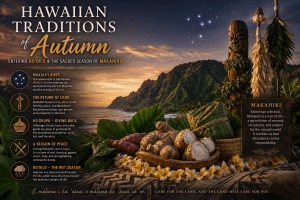
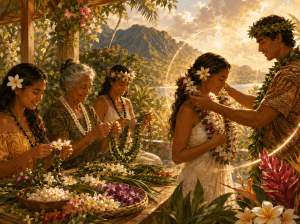
 

Hawaiian Traditions of Autumn | Entering Hoʻoilo and the Sacred Season of Makahiki | Victoria Generao, PhD

When autumn arrives in much of the Northern Hemisphere, the familiar imagery is of falling leaves, lengthening nights, harvest fields, and the gradual descent toward winter. Hawaiʻi experiences this turning of the year differently. There is no broad landscape of forests changing from green to gold, nor did traditional Hawaiian culture divide the year according to the familiar European pattern of spring, summer, autumn, and winter.

Instead, the Hawaiian seasonal worldview arose from careful observation of rain, wind, ocean, stars, plants, animals, lunar cycles, and the productivity of the ʻāina.

Thus, to ask what Hawaiian traditions belong to autumn is to enter a very different understanding of sacred time.

The months that roughly correspond to September through November form a threshold. The hotter and generally drier portion of the year begins yielding to Hoʻoilo, the wetter, cooler season. The winds change. Rains become increasingly significant. Ocean conditions shift. The lunar calendar moves onward. And eventually the star cluster Makaliʻi—the Pleiades—appears in the evening sky, announcing one of the most important ceremonial periods of old Hawaiʻi:

Makahiki.

Rather than a Hawaiian equivalent of a European autumn festival such as Mabon, Makahiki represents an indigenous seasonal system of its own—one concerned with renewal, abundance, peace, reciprocity, agricultural fertility, community, and the relationship between human beings, the gods, and the living land.


Hawaiʻi’s Year Was Read from Nature

Traditional Hawaiian timekeeping was ecological as much as chronological.

Rather than looking only at numbered dates on a fixed calendar, Hawaiian communities observed the relationships between the mahina, or Moon; the Sun; stars; rainfall; winds; tides; spawning cycles; plant growth; agricultural conditions; and fishing opportunities.

The traditional year is commonly described as having two broad seasons:

Kau or Kauwela — the warmer, generally drier season

and

Hoʻoilo — the cooler, wetter season.

University of Hawaiʻi sources describe Hoʻoilo as encompassing the wetter half of the year, while Hawaiian resource-management calendars connect specific lunar months with environmental conditions and appropriate agricultural and fishing activities. (University of Hawaii at Hilo)

This is important because Hawaiian seasonal spirituality cannot easily be separated from Hawaiian environmental knowledge.

The sacred calendar was written across the landscape.

Rain was part of the calendar.

Fish were part of the calendar.

The flowering and fruiting of plants were part of the calendar.

The movements of stars were part of the calendar.

The Moon was part of the calendar.

The human community lived within that greater clock.


The Hawaiian “Autumn” as a Threshold

The period Western calendars call autumn roughly overlaps the latter portion of the dry season and the transition into Hoʻoilo.

Individual Hawaiian month names and their alignment with Gregorian months could vary according to island and tradition; Hawaiian-language historical sources themselves preserve such regional differences. (Bishop Museum Blog)

For that reason, it is better not to imagine a universally fixed ancient Hawaiian calendar mapped neatly over September, October, and November.

Nevertheless, an important pattern emerges.

As the year moves toward ʻIkuwā and Welehu, environmental conditions begin changing. Hawaiian lunar-calendar sources associate ʻIkuwā with increasing rain, thunder, lightning, wind, and preparation for Makahiki. (University of Hawaii)

The season therefore carries something recognizable to many traditional cultures:

a sense of completion and transition.

The productive cycle has reached a turning point.

What has grown is acknowledged.

What has been received must be reciprocated.

The community prepares itself for another phase in its relationship with the land.


Makaliʻi: The Stars Announce the Sacred Season

Perhaps the most beautiful symbol of this transition is Makaliʻi, the Hawaiian name for the Pleiades.

The appearance of Makaliʻi in the eastern evening sky served as an important celestial sign connected with the beginning of Makahiki.

The National Park Service describes the traditional festival as beginning when Makaliʻi rises over Hawaiʻi around sunset, generally around late October or early November, although the precise reckoning depended upon traditional observation rather than an arbitrary Gregorian date. (National Park Service)

This gives Hawaiian autumn a celestial character.

Imagine standing beneath the Hawaiian night sky.

The heat of the dry season has begun to loosen its hold.

Clouds gather differently.

The smell of approaching rain moves across the land.

Then the small cluster of stars appears.

Makaliʻi has returned.

To those trained to read the heavens, this is not merely astronomy.

It is announcement.

The heavens and the ʻāina are speaking together.

A new sacred season is beginning.


Makahiki: The Great Season of Lono

At the center of this seasonal transition stands Lono, one of the principal akua of Hawaiian religious tradition.

Lono is strongly associated with rain, agricultural fertility, abundance, peace, music, and cultivated food. Hawaiian traditions connected his return with the rains of Hoʻoilo and the Makahiki season. (National Park Service)

Makahiki traditionally lasted for several lunar months.

During this period, the ordinary rhythms of society changed.

Certain forms of labor were restricted.

Warfare was prohibited.

Ceremonial processions occurred.

Offerings were made.

Athletic competitions were held.

People feasted.

Communities rested and celebrated.

Religious observances acknowledged the powers responsible for sustaining life.

It was therefore simultaneously an agricultural festival, religious cycle, political institution, period of recreation, and renewal of the reciprocal relationship between people and the sacred powers governing the land.


The Coming of Lono

One of the striking features of traditional Makahiki was the ceremonial movement of an image representing Lono through the districts of the island.

An important form was the akua loa, a tall ceremonial standard associated with Lono.

Accounts describe priests carrying the image through different ahupuaʻa, the traditional land divisions extending through ecological zones from uplands toward the sea.

The movement was therefore more than a procession.

It was, symbolically, a visitation.

Lono moved through the land.

At each place the relationship between land, people, ruler, and deity was recognized.

The National Park Service describes the akua loa traveling through districts in what functioned as a ritual survey of the land’s wealth and productivity. (National Park Service)

One might almost imagine the entire island becoming ceremonial ground.

Mountain.

Field.

Village.

Fishpond.

Shore.

Each existed within the same sacred ecology.


Hoʻokupu: Giving Back from What Has Been Given

Central to Makahiki was the practice of hoʻokupu, or offerings.

Communities presented agricultural and material goods associated with the productivity of their lands.

Traditional offerings could include:

  • kalo, or taro;
  • ʻuala, or sweet potato;
  • puaʻa, or pigs;
  • kapa;
  • woven mats;
  • feathers;
  • and other products representing the abundance and craftsmanship of the community.

These offerings were connected both with religious devotion and with the political economy of chiefly society. (National Park Service)

Yet hoʻokupu carries an idea larger than simply paying tribute.

It embodies reciprocity.

The land gives.

The rains give.

Plants give.

The ocean gives.

The gods give.

Human beings therefore do not merely consume.

They return something.

This principle remains one of the most profound lessons that Makahiki can offer a modern reader.

Gratitude is incomplete when it remains only an emotion.

Gratitude becomes sacred when it becomes reciprocal action.


A Season in Which War Became Kapu

One of the most extraordinary characteristics associated with Makahiki was the restriction of warfare.

The season belonged to Lono and to renewal.

Military activities associated especially with the domain of Kū gave way to another sacred rhythm.

War became kapu.

The National Park Service describes ancient Makahiki as a period of rest, feasting, games, dancing, religious observance, and suspended warfare. (National Park Service)

This ceremonial interruption is deeply significant.

Society was being reminded that life could not consist perpetually of acquisition, conflict, expansion, labor, and conquest.

There must also be a season of restoration.

A time when the hand releases the weapon.

A time when productivity yields to gratitude.

A time when the community remembers that continued life depends upon relationships more fundamental than political struggle.

In that sense, the coming of Lono represented not weakness but balance.


Makahiki Games: Strength Expressed without War

The suspension of warfare did not mean inactivity.

Makahiki was famous for physical contests and games.

Historical descriptions include such activities as:

ʻulu maika — rolling a specially shaped stone between markers;

mokomoko — boxing;

hakoko — wrestling;

ʻōʻō ihe — spear or javelin throwing;

as well as sledding, surfing, canoe racing, and other demonstrations of physical skill.

Hula, feasting, and communal celebration accompanied the season as well. (National Park Service)

There is a fascinating transformation occurring here.

Competitive energy does not disappear.

It is redirected.

Instead of proving strength through warfare, people demonstrate strength through skill, discipline, endurance, coordination, play, and ceremony.

The warrior impulse becomes the athletic impulse.

Competition becomes festivity.

Power is allowed expression without requiring destruction.


Rain as Blessing

For cultures accustomed to temperate climates, rain during autumn may signify inconvenience or approaching cold.

Within the Hawaiian agricultural world, rain could carry a much more intimate spiritual significance.

Lono was associated with rain and agricultural fertility.

As the land entered Hoʻoilo, the arrival of wetter weather belonged to a great ecological cycle upon which food production depended.

The clouds gathering over the mountains were therefore not separate from spirituality.

Water falling upon ʻāina was life moving visibly through creation.

The Hawaiian word wai, water, appears in concepts associated with prosperity and abundance; freshwater was—and remains—fundamental to the productivity and health of the land.

The autumn threshold therefore invites attention upward toward the clouds and downward toward the soil simultaneously.

The heavens fertilize the earth.

The earth responds.

Humanity receives.

And humanity is consequently obligated to mālama—to care for what sustains life.


Preparing for the Wet Season

The approach of Makahiki was not concerned solely with ceremony.

Traditional Hawaiian environmental knowledge also involved careful preparation.

The University of Hawaiʻi’s Hawaiian lunar-calendar resource records that during the period preceding Makahiki, fishing activity could increase so that fish might be harvested and stored before the wetter season. It also describes changing fishing responsibilities and environmental conditions during ʻIkuwā and Welehu. (University of Hawaii)

Seasonal awareness therefore required prudence.

Sacred observance and practical survival were not opposites.

Knowing when to fish was spiritual knowledge.

Knowing when to plant was spiritual knowledge.

Knowing when storms might arrive was spiritual knowledge.

Knowing when not to harvest was spiritual knowledge.

Knowing when the land required rest was spiritual knowledge.

The sacred existed within competent relationship with place.


Rest Was Part of the Cycle

There is an old Hawaiian saying associated with Welehu recorded in Mary Kawena Pukui’s ʻŌlelo Noʻeau and discussed by Bishop Museum:

“Rest the head on the pillow; Welehu is the month.” (Bishop Museum Blog)

The statement is remarkably simple.

Yet behind it lies an entire philosophy of seasonal life.

There are times for work.

Times for fishing.

Times for planting.

Times for harvest.

And there are times for rest.

Modern culture often treats rest as the absence of productivity.

Traditional seasonal cultures frequently understood something different:

rest is one of the conditions that makes future productivity possible.

Land requires intervals.

Bodies require intervals.

Communities require intervals.

Even ritual calendars breathe.

Makahiki creates such a breathing space.


There Was No Hawaiian “Mabon”

For modern practitioners familiar with the Western esoteric or contemporary Pagan Wheel of the Year, an important distinction should be maintained.

There is no need to rename Makahiki as a “Hawaiian Mabon.”

Nor should the autumnal equinox automatically be treated as though it were the central ancient Hawaiian autumn festival.

The two traditions arise from different geographies, histories, cosmologies, agricultural systems, and celestial observations.

Mabon, as practiced within modern Pagan traditions, is commonly centered upon the autumn equinox.

Traditional Hawaiian seasonal observance was embedded within a lunar and ecological calendar and prominently marked the emergence of Makaliʻi and the commencement of Makahiki.

Recognizing similarities—harvest, gratitude, seasonal transition, communal feasting—can be illuminating.

Collapsing the traditions into one another is not.

Each deserves to retain its own voice.


The Deeper Spiritual Pattern

Seen through a contemplative lens, the Hawaiian autumn threshold presents several intertwined movements.

Observation.

Before people act, they watch.

They watch the Moon.

They watch the stars.

They watch the sea.

They watch the clouds.

They watch the crops.

The spiritual life begins in attention.

Then comes:

Recognition.

Something greater than the individual sustains life.

No farmer creates rain.

No fisherman commands the sea.

No chief causes the stars to rise.

Life exists inside relationships.

Then comes:

Gratitude.

Abundance is acknowledged.

But gratitude becomes meaningful through:

Reciprocity.

Hoʻokupu is given.

Resources are respected.

Relationships are renewed.

Then comes:

Restraint.

War ceases.

Ordinary activity changes.

The culture enters sacred time.

And finally:

Renewal.

Games are played.

People feast.

Bodies rest.

Communities reconnect.

The land receives rain.

Another cycle begins.


A Hawaiian Theology of Relationship

One of the most powerful ideas that emerges from these traditions is that humanity does not stand outside nature observing it.

Human beings participate within a larger network of relationships involving akua, ʻāina, wai, kai, plants, animals, ancestors, family, and community.

This makes seasonal consciousness fundamentally relational.

The question is not simply:

“What can I harvest?”

The deeper question becomes:

“What relationship made this harvest possible?”

And after that:

“What is my responsibility to that relationship?”

Such questions move beyond seasonal celebration into ethics.

If ʻāina feeds us, how do we care for ʻāina?

If water sustains us, how do we protect water?

If ancestors carried knowledge forward, how do we honor that knowledge?

If community sustains the individual, what does the individual return to community?

Makahiki answers through reciprocity.


Makahiki Today

Makahiki did not remain unchanged through Hawaiian history. Colonial transformation, suppression and displacement of Hawaiian religious institutions, and enormous political and social changes disrupted many traditional practices.

Yet Makahiki did not vanish.

The Hawaiian cultural renaissance of the twentieth century contributed strongly to its revitalization, and Makahiki observances are again found in Hawaiian communities, cultural organizations, schools, and public educational programs. The National Park Service notes that contemporary cultural revival has helped restore the tradition since the 1980s. (National Park Service)

Traditional Hawaiian games are taught.

Makaliʻi is watched.

Lunar calendars are studied.

Hoʻokupu is offered.

Hawaiian environmental knowledge is being perpetuated.

Most importantly, Native Hawaiian cultural practitioners continue defining what living Hawaiian tradition means within their own communities.

Makahiki therefore should not be approached merely as an artifact of a vanished past.

It is part of a living cultural inheritance.


Observing the Season Respectfully Today

For someone wishing to honor the wisdom of the Hawaiian autumn season without claiming practices that do not belong to them, perhaps the most meaningful approach is remarkably simple.

Observe.

Go outside.

Look toward the night sky.

Learn to recognize Makaliʻi.

Notice the wind.

Observe what plants are flowering or fruiting.

Notice changes in rain.

Watch the Moon.

Learn the names of the places around you.

Learn where your water originates.

Discover the traditional watershed or ahupuaʻa in which you live.

Consider where your food comes from.

Offer something—not necessarily ceremonially, but concretely—in gratitude.

Care for land.

Feed someone.

Clean a shoreline.

Share food.

Support Hawaiian cultural organizations.

Learn ʻōlelo Hawaiʻi correctly.

Listen to Native Hawaiian practitioners speaking about their own traditions.

And perhaps most importantly, ask:

What has sustained me this year, and what am I returning in gratitude?

That question belongs comfortably beside Makahiki.


When Makaliʻi Rises

There is something profoundly beautiful about a culture allowing a cluster of stars to tell it when sacred time has arrived.

No clock rings.

No printed calendar announces the holy day.

The universe itself gives the sign.

Makaliʻi rises.

Rain approaches.

Lono returns.

Weapons are set aside.

Offerings are gathered.

Games begin.

Food is shared.

The land and people enter a period of renewal.

This is the great Hawaiian lesson of the autumn threshold:

abundance carries responsibility.

Harvest calls forth gratitude.

Gratitude requires reciprocity.

Strength must sometimes yield to peace.

Work must sometimes yield to rest.

And humanity must periodically remember that the world is not merely a collection of resources surrounding us.

It is a web of relationships sustaining us.

So as the days of late Kau move toward Hoʻoilo and the little stars of Makaliʻi appear again in the Hawaiian sky, the season seems to whisper an ancient instruction:

Look carefully at what has been given.

Give thanks.

Give something back.

Make peace where peace can be made.

Care for the source of your abundance.

And prepare yourself to enter another turning of the sacred year.


Sources Consulted

National Park Service, Haleakalā National Park, “Makahiki.” An accessible overview of Makahiki, Lono, hoʻokupu, the Makahiki procession, traditional games, ceremonial observances, and the modern revival of the festival. (National Park Service)

National Park Service, Puʻuhonua o Hōnaunau National Historical Park, “Kau Makaliʻi — Season of the Makahiki Ritual.” Particularly useful for understanding Makaliʻi, celestial observation, ritual time, and the movement of the akua loa through Hawaiian districts.

University of Hawaiʻi, Hawaiʻi Climate Data Portal, “Hawaiian Moon Calendar.” Provides information about Hoʻoilo and Kauwela, lunar months, fishing practices, environmental observations, and traditional natural-resource management. (University of Hawaii)

University of Hawaiʻi at Hilo, “Kaulana Mahina vs. Gregorian Calendar.” Useful for understanding the broad division between Hoʻoilo and Kauwela and the relationship of Hawaiian lunar reckoning to seasonal activities. (University of Hawaii at Hilo)

Bishop Museum, Nūpepa / Traditional Knowledge resources. Preserves Hawaiian-language historical material concerning traditional month names, seasonal conditions, fishing, planting, rest, and regional variation in calendrical traditions. (Bishop Museum Blog)

University of Hawaiʻi Kawaihāpai, “ʻAha Makahiki.” Hawaiian-language cultural reference describing the rising of Makaliʻi, Lono, hoʻokupu, feasting, games, and Makahiki ceremonial practice. (University of Hawaii)

The Art of Making Lei and Giving Lei to Others | Victoria Generao, PhD

A Circle of Beauty, Intention, Relationship, and Aloha

There are gifts we purchase, gifts we select, and gifts we make with our own hands.

And then there is the lei.

A lei may be woven from flowers gathered at sunrise, fragrant leaves clipped carefully from a garden, ferns carried home from the forest, shells collected over many seasons, seeds polished until they gleam, or feathers painstakingly arranged by an accomplished artisan. Yet whatever its material, a lei becomes more than the sum of the things from which it is fashioned.

Someone has gathered.

Someone has prepared.

Someone has sat quietly—or perhaps laughed and talked with family and friends—while the materials passed repeatedly through the hands.

Someone has thought of the person who will eventually wear it.

This is one reason the art of lei making cannot be understood merely as floral design. Within Hawaiian culture, the making and giving of lei is a continuing cultural practice, associated with relationship, celebration, remembrance, hospitality, affection, and aloha. Kamehameha Schools describes the making and giving of lei as significant both to Hawaiians and to the wider community of people who call Hawaiʻi home, emphasizing the importance of good intention in the process. (Kamehameha Schools)

To make a lei, therefore, is to create something beautiful.

To give a lei is to give something more.

It is to say:

I see you.

I honor this moment.

I have prepared something for you.

Carry this beauty with you.

And sometimes, without speaking a word:

You are loved.


Lei Is a Verb as Much as It Is a Thing

We tend to think of a lei as an object: a garland placed around someone’s neck.

But the deeper beauty of lei emerges when we begin thinking relationally.

There is the person who gathers.

There is the land from which the materials arise.

There is the plant.

There are the hands of the maker.

There is the person who receives.

There is the occasion.

And there is the relationship connecting them all.

A University of Hawaiʻi cultural-resource description of hana lei—the practice of lei making—beautifully explains that lei can be made from many kinds of materials, including flowers, leaves, ferns, limu, shells, feathers, and other natural materials. It describes the lei as adorning the wearer with the kinolau of the land: the embodied forms or manifestations present within the natural world. (University of Hawaii)

That idea deserves contemplation.

When a person receives a lei of flowers, leaves, seeds, or other natural materials, the person is not simply being decorated.

Something of place has been placed upon them.

The fragrance of the garden accompanies them.

The greenery of the mountain rests upon their shoulders.

The colors of the blossoms surround their body.

The labor of the maker rests against their skin.

The lei becomes a meeting place between land, maker, receiver, and occasion.

This is why intention matters.


Before Making the Lei: Gathering

The making of a lei begins long before the first flower touches the needle.

It begins with gathering.

For the thoughtful lei maker, gathering is not simply an act of taking. It is an act of relationship.

One looks at what is available.

What is flowering?

What is abundant?

What belongs here?

What may appropriately be gathered?

What should be left alone?

Contemporary conservation guidance has emphasized that growing lei plants in home gardens can help perpetuate lei traditions while reducing gathering pressure on remaining native vegetation. (Hawaii DLNR)

This creates an important principle for anyone learning the art:

Beauty should not require careless taking.

Gather with permission.

Gather sustainably.

Learn which plants are culturally significant.

Learn which plants are native, rare, protected, cultivated, or invasive.

Take what is appropriate.

Leave enough for the plant, the ecosystem, and those who come after you.

In this way, the lei begins with gratitude rather than possession.


Preparing the Materials

Once gathered, the materials must be prepared.

Flowers may need to be sorted.

Leaves may need to be cleaned.

Stems may need trimming.

Certain materials benefit from being cooled, hydrated, wrapped, softened, or allowed to rest.

Damaged blossoms are set aside.

Leaves are examined.

Colors are arranged.

Textures are considered.

And gradually a pattern begins to reveal itself.

This is where lei making becomes meditative.

The hands repeat movements.

Select.

Place.

Pierce.

String.

Braid.

Wrap.

Turn.

Tighten.

Continue.

One cannot hurry certain kinds of beauty.

A beautiful lei teaches rhythm.


The Traditional Arts of Lei Construction

There is no single way to make a Hawaiian lei. The particular method often depends upon the material being used, and Hawaiian lei traditions include a rich vocabulary of techniques. University of Hawaiʻi resources identify styles including kui pololei, kui poepoe, wili, haku, hili, humupapa, and hilo, among others. (University of Hawaii)

Several fundamental techniques are especially useful for understanding the art.

Kui — Stringing

Kūʻi or kui lei are among the forms most immediately recognizable to beginners.

The materials are pierced and strung together. A University of Hawaiʻi description defines kui in this context as stringing pierced objects such as flowers. (University of Hawaii at Hilo)

There are variations.

In kui pololei, materials are strung in a relatively straight orientation.

In kui poepoe, materials are arranged so that they radiate around the cord, producing a fuller, rounded lei. Kapiʻolani Community College describes kui construction as stringing plant materials either through the center (pololei) or from the sides (poepoe). (Kapiolani Community College)

Plumeria, orchids, pīkake and other flowers may be used in forms of stringing lei, depending upon availability and the desired effect. (Hawaii Airports)

For many beginners, kui is an excellent doorway into lei making because the basic principle is simple while the possibilities for color, rhythm, fragrance, spacing, and pattern are nearly endless.


Haku — Braiding and Arranging

The word haku carries meanings associated with composing, arranging, inventing, and braiding. (University of Hawaii at Hilo)

That alone tells us something important.

The maker is not merely attaching flowers.

The maker is composing.

In lei haku, plant materials are incorporated through a braiding or plaiting technique. Kapiʻolani Community College identifies haku as the braiding of plant materials, while other University of Hawaiʻi educational resources distinguish it from methods involving only a single material. (Kapiolani Community College)

A haku lei can become wonderfully complex: blossoms, greenery, texture, shape, fragrance, and repetition appearing together like botanical music.

And an important distinction is worth remembering:

Haku describes a method.

It is not simply another word for every lei worn upon the head.

A head lei may appropriately be called a lei poʻo—literally a lei associated with the head—while haku refers to a particular construction technique.


Wili — Winding

Wili is the art of winding or wrapping materials securely around a foundation.

Kapiʻolani Community College describes this technique as placing plant materials against a backing and winding fiber or cord around both the material and the backing to bind them together. (Kapiolani Community College)

Wili allows the maker tremendous freedom.

A leaf.

Then a blossom.

Then fern.

Then another blossom.

Wrap.

Turn.

Add.

Wrap again.

Patterns gradually emerge.

From the front the viewer sees abundance.

Behind the beauty lies structure.

There is a lovely metaphor here.

What appears effortless often rests upon invisible discipline.


Hili — Braiding a Single Material

Hili involves braiding or plaiting and is particularly associated with lei created from a single kind of material. University of Hawaiʻi educational material distinguishes it from haku on this basis. (Leeward Community College Library)

Fern, vine, leaf, or another flexible material may become a continuous braided form.

Here the beauty does not necessarily arise from contrast.

It arises from repetition.

One material.

One rhythm.

One evolving line.

Hili demonstrates that simplicity can possess tremendous elegance.


Hīpuʻu — Knotting

Another fascinating technique is hīpuʻu, the joining of suitable plant materials through knotting.

Kapiʻolani Community College defines it as creating a chain by knotting plant stems together without cordage or a needle. (Kapiolani Community College)

Here the material itself becomes its own fastening.

The plant provides both beauty and structure.


Humupapa — Sewing to a Foundation

Humupapa involves sewing materials onto a backing. Kapiʻolani Community College describes the process as attaching plant materials to a foundation, and Bishop Museum documents humupapa as an important technique in Hawaiian featherwork as well. (Kapiolani Community College)

This method reminds us that the category “lei” reaches well beyond the familiar strand of tropical flowers.

Lei may represent extraordinary levels of craftsmanship.

Some are ephemeral.

Some may endure for generations.


A Simple Beginner’s Lei Kui

For someone learning lei making for the first time, a simple lei kui offers a beautiful introduction.

You will need fresh, suitable flowers; lei cord or strong thread; a lei needle; scissors; and a clean working surface.

Begin by examining your flowers.

Do not immediately start stringing.

Notice them.

Which are large?

Which are small?

Which have opened fully?

Which colors naturally belong beside one another?

Arrange them before you.

Then decide upon a rhythm.

Perhaps:

white — yellow — white — yellow.

Or:

three blossoms of one color followed by one blossom of another.

Or perhaps no formal pattern at all.

There is beauty in ordered repetition, but there is also beauty in organic variation.

Thread the lei needle carefully.

Pierce each blossom in a manner appropriate to that particular flower and gently guide it along the cord.

Do not crush the blossoms together.

Allow them to rest naturally.

Continue.

Flower after flower.

Movement after movement.

Soon something remarkable occurs.

Individual blossoms cease appearing as isolated flowers.

They become lei.

Multiplicity becomes unity.

One flower could never create the whole pattern.

Each flower contributes something.

This, too, is part of the teaching.


Make the Lei With the Receiver in Mind

There is a profound difference between making a lei and making a lei for someone.

When the receiver is known, every decision acquires another layer of meaning.

Perhaps you remember their favorite color.

Perhaps the fragrance reminds you of their childhood.

Perhaps a flower comes from a plant grown by their grandmother.

Perhaps greenery comes from your own garden.

Perhaps the lei is being made because a child has graduated.

A friend has arrived.

A loved one is departing.

A couple is marrying.

An elder is being honored.

A teacher is being thanked.

A life is being remembered.

Now the lei becomes biography.

Memory enters the pattern.

Relationship enters the pattern.

Intention enters the pattern.

The lei becomes a message that does not require paper.


Giving the Lei

Then comes the moment for which the lei has been created.

The giving.

A lei should never become merely an accessory tossed toward someone as though it were party decoration.

The meaningful act is relational.

You approach the person.

They receive you.

You receive them.

The lei passes from your hands to their body.

Across Hawaiʻi today, lei continue to mark welcomes, graduations, celebrations, commemorations, family occasions and other important transitions. The tradition is visible everywhere from community lei-making workshops to airport greetings and public memorial observances. (University of Hawaii)

The lei says:

Welcome.

Congratulations.

Thank you.

I honor you.

Remember us.

Carry our affection with you.

Depending upon relationship, family custom, and occasion, an embrace or honi may accompany a presentation, while in other circumstances a respectful offering is more appropriate. Cultural practices are best learned from the people and communities who carry them rather than reduced to a single rigid rule.

The central principle is simple:

Give with respect.


Receiving Lei

There is also an art to receiving.

Sometimes receiving gracefully is harder than giving.

We may instinctively say:

“Oh, you shouldn’t have.”

“This is too much.”

“I don’t deserve this.”

But imagine the hours represented by a handmade lei.

Someone gathered those flowers.

Someone prepared them.

Someone sat with them.

Someone used their hands to make something for you.

Receiving the lei respectfully honors that labor.

The gift is not merely the physical garland.

The gift includes the time.

And time, once given, can never be recovered.

That makes handmade gifts precious in a way money cannot measure.


Lei and the Great Passages of Life

Perhaps this explains why lei so naturally accompany thresholds.

Arrival.

Departure.

Graduation.

Marriage.

Achievement.

Birthday.

Reunion.

Commemoration.

Death.

Remembrance.

These are moments when one identity gives way to another.

The student becomes the graduate.

Two individuals become a married couple.

The traveler arrives.

The visitor departs.

The living gather around the memory of someone who has crossed from physical presence into ancestry and remembrance.

Lei making and giving therefore participate in something much larger than decoration.

They mark transition.

They say:

This moment matters.


May Day Is Lei Day

The modern public celebration of Lei Day began in Hawaiʻi in 1928, and May 1 subsequently became officially recognized in Hawaiʻi as Lei Day. (City and County of Honolulu)

Over the decades, Lei Day has helped celebrate both the artistry and cultural significance of lei through exhibitions, competitions, music, hula, ceremony, and community participation. (City and County of Honolulu)

Yet perhaps the greatest lei celebrations remain the quieter ones.

A grandmother teaching a grandchild.

Friends sitting around a table.

Hands sorting flowers.

Stories being told while fingers work.

Someone arriving with boxes of blossoms.

Someone else preparing food.

A lei slowly lengthening across a table while conversation flows around it.

Here culture is not merely being remembered.

It is being practiced.

The Spiritual Lesson Hidden in the Lei

There is a metaphysical teaching within the making of lei that need not be imposed upon Hawaiian tradition to be recognized.

Consider what happens.

Separate things are gathered.

Each retains its own identity.

The fern remains fern.

The flower remains flower.

The leaf remains leaf.

The shell remains shell.

Yet through relationship they become something greater.

The lei does not destroy individuality.

It creates harmony among differences.

And so the lei becomes an extraordinary image of community.

Every person is a blossom.

Every life carries its own fragrance.

Every individual possesses a color, shape, history, strength, and season.

None need become identical.

They need only discover how to belong together.

This may be one reason the image of the lei possesses such emotional power.

A lei is a circle made from many.

A family is a circle made from many.

A community is a circle made from many.

A lineage is a circle made from many.

Even memory becomes a lei: moment joined to moment, person joined to person, generation joined to generation.


Lei as Prayer

There is historical evidence that lei making was accompanied by mele and prayer. Bishop Museum preserves, for example, a pule kui lei—a lei-making prayer—within its collections of Hawaiian mele. (Bishop Museum Blog)

This should cause us to reconsider what the hands may be doing while they work.

Perhaps making something beautiful can itself become prayer.

Not because every lei must be treated as ritual.

But because focused human attention transforms ordinary actions.

Threading flowers can become gratitude.

Braiding leaves can become remembrance.

Gathering can become stewardship.

Giving can become blessing.

Receiving can become humility.

And so the lei teaches that sacredness is not always found far away.

Sometimes sacredness is sitting at the kitchen table with flowers scattered everywhere.


The Lei Eventually Fades

There is one final teaching.

A fresh lei will not remain fresh forever.

Its perfume fades.

Its blossoms soften.

Colors change.

Leaves dry.

And eventually the physical form that seemed so vibrant begins returning toward the earth from which it came.

This does not make the lei less valuable.

It makes it more valuable.

Its beauty was never based upon permanence.

Its beauty existed because, for one particular moment, someone gathered living things and fashioned them into an expression of relationship.

That moment existed.

The lei was made.

The lei was given.

The lei was received.

And afterward, even when the flowers disappeared, the giving remained.


To Give Lei Is to Say: You Belong Within My Circle

Perhaps this is the heart of the entire tradition.

A lei surrounds.

It encircles without imprisoning.

It rests upon the body without demanding anything in return.

It adorns the receiver while simultaneously revealing something about the giver.

The lei says:

I gathered this.

I made this.

I carried this to you.

I place it around you.

And for this moment, I surround you with beauty.

That is why the art of lei making deserves to be preserved not merely as craft, but as relationship.

Learn the names of the plants.

Learn where they come from.

Learn the proper ways to gather.

Learn kui.

Learn haku.

Learn wili.

Learn hili.

Learn the stories.

Learn from practitioners.

Teach the next person.

Grow the plants.

Share the flowers.

Sit together.

Make lei.

And when the lei is finished, do not think only about whether it is perfect.

Look instead at the person for whom it was made.

Place it into their hands or gently around them.

And let the lei speak.

Because perhaps the deepest meaning of giving lei has always been very simple:

I remembered you while my hands were working.

And now I give that remembrance to you.

Aloha kekahi i kekahi.

May we love and care for one another.


The Spiritual and Metaphysical Symbolism of Lei

There is another dimension of lei that becomes visible when we move beyond asking, “What is the lei made from?” and begin asking:

What is being joined together?

What is being transferred?

What relationship is being created?

Traditional Hawaiian sources already give us a foundation for approaching these questions carefully. The University of Hawaiʻi’s Kahoʻiwai cultural knowledge resource describes lei as adorning the wearer with the kinolau of the land—the embodied forms of the ʻāina represented in flowers, leaves, ferns, shells, feathers, limu, and other materials.

The City and County of Honolulu’s description of Lei Day goes further, explaining that as a lei is gathered, prepared, and fashioned, the mana of the maker becomes woven or sewn into it; therefore giving a lei is, symbolically, giving something of oneself.

This gives us an important doorway into the spiritual meaning of lei.

But a distinction should be made.

The interpretation that follows is a comparative metaphysical contemplation inspired by Hawaiian lei traditions. It should not be taken to mean that Hawaiian spirituality is simply another form of Hermeticism, Qabalah, chakra theory, or Western occultism. Hawaiian concepts deserve to be understood first within their own cultural and linguistic world. The Hawaiian term mana, for example, carries meanings of supernatural or divine power, authority, potency, and efficacy; reducing it merely to the Western esoteric idea of “energy” would flatten a much richer concept.

With that respect firmly established, the lei can nevertheless become a profound object of metaphysical contemplation.

The Lei as Sacred Circle

The most immediately apparent symbolic feature of a lei is its circularity.

It has no obvious beginning and no obvious end.

For the contemplative mind, the circle naturally suggests continuity, relationship, return, completeness, and the joining together of what was previously separate.

A flower by itself is a flower.

A leaf by itself is a leaf.

A shell by itself is a shell.

But when these individual forms are gathered and joined intentionally, they become lei.

The mystery is not that individuality disappears.

It does not.

Each blossom remains itself.

Each leaf preserves its shape.

Each shell retains the marks of its own formation.

Yet together they participate in another identity.

This makes the lei a beautiful image of unity without uniformity.

A family functions this way.

A community functions this way.

A lineage functions this way.

The ancestors, the living, and those yet to be born may likewise be contemplated as individual lives threaded upon a greater continuum.

Seen in this way, the lei becomes an image of relationship itself.


The Thread as the Invisible Bond

Most people notice the flowers.

Few notice the thread.

Yet without the thread, the lei falls apart.

This hidden cord offers one of the most compelling metaphysical images within the craft.

The visible blossoms may be compared to the visible circumstances of life: bodies, personalities, places, events, relationships, and memories.

The thread remains largely unseen.

Yet it passes through everything.

Metaphysically, we may contemplate that hidden thread as aloha, memory, intention, ancestry, relationship, or spiritual continuity.

One could even ask:

What is the invisible thread running through my own life?

What joins childhood to adulthood?

What joins student to teacher?

What joins grandparent to grandchild?

What joins one generation to another?

What joins those who have departed with those who continue to speak their names?

Like the cord inside the lei, these bonds may not always be visible.

Yet they hold the pattern together.


Lei as Embodied Intention

The making of lei requires repeated acts of attention.

A flower is selected.

A stem is prepared.

A leaf is folded.

A blossom is pierced.

A cord is tightened.

Another element is added.

Then another.

And another.

Through repetition, intention becomes physical form.

This gives lei making a quality familiar to many contemplative traditions: the hands eventually begin expressing what the mind and heart have been holding.

A lei made hurriedly and carelessly is physically different from one made attentively.

But there is also a relational difference.

The maker has spent time with the gift.

Time has entered the lei.

Attention has entered it.

Thought of the receiver has entered it.

The Honolulu Lei Day tradition explicitly speaks of the maker’s mana becoming incorporated into the process of creating the lei. Bishop Museum also preserves a traditional pule kui lei—a lei-making prayer—in which the gathering, piercing, stringing, and assembling of flowers appear within a sacred poetic context.

The act of making can therefore become more than production.

It can become devotion embodied through the hands.


Gathering as Communion With ʻĀina

Before there can be a lei, there must be material.

And before there is material, there is ʻāina.

Flower.

Fern.

Leaf.

Seed.

Shell.

Fiber.

All arise from a world that existed before the maker touched them.

The University of Hawaiʻi description of lei as adorning the wearer with the kinolau of the land is especially significant here.

From a metaphysical perspective, this changes the relationship between maker and material.

The flower is not merely “craft supply.”

The leaf is not merely decoration.

They originate within a living network of place.

Rain touched them.

Sunlight fed them.

Soil sustained them.

Wind moved across them.

Human hands eventually gathered them.

The resulting lei therefore brings together place and person.

When the lei is placed upon the receiver, something gathered from the landscape has quite literally been placed upon the human body.

The person becomes adorned by place.

This is one reason lei can communicate belonging so powerfully.

The land is no longer merely beneath one’s feet.

It rests upon one’s shoulders.


The Metaphysics of Giving

There is a profound difference between possessing a lei and giving one away.

The lei reaches completion through relationship.

The maker has gathered and assembled it, but the gift has not yet fulfilled its purpose.

Then comes the encounter.

One person stands before another.

The lei passes between them.

The giver releases possession.

The receiver accepts.

Something changes.

The lei becomes a bridge.

The Hawaiian dictionary tradition itself identifies lei not merely as garland or ornament but also as something given as a symbol of affection. Contemporary Hawaiian cultural sources likewise continue to associate lei with aloha, connection, honor, celebration, and relationship.

Seen metaphysically, the giving of lei creates a threefold movement:

Intention becomes form.

Form becomes gift.

Gift becomes relationship.

This is why a handmade lei possesses a quality that cannot be measured by the monetary value of its flowers.

The giver has transferred time.

Attention.

Labor.

Memory.

Beauty.

And intention.

The physical lei carries an invisible offering.


Lei and the Mystery of Blessing

To place something around another person’s shoulders is an intimate act.

The lei surrounds without binding.

It rests without imprisoning.

It beautifies without obscuring the wearer.

In this sense, the lei offers a compelling image of blessing.

A blessing does not possess another person.

It surrounds them with a wish.

May you prosper.

May you travel safely.

May you remember where you came from.

May you know that you are loved.

May you carry the affection of those who cannot accompany you.

May this threshold in your life be marked with beauty.

The lei therefore becomes almost like a visible circumference of goodwill around the receiver.

Not a wall.

A circle of aloha.


Lei as Memory and Ancestral Continuity

Lei are also given in remembrance.

At Honolulu’s Lei Day observances, lei from the annual contest are taken to Mauna ʻAla, the Royal Mausoleum, and Kawaiāhaʻo Church and placed upon the resting places of Hawaiian aliʻi as expressions of mahalo and aloha.

Here the lei crosses another boundary.

It is no longer simply a gift between two living people.

It becomes an offering of memory.

The deceased cannot physically return the gift.

Yet the relationship remains.

This reveals something profound about remembrance:

Love continues to make offerings even when reciprocity is impossible.

The lei becomes testimony that relationship can extend beyond physical absence.

For the metaphysical contemplative, the circle again becomes significant.

Birth and death.

Arrival and departure.

Presence and memory.

Ancestor and descendant.

The circle does not erase death.

It places death within continuity.

The Lei as a Living Mandala

In comparative metaphysical language, one might describe a carefully made lei as a kind of living mandala.

Not because this is a traditional Hawaiian designation, but because the comparison illuminates its contemplative structure.

A mandala gathers many elements around relationship and order.

So does the lei.

Color follows color.

Flower follows flower.

Pattern repeats.

Difference enters harmony.

The maker moves gradually from fragments toward wholeness.

The finished lei may therefore be contemplated as a physical representation of a fundamental metaphysical principle:

the Many becoming One without ceasing to be Many.

One lei.

Many flowers.

One family.

Many persons.

One community.

Many voices.

One ancestry.

Many generations.

One living world.

Countless forms.


The Impermanence of the Flower

Perhaps the deepest teaching of the flower lei is that it will die.

A fresh lei is extraordinarily beautiful precisely because its beauty cannot be permanently possessed.

The blossom opens.

It releases fragrance.

It begins to fade.

Eventually it returns to the elements.

This gives the lei a contemplative relationship with impermanence.

The gift cannot be preserved exactly as it was.

Neither can the moment.

The graduation ends.

The wedding day passes.

The visitor eventually leaves.

Children grow.

Elders become ancestors.

Photographs remain, but the moment itself moves onward.

The lei quietly teaches:

Do not demand permanence before allowing something to be sacred.

Some sacred things are sacred precisely because they occur only once.

The flowers fade.

The giving remains.


The Lei as a Teaching of Aloha

Ultimately, the metaphysical symbolism of lei returns us not to abstraction, but to relationship.

The circle is meaningless without the flowers.

The flowers do not become lei without the thread.

The thread serves no purpose without the maker.

The maker’s work remains incomplete without the receiver.

The receiver eventually returns the organic materials to the earth.

And the earth produces flowers again.

So the pattern continues:

ʻĀina → material → maker → lei → receiver → memory → ʻāina.

A circle.

Perhaps this is why lei can carry such extraordinary emotional power.

It gives physical form to something ordinarily invisible.

Affection becomes flowers.

Gratitude becomes leaves.

Memory becomes fragrance.

Honor becomes a circle.

Aloha becomes something that can be placed gently upon another person’s shoulders.

And for one beautiful moment, the unseen becomes visible.

Annotated Bibliography

Bishop Museum. “He Pule Kui Lei.” Welo Hou, June 10, 2019.

This Bishop Museum resource presents a lei-making prayer from the Roberts Mele Collection, with translation by renowned Hawaiian scholar Mary Kawena Pukui. The composition describes Hiʻiaka gathering flowers, piercing them, stringing them, and assembling a lehua lei. It is especially valuable for this blog because it demonstrates that lei making appears within Hawaiian poetic and prayer traditions and therefore cannot be reduced merely to decorative handicraft. The Museum also identifies mele as an important primary resource for Hawaiian scholarship and cultural connection.

City and County of Honolulu, Department of Parks and Recreation. “Lei Day.”

This official cultural resource provides one of the clearest explanations of the relational spirituality associated with making and giving lei. It describes the lei as a symbol of aloha and states that the mana of the maker becomes incorporated into the lei through gathering, preparation, and construction. It also documents the continuation of lei traditions through Honolulu’s Lei Day celebration and the offering of lei at Mauna ʻAla and Kawaiāhaʻo Church in remembrance of Hawaiian aliʻi. This source is particularly important to the blog’s discussion of intention, reciprocity, remembrance, and ceremonial giving.

Kahoʻiwai, University of Hawaiʻi. “Hana Lei.”

Kahoʻiwai identifies lei making as an enduring Hawaiian cultural practice and catalogs numerous forms, including kui pololei, kui poepoe, wili, haku, hili, humupapa, and hilo. Most important for the spiritual interpretation developed in this blog is its description of a lei as adorning its wearer with the kinolau of the land. This idea provides an important Indigenous Hawaiian foundation for understanding the relationship among lei, wearer, natural material, and ʻāina.

Kamehameha Schools. “Nā ʻAno Hana Lei: Types of Lei-Making.” 2021.

This accessible educational article gives practical descriptions of major lei-making methods, including kui, haku, wili, hili, hīpuʻu, and humupapa. It is especially useful for readers who wish to move from cultural appreciation into actual practice, because it discusses construction methods and appropriate materials while situating lei making within the living culture of Hawaiʻi. It supports the technical portions of the blog and demonstrates the diversity hidden behind the English phrase “making a lei.”

Pukui, Mary Kawena, and Samuel H. Elbert. Hawaiian Dictionary: Hawaiian-English, English-Hawaiian. Revised and Enlarged Edition. Honolulu: University of Hawaiʻi Press, 1986.

Pukui and Elbert’s Hawaiian Dictionary remains a foundational linguistic reference for serious study of Hawaiian words and concepts. University of Hawaiʻi Press describes the revised edition as containing nearly 30,000 Hawaiian-English entries together with material relating to folklore, poetry, and ethnology. For this blog, the dictionary is essential because terms such as lei, mana, aloha, and the vocabulary of lei construction possess meanings that cannot safely be reconstructed from English translations alone.

Pukui, Mary Kawena, E. W. Haertig, and Catherine A. Lee. Nānā I Ke Kumu: Look to the Source. Volume 1. Honolulu: Hui Hānai / University of Hawaiʻi Press, 2014 edition.

Nānā I Ke Kumu is a major source for understanding Hawaiian cultural practices, concepts, beliefs, family relationships, spirituality, healing, dreams, symbolism, and social values. The work grew from years of study by the Culture Committee of the Queen Liliʻuokalani Children’s Center, with Mary Kawena Pukui serving as kumu. Its greatest value for the present blog is methodological: it reminds the student to understand Hawaiian concepts from Hawaiian cultural foundations rather than forcing them prematurely into foreign philosophical categories.

Wehewehe Wikiwiki / Hawaiian Dictionaries. “Lei” and “Mana,” drawing upon Pukui and Elbert.

The online Hawaiian dictionary collections make foundational lexical material readily accessible. The entry for lei includes meanings associated with garland, wreath, ornament, and a gift expressing affection, while the Pukui-Elbert material for mana includes supernatural or divine power, authority, potency, and power. These entries are especially useful in guarding against overly simplistic translations. In a metaphysical discussion, they help prevent mana from being casually equated with an undifferentiated New Age concept of “energy.”

A Note on Metaphysical Interpretation

Readers approaching lei through Western Mystery traditions, Hermeticism, Qabalah, Reiki, ceremonial magic, or other metaphysical systems may naturally perceive parallels: the circle as wholeness, the thread as an invisible bond, the act of construction as intention made manifest, and the giving of the completed lei as transmission or blessing.

Such comparisons can be fruitful when they remain comparisons.

The more respectful approach is:

first Hawaiian understanding, then comparative contemplation.

Rather than claiming that Hawaiian lei traditions secretly encode Hermetic, Qabalistic, or other Western doctrines, we may allow each tradition to remain itself while noticing where human spiritual experience produces resonant symbols.

The lei then becomes not evidence that all traditions are identical, but something much more beautiful:

a meeting place where distinct spiritual languages can recognize one another without losing their own names.


26th Anniversary Message to Our School of Reiki Practitioners


Beloved Practitioners, Teachers, and Keepers of the Current,

Twenty six years ago, a small intention was placed gently into the world, like hands resting over the heart. No spectacle. No urgency. Just trust in the quiet intelligence of healing and the willingness to listen. From that simple beginning, a living lineage has grown.

A school is not walls, syllabi, or certificates. A Reiki school is a field. It is shaped every time one of you pauses, breathes, and allows harmony to move where it is needed most. Over twenty six years, that field has been strengthened by thousands of such moments. Unseen, yet unmistakable.

You have carried Reiki into homes, hospitals, classrooms, offices, and sacred spaces. You have offered it in times of grief, transition, birth, exhaustion, and renewal. Often without recognition. Often without words. Always with presence. This is how real traditions endure.

Twenty six years marks more than longevity. It marks trust. Trust in the practice. Trust in one another. Trust in the quiet power of hands guided by compassion rather than force. In a world that constantly demands speed and certainty, you have chosen attunement and listening.

May this anniversary remind you that your practice matters, even when it feels subtle. Especially when it feels subtle. Healing rarely announces itself loudly. It arrives softly, rearranging things from the inside out.

As we step into the years ahead, may curiosity stay alive in your hands. May humility keep your practice clear. May joy remain part of your discipline. And may the current that first brought us together continue to flow through you, steady and generous.

Thank you for twenty six years of dedication, care, and quiet courage.

The work continues, and so does the blessing of walking it together.

Mahalo Ke ʻĀkūa,

Lanakilaonakupuna
Kumu ‘Akahi
Reiki Grandmaster, 18th dan
Usui Teate System of Natural Healing

Usui Teate Reiki | Introducing Reiki Sensei Shinpiden Chrystian Guardado-Lopez!

Chrystian Sensei is a member of the original Hālau located at Vallejo, California, where he also resides. He is a licensed Massage Therapist on staff at Orcanit Wellness in Oakland, California; a Chi Gung practitioner, and a student of the Western Mysteries Tradition. Aloha e komo mai, Chrystian!

Na Mo’olelo | Princess Ka‘iulani of Hawai‘i: Parts 1 and 2

Princess Ka‘iulani of Hawai‘i’s story is one of hope and betrayal, of deception and revolution, of surfing and painting and dancing, and of incredible tenacity and bravery.

In this first installment, we meet her parents, Archibald Scott Cleghorn and Princess Likelike of Hawai‘i. We see little Ka‘iulani grow up with full confidence in the role she was born to play – a future sovereign of her country. And we see her face the first devastating tragedy of her young life.

But to set up what’s about to happen to her, we have to take a step back in time and find out why Hawai‘i’s political situation was so tense during the reign of her uncle, King Kalākaua.

Because once you understand how we got here, Ka‘iulani’s story is even more poignant. Yes, this is the story of a little girl with a pony who asked her uncle for a diamond ring. But it’s also the story of a country struggling to keep its culture and its independence. Of a country fighting enemies seen and unseen – including death, disease, and infertility.

The stakes? Nothing less than the land and the soul of a nation.

A princess in training, a surfing legend, Dr. Jekyll, and Sherlock Holmes. Bet you didn’t expect those last two …

This is the second installment in the story of Princess Ka‘iulani of Hawai‘i. In this episode, we see what happens when the white planters challenged Ka‘iulani’s uncle, King Kalākaua…and won. With a kingdom changing before their eyes, Kalākaua and her father Archie sent Ka‘iulani to England for her education.

When the king gave her permission to leave the country, he specified that she was to come home in 1890. But that’s not what happened. Not by a long shot. By the time she set foot on Hawaiian soil again, she was a worldwide celebrity…and a player in the fight for her country’s survival.

But how do you learn to be a queen? And what do you do when your destiny seems out of reach…over 7,000 miles away? And what the heck does Sherlock Holmes have to do with this? Maybe nothing…but we should ask Ka‘iulani’s father to be sure. Check out the chapter “Father Knows Best” for that little tidbit. 😉

Stay tuned for part 3, where we see the second of her mother Likelike’s deathbed predictions come true.

Aloha Spirit | Living Like A Hawaiian 🌺

A deep immersive journey into the heart of the Hawaiian islands. Through the stewards of ‘aina, Kanaka Maoli.

Aloha! In this video I spend the day with Unko I and do a catch and cook. Alot of people were curious about why only Hawaiian’s can live in this area so he talks about it.

Contact Ben for hunts, fishing & adventures on Molokai: florendoben84@gmail.com or 808-269-1149

Out in the Hawaiian islands is a place that stands out on its own. Molokai is the island (outside of unaccessible Niihau) that’s kept development away. This is old Hawaii, a place without traffic lights or bustle. Here, time stands still, and the locals have fought hard to keep it this way. Join me on an epic adventure with a Molokai local into a Hawaiian island that has stayed true to its roots.

Women’s Involvement in Hawaiian Politics

Mililani Trask (Kanaka Oiwi) is a Native Hawaiian political speaker, attorney, and champion of indigenous and human rights. During the Hawaiian sovereignty movement in the 1980s, Trask founded Ka Lahui Hawaii, a Native Hawaiian initiative for self governance. She worked as a diplomat and has testified multiple times at the United Nations, advocating for the passage of the UN Declaration on the Rights of Indigenous Peoples. She remains prominent in Native Hawaiian politics, and currently serves as an advisor to Innovations Development Group, a firm focused on bringing clean, renewable, energy to Hawaiian communities.

Phanem-anon: Celebrating Indigenous Women and Leadership – May 4-5

We invite the Dartmouth community and the public to join in the conversation with Jennifer Rose Denetdale (dine), Winona LaDuke (Ojibwe), Mililani Trask (Kanaka Oiwi), and Ellen Gabriel (Mohawk). Their involvement in indigenous resistance movements include DAPL, the Keystone XL Pipeline, Indigenous gender issues, Treaty rights, history, the United Nations Declaration of Rights of Indigenous peoples, and more. Please join the Native American community at Dartmouth in welcoming these extraordinary women, while engaging in opportunities to bring awareness to prominent indigenous issues.

Sponsored by: Native American Studies Program, Office of the Provost, Environmental Studies Department, the John Sloan Dickey Center for International Understanding, the Office of Sustainability, Porter Family Fund for Sustainability in the Curriculum, Office of Residential Life and the Living Learning Communities, Native American Program, and the First Year Student Enrichment Program

Remembering fearless Hawaiian activist Haunani-Kay Trask

The Pacific and the world are mourning the loss of Hawaiian scholar and activist Haunani-Kay Trask, who died at the weekend aged 71.

In 1991 Tagata Pasifika had the privilege of interviewing Professor Trask for the documentary The Hawaiians. Trask, a fearless advocate for the Kānaka Maoli, spoke passionately about Native Hawaiian rights and indigenous sovereignty.

“As far as I’m concerned, I’m a patriot of the Hawaiian nation. The Hawaiian nation burns in our hearts. It’s still alive. It’s right here on my land.”

Our alofa to Haunani-Kay Trask’s family, friends and the Hawaiian community.


Dr Haunani-Kay Trask 03 October 1949 – 03 July 2021

Hawaii: Stolen Paradise

Hawaii was a recognized independent nation prior to January 17, 1893. On that day, the nation and government was illegally overthrown by the United States. Since then, the USA has illegally assumed control over Hawaii turning the islands into Military Bases that threaten world peace.

The United States claims that Hawaii was lawfully annexed as the 50th State.

What would you think when you find out that is Not True! In fact the United States government signed a Joint Resolution of the Congress in 1993 that “acknowledges that the overthrow of the Kingdom of Hawaii occurred with the active participation of agents and citizens of the United States and further acknowledges that the Native Hawaiian people never directly relinquished to the United States their claims to their inherent sovereignty as a people over their national lands, either through the Kingdom of Hawaii or through a plebiscite or referendum”.

Director : Luis Castro


Good Eats | Fresh Spring Rolls with Best Sauce (VIDEO)

Homemade fresh Vietnamese Spring Rolls are easy to make and perfect for summer gatherings or a light dinner tonight.  You’ll love the Spring Roll dipping sauce options, including a traditional Vietnamese dipping sauce and a 2-ingredient peanut sauce that we also use for Shrimp Lettuce Wraps. Watch the video tutorial and see how easy it is to make Fresh Spring Rolls.  […]

Source: Fresh Spring Rolls with Best Sauce (VIDEO)

On Molokai | Inside Hawaii’s Most Isolated Island (no traffic lights) 🇺🇸

Out in the Hawaiian islands is a place that stands out on its own. Molokai is the island (outside of unaccessible Niihau) that’s kept development away. This is old Hawaii, a place without traffic lights or bustle. Here, time stands still, and the locals have fought hard to keep it this way. Join me on an epic adventure with a Molokai local into a Hawaiian island that has stayed true to its roots.

On Mau’i | Inside the Restricted Burn Zone of Lahaina – What’s It Like Now? 🇺🇸

Over eight months ago, the deadliest fire in modern American history torched the city of Lahaina on the Hawaiian Island of Maui. So, what’s it like now? Join local firefighter Jonny and me as we explore the restricted burn zone to better understand the situation from a local’s perspective.

JUNE 2024 FREE HAWAII NEWS

@FreeHawaiiNews – Why Are Mauiʻs Residents Saying “No” To Building Seven More Telescopes Atop Haleakalā? What Do Hawai`i Island Residents Think About Extending The US Armyʻs Lease For Pohakuloa Beyond 2029? Also Our Pacific Way Report On The 2024 Festival Of The Pacific Arts Held For The First Time In Hawaii, Why The Hawaiian Islands Have Never Been Specifically Named As Part Of The State Of Hawaii In Legal Documents & Another Fascinating Kumu Hinaʻs Mana`o. Join Hosts Hinaleimoana Wong & Leon Siu As They Give The Kanaka Perspective On Issues In Hawaii You Wonʻt Get Anywhere Else.

Pohaku La’au | The Mystical World of Jade: A Gem of Beauty and Spirituality

In the realm of gemstones, few captivate the imagination quite like jade. Renowned for its stunning beauty and deep cultural significance, jade has been revered by civilizations for millennia. From ancient rituals to modern adornments, this gemstone continues to hold a special place in both the material and spiritual […]


Source: The Mystical World of Jade: A Gem of Beauty and Spirituality

Astrology | We’re still off center due to the quincunx aspects – be sure you gather yourself; Void Moon is long, which urges us to ground to allow the flow to move through us; Another quincunx on the 18th – pay attention these days!

Visit the post for more.

Source: We’re still off center due to the quincunx aspects – be sure you gather yourself; Void Moon is long, which urges us to ground to allow the flow to move through us; Another quincunx on the 18th – pay attention these days!

Astrology | Libra season eclipses are here; Mercury and Chiron offer clarification on healing processes; Moon Void time bridges the days; the Sun and Uranus pull us off center – breathe

Visit the post for more.

Source: Libra season eclipses are here; Mercury and Chiron offer clarification on healing processes; Moon Void time bridges the days; the Sun and Uranus pull us off center – breathe

The Three Principles of Wabi-Sabi: Embracing Imperfection and Transience – 9creation

9creation 3D visualization specialist If you’ve ever found beauty in the worn, weathered, or rustic, you might be drawn to the Japanese aesthetic of wabi-sabi. This worldview celebrates the The Three Principles of Wabi-Sabi: Embracing Imperfection and Transience […]

Source: The Three Principles of Wabi-Sabi: Embracing Imperfection and Transience – 9creation

Na Wahine Koa ‘Ikaika | The Woman Warrior

May be an illustration
Artist: Martina Hoffman

Here is a truth you often don’t hear:

Traumatized women have the potential to become the most powerful people in this world.
The most ignorant members of society call this type of woman “damaged.” But she is the most powerful type of woman there is.
What they forget is that survivors have the most dangerous advantage of all: resilience.
When you try and you try but you can never bring a woman down, you’ll know there is no going back.
Don’t fool yourself. You could never defeat her. You never will.
This is the woman who will always rise from the dead; Lady Lazarus, after going through hell and back.
This is the woman who has burned her feet in the flames time and time again and always lives to tell another tale – even if she has to crawl back to life. . . .
When someone tells her, “You can’t do it,” she says, “Watch me.”
She is fiery light birthed out of wintery darkness. Brought into the underworld by Hades, Persephone brings forth spring and rebirth when she reemerges finally from the cold.
She owns her shadows and seamlessly weaves them into the fabric of her freedom, creativity, imagination and independence. . . .
She lived all of her nightmares in high definition. She was given every reason to give up, handed every justification to never believe in herself or anyone.
But, there is raw magic in the ways in which she cultivates a faith in herself, to manifest the dreams her soul was meant to bring forth.
Despite it all, she still conquers.
She still survives and thrives.
The “damaged” woman is capable of immense manifestation not just in spite of, but because of the traumas she has gone through.
There is no one more motivated than a woman who has constantly been told what she cannot do or who she cannot be throughout her lifetime.
There is no one more determined to succeed than someone who has nothing left to lose.
The “damaged” woman doesn’t sign up for the hardships of her journey – but she plays the hell out of the cards she’s been dealt.
The “damaged” woman is not damaged at all – she is wounded, and in channeling and healing her wounds, she becomes the source of incredible energy, the site of unbelievable potential for abundance and change.
She possesses the power to use her wounds for the greater good and her highest good.
She builds her own success and becomes her own rugged hero; tends to her own scraped knees.
She uses every stone thrown at her to build the foundation for her empire.
Brick by brick she builds – and despite every attempt to tear her walls down, she rescues herself again and again.
Despite it all, this type of survivor may still face hatred, envy, greed from those around her. . . .
As a result, she becomes the survivor of countless witch hunts, the target of many persecutors. Yet when they try to burn her at the stake, she does what comes naturally: she resurrects herself. . . .
Now when she creates, she creates new worlds and transforms and manifests on a level that cannot be recreated by someone who never had to struggle to survive.
When you hear the voice of a powerful survivor and the will of a warrior – there is nothing you can do but to stop and listen.
She is the voice of a million lifetimes lived.
She is the voice of the hopeless and the powerless when the fire is brought back to their eyes. She is the harbinger of the justice that the voiceless have longed to hear and feel and touch.
Regardless of how much you try and how it may seem, you can never truly bring a survivor like this to her knees; she already knows the value her scars bring.
She knows how to fill the cracks between her wounds with gold.
She knows how to transform each bitter word cast upon her into an iron-clad will that will set her and other caged birds free.
You can’t ever defeat a “damaged” woman, because she knows exactly how to save herself.
~ Shahida Arabi, excerpts from SHE IS POWERFUL