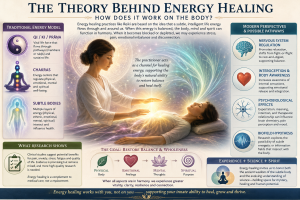
The Theory Behind Energy Healing:  How Does It Work on the Body? | Victoria Generao, PhD

For thousands of years, healing traditions have proposed that the human being is more than a collection of organs, tissues, chemicals, and electrical impulses. Beneath—or perhaps interwoven with—the physical body, these traditions describe another dimension of human life: a vital, organizing force.

Chinese traditions speak of Qi. Indian philosophy describes Prāṇa. Japanese healing systems use the concept of Ki. Western esoteric traditions have spoken of the vital force, astral light, and subtle bodies. Contemporary practitioners may simply call it the human energy field or biofield.

From this worldview arises the basic theory of energy healing:

When the energetic organization of the person becomes disturbed, the physical, emotional, mental, or spiritual person may also experience disharmony. By supporting balance within that energetic system, the practitioner seeks to encourage the person’s own capacity for restoration.

But what does that actually mean?

And perhaps more importantly, what happens to the physical body during an energy-healing session?

The answer depends upon whether we approach the question metaphysically, physiologically, psychologically, or scientifically. Rather than forcing these perspectives into opposition, it is useful to examine them side by side.


The Human Being as an Energetic Organism

Even conventional physiology recognizes that the body is not merely mechanical.

Every heartbeat is initiated through electrical activity.

The nervous system communicates through electrochemical signals.

Muscle fibers contract through changes in electrical potential across cellular membranes.

The brain produces measurable electrical activity.

Cells maintain voltage differences across their membranes.

The heart produces an electromagnetic field measurable outside the body.

None of these established biological phenomena, however, automatically proves the existence of the subtle-energy fields described in Reiki, Qigong, Therapeutic Touch, or esoteric healing traditions. This distinction is important.

When an energy healer speaks of Ki, Prāṇa, chakras, meridians, or the aura, the word energy is being used within a traditional or metaphysical model. It should not automatically be equated with electromagnetic energy measured in joules, volts, or teslas.

The National Center for Complementary and Integrative Health describes Reiki as a complementary approach based upon the idea that an energy supports the body’s natural healing abilities, while also noting that the specific energy field proposed by Reiki has not been scientifically demonstrated. (NCCIH)

We therefore encounter two different languages describing the human organism.

One is the language of biology.

The other is the language of subtle energy.

Energy healing proposes that the two may interact.

Science has not yet established that this interaction occurs through a presently measurable external energy field.


The Traditional Theory: Illness as Disturbance of Flow

Most energy-healing systems do not regard the practitioner as literally “curing” another person.

The healer instead attempts to create conditions in which greater balance can emerge.

Imagine a river.

When the river moves freely, water continually circulates through the landscape. But if debris accumulates, currents become diverted, areas stagnate, and pressure develops elsewhere.

Traditional energetic systems use remarkably similar imagery.

Energy may be described as:

  • deficient,
  • excessive,
  • stagnant,
  • blocked,
  • scattered,
  • depleted,
  • congested,
  • or unbalanced.

Healing therefore involves restoring flow, coherence, and equilibrium.

A Reiki practitioner might describe this as allowing universal life-force energy to move where it is required.

A practitioner of Chinese energetic medicine might speak of harmonizing Qi.

A yogic healer might describe balancing Prāṇa through the nāḍīs and chakras.

An esoteric healer might speak of bringing the subtle bodies into greater alignment.

Although the terminology differs, the underlying principle is strikingly similar:

Life seeks organization, balance, and wholeness.

The healer attempts to cooperate with that tendency.


The Body’s Extraordinary Capacity for Self-Regulation

Here the metaphysical and biomedical perspectives begin to approach one another.

The body constantly attempts to maintain internal stability.

Temperature is regulated.

Blood chemistry is regulated.

Blood pressure is continually adjusted.

Tissues repair themselves.

Immune cells respond to injury.

Hormones shift according to changing circumstances.

The nervous system constantly evaluates whether the organism needs to mobilize, defend, digest, repair, sleep, reproduce, or recover.

Medicine calls this regulatory tendency homeostasis, while broader contemporary models also use concepts such as allostasis—the body’s ability to adapt its internal operations to changing demands.

Energy-healing philosophies often interpret healing similarly, although through another vocabulary.

The healer is therefore not necessarily imagined as supplying something the body completely lacks.

Rather, the session is intended to help the organism return to a state in which its own regulatory processes can function more effectively.

This idea becomes especially interesting when we examine the nervous system.


The Nervous System May Be One Important Bridge

Modern life frequently places human beings into prolonged states of vigilance.

The sympathetic nervous system—the portion associated with mobilization—prepares us to respond to challenge.

Heart rate may increase.

Muscles tense.

Attention narrows.

Stress hormones may rise.

Digestion and restorative functions may temporarily become secondary.

This response is not pathological. It is essential for survival.

The problem arises when the organism has difficulty returning from mobilization into restoration.

During many energy-healing sessions, however, the conditions are almost the opposite.

The recipient lies quietly.

External stimulation decreases.

Breathing may slow.

The eyes close.

Attention turns inward.

A trusted practitioner remains quietly present.

Touch, when used, is generally gentle and noninvasive.

The recipient is essentially being given permission to stop doing.

For some people this creates profound relaxation.

And relaxation is not merely psychological.

Changing psychological states can influence breathing, muscle tension, pain perception, cardiovascular activity, attention, endocrine activity, and autonomic regulation.

Thus one scientifically plausible component of energy healing is not necessarily the transfer of an unidentified energy at all.

It may involve helping the nervous system enter a physiological environment more compatible with rest, recovery, and self-regulation.


The Parasympathetic State: From Vigilance to Restoration

The parasympathetic nervous system participates in many of the body’s quieter functions—rest, digestion, energy conservation, and recovery.

People receiving Reiki and similar therapies frequently report experiences such as:

warmth,

heaviness,

lightness,

tingling,

slowed breathing,

sleepiness,

emotional release,

a sense of expansion,

or unusually deep calm.

Energetic traditions interpret some of these sensations as evidence that energy is moving.

Biomedical science cannot presently confirm that interpretation.

But many of these experiences are also compatible with shifts in attention, relaxation, autonomic activity, sensory processing, and emotional state.

This creates an intriguing possibility.

Perhaps some of what practitioners call energetic balancing corresponds phenomenologically to a person moving from physiological vigilance toward greater regulation.

That does not prove the metaphysical theory.

But neither does it make the experience meaningless.


Healing Through Attention

There is another mechanism that receives far less attention: awareness itself.

Most of us spend enormous portions of our lives cognitively projected outward.

We are thinking about what happened yesterday.

What we need to accomplish tomorrow.

What someone said.

What might go wrong.

During an energy-healing session, attention often returns to the body.

Suddenly the recipient notices breathing.

Heartbeat.

Muscle tension.

Warmth.

Cold.

Pressure.

Emotion.

Fatigue.

Areas of comfort.

Areas of discomfort.

This inward awareness is sometimes called interoception—the perception of signals arising from within the body.

A person who becomes more sensitive to internal states may begin recognizing tension before it becomes overwhelming, exhaustion before complete depletion, or emotional activation before it turns into reactive behavior.

From an energetic perspective, the person is becoming more aware of the subtle body.

From a physiological perspective, the person may simply be becoming more conscious of bodily signals.

These interpretations are not necessarily mutually exclusive as descriptions of subjective experience.


The Healing Relationship Itself Matters

There is another element that should not be underestimated:

human presence.

A compassionate therapeutic encounter can itself alter experience.

For thirty or sixty minutes someone is effectively communicating:

You are safe enough to rest.

You do not have to perform.

You may receive.

Your discomfort is being acknowledged.

Someone is present with you.

Human beings are profoundly social organisms. Perceived safety, supportive interaction, expectation, prior experience, and therapeutic context can all influence pain and other symptoms.

This is sometimes dismissed as “just placebo.”

That description misunderstands placebo physiology.

Placebo responses can involve genuine changes in neural processing and neurochemical systems. Research on placebo analgesia, for example, has demonstrated roles for expectation, conditioning, endogenous opioid systems, and other mechanisms involved in regulating pain. (PubMed)

If ritual, expectation, attention, touch, therapeutic relationship, and perceived safety influence physiology, their effects are not imaginary simply because they originate partly through the brain.

The brain is part of the body.


The Energetic Model of the Aura and Chakras

Within metaphysical healing systems, however, the explanation goes considerably further.

The physical body is often regarded as the densest expression of several interpenetrating levels of being.

Different traditions describe these levels differently, but a typical esoteric model might include:

Physical Body → Etheric or Vital Body → Emotional or Astral Body → Mental Body → Spiritual Levels of Consciousness

The etheric body is frequently described as the energetic matrix immediately underlying physical life.

Within yogic systems, major organizing centers within the subtle body are called chakras.

Rather than viewing chakras merely as colored disks located along the spine, it may be more useful to understand them as symbolic or subtle centers through which physical, psychological, emotional, and spiritual experiences are organized.

For example:

The root center concerns embodiment, survival, stability, and belonging.

The sacral center concerns feeling, sexuality, relationship, and creativity.

The solar plexus concerns identity, power, autonomy, and action.

The heart center concerns love, grief, compassion, relationship, and integration.

The throat center concerns communication and expression.

The brow center concerns perception, imagination, and insight.

The crown concerns transcendence and relationship with the Sacred.

In energy-healing theory, prolonged disturbance within one level of the human being may eventually influence another.

An emotional pattern may produce chronic muscular tension.

Fear may influence breathing.

Grief may profoundly alter sleep, appetite, and energy.

Chronic physical pain may alter mood and cognition.

The metaphysical model interprets these interactions as movements occurring between layers of the subtle and physical organism.

Modern medicine describes many of them through nervous, endocrine, immune, behavioral, and psychological pathways.

Different maps.

Sometimes remarkably similar territory.


What Is the Practitioner Actually Doing?

One of the greatest misconceptions concerning energy healing is that the healer is pouring personal energy into the recipient.

Most mature traditions explicitly discourage this interpretation.

In Reiki, for example, the practitioner ideally functions as a conduit rather than a battery.

The healer does not force the recipient into healing.

The healer establishes a therapeutic field or condition in which healing may occur.

This concept has parallels throughout mystical traditions.

The healer becomes quiet.

Attention becomes focused.

Intention becomes singular.

Personal concerns temporarily recede.

The practitioner attempts to become receptive rather than controlling.

In metaphysical language, the healer aligns with a greater organizing intelligence.

In psychological language, the healer enters a highly regulated state of sustained compassionate attention.

Whether those descriptions ultimately refer to one phenomenon or two remains an open philosophical question.


Resonance and Entrainment: An Attractive but Unproven Hypothesis

Energy healers frequently use the concept of resonance.

A well-known physical analogy is that of two tuning forks.

Strike one tuning fork near another tuned to the same frequency and the second may begin vibrating sympathetically.

Energy-healing traditions propose something analogous between living systems.

A coherent practitioner, according to this theory, creates conditions in which a dysregulated recipient can gradually move toward greater coherence.

This is sometimes described as entrainment.

The analogy is elegant.

But it should remain an analogy unless direct biological evidence demonstrates the proposed subtle-energy mechanism.

There is research investigating physiological changes during biofield practices, including EEG and heart-rate variability, but a systematic review found that results were inconsistent and did not establish a unique physiological signature of the healer’s state. (PubMed)

Thus, resonance remains an intriguing theoretical model rather than an established explanation of energy healing.


Does Science Show That Reiki Works?

This is where precision matters.

The scientific literature is neither equivalent to saying “energy healing has been proven” nor accurately summarized by saying “nothing ever happens.”

Recent clinical studies have reported reductions in symptoms such as pain, anxiety, and stress in some populations.

For example, a randomized study published in 2025 involving cancer patients reported greater improvements in several subjective outcomes among participants receiving Reiki, although cortisol did not differ significantly between groups. (PubMed)

Another recent randomized placebo-controlled trial reported improvements in pain, anxiety, heart rate, and some cardiovascular measures among mechanically ventilated patients receiving Reiki compared with sham Reiki. (PubMed)

A 2025 meta-analysis examining randomized trials also reported improvements in quality-of-life outcomes associated with Reiki. (PubMed)

Yet this must be balanced against the larger evidence base.

Research varies considerably in quality, intervention design, sample size, comparison groups, practitioner training, blinding procedures, and outcome measurement.

A recent systematic review examining Reiki and Therapeutic Touch in palliative care found some promising symptom reports but concluded that the overall evidence remained limited and heterogeneous. (PubMed)

NCCIH likewise states that Reiki has not been clearly demonstrated to be effective for a specific health purpose and that research results remain inconsistent. (NCCIH)

The fairest conclusion at present is therefore:

People can experience meaningful subjective and sometimes measurable physiological changes during energy-healing interventions, but science has not established that these effects occur because a distinct subtle energy is being transferred or manipulated.

That distinction is crucial.


Perhaps the Better Question Is Not “Is Energy Real?”

The conversation surrounding energy healing often becomes trapped between two extremes.

One side insists:

“Science hasn’t measured the energy, therefore the entire experience is meaningless.”

The other insists:

“People experience effects, therefore the metaphysical explanation must already be scientifically proven.”

Neither position is necessary.

A more intellectually useful position is:

Something may be happening during these healing encounters. We should carefully investigate what components produce the effects.

Perhaps relaxation matters.

Perhaps expectation matters.

Perhaps touch matters.

Perhaps meditative attention matters.

Perhaps human connection matters.

Perhaps changes in autonomic regulation matter.

Perhaps ritual matters.

Perhaps consciousness plays roles we do not yet fully understand.

And perhaps future research will identify additional mechanisms.

Science advances precisely because unanswered questions remain unanswered long enough to be investigated properly.


The Metaphysical Interpretation: Healing as Restoration of Coherence

From an esoteric perspective, healing is not simply the removal of symptoms.

It is the restoration of right relationship.

Body with mind.

Mind with emotion.

Personality with soul.

Individual with community.

Human being with nature.

Finite self with the Sacred.

Disease, in this wider philosophical model, does not necessarily represent punishment or spiritual failure. Nor should illness ever be blamed upon someone’s supposed “negative energy.”

Rather, healing becomes the continuing process by which fragmented aspects of ourselves are brought back toward integration.

The healer therefore does not battle the body.

The healer listens.

The healer does not command the life-force.

The healer cooperates with it.

The healer does not impose wholeness.

The healer creates space in which wholeness may reveal itself.


Where Reiki Fits Into This Model

Reiki provides one of the clearest expressions of this philosophy.

The word is commonly interpreted through the Japanese concepts Rei and Ki, broadly pointing toward spiritual or universal reality and vital life energy.

During a Reiki session, the practitioner places the hands lightly upon or just above various areas of the recipient’s body.

There is no massage.

There is no physical manipulation.

There is often very little conversation.

From the traditional perspective, Reiki moves according to the recipient’s need rather than according to the practitioner’s personal will.

The healer becomes the intermediary.

The recipient becomes receptive.

Healing becomes less an act of doing and more an act of allowing.

Whether interpreted spiritually or psychologically, that principle may be one of Reiki’s most profound teachings.

Modern humanity is extremely practiced at effort.

We are considerably less practiced at receptivity.


Energy Healing as Ritualized Stillness

There may therefore be another way of understanding these practices.

Energy healing creates ritualized stillness.

For a defined period of time:

the phone stops,

the conversation stops,

the demands stop,

the obligations stop,

the outward performance of identity stops.

The recipient enters a liminal space.

The practitioner enters focused presence.

The ordinary world becomes temporarily quieter.

Whatever else may or may not be happening energetically, this alone changes the conditions under which the nervous system is operating.

And sometimes healing begins not because something dramatic has been added—

but because something exhausting has finally been removed.


Healing Is Not the Same as Curing

Perhaps the most important distinction in any discussion of energy work is the difference between healing and curing.

Curing concerns the elimination or successful treatment of disease.

Healing is broader.

A person may experience healing while still living with illness.

Someone may find peace while receiving cancer treatment.

A grieving person may begin integrating loss.

Someone with chronic pain may discover moments of profound calm.

A dying person may experience reconciliation, meaning, or spiritual acceptance.

None of these experiences necessarily cures disease.

Yet few would call them insignificant.

Energy healing may therefore be best understood not as a replacement for medicine, but as a complementary practice concerned with the human dimensions that medicine does not always have sufficient time to address:

presence,

rest,

meaning,

touch,

attention,

relationship,

spirituality,

and the experience of wholeness.


The Mystery Behind the Mechanism

We ultimately arrive at a fascinating threshold.

Traditional healers say that life-force moves through us.

Biology says that the organism possesses extraordinarily complex mechanisms of regulation and repair.

Psychology demonstrates that expectation, perception, emotion, attention, and relationship influence bodily experience.

Neuroscience demonstrates that changing states of consciousness can alter pain processing and neurophysiology.

Medicine demonstrates that the body is continuously attempting to regulate itself.

Energy healing gathers all of these questions into a single encounter between practitioner and recipient.

Does an independent subtle biofield exist?

Science has not yet established that it does.

Can people nonetheless experience relaxation, comfort, altered pain perception, emotional release, and meaningful changes during energy-healing sessions?

Yes, such experiences are reported, and some clinical studies have observed measurable differences—although the evidence remains inconsistent and the mechanisms unresolved. (PubMed)

And so energy healing occupies an unusual territory.

It sits between ancient metaphysics and modern physiology.

Between subjective experience and objective measurement.

Between ritual and medicine.

Between what humanity has believed for millennia and what experimental science can presently demonstrate.

Perhaps that is precisely why the subject remains so compelling.

For underneath every system of healing lies essentially the same question:

What allows a living being to move from disorder toward greater wholeness?

Energy-healing traditions answer:

Restore the flow.

Physiology answers:

Restore regulation.

Psychology answers:

Restore safety and integration.

Mysticism answers:

Restore relationship with the Source.

Perhaps these are entirely different explanations.

Or perhaps, seen from a sufficiently broad perspective, they are different languages describing humanity’s ancient search for the same mystery:

the innate movement of life toward balance, coherence, and wholeness.


A Responsible Place for Energy Healing

Energy healing is most appropriately regarded as a complementary practice, not a substitute for evidence-based diagnosis or treatment. Persistent pain, infection, neurological symptoms, cardiovascular symptoms, unexplained weight loss, severe psychiatric symptoms, or other significant health concerns require appropriate professional medical evaluation.

Using Reiki or another contemplative healing practice alongside appropriate healthcare allows the metaphysical question to remain open without asking the practice to perform a medical role that current evidence cannot justify.

That approach leaves room for both discernment and mystery—and perhaps that is exactly where meaningful inquiry into healing should begin.


Annotated Bibliography

The Theory Behind Energy Healing — How Does It Work on the Body?

Introduction

The literature surrounding energy healing spans several very different intellectual traditions. Some sources approach healing through the traditional concepts of Qi, Ki, Prāṇa, chakras, subtle bodies, and the human energy field. Others attempt to formulate a scientific concept of the biofield, while still others investigate measurable outcomes such as pain, anxiety, quality of life, heart-rate variability, relaxation, or nervous-system regulation.

These categories should not be confused with one another. Biological electricity and electromagnetic activity are established physiological phenomena; their existence does not, by itself, prove the existence of the subtle energy proposed in Reiki and comparable systems. Likewise, clinical improvement following an energy-healing intervention does not necessarily identify the mechanism responsible for that improvement.

The following bibliography therefore intentionally brings together traditional sources, esoteric models, clinical research, physiology, psychology, and critical scientific evaluation.

I. Reiki and the Traditional Energy-Healing Model

Logan, B., & Stiene, F. (2024). The Reiki sourcebook: A timeless reference book for Reiki practitioners of all levels. O-Books.

This extensive reference work examines Reiki’s Japanese origins, practices, teachings, lineages, symbols, attunements, and subsequent development in the West. It is particularly useful for distinguishing historically grounded Reiki practice from many concepts that were later incorporated into Western Reiki culture. The work helps establish what practitioners mean by Ki, energetic balance, hands-on healing, and the practitioner’s role. It should be treated primarily as a historical and practitioner-oriented source rather than as biomedical evidence. For a blog addressing the theory behind energy healing, it provides valuable context concerning how Reiki itself understands the healing process.

Miles, P. (2008). Reiki: A comprehensive guide. Tarcher.

Pamela Miles presents Reiki from the perspective of a long-term practitioner who has worked to introduce the practice into conventional healthcare environments. The book describes Reiki as a gentle, nonmanipulative practice intended to support the body’s natural healing response rather than replace medical treatment. Miles is especially useful for explaining the distinction between the practitioner as a facilitator and the mistaken idea that the practitioner personally forces healing into another person. The book provides an accessible bridge between traditional Reiki philosophy and contemporary integrative-health language, though its therapeutic claims should be evaluated separately from controlled clinical research.

National Center for Complementary and Integrative Health. (n.d.). Reiki. U.S. Department of Health and Human Services, National Institutes of Health.

NCCIH provides an essential scientific and medical counterbalance to practitioner literature. It defines Reiki as a complementary practice in which practitioners place their hands lightly on or above a person with the intention of facilitating the person’s healing response. Importantly, NCCIH notes that research regarding Reiki’s effectiveness remains inconsistent and that there is currently no scientific evidence demonstrating the existence of the specific energy field proposed in Reiki theory. This source is particularly important for maintaining scholarly integrity when discussing Reiki as a metaphysical or complementary practice rather than presenting its traditional explanatory mechanism as established biomedical fact.

II. The Biofield Hypothesis and Energy Medicine

Rubik, B., Muehsam, D., Hammerschlag, R., & Jain, S. (2015). Biofield science and healing: History, terminology, and concepts. Global Advances in Health and Medicine, 4(Suppl.), 8–14. DOI: 10.7453/gahmj.2015.038.suppl

This article provides one of the most useful scholarly introductions to the modern concept of the biofield. The authors review historical ideas about vital forces and biological fields while attempting to develop terminology that can be used in scientific research. Of particular value is the distinction between known electromagnetic processes and proposed organizing fields that remain hypothetical. The article is useful for discussing attempts to build a conceptual bridge between traditional subtle-energy systems and biophysics. It should nevertheless be recognized as a theoretical framework within an emerging and controversial research area rather than evidence that a Reiki-like biofield has been conclusively demonstrated.

Oschman, J. L. (2015). Energy medicine: The scientific basis (2nd ed.). Churchill Livingstone/Elsevier.

Oschman explores biological electricity, electromagnetism, connective tissue, cellular signaling, resonance, regulatory processes, and proposed energetic mechanisms involved in healing. His work is influential within integrative and energy-medicine circles because it attempts to connect energy-healing theory with known principles of physiology and biophysics. Chapters addressing electrophysiology, bioelectromagnetism, acupuncture, resonance, and the body’s regulatory systems are particularly relevant to the present topic. However, readers should distinguish carefully between well-established biological phenomena discussed in the book and broader theoretical interpretations that remain debated. It is most useful as a hypothesis-generating interdisciplinary source, not as definitive proof of subtle-energy healing.

Jain, S., Hammerschlag, R., Mills, P., Cohen, L., Krieger, R., Vieten, C., & Lutgendorf, S. (2015). Clinical studies of biofield therapies: Summary, methodological challenges, and recommendations. Global Advances in Health and Medicine, 4(Suppl.), 58–66. DOI: 10.7453/gahmj.2015.034.suppl

This paper reviews clinical studies involving Reiki, Healing Touch, Therapeutic Touch, and related biofield therapies while also examining the methodological problems inherent in studying them. These include practitioner variability, treatment dose, sham-healing controls, blinding, small sample sizes, and uncertainty about what mechanism is actually being tested. The article is particularly useful because it neither simply dismisses biofield therapies nor assumes that their proposed mechanisms have been proven. It demonstrates how researchers can investigate patient outcomes even while the underlying mechanism remains unresolved. This makes it an excellent source for framing energy healing as an area of legitimate inquiry that still requires substantially better research.

Baldwin, A. L., & Hammerschlag, R. (2014). Biofield-based therapies: A systematic review of physiological effects on practitioners during healing. Explore, 10(3), 150–161. DOI: 10.1016/j.explore.2014.02.003

This systematic review asks an unusually important question: Does the healer enter a distinctive physiological state while performing biofield healing? The authors examined studies measuring variables such as electroencephalography and heart-rate variability. Findings were inconsistent, and the authors concluded that robust evidence of a unique physiological state characteristic of biofield healers had not emerged. This study is particularly valuable because it tests one aspect of the energetic hypothesis rather than merely measuring whether patients report feeling better. It provides an important caution against making unsupported claims concerning measurable “healing frequencies” or physiological signatures in practitioners.

III. Clinical Evidence for Reiki and Related Practices

Liu, K., Qin, Z., Qin, Y., Li, Y., Liu, Q., Gao, F., Zhang, P., & Wang, W. (2025). Effects of Reiki therapy on quality of life: A meta-analysis of randomized controlled trials. Systematic Reviews, 14(1), 72. DOI: 10.1186/s13643-025-02811-5

This 2025 meta-analysis examined randomized controlled trials investigating Reiki and quality of life. The combined sample included 661 participants, and the analysis found a statistically significant but modest improvement in quality-of-life measures associated with Reiki. The study is important because meta-analysis provides a broader view than individual trials. At the same time, positive pooled results do not establish that subtle-energy transfer caused the observed improvements. Factors such as relaxation, attention, expectancy, practitioner interaction, and treatment setting remain possible contributors. This source supports the position that Reiki deserves continued research while avoiding the stronger claim that its traditional mechanism has been proven.

Pontes-Gomes, R., & Reis-Pina, P. (2026). Reiki and Therapeutic Touch for symptom burden and quality of life in palliative settings: A systematic review. Palliative Medicine, 40(7), 958–970. DOI: 10.1177/02692163261437606

This recent systematic review examined Reiki and Therapeutic Touch in palliative and end-of-life care. Nine studies involving 415 participants were included. Some reported improvements in pain, anxiety, depression, fatigue, stress, sleep, relaxation, hope, and emotional well-being. However, the authors emphasized methodological limitations, heterogeneous interventions, risk of bias, and very low certainty of evidence, preventing firm conclusions about effectiveness. This is an especially valuable source because it illustrates the nuanced state of contemporary research: patient benefits are sometimes reported, yet stronger evidence is required. It reinforces the responsible use of energy healing as complementary supportive care rather than a substitute for established medical treatment.

Avci, A., & Gün, M. (2023). The effect of Reiki on pain applied to patients with cancer: A systematic review. Holistic Nursing Practice, 37(5), 268–276. DOI: 10.1097/HNP.0000000000000601

Avci and Gün reviewed seven experimental and quasi-experimental studies involving 572 cancer patients. Five studies reported reductions in pain following Reiki, while two did not demonstrate an effect. The authors therefore concluded that Reiki may have potential for pain management but emphasized the limited number of high-quality studies and the need for additional randomized controlled trials. The article is useful in discussing one of the most common reported benefits of energy-healing sessions: decreased pain or altered pain perception. Importantly, the findings establish neither cure nor proof of subtle-energy transmission; they concern reported clinical outcomes.

Jain, S., & Mills, P. J. (2010). Biofield therapies: Helpful or full of hype? A best evidence synthesis. International Journal of Behavioral Medicine, 17(1), 1–16. DOI: 10.1007/s12529-009-9062-4

This influential review examined dozens of clinical studies involving Reiki, Healing Touch, Therapeutic Touch, and related approaches. The authors reported evidence suggesting potential benefit for some outcomes, particularly pain and anxiety, while also noting substantial methodological limitations across the literature. The article remains important because it helped establish a framework for evaluating biofield therapies using conventional evidence standards. It is particularly useful when discussing why subjective symptom improvement should be taken seriously while simultaneously recognizing that improvements in symptoms do not prove a specific energetic mechanism.

Hammerschlag, R., Marx, B. L., & Aickin, M. (2014). Nontouch biofield therapy: A systematic review of human randomized controlled trials reporting use of only nonphysical contact treatment. Journal of Alternative and Complementary Medicine, 20(12), 881–892. DOI: 10.1089/acm.2014.0017

This review focuses specifically on energy-healing interventions performed without physical contact, making it particularly relevant to claims that energy can act independently of touch. Twenty-eight randomized controlled trials met the initial criteria, although several were excluded because of methodological quality concerns. Some of the better-quality studies reported beneficial outcomes, but the authors stressed that the small sample sizes and pilot nature of the research prevented strong conclusions. The study is useful because removing touch from the intervention helps researchers examine whether effects can be explained solely through tactile stimulation, although expectation, attention, context, and other variables remain difficult to eliminate completely.

Hammerschlag, R., Sprengel, M., & Baldwin, A. L. (2024). Biofield therapies: Guidelines for reporting clinical trials. Journal of Integrative and Complementary Medicine, 30(2), 133–145. DOI: 10.1089/jicm.2024.29128.rh

This methodological paper provides formal recommendations for improving research on External Qigong, Healing Touch, Reiki, Therapeutic Touch, and related therapies. Its importance lies not in proving or disproving energy healing but in establishing better standards for testing it. Detailed reporting of practitioner background, intervention procedures, treatment dose, controls, outcomes, and study design allows future trials to become more reproducible and scientifically interpretable. This source is excellent for demonstrating that energy healing remains a developing research area in which improved methodology is essential before strong conclusions concerning mechanisms can be reached.

IV. Nervous-System Regulation, Body Awareness, and Plausible Physiological Pathways

Khalsa, S. S., Adolphs, R., Cameron, O. G., Critchley, H. D., Davenport, P. W., Feinstein, J. S., Feusner, J. D., Garfinkel, S. N., Lane, R. D., Mehling, W. E., Meuret, A. E., Nemeroff, C. B., Oppenheimer, S., Petzschner, F. H., Pollatos, O., Rhudy, J. L., Schramm, L. P., Simmons, W. K., Stein, M. B., Stephan, K. E., Van den Bergh, O., Van Diest, I., von Leupoldt, A., & Paulus, M. P. (2018). Interoception and mental health: A roadmap. Biological Psychiatry: Cognitive Neuroscience and Neuroimaging, 3(6), 501–513. DOI: 10.1016/j.bpsc.2017.12.004

This major review explains interoception, the nervous system’s sensing and interpretation of signals arising from within the body. Interoception contributes to emotion, bodily awareness, homeostasis, cognition, and self-regulation. The concept is highly relevant to energy healing because recipients frequently become intensely aware of warmth, tingling, breathing, heartbeat, pressure, tension, relaxation, or other internal sensations during sessions. Interoceptive science provides a credible physiological framework for understanding such experiences without requiring that every sensation be attributed to an external subtle energy. It therefore creates an important conceptual bridge between subjective energetic experience and neuroscience.

Benedetti, F. (2008). Placebo effects: Understanding the mechanisms in health and disease. Oxford University Press.

Benedetti’s work is foundational for understanding why therapeutic context, expectation, conditioning, ritual, practitioner interaction, and belief can influence symptoms through genuine neurobiological mechanisms. Placebo effects are not equivalent to imaginary symptoms; they can involve measurable changes in pain-processing pathways, endogenous opioids, dopamine, expectation, and learning. This source is essential for a sophisticated discussion of energy healing because some benefits experienced during a session may arise through contextual and psychobiological pathways. Recognizing such mechanisms does not invalidate a person’s experience. Rather, it demonstrates how profoundly meaning, expectation, relationship, and consciousness can interact with physiology.

V. Traditional Concepts of Vital Energy

Kaptchuk, T. J. (2000). The web that has no weaver: Understanding Chinese medicine (Rev. ed.). Contemporary Books.

Kaptchuk provides one of the most influential Western-language introductions to the philosophical and diagnostic framework of Chinese medicine. Particularly relevant is his treatment of Qi, which should not be reduced simplistically to electricity or a Western physics concept of energy. In traditional Chinese medicine, Qi participates in a much broader model involving movement, function, pattern, relationship, transformation, and balance. This book is valuable for demonstrating that traditional energetic language exists within a complete medical-philosophical worldview. It helps prevent the common error of assuming that every traditional reference to “energy” means electromagnetic energy in the modern scientific sense.

VI. Western Esoteric Models of the Subtle Body

Brennan, B. A. (1988). Hands of light: A guide to healing through the human energy field. Bantam Books. (Original work published 1987)

Barbara Brennan’s work became one of the most influential modern Western presentations of the human energy field, aura, chakras, subtle bodies, and hands-on healing. Brennan proposes multiple layers of energetic organization corresponding to physical, emotional, mental, and spiritual aspects of the person. The work strongly influenced contemporary energy-healing culture and is especially relevant to the blog’s discussion of the etheric, emotional, mental, and spiritual bodies. It should, however, be identified explicitly as an experiential and metaphysical model, not as an established anatomical or biophysical description of the human organism.

Leadbeater, C. W. (1927). The chakras. Theosophical Publishing House.

Leadbeater’s text was instrumental in shaping the modern Western esoteric understanding of chakras. Drawing upon Theosophy, clairvoyant interpretation, Indian concepts, and Western occultism, he described chakras as subtle force centers interacting with vitality and consciousness. The book strongly influenced subsequent New Age, occult, and energy-healing representations of the chakra system. Historically, it is important because many contemporary Western assumptions about chakra colors, functions, and appearances owe as much to twentieth-century Theosophy as to classical Indian texts. It should therefore be used as a historical esoteric source rather than scientific evidence concerning human anatomy.

VII. Recommended Interpretive Framework

Taken collectively, these sources suggest that energy healing should be studied through several overlapping but distinct explanatory layers.

1. Traditional-Energetic Layer

Reiki, Chinese medicine, yogic systems, and Western esoteric traditions describe a vital principle—Ki, Qi, Prāṇa, vital force, or subtle energy—whose balanced movement is associated with health and vitality.

This model is metaphysical and traditional rather than established biophysical fact.

2. Biofield Hypothesis

Contemporary biofield researchers have proposed that living organisms may exhibit organizing energetic or informational processes that deserve systematic investigation.

Known biological electromagnetic phenomena clearly exist, but these should not automatically be equated with the proposed subtle biofield of Reiki and related practices.

3. Autonomic and Regulatory Layer

Quiet environments, reduced stimulation, meditative attention, breathing changes, gentle touch, and perceived safety can affect nervous-system activity.

The transition from heightened vigilance toward relaxation may therefore account for some of the restorative experiences reported during energy healing.

4. Interoceptive Layer

Healing sessions increase awareness of internal bodily sensations.

Warmth, tingling, heaviness, pulsing, pressure, emotional release, and changes in breathing may consequently reflect changes in interoceptive attention and sensory processing, whether or not a subtle-energy interpretation is also adopted.

5. Psychobiological Layer

Expectation, ritual, therapeutic relationship, meaning, conditioning, attention, and practitioner presence can alter pain and other symptoms through real neurobiological mechanisms.

These effects should not be dismissed as “imaginary.”

6. Clinical-Outcome Layer

Some clinical trials and reviews report improvements in pain, anxiety, stress, fatigue, relaxation, and quality of life following Reiki or related interventions.

The findings remain heterogeneous, and methodological limitations prevent the conclusion that a specific subtle-energy mechanism has been proven.

7. Metaphysical Layer

Within esoteric philosophy, healing represents more than symptom reduction.

It is the restoration of coherence and right relationship among the physical, vital, emotional, mental, and spiritual dimensions of the person.

This is best presented as a spiritual and philosophical model rather than a medical claim.


Conclusion

The bibliography demonstrates why the subject of energy healing cannot be responsibly reduced either to the statement “science has proven subtle energy” or to the statement “nothing happens.”

Current research occupies a more interesting middle ground.

Some recipients demonstrably report meaningful changes in pain, stress, relaxation, anxiety, and quality of life. Physiological mechanisms involving autonomic regulation, interoception, therapeutic context, expectation, attention, and human relationship offer plausible explanations for at least some of these effects.

At the same time, the traditional theory proposes something more: that the human being participates in an organizing field of life that extends beyond presently understood biochemical mechanisms.

That proposition remains scientifically unresolved.

For the student of energy healing, this distinction is not a weakness. It creates an important intellectual discipline:

experience may be honored without converting belief into scientific fact, and science may be respected without assuming that every mystery of human healing has already been solved.

The most fruitful position is therefore one of informed inquiry—placing ancient models of Qi, Ki, Prāṇa, chakras, subtle bodies, and vital force into conversation with contemporary research on the biofield, nervous system, homeostasis, interoception, psychobiology, consciousness, and therapeutic relationship.

In that conversation lies one of the most compelling questions in healing:

What allows a living organism to move from fragmentation and dysregulation toward coherence, adaptation, and wholeness?
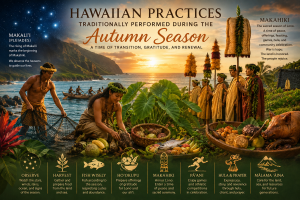
 

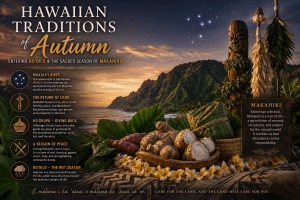
Hawaiian Practices Traditionally Performed During the Autumn Season From the Last Months of Kau to the Sacred Season of Makahiki | Victoria Generao, PhD

When people in Europe or North America speak of autumn, the imagination naturally turns toward falling leaves, shortening days, harvest fields, and preparations for winter. In Hawaiʻi, however, the seasonal story is different. The islands do not traditionally organize the year according to the familiar four-season cycle of spring, summer, autumn, and winter.

For Native Hawaiians, time was read through the movements of the heavens, the phases of the Moon, the appearance of stars, rainfall, winds, ocean conditions, the flowering and fruiting of plants, the migrations and spawning of fish, and countless other signs within the living environment.

Traditionally, the Hawaiian year was broadly understood through two great seasonal movements: Kau, the warmer and generally drier season, and Hoʻoilo, the cooler and wetter season. Historical Hawaiian accounts describe six lunar months belonging to each. The transition into Hoʻoilo occurred around what the Western calendar calls late autumn. (University of Hawaii)

Therefore, when we ask what Hawaiian people traditionally practiced during “autumn,” we are really asking about something more interesting:

What happened during the closing months of Kau, the preparation for Hoʻoilo, and the approach and opening of Makahiki?

The answer reveals a season concerned with observation, harvesting, food preservation, redistribution, gratitude, ritual offering, peace, physical competition, communal celebration, and the renewal of the relationship between humanity, the ʻāina, the sea, the ancestors, and the akua.


Autumn in Hawaiʻi Was a Time of Transition

The Gregorian months of approximately September through November overlap several traditional lunar months, although the correspondence is never exact because the Hawaiian calendar follows lunar and environmental observations rather than fixed Gregorian dates.

Older Hawaiian calendrical traditions identify the latter portion of Kau with months such as Mahoe Hope and ʻIkuwā, followed by Welehu, which marks the transition toward Hoʻoilo. David Malo’s nineteenth-century account describes ʻIkuwā as the final month of Kau and Welehu as the first month of Hoʻoilo. (University of Hawaii at Hilo)

The University of Hawaiʻi’s Hawaiian lunar-calendar resources similarly present ʻIkuwā as a period of increasing rain, thunder, wind, environmental change, and preparation for Makahiki, while Welehu opens the wetter season. (University of Hawaii)

This transitional quality is important.

Traditional Hawaiian seasonal activity was not governed by a printed date announcing that “autumn has begun.” A knowledgeable observer watched the world.

The sky announced the season.

The ocean announced the season.

The plants announced the season.

The winds announced the season.

The behavior of animals announced the season.

And eventually, Makaliʻi—the Pleiades—announced one of the most sacred transitions of the year.


Watching the Heavens: The Rising of Makaliʻi

Among the most important autumn practices was simply one of the most profound: observation.

The night sky served as calendar, clock, navigational map, agricultural guide, and ceremonial indicator.

The star cluster known in Hawaiian as Makaliʻi, commonly identified with the Pleiades, became especially significant as the year approached the season of Makahiki.

According to the National Park Service, Makahiki traditionally began when Makaliʻi became visible rising on the eastern horizon after sunset, generally around late October or early November, although timing and practice varied between islands and communities. (National Park Service)

This was not casual stargazing.

It was kilo—careful observation of natural phenomena.

Celestial and environmental signs helped knowledgeable practitioners determine the resetting of the lunar and ritual calendar. At Puʻuhonua o Hōnaunau, the National Park Service describes Kau Makaliʻi as a period during which traditional practitioners observed astronomical and environmental signs associated with the annual cycle of ritual. (National Park Service)

The autumn sky therefore became a sacred text.

Instead of reading the changing season from a calendar hanging upon a wall, one could read it in the stars.


Harvesting and Preparing Food

The months immediately preceding Makahiki were closely connected with the harvesting and securing of resources.

Fishing, gathering, farming, drying, salting, and storing foods were not merely economic activities. They formed part of a sophisticated system in which human consumption was coordinated with ecological cycles.

Traditional Hawaiian lunar knowledge connected particular phases and months with appropriate times for planting, harvesting, fishing, resting gardens, and allowing marine resources to replenish. The University of Hawaiʻi’s Hawaiian Lunar Calendar emphasizes that generations of Hawaiians used lunar observation to guide both agricultural and fishing practices. (University of Hawaii)

During the later months before Makahiki, fishing activity could increase specifically so that fish might be harvested, prepared, and stored before the coming wet season and ceremonial period. (University of Hawaii)

Foods such as kalo (taro), ʻuala (sweet potato), fish, and other locally available foods were central to community subsistence. Pigs, cultivated crops, and crafted goods could later become part of Makahiki tribute and ceremonial offerings. (National Park Service)

Thus, the Hawaiian autumn harvest was not simply a moment of taking abundance from the earth.

It existed within a larger rhythm:

observe → cultivate → harvest → preserve → offer → redistribute → rest → begin again.


Fishing According to the Season

The sea was just as much a part of the seasonal calendar as the land.

Fish behavior, ocean temperature, tides, spawning cycles, currents, moon phases, winds, and rainfall were carefully observed. Certain species became plentiful during particular months, while other species might be protected or avoided.

The Hawaiian lunar-calendar tradition records periods when particular fish were spawning, when certain fisheries were especially productive, and when restrictions or kapu were placed or removed. Such practices demonstrate an intimate connection between subsistence and ecological observation. (University of Hawaii)

One recorded tradition associates ʻIkuwā and Welehu with changing fishing responsibilities, including women and children gathering or catching freshwater and nearshore resources such as ʻoʻopu, hinana, hīhīwai, and ʻōpae. (University of Hawaii)

These details should not necessarily be treated as universal rules practiced identically on every island. Hawaiian ecological practices were intensely place-based. What was appropriate in Kona might differ from what was appropriate on Molokaʻi, Oʻahu, Maui, or Kauaʻi.

That principle itself is deeply Hawaiian.

Knowledge belongs to place.


Preparing Hoʻokupu: Offerings of Gratitude and Obligation

As Makahiki approached, communities prepared hoʻokupu, ceremonial offerings presented in connection with Lono, the aliʻi, and the ritual obligations of the season.

Historical descriptions of Makahiki offerings include valuable foods and goods such as:

  • puaʻa — pigs
  • kalo — taro
  • ʻuala — sweet potatoes
  • hulu — feathers
  • moena — woven mats
  • kapa — bark cloth

(National Park Service)

These offerings represented more than what a modern person might call taxation.

They participated in a ritual economy.

The productivity of the land was acknowledged. The relationship between people, aliʻi, land, and divine powers was reaffirmed. The abundance generated within an ahupuaʻa became visible through what it could ceremonially present.

The University of Hawaiʻi’s Kahoʻiwai resource describes ʻAha Makahiki as involving offerings of food harvested from the various lands, presented in honor of Lono. (University of Hawaii)

The act of giving therefore became one of the great spiritual gestures of the season.

One received from the ʻāina.

One returned something to the sacred order.


The Beginning of Makahiki

The defining traditional observance overlapping the later part of what Western calendars call autumn was, of course, Makahiki.

Makahiki was a major ceremonial season associated particularly with Lono, an akua closely connected with rain, agriculture, fertility, atmospheric forces, peace, and abundance.

Depending upon island and period, customs differed. The surviving written record is especially rich for Hawaiʻi Island, and modern summaries should therefore avoid assuming that every community practiced precisely the same rites. The National Park Service explicitly notes that individual islands had their own ways of observing Makahiki. (National Park Service)

Yet several broad themes recur.

Makahiki represented a shift away from ordinary political and productive activity toward ceremony, renewal, tribute, recreation, and peace.

War became kapu.

Labor patterns changed.

Offerings were gathered.

Lono was honored.

Communities feasted.

Athletic competitions were held.

Hula and celebration accompanied the sacred season.

For a time, the rhythm of society itself changed. (National Park Service)


The Procession of Lono

One of Makahiki’s most dramatic ceremonies involved an image or emblem of Lono known as the Akua Loa.

According to traditions documented by the National Park Service, the Akua Loa traveled through districts in a ritual circuit, visiting the lands and receiving offerings. A related form called the Akua Poko also participated in the ritual complex. (National Park Service)

At Puʻuhonua o Hōnaunau, this circuit is described as something like a ritual survey of the wealth and productivity of the land. (National Park Service)

Imagine the meaning of such a procession.

The god does not remain hidden within a distant temple.

The sacred presence moves through the land.

The productivity of each district is encountered.

Offerings are presented.

Human communities publicly acknowledge their dependence upon forces greater than themselves.

The sacred travels through the inhabited world.

This is one reason Makahiki should not be reduced simply to “the Hawaiian Thanksgiving.”

Gratitude and harvest are certainly present, but Makahiki is considerably larger: it is a political, ecological, agricultural, religious, social, and cosmic season of renewal.


A Time of Peace

Among the most striking features of Makahiki was the suspension of warfare.

During the season dedicated to Lono, war was traditionally prohibited. (National Park Service)

Symbolically, this represents one of the most powerful transitions of the Hawaiian ceremonial year.

Weapons that might otherwise defend territory or advance political power were temporarily subordinated to another principle.

The community entered a sacred interval.

One might call it an annual rebalancing between human ambition and cosmic order.

The season declared, in effect:

There must be times for striving.

There must also be times for peace.

There must be times to cultivate.

There must also be times to enjoy what has been cultivated.

There must be times to compete for power.

There must also be times to remember that all power ultimately depends upon land, rain, ocean, community, and the unseen forces sustaining life.


Feasting and Communal Celebration

Once appropriate ritual restrictions were lifted, feasting became an important part of Makahiki observance.

The ʻAha Makahiki tradition preserved in University of Hawaiʻi cultural resources describes the ceremonial acceptance of offerings, after which the period of enjoyment could begin with feasting and games. (University of Hawaii)

Eating together had social significance.

Food demonstrated the prosperity of the land.

It expressed hospitality.

It strengthened relationships.

It redistributed abundance.

It also transformed the results of months of agricultural and fishing labor into communal experience.

Harvest became feast.

Work became celebration.

Abundance became relationship.


Pāʻani Makahiki: The Games of the Season

Autumn’s movement into Makahiki also brought one of the most joyful dimensions of Hawaiian ceremonial culture: pāʻani, games and athletic contests.

Traditional Makahiki competitions could include activities such as:

ʻUlu maika — rolling a shaped stone between stakes, sometimes compared loosely with bowling.

Mokomoko — boxing.

Hakoko — wrestling.

ʻŌʻō ihe — spear or javelin throwing.

Kūkini — foot racing.

Other traditions included surfing, sledding, canoe racing, and various contests of physical ability. (University of Hawaii)

These were not merely diversions.

Athletic skill demonstrated discipline, balance, endurance, courage, coordination, and bodily intelligence.

In this sense, Makahiki celebrated the prosperity not only of the land but of the human body.

A healthy community required strong land.

Strong land nourished strong people.

Strong people could then celebrate the abundance of the land.

The relationship was reciprocal.


Hula, Prayer, and Sacred Celebration

Makahiki festivities also included hula, prayer, religious ceremony, and communal celebration. (University of Hawaii)

Hula in traditional Hawaiian culture cannot be reduced simply to entertainment.

It can carry genealogy, history, prayer, praise, memory, environmental knowledge, and spiritual relationship.

Within a sacred seasonal setting, chant and movement help join the visible community with the invisible dimensions of memory and divine presence.

Thus, during this season, celebration itself could become an act of reverence.

Joy and holiness did not have to be opposites.

They could be expressions of the same sacred abundance.


Hōʻihi: Entering Sacred Places With Reverence

Another important principle connected with Makahiki observance is hōʻihi—reverence, respect, and dignified conduct.

At Puʻuhonua o Hōnaunau, contemporary cultural practitioners continue to present hoʻokupu during Makahiki ceremonies, and the National Park Service describes hōʻihi as the attitude with which sacred places and ceremonial actions are approached.

This principle gives us a deeper way of understanding Hawaiian seasonal spirituality.

The important question was not simply:

“What ritual should I perform?”

It was also:

“How should I stand in relationship with this place?”

Sacredness required appropriate behavior.

The land was not scenery.

The ocean was not merely a resource.

The heavens were not merely astronomical objects.

The season itself was not merely weather.

Each participated in relationship.


Mālama ʻĀina: Caring for What Sustains Life

Although the expression mālama ʻāina is used widely today, the underlying principle of reciprocal care is clearly reflected in traditional Hawaiian resource management.

The lunar calendar demonstrates a system in which people observed when to fish, when to harvest, when to plant, and when certain resources should be left alone. (University of Hawaii)

This is a profoundly different attitude from extracting as much as possible whenever an opportunity arises.

The traditional ecological question was often closer to:

What is the appropriate action at this particular time?

The answer changed according to the Moon.

It changed according to rain.

It changed according to spawning cycles.

It changed according to currents.

It changed according to place.

It changed according to season.

What modern people call sustainability was embedded within a broader discipline of attention and reciprocity.


Autumn as a Spiritual Threshold

Seen through Hawaiian seasonal consciousness, the autumn months represent a threshold.

The dry season approaches its conclusion.

The Sun moves southward.

Rain increases.

The winds change.

The sea changes.

Foods are harvested and preserved.

Makaliʻi returns to prominence in the evening sky.

Makahiki approaches.

Lono returns ceremonially.

Offerings are made.

War falls silent.

Work gives way, at least temporarily, to rest.

Games replace battle.

Feasting replaces accumulation.

The community pauses within the turning of the year.

And this may be the deepest spiritual teaching of the Hawaiian autumn:

A people cannot live only by producing.

There must also be a time for acknowledging.

A time for giving.

A time for remembering.

A time for observing.

A time for peace.

A time for celebration.

And a time for recognizing that human prosperity exists only because human life participates within a much greater living system.


The Spiritual Meaning of the Hawaiian Autumn

For a modern spiritual practitioner, the greatest lesson of this season may not be to imitate ceremonies belonging to Native Hawaiian cultural lineages without proper understanding or relationship.

The deeper invitation is to learn from their underlying wisdom.

Observe before acting.

Know the land upon which you stand.

Understand what the season is actually doing.

Give something back when you receive.

Allow periods of restraint to accompany periods of abundance.

Honor those who came before.

Cultivate peace deliberately.

Recognize that food is sacred because life produced it.

Understand that celebration can itself become prayer.

And remember that the natural world is not merely happening around us.

We are happening within it.

Makahiki expresses this beautifully.

Humanity pauses long enough to recognize the powers that sustain it.

The rain.

The soil.

The cultivated field.

The ocean.

The Moon.

The stars.

The ancestors.

The akua.

The community.

All are woven together.


Autumn in Hawaiʻi: Not a Season of Falling Leaves, but of Returning Relationship

The Hawaiian autumn is therefore best understood not as a tropical version of a European harvest festival, but as the closing movement of one seasonal cycle and the opening of another.

It is a time of kilo, careful observation.

A time of harvesting and preserving.

A time of responsible fishing and agricultural management.

A time of preparing hoʻokupu.

A time of watching for Makaliʻi.

A time of entering Hoʻoilo.

And ultimately, a time of Makahiki—of Lono, peace, feasting, games, hula, prayer, gratitude, redistribution, and renewal.

The leaves may not turn crimson and gold across Hawaiʻi as they do in temperate forests.

But the season nevertheless changes.

The heavens change.

The rains change.

The waters change.

Human responsibilities change.

And within those changes is an ancient lesson:

To know the season is to know when to work, when to gather, when to give, when to refrain—and when to celebrate the sacred abundance of life.


Annotated Bibliography

Hawaiian Practices Traditionally Performed During the Autumn Season

Research Note

The concept of “autumn” should be used cautiously when discussing traditional Hawaiian culture. The Hawaiian calendar was not historically divided into the four temperate seasons of spring, summer, autumn, and winter. Rather, Hawaiian communities followed lunar months, celestial observations, rainfall, winds, ocean conditions, agricultural cycles, and broader seasonal divisions such as Kau and Hoʻoilo. The Western autumn months overlap especially with ʻIkuwā, Welehu, and the opening of the Makahiki season. The sources below are therefore selected for their usefulness in understanding Makahiki, Lono, Makaliʻi, lunar calendrics, agriculture, fishing, hoʻokupu, seasonal games, environmental observation, and Hawaiian relationships with ʻāina.

1. Malo, David. Hawaiian Antiquities (Moolelo Hawaii). Translated by Nathaniel B. Emerson. Honolulu: Bishop Museum Press, 1951.

David Malo’s Hawaiian Antiquities is one of the foundational sources for the study of traditional Hawaiian society. Malo (c. 1795–1853) was a Native Hawaiian historian and scholar whose knowledge came from a period when substantial elements of the older religious and social systems remained within living memory. The work discusses Hawaiian social organization, gods, religious observances, calendrical concepts, agriculture, fishing, government, kapu, and ceremonies. A 1951 Bishop Museum edition is widely cited, while the English translation had appeared much earlier. (Department of Hawaiian Home Lands)

Relevance to this topic: Malo is particularly valuable for establishing that Hawaiian seasonal reckoning cannot simply be mapped onto the European four-season calendar. His descriptions help situate Makahiki within the broader annual religious and social cycle.

Research value: ★★★★★ — Essential historical source.

2. Kamakau, Samuel Mānaiakalani. Ruling Chiefs of Hawaii. Rev. ed. Honolulu: Kamehameha Schools Press, 1992.

Samuel Mānaiakalani Kamakau (1815–1876) was one of the most important nineteenth-century Native Hawaiian historians. Much of his historical work originally appeared in Hawaiian-language newspapers before being collected and translated. Ruling Chiefs of Hawaii records political history, chiefly institutions, ceremonial practices, religion, warfare, and social organization. The revised 1992 edition includes additional editorial and reference material. (WorldCat)

Relevance to this topic: Makahiki was not only an agricultural observance but also part of the political and chiefly order. Kamakau provides crucial background for understanding the relationship among aliʻi, makaʻāinana, tribute, religious authority, warfare, and ceremonial cycles.

Research value: ★★★★★ — Especially important for the political and historical dimensions of Makahiki.

3. Kamakau, Samuel Mānaiakalani. Ka Poʻe Kahiko: The People of Old. Translated by Mary Kawena Pukui. Arranged and edited by Dorothy B. Barrère. Honolulu: Bishop Museum Press, 1964; later reprints.

This volume gathers Kamakau’s Hawaiian-language writings concerning the lives, beliefs, practices, and social organization of earlier generations of Hawaiians. Bishop Museum describes the work as documenting fundamental principles underlying everyday Hawaiian life, with particular attention to spiritual and religious dimensions. (Bishop Museum Press)

Relevance to this topic: The volume provides cultural context for interpreting activities such as prayer, offerings, kapu, work, communal responsibilities, and relationships with supernatural powers. It helps prevent Makahiki from being treated merely as a harvest festival divorced from the religious worldview within which it operated.

Research value: ★★★★★ — Strong Native Hawaiian historical foundation.

4. “Ka Hoomana Kahiko. Helu 30 / Old Worship. Number 30.” Ka Nupepa Kuokoa, December 9, 1865. IHLRT Hawaiian Newspaper Archive, University of Hawaiʻi at Mānoa.

This Hawaiian-language newspaper article is an especially significant primary historical source. It describes a Makahiki manifestation of Lono, including the ceremonial image carried from place to place, its movement between lands, sacred restrictions surrounding it, and the presentation of pigs, food, and other hoʻokupu by commoners and chiefs. The University of Hawaiʻi archive provides both transcription and English translation. (University of Hawaii at Manoa)

Relevance to this topic: This source directly supports descriptions of the procession of Lono and the gathering of ceremonial offerings during Makahiki.

Research value: ★★★★★ — One of the strongest primary sources for Makahiki ritual.

5. Handy, E. S. Craighill, and Elizabeth Green Handy, with Mary Kawena Pukui. Native Planters in Old Hawaii: Their Life, Lore, and Environment. Honolulu: Bishop Museum Press, 1972.

This substantial ethnographic work examines Hawaiian agriculture, land use, irrigation, cultivated plants, environmental adaptation, mythology, rituals, and agricultural knowledge. Bishop Museum notes that the work arose from extensive research and collaboration with Hawaiian cultural authority Mary Kawena Pukui. A major portion of the study also addresses the Makahiki harvest festival. (Bishop Museum Press)

Relevance to this topic: This is perhaps the single most useful secondary reference for explaining the connection among harvest, agriculture, land productivity, religious observance, and Makahiki. It also demonstrates how agricultural practices differed according to local environments across the islands.

Research value: ★★★★★ — Essential for agriculture, harvest, and land-based seasonal practices.

6. Abbott, Isabella Aiona. Lāʻau Hawaiʻi: Traditional Hawaiian Uses of Plants. Honolulu: Bishop Museum Press, 1992.

Renowned Hawaiian ethnobotanist Isabella Aiona Abbott assembled this study of traditional Hawaiian relationships with plants. It addresses food, medicine, clothing, shelter, cordage, religion, recreation, cultivated crops, aquatic plant foods, kalo, ʻuala, hula, and other forms of plant knowledge. Bishop Museum describes it as a broad account connecting Hawaiian flora directly with Hawaiian cultural practice. (Google Books)

Relevance to this topic: Abbott’s work provides botanical and cultural depth for discussions of harvest foods, cultivated plants, offerings, lei and ritual plant materials, and the relationship between seasonal abundance and Hawaiian religious life.

Research value: ★★★★☆ — Excellent ethnobotanical companion to Native Planters in Old Hawaii.

7. Kanahele, Pualani Kanakaʻole. Ka Honua Ola: ʻEliʻeli Kau Mai—The Living Earth: Descend, Deepen the Revelation. Honolulu: Kamehameha Publishing, 2011.

Cultural scholar and practitioner Pualani Kanakaʻole Kanahele explores Hawaiian relationships with the living earth through twenty-five mele associated with Pele and Hiʻiaka. The work draws together genealogy, land, divine presence, hula, ancestral memory, and environmental relationships. (Kamehameha Publishing)

Relevance to this topic: Although not a manual of Makahiki ritual, this work provides a valuable Hawaiian-centered philosophical foundation for understanding why ʻāina, weather, growth, water, genealogy, human activity, and divine powers cannot easily be separated in traditional Hawaiian thought.

It is especially useful when discussing the deeper spiritual meaning of seasonal observance without reducing Hawaiian ecological knowledge to modern environmental terminology alone.

Research value: ★★★★☆ — Excellent for Hawaiian metaphysics, sacred ecology, and worldview.

8. University of Hawaiʻi. “Hawaiian Lunar Calendar.” Hawaiʻi Climate Data Portal.

This University of Hawaiʻi resource presents the Hawaiian lunar calendar as an environmental knowledge system developed through generations of observation. It explains how lunar phases were used alongside the observation of organisms, weather, marine conditions, agriculture, and fishing to determine appropriate periods for resource use and rest. (University of Hawaii)

Of particular importance to the autumn topic are its descriptions of the lunar months Mahoe Hope, ʻIkuwā, and Welehu. The resource notes that fishing effort could increase before Makahiki in order to prepare and store food, while ʻIkuwā brought rain, thunder, wind, and preparations for Makahiki. It also connects the season with the rising of Makaliʻi. (University of Hawaii)

Relevance to this topic: This is one of the strongest accessible sources for explaining why a Hawaiian discussion of “autumn” must be based on lunar months and ecological indicators rather than simply September, October, and November.

Research value: ★★★★★ — Essential for the seasonal framework of the blog.

9. University of Hawaiʻi. “ʻAha Makahiki.” Kahoʻiwai.

This cultural knowledge resource describes ʻAha Makahiki as ceremony associated with the coming of Lono and the rainy season. It discusses the movement of Lono through the ahupuaʻa, the gathering of harvested food offerings, the lifting of kapu, feasting, and traditional games including mokomoko, ʻulu maika, ʻōʻō ihe, kōnane, kūkini, and related activities. (University of Hawaii)

Importantly, the resource cites major Hawaiian cultural references such as Native Planters in Old Hawaii, helping connect contemporary Hawaiian educational interpretation with established historical scholarship.

Relevance to this topic: Excellent support for sections concerning hoʻokupu, Lono, feasting, games, prayer, agriculture, and ceremonial procession.

Research value: ★★★★★ — Particularly useful for a public-facing blog.

10. National Park Service. “Makahiki.” Haleakalā National Park.

The National Park Service’s Makahiki overview provides a concise account of the ceremonial season associated with Lono. It identifies the appearance of Makaliʻi near the eastern horizon after sunset as a traditional indicator of the beginning of Makahiki and describes the season as involving rest, religious festivities, feasting, games, dancing, offerings, and the prohibition of warfare. (National Park Service)

The page also identifies traditional offerings including pigs, kalo, ʻuala, feathers, mats, and kapa and describes the Akua Loa procession connected with Lono. Importantly, it cautions that individual Hawaiian islands possessed their own forms of Makahiki observance and that much surviving documentation relates particularly to Hawaiʻi Island. (National Park Service)

Relevance to this topic: An excellent source for establishing the basic structure of Makahiki while retaining the important warning against presenting one island’s customs as universally Hawaiian.

Research value: ★★★★★ — Highly useful synthesis for general readers.

11. National Park Service. “Kau Makaliʻi—Season of the Makahiki Ritual.” Puʻuhonua o Hōnaunau National Historical Park.

This resource provides one of the clearest contemporary cultural explanations of Kau Makaliʻi, connecting celestial observation, environmental phenomena, Hawaiian lunar reckoning, Lono, games, agricultural abundance, and seasonal renewal. It identifies ʻIkuwā, Welehu, and Makaliʻi as lunar months associated with this ritual period and places them approximately between November and January. (National Park Service)

The page also explains that the Akua Loa traveled through the moku as part of a ritualized assessment of the productivity and wealth of the land. It emphasizes renewal and the maintenance of balance among people, land, water, and natural resources. (National Park Service)

Relevance to this topic: Particularly important for the blog’s themes of kilo, celestial observation, Makaliʻi, seasonal transition, Lono, ritual procession, environmental productivity, and renewal.

Research value: ★★★★★ — One of the best modern interpretive sources for the subject.

12. National Park Service. “Kau Makahiki.” Video presentation by Kahakaiʻo Ravenscraft. Puʻuhonua o Hōnaunau National Historical Park, November 5, 2021.

In this cultural presentation, Park Ranger and cultural demonstrator Kahakaiʻo Ravenscraft discusses the changing Hawaiian seasons and their relationship with management of the ahupuaʻa. The presentation emphasizes that Makahiki also involved assessments of ʻāina, land productivity, population, and distribution of resources. (National Park Service)

Relevance to this topic: This source adds an important dimension sometimes absent from popular descriptions: Makahiki was simultaneously religious, ecological, economic, social, and political. Seasonal observance helped communities evaluate the actual productivity and condition of their lands.

Research value: ★★★★☆ — Excellent supplemental cultural interpretation.

Additional Contemporary Resource

University of Hawaiʻi. “Makahiki Column.” Ka Huli Ao Center for Excellence in Native Hawaiian Law, William S. Richardson School of Law.

This short interpretive article connects the rising of Nā Huihui o Makaliʻi, the Pleiades, with the traditional Makahiki season and describes Makahiki as a time associated with harvest, rest, spiritual renewal, and thanksgiving. (University of Hawaii at Manoa)

Relevance to this topic: Helpful for discussing the continued importance of Makahiki within contemporary Native Hawaiian institutions.

Research value: ★★★☆☆ — Useful supplemental reading rather than a primary historical authority.

Recommended Research Hierarchy

For the strongest historical treatment of Hawaiian autumnal practices, the sources should not all be weighted equally.

The most authoritative foundation should begin with Native Hawaiian historical voices, particularly David Malo and Samuel Mānaiakalani Kamakau. The nineteenth-century Hawaiian-language newspaper material preserved through the University of Hawaiʻi should likewise receive special attention because it brings the researcher close to Hawaiian-language accounts created during a period when knowledge of the older traditions remained comparatively immediate.

For agriculture and subsistence, Handy, Handy, and Pukui’s Native Planters in Old Hawaii should be a principal reference, supplemented by Isabella Abbott’s Lāʻau Hawaiʻi.

For understanding how the lunar and environmental calendar functioned, the University of Hawaiʻi Hawaiian Lunar Calendar is particularly valuable.

For contemporary Hawaiian interpretation and the continued cultural life of Makahiki, the resources from Kahoʻiwai, Puʻuhonua o Hōnaunau National Historical Park, and Hawaiian cultural practitioners are especially useful.

Taken together, these sources reveal that what we call the Hawaiian “autumn season” was not simply a harvest period. It represented a complex transition involving:

kilo — careful observation;

mahina — lunar reckoning;

Makaliʻi — celestial seasonal indication;

mahiai — cultivation and harvest;

lawaiʻa — fishing according to ecological cycles;

hoʻokupu — ceremonial giving;

Lono — rain, fertility, abundance, and Makahiki;

kapu — sacred regulation and restraint;

pāʻani — games and athletic competition;

ʻahaʻaina — feasting and communal sharing;

maluhia — a sacred interval of peace;

and mālama ʻāina — the continuing responsibility to care for the lands and waters that sustain human life.

The resulting picture is therefore much richer than a Hawaiian equivalent of a Western harvest festival. Kau Makaliʻi and Makahiki reveal an entire system of seasonal consciousness in which astronomy, ecology, religion, governance, agriculture, community, and spiritual renewal converge.


Hawaiian Traditions of Autumn | Entering Hoʻoilo and the Sacred Season of Makahiki | Victoria Generao, PhD

When autumn arrives in much of the Northern Hemisphere, the familiar imagery is of falling leaves, lengthening nights, harvest fields, and the gradual descent toward winter. Hawaiʻi experiences this turning of the year differently. There is no broad landscape of forests changing from green to gold, nor did traditional Hawaiian culture divide the year according to the familiar European pattern of spring, summer, autumn, and winter.

Instead, the Hawaiian seasonal worldview arose from careful observation of rain, wind, ocean, stars, plants, animals, lunar cycles, and the productivity of the ʻāina.

Thus, to ask what Hawaiian traditions belong to autumn is to enter a very different understanding of sacred time.

The months that roughly correspond to September through November form a threshold. The hotter and generally drier portion of the year begins yielding to Hoʻoilo, the wetter, cooler season. The winds change. Rains become increasingly significant. Ocean conditions shift. The lunar calendar moves onward. And eventually the star cluster Makaliʻi—the Pleiades—appears in the evening sky, announcing one of the most important ceremonial periods of old Hawaiʻi:

Makahiki.

Rather than a Hawaiian equivalent of a European autumn festival such as Mabon, Makahiki represents an indigenous seasonal system of its own—one concerned with renewal, abundance, peace, reciprocity, agricultural fertility, community, and the relationship between human beings, the gods, and the living land.


Hawaiʻi’s Year Was Read from Nature

Traditional Hawaiian timekeeping was ecological as much as chronological.

Rather than looking only at numbered dates on a fixed calendar, Hawaiian communities observed the relationships between the mahina, or Moon; the Sun; stars; rainfall; winds; tides; spawning cycles; plant growth; agricultural conditions; and fishing opportunities.

The traditional year is commonly described as having two broad seasons:

Kau or Kauwela — the warmer, generally drier season

and

Hoʻoilo — the cooler, wetter season.

University of Hawaiʻi sources describe Hoʻoilo as encompassing the wetter half of the year, while Hawaiian resource-management calendars connect specific lunar months with environmental conditions and appropriate agricultural and fishing activities. (University of Hawaii at Hilo)

This is important because Hawaiian seasonal spirituality cannot easily be separated from Hawaiian environmental knowledge.

The sacred calendar was written across the landscape.

Rain was part of the calendar.

Fish were part of the calendar.

The flowering and fruiting of plants were part of the calendar.

The movements of stars were part of the calendar.

The Moon was part of the calendar.

The human community lived within that greater clock.


The Hawaiian “Autumn” as a Threshold

The period Western calendars call autumn roughly overlaps the latter portion of the dry season and the transition into Hoʻoilo.

Individual Hawaiian month names and their alignment with Gregorian months could vary according to island and tradition; Hawaiian-language historical sources themselves preserve such regional differences. (Bishop Museum Blog)

For that reason, it is better not to imagine a universally fixed ancient Hawaiian calendar mapped neatly over September, October, and November.

Nevertheless, an important pattern emerges.

As the year moves toward ʻIkuwā and Welehu, environmental conditions begin changing. Hawaiian lunar-calendar sources associate ʻIkuwā with increasing rain, thunder, lightning, wind, and preparation for Makahiki. (University of Hawaii)

The season therefore carries something recognizable to many traditional cultures:

a sense of completion and transition.

The productive cycle has reached a turning point.

What has grown is acknowledged.

What has been received must be reciprocated.

The community prepares itself for another phase in its relationship with the land.


Makaliʻi: The Stars Announce the Sacred Season

Perhaps the most beautiful symbol of this transition is Makaliʻi, the Hawaiian name for the Pleiades.

The appearance of Makaliʻi in the eastern evening sky served as an important celestial sign connected with the beginning of Makahiki.

The National Park Service describes the traditional festival as beginning when Makaliʻi rises over Hawaiʻi around sunset, generally around late October or early November, although the precise reckoning depended upon traditional observation rather than an arbitrary Gregorian date. (National Park Service)

This gives Hawaiian autumn a celestial character.

Imagine standing beneath the Hawaiian night sky.

The heat of the dry season has begun to loosen its hold.

Clouds gather differently.

The smell of approaching rain moves across the land.

Then the small cluster of stars appears.

Makaliʻi has returned.

To those trained to read the heavens, this is not merely astronomy.

It is announcement.

The heavens and the ʻāina are speaking together.

A new sacred season is beginning.


Makahiki: The Great Season of Lono

At the center of this seasonal transition stands Lono, one of the principal akua of Hawaiian religious tradition.

Lono is strongly associated with rain, agricultural fertility, abundance, peace, music, and cultivated food. Hawaiian traditions connected his return with the rains of Hoʻoilo and the Makahiki season. (National Park Service)

Makahiki traditionally lasted for several lunar months.

During this period, the ordinary rhythms of society changed.

Certain forms of labor were restricted.

Warfare was prohibited.

Ceremonial processions occurred.

Offerings were made.

Athletic competitions were held.

People feasted.

Communities rested and celebrated.

Religious observances acknowledged the powers responsible for sustaining life.

It was therefore simultaneously an agricultural festival, religious cycle, political institution, period of recreation, and renewal of the reciprocal relationship between people and the sacred powers governing the land.


The Coming of Lono

One of the striking features of traditional Makahiki was the ceremonial movement of an image representing Lono through the districts of the island.

An important form was the akua loa, a tall ceremonial standard associated with Lono.

Accounts describe priests carrying the image through different ahupuaʻa, the traditional land divisions extending through ecological zones from uplands toward the sea.

The movement was therefore more than a procession.

It was, symbolically, a visitation.

Lono moved through the land.

At each place the relationship between land, people, ruler, and deity was recognized.

The National Park Service describes the akua loa traveling through districts in what functioned as a ritual survey of the land’s wealth and productivity. (National Park Service)

One might almost imagine the entire island becoming ceremonial ground.

Mountain.

Field.

Village.

Fishpond.

Shore.

Each existed within the same sacred ecology.


Hoʻokupu: Giving Back from What Has Been Given

Central to Makahiki was the practice of hoʻokupu, or offerings.

Communities presented agricultural and material goods associated with the productivity of their lands.

Traditional offerings could include:

  • kalo, or taro;
  • ʻuala, or sweet potato;
  • puaʻa, or pigs;
  • kapa;
  • woven mats;
  • feathers;
  • and other products representing the abundance and craftsmanship of the community.

These offerings were connected both with religious devotion and with the political economy of chiefly society. (National Park Service)

Yet hoʻokupu carries an idea larger than simply paying tribute.

It embodies reciprocity.

The land gives.

The rains give.

Plants give.

The ocean gives.

The gods give.

Human beings therefore do not merely consume.

They return something.

This principle remains one of the most profound lessons that Makahiki can offer a modern reader.

Gratitude is incomplete when it remains only an emotion.

Gratitude becomes sacred when it becomes reciprocal action.


A Season in Which War Became Kapu

One of the most extraordinary characteristics associated with Makahiki was the restriction of warfare.

The season belonged to Lono and to renewal.

Military activities associated especially with the domain of Kū gave way to another sacred rhythm.

War became kapu.

The National Park Service describes ancient Makahiki as a period of rest, feasting, games, dancing, religious observance, and suspended warfare. (National Park Service)

This ceremonial interruption is deeply significant.

Society was being reminded that life could not consist perpetually of acquisition, conflict, expansion, labor, and conquest.

There must also be a season of restoration.

A time when the hand releases the weapon.

A time when productivity yields to gratitude.

A time when the community remembers that continued life depends upon relationships more fundamental than political struggle.

In that sense, the coming of Lono represented not weakness but balance.


Makahiki Games: Strength Expressed without War

The suspension of warfare did not mean inactivity.

Makahiki was famous for physical contests and games.

Historical descriptions include such activities as:

ʻulu maika — rolling a specially shaped stone between markers;

mokomoko — boxing;

hakoko — wrestling;

ʻōʻō ihe — spear or javelin throwing;

as well as sledding, surfing, canoe racing, and other demonstrations of physical skill.

Hula, feasting, and communal celebration accompanied the season as well. (National Park Service)

There is a fascinating transformation occurring here.

Competitive energy does not disappear.

It is redirected.

Instead of proving strength through warfare, people demonstrate strength through skill, discipline, endurance, coordination, play, and ceremony.

The warrior impulse becomes the athletic impulse.

Competition becomes festivity.

Power is allowed expression without requiring destruction.


Rain as Blessing

For cultures accustomed to temperate climates, rain during autumn may signify inconvenience or approaching cold.

Within the Hawaiian agricultural world, rain could carry a much more intimate spiritual significance.

Lono was associated with rain and agricultural fertility.

As the land entered Hoʻoilo, the arrival of wetter weather belonged to a great ecological cycle upon which food production depended.

The clouds gathering over the mountains were therefore not separate from spirituality.

Water falling upon ʻāina was life moving visibly through creation.

The Hawaiian word wai, water, appears in concepts associated with prosperity and abundance; freshwater was—and remains—fundamental to the productivity and health of the land.

The autumn threshold therefore invites attention upward toward the clouds and downward toward the soil simultaneously.

The heavens fertilize the earth.

The earth responds.

Humanity receives.

And humanity is consequently obligated to mālama—to care for what sustains life.


Preparing for the Wet Season

The approach of Makahiki was not concerned solely with ceremony.

Traditional Hawaiian environmental knowledge also involved careful preparation.

The University of Hawaiʻi’s Hawaiian lunar-calendar resource records that during the period preceding Makahiki, fishing activity could increase so that fish might be harvested and stored before the wetter season. It also describes changing fishing responsibilities and environmental conditions during ʻIkuwā and Welehu. (University of Hawaii)

Seasonal awareness therefore required prudence.

Sacred observance and practical survival were not opposites.

Knowing when to fish was spiritual knowledge.

Knowing when to plant was spiritual knowledge.

Knowing when storms might arrive was spiritual knowledge.

Knowing when not to harvest was spiritual knowledge.

Knowing when the land required rest was spiritual knowledge.

The sacred existed within competent relationship with place.


Rest Was Part of the Cycle

There is an old Hawaiian saying associated with Welehu recorded in Mary Kawena Pukui’s ʻŌlelo Noʻeau and discussed by Bishop Museum:

“Rest the head on the pillow; Welehu is the month.” (Bishop Museum Blog)

The statement is remarkably simple.

Yet behind it lies an entire philosophy of seasonal life.

There are times for work.

Times for fishing.

Times for planting.

Times for harvest.

And there are times for rest.

Modern culture often treats rest as the absence of productivity.

Traditional seasonal cultures frequently understood something different:

rest is one of the conditions that makes future productivity possible.

Land requires intervals.

Bodies require intervals.

Communities require intervals.

Even ritual calendars breathe.

Makahiki creates such a breathing space.


There Was No Hawaiian “Mabon”

For modern practitioners familiar with the Western esoteric or contemporary Pagan Wheel of the Year, an important distinction should be maintained.

There is no need to rename Makahiki as a “Hawaiian Mabon.”

Nor should the autumnal equinox automatically be treated as though it were the central ancient Hawaiian autumn festival.

The two traditions arise from different geographies, histories, cosmologies, agricultural systems, and celestial observations.

Mabon, as practiced within modern Pagan traditions, is commonly centered upon the autumn equinox.

Traditional Hawaiian seasonal observance was embedded within a lunar and ecological calendar and prominently marked the emergence of Makaliʻi and the commencement of Makahiki.

Recognizing similarities—harvest, gratitude, seasonal transition, communal feasting—can be illuminating.

Collapsing the traditions into one another is not.

Each deserves to retain its own voice.


The Deeper Spiritual Pattern

Seen through a contemplative lens, the Hawaiian autumn threshold presents several intertwined movements.

Observation.

Before people act, they watch.

They watch the Moon.

They watch the stars.

They watch the sea.

They watch the clouds.

They watch the crops.

The spiritual life begins in attention.

Then comes:

Recognition.

Something greater than the individual sustains life.

No farmer creates rain.

No fisherman commands the sea.

No chief causes the stars to rise.

Life exists inside relationships.

Then comes:

Gratitude.

Abundance is acknowledged.

But gratitude becomes meaningful through:

Reciprocity.

Hoʻokupu is given.

Resources are respected.

Relationships are renewed.

Then comes:

Restraint.

War ceases.

Ordinary activity changes.

The culture enters sacred time.

And finally:

Renewal.

Games are played.

People feast.

Bodies rest.

Communities reconnect.

The land receives rain.

Another cycle begins.


A Hawaiian Theology of Relationship

One of the most powerful ideas that emerges from these traditions is that humanity does not stand outside nature observing it.

Human beings participate within a larger network of relationships involving akua, ʻāina, wai, kai, plants, animals, ancestors, family, and community.

This makes seasonal consciousness fundamentally relational.

The question is not simply:

“What can I harvest?”

The deeper question becomes:

“What relationship made this harvest possible?”

And after that:

“What is my responsibility to that relationship?”

Such questions move beyond seasonal celebration into ethics.

If ʻāina feeds us, how do we care for ʻāina?

If water sustains us, how do we protect water?

If ancestors carried knowledge forward, how do we honor that knowledge?

If community sustains the individual, what does the individual return to community?

Makahiki answers through reciprocity.


Makahiki Today

Makahiki did not remain unchanged through Hawaiian history. Colonial transformation, suppression and displacement of Hawaiian religious institutions, and enormous political and social changes disrupted many traditional practices.

Yet Makahiki did not vanish.

The Hawaiian cultural renaissance of the twentieth century contributed strongly to its revitalization, and Makahiki observances are again found in Hawaiian communities, cultural organizations, schools, and public educational programs. The National Park Service notes that contemporary cultural revival has helped restore the tradition since the 1980s. (National Park Service)

Traditional Hawaiian games are taught.

Makaliʻi is watched.

Lunar calendars are studied.

Hoʻokupu is offered.

Hawaiian environmental knowledge is being perpetuated.

Most importantly, Native Hawaiian cultural practitioners continue defining what living Hawaiian tradition means within their own communities.

Makahiki therefore should not be approached merely as an artifact of a vanished past.

It is part of a living cultural inheritance.


Observing the Season Respectfully Today

For someone wishing to honor the wisdom of the Hawaiian autumn season without claiming practices that do not belong to them, perhaps the most meaningful approach is remarkably simple.

Observe.

Go outside.

Look toward the night sky.

Learn to recognize Makaliʻi.

Notice the wind.

Observe what plants are flowering or fruiting.

Notice changes in rain.

Watch the Moon.

Learn the names of the places around you.

Learn where your water originates.

Discover the traditional watershed or ahupuaʻa in which you live.

Consider where your food comes from.

Offer something—not necessarily ceremonially, but concretely—in gratitude.

Care for land.

Feed someone.

Clean a shoreline.

Share food.

Support Hawaiian cultural organizations.

Learn ʻōlelo Hawaiʻi correctly.

Listen to Native Hawaiian practitioners speaking about their own traditions.

And perhaps most importantly, ask:

What has sustained me this year, and what am I returning in gratitude?

That question belongs comfortably beside Makahiki.


When Makaliʻi Rises

There is something profoundly beautiful about a culture allowing a cluster of stars to tell it when sacred time has arrived.

No clock rings.

No printed calendar announces the holy day.

The universe itself gives the sign.

Makaliʻi rises.

Rain approaches.

Lono returns.

Weapons are set aside.

Offerings are gathered.

Games begin.

Food is shared.

The land and people enter a period of renewal.

This is the great Hawaiian lesson of the autumn threshold:

abundance carries responsibility.

Harvest calls forth gratitude.

Gratitude requires reciprocity.

Strength must sometimes yield to peace.

Work must sometimes yield to rest.

And humanity must periodically remember that the world is not merely a collection of resources surrounding us.

It is a web of relationships sustaining us.

So as the days of late Kau move toward Hoʻoilo and the little stars of Makaliʻi appear again in the Hawaiian sky, the season seems to whisper an ancient instruction:

Look carefully at what has been given.

Give thanks.

Give something back.

Make peace where peace can be made.

Care for the source of your abundance.

And prepare yourself to enter another turning of the sacred year.


Sources Consulted

National Park Service, Haleakalā National Park, “Makahiki.” An accessible overview of Makahiki, Lono, hoʻokupu, the Makahiki procession, traditional games, ceremonial observances, and the modern revival of the festival. (National Park Service)

National Park Service, Puʻuhonua o Hōnaunau National Historical Park, “Kau Makaliʻi — Season of the Makahiki Ritual.” Particularly useful for understanding Makaliʻi, celestial observation, ritual time, and the movement of the akua loa through Hawaiian districts.

University of Hawaiʻi, Hawaiʻi Climate Data Portal, “Hawaiian Moon Calendar.” Provides information about Hoʻoilo and Kauwela, lunar months, fishing practices, environmental observations, and traditional natural-resource management. (University of Hawaii)

University of Hawaiʻi at Hilo, “Kaulana Mahina vs. Gregorian Calendar.” Useful for understanding the broad division between Hoʻoilo and Kauwela and the relationship of Hawaiian lunar reckoning to seasonal activities. (University of Hawaii at Hilo)

Bishop Museum, Nūpepa / Traditional Knowledge resources. Preserves Hawaiian-language historical material concerning traditional month names, seasonal conditions, fishing, planting, rest, and regional variation in calendrical traditions. (Bishop Museum Blog)

University of Hawaiʻi Kawaihāpai, “ʻAha Makahiki.” Hawaiian-language cultural reference describing the rising of Makaliʻi, Lono, hoʻokupu, feasting, games, and Makahiki ceremonial practice. (University of Hawaii)

Mabon | The Autumn Equinox, the Harvest, and the Mystery of Balance | Victoria Generao, PhD

There comes a moment each year when summer loosens its hold upon the Earth.

The blazing fullness of the Sun begins to soften. Fields that only weeks before stood green and growing become gold, russet, amber, and brown. Fruit hangs heavily from branches. Grain bends upon its stalk. The air changes. Mornings become cooler, shadows grow longer, and evening seems to arrive a little sooner each day.

In the Northern Hemisphere, this threshold is marked astronomically by the September equinox, the point at which the Sun crosses the celestial equator as it journeys southward. It marks the beginning of astronomical autumn. Although the word equinox derives from the Latin for “equal night,” daylight and darkness are not literally identical in duration on the equinox because atmospheric refraction and the way sunrise and sunset are measured make daylight slightly longer. Symbolically, however, the image of light and darkness standing in equilibrium has become one of the defining themes of the season. (NOAA Satellites)

Within many contemporary Pagan traditions, this autumnal turning of the year is celebrated as Mabon.

Mabon is a festival of harvest, gratitude, balance, completion, preparation, and the recognition that every season of abundance must eventually give way to a season of rest.

Yet Mabon has an especially interesting history, because the festival as modern Pagans know it is both ancient in its seasonal symbolism and distinctly modern in its name.

Understanding that distinction does not diminish Mabon. In many ways, it makes the festival more fascinating.

The Harvest Before There Was “Mabon”

Long before the word Mabon was associated with the autumn equinox, agricultural peoples throughout Europe and elsewhere observed the harvest season with feasting, thanksgiving, offerings, communal labor, and preparation for winter.

For an agricultural society, harvest was not merely picturesque.

It was survival.

Grain stored in barns, fruit dried or preserved, livestock managed, seeds saved, and food successfully gathered determined whether a community could endure the approaching winter.

The harvest therefore carried both joy and solemnity.

There was gratitude because the Earth had provided.

There was relief because labor had produced its fruit.

But beneath that gratitude lay another awareness: winter was coming.

This combination of abundance and impermanence remains at the heart of Mabon today.

The laden harvest table contains within itself the memory of the empty field.

The ripe apple already carries its seeds.

The grain that is cut down becomes both bread and the promise of another planting.

Nature teaches a strange but beautiful truth at this season:

Fulfillment and ending often arrive together.

Is Mabon an Ancient Celtic Festival?

This is where historical precision becomes important.

It is common in popular books and websites to encounter statements suggesting that ancient Celts celebrated a festival called Mabon at the autumn equinox.

There is no good historical evidence for this.

The name Mabon, as a designation for the Pagan autumn equinox, is a product of the modern Pagan revival.

The term was introduced into modern Pagan usage by American Pagan scholar and ritualist Aidan Kelly while he was creating a Pagan calendar in 1974. Kelly later explained that he wanted the solstices and equinoxes to possess mythologically evocative names similar to the established Gaelic festival names such as Samhain and Beltane. For the autumn equinox he selected the name of the Welsh mythological figure Mabon ap Modron. (Patheos)

The name subsequently circulated through the influential Pagan publication Green Egg and gradually entered the vocabulary of American Paganism. By the late twentieth century, “Mabon” had become one of the commonly used names for the autumn equinox within Wiccan and Wicca-influenced traditions. (Patheos)

Historian Ronald Hutton has discussed this development as an example of the way modern Pagan traditions consciously create meaningful ritual forms by drawing upon older mythological, folkloric, and seasonal materials. (Taylor & Francis Online)

Thus the most historically accurate statement is:

Mabon is a modern Pagan festival built around a genuinely ancient seasonal reality.

People have celebrated harvests for millennia.

The autumn equinox is an astronomical event as old as the Earth’s seasonal cycle.

But calling the Pagan autumn equinox Mabon is a twentieth-century development.

Who Is Mabon ap Modron?

The name was not invented from nothing.

Mabon ap Modron belongs to medieval Welsh literary tradition.

His name is generally interpreted as “Mabon, son of Modron,” with Mabon associated etymologically with the idea of the divine youth or son and Modron with the mother.

Mabon appears prominently in the Welsh tale Culhwch and Olwen, preserved within the collection commonly called the Mabinogion. Medieval manuscripts such as the White Book of Rhydderch, copied during the fourteenth century, preserve these Welsh narratives, although many of the stories themselves derive from much older oral traditions. (National Library of Wales)

In Culhwch and Olwen, Mabon has been taken from his mother when he is only three nights old.

His whereabouts are unknown.

To find him, Arthur’s companions undertake a remarkable quest, questioning increasingly ancient creatures—the blackbird, stag, owl, eagle, and finally the great salmon.

Eventually Mabon is discovered imprisoned at Gloucester and is liberated.

The National Library of Wales’ Welsh Classical Dictionary describes the legendary Mabon as a figure of extraordinary antiquity whose rescue becomes essential to the later hunting of the magical boar Twrch Trwyth. The same source also notes the relationship scholars have proposed between Mabon and the older Celtic deity Maponos. (National Library of Wales)

The myth therefore contains powerful themes:

the divine child,

separation from the mother,

imprisonment,

the descent into hidden places,

the wisdom of ancient creatures,

discovery,

liberation,

and return.

Aidan Kelly saw in these themes an appropriate mythological image for the autumnal mystery and deliberately associated Mabon with the equinox. That connection is modern rather than a demonstrable survival of an ancient Welsh equinox festival. (Patheos)

But symbolically, the association is striking.

The Second Harvest

Within the contemporary eightfold Wheel of the Year, Mabon is often described as the Second Harvest.

The cycle commonly begins its harvest sequence with Lughnasadh or Lammas, around August 1, traditionally associated with grain and the first fruits of harvest.

Mabon follows at the autumn equinox.

Then comes Samhain, when the agricultural year reaches another profound threshold and the dark half of the year becomes dominant.

Seen in this way, the harvest does not occur in a single moment.

It unfolds.

First comes the grain.

Then come the fruits, vines, orchards, nuts, vegetables, and later crops.

Finally comes the preparation for winter.

Mabon therefore occupies an important position between abundance and withdrawal.

The Earth has given much.

But she is beginning to turn inward.

The Mystery of the Scales

The most recognizable spiritual symbolism of Mabon is balance.

Light and darkness appear poised at the threshold.

Neither dominates completely.

Summer stands behind us.

Winter waits ahead.

Mabon therefore occupies a liminal place—a doorway between worlds of experience.

This makes the autumn equinox an especially useful time for contemplation.

Where is there imbalance in my life?

Where have I given too much?

Where have I withheld too much?

What have I cultivated successfully?

What has failed to bear fruit?

What should be preserved?

What should be allowed to die away?

These are profoundly autumnal questions.

Balance, however, does not mean remaining motionless between opposites.

The equinox itself proves this.

The moment of equilibrium is fleeting.

Immediately afterward, the Northern Hemisphere continues its movement toward longer nights.

True equilibrium is therefore not stagnation.

It is the ability to remain centered while change is occurring.

That is a deeper spiritual teaching.

The Harvest as a Mirror of the Soul

The field offers one of humanity’s oldest metaphors for spiritual life.

Every thought is a seed.

Every repeated action becomes cultivation.

Every habit creates a field.

Eventually there is a harvest.

At Mabon, we may therefore look upon our lives as though standing before an inner field.

What did we plant earlier in the year?

What did we nourish?

What did we neglect?

What has now matured?

Some harvests are visible.

A finished project.

A relationship strengthened.

A skill learned.

A business built.

A student taught.

A promise fulfilled.

Other harvests are hidden.

Wisdom.

Patience.

Discernment.

Forgiveness.

Courage.

The ability to say no.

The ability to say yes.

The strength to leave something behind.

Mabon invites us to acknowledge both.

Gratitude as Sacred Reciprocity

Modern Mabon celebrations frequently emphasize gratitude, and this fits naturally with harvest symbolism.

But gratitude in older agricultural societies was not merely sentiment.

It arose from dependence.

Human beings knew that they did not create the rain.

They did not create sunlight.

They did not create fertile soil.

They cooperated with forces far greater than themselves.

That awareness can easily disappear in modern life, where food arrives packaged and seasons can seem distant from everyday survival.

Mabon restores perspective.

The loaf of bread represents soil, seed, rain, sunlight, farmer, miller, baker, transportation, labor, and time.

The apple contains tree, blossom, bee, rainfall, Earth, and season.

To eat consciously is therefore to participate in an enormous web of relationship.

Mabon asks us to remember the invisible hands and powers that sustain our visible lives.

The Descent Into Darkness

Mabon is not merely a festival of abundance.

It is also a preparation for darkness.

After the autumn equinox in the Northern Hemisphere, nights continue to lengthen until the winter solstice.

Symbolically, the descent begins.

Yet darkness need not mean evil.

In mystical traditions, darkness may represent gestation, mystery, incubation, dream, silence, unconsciousness, initiation, and the hidden womb from which new life eventually emerges.

Seeds germinate beneath soil.

Children develop within the darkness of the womb.

Dreams arise when the eyes close.

Mysteries are often discovered only when ordinary sight fails.

Mabon therefore teaches that the dark half of the year is not simply something to endure.

It is something to enter consciously.

The outward harvest eventually becomes an inward journey.

Symbols of Mabon

Contemporary Mabon practice has accumulated a rich vocabulary of seasonal symbols.

Apples are especially powerful.

When an apple is cut horizontally, its seeds frequently reveal a five-pointed pattern reminiscent of the pentagram. For many modern esoteric practitioners, the apple therefore becomes an emblem of hidden wisdom contained inside ordinary nature.

Grapes and wine symbolize transformation—the fruit crushed so that another substance may emerge.

Grain represents sacrifice, nourishment, regeneration, and the ancient mystery of seed becoming food and food sustaining life.

Cornucopias represent abundance.

Autumn leaves remind us that beauty does not disappear merely because something is ending.

Acorns carry enormous possibility within tiny forms.

Pomegranates, especially through the Greek myth of Persephone, evoke descent into the underworld and the cyclical return from darkness.

None of these symbols needs to belong exclusively to Mabon. Rather, contemporary practitioners gather them into a seasonal symbolic language through which autumn may be contemplated.

Mabon and the Wheel of the Year

The modern Pagan Wheel of the Year presents nature not as a straight line but as a circle.

Birth becomes growth.

Growth becomes maturity.

Maturity becomes harvest.

Harvest becomes decline.

Decline becomes death.

Death becomes gestation.

Gestation becomes birth again.

Within that cycle, Mabon represents the moment when we can finally see what our previous actions have produced.

It is therefore both a celebration and an accounting.

There is an old spiritual law hidden within every harvest:

We eventually meet what we have cultivated.

The farmer cannot harvest wheat from a field planted with barley.

Likewise, repeated choices eventually become character.

Repeated thoughts become patterns of consciousness.

Repeated acts become destiny.

Mabon therefore carries an ethical dimension.

The harvest does not judge us.

It simply reveals the nature of the seeds.

Celebrating Mabon Today

A contemporary Mabon observance may be elaborate or very simple.

One might prepare a meal from seasonal foods, bake bread, drink cider or wine, decorate an altar with apples and autumn leaves, walk through a forest, donate food, share a meal with friends, or simply watch the sunset.

One particularly meaningful practice is to create two lists.

On one, write:

What I Have Harvested.

Record achievements, insights, blessings, relationships, lessons, and growth from the previous year.

On the second write:

What I Am Releasing.

Record habits, resentments, fears, obligations, projects, or identities that have reached their natural conclusion.

The two lists represent the mystery of Mabon perfectly.

Gather.

Release.

Give thanks.

Prepare.

The Historical Significance of Mabon

Mabon’s historical significance lies not in being an unchanged survival from some remote Celtic antiquity.

Its significance is subtler.

It demonstrates how spiritual traditions evolve.

Modern Paganism inherited fragments from folklore, mythology, ceremonial magic, agricultural customs, Romanticism, occult revivalism, comparative religion, archaeology, and reconstructed pre-Christian traditions.

Those fragments were not merely preserved.

They were recombined.

Reinterpreted.

Ritualized.

Mabon is one result of that process.

The festival therefore stands at an interesting crossroads between history and living tradition.

Its name is modern.

Its Welsh mythological inspiration is medieval and probably contains older elements.

Its harvest symbolism is ancient.

Its astronomical foundation is universal.

Its spiritual meaning continues to evolve.

That does not make Mabon less authentic.

Traditions have always developed.

Every ritual was new once.

The more useful question may not be, “Is this custom ancient?”

The better question is:

“Does this practice truthfully connect us with the mystery it claims to honor?”

For Mabon, that mystery is unmistakable.

The harvest is real.

The shortening days are real.

The turning Earth is real.

The necessity of gratitude is real.

And the human need to pause at the threshold between abundance and darkness is very old indeed.

Standing at the Autumn Gate

Imagine standing at sunset beside a harvested field.

Behind you lies summer.

Before you lies winter.

In your hands rests whatever this year has given you.

Some of it came through labor.

Some through grace.

Some through suffering.

Some through circumstances you never expected.

Mabon asks you to look at all of it.

Not merely the pleasant harvest.

The whole harvest.

Give thanks for what nourished you.

Learn from what did not.

Preserve what should continue.

Return what has finished to the Earth.

And then stand for a moment at the place of balance.

The Sun is descending.

The darkness is increasing.

But the darkness is not the end of the Wheel.

Deep within autumn already sleeps the seed of spring.

This may be the deepest wisdom of Mabon:

Nothing is possessed forever.

Every harvest must eventually be released.

Every ending contains another beginning.

Every descent hides the possibility of return.

And when we learn to receive abundance without clinging to it, and enter darkness without fearing it, we begin to understand what the turning Wheel has been teaching humanity all along.

There is a time to sow.

There is a time to grow.

There is a time to gather.

And there is a sacred time to let go.

Arts and Crafts | Creating Hemp-and-Bead Bracelets

If you want hemp-and-bead bracelets that last for years instead of weeks, the biggest factors are the cord you choose, the knots you use, and how you finish the ends. Natural hemp is beautiful, but untreated hemp alone will eventually fray. Many professional makers either wax the hemp or use polished hemp cord.

Here are several durable styles, from easiest to most advanced.

1. Simple Spiral Knot Bracelet (Best for Beginners)

Image

Image

Image

Image

Materials

  • 1 mm polished hemp cord
  • 6–10 mm gemstone or wooden beads
  • Scissors
  • Beeswax
  • Lighter (optional)

Construction

  • Cut four strands about 4 feet long.
  • Tie a loop at one end.
  • Work repeated half-square knots around the center cords.
  • Add a bead every inch or two.
  • Finish with a sliding knot.

Why it’s durable

  • Spiral knots distribute tension evenly.
  • Little stress is placed on the beads.
  • Sliding closures are less likely to fail than metal clasps.

2. Square Knot Macramé Bracelet

Image

Image

Image

Image

Image

Image

This is probably the strongest traditional hemp bracelet.

The square knot alternates left and right half knots so the bracelet stays flat.

Good bead choices:

  • Jasper
  • Tiger’s Eye
  • Rose Quartz
  • Lava Stone
  • Hematite
  • Wood

This style is excellent for heavier stones.


3. Ladder Bead Bracelet

Image

Image

Image

Instead of placing beads randomly, each bead is locked between knots.

Pattern:

Square knot
Bead
Square knot
Bead
Square knot

Because every bead is trapped by knots, nothing slides around.


4. Wrapped Stone Bracelet

Image

Image

Image

Image

Image

Perfect for crystal lovers.

Instead of drilling the stone:

  • Create a tiny macramé net.
  • Capture the stone.
  • Attach the net to the bracelet.

No glue required.


5. Braided Hemp Bracelet

Image

Image

Image

Image

Image

Use:

  • 4 strands
  • 6 strands
  • 8 strands

Add beads onto one strand before braiding.

This style is extremely resistant to pulling.


6. Cobra Knot Bracelet (Paracord Style in Hemp)

Image

Image

Image

Image

Image

A cobra weave is thicker than ordinary macramé.

Advantages:

  • Very strong
  • Comfortable
  • Doesn’t stretch much
  • Looks substantial

Making Bracelets That Don’t Break

Use these practices regardless of the design:

  • Choose polished hemp (1 mm or 1.2 mm) instead of rough craft hemp.
  • Wax the cord lightly with beeswax before knotting to reduce fraying and help knots stay tight.
  • Pre-stretch the hemp by pulling firmly before you begin.
  • Tie every knot snugly and consistently.
  • Use beads with smooth, rounded holes; sharp-edged holes can cut natural fibers over time.
  • Secure end knots with a tiny drop of flexible jewelry adhesive (such as G-S Hypo Cement or a flexible fabric adhesive), then trim the tails after it cures.
  • For adjustable bracelets, use a double sliding knot rather than metal clasps, since it has fewer failure points.

Best Beads for Hemp

Natural materials complement hemp beautifully and are generally gentle on the cord:

  • Gemstones (amethyst, labradorite, jasper, agate, quartz)
  • Sandalwood
  • Olive wood
  • Coconut shell
  • Bone or horn (where ethically sourced)
  • Brass or copper accent beads
  • Matte glass beads

Avoid inexpensive metal beads with rough interior edges, as they can wear through hemp over time.

A Rosicrucian or Esoteric Series

Given your interest in the Western Mystery Tradition, you could even create a symbolic bracelet collection where each design corresponds to a spiritual theme:

  • Earth (Malkuth): green hemp with moss agate and wooden beads.
  • Air (Yesod/Mercury): blue-gray hemp with sodalite and silver spacers.
  • Fire (Tiphareth/Solar): golden hemp with tiger’s eye and citrine.
  • Water (Netzach/Venus): burgundy hemp with rose quartz and copper accents.
  • Spirit (Kether): natural hemp with clear quartz and white sandalwood.

Each bracelet could incorporate knot counts, bead numbers, or color correspondences that reflect Qabalistic, planetary, or elemental symbolism while remaining attractive as everyday jewelry.

With good-quality polished hemp, proper waxing, secure knotting, and smooth-hole beads, a handcrafted hemp bracelet can withstand daily wear for years.

New Learning Series | Astra Prima™ Astrology for Novices, and Tarot 101

I have been approached by many of my Reiki students expressing their desire to learn more about metaphysical subject matters. It appears there is an avid interest in learning more about Astrology and learning to read the Tarot proficiently. I was delighted to hear their enthusiasm and see their eagerness to learn about these occult areas of knowledge, and decided to write about both topics, since I have been teaching on such topics on other platforms for the better part of 25 years.

I ended up writing a series of manuals for use and reference alongside my live lectures. These publications are now available for purchase online.

The new training courses I’m offering through the Hālau are called Astra Prima™ Astrology for Novices and the Arcana Institute’s Tarot 101. I’m engaged in a project where I’m lecturing on both subjects concurrently, with students using my books as their course textbooks. We are seven weeks into our coursework, and so far, feedback has been positive, and the material has been enthusiastically received. Well, that is, until they engage in our first round of midterms, scheduled for the first two weeks of August. I won’t gloss over the fact that I am a strict instructor, but then again, proof of the success of my approach continues to manifest in the quality of my students’ acumen and proficiency.

I’m now extending an invitation to the Halau’s readership to consider and join me in these new opportunities for growth in learning the basic concepts of Astrology and the foundational bridges it shares with Tarot, and learning how to read the Tarot proficiently and beyond the ken of a soothsayer. Both courses will become paths toward deeper innerstanding of yourself, who you are, and realizing your life purpose … insights often characterized as achieving your Great Work, accomplishing your Magnum Opus.

I will list these specific course offerings through the pull-down menus above.

For now, I leave you with a sample of my work. This linked MP3 is my brief introduction to astrology and my learning approach. Enjoy, and I hope to see you in class soon!

Ko Aloha la ‘ia … Always keep your Love of Self and each other,

Kumu Akahi Lana Generao

26th Anniversary Message to Our School of Reiki Practitioners


Beloved Practitioners, Teachers, and Keepers of the Current,

Twenty six years ago, a small intention was placed gently into the world, like hands resting over the heart. No spectacle. No urgency. Just trust in the quiet intelligence of healing and the willingness to listen. From that simple beginning, a living lineage has grown.

A school is not walls, syllabi, or certificates. A Reiki school is a field. It is shaped every time one of you pauses, breathes, and allows harmony to move where it is needed most. Over twenty six years, that field has been strengthened by thousands of such moments. Unseen, yet unmistakable.

You have carried Reiki into homes, hospitals, classrooms, offices, and sacred spaces. You have offered it in times of grief, transition, birth, exhaustion, and renewal. Often without recognition. Often without words. Always with presence. This is how real traditions endure.

Twenty six years marks more than longevity. It marks trust. Trust in the practice. Trust in one another. Trust in the quiet power of hands guided by compassion rather than force. In a world that constantly demands speed and certainty, you have chosen attunement and listening.

May this anniversary remind you that your practice matters, even when it feels subtle. Especially when it feels subtle. Healing rarely announces itself loudly. It arrives softly, rearranging things from the inside out.

As we step into the years ahead, may curiosity stay alive in your hands. May humility keep your practice clear. May joy remain part of your discipline. And may the current that first brought us together continue to flow through you, steady and generous.

Thank you for twenty six years of dedication, care, and quiet courage.

The work continues, and so does the blessing of walking it together.

Mahalo Ke ʻĀkūa,

Lanakilaonakupuna
Kumu ‘Akahi
Reiki Grandmaster, 18th dan
Usui Teate System of Natural Healing

Theosophy | SPIRITUAL ATTENTION – II

 One must use with care those living messengers called words, and this reference to messengers has to do with different classes of elementals, all the myriad invisible centres of energy that permeate the diverse departments of Nature. To be full of the fire of devotion and to do the best work one can, one must have the right basis in thinking. The immortal soul is capable of immortal love, of immortal longings that may summon the life-essence that permeates this globe, the omnipresent spirit that is dateless and deathless. Everyone is inherently capable of an unending, unconditional love and courage and endurance, ready “to suffer woes hope thinks infinite”. The depth of devotion depends upon the level of being. Those who are unafraid of death, who see themselves neither in terms of the body nor in terms of the mind, but as immortal monads, can generate and sustain devotion to the greater hearts and minds of the Bodhisattvas. This constant devotion is in the context of universal mind or Mahat, and the hebdomadal heart of the cosmos. They come under the protection of supreme compassion, the universal umbrella of Dharma. When devotion thus becomes a sovereign talisman, it is continually enriched by yajna and tapassacrificial meditation. The wise are those who, starting from small drops of genuine devotion, humility and wisdom, make them grow. They are wise because they grow the way Nature grows. They will, of course, make mistakes, but as long as they maintain their original recognition of the utter simplicity, the transparency and truth of devotion, they can strengthen the current of resolve and regeneration. Magic is possible where there is authenticity, continuity and a sense of proportion, where there is sacrifice, care and a willingness to learn, as well as a capacity to merge the little self in the greater Self.

 The path of spiritual attention is not easy, although anyone can make a beginning by trying to understand. Those who still have desires should pursue the path of sublimation through sacrificial works. To those who are neither completely indifferent nor too much attached, the devotional path bears fruit. One is not expected to be perfectly indifferent to everything nor suddenly to show effortless mastery in the practice of devotion. Devotees have their many limitations, but they are expected to moderate their attachment to the fruits of results. Then the path of devotion will bear fruit at the moment of death or in other lives. The mathematics of the universe is exact; one merely does the best one can and leaves the rest to the Law. It is necessary to elevate what is mortal and unreal with the help of a mental posture which involves true obeisance. To remember properly the original moment is to gain glimpses into the future. The divisions of time into night and day, clock time and calendars, engender an illusory sense of past and present and future. It may be that in a certain year upon a certain day one had a spiritual awakening because one came into the presence of spiritual wisdom. If so, to be true to that means to keep going back again and again to the original moment, because the more one can do that, the more one will come closer to the Teachers of Wisdom. If on any issue one understood the original moment, then one would see that the whole story is compressed in that original moment. In that is already determined and defined the future outcome of everything that is connected with that original moment.

 One cannot awaken the powers of spiritual attention if one is preoccupied with externals. One cannot be spiritually awake and attentive if one has forgotten that one is an immortal soul. Even if at some level one knew it and then forgot it, that is going to have an effect upon the power of attention. Understanding means making connections. When one truly enjoys thinking about what one is trying to recall, then one can summon other ideas connected with the same line of thinking. Correlations begin to emerge and connections can be made. With calm and detachment and true love of something larger than oneself, there can be access to a vaster perspective. The reason why people forget and why they fantasize is that they do not really know in the present. The reason they do not know in the present is that they are not fully attentive as immortal souls. They are misled by the sensorium, by the shadowy screen of prejudice, by the film of false anticipation and by the burden of failure, shame and regret. Therefore, they have neither lightness nor freedom nor joy, neither do they have any fullness of receptivity and devotion. The path of spiritual reminiscence has to be summoned, and the future is obscure to those who desperately want clues or cues from the outside.

 Human beings define themselves during the day by how they relate to deep sleep, and during their lifetime by how they relate to their golden moments. They could know their karma if only they would have the courage to look at their vows, at their highest moments and the extent of their fidelity to them. If they can say that they have at some level made an effort to be true but failed, then they should go on and say that they are willing for Karma to work. They must be honest with themselves if they would gain the strength they need through rekindling a golden moment. This could again become real for them in the present. Then they do not have to see their future only in terms of failures, betrayals, forgetfulness and loss of vision. They could see it in terms of a renewal of vision and a rekindling of strength.

 To work with Karma is to learn why one is what one is at any given time on any plane, to look at one’s strengths and with the help of this awareness to recognize the seeds of former resolve. One always has the opportunity to be grateful to those who made it possible, to have the courage to look at one’s weaknesses and understand calmly how they arose, and be determined to counteract them. Then one has a sense of actually shaping the future on the basis of true knowledge, not on the basis of mere chance or the whim of a capricious god. This is true spiritual knowledge based upon a courageous correction of one’s own relationship to the divine spirit within, the indwelling Ishwara.

 Great teachers work under a law where every genuine striving is noticed, but all human beings throughout the world come under the same law. Those who can see the past, the present and the future simultaneously will only let their gaze fall where it is merited, because where it falls there is a tremendous quickening of opportunities for growth, but also an enormous increase of the hazards of neglect. In a dynamic universe of thought and of consciousness, a great difference can be made in one’s understanding of causality and of energy through one’s concept of time which is determined by one’s concept of selfhood and being. This is truly a function of how one thinks at this moment today, how one sleeps tonight and how one wakes up tomorrow, in a cycle of progressive awakenings through meditation and ethical practice, not for the sake of oneself but for the sake of all living beings in the visible and invisible cosmos.

Raghavan Iyer
The Gupta Vidya III

Theosophy | KNOWLEDGE AND NEGLIGENCE – II

 The persistent asking of the question “Who am I?” raises a person beyond the boundaries of the personality. The lower mind is typically trapped in the realm of external differentiation, of comparison and contrast. It is fragmented through the fleeting succession of states of consciousness which produces the illusion of time. It is delusively dependent through its polarization between past and future, regrets and anticipations, fears and fantasies. Through deep meditation it is indeed possible to silence the lower mind and initiate a state of true calm. It is essential to release the serene awareness of the higher mind, which is inherently capable of abstraction, universalization and thinking through particulars (dianoia). By repeated and regular efforts in meditation and self-scrutiny, one could correct the more glaring discontinuities. One might make it a daily practice to prepare before sleep by reflecting upon the Anahata, the deathless vibration in the secret heart, the ceaseless pulsation of the AUM. This could be fused with a true feeling of compassion for all beings, as evoked by The Voice of the Silence in its poignant lament:

 Alas, alas, that all men should possess Alaya, be one with the Great Soul, and that possessing it, Alaya should so little avail them! Behold how like the moon, reflected in the tranquil waves, Alaya is reflected by the small and by the great, is mirrored in the tiniest atoms, yet fails to reach the heart of all. Alas, that so few men should profit by the gift, the priceless boon of learning truth, the right perception of existing things, the knowledge of the non-existent!

 All rays of light emanate from a single source. Once one has abstracted from habitual identification with a name and a form and assumed the mental posture of an individual ray of light, one may experience the effulgence of the Atman. Self-knowledge will spontaneously arise through active contemplation, which will be food for the soul. If one found that despite proper preparation at night, one still woke up with no lucid recollection in the mind, intense self-questioning is needed. Who is the ‘I’ that entered sushupti and what is the ‘I’ that cannot remember? One has to make daily experiments with truth. All of this is valuable and valid as a process of knowing, though it is only the partial awareness of a partly self-conscious being of dim reflections of a deeper realm. Nothing learnt is ever lost by the immortal soul. It is important to see the painful process of progressive knowing as constructive and continuous. It is helpful to lose the thraldom and tension of effort by devotedly meditating upon the invisible form of the Guru, the Atmajnani in whom the knower, knowing and the known are all one. This is uplifting because it elevates one’s level of consciousness to meditate on the Self as incarnated in a fully self-conscious Sage, who is outside time and yet in contact with the temporal, who is beyond visible space yet omnipresent, and always accessible on subtler planes of manifestation.

 One is only partly awake when asking questions about the true Self; one is more awake when one actively meditates and even more awake when one ardently seeks the Knower of the AtmanThe Atmajnani is in a steady state of turiyacontinuous spiritual wakefulness. Total wakefulness is only possible on the plane of the Atman, wherein no distinctions made by the mind have any meaning. It is a pure, primordial state of consciousness which is incommunicable. It can neither be described nor characterized but it is approached to some extent when emptying out, when negating and questioning. It is the miniature light in the eyes of every human being. To kindle the small spark of light into the blazing fire of divine wisdom is the task of many lifetimes. The yogin is fully consumed, says Shankaracharya, in the fire of true knowledge. The important thing for each and every person is to make an honest effort to keep moving towards an ideal state of inward freedom. One must grasp all available opportunities for greater knowing, for deeper self-knowledge, profounder knowledge of the Self and pure selflessness.

 The feeling of responsibility is the first step towards selflessness. All spiritual Teachers promulgate what everyone already knows at some level – that everything adds up, that nothing is lost, that no one can evade anything. The homilies and proverbs of all traditions only point to the accumulated wisdom of humanity. The half-asleep individual has lost the key and does not know how to use the heritage of universal truth. Great Teachers descend amidst humanity so that a second birth is possible for the disciples who are ready. This profound awakening of spiritual consciousness takes place among many at critical thresholds in human evolution. The karma of the whole of humanity for the duration of an epoch is nobly assumed by one of the Brotherhood of Sages, who comes into the world and becomes responsible for the progress of humanity during a cycle of awakening. The Bodhisattva elevates the idea of responsibility to its greatest height. What does it mean to be responsible for an age and to be responsible for the whole of humanity? This is an awesome and staggering conception. How can it be even sensed by those who refuse to recognize their errors and the future consequences to be faced?

 In general, an awareness of individual responsibility is the mark of a Manasa, a thinking being and moral agent. Though one cannot put everything right in this life and all the people one has affected are no longer around or alive, still some things can be rectified right now. It is possible to clean up one’s copybook significantly without any clues to the complex mathematics of the cosmos. It is a waste of energy to fret and fume over the past, which is already part of our present make-up. Every cell of one’s being carries the imprint of every thought, feeling, emotion, word and deed that one emanated in this life. At least, one can be responsible in relation to what one can see. At the present point of history the sense of responsibility has been enormously heightened for the whole of humanity. Never before have there been so many millions of human beings in search of divine wisdom, the science of self-regeneration. The Voice of the Silence instructs the disciple: “Look not behind or thou art lost.” It is an exercise in futility to look behind because what has receded will recur. Instead of idle regret, it is possible to use the gospel of gratitude to transmute every precipitation of Karma into an avenue for fundamental growth through courageous self-correction.

 Gratitude is no longer a threatening term, even in the United States. Many people everywhere respond to the beauty of reverence as it is truly innate to the human soul. Miseducation may foster mental presumption but it cannot extinguish the immortal spark of devotion. In all human beings there are natural feelings and intuitions which can be awakened and quickened. It would indeed be wrong to think that purely by penitence one could wipe out the consequences of past irresponsibility. This is a costly failure to understand the law of ethical causation. If one already has wronged others wilfully or thoughtlessly, feelings of remorse or empathy cannot erase past debts. This untenable doctrine of moral evasion did much harm over two thousand years. It was a travesty of true religion, an arbitrary breach of natural harmony. The irresponsible dogma of vicarious atonement traduced the exalted ethical teaching of Jesus. He taught that the Divine is not mocked: as ye sow, so shall ye reap. This is a central tenet in the teachings of all Initiates, and the erosion of the idea of responsibility is everywhere the consequence of priestcraft and ceremonialism. There are myriad ways in which people run away from the mature acceptance of full responsibility for past misdeeds. The Aquarian sees that true responsibility begins in the realm of thought and must include every thought. Surely one can appreciate the profound integrity of the teaching that every thought connects each human being with every other. The intuitive recognition of universal interdependence and of human solidarity is the basis of an ever-expanding conception of moral responsibility, renewed and refined through successive lives of earthly probation by a galaxy of immortal souls in a vast pilgrimage of self-discovery reaching towards universal self-consciousness.

Raghavan Iyer
The Gupta Vidya III

Theosophy | SPIRITUAL ATTENTION – I

Sit evenly, erect, at ease, with palms folded on the lap, with eyes fixed on the nose; cleanse your lungs by taking a deep breath, holding it in and then discharging it, raise in your heart the OM sounding like the tolling of a bell, and in the lotus of your heart, contemplate My form as encircled by light.

The path of knowledge is for those who are weary of life; those who still have desires should pursue the path of sublimation through works; and to those who are not completely indifferent nor too much attached the devotional path bears fruit.

Perform your actions for Me and with thoughts fixed on Me; untainted like the sky, see yourself within your self; consider all beings as Myself and adore them; bow to everybody, high or low, great or small, kind or cruel; by seeing Me constantly in all, rid yourself of jealousy, intolerance, violence and egoism. Casting aside your pride, prestige, and sense of shame, fall prostrate in humility before all, down to the dog and ass. This is the knowledge of the learned, the wisdom of the wise – that man attains the Real with the unreal and the Immortal with the mortal.

Krishna to Uddhava


 The universe is mostly unmanifest, and every human being is a microcosmic reflection of the entire egg-like cosmos. Each individual is a vast but largely hidden force-field, but all are manifesting with varying degrees of knowledge, deliberation and discrimination. These diversities are the product of a long history of use, overuse and misuse of the sheaths and vestures in which immortal monads have been embodied in myriad environments over eighteen million years. Given this far-reaching perspective, how can any person use this potent teaching in order to become a better human being? How can an individual become more attentive and discriminating in using the sacred gift of creative imagination, training the mind as an instrument for concentrated thought, directed with a benevolent feeling towards goals compatible with the purposes of all living beings, towards universal good? Strange as it may seem, everyone can discover indispensable clues for answering this question in the simple fact that he or she is a certain kind of human being. The whole story is recorded from head to toe: the way a person walks and talks; the way a person holds himself or herself; the way a person thinks, feels and acts; the way a person relates to other beings; but, above all, the way a person lives through waking and sleeping from day to day, passing through the three halls of consciousness – jagrat, swapna and sushupti – connecting moments in childhood through the seasons of human life, growing, maturing and mellowing with intermittent glimpses of wisdom.

 Every person can test motives and methods in the daily attempts to translate thought and intention into outer modes of expression. If someone gets a chance to work upon certain details of some part of a larger work in which the levels of motivation markedly vary, that person can learn through what karma brings to him or her. If, by mistake, one became involved in more than one can manage, this would be known within a short time because one would get burnt. To be unready is to have a shrunken sense of self and therefore a force-field that is very congested with blurred, contradictory and weak currents liable to short circuits and shocks. As long as there is the opportunity to learn and to correct, it is always possible to make a difference because all human beings are capable in their finest moments of the highest possible motivation. There is hardly a person who has not had moments of pure love of the human race. There are few who have gone through the whole of life without even once having looked at the stars and sky and wondered at the magnitude of the universe. Nature cannot support a human being who cannot ever negate the suffocation of confinement within shallow perspectives of mind and heart. As long as there is the beneficence of sleep, every human being has abundant opportunities to renew the larger Self, the greater motive, the fuller perspective. The problem then is not that a human being is without spiritual resources, but rather how to make those resources tapped during deep dreamless sleep relevant when one is out in the field of duty, KurukshetraWakeful deployment of resources will require sufficient noetic detachment to avert captivity to compulsive activity, and thereby avoid being cut off from the greater Self. When the only correction available is sleep, it is too inefficient to rely upon automatically because the daily passage through confused dream states vitiates the healing effects of deeper dreamless states.

 Meditation is the source of noetic understanding, but this depends upon an initial humbling of the false self that otherwise undermines every effort. Learning without unlearning is not only useless, but, like eating without elimination, it can be fatal. Bad habits must be unlearnt while learning new ways of doing things that come from new ways of thinking, and in this continuous process one has to be courageous in assessing one’s spiritual strivings. By seeing where one is going wrong and why, it is possible to make significant connections between causes and consequences and then see where a real difference can be made. It is always possible to make a difference, but only on the basis of self-examination that leaves one more determined and relaxed – more relaxed because of seeing oneself in relation to the whole of humanity. Without running away from the facts, it is possible to take an honest inventory, and if this is done, one will soon begin to discover that it is not that one’s motive is entirely bad or that one is altogether no good. It is rather that one is not very good at learning because of having created blockages in the self through pride, blockages in the mind through prejudice, blockages in the heart through partiality, blockages in the will through perversity. These blockages precipitate very quickly in the presence of great resolves, and if they are not faced, it is difficult to avoid walking backwards. But if this realization brings a sense of defeat, that means one never really understood the teaching of Karma. The Self that has to make the effort of understanding is that ray of the immortal soul which is put in charge of the kingdom in which the different parts of one’s being must be dynamically balanced. When there is a greater harmony within, it is possible to contribute more to harmony without. This is what each is meant to do. The general accounting can be left to Karma. By altering radically one’s attitude to work, to motive and method, and one’s way of balancing them, there is the opportunity for growth on the basis of a larger and a firmer recognition of the invisible forces, realities and laws constantly at work in Nature and in oneself.

Raghavan Iyer
The Gupta Vidya III

Theosophy | KNOWLEDGE AND NEGLIGENCE – I

Fix thy Soul’s gaze upon the star whose ray thou art, the flaming star that shines within the lightless depths of ever-being, the boundless fields of the Unknown.

The Voice of the Silence


 Every human being is endowed with a mind which is a focussing mirror for concentrated thought and cognition. Every being in the seven kingdoms of Nature is sentient at some level of intrinsic and potential intelligence and apperception. Human beings, as self-conscious monads, are capable of deliberate reflection, of making every item in the external world an object of intense thought, and also pondering upon themselves in relation to other selves. If all beings participate in an expanding universe of mind, in degrees of awareness which are heightened by the plastic power of self-consciousness, what is the basis of the ubiquitous distinction between knower and known, subject and object? If there is to be an intelligible universe of multiple manifestation arising from a single source but only partly related to it, there must also be an array of minds capable of focussing the light of universal awareness in varying degrees in relation to fields of cognition that are partly governed by the porosity of material vestures – the physical body, the astral form, the subtler veils that belong to every being and which are more distinctly differentiated at the human level. Consciousness in a world of heterogeneous objects differentiated through a variety of vestures must necessarily involve the ever-changing contrast between the knower and the known. It takes a long series of meditations to discern the unmodified unity behind the multiplicity of objects. To understand this ethically is even more difficult. It means using the persistent distinction between subject and object as the foothold for recovering a sense of unity in the realm of relativities and contrasts.

 Ethically, the thinking individual encounters the need to put oneself into the position of another person, who is both an active knower and a moral agent. Given the initial difficulty of apprehending the contrast of subject and object, how can one comprehend the mystical teaching of Shankaracharya which seems to suggest that the knower is an illusion? If the knower is an illusion, what sense is to be made of knowing? If a person sees the illusion of separateness, what meaning may be assigned to percepts, concepts and the very act of cognition? Such questions merely start the protracted process of enquiry into the knower, the known and knowing. A person who has passed through a preliminary period of earnest questioning may reach a point where he or she may meditate upon the ancient teaching concerning the Atman and the Atmajnani. The Atman, the one source of all light, life and energy, is itself the pristine reflection of the attributeless reality of the Divine Ground, Brahman. The Atman is the light in every atom and the Logos overbrooding every human being. It is the fully incarnated deity in the Atmajnani, the self-governed Sage, the initiator into Atmavidya, the wisdom of the Atman.

 How can the ordinary human being make use of a recondite teaching about what seems far beyond everyday experience and ordinary modes of thinking? The kernel of Shankaracharya’s teaching is that in reality there is no above and beyond, there is no near and far. Atmavidya is itself dimensionless like the AtmanThe Atman is without axes in either physical or conceptual space. The Atman is omnipresent, homogeneous and impenetrable. If the light of the Atman is hidden in the heart of every human being, its radiance is reflected in all human longings. One must love the Atman if one hopes to focus upon the light of the Atman and if one aspires to unite completely with the Atman. True meditation is self-sustaining to some degree. For the Sage it is utterly uninterrupted at all times because he is ever established in that exalted state of meditation. He merely assumes a mayavic form for the sake of serving a self-chosen mission of mercy in the sphere of cyclic time. If every human being daily comes closer to the Atman in deep sleep, everyone is essentially capable of that Atmic awareness which transcends the polarity of known and unknown, knower and knowing. Human beings live ostensibly in a world of fugitive time, fragmented space and differentiated objects. Time is differentiated in terms of seconds and minutes, days and months, for the sake of availing oneself of cyclic rhythms and linear succession. Space is differentiated by place and relationship, and this helps one to locate oneself and one’s role in a world of shifting boundaries and continuous reconstruction.

 How can one make use of a metaphysical teaching that is typically realized only in a few moments of dreamless sleep every night? The only way this can become continually relevant is by a conscious exercise of contemplation. We need to enter repeatedly into that state of consciousness which transcends the polarities and pairs of opposites, the fluctuating contrasts of light and shade. Since this is far from easy, the opportunity must be taken to do something in this direction on a regular basis, to concentrate the mind on a central truth, to see it from the standpoint of one’s own immediate needs but also to grasp it philosophically and impersonally. To look at an idea independently of one’s personal standpoint requires effort; to see it from the standpoint of many other people is even more difficult. Nonetheless, it is vital to sustain the effort, to increase continuity by recognizing and overcoming discontinuities. So as long as there is discontinuity in consciousness, the mind will be captive to the sharp distinction between the knower and the known and knowing, will reinforce rather than transcend the sense of separateness. Self-correction is the basis of science and philosophy, but such correction is usually confined to the level of perception or awareness at which the error is identified and the subsequent correction is applied.

 Through daily meditation one has a firm basis for self-study, for scrutinizing one’s sets of thoughts, behaviour patterns and modes of cognition in terms of discontinuity and continuity. If one is truly trying to maintain continuity, then one is most concerned to examine why one loses it. By persisting in self-study on a regular basis, one may come to see clearly the causes of recurring patterns of deviation, forgetfulness and irresponsibility. At some point of intensive enquiry, one isolates the root causes of sporadic effort, shallow resolve and diffused desire. Shankaracharya teaches that the chief cause of bondage is captivity to a false identity which has no basis in reality but is merely like a photograph one mistakes for oneself. The true Self cannot be known until one can consciously live in and through other beings. Every person does this to a limited extent. Otherwise, there would be no possibility of communication, no extension of empathy, no growth in understanding. Yet human beings are not sufficiently motivated to strengthen the innate capacity for transcendence of the false self. Scattering of consciousness arises through mistaken identification with the persona, with name and form, likes and dislikes, borrowed opinions and ill-digested insights, with everything that is like excess luggage which cannot be carried by the immortal soul at the moment of death when the lower vestures are discarded. For the immortal soul – the Atman in its pristine ray – there is no illusion of separateness, no tension through duality, no captivity to the conceptualization of particulars.

 The Atman dwells within, free from attachment and beyond all action. A man must separate this Atman from every object of experience, as a stalk of grass is separated from its enveloping sheath. Then he must dissolve into the Atman all those appearances which make up the world of name and form. He is indeed a free soul who can remain thus absorbed in the Atman alone.

Raghavan Iyer
The Gupta Vidya III


Divine Feminine Oracle | Mother Mary, for Juneteenth – June 19, 2025

7d3ca9db-ee8a-4db2-b884-f64378580c28.f1a990ccfc579a3cacf92efb503c8977

Mother Mary’s message for you

You are free to achieve anything you wish to, my beloved one! You can move mountains because you have my power within you. You are not a slave to anything or anyone because you are a divine being. By using your creative choice you can make your mark on the world in little and huge ways. Remember that even the tiniest decision relies on your creative power.


Have faith in yourself, dear one. With my help, love and guidance, you have all the resources you need to succeed. You can positively touch so many lives with your creative choices. I will assist you to connect with the passion that lies within your heart so do not ever feel that you need to cast your ambitions aside to put other things first. You can have it all!

What you need to know

Your choices have a far greater impact than you might expect. You are important. Don’t ever forget that, dear one. Today, Our Lady of Creative Choice comes to you with a strong and clear message. No matter what’s going on in your life and how powerless or empowered you feel, you can take control of the situation via your own choices.


If something is upsetting you, you have the power within you to move forward from this even though this decision may cause temporary upset. If there is something that you wish to do or to try, you have the innate potential to have a go! What’s the worst that can happen? Remember that Mother Mary is holding your hand always so that you can walk confidently forward!

Prayer for healing

Sit quietly as you see yourself sitting by a beautiful blue lake. The sun is setting as you look at the pebbles dotted around your feet. As you take a closer look, you notice that each one has a word painted on it. Kindness. Courage. Peace. Honesty. Just think of any word you choose, then pick up the corresponding pebble. Hold it in your hands as you feel the energy of your chosen word then say the following.


“Our Lady of Creative Choice, my dearest Mother Mary, I revel in your unconditional love! I thank you for reminding me of my divine power of creative choice. I understand that there are many routes ahead of me that I can choose from. I trust myself to go down the ones that serve my highest good. I ask that you bless me as I become more creative with my choices along my personal path.”

Theosophy | THE AQUARIAN ELIXIR – II

 The relationship between sutratmic continuity and present learning is likely to remain obscure unless one is ready to probe deeply into the simplest things of life. For example, whilst it may seem easy to learn to walk, anyone who has ever made the effort to teach a cat or dog to walk on two legs would soon discover that it is exceedingly difficult. Circus trainers are able to get four-legged animals to walk like two-legged human beings for short lengths of time. With proper stimuli they can produce predictable responses. But these patterned responses are quite different from the intrinsic Manasic ability of children to hold their heads and spines erect and to be able to function as self-moving beings. The Socratic conception of the psuche as a self-moving agent, together with the Platonic idea of nous as the matter-moving mind, points to the initiatory potential inherent within every human being. Whenever an individual makes a new beginning, initiating a considered line of activity during a day, a week, a month or a year, such a commencement could signify the start of a new phase of learning. Whether one takes as the starting-point of such an endeavour one’s birthday or any other cyclic reference-point in life, one is recognizing the permanent possibility for all individuals of making fresh ventures into the unknown. Ordinarily, human beings are protected by not knowing too much about their previous lives or knowing too much even about the immediate future of this one. Since individuals learn to live in ignorance of the unknown, and at the same time venture on the basis of what they do know, clearly there is an indestructible element in every immortal soul which enables a human being again and again to make a fresh start. This permanent element is not simply the Atma-Buddhi or Divine Monad, but also the distilled and assimilated wisdom of past lives gathered in the sutratman, the repository of the fragrant aroma of past learning.

 If every human being brings this precious inheritance of prior efforts towards individuation into the present life, and if all have passed through several initiations in distant lives, what relevance does this have to the onset of the Aquarian Age? Commencing on June 19, 1902, and having completed its first degree, the Aquarian Age has already brought about an unprecedented heightening of self-consciousness, and it holds a tremendous potential for the future. Something of the fundamental significance of the Aquarian Age can be glimpsed by recollecting that the year 1902 was not unconnected with the increasing concern to fly in the air. In the nineteenth century, on the other hand, the ocean was the common term of reference for many people in regard to travel, exploration and geopolitics. If people in the last century took many of their analogies and metaphors from the nautical world, this was because they had such an impressive collection of imposing sailing ships and modern steamships. In Greenwich and in Plymouth, from Cathay to Cape Horn, the romance and excitement of the pioneering exploration of the world’s oceans fired the imagination of adults and children alike. Beginning in the sixteenth century, the rapid expansion of sea trade lay at the basis of the commercial and cultural growth of European civilization. By the close of the Victorian Age, the idea of a maritime civilization had become crystallized in the minds of such writers as Mahan and Fisher and consolidated the image of a globe governed by sea power. The construction of large ocean liners capable of sailing thousands of miles at considerable rates of speed provided ordinary people with basic metaphors concerning the conduct of life. The exacting skills needed in navigation received an attention reminiscent of older conceptions in literature and myth, viewing man as the captain of his soul. Yet now, in the twentieth century, with the vast elaboration upon what the Wright Brothers began, there is a fundamentally new outlook that has emerged with reference to the atmosphere surrounding the earth.

 Even early in the century, artists and visionaries were stimulated by grand, if sometimes fanciful, conceptions of what the implications of flight could mean to human beings in general. By the time of the First World War, shrewd politicians like Winston Churchill perceived with almost prophetic clarity the significant change in the balance of power brought about by the airplane and the appalling dangers that this new capacity could unleash. For most people, despite pioneering efforts by individuals and businesses, it was not until after the Second World War that they were able on a large scale to travel by air. Then suddenly they experienced what otherwise could only have been done by climbing mountains – they gained some sense of what it is like at different elevations. In the past few decades this upward ascent has passed beyond the proximate atmosphere of the earth, reaching into the empyrean of space. Tapping the theoretical insights of a few and drawing upon the cooperative labours of specialized teams of scientists and engineers, a small coterie of intrepid individuals has travelled into space and brought back beautiful images of the earth as a shining gem suspended in the void. Spacecraft with intricate instruments have ventured towards Mercury, Venus, Mars, Jupiter and Saturn, linked to earth only by the finest etheric threads of electrical impulse, and returning copious information regarding long-recognized globes in our solar system.

 Broadly, the Aquarian Age is typified by the concept of vertical ascent, whereas during the nineteenth century and before, the idea of horizontal movement was far more prevalent. This is not to minimize the importance of the great circumnavigations of the globe conducted in the maritime era, nor to discount the considerable knowledge gained by daring explorers and naturalists in regard to diverse forms of life. At their best, the nineteenth century naturalists discovered valuable principles of continuity in living form and developed significant intuitions into the geometry of dynamic growth. But now, in the twentieth century, principally because of air travel, people are much more conscious of the enormous relevance of factors such as altitude and atmosphere in relation to the elevation of consciousness. Through the beneficent invention of pressurized cabins, vast numbers of people have had the opportunity to observe that the earth does not seem the same when seen from an airplane as it does when seen on the plains.

 All of this merely suggests that there has been a vital change taking place in human consciousness progressively over the last eighty years. From a merely empirical standpoint the entry of human beings into the airy regions is conclusive of nothing. From the standpoint of the Gupta Vidya, however, these outward changes are emblematic of the shift in the fundamental perspective of human experience. The nature and significance of this change cannot be comprehended through conventional and pseudo-rationalistic schemes of popular astrology. Caught up in erratic frameworks and outdated calculations, most astrologers are no more aware of the true meaning of the Aquarian Age than the average person. Few, if any, have deeply reflected upon the precession of the equinoxes, or upon the essential differences between the Taurean, Piscean and Aquarian Ages. Nonetheless, an increasingly large number of individuals have begun to sense a new awakening of human consciousness. Whether they interpret this from a purely personal standpoint, or connect it to some form of secular or sectarian millennial thinking, they can discern that a fundamental change is taking place in the global atmosphere of human life. Some who are sensitive see this in terms of a subtle beauty and alteration in the atmosphere of the earth itself, whilst those who are more perceptive detect a similar change in the atmosphere that surrounds each human being. In general, there is a growing recognition and widespread acknowledgement of a fresh opportunity for human souls at the present time of metamorphosis. Such glimmerings provide an array of opportunities which bring with them fresh avenues for awakening and growth.

Raghavan Iyer
The Gupta Vidya III

Theosophy | AQUARIAN SPIRITUALITY – I

It is argued that the Universal Evolution, otherwise, the gradual development of species in all the kingdoms of nature, works by uniform laws. This is admitted, and the law enforced far more strictly in Esoteric than in modern Science. But we are told also, that it is equally a law that ‘development works from the less to the more perfect, and from the simpler to the more complicated, by incessant changes, small in themselves, but constantly accumulating in the required direction.’ . . . Esoteric Science agrees with it but adds that this law applies only to what is known to it as the Primary Creation – the evolution of worlds from primordial atoms, and the pre-primordial ATOM, at the first differentiation of the former; and that during the period of cyclic evolution in space and time, this law is limited and works only in the lower kingdoms . . . . As the Hindu philosophy very justly teaches, the ‘Aniyamsam Aniyasam,’ can be known only through false notions. It is the ‘many’ that proceed from the ONE – the living spiritual germs or centres of forces – each in a septenary form, which first generate, and then give the PRIMARY IMPULSE to the law of evolution and gradual slow development.

The Secret Doctrine, ii 731-732

 Viewed from the impersonal standpoint of collective Karma and cyclic evolution, Nature suffers fools not unkindly but with compassion. Nature will not indefinitely indulge or underwrite human folly, for as Cicero observed, time destroys the speculations of man whilst it confirms the judgement of Nature. Through cyclic opportunities, Nature actually affords individuals innumerable occasions for the clarification and purification of perception and intention. If human judgement and design are to have adequate leverage on Nature, they must have as their stable fulcrum an intuitive apprehension of law. At the most fundamental level, human judgement and natural law alike stand upon a common ground, a single transcendental source of Being. It is only by rejecting all dualisms, mediaeval or modern, and by refusing to absolutize polarities that the designs of men and the differentiations of Nature may be brought into self-conscious harmony. In Gupta Vidya, there is no cleavage between the aim of Self-knowledge (Atma Vidya) and the practical ideal of helping Nature and working on with her (Ahimsa Yagna). To the perfected will of the yogin of Time’s circle (Kalachakra), Nature is the ally, pupil and servant. Fully comprehending that man is the key to the lock of Nature, the wise yogin finds no intrinsic tension been obeisance to the judgement of Nature in Time and obedience to Shiva, the good gardener of Nature in Eternity.

 This philosophic fusion of science and religion, of vidya and dharmais essential to the structure of the Aquarian civilization of the future and enshrined in the axiom that there is no religion higher than Truth. In accordance with this evolutionary programme and in tune with the Avataric vibration of the age, the Brotherhood of Bodhisattvas has actively sought to dispel the delusive dichotomy between science and religion. Krishna conveyed the beautiful synthesis of jnana and bhakti in his classic portrait of the Self-governed Sage in the Bhagavad Gita. Spiritual teachers have repeatedly warned against the degrading effects upon the mind-principle of ahankaric greed and atavistic fear working through materialism and superstition. From the therapeutic standpoint of the ancient Rishis, the murky ferment of the twentieth century is not to be viewed as a creative tension between two viable cultures, the one religious and traditional, the other modern and scientific. Rather, it is to be seen as the ignorant and schizophrenic clash of two largely moribund inversions of authentic culture. Neither secular religion, with its crude demonolatry and selfish salvationism, nor materialistic science, with its cowardly conformity and slavish hedonism, still less the mutual recriminations and denunciations of one by the other, can offer human beings an assured basis for fulfilment and growth. Just as two wrongs do not make a right, no compound of these costly inversions can rectify the malaise of modern civilization. Neither fight nor flight nor unholy alliance can correct the deficiencies of two waning schemes of thought that do little justice to Man or Nature.

 In order to participate freely in the regenerative, not the destructive, tendencies of the Aquarian Age, one must recognize that true religion and science do not need to be rescued from contemporary chaos by messianic crusaders. On the contrary, creative individuals must learn to cultivate moral courage and cool magnanimity so that they may plumb the depths of pure science and true religion within themselves. This cannot be done without assuming some degree of responsibility for the intense karmic precipitations during the present period of rapid transition. Without self-confidence based upon inviolable integrity, the bewildered individual will regrettably fall prey to the contagion of despairing diagnoses, sanctimonious effusions and evasive rationalizations offered by self-appointed pundits and critics alike. No shallow conceit, cynical or complacent, can substitute for the mental discernment and spiritual strength required of pathfinders in the Aquarian Age. Rather than sitting in idle judgement upon contemporary history and humanity, wise individuals will seek to insert themselves into the tremendous rethinking initiated by scattered pioneers in regard to the essential core of Man and Nature and the vital relationship between them. If through earnestness, simplicity and dianoia one can radically revise one’s conception of Nature and Man, then one may powerfully assist that silent revolution and subtle healing taking place today behind the clutter of competing slogans and chaotic events.

 As individuals increasingly recognize that the faults which bedevil them lie in themselves and not in the stars, they will progressively discern the Aquarian design woven in the heavens. Through the religion of renunciation of the personal self and the science of Buddhic correlation, one can begin the difficult ascent in consciousness towards comprehension of the mysteries of heaven and earth.

 As above, so below. Sidereal phenomena, and the behaviour of the celestial bodies in the heavens, were taken as a model, and the plan was carried out below, on earth. Thus, space, in its abstract sense, was called ‘the realm of divine knowledge,’ and by the Chaldees or Initiates Ab Soo, the habitat . . . of knowledge, because it is in space that dwell the intelligent Powers which invisibly rule the Universe.

The Secret Doctrine, ii 502


 Conceptions of space have varied significantly over the centuries, depending largely upon cognate conceptions of time, matter and energy. The arcane conception of space as at once an infinite void and an invisible plenum, replete with intelligence, offers a profound challenge not only to post-Einsteinian science but also to post-Gandhian religion. It demands an entirely fresh view of causality and consciousness, of activity and time. From the standpoint of contemporary physics, any object, including the human form, is almost entirely empty space devoid of anything that might be considered matter. Even without studying particle physics, perceptive individuals are prepared to accept that if they could visualize what an X-ray would show, they would find that only about one quadrillionth of any object is constituted of a few particles and that all the rest is seemingly empty space. Similarly, if they could visualize what various detectors operating over the visible and invisible spectrum reveal, they would find that every point in space is the intersection of myriad vibrating fields of energy. Again, if one were prepared to penetrate beneath the surface of personal and collective habits and institutions, through the discerning power of the disciplined conscience and awakened intuition, one would find an array of Monadic individuals suspended like stars in the boundless void of the unmanifest. To the resonant heart, this immense void would reveal itself as alive at every point with the vibration of the Great Breath in its complex rhythmic differentiations. Through such reflection one may recognize that the seeming solidity of things is mayavic. Their surfaces and contours as they appear to the physical senses and the perception of the psyche are enormously deceptive and strangely confining. By using the mind’s eye one can come to see that what is seemingly full is void and that what is seemingly void is extremely full of Atma-Buddhi-Manasic or noumenal aspects of invisible atoms.

Raghavan Iyer
The Gupta Vidya III

Health & Wellness | Common Mouth Bacteria Linked to Higher Stroke Risk

A study found that Streptococcus anginosus, a common mouth and gut bacterium, is more prevalent in stroke patients and linked to higher stroke risk and mortality. Streptococcus anginosus, a bacterium commonly found in the mouth and gastrointestinal tract, may be present in high levels in the gut […]

Source: Common Mouth Bacteria Linked to Higher Stroke Risk

La’au Lapa’au | 9 Best Indoor Plants That Bring Good Things For Your Home

There are many different ways that indoor plants work in a household, from purifying the air around it to bringing more nature to home or even just serving as home décor. They can offer even more, like bring fortune and positive energy. According to science, like humans, plants also have energy and it can make […]

Source: 9 Best Indoor Plants That Bring Good Things For Your Home

La’au Lapa’au | No matter how small your house is, you must grow this plant in your house 

Did you know that Vietnamese coriander (Persicaria odorata) flowers and bears fruit annually, especially on plants that are regularly pruned and harvested? This versatile herb is not only a staple vegetable but also a valuable medicinal plant. Here’s why you should consider having a Vietnamese coriander plant at home. Medicinal Properties of Vietnamese Coriander According […]

Source: No matter how small your house is, you must grow this plant in your house.

Health | 10 Warning Signs Your Kidneys May Be in Danger

Kidney disease is a serious condition affecting millions worldwide. When the kidneys are damaged, they can’t function properly, which is crucial for maintaining fluid and electrolyte balance and filtering waste from the blood. Early detection and treatment are essential to prevent further damage and complications. Thankfully, the body sends signals that something might be wrong […]

Source: 10 Warning Signs Your Kidneys May Be in Danger

La’au Lapa’au | If you see this in your yard, do not break it under any circumstances

Purslane, scientifically known as Portulaca oleracea, is a herb native to Asia with a global presence. Often dismissed as a weed, this plant is not only edible but also exceptionally nutritious. Loaded with antioxidants, minerals, omega-3 fatty acids, and beneficial plant compounds, purslane boasts significant health benefits. Abundant in beta-carotene, the pigment responsible for its […]

Source: If you see this in your yard, do not break it under any circumstances

Na Mo’olelo | Princess Ka‘iulani of Hawai‘i: Parts 1 and 2

Princess Ka‘iulani of Hawai‘i’s story is one of hope and betrayal, of deception and revolution, of surfing and painting and dancing, and of incredible tenacity and bravery.

In this first installment, we meet her parents, Archibald Scott Cleghorn and Princess Likelike of Hawai‘i. We see little Ka‘iulani grow up with full confidence in the role she was born to play – a future sovereign of her country. And we see her face the first devastating tragedy of her young life.

But to set up what’s about to happen to her, we have to take a step back in time and find out why Hawai‘i’s political situation was so tense during the reign of her uncle, King Kalākaua.

Because once you understand how we got here, Ka‘iulani’s story is even more poignant. Yes, this is the story of a little girl with a pony who asked her uncle for a diamond ring. But it’s also the story of a country struggling to keep its culture and its independence. Of a country fighting enemies seen and unseen – including death, disease, and infertility.

The stakes? Nothing less than the land and the soul of a nation.

A princess in training, a surfing legend, Dr. Jekyll, and Sherlock Holmes. Bet you didn’t expect those last two …

This is the second installment in the story of Princess Ka‘iulani of Hawai‘i. In this episode, we see what happens when the white planters challenged Ka‘iulani’s uncle, King Kalākaua…and won. With a kingdom changing before their eyes, Kalākaua and her father Archie sent Ka‘iulani to England for her education.

When the king gave her permission to leave the country, he specified that she was to come home in 1890. But that’s not what happened. Not by a long shot. By the time she set foot on Hawaiian soil again, she was a worldwide celebrity…and a player in the fight for her country’s survival.

But how do you learn to be a queen? And what do you do when your destiny seems out of reach…over 7,000 miles away? And what the heck does Sherlock Holmes have to do with this? Maybe nothing…but we should ask Ka‘iulani’s father to be sure. Check out the chapter “Father Knows Best” for that little tidbit. 😉
Stay tuned for part 3, where we see the second of her mother Likelike’s deathbed predictions come true.