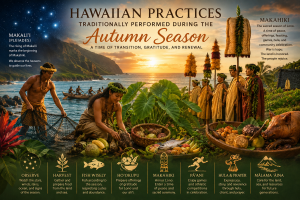
Hawaiian Practices Traditionally Performed During the Autumn Season From the Last Months of Kau to the Sacred Season of Makahiki | Victoria Generao, PhD

When people in Europe or North America speak of autumn, the imagination naturally turns toward falling leaves, shortening days, harvest fields, and preparations for winter. In Hawaiʻi, however, the seasonal story is different. The islands do not traditionally organize the year according to the familiar four-season cycle of spring, summer, autumn, and winter.

For Native Hawaiians, time was read through the movements of the heavens, the phases of the Moon, the appearance of stars, rainfall, winds, ocean conditions, the flowering and fruiting of plants, the migrations and spawning of fish, and countless other signs within the living environment.

Traditionally, the Hawaiian year was broadly understood through two great seasonal movements: Kau, the warmer and generally drier season, and Hoʻoilo, the cooler and wetter season. Historical Hawaiian accounts describe six lunar months belonging to each. The transition into Hoʻoilo occurred around what the Western calendar calls late autumn. (University of Hawaii)

Therefore, when we ask what Hawaiian people traditionally practiced during “autumn,” we are really asking about something more interesting:

What happened during the closing months of Kau, the preparation for Hoʻoilo, and the approach and opening of Makahiki?

The answer reveals a season concerned with observation, harvesting, food preservation, redistribution, gratitude, ritual offering, peace, physical competition, communal celebration, and the renewal of the relationship between humanity, the ʻāina, the sea, the ancestors, and the akua.


Autumn in Hawaiʻi Was a Time of Transition

The Gregorian months of approximately September through November overlap several traditional lunar months, although the correspondence is never exact because the Hawaiian calendar follows lunar and environmental observations rather than fixed Gregorian dates.

Older Hawaiian calendrical traditions identify the latter portion of Kau with months such as Mahoe Hope and ʻIkuwā, followed by Welehu, which marks the transition toward Hoʻoilo. David Malo’s nineteenth-century account describes ʻIkuwā as the final month of Kau and Welehu as the first month of Hoʻoilo. (University of Hawaii at Hilo)

The University of Hawaiʻi’s Hawaiian lunar-calendar resources similarly present ʻIkuwā as a period of increasing rain, thunder, wind, environmental change, and preparation for Makahiki, while Welehu opens the wetter season. (University of Hawaii)

This transitional quality is important.

Traditional Hawaiian seasonal activity was not governed by a printed date announcing that “autumn has begun.” A knowledgeable observer watched the world.

The sky announced the season.

The ocean announced the season.

The plants announced the season.

The winds announced the season.

The behavior of animals announced the season.

And eventually, Makaliʻi—the Pleiades—announced one of the most sacred transitions of the year.


Watching the Heavens: The Rising of Makaliʻi

Among the most important autumn practices was simply one of the most profound: observation.

The night sky served as calendar, clock, navigational map, agricultural guide, and ceremonial indicator.

The star cluster known in Hawaiian as Makaliʻi, commonly identified with the Pleiades, became especially significant as the year approached the season of Makahiki.

According to the National Park Service, Makahiki traditionally began when Makaliʻi became visible rising on the eastern horizon after sunset, generally around late October or early November, although timing and practice varied between islands and communities. (National Park Service)

This was not casual stargazing.

It was kilo—careful observation of natural phenomena.

Celestial and environmental signs helped knowledgeable practitioners determine the resetting of the lunar and ritual calendar. At Puʻuhonua o Hōnaunau, the National Park Service describes Kau Makaliʻi as a period during which traditional practitioners observed astronomical and environmental signs associated with the annual cycle of ritual. (National Park Service)

The autumn sky therefore became a sacred text.

Instead of reading the changing season from a calendar hanging upon a wall, one could read it in the stars.


Harvesting and Preparing Food

The months immediately preceding Makahiki were closely connected with the harvesting and securing of resources.

Fishing, gathering, farming, drying, salting, and storing foods were not merely economic activities. They formed part of a sophisticated system in which human consumption was coordinated with ecological cycles.

Traditional Hawaiian lunar knowledge connected particular phases and months with appropriate times for planting, harvesting, fishing, resting gardens, and allowing marine resources to replenish. The University of Hawaiʻi’s Hawaiian Lunar Calendar emphasizes that generations of Hawaiians used lunar observation to guide both agricultural and fishing practices. (University of Hawaii)

During the later months before Makahiki, fishing activity could increase specifically so that fish might be harvested, prepared, and stored before the coming wet season and ceremonial period. (University of Hawaii)

Foods such as kalo (taro), ʻuala (sweet potato), fish, and other locally available foods were central to community subsistence. Pigs, cultivated crops, and crafted goods could later become part of Makahiki tribute and ceremonial offerings. (National Park Service)

Thus, the Hawaiian autumn harvest was not simply a moment of taking abundance from the earth.

It existed within a larger rhythm:

observe → cultivate → harvest → preserve → offer → redistribute → rest → begin again.


Fishing According to the Season

The sea was just as much a part of the seasonal calendar as the land.

Fish behavior, ocean temperature, tides, spawning cycles, currents, moon phases, winds, and rainfall were carefully observed. Certain species became plentiful during particular months, while other species might be protected or avoided.

The Hawaiian lunar-calendar tradition records periods when particular fish were spawning, when certain fisheries were especially productive, and when restrictions or kapu were placed or removed. Such practices demonstrate an intimate connection between subsistence and ecological observation. (University of Hawaii)

One recorded tradition associates ʻIkuwā and Welehu with changing fishing responsibilities, including women and children gathering or catching freshwater and nearshore resources such as ʻoʻopu, hinana, hīhīwai, and ʻōpae. (University of Hawaii)

These details should not necessarily be treated as universal rules practiced identically on every island. Hawaiian ecological practices were intensely place-based. What was appropriate in Kona might differ from what was appropriate on Molokaʻi, Oʻahu, Maui, or Kauaʻi.

That principle itself is deeply Hawaiian.

Knowledge belongs to place.


Preparing Hoʻokupu: Offerings of Gratitude and Obligation

As Makahiki approached, communities prepared hoʻokupu, ceremonial offerings presented in connection with Lono, the aliʻi, and the ritual obligations of the season.

Historical descriptions of Makahiki offerings include valuable foods and goods such as:

  • puaʻa — pigs
  • kalo — taro
  • ʻuala — sweet potatoes
  • hulu — feathers
  • moena — woven mats
  • kapa — bark cloth

(National Park Service)

These offerings represented more than what a modern person might call taxation.

They participated in a ritual economy.

The productivity of the land was acknowledged. The relationship between people, aliʻi, land, and divine powers was reaffirmed. The abundance generated within an ahupuaʻa became visible through what it could ceremonially present.

The University of Hawaiʻi’s Kahoʻiwai resource describes ʻAha Makahiki as involving offerings of food harvested from the various lands, presented in honor of Lono. (University of Hawaii)

The act of giving therefore became one of the great spiritual gestures of the season.

One received from the ʻāina.

One returned something to the sacred order.


The Beginning of Makahiki

The defining traditional observance overlapping the later part of what Western calendars call autumn was, of course, Makahiki.

Makahiki was a major ceremonial season associated particularly with Lono, an akua closely connected with rain, agriculture, fertility, atmospheric forces, peace, and abundance.

Depending upon island and period, customs differed. The surviving written record is especially rich for Hawaiʻi Island, and modern summaries should therefore avoid assuming that every community practiced precisely the same rites. The National Park Service explicitly notes that individual islands had their own ways of observing Makahiki. (National Park Service)

Yet several broad themes recur.

Makahiki represented a shift away from ordinary political and productive activity toward ceremony, renewal, tribute, recreation, and peace.

War became kapu.

Labor patterns changed.

Offerings were gathered.

Lono was honored.

Communities feasted.

Athletic competitions were held.

Hula and celebration accompanied the sacred season.

For a time, the rhythm of society itself changed. (National Park Service)


The Procession of Lono

One of Makahiki’s most dramatic ceremonies involved an image or emblem of Lono known as the Akua Loa.

According to traditions documented by the National Park Service, the Akua Loa traveled through districts in a ritual circuit, visiting the lands and receiving offerings. A related form called the Akua Poko also participated in the ritual complex. (National Park Service)

At Puʻuhonua o Hōnaunau, this circuit is described as something like a ritual survey of the wealth and productivity of the land. (National Park Service)

Imagine the meaning of such a procession.

The god does not remain hidden within a distant temple.

The sacred presence moves through the land.

The productivity of each district is encountered.

Offerings are presented.

Human communities publicly acknowledge their dependence upon forces greater than themselves.

The sacred travels through the inhabited world.

This is one reason Makahiki should not be reduced simply to “the Hawaiian Thanksgiving.”

Gratitude and harvest are certainly present, but Makahiki is considerably larger: it is a political, ecological, agricultural, religious, social, and cosmic season of renewal.


A Time of Peace

Among the most striking features of Makahiki was the suspension of warfare.

During the season dedicated to Lono, war was traditionally prohibited. (National Park Service)

Symbolically, this represents one of the most powerful transitions of the Hawaiian ceremonial year.

Weapons that might otherwise defend territory or advance political power were temporarily subordinated to another principle.

The community entered a sacred interval.

One might call it an annual rebalancing between human ambition and cosmic order.

The season declared, in effect:

There must be times for striving.

There must also be times for peace.

There must be times to cultivate.

There must also be times to enjoy what has been cultivated.

There must be times to compete for power.

There must also be times to remember that all power ultimately depends upon land, rain, ocean, community, and the unseen forces sustaining life.


Feasting and Communal Celebration

Once appropriate ritual restrictions were lifted, feasting became an important part of Makahiki observance.

The ʻAha Makahiki tradition preserved in University of Hawaiʻi cultural resources describes the ceremonial acceptance of offerings, after which the period of enjoyment could begin with feasting and games. (University of Hawaii)

Eating together had social significance.

Food demonstrated the prosperity of the land.

It expressed hospitality.

It strengthened relationships.

It redistributed abundance.

It also transformed the results of months of agricultural and fishing labor into communal experience.

Harvest became feast.

Work became celebration.

Abundance became relationship.


Pāʻani Makahiki: The Games of the Season

Autumn’s movement into Makahiki also brought one of the most joyful dimensions of Hawaiian ceremonial culture: pāʻani, games and athletic contests.

Traditional Makahiki competitions could include activities such as:

ʻUlu maika — rolling a shaped stone between stakes, sometimes compared loosely with bowling.

Mokomoko — boxing.

Hakoko — wrestling.

ʻŌʻō ihe — spear or javelin throwing.

Kūkini — foot racing.

Other traditions included surfing, sledding, canoe racing, and various contests of physical ability. (University of Hawaii)

These were not merely diversions.

Athletic skill demonstrated discipline, balance, endurance, courage, coordination, and bodily intelligence.

In this sense, Makahiki celebrated the prosperity not only of the land but of the human body.

A healthy community required strong land.

Strong land nourished strong people.

Strong people could then celebrate the abundance of the land.

The relationship was reciprocal.


Hula, Prayer, and Sacred Celebration

Makahiki festivities also included hula, prayer, religious ceremony, and communal celebration. (University of Hawaii)

Hula in traditional Hawaiian culture cannot be reduced simply to entertainment.

It can carry genealogy, history, prayer, praise, memory, environmental knowledge, and spiritual relationship.

Within a sacred seasonal setting, chant and movement help join the visible community with the invisible dimensions of memory and divine presence.

Thus, during this season, celebration itself could become an act of reverence.

Joy and holiness did not have to be opposites.

They could be expressions of the same sacred abundance.


Hōʻihi: Entering Sacred Places With Reverence

Another important principle connected with Makahiki observance is hōʻihi—reverence, respect, and dignified conduct.

At Puʻuhonua o Hōnaunau, contemporary cultural practitioners continue to present hoʻokupu during Makahiki ceremonies, and the National Park Service describes hōʻihi as the attitude with which sacred places and ceremonial actions are approached.

This principle gives us a deeper way of understanding Hawaiian seasonal spirituality.

The important question was not simply:

“What ritual should I perform?”

It was also:

“How should I stand in relationship with this place?”

Sacredness required appropriate behavior.

The land was not scenery.

The ocean was not merely a resource.

The heavens were not merely astronomical objects.

The season itself was not merely weather.

Each participated in relationship.


Mālama ʻĀina: Caring for What Sustains Life

Although the expression mālama ʻāina is used widely today, the underlying principle of reciprocal care is clearly reflected in traditional Hawaiian resource management.

The lunar calendar demonstrates a system in which people observed when to fish, when to harvest, when to plant, and when certain resources should be left alone. (University of Hawaii)

This is a profoundly different attitude from extracting as much as possible whenever an opportunity arises.

The traditional ecological question was often closer to:

What is the appropriate action at this particular time?

The answer changed according to the Moon.

It changed according to rain.

It changed according to spawning cycles.

It changed according to currents.

It changed according to place.

It changed according to season.

What modern people call sustainability was embedded within a broader discipline of attention and reciprocity.


Autumn as a Spiritual Threshold

Seen through Hawaiian seasonal consciousness, the autumn months represent a threshold.

The dry season approaches its conclusion.

The Sun moves southward.

Rain increases.

The winds change.

The sea changes.

Foods are harvested and preserved.

Makaliʻi returns to prominence in the evening sky.

Makahiki approaches.

Lono returns ceremonially.

Offerings are made.

War falls silent.

Work gives way, at least temporarily, to rest.

Games replace battle.

Feasting replaces accumulation.

The community pauses within the turning of the year.

And this may be the deepest spiritual teaching of the Hawaiian autumn:

A people cannot live only by producing.

There must also be a time for acknowledging.

A time for giving.

A time for remembering.

A time for observing.

A time for peace.

A time for celebration.

And a time for recognizing that human prosperity exists only because human life participates within a much greater living system.


The Spiritual Meaning of the Hawaiian Autumn

For a modern spiritual practitioner, the greatest lesson of this season may not be to imitate ceremonies belonging to Native Hawaiian cultural lineages without proper understanding or relationship.

The deeper invitation is to learn from their underlying wisdom.

Observe before acting.

Know the land upon which you stand.

Understand what the season is actually doing.

Give something back when you receive.

Allow periods of restraint to accompany periods of abundance.

Honor those who came before.

Cultivate peace deliberately.

Recognize that food is sacred because life produced it.

Understand that celebration can itself become prayer.

And remember that the natural world is not merely happening around us.

We are happening within it.

Makahiki expresses this beautifully.

Humanity pauses long enough to recognize the powers that sustain it.

The rain.

The soil.

The cultivated field.

The ocean.

The Moon.

The stars.

The ancestors.

The akua.

The community.

All are woven together.


Autumn in Hawaiʻi: Not a Season of Falling Leaves, but of Returning Relationship

The Hawaiian autumn is therefore best understood not as a tropical version of a European harvest festival, but as the closing movement of one seasonal cycle and the opening of another.

It is a time of kilo, careful observation.

A time of harvesting and preserving.

A time of responsible fishing and agricultural management.

A time of preparing hoʻokupu.

A time of watching for Makaliʻi.

A time of entering Hoʻoilo.

And ultimately, a time of Makahiki—of Lono, peace, feasting, games, hula, prayer, gratitude, redistribution, and renewal.

The leaves may not turn crimson and gold across Hawaiʻi as they do in temperate forests.

But the season nevertheless changes.

The heavens change.

The rains change.

The waters change.

Human responsibilities change.

And within those changes is an ancient lesson:

To know the season is to know when to work, when to gather, when to give, when to refrain—and when to celebrate the sacred abundance of life.


Annotated Bibliography

Hawaiian Practices Traditionally Performed During the Autumn Season

Research Note

The concept of “autumn” should be used cautiously when discussing traditional Hawaiian culture. The Hawaiian calendar was not historically divided into the four temperate seasons of spring, summer, autumn, and winter. Rather, Hawaiian communities followed lunar months, celestial observations, rainfall, winds, ocean conditions, agricultural cycles, and broader seasonal divisions such as Kau and Hoʻoilo. The Western autumn months overlap especially with ʻIkuwā, Welehu, and the opening of the Makahiki season. The sources below are therefore selected for their usefulness in understanding Makahiki, Lono, Makaliʻi, lunar calendrics, agriculture, fishing, hoʻokupu, seasonal games, environmental observation, and Hawaiian relationships with ʻāina.

1. Malo, David. Hawaiian Antiquities (Moolelo Hawaii). Translated by Nathaniel B. Emerson. Honolulu: Bishop Museum Press, 1951.

David Malo’s Hawaiian Antiquities is one of the foundational sources for the study of traditional Hawaiian society. Malo (c. 1795–1853) was a Native Hawaiian historian and scholar whose knowledge came from a period when substantial elements of the older religious and social systems remained within living memory. The work discusses Hawaiian social organization, gods, religious observances, calendrical concepts, agriculture, fishing, government, kapu, and ceremonies. A 1951 Bishop Museum edition is widely cited, while the English translation had appeared much earlier. (Department of Hawaiian Home Lands)

Relevance to this topic: Malo is particularly valuable for establishing that Hawaiian seasonal reckoning cannot simply be mapped onto the European four-season calendar. His descriptions help situate Makahiki within the broader annual religious and social cycle.

Research value: ★★★★★ — Essential historical source.

2. Kamakau, Samuel Mānaiakalani. Ruling Chiefs of Hawaii. Rev. ed. Honolulu: Kamehameha Schools Press, 1992.

Samuel Mānaiakalani Kamakau (1815–1876) was one of the most important nineteenth-century Native Hawaiian historians. Much of his historical work originally appeared in Hawaiian-language newspapers before being collected and translated. Ruling Chiefs of Hawaii records political history, chiefly institutions, ceremonial practices, religion, warfare, and social organization. The revised 1992 edition includes additional editorial and reference material. (WorldCat)

Relevance to this topic: Makahiki was not only an agricultural observance but also part of the political and chiefly order. Kamakau provides crucial background for understanding the relationship among aliʻi, makaʻāinana, tribute, religious authority, warfare, and ceremonial cycles.

Research value: ★★★★★ — Especially important for the political and historical dimensions of Makahiki.

3. Kamakau, Samuel Mānaiakalani. Ka Poʻe Kahiko: The People of Old. Translated by Mary Kawena Pukui. Arranged and edited by Dorothy B. Barrère. Honolulu: Bishop Museum Press, 1964; later reprints.

This volume gathers Kamakau’s Hawaiian-language writings concerning the lives, beliefs, practices, and social organization of earlier generations of Hawaiians. Bishop Museum describes the work as documenting fundamental principles underlying everyday Hawaiian life, with particular attention to spiritual and religious dimensions. (Bishop Museum Press)

Relevance to this topic: The volume provides cultural context for interpreting activities such as prayer, offerings, kapu, work, communal responsibilities, and relationships with supernatural powers. It helps prevent Makahiki from being treated merely as a harvest festival divorced from the religious worldview within which it operated.

Research value: ★★★★★ — Strong Native Hawaiian historical foundation.

4. “Ka Hoomana Kahiko. Helu 30 / Old Worship. Number 30.” Ka Nupepa Kuokoa, December 9, 1865. IHLRT Hawaiian Newspaper Archive, University of Hawaiʻi at Mānoa.

This Hawaiian-language newspaper article is an especially significant primary historical source. It describes a Makahiki manifestation of Lono, including the ceremonial image carried from place to place, its movement between lands, sacred restrictions surrounding it, and the presentation of pigs, food, and other hoʻokupu by commoners and chiefs. The University of Hawaiʻi archive provides both transcription and English translation. (University of Hawaii at Manoa)

Relevance to this topic: This source directly supports descriptions of the procession of Lono and the gathering of ceremonial offerings during Makahiki.

Research value: ★★★★★ — One of the strongest primary sources for Makahiki ritual.

5. Handy, E. S. Craighill, and Elizabeth Green Handy, with Mary Kawena Pukui. Native Planters in Old Hawaii: Their Life, Lore, and Environment. Honolulu: Bishop Museum Press, 1972.

This substantial ethnographic work examines Hawaiian agriculture, land use, irrigation, cultivated plants, environmental adaptation, mythology, rituals, and agricultural knowledge. Bishop Museum notes that the work arose from extensive research and collaboration with Hawaiian cultural authority Mary Kawena Pukui. A major portion of the study also addresses the Makahiki harvest festival. (Bishop Museum Press)

Relevance to this topic: This is perhaps the single most useful secondary reference for explaining the connection among harvest, agriculture, land productivity, religious observance, and Makahiki. It also demonstrates how agricultural practices differed according to local environments across the islands.

Research value: ★★★★★ — Essential for agriculture, harvest, and land-based seasonal practices.

6. Abbott, Isabella Aiona. Lāʻau Hawaiʻi: Traditional Hawaiian Uses of Plants. Honolulu: Bishop Museum Press, 1992.

Renowned Hawaiian ethnobotanist Isabella Aiona Abbott assembled this study of traditional Hawaiian relationships with plants. It addresses food, medicine, clothing, shelter, cordage, religion, recreation, cultivated crops, aquatic plant foods, kalo, ʻuala, hula, and other forms of plant knowledge. Bishop Museum describes it as a broad account connecting Hawaiian flora directly with Hawaiian cultural practice. (Google Books)

Relevance to this topic: Abbott’s work provides botanical and cultural depth for discussions of harvest foods, cultivated plants, offerings, lei and ritual plant materials, and the relationship between seasonal abundance and Hawaiian religious life.

Research value: ★★★★☆ — Excellent ethnobotanical companion to Native Planters in Old Hawaii.

7. Kanahele, Pualani Kanakaʻole. Ka Honua Ola: ʻEliʻeli Kau Mai—The Living Earth: Descend, Deepen the Revelation. Honolulu: Kamehameha Publishing, 2011.

Cultural scholar and practitioner Pualani Kanakaʻole Kanahele explores Hawaiian relationships with the living earth through twenty-five mele associated with Pele and Hiʻiaka. The work draws together genealogy, land, divine presence, hula, ancestral memory, and environmental relationships. (Kamehameha Publishing)

Relevance to this topic: Although not a manual of Makahiki ritual, this work provides a valuable Hawaiian-centered philosophical foundation for understanding why ʻāina, weather, growth, water, genealogy, human activity, and divine powers cannot easily be separated in traditional Hawaiian thought.

It is especially useful when discussing the deeper spiritual meaning of seasonal observance without reducing Hawaiian ecological knowledge to modern environmental terminology alone.

Research value: ★★★★☆ — Excellent for Hawaiian metaphysics, sacred ecology, and worldview.

8. University of Hawaiʻi. “Hawaiian Lunar Calendar.” Hawaiʻi Climate Data Portal.

This University of Hawaiʻi resource presents the Hawaiian lunar calendar as an environmental knowledge system developed through generations of observation. It explains how lunar phases were used alongside the observation of organisms, weather, marine conditions, agriculture, and fishing to determine appropriate periods for resource use and rest. (University of Hawaii)

Of particular importance to the autumn topic are its descriptions of the lunar months Mahoe Hope, ʻIkuwā, and Welehu. The resource notes that fishing effort could increase before Makahiki in order to prepare and store food, while ʻIkuwā brought rain, thunder, wind, and preparations for Makahiki. It also connects the season with the rising of Makaliʻi. (University of Hawaii)

Relevance to this topic: This is one of the strongest accessible sources for explaining why a Hawaiian discussion of “autumn” must be based on lunar months and ecological indicators rather than simply September, October, and November.

Research value: ★★★★★ — Essential for the seasonal framework of the blog.

9. University of Hawaiʻi. “ʻAha Makahiki.” Kahoʻiwai.

This cultural knowledge resource describes ʻAha Makahiki as ceremony associated with the coming of Lono and the rainy season. It discusses the movement of Lono through the ahupuaʻa, the gathering of harvested food offerings, the lifting of kapu, feasting, and traditional games including mokomoko, ʻulu maika, ʻōʻō ihe, kōnane, kūkini, and related activities. (University of Hawaii)

Importantly, the resource cites major Hawaiian cultural references such as Native Planters in Old Hawaii, helping connect contemporary Hawaiian educational interpretation with established historical scholarship.

Relevance to this topic: Excellent support for sections concerning hoʻokupu, Lono, feasting, games, prayer, agriculture, and ceremonial procession.

Research value: ★★★★★ — Particularly useful for a public-facing blog.

10. National Park Service. “Makahiki.” Haleakalā National Park.

The National Park Service’s Makahiki overview provides a concise account of the ceremonial season associated with Lono. It identifies the appearance of Makaliʻi near the eastern horizon after sunset as a traditional indicator of the beginning of Makahiki and describes the season as involving rest, religious festivities, feasting, games, dancing, offerings, and the prohibition of warfare. (National Park Service)

The page also identifies traditional offerings including pigs, kalo, ʻuala, feathers, mats, and kapa and describes the Akua Loa procession connected with Lono. Importantly, it cautions that individual Hawaiian islands possessed their own forms of Makahiki observance and that much surviving documentation relates particularly to Hawaiʻi Island. (National Park Service)

Relevance to this topic: An excellent source for establishing the basic structure of Makahiki while retaining the important warning against presenting one island’s customs as universally Hawaiian.

Research value: ★★★★★ — Highly useful synthesis for general readers.

11. National Park Service. “Kau Makaliʻi—Season of the Makahiki Ritual.” Puʻuhonua o Hōnaunau National Historical Park.

This resource provides one of the clearest contemporary cultural explanations of Kau Makaliʻi, connecting celestial observation, environmental phenomena, Hawaiian lunar reckoning, Lono, games, agricultural abundance, and seasonal renewal. It identifies ʻIkuwā, Welehu, and Makaliʻi as lunar months associated with this ritual period and places them approximately between November and January. (National Park Service)

The page also explains that the Akua Loa traveled through the moku as part of a ritualized assessment of the productivity and wealth of the land. It emphasizes renewal and the maintenance of balance among people, land, water, and natural resources. (National Park Service)

Relevance to this topic: Particularly important for the blog’s themes of kilo, celestial observation, Makaliʻi, seasonal transition, Lono, ritual procession, environmental productivity, and renewal.

Research value: ★★★★★ — One of the best modern interpretive sources for the subject.

12. National Park Service. “Kau Makahiki.” Video presentation by Kahakaiʻo Ravenscraft. Puʻuhonua o Hōnaunau National Historical Park, November 5, 2021.

In this cultural presentation, Park Ranger and cultural demonstrator Kahakaiʻo Ravenscraft discusses the changing Hawaiian seasons and their relationship with management of the ahupuaʻa. The presentation emphasizes that Makahiki also involved assessments of ʻāina, land productivity, population, and distribution of resources. (National Park Service)

Relevance to this topic: This source adds an important dimension sometimes absent from popular descriptions: Makahiki was simultaneously religious, ecological, economic, social, and political. Seasonal observance helped communities evaluate the actual productivity and condition of their lands.

Research value: ★★★★☆ — Excellent supplemental cultural interpretation.

Additional Contemporary Resource

University of Hawaiʻi. “Makahiki Column.” Ka Huli Ao Center for Excellence in Native Hawaiian Law, William S. Richardson School of Law.

This short interpretive article connects the rising of Nā Huihui o Makaliʻi, the Pleiades, with the traditional Makahiki season and describes Makahiki as a time associated with harvest, rest, spiritual renewal, and thanksgiving. (University of Hawaii at Manoa)

Relevance to this topic: Helpful for discussing the continued importance of Makahiki within contemporary Native Hawaiian institutions.

Research value: ★★★☆☆ — Useful supplemental reading rather than a primary historical authority.

Recommended Research Hierarchy

For the strongest historical treatment of Hawaiian autumnal practices, the sources should not all be weighted equally.

The most authoritative foundation should begin with Native Hawaiian historical voices, particularly David Malo and Samuel Mānaiakalani Kamakau. The nineteenth-century Hawaiian-language newspaper material preserved through the University of Hawaiʻi should likewise receive special attention because it brings the researcher close to Hawaiian-language accounts created during a period when knowledge of the older traditions remained comparatively immediate.

For agriculture and subsistence, Handy, Handy, and Pukui’s Native Planters in Old Hawaii should be a principal reference, supplemented by Isabella Abbott’s Lāʻau Hawaiʻi.

For understanding how the lunar and environmental calendar functioned, the University of Hawaiʻi Hawaiian Lunar Calendar is particularly valuable.

For contemporary Hawaiian interpretation and the continued cultural life of Makahiki, the resources from Kahoʻiwai, Puʻuhonua o Hōnaunau National Historical Park, and Hawaiian cultural practitioners are especially useful.

Taken together, these sources reveal that what we call the Hawaiian “autumn season” was not simply a harvest period. It represented a complex transition involving:

kilo — careful observation;

mahina — lunar reckoning;

Makaliʻi — celestial seasonal indication;

mahiai — cultivation and harvest;

lawaiʻa — fishing according to ecological cycles;

hoʻokupu — ceremonial giving;

Lono — rain, fertility, abundance, and Makahiki;

kapu — sacred regulation and restraint;

pāʻani — games and athletic competition;

ʻahaʻaina — feasting and communal sharing;

maluhia — a sacred interval of peace;

and mālama ʻāina — the continuing responsibility to care for the lands and waters that sustain human life.

The resulting picture is therefore much richer than a Hawaiian equivalent of a Western harvest festival. Kau Makaliʻi and Makahiki reveal an entire system of seasonal consciousness in which astronomy, ecology, religion, governance, agriculture, community, and spiritual renewal converge.
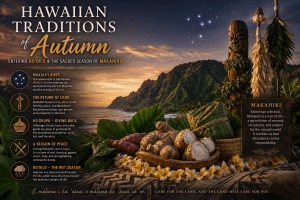
 

Hawaiian Traditions of Autumn | Entering Hoʻoilo and the Sacred Season of Makahiki | Victoria Generao, PhD

When autumn arrives in much of the Northern Hemisphere, the familiar imagery is of falling leaves, lengthening nights, harvest fields, and the gradual descent toward winter. Hawaiʻi experiences this turning of the year differently. There is no broad landscape of forests changing from green to gold, nor did traditional Hawaiian culture divide the year according to the familiar European pattern of spring, summer, autumn, and winter.

Instead, the Hawaiian seasonal worldview arose from careful observation of rain, wind, ocean, stars, plants, animals, lunar cycles, and the productivity of the ʻāina.

Thus, to ask what Hawaiian traditions belong to autumn is to enter a very different understanding of sacred time.

The months that roughly correspond to September through November form a threshold. The hotter and generally drier portion of the year begins yielding to Hoʻoilo, the wetter, cooler season. The winds change. Rains become increasingly significant. Ocean conditions shift. The lunar calendar moves onward. And eventually the star cluster Makaliʻi—the Pleiades—appears in the evening sky, announcing one of the most important ceremonial periods of old Hawaiʻi:

Makahiki.

Rather than a Hawaiian equivalent of a European autumn festival such as Mabon, Makahiki represents an indigenous seasonal system of its own—one concerned with renewal, abundance, peace, reciprocity, agricultural fertility, community, and the relationship between human beings, the gods, and the living land.


Hawaiʻi’s Year Was Read from Nature

Traditional Hawaiian timekeeping was ecological as much as chronological.

Rather than looking only at numbered dates on a fixed calendar, Hawaiian communities observed the relationships between the mahina, or Moon; the Sun; stars; rainfall; winds; tides; spawning cycles; plant growth; agricultural conditions; and fishing opportunities.

The traditional year is commonly described as having two broad seasons:

Kau or Kauwela — the warmer, generally drier season

and

Hoʻoilo — the cooler, wetter season.

University of Hawaiʻi sources describe Hoʻoilo as encompassing the wetter half of the year, while Hawaiian resource-management calendars connect specific lunar months with environmental conditions and appropriate agricultural and fishing activities. (University of Hawaii at Hilo)

This is important because Hawaiian seasonal spirituality cannot easily be separated from Hawaiian environmental knowledge.

The sacred calendar was written across the landscape.

Rain was part of the calendar.

Fish were part of the calendar.

The flowering and fruiting of plants were part of the calendar.

The movements of stars were part of the calendar.

The Moon was part of the calendar.

The human community lived within that greater clock.


The Hawaiian “Autumn” as a Threshold

The period Western calendars call autumn roughly overlaps the latter portion of the dry season and the transition into Hoʻoilo.

Individual Hawaiian month names and their alignment with Gregorian months could vary according to island and tradition; Hawaiian-language historical sources themselves preserve such regional differences. (Bishop Museum Blog)

For that reason, it is better not to imagine a universally fixed ancient Hawaiian calendar mapped neatly over September, October, and November.

Nevertheless, an important pattern emerges.

As the year moves toward ʻIkuwā and Welehu, environmental conditions begin changing. Hawaiian lunar-calendar sources associate ʻIkuwā with increasing rain, thunder, lightning, wind, and preparation for Makahiki. (University of Hawaii)

The season therefore carries something recognizable to many traditional cultures:

a sense of completion and transition.

The productive cycle has reached a turning point.

What has grown is acknowledged.

What has been received must be reciprocated.

The community prepares itself for another phase in its relationship with the land.


Makaliʻi: The Stars Announce the Sacred Season

Perhaps the most beautiful symbol of this transition is Makaliʻi, the Hawaiian name for the Pleiades.

The appearance of Makaliʻi in the eastern evening sky served as an important celestial sign connected with the beginning of Makahiki.

The National Park Service describes the traditional festival as beginning when Makaliʻi rises over Hawaiʻi around sunset, generally around late October or early November, although the precise reckoning depended upon traditional observation rather than an arbitrary Gregorian date. (National Park Service)

This gives Hawaiian autumn a celestial character.

Imagine standing beneath the Hawaiian night sky.

The heat of the dry season has begun to loosen its hold.

Clouds gather differently.

The smell of approaching rain moves across the land.

Then the small cluster of stars appears.

Makaliʻi has returned.

To those trained to read the heavens, this is not merely astronomy.

It is announcement.

The heavens and the ʻāina are speaking together.

A new sacred season is beginning.


Makahiki: The Great Season of Lono

At the center of this seasonal transition stands Lono, one of the principal akua of Hawaiian religious tradition.

Lono is strongly associated with rain, agricultural fertility, abundance, peace, music, and cultivated food. Hawaiian traditions connected his return with the rains of Hoʻoilo and the Makahiki season. (National Park Service)

Makahiki traditionally lasted for several lunar months.

During this period, the ordinary rhythms of society changed.

Certain forms of labor were restricted.

Warfare was prohibited.

Ceremonial processions occurred.

Offerings were made.

Athletic competitions were held.

People feasted.

Communities rested and celebrated.

Religious observances acknowledged the powers responsible for sustaining life.

It was therefore simultaneously an agricultural festival, religious cycle, political institution, period of recreation, and renewal of the reciprocal relationship between people and the sacred powers governing the land.


The Coming of Lono

One of the striking features of traditional Makahiki was the ceremonial movement of an image representing Lono through the districts of the island.

An important form was the akua loa, a tall ceremonial standard associated with Lono.

Accounts describe priests carrying the image through different ahupuaʻa, the traditional land divisions extending through ecological zones from uplands toward the sea.

The movement was therefore more than a procession.

It was, symbolically, a visitation.

Lono moved through the land.

At each place the relationship between land, people, ruler, and deity was recognized.

The National Park Service describes the akua loa traveling through districts in what functioned as a ritual survey of the land’s wealth and productivity. (National Park Service)

One might almost imagine the entire island becoming ceremonial ground.

Mountain.

Field.

Village.

Fishpond.

Shore.

Each existed within the same sacred ecology.


Hoʻokupu: Giving Back from What Has Been Given

Central to Makahiki was the practice of hoʻokupu, or offerings.

Communities presented agricultural and material goods associated with the productivity of their lands.

Traditional offerings could include:

  • kalo, or taro;
  • ʻuala, or sweet potato;
  • puaʻa, or pigs;
  • kapa;
  • woven mats;
  • feathers;
  • and other products representing the abundance and craftsmanship of the community.

These offerings were connected both with religious devotion and with the political economy of chiefly society. (National Park Service)

Yet hoʻokupu carries an idea larger than simply paying tribute.

It embodies reciprocity.

The land gives.

The rains give.

Plants give.

The ocean gives.

The gods give.

Human beings therefore do not merely consume.

They return something.

This principle remains one of the most profound lessons that Makahiki can offer a modern reader.

Gratitude is incomplete when it remains only an emotion.

Gratitude becomes sacred when it becomes reciprocal action.


A Season in Which War Became Kapu

One of the most extraordinary characteristics associated with Makahiki was the restriction of warfare.

The season belonged to Lono and to renewal.

Military activities associated especially with the domain of Kū gave way to another sacred rhythm.

War became kapu.

The National Park Service describes ancient Makahiki as a period of rest, feasting, games, dancing, religious observance, and suspended warfare. (National Park Service)

This ceremonial interruption is deeply significant.

Society was being reminded that life could not consist perpetually of acquisition, conflict, expansion, labor, and conquest.

There must also be a season of restoration.

A time when the hand releases the weapon.

A time when productivity yields to gratitude.

A time when the community remembers that continued life depends upon relationships more fundamental than political struggle.

In that sense, the coming of Lono represented not weakness but balance.


Makahiki Games: Strength Expressed without War

The suspension of warfare did not mean inactivity.

Makahiki was famous for physical contests and games.

Historical descriptions include such activities as:

ʻulu maika — rolling a specially shaped stone between markers;

mokomoko — boxing;

hakoko — wrestling;

ʻōʻō ihe — spear or javelin throwing;

as well as sledding, surfing, canoe racing, and other demonstrations of physical skill.

Hula, feasting, and communal celebration accompanied the season as well. (National Park Service)

There is a fascinating transformation occurring here.

Competitive energy does not disappear.

It is redirected.

Instead of proving strength through warfare, people demonstrate strength through skill, discipline, endurance, coordination, play, and ceremony.

The warrior impulse becomes the athletic impulse.

Competition becomes festivity.

Power is allowed expression without requiring destruction.


Rain as Blessing

For cultures accustomed to temperate climates, rain during autumn may signify inconvenience or approaching cold.

Within the Hawaiian agricultural world, rain could carry a much more intimate spiritual significance.

Lono was associated with rain and agricultural fertility.

As the land entered Hoʻoilo, the arrival of wetter weather belonged to a great ecological cycle upon which food production depended.

The clouds gathering over the mountains were therefore not separate from spirituality.

Water falling upon ʻāina was life moving visibly through creation.

The Hawaiian word wai, water, appears in concepts associated with prosperity and abundance; freshwater was—and remains—fundamental to the productivity and health of the land.

The autumn threshold therefore invites attention upward toward the clouds and downward toward the soil simultaneously.

The heavens fertilize the earth.

The earth responds.

Humanity receives.

And humanity is consequently obligated to mālama—to care for what sustains life.


Preparing for the Wet Season

The approach of Makahiki was not concerned solely with ceremony.

Traditional Hawaiian environmental knowledge also involved careful preparation.

The University of Hawaiʻi’s Hawaiian lunar-calendar resource records that during the period preceding Makahiki, fishing activity could increase so that fish might be harvested and stored before the wetter season. It also describes changing fishing responsibilities and environmental conditions during ʻIkuwā and Welehu. (University of Hawaii)

Seasonal awareness therefore required prudence.

Sacred observance and practical survival were not opposites.

Knowing when to fish was spiritual knowledge.

Knowing when to plant was spiritual knowledge.

Knowing when storms might arrive was spiritual knowledge.

Knowing when not to harvest was spiritual knowledge.

Knowing when the land required rest was spiritual knowledge.

The sacred existed within competent relationship with place.


Rest Was Part of the Cycle

There is an old Hawaiian saying associated with Welehu recorded in Mary Kawena Pukui’s ʻŌlelo Noʻeau and discussed by Bishop Museum:

“Rest the head on the pillow; Welehu is the month.” (Bishop Museum Blog)

The statement is remarkably simple.

Yet behind it lies an entire philosophy of seasonal life.

There are times for work.

Times for fishing.

Times for planting.

Times for harvest.

And there are times for rest.

Modern culture often treats rest as the absence of productivity.

Traditional seasonal cultures frequently understood something different:

rest is one of the conditions that makes future productivity possible.

Land requires intervals.

Bodies require intervals.

Communities require intervals.

Even ritual calendars breathe.

Makahiki creates such a breathing space.


There Was No Hawaiian “Mabon”

For modern practitioners familiar with the Western esoteric or contemporary Pagan Wheel of the Year, an important distinction should be maintained.

There is no need to rename Makahiki as a “Hawaiian Mabon.”

Nor should the autumnal equinox automatically be treated as though it were the central ancient Hawaiian autumn festival.

The two traditions arise from different geographies, histories, cosmologies, agricultural systems, and celestial observations.

Mabon, as practiced within modern Pagan traditions, is commonly centered upon the autumn equinox.

Traditional Hawaiian seasonal observance was embedded within a lunar and ecological calendar and prominently marked the emergence of Makaliʻi and the commencement of Makahiki.

Recognizing similarities—harvest, gratitude, seasonal transition, communal feasting—can be illuminating.

Collapsing the traditions into one another is not.

Each deserves to retain its own voice.


The Deeper Spiritual Pattern

Seen through a contemplative lens, the Hawaiian autumn threshold presents several intertwined movements.

Observation.

Before people act, they watch.

They watch the Moon.

They watch the stars.

They watch the sea.

They watch the clouds.

They watch the crops.

The spiritual life begins in attention.

Then comes:

Recognition.

Something greater than the individual sustains life.

No farmer creates rain.

No fisherman commands the sea.

No chief causes the stars to rise.

Life exists inside relationships.

Then comes:

Gratitude.

Abundance is acknowledged.

But gratitude becomes meaningful through:

Reciprocity.

Hoʻokupu is given.

Resources are respected.

Relationships are renewed.

Then comes:

Restraint.

War ceases.

Ordinary activity changes.

The culture enters sacred time.

And finally:

Renewal.

Games are played.

People feast.

Bodies rest.

Communities reconnect.

The land receives rain.

Another cycle begins.


A Hawaiian Theology of Relationship

One of the most powerful ideas that emerges from these traditions is that humanity does not stand outside nature observing it.

Human beings participate within a larger network of relationships involving akua, ʻāina, wai, kai, plants, animals, ancestors, family, and community.

This makes seasonal consciousness fundamentally relational.

The question is not simply:

“What can I harvest?”

The deeper question becomes:

“What relationship made this harvest possible?”

And after that:

“What is my responsibility to that relationship?”

Such questions move beyond seasonal celebration into ethics.

If ʻāina feeds us, how do we care for ʻāina?

If water sustains us, how do we protect water?

If ancestors carried knowledge forward, how do we honor that knowledge?

If community sustains the individual, what does the individual return to community?

Makahiki answers through reciprocity.


Makahiki Today

Makahiki did not remain unchanged through Hawaiian history. Colonial transformation, suppression and displacement of Hawaiian religious institutions, and enormous political and social changes disrupted many traditional practices.

Yet Makahiki did not vanish.

The Hawaiian cultural renaissance of the twentieth century contributed strongly to its revitalization, and Makahiki observances are again found in Hawaiian communities, cultural organizations, schools, and public educational programs. The National Park Service notes that contemporary cultural revival has helped restore the tradition since the 1980s. (National Park Service)

Traditional Hawaiian games are taught.

Makaliʻi is watched.

Lunar calendars are studied.

Hoʻokupu is offered.

Hawaiian environmental knowledge is being perpetuated.

Most importantly, Native Hawaiian cultural practitioners continue defining what living Hawaiian tradition means within their own communities.

Makahiki therefore should not be approached merely as an artifact of a vanished past.

It is part of a living cultural inheritance.


Observing the Season Respectfully Today

For someone wishing to honor the wisdom of the Hawaiian autumn season without claiming practices that do not belong to them, perhaps the most meaningful approach is remarkably simple.

Observe.

Go outside.

Look toward the night sky.

Learn to recognize Makaliʻi.

Notice the wind.

Observe what plants are flowering or fruiting.

Notice changes in rain.

Watch the Moon.

Learn the names of the places around you.

Learn where your water originates.

Discover the traditional watershed or ahupuaʻa in which you live.

Consider where your food comes from.

Offer something—not necessarily ceremonially, but concretely—in gratitude.

Care for land.

Feed someone.

Clean a shoreline.

Share food.

Support Hawaiian cultural organizations.

Learn ʻōlelo Hawaiʻi correctly.

Listen to Native Hawaiian practitioners speaking about their own traditions.

And perhaps most importantly, ask:

What has sustained me this year, and what am I returning in gratitude?

That question belongs comfortably beside Makahiki.


When Makaliʻi Rises

There is something profoundly beautiful about a culture allowing a cluster of stars to tell it when sacred time has arrived.

No clock rings.

No printed calendar announces the holy day.

The universe itself gives the sign.

Makaliʻi rises.

Rain approaches.

Lono returns.

Weapons are set aside.

Offerings are gathered.

Games begin.

Food is shared.

The land and people enter a period of renewal.

This is the great Hawaiian lesson of the autumn threshold:

abundance carries responsibility.

Harvest calls forth gratitude.

Gratitude requires reciprocity.

Strength must sometimes yield to peace.

Work must sometimes yield to rest.

And humanity must periodically remember that the world is not merely a collection of resources surrounding us.

It is a web of relationships sustaining us.

So as the days of late Kau move toward Hoʻoilo and the little stars of Makaliʻi appear again in the Hawaiian sky, the season seems to whisper an ancient instruction:

Look carefully at what has been given.

Give thanks.

Give something back.

Make peace where peace can be made.

Care for the source of your abundance.

And prepare yourself to enter another turning of the sacred year.


Sources Consulted

National Park Service, Haleakalā National Park, “Makahiki.” An accessible overview of Makahiki, Lono, hoʻokupu, the Makahiki procession, traditional games, ceremonial observances, and the modern revival of the festival. (National Park Service)

National Park Service, Puʻuhonua o Hōnaunau National Historical Park, “Kau Makaliʻi — Season of the Makahiki Ritual.” Particularly useful for understanding Makaliʻi, celestial observation, ritual time, and the movement of the akua loa through Hawaiian districts.

University of Hawaiʻi, Hawaiʻi Climate Data Portal, “Hawaiian Moon Calendar.” Provides information about Hoʻoilo and Kauwela, lunar months, fishing practices, environmental observations, and traditional natural-resource management. (University of Hawaii)

University of Hawaiʻi at Hilo, “Kaulana Mahina vs. Gregorian Calendar.” Useful for understanding the broad division between Hoʻoilo and Kauwela and the relationship of Hawaiian lunar reckoning to seasonal activities. (University of Hawaii at Hilo)

Bishop Museum, Nūpepa / Traditional Knowledge resources. Preserves Hawaiian-language historical material concerning traditional month names, seasonal conditions, fishing, planting, rest, and regional variation in calendrical traditions. (Bishop Museum Blog)

University of Hawaiʻi Kawaihāpai, “ʻAha Makahiki.” Hawaiian-language cultural reference describing the rising of Makaliʻi, Lono, hoʻokupu, feasting, games, and Makahiki ceremonial practice. (University of Hawaii)

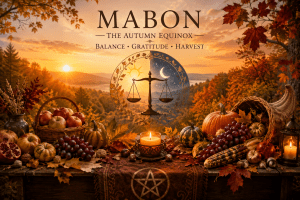
Mabon | The Autumn Equinox, the Harvest, and the Mystery of Balance | Victoria Generao, PhD

There comes a moment each year when summer loosens its hold upon the Earth.

The blazing fullness of the Sun begins to soften. Fields that only weeks before stood green and growing become gold, russet, amber, and brown. Fruit hangs heavily from branches. Grain bends upon its stalk. The air changes. Mornings become cooler, shadows grow longer, and evening seems to arrive a little sooner each day.

In the Northern Hemisphere, this threshold is marked astronomically by the September equinox, the point at which the Sun crosses the celestial equator as it journeys southward. It marks the beginning of astronomical autumn. Although the word equinox derives from the Latin for “equal night,” daylight and darkness are not literally identical in duration on the equinox because atmospheric refraction and the way sunrise and sunset are measured make daylight slightly longer. Symbolically, however, the image of light and darkness standing in equilibrium has become one of the defining themes of the season. (NOAA Satellites)

Within many contemporary Pagan traditions, this autumnal turning of the year is celebrated as Mabon.

Mabon is a festival of harvest, gratitude, balance, completion, preparation, and the recognition that every season of abundance must eventually give way to a season of rest.

Yet Mabon has an especially interesting history, because the festival as modern Pagans know it is both ancient in its seasonal symbolism and distinctly modern in its name.

Understanding that distinction does not diminish Mabon. In many ways, it makes the festival more fascinating.

The Harvest Before There Was “Mabon”

Long before the word Mabon was associated with the autumn equinox, agricultural peoples throughout Europe and elsewhere observed the harvest season with feasting, thanksgiving, offerings, communal labor, and preparation for winter.

For an agricultural society, harvest was not merely picturesque.

It was survival.

Grain stored in barns, fruit dried or preserved, livestock managed, seeds saved, and food successfully gathered determined whether a community could endure the approaching winter.

The harvest therefore carried both joy and solemnity.

There was gratitude because the Earth had provided.

There was relief because labor had produced its fruit.

But beneath that gratitude lay another awareness: winter was coming.

This combination of abundance and impermanence remains at the heart of Mabon today.

The laden harvest table contains within itself the memory of the empty field.

The ripe apple already carries its seeds.

The grain that is cut down becomes both bread and the promise of another planting.

Nature teaches a strange but beautiful truth at this season:

Fulfillment and ending often arrive together.

Is Mabon an Ancient Celtic Festival?

This is where historical precision becomes important.

It is common in popular books and websites to encounter statements suggesting that ancient Celts celebrated a festival called Mabon at the autumn equinox.

There is no good historical evidence for this.

The name Mabon, as a designation for the Pagan autumn equinox, is a product of the modern Pagan revival.

The term was introduced into modern Pagan usage by American Pagan scholar and ritualist Aidan Kelly while he was creating a Pagan calendar in 1974. Kelly later explained that he wanted the solstices and equinoxes to possess mythologically evocative names similar to the established Gaelic festival names such as Samhain and Beltane. For the autumn equinox he selected the name of the Welsh mythological figure Mabon ap Modron. (Patheos)

The name subsequently circulated through the influential Pagan publication Green Egg and gradually entered the vocabulary of American Paganism. By the late twentieth century, “Mabon” had become one of the commonly used names for the autumn equinox within Wiccan and Wicca-influenced traditions. (Patheos)

Historian Ronald Hutton has discussed this development as an example of the way modern Pagan traditions consciously create meaningful ritual forms by drawing upon older mythological, folkloric, and seasonal materials. (Taylor & Francis Online)

Thus the most historically accurate statement is:

Mabon is a modern Pagan festival built around a genuinely ancient seasonal reality.

People have celebrated harvests for millennia.

The autumn equinox is an astronomical event as old as the Earth’s seasonal cycle.

But calling the Pagan autumn equinox Mabon is a twentieth-century development.

Who Is Mabon ap Modron?

The name was not invented from nothing.

Mabon ap Modron belongs to medieval Welsh literary tradition.

His name is generally interpreted as “Mabon, son of Modron,” with Mabon associated etymologically with the idea of the divine youth or son and Modron with the mother.

Mabon appears prominently in the Welsh tale Culhwch and Olwen, preserved within the collection commonly called the Mabinogion. Medieval manuscripts such as the White Book of Rhydderch, copied during the fourteenth century, preserve these Welsh narratives, although many of the stories themselves derive from much older oral traditions. (National Library of Wales)

In Culhwch and Olwen, Mabon has been taken from his mother when he is only three nights old.

His whereabouts are unknown.

To find him, Arthur’s companions undertake a remarkable quest, questioning increasingly ancient creatures—the blackbird, stag, owl, eagle, and finally the great salmon.

Eventually Mabon is discovered imprisoned at Gloucester and is liberated.

The National Library of Wales’ Welsh Classical Dictionary describes the legendary Mabon as a figure of extraordinary antiquity whose rescue becomes essential to the later hunting of the magical boar Twrch Trwyth. The same source also notes the relationship scholars have proposed between Mabon and the older Celtic deity Maponos. (National Library of Wales)

The myth therefore contains powerful themes:

the divine child,

separation from the mother,

imprisonment,

the descent into hidden places,

the wisdom of ancient creatures,

discovery,

liberation,

and return.

Aidan Kelly saw in these themes an appropriate mythological image for the autumnal mystery and deliberately associated Mabon with the equinox. That connection is modern rather than a demonstrable survival of an ancient Welsh equinox festival. (Patheos)

But symbolically, the association is striking.

The Second Harvest

Within the contemporary eightfold Wheel of the Year, Mabon is often described as the Second Harvest.

The cycle commonly begins its harvest sequence with Lughnasadh or Lammas, around August 1, traditionally associated with grain and the first fruits of harvest.

Mabon follows at the autumn equinox.

Then comes Samhain, when the agricultural year reaches another profound threshold and the dark half of the year becomes dominant.

Seen in this way, the harvest does not occur in a single moment.

It unfolds.

First comes the grain.

Then come the fruits, vines, orchards, nuts, vegetables, and later crops.

Finally comes the preparation for winter.

Mabon therefore occupies an important position between abundance and withdrawal.

The Earth has given much.

But she is beginning to turn inward.

The Mystery of the Scales

The most recognizable spiritual symbolism of Mabon is balance.

Light and darkness appear poised at the threshold.

Neither dominates completely.

Summer stands behind us.

Winter waits ahead.

Mabon therefore occupies a liminal place—a doorway between worlds of experience.

This makes the autumn equinox an especially useful time for contemplation.

Where is there imbalance in my life?

Where have I given too much?

Where have I withheld too much?

What have I cultivated successfully?

What has failed to bear fruit?

What should be preserved?

What should be allowed to die away?

These are profoundly autumnal questions.

Balance, however, does not mean remaining motionless between opposites.

The equinox itself proves this.

The moment of equilibrium is fleeting.

Immediately afterward, the Northern Hemisphere continues its movement toward longer nights.

True equilibrium is therefore not stagnation.

It is the ability to remain centered while change is occurring.

That is a deeper spiritual teaching.

The Harvest as a Mirror of the Soul

The field offers one of humanity’s oldest metaphors for spiritual life.

Every thought is a seed.

Every repeated action becomes cultivation.

Every habit creates a field.

Eventually there is a harvest.

At Mabon, we may therefore look upon our lives as though standing before an inner field.

What did we plant earlier in the year?

What did we nourish?

What did we neglect?

What has now matured?

Some harvests are visible.

A finished project.

A relationship strengthened.

A skill learned.

A business built.

A student taught.

A promise fulfilled.

Other harvests are hidden.

Wisdom.

Patience.

Discernment.

Forgiveness.

Courage.

The ability to say no.

The ability to say yes.

The strength to leave something behind.

Mabon invites us to acknowledge both.

Gratitude as Sacred Reciprocity

Modern Mabon celebrations frequently emphasize gratitude, and this fits naturally with harvest symbolism.

But gratitude in older agricultural societies was not merely sentiment.

It arose from dependence.

Human beings knew that they did not create the rain.

They did not create sunlight.

They did not create fertile soil.

They cooperated with forces far greater than themselves.

That awareness can easily disappear in modern life, where food arrives packaged and seasons can seem distant from everyday survival.

Mabon restores perspective.

The loaf of bread represents soil, seed, rain, sunlight, farmer, miller, baker, transportation, labor, and time.

The apple contains tree, blossom, bee, rainfall, Earth, and season.

To eat consciously is therefore to participate in an enormous web of relationship.

Mabon asks us to remember the invisible hands and powers that sustain our visible lives.

The Descent Into Darkness

Mabon is not merely a festival of abundance.

It is also a preparation for darkness.

After the autumn equinox in the Northern Hemisphere, nights continue to lengthen until the winter solstice.

Symbolically, the descent begins.

Yet darkness need not mean evil.

In mystical traditions, darkness may represent gestation, mystery, incubation, dream, silence, unconsciousness, initiation, and the hidden womb from which new life eventually emerges.

Seeds germinate beneath soil.

Children develop within the darkness of the womb.

Dreams arise when the eyes close.

Mysteries are often discovered only when ordinary sight fails.

Mabon therefore teaches that the dark half of the year is not simply something to endure.

It is something to enter consciously.

The outward harvest eventually becomes an inward journey.

Symbols of Mabon

Contemporary Mabon practice has accumulated a rich vocabulary of seasonal symbols.

Apples are especially powerful.

When an apple is cut horizontally, its seeds frequently reveal a five-pointed pattern reminiscent of the pentagram. For many modern esoteric practitioners, the apple therefore becomes an emblem of hidden wisdom contained inside ordinary nature.

Grapes and wine symbolize transformation—the fruit crushed so that another substance may emerge.

Grain represents sacrifice, nourishment, regeneration, and the ancient mystery of seed becoming food and food sustaining life.

Cornucopias represent abundance.

Autumn leaves remind us that beauty does not disappear merely because something is ending.

Acorns carry enormous possibility within tiny forms.

Pomegranates, especially through the Greek myth of Persephone, evoke descent into the underworld and the cyclical return from darkness.

None of these symbols needs to belong exclusively to Mabon. Rather, contemporary practitioners gather them into a seasonal symbolic language through which autumn may be contemplated.

Mabon and the Wheel of the Year

The modern Pagan Wheel of the Year presents nature not as a straight line but as a circle.

Birth becomes growth.

Growth becomes maturity.

Maturity becomes harvest.

Harvest becomes decline.

Decline becomes death.

Death becomes gestation.

Gestation becomes birth again.

Within that cycle, Mabon represents the moment when we can finally see what our previous actions have produced.

It is therefore both a celebration and an accounting.

There is an old spiritual law hidden within every harvest:

We eventually meet what we have cultivated.

The farmer cannot harvest wheat from a field planted with barley.

Likewise, repeated choices eventually become character.

Repeated thoughts become patterns of consciousness.

Repeated acts become destiny.

Mabon therefore carries an ethical dimension.

The harvest does not judge us.

It simply reveals the nature of the seeds.

Celebrating Mabon Today

A contemporary Mabon observance may be elaborate or very simple.

One might prepare a meal from seasonal foods, bake bread, drink cider or wine, decorate an altar with apples and autumn leaves, walk through a forest, donate food, share a meal with friends, or simply watch the sunset.

One particularly meaningful practice is to create two lists.

On one, write:

What I Have Harvested.

Record achievements, insights, blessings, relationships, lessons, and growth from the previous year.

On the second write:

What I Am Releasing.

Record habits, resentments, fears, obligations, projects, or identities that have reached their natural conclusion.

The two lists represent the mystery of Mabon perfectly.

Gather.

Release.

Give thanks.

Prepare.

The Historical Significance of Mabon

Mabon’s historical significance lies not in being an unchanged survival from some remote Celtic antiquity.

Its significance is subtler.

It demonstrates how spiritual traditions evolve.

Modern Paganism inherited fragments from folklore, mythology, ceremonial magic, agricultural customs, Romanticism, occult revivalism, comparative religion, archaeology, and reconstructed pre-Christian traditions.

Those fragments were not merely preserved.

They were recombined.

Reinterpreted.

Ritualized.

Mabon is one result of that process.

The festival therefore stands at an interesting crossroads between history and living tradition.

Its name is modern.

Its Welsh mythological inspiration is medieval and probably contains older elements.

Its harvest symbolism is ancient.

Its astronomical foundation is universal.

Its spiritual meaning continues to evolve.

That does not make Mabon less authentic.

Traditions have always developed.

Every ritual was new once.

The more useful question may not be, “Is this custom ancient?”

The better question is:

“Does this practice truthfully connect us with the mystery it claims to honor?”

For Mabon, that mystery is unmistakable.

The harvest is real.

The shortening days are real.

The turning Earth is real.

The necessity of gratitude is real.

And the human need to pause at the threshold between abundance and darkness is very old indeed.

Standing at the Autumn Gate

Imagine standing at sunset beside a harvested field.

Behind you lies summer.

Before you lies winter.

In your hands rests whatever this year has given you.

Some of it came through labor.

Some through grace.

Some through suffering.

Some through circumstances you never expected.

Mabon asks you to look at all of it.

Not merely the pleasant harvest.

The whole harvest.

Give thanks for what nourished you.

Learn from what did not.

Preserve what should continue.

Return what has finished to the Earth.

And then stand for a moment at the place of balance.

The Sun is descending.

The darkness is increasing.

But the darkness is not the end of the Wheel.

Deep within autumn already sleeps the seed of spring.

This may be the deepest wisdom of Mabon:

Nothing is possessed forever.

Every harvest must eventually be released.

Every ending contains another beginning.

Every descent hides the possibility of return.

And when we learn to receive abundance without clinging to it, and enter darkness without fearing it, we begin to understand what the turning Wheel has been teaching humanity all along.

There is a time to sow.

There is a time to grow.

There is a time to gather.

And there is a sacred time to let go.

New Learning Series | Astra Prima™ Astrology for Novices, and Tarot 101

I have been approached by many of my Reiki students expressing their desire to learn more about metaphysical subject matters. It appears there is an avid interest in learning more about Astrology and learning to read the Tarot proficiently. I was delighted to hear their enthusiasm and see their eagerness to learn about these occult areas of knowledge, and decided to write about both topics, since I have been teaching on such topics on other platforms for the better part of 25 years.

I ended up writing a series of manuals for use and reference alongside my live lectures. These publications are now available for purchase online.

The new training courses I’m offering through the Hālau are called Astra Prima™ Astrology for Novices and the Arcana Institute’s Tarot 101. I’m engaged in a project where I’m lecturing on both subjects concurrently, with students using my books as their course textbooks. We are seven weeks into our coursework, and so far, feedback has been positive, and the material has been enthusiastically received. Well, that is, until they engage in our first round of midterms, scheduled for the first two weeks of August. I won’t gloss over the fact that I am a strict instructor, but then again, proof of the success of my approach continues to manifest in the quality of my students’ acumen and proficiency.

I’m now extending an invitation to the Halau’s readership to consider and join me in these new opportunities for growth in learning the basic concepts of Astrology and the foundational bridges it shares with Tarot, and learning how to read the Tarot proficiently and beyond the ken of a soothsayer. Both courses will become paths toward deeper innerstanding of yourself, who you are, and realizing your life purpose … insights often characterized as achieving your Great Work, accomplishing your Magnum Opus.

I will list these specific course offerings through the pull-down menus above.

For now, I leave you with a sample of my work. This linked MP3 is my brief introduction to astrology and my learning approach. Enjoy, and I hope to see you in class soon!

Ko Aloha la ‘ia … Always keep your Love of Self and each other,

Kumu Akahi Lana Generao

Victoria Generao, PhD | Lammas: The First Harvest and the Sacred Mystery of Bread

There comes a moment in the turning of the year when the green abundance of summer begins to reveal its purpose.

The fields, once young and tender beneath the spring sun, now bow beneath the weight of ripening grain. The days are still warm. The light remains strong. Yet something has changed.

The Earth has begun to give herself away.

This is the season of Lammas, the ancient festival of the First Harvest.

Traditionally observed around August 1, Lammas stands at the threshold between high summer and the first subtle descent toward autumn. It is a festival of grain, bread, labor, gratitude, sacrifice, and the profound spiritual mystery of transformation.

At Lammas, we are invited to look upon the harvest of our own lives and ask a deceptively simple question:

What has grown from the seeds I planted?

The Meaning of Lammas

The word Lammas is commonly understood to derive from the Old English expression meaning “loaf mass.”

In the agricultural communities of early medieval Britain, the first grain of the harvest could be gathered, ground, and baked into bread. A loaf made from the new wheat might then be brought for blessing.

Bread was never merely a convenient food.

It was survival.

It represented the cooperation of soil, rain, sunlight, human labor, animal labor, and the mysterious generative powers of nature. A loaf of bread contained within it an entire cosmology.

The seed disappears beneath the soil.

The grain rises.

The stalk matures.

The sickle cuts.

The millstone crushes.

The oven transforms.

Only then does bread appear.

Lammas therefore carries a hidden teaching.

Transformation often requires the surrender of one form so that another form may emerge.

The grain cannot remain standing eternally in the field if it is to become nourishment.

There is a time for growing.

And there is a time for harvesting.

Lammas and Lughnasadh

Lammas is often celebrated alongside, or spoken of in relation to, the Gaelic festival of Lughnasadh.

Although the two observances developed through distinct cultural and historical traditions, modern Pagan practice frequently brings their themes together.

Lughnasadh is associated with the god Lugh, a powerful figure of Irish tradition connected with kingship, skill, mastery, and many arts. The festival was traditionally connected with gatherings, games, trade, community assemblies, and the beginning of the harvest season.

The stories surrounding Lughnasadh also contain an important theme of remembrance.

In Irish tradition, the festival is linked with Tailtiu, the foster mother of Lugh, who was remembered for her labor in preparing the land for agriculture. According to tradition, Lugh established funeral games in her honor.

Here again we encounter the mystery of sacrifice.

The cultivated field exists because labor has been offered.

The harvest exists because the Earth has given of herself.

Every abundance carries the memory of something spent.

Lammas asks us not merely to celebrate what we possess, but to remember what made the harvest possible.

The First of the Harvest Festivals

Within many modern Pagan interpretations of the Wheel of the Year, Lammas is regarded as the first of three great harvest celebrations.

Lammas honors the grain harvest.

The Autumn Equinox, often called Mabon in modern Pagan practice, celebrates the balance of the season and the gathering of fruits and agricultural abundance.

Samhain marks the final harvest and the entrance into the darker half of the year.

Lammas therefore begins a long spiritual meditation upon gathering, discernment, and release.

The year is no longer primarily asking:

What will you plant?

Now it begins to ask:

What will you keep?

What will you share?

What must be cut away?

These are questions of harvest.

And harvest requires judgment.

A wise harvester knows the difference between ripe grain and barren stalks.

Spiritually, we must learn the same art.

The Sacred Mystery of the Grain

The symbolism of grain is among the oldest spiritual symbols known to humanity.

A seed appears small and lifeless.

Placed within darkness, it disappears.

Then, mysteriously, life emerges.

The seed becomes the plant.

The plant becomes grain.

The grain is harvested and transformed into food.

For this reason, agricultural symbolism has frequently been associated with death, rebirth, initiation, and divine sacrifice.

The grain offers a powerful spiritual metaphor:

That which is cut down is not necessarily destroyed.

Sometimes it is being prepared for transformation.

At Lammas, the sickle becomes more than an agricultural instrument.

It becomes a symbol of spiritual discernment.

What within us has reached maturity?

What work is complete?

What habit has served its purpose?

What dream is ready to move from imagination into manifestation?

And perhaps most difficult of all:

What must now be released because its season has ended?

The spiritual harvest cannot occur without the courage to cut the stalk.

The God of the Grain

In some modern Pagan and magical traditions, Lammas is associated with the mythic image of the Grain God or Corn King.

This figure embodies the living vitality of the fields.

His life is visible in the green stalk.

His strength grows beneath the summer sun.

At harvest, he is symbolically cut down.

Yet his death is not meaningless.

Through the harvested grain, the community is nourished.

Through the preserved seed, the next generation of crops becomes possible.

He returns.

The myth expresses a profound magical principle:

Life sustains life through cycles of offering and renewal.

The harvest is therefore simultaneously joyful and solemn.

We rejoice because the fields are abundant.

We pause because the fields must be cut.

Lammas understands that gratitude and grief can occupy the same sacred space.

This is one reason harvest festivals possess such emotional depth.

Every fulfilled dream carries within it the memory of the person we were before the journey began.

Something has been gained.

Something has also been left behind.

Lammas as a Festival of Work

Lammas is sometimes romanticized as a picturesque celebration of bread, wheat, candles, and golden fields.

Yet at its heart, Lammas is a festival of labor.

Harvest does not happen through intention alone.

Someone must prepare the field.

Someone must sow.

Someone must tend.

Someone must wait.

Someone must cut the grain.

Someone must carry it home.

This gives Lammas particular significance for practitioners of magic and spiritual development.

We may speak often of intention, manifestation, visualization, prayer, and will.

But Lammas asks a more practical question:

What work did you actually perform?

Magic without participation easily becomes fantasy.

A seed may contain tremendous potential, but the field must still be cultivated.

Lammas teaches that manifestation is a partnership between inspiration and labor.

The magician wills.

The practitioner acts.

The harvest reveals the relationship between the two.

Taking Inventory of the Soul

Lammas is an excellent season for spiritual inventory.

Think back to the beginning of the year.

Perhaps at Yule you contemplated the return of the Light.

Perhaps at Imbolc you sensed the first stirring of a new intention.

At Ostara you planted symbolic seeds.

At Beltane you gave those desires passion and vitality.

At Litha you stood beneath the fullness of the Sun.

Now Lammas arrives.

What happened?

Look honestly.

Some intentions may have grown beyond your expectations.

Others may have developed slowly.

Some may have failed entirely.

This is not a spiritual condemnation.

A farmer does not stand in the field screaming at every seed that failed to sprout.

The farmer observes.

The farmer learns.

The farmer adjusts.

Lammas invites the same wisdom.

Celebrate what has grown.

Study what has not.

The harvest is information.

Bread as a Magical Symbol

Few ritual objects are as beautifully ordinary as bread.

Bread contains all four classical Elements.

The grain rises from Earth.

Water enters the dough.

Air causes the bread to expand.

Fire completes the transformation.

Spirit, we might say, is present in the life-giving mystery that unites them.

For this reason, baking bread can become a profound Lammas ritual.

As the ingredients are combined, intentions may be contemplated.

As the dough is kneaded, effort and discipline may be acknowledged.

As the dough rises, the mysterious processes of growth may be honored.

As the bread enters the oven, transformation through sacred Fire may be contemplated.

When the loaf is finally broken and shared, abundance becomes communion.

A harvest that is never shared easily becomes hoarding.

Lammas reminds us that true abundance naturally seeks circulation.

The loaf is broken.

The table expands.

The community is fed.

Ways to Celebrate Lammas

Lammas does not require an elaborate ceremony.

The deepest observances are often simple.

Bake bread from scratch and offer the first portion in gratitude.

Create a meal using seasonal grains, fruits, herbs, or vegetables.

Visit a farmers’ market and consciously honor the labor behind the food you purchase.

Place wheat, oats, corn, sunflowers, or other harvest symbols upon your altar.

Light a gold, yellow, orange, or brown candle.

Write down the achievements and blessings that have emerged during the year.

Give food, money, or practical assistance to someone experiencing need.

Complete a project that has remained unfinished.

Gather with friends and share a meal.

Tell stories.

Sing.

Create.

Lammas is also traditionally compatible with festivals of skill and craftsmanship.

In the spirit of Lugh, you might practice an art, demonstrate a skill, teach something you know, or begin mastering a discipline that requires patience.

The sacred is not found only in prayer.

Sometimes the sacred appears in a craft practiced well.

A Simple Lammas Reflection

Sit before a candle and place a piece of bread upon a plate.

Take several slow breaths.

Consider everything that was necessary for this simple food to exist.

Earth.

Rain.

Sunlight.

Seed.

Time.

Labor.

Harvest.

Transportation.

Preparation.

Fire.

Now consider your own life.

Ask yourself:

What is my harvest at this moment?

Do not immediately judge the answer.

Observe.

What have you learned?

What have you built?

What relationship has deepened?

What skill has improved?

What pain have you survived?

What truth have you finally accepted?

These too are harvests.

Then ask:

What must I release so that the next season of my life may begin?

Remain in silence.

When you are ready, break the bread.

Eat slowly.

Receive the harvest.

The Wisdom of Lammas

Lammas teaches a spiritual lesson that our modern world frequently attempts to avoid.

Nothing remains at its peak forever.

Summer does not fail when autumn approaches.

The grain does not fail when the sickle arrives.

A season ending is not evidence that the season was meaningless.

The purpose of a cycle is not permanence.

The purpose of a cycle is completion.

At Lammas, we stand beneath the golden Sun and observe the first signs of the coming descent into darkness.

Yet we do not despair.

The barns are beginning to fill.

The bread is upon the table.

The seed of tomorrow is hidden within today’s harvest.

And perhaps this is the deepest mystery of Lammas:

We are always harvesting the past while planting the future.

Every action becomes a seed.

Every habit cultivates a field.

Every choice moves quietly toward harvest.

So at Lammas, pause.

Give thanks.

Honor your labor.

Share your abundance.

Cut away what has completed its season.

And when the bread is broken, remember that you too are part of the great cycle of becoming.

The Wheel turns.

The harvest comes.

And the sacred Earth, generous and ancient, continues to teach us how to live.

26th Anniversary Message to Our School of Reiki Practitioners


Beloved Practitioners, Teachers, and Keepers of the Current,

Twenty six years ago, a small intention was placed gently into the world, like hands resting over the heart. No spectacle. No urgency. Just trust in the quiet intelligence of healing and the willingness to listen. From that simple beginning, a living lineage has grown.

A school is not walls, syllabi, or certificates. A Reiki school is a field. It is shaped every time one of you pauses, breathes, and allows harmony to move where it is needed most. Over twenty six years, that field has been strengthened by thousands of such moments. Unseen, yet unmistakable.

You have carried Reiki into homes, hospitals, classrooms, offices, and sacred spaces. You have offered it in times of grief, transition, birth, exhaustion, and renewal. Often without recognition. Often without words. Always with presence. This is how real traditions endure.

Twenty six years marks more than longevity. It marks trust. Trust in the practice. Trust in one another. Trust in the quiet power of hands guided by compassion rather than force. In a world that constantly demands speed and certainty, you have chosen attunement and listening.

May this anniversary remind you that your practice matters, even when it feels subtle. Especially when it feels subtle. Healing rarely announces itself loudly. It arrives softly, rearranging things from the inside out.

As we step into the years ahead, may curiosity stay alive in your hands. May humility keep your practice clear. May joy remain part of your discipline. And may the current that first brought us together continue to flow through you, steady and generous.

Thank you for twenty six years of dedication, care, and quiet courage.

The work continues, and so does the blessing of walking it together.

Mahalo Ke ʻĀkūa,

Lanakilaonakupuna
Kumu ‘Akahi
Reiki Grandmaster, 18th dan
Usui Teate System of Natural Healing

Divine Feminine Oracle | Mother Mary, for Juneteenth – June 19, 2025

7d3ca9db-ee8a-4db2-b884-f64378580c28.f1a990ccfc579a3cacf92efb503c8977

Mother Mary’s message for you

You are free to achieve anything you wish to, my beloved one! You can move mountains because you have my power within you. You are not a slave to anything or anyone because you are a divine being. By using your creative choice you can make your mark on the world in little and huge ways. Remember that even the tiniest decision relies on your creative power.


Have faith in yourself, dear one. With my help, love and guidance, you have all the resources you need to succeed. You can positively touch so many lives with your creative choices. I will assist you to connect with the passion that lies within your heart so do not ever feel that you need to cast your ambitions aside to put other things first. You can have it all!

What you need to know

Your choices have a far greater impact than you might expect. You are important. Don’t ever forget that, dear one. Today, Our Lady of Creative Choice comes to you with a strong and clear message. No matter what’s going on in your life and how powerless or empowered you feel, you can take control of the situation via your own choices.


If something is upsetting you, you have the power within you to move forward from this even though this decision may cause temporary upset. If there is something that you wish to do or to try, you have the innate potential to have a go! What’s the worst that can happen? Remember that Mother Mary is holding your hand always so that you can walk confidently forward!

Prayer for healing

Sit quietly as you see yourself sitting by a beautiful blue lake. The sun is setting as you look at the pebbles dotted around your feet. As you take a closer look, you notice that each one has a word painted on it. Kindness. Courage. Peace. Honesty. Just think of any word you choose, then pick up the corresponding pebble. Hold it in your hands as you feel the energy of your chosen word then say the following.


“Our Lady of Creative Choice, my dearest Mother Mary, I revel in your unconditional love! I thank you for reminding me of my divine power of creative choice. I understand that there are many routes ahead of me that I can choose from. I trust myself to go down the ones that serve my highest good. I ask that you bless me as I become more creative with my choices along my personal path.”

Astrology | Mutable Energies Lead to Gemini Clarity: Expect a Uranus Bolt ♒️🌬️⚡️

Miracles Abound As the North Node in Pisces continues slowly retrograding its way through Pisces until July 26, 2026. Pisces is the sign of Miracles and with the North Node here this Miracle factor…


Source: Mutable Energies Lead to Gemini Clarity: Expect a Uranus Bolt ♒️🌬️⚡️

Current Events | The Sean Combs (P.Diddy) case. An astrological reading of the Gods and Goddesses of Desire, Power and Extasis

Sean Combs’ natal chart (November 4, 1969, Harlem, New York, birth time unknown — therefore houses are not considered) reveals deep layers of desire, control, and sexual compulsion that reson…

Source: The Sean Combs (P.Diddy) case. An astrological reading of the Gods and Goddesses of Desire, Power and Extasis

Full Moon in Libra – April 13, 2025: Venus Between Shadows, Myths, and the Flame of Rebirth with Chiron

As we leave March behind, having moved through the first eclipse season of the year — marked by the total Lunar Eclipse in Virgo (ruled by Mercury), which brought the intensification of the U.S. ta […]

Source: Full Moon in Libra – April 13, 2025: Venus Between Shadows, Myths, and the Flame of Rebirth with Chiron

Technology | Researchers combine holograms and AI to create uncrackable optical encryption system

WASHINGTON — As the demand for digital security grows, researchers have developed a new optical system that uses holograms to encode information, creating a level of encryption that traditional methods cannot penetrate. This advance could pave the way for more secure communication channels, helping to protect sensitive data.
“From rapidly evolving digital currencies to governance, healthcare, communications and social networks, the demand for robust protection systems to combat digital fraud continues to grow,” said research team leader Stelios Tzortzakis from the Institute of Electronic Structure and Laser, Foundation for Research and Technology Hellas and the University of Crete, both in Greece.

Optica is the leading society in optics and photonics. Quality information and inspiring interactions through publications, meetings, and membership.  […]

Source:  Optica

Happy New Year 2025 | Year of the Snake: 2025 Is the Year of the Wood Snake, A Time for Personal Evolution

year of the snake wood snake

The Year of the Snake: 2025 Chinese Zodiac

The Year of the Snake slinks in on January 29, 2025, at the Aquarius new moon, bringing with it 12 months of renewal and growth. Known for its stealthiness and wisdom, the Snake wants you to move with purpose and precision. Relinquish what no longer serves you so you can evolve. […]

Read on:  Wood Snake 2025