What Are Solfeggio Frequencies, and How Do They Heal the Human Body and Spirit? | Victoria Generao, PhD

This blog honors the metaphysical use of sacred sound while distinguishing spiritual tradition, emerging frequency research, and established music-therapy evidence.

There are moments when sound seems to do more than simply enter the ears.

A chant heard inside a cathedral can alter the atmosphere of the room. A singing bowl can make the body seem unusually still. A single sustained tone can quiet the mind more quickly than words. A beloved piece of music may release grief that has been carried silently for years.

Human beings have intuitively understood this mysterious relationship between sound, consciousness, emotion, and the body for thousands of years.

Among the modern expressions of sacred sound practice are what have come to be called the Solfeggio frequencies: a group of specific sound frequencies used in meditation, energy work, spiritual practice, relaxation, and contemporary sound healing.

Their advocates sometimes describe them as ancient healing tones capable of restoring the body’s energetic architecture, awakening consciousness, or even repairing DNA.

The reality is both more complicated and, in some respects, more interesting.

Science does provide growing evidence that music and structured sound can influence stress physiology, emotion, autonomic nervous system activity, pain perception, and psychological well-being. What science has not established is that each individual Solfeggio frequency possesses the precise miraculous biological property commonly attributed to it.

Understanding that distinction allows us to explore Solfeggio frequencies without either dismissing their spiritual value or exaggerating what has been scientifically demonstrated.

What Is a Frequency?

Everything we hear as sound begins with vibration.

When something vibrates, it creates pressure waves that travel through a medium such as air. The number of vibrations occurring each second is measured in hertz, abbreviated Hz.

A tone of 528 Hz, for example, vibrates approximately 528 times each second.

Lower frequencies are perceived as deeper sounds. Higher frequencies are perceived as higher pitches.

The human auditory system transforms those vibrations into electrical and chemical signals that travel through the nervous system and are interpreted by the brain. Sound therefore does not merely remain outside the body. Once perceived, it becomes part of a complex neurological experience involving attention, emotion, memory, expectation, movement, and autonomic regulation.

This is one reason sound has such extraordinary power.

We do not merely hear music.

We respond to it.

What Are the Solfeggio Frequencies?

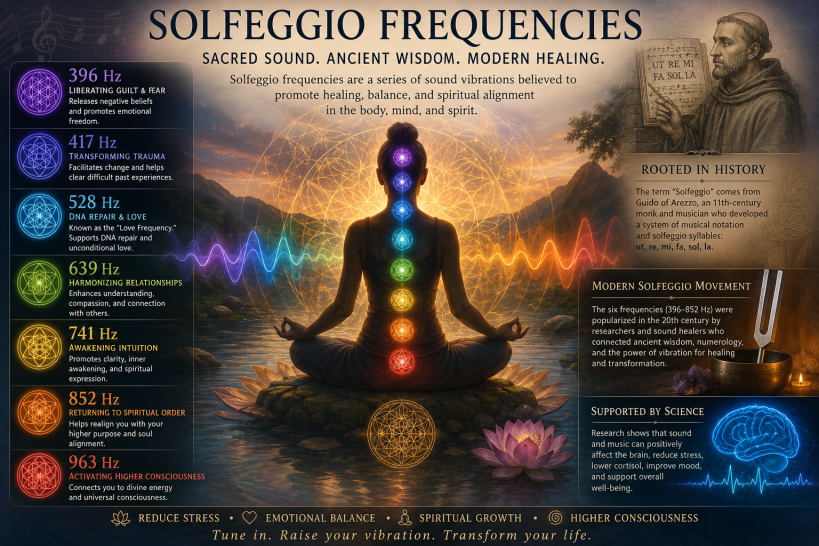
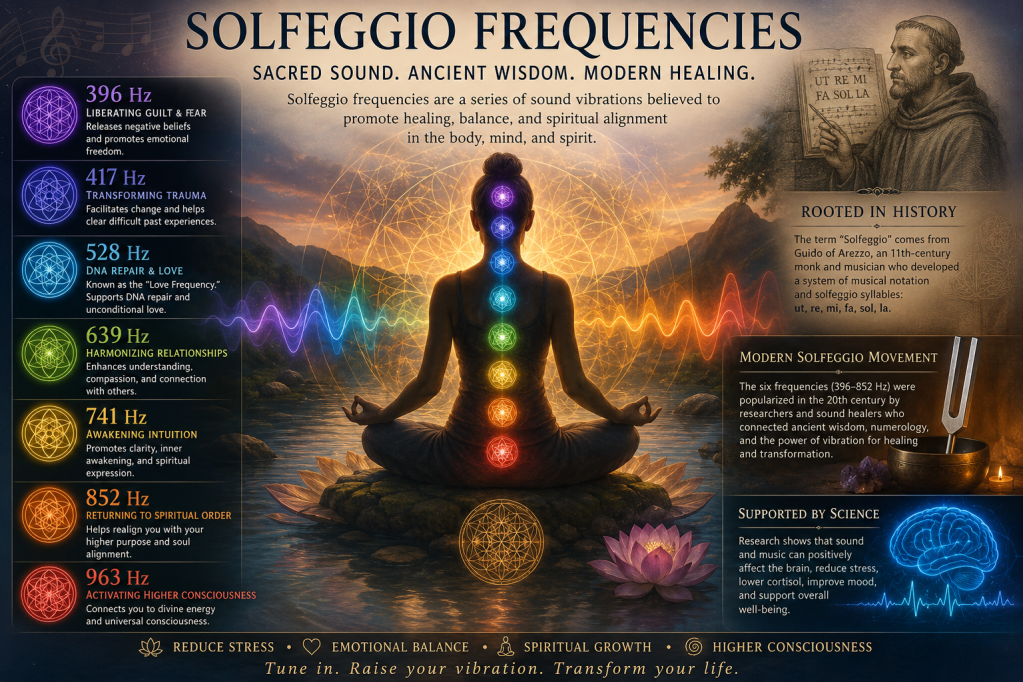
The contemporary Solfeggio system generally contains nine frequencies:

FrequencyCommon Contemporary Spiritual Ass’n
174 HzGrounding, security, physical comfort
285 HzRestoration, energetic renewal
396 HzReleasing fear, guilt, and limitation
417 HzChange, transition, clearing old patterns
528 HzTransformation, love, restoration
639 HzRelationships, compassion, reconciliation
741 HzExpression, purification, intuitive clarity
852 HzSpiritual awareness and inner perception
963 HzUnity consciousness and connection with the Divine

These interpretations are widely used within modern sound-healing communities, but they should be understood primarily as contemporary metaphysical correspondences rather than medically established functions.

The original modern core usually consisted of six frequencies:

396, 417, 528, 639, 741, and 852 Hz.

The additional tones—174, 285, and 963 Hz—became incorporated into the expanded system later.

Are the Solfeggio Frequencies Ancient?

This is where history requires some clarification.

There genuinely is an ancient and medieval history behind the word solfeggio.

In the eleventh century, the Benedictine music theorist Guido of Arezzo developed an influential method for teaching singers musical intervals. The syllables were:

Ut — Re — Mi — Fa — Sol — La

They were derived from the opening syllables of lines from a Latin hymn associated with Saint John the Baptist.

This system eventually developed into the familiar:

Do — Re — Mi — Fa — Sol — La — Ti.

Historical musicology confirms Guido’s importance in the development of Western musical education and solmization. (Library of Congress Blogs)

What historical evidence does not demonstrate is that medieval monks were deliberately singing the modern fixed frequencies of 396, 417, 528, 639, 741, and 852 Hz for healing purposes.

Guido’s syllables represented musical relationships and intervals rather than the modern set of fixed hertz values.

The contemporary healing-frequency system emerged much later and became especially popular through twentieth-century metaphysical and alternative-healing literature.

So there are really two histories that are frequently blended together:

Historical solfeggio is a genuine medieval system of musical education.

Solfeggio healing frequencies are a modern system of spiritual and therapeutic sound correspondences inspired in part by that older tradition.

Recognizing this distinction does not invalidate meditation with these tones. It simply places the practice in its proper historical setting.

Can Sound Actually Affect the Human Body?

Absolutely.

This is where the scientific conversation becomes particularly fascinating.

Sound is processed through neurological systems interconnected with regions involved in emotion, memory, attention, arousal, and autonomic regulation.

Relaxing music can therefore influence the relationship between the two primary branches of the autonomic nervous system:

the sympathetic nervous system, associated with mobilization and the stress response,

and the parasympathetic nervous system, associated with restoration, digestion, relaxation, and recovery.

A 2026 systematic review and meta-analysis examined 24 randomized controlled trials involving 1,295 participants and found that music interventions produced measurable changes in heart-rate-variability parameters associated with autonomic regulation. Particularly noticeable effects appeared among people experiencing stress, anxiety, fear, or sleep difficulties. Short interventions of thirty minutes or less were often effective, and personally selected music sometimes performed better than standardized selections. (Frontiers)

Music listening has also been associated with changes in stress-related physiology.

An everyday-life study found that listening to music for relaxation was associated with lower perceived stress and lower cortisol concentrations. (PubMed)

Broader reviews of music-based interventions have similarly reported effects on psychological stress and, in some studies, heart rate, blood pressure, and stress-related hormones. (Frontiers)

The important point is this:

Sound does interact with physiology.

The question still being investigated is whether particular isolated frequencies possess uniquely specific healing effects beyond the wider effects of music, rhythm, expectation, breathing, emotional meaning, and relaxation.

What About 528 Hz—the So-Called “Love Frequency”?

No Solfeggio tone has received more attention than 528 Hz.

Within modern metaphysical literature it has been called the:

Love Frequency

Miracle Tone

Transformation Frequency

and sometimes the DNA Repair Frequency.

The DNA-repair claim is especially important to approach cautiously.

At present, listening to 528 Hz has not been established as a medical technique capable of repairing human DNA.

There is, however, some intriguing emerging research concerning physiological responses to music organized around 528 Hz.

A small 2018 study involving only nine participants compared music associated with 528 Hz with conventionally tuned music. Researchers observed changes including decreased cortisol, increased oxytocin, and reductions in reported tension after the 528-Hz condition. The extremely small sample means the findings should be considered preliminary rather than proof of a unique healing mechanism. (CiNii Research)

More recently, a 2026 randomized controlled trial involving 162 healthy university students compared twenty minutes of 528-Hz music, 432-Hz music, and no music during examination-related stress.

Researchers found differences in several salivary biomarkers. The 528-Hz group demonstrated increases in salivary BDNF and CREB compared with controls. However, there were no significant differences in cognitive performance on the Stroop test. The researchers therefore described biological responses to frequency-based music rather than evidence of miraculous healing. (PubMed)

These studies make 528 Hz scientifically interesting.

They do not yet establish that 528 Hz repairs DNA, cures illness, or possesses a universal biological effect unique to that exact numerical frequency.

Much more controlled replication is necessary.

Then How Might Solfeggio Frequencies Support Healing?

A better way to understand sound healing may be through several interacting layers.

1. Regulation of the Nervous System

Slow, predictable, nonthreatening sound may encourage the nervous system to shift away from states of hyperarousal.

Breathing slows.

Muscular tension may decrease.

Attention becomes less scattered.

The body receives fewer signals requiring immediate action.

Under appropriate conditions, this can support the physiological environment associated with rest and recovery.

Healing frequently begins not because sound directly “fixes” tissue, but because a chronically activated organism finally enters a state in which restoration can occur.

2. Stress Reduction

Chronic stress places extraordinary demands upon the body.

Stress influences sleep, cardiovascular activity, endocrine function, digestion, immune regulation, pain perception, and emotional health.

If music or sound reduces stress, its effects may therefore ripple across several bodily systems.

This is considerably different from claiming that one frequency cures a disease.

Yet reducing physiological stress can itself be therapeutically meaningful.

3. Emotional Release

Music possesses an unusual ability to bypass intellectual defenses.

A person may understand intellectually that grief exists within them while remaining incapable of feeling it.

Then a particular sound appears.

Suddenly the grief moves.

Tears come.

Memories surface.

The emotional body opens.

Sound can become a doorway through which previously inaccessible psychological material enters awareness.

In spiritual healing traditions, this is sometimes described as energetic release.

Psychology might describe aspects of the same experience through emotional processing, memory activation, regulation, and meaning-making.

The vocabulary differs.

The human experience may be remarkably similar.

Sound and the Human Energy Field

Esoteric traditions approach sound from another perspective.

Within many metaphysical systems, creation itself is understood as fundamentally vibratory.

The ancient Indian tradition speaks of Nāda, sacred sound.

The Vedic Om represents primordial vibration.

Hebrew and Qabalistic mysticism places extraordinary importance upon sacred letters, Divine Names, and spoken vibration.

Christian mystical traditions developed chant.

Islamic spirituality cultivated sacred recitation and remembrance.

Tibetan traditions employ mantra, horns, bells, and resonant instruments.

Western ceremonial magic uses the vibration of Divine Names as a fundamental technique.

Across remarkably different cultures appears a recurring intuition:

consciousness can be changed through sacred sound.

From an esoteric perspective, sound may organize consciousness because vibration acts as an intermediary between subtle and material worlds.

Whether one interprets the subtle body literally, symbolically, psychologically, or spiritually, chanting and sustained tones can profoundly alter subjective states.

And subjective states matter.

They influence perception, emotion, behavior, relationship, and spiritual experience.

Do Frequencies “Raise Your Vibration”?

This popular expression can be useful metaphysically, but it should not be confused with the scientific meaning of frequency.

Someone experiencing compassion does not literally begin vibrating at 639 Hz.

Nor does enlightenment mean that the cells suddenly oscillate at 963 Hz.

In spiritual language, raising vibration usually describes a qualitative change in consciousness:

from fear toward trust,

from agitation toward stillness,

from fragmentation toward integration,

from resentment toward compassion,

from unconsciousness toward awareness.

Used that way, frequency becomes both sound and symbol.

The tone becomes a contemplative anchor around which consciousness is organized.

The Spiritual Power May Not Be in the Number Alone

This may ultimately be one of the most important insights regarding Solfeggio work.

A healing session consists of much more than frequency.

It includes:

sound,

rhythm,

breathing,

attention,

intention,

expectation,

environment,

memory,

symbolism,

silence,

and consciousness.

If someone enters a sacred space, lights a candle, breathes deliberately, invokes the Divine, listens deeply to a sustained tone, allows difficult emotions to surface, and remains in meditation for twenty minutes, an altered psychophysiological state may develop.

It would be simplistic to attribute the entire experience solely to the number 528.

But it would be equally simplistic to dismiss the experience because 528 Hz itself has not been proven miraculous.

Ritual works through relationships among many factors.

Sound can become the organizing center of those relationships.

A Simple Solfeggio Meditation Practice

Choose a frequency according to the spiritual quality you wish to contemplate.

For example:

396 Hz — release fear.

417 Hz — welcome change.

528 Hz — cultivate love and restoration.

639 Hz — contemplate relationship and reconciliation.

741 Hz — seek clarity.

852 Hz — enter inner silence.

Sit comfortably and allow the body to settle.

Before beginning the recording, establish an intention—not a demand, but an orientation.

You might inwardly say:

May this period of sound bring my body, mind, and spirit into greater harmony.

Begin breathing slowly.

Rather than concentrating aggressively upon the tone, allow yourself to receive it.

Notice where the sound seems to be felt.

Perhaps it appears in the chest.

Perhaps the head.

Perhaps nowhere physically at all.

Do not force an experience.

After several minutes, gently vocalize a comfortable vowel or hum along with the sound if desired.

The vibration of one’s own voice introduces another dimension because vocalization engages respiration, resonance, attention, and bodily sensation simultaneously.

After approximately fifteen to thirty minutes, turn the sound off.

Then remain in silence.

This final silence is important.

The tone prepares the field.

Silence reveals what has changed.

Notice your breathing, emotional state, bodily sensations, imagery, memories, or intuitive impressions.

A journal can be particularly valuable for recording what repeatedly emerges during work with different frequencies.

Which Frequency Should You Use?

There is no scientific evidence requiring a person to use a specific Solfeggio tone for a particular condition.

The traditional modern correspondences can instead function as meditative keys.

Use them intentionally.

For grounding, experiment with 174 or 396 Hz.

For periods of transition, work with 417 Hz.

For heart-centered meditation, experiment with 528 or 639 Hz.

For contemplation and intuitive work, explore 741 or 852 Hz.

For mystical meditation upon unity or Divine consciousness, some practitioners prefer 963 Hz.

But pay attention to your own response.

A 2026 review of music and autonomic regulation found that personally selected music could sometimes produce stronger responses than standardized selections. In other words, what genuinely speaks to the individual nervous system may be just as important as any prescribed frequency. (Frontiers)

Sound Healing Is Best Understood as Complementary Healing

There is now substantial evidence that music can have meaningful therapeutic effects.

A recent systematic review of music therapy for anxiety found an overall moderate benefit across psychological anxiety outcomes, although physiological effects were smaller and statistically uncertain. (PubMed)

Cochrane evidence examining people with cancer has also found that music interventions may improve outcomes including anxiety, depression, hope, pain, and fatigue, while emphasizing limitations in study quality and the need for further research. (Cochrane Library)

This gives us a sensible middle path.

Sound healing should neither be dismissed as meaningless nor promoted as a substitute for medicine.

It is better understood as a complementary practice capable of supporting relaxation, emotional regulation, contemplative awareness, spiritual practice, and potentially certain aspects of physiological well-being.

Anyone experiencing illness should continue appropriate medical evaluation and treatment rather than attempting to replace necessary healthcare with frequency recordings.

Sound can accompany healing.

It should not be promised as a cure.

The Mystery of Resonance

Perhaps the deepest principle behind sacred sound is not frequency but resonance.

Two instruments tuned sympathetically can respond to one another even when only one is struck.

Something similar happens metaphorically within human beings.

A sound enters us.

Something answers.

A memory.

An emotion.

A prayer.

A forgotten grief.

An image.

A sensation of peace.

A sudden realization.

The sound has not placed something foreign within us.

It has awakened something that was already capable of responding.

This may be one of the most profound ways to understand spiritual sound healing.

The healer is not necessarily the frequency.

The frequency may be the key.

The instrument being tuned is consciousness itself.

Sound as a Bridge Between Body and Spirit

The scientific study of therapeutic sound is still developing, and research specifically concerning Solfeggio frequencies remains much smaller than research concerning music therapy in general.

We should therefore be careful with extraordinary claims.

We cannot presently say that 528 Hz repairs DNA, that 639 Hz biologically heals relationships, or that 963 Hz scientifically activates enlightenment.

But neither must we conclude that sacred sound possesses no value.

We know that music can influence emotion.

We know that sound can affect attention.

We know that music can modify aspects of stress physiology and autonomic regulation.

We know that chanting, prayer, music, and sacred recitation have been used across civilizations to enter contemplative states.

And we know from human experience that certain sounds can reach places within consciousness that ordinary language cannot.

The Solfeggio frequencies may therefore be most fruitfully approached not as magical prescriptions but as contemplative technologies of resonance.

They invite the practitioner to listen.

To breathe.

To become still.

To allow the nervous system to soften.

To observe the interior world.

And perhaps, through sound, to remember a more fundamental harmony.

For beneath all the discussions of hertz, nervous systems, cortisol, chakras, meditation, and consciousness lies a very ancient spiritual intuition:

Before there was music, there was vibration.

Before there was speech, there was sound.

And before the human being could explain the mystery of existence, we were already listening for it.

I can also develop a matching annotated bibliography for this article that separates peer-reviewed sound/music research, historical solfeggio scholarship, and modern metaphysical sources.


Following is an annotated bibliography in a Chicago-style format. The three sections deliberately distinguish scientific evidence from medieval music history and from modern metaphysical literature, so readers can see exactly what kind of authority each source carries.

Annotated Bibliography

Solfeggio Frequencies, Sound Healing, and the Human Body and Spirit

A Note on the Sources

The literature surrounding Solfeggio frequencies belongs to three substantially different categories, and they should not be treated as interchangeable.

The first category consists of peer-reviewed biomedical, psychological, and music-therapy research. This literature provides evidence that music and sound can influence anxiety, stress perception, autonomic regulation, hormonal biomarkers, pain, and other physiological or psychological outcomes. A much smaller subset investigates specific frequencies such as 528 Hz or 432 Hz.

The second category consists of historical and musicological scholarship concerning Guido of Arezzo, medieval solmization, the hexachord, chant, and the syllables ut–re–mi–fa–sol–la. These sources establish the genuine medieval history behind the word solfeggio. They do not, however, document the modern sequence 396–417–528–639–741–852 Hz as an ancient medieval healing scale.

The third category contains modern metaphysical and sound-healing sources. These are important for understanding the development, symbolism, spiritual interpretation, and contemporary practice of the frequencies, but they should be regarded as primary sources for modern Solfeggio doctrine rather than as scientific proof of medical efficacy.


I. Peer-Reviewed Sound, Music, and Physiological Research

Akimoto, Kaho, Ailing Hu, Takuji Yamaguchi, and Hiroyuki Kobayashi. “Effect of 528 Hz Music on the Endocrine System and Autonomic Nervous System.” Health 10, no. 9 (2018): 1159–1170. https://doi.org/10.4236/health.2018.109088.

This exploratory study is one of the most frequently cited scientific investigations specifically involving 528-Hz music. Nine healthy adults listened on separate occasions to music associated with 528-Hz and 440-Hz tuning. The researchers measured cortisol, chromogranin A, oxytocin, autonomic nervous-system activity, and mood.

Following the 528-Hz condition, cortisol decreased, oxytocin increased, and some measures of tension and mood disturbance improved. The sample, however, consisted of only nine people, making the study far too small to demonstrate that 528 Hz possesses a unique universal healing property. It should therefore be presented as preliminary evidence warranting further investigation, not as proof of claims such as DNA repair or disease treatment. (CiNii Research)

Use in the blog: Excellent for demonstrating that 528 Hz has received genuine scientific investigation while simultaneously explaining the limits of the available evidence.


Bozok, Ümmü Gülşen, et al. “Acute Music-Frequency Exposure Modulates Salivary Stress and Neurotrophic Markers in Young Adults: A Randomized Controlled Trial.” Brain and Behavior 16 (2026): e71452. https://doi.org/10.1002/brb3.71452.

This 2026 randomized controlled trial substantially expands the human evidence concerning frequency-based music. A total of 162 university students were randomly assigned to listen to 528-Hz music, 432-Hz music, or no music for twenty minutes during an examination-related stress period.

The investigators measured salivary BDNF, CREB, and GRP78. The 528-Hz group demonstrated significantly higher BDNF and CREB levels than the control group, while 432-Hz music produced a different biomarker pattern. No significant difference appeared between groups in Stroop cognitive-performance scores.

The study is especially valuable because of its larger randomized design. Even so, it demonstrates short-term biomarker differences, not miraculous healing, DNA reconstruction, or long-term medical outcomes. Replication and mechanistic investigation remain necessary. (Wiley Online Library)

Use in the blog: One of the strongest current sources for stating that particular musical tuning conditions may produce measurable biological differences without overstating what those differences mean clinically.


Babayi Daylari, T., G. H. Riazi, Sh. Pooyan, E. Fathi, and F. Hedayati Katouli. “Influence of Various Intensities of 528 Hz Sound-Wave in Production of Testosterone in Rat’s Brain and Analysis of Behavioral Changes.” Genes & Genomics 41, no. 2 (2019): 201–211. https://doi.org/10.1007/s13258-018-0753-6.

This animal study investigated direct exposure to a 528-Hz sound wave rather than simply listening to musical compositions tuned around that frequency. Researchers reported changes involving testosterone production, expression of steroidogenic regulatory pathways, reactive oxygen species, and anxiety-related behavior in rats.

The research is scientifically interesting because it suggests that audible acoustic stimulation can have measurable biological consequences. It cannot, however, be directly extrapolated to human spiritual or clinical healing. The experimental intensity—particularly the reported 100-dB condition—is also quite different from ordinary meditation listening. (PubMed)

Use in the blog: Helpful when discussing the emerging field of sonobiology and the possibility that acoustic vibration can interact with living biological systems.


Aravena, Pedro Christian, Camila Almonacid, and Marcelo Ignacio Mancilla. “Effect of Music at 432 Hz and 440 Hz on Dental Anxiety and Salivary Cortisol Levels in Patients Undergoing Tooth Extraction: A Randomized Clinical Trial.” Journal of Applied Oral Science 28 (2020): e20190601. https://doi.org/10.1590/1678-7757-2019-0601.

Although 432 Hz is not one of the canonical Solfeggio frequencies, this randomized clinical trial is important to the larger question of whether musical tuning frequency itself may influence physiological responses.

Forty-two patients undergoing tooth extraction were assigned to 432-Hz music, 440-Hz music, or no music. Both musical groups demonstrated lower anxiety than controls, while the 432-Hz group demonstrated significantly lower salivary cortisol than either the 440-Hz or control groups.

The study suggests that tuning differences deserve further investigation. It does not demonstrate a universal superiority of 432 Hz or establish that single frequencies independently cause the observed effects. (PubMed)

Use in the blog: Useful for placing Solfeggio research within the broader scientific investigation of tuning, pitch reference, music, stress, and physiology.


Flater, Bettina, Are Brean, and Daniel S. Quintana. “Music Therapy and Vagally Mediated Heart Rate Variability: A Systematic Review and Narrative Synthesis.” International Journal of Psychophysiology 219 (2026): 113288. https://doi.org/10.1016/j.ijpsycho.2025.113288.

This systematic review examined 28 studies evaluating music therapy and vagally mediated heart-rate variability, an indicator associated with parasympathetic cardiac regulation.

The reviewed literature generally suggested increased cardiac parasympathetic activity during music therapy, but the authors emphasized substantial heterogeneity, methodological differences, small sample sizes, and a high overall risk of bias.

This source is particularly important because it supports a scientifically plausible pathway through which sound practices may affect bodily state: autonomic regulation. At the same time, it demonstrates why broad claims about specific healing frequencies should remain cautious. (ScienceDirect)

Use in the blog: Strong support for explaining how soothing sound may influence the sympathetic–parasympathetic balance without requiring an unproven “energy frequency” mechanism.


Zhang, E., et al. “Effect of Music Intervention on Heart Rate Variability: A Systematic Review and Meta-Analysis of Randomized Controlled Trials.” Frontiers in Psychology 17 (2026). https://doi.org/10.3389/fpsyg.2026.1750786.

This systematic review and meta-analysis examined randomized clinical trials of music interventions and heart-rate variability. The research addresses whether listening to music can measurably affect autonomic nervous-system regulation.

The analysis supports the broader view that musical interventions can influence HRV parameters, although effects depend upon variables such as tempo, duration, musical selection, participant population, and study design. (Frontiers)

Use in the blog: Particularly useful for explaining why relaxation produced during Solfeggio meditation may involve more than the numerical frequency itself. Tempo, musical structure, preference, breathing, expectation, and emotional state may all contribute.


Wong, Melanie Mitsui, Talha Tahir, Michael Mitsui Wong, Annilee Baron, and Rachael Finnerty. “Biomarkers of Stress in Music Interventions: A Systematic Review.” Journal of Music Therapy 58, no. 3 (2021): 241–277. https://doi.org/10.1093/jmt/thab003.

This systematic review examined biological stress markers in randomized music-intervention research. Fourteen trials investigated eighteen different biomarkers, with cortisol and salivary alpha-amylase among the most frequently measured.

The authors found evidence suggesting that music interventions can reduce both psychological stress and stress-related biomarkers in some acute situations, but the diversity of methods makes it difficult to calculate one universal physiological effect. (PubMed)

Use in the blog: An excellent scientific foundation for the statement that music may affect endocrine and stress physiology even when the exact mechanisms associated with particular Solfeggio frequencies remain uncertain.


de Witte, Martina, Sonja Aalbers, Annemieke Vink, et al. “Music Therapy for the Treatment of Anxiety: A Systematic Review with Multilevel Meta-Analyses.” eClinicalMedicine 84 (2025): 103293. https://doi.org/10.1016/j.eclinm.2025.103293.

This major systematic review analyzed 51 studies and 93 effect sizes concerning music therapy and anxiety. The researchers found an overall moderate benefit for anxiety outcomes, particularly self-reported anxiety. Physiological outcomes showed a smaller and statistically uncertain effect.

The study is important because it demonstrates that music-based therapeutic practice has genuine clinical research behind it while also distinguishing psychological improvements from stronger biological claims. (PubMed)

Use in the blog: Supports discussion of sound as a complementary method for emotional regulation, anxiety reduction, and psychological well-being.


Bradt, Joke, Cheryl Dileo, Katherine Myers-Coffman, and Joachim Biondo. “Music Interventions for Improving Psychological and Physical Outcomes in People with Cancer.” Cochrane Database of Systematic Reviews, no. 10 (2021): CD006911. https://doi.org/10.1002/14651858.CD006911.pub4.

This extensive Cochrane review incorporated 81 studies involving 5,576 participants. Music interventions were associated with potential benefits for anxiety, depression, hope, pain, fatigue, heart rate, and blood pressure among adults with cancer.

The authors also emphasized that much of the evidence was of low or very low certainty and that many trials carried a substantial risk of bias.

This review is especially useful for drawing the line between legitimate complementary therapy and claims that sound itself cures disease. Music may support people undergoing treatment; it should not be presented as a replacement for medical care. (Cochrane)

Use in the blog: Strong evidence for describing therapeutic music as complementary healing rather than a substitute for conventional medicine.


II. Historical Solfeggio, Guido of Arezzo, and Medieval Music Scholarship

Guido of Arezzo. Micrologus. In Hucbald, Guido, and John on Music: Three Medieval Treatises. Translated by Warren Babb. Edited by Claude V. Palisca. New Haven: Yale University Press, 1978.

This is one of the most important primary texts for understanding medieval Western music theory. Guido of Arezzo was among the most influential music theorists of the eleventh century and helped systematize pedagogical methods that made chant easier to learn and transmit.

His musical teaching is directly relevant to the development of solmization, but the historical material concerns interval relationships, chant pedagogy, notation, and singing—not a series of fixed healing frequencies expressed in modern hertz values. (WorldCat)

Use in the blog: A crucial primary source for separating authentic Guidonian music theory from modern legends concerning “ancient Solfeggio frequencies.”


Guido of Arezzo. Guido d’Arezzo’s Regule Rithmice, Prologus in Antiphonarium, and Epistola ad Michahelem: A Critical Text and Translation. Edited and translated by Dolores Pesce. Ottawa: Institute of Mediaeval Music, 1999.

Pesce’s critical edition and translation makes several of Guido’s important writings available with extensive scholarly commentary, manuscript inventories, annotation, and historical apparatus.

These writings help reconstruct what Guido actually taught about music, interval recognition, chant, notation, and musical education. They are particularly useful for testing later claims attributed to him against surviving medieval textual evidence. (WorldCat)

Use in the blog: Among the best scholarly sources for demonstrating that historical claims concerning Guido should be based on his actual surviving writings rather than modern sound-healing lore.


Grier, James. “Guido of Arezzo.” Oxford Bibliographies in Music. Oxford University Press, 2018. https://doi.org/10.1093/obo/9780199757824-0248.

Grier provides a modern scholarly overview of Guido’s life, writings, historical setting, and enormous contribution to medieval musical pedagogy. He identifies solmization and staff notation with clefs as central developments associated with Guido’s work. (OUP Academic)

The entry is especially valuable as an orientation to the larger scholarly literature on Guidonian music theory.

Use in the blog: Recommended as an authoritative secondary reference for readers wishing to investigate the historical Guido beyond popular internet accounts.


Haines, John. “The Origins of the Musical Staff.” The Musical Quarterly 91, nos. 3–4 (2008): 327–378. https://doi.org/10.1093/musqtl/gdp002.

Haines examines the development of Western staff notation and critically addresses the tendency to reduce complicated historical developments to simplistic stories about individual “inventors,” including Guido of Arezzo.

The study demonstrates why the history of medieval music requires careful contextual scholarship rather than retroactively projecting modern concepts into the Middle Ages. (OUP Academic)

Use in the blog: Useful for correcting overly simplified claims that a single medieval figure suddenly created the complete system of Western notation—or the modern Solfeggio healing-frequency system.


Herissone, Rebecca. Music Theory in Seventeenth-Century England. Oxford: Oxford University Press, 2000.

Herissone’s discussion of pitch structure explains how the medieval hexachordal tradition continued to shape musical education into the early modern period. The system organized notes into six-note collections corresponding to ut, re, mi, fa, sol, and la, with the intervallic structure tone–tone–semitone–tone–tone.

The syllables derive from the hymn associated with Saint John the Baptist and served primarily as a means of teaching singers interval relationships. (OUP Academic)

Use in the blog: Particularly valuable for showing what historical “solmization” actually meant: a movable pedagogical system of intervals rather than six immutable frequencies measured in Hz.


III. Modern Metaphysical and Solfeggio-Frequency Sources

Horowitz, Leonard G., and Joseph Puleo. Healing Codes for the Biological Apocalypse. Sandpoint, ID: Tetrahedron Publishing Group, 1999.

This book is one of the most important primary sources for the modern Solfeggio-frequency movement. Library records confirm its publication by Tetrahedron Publishing Group in 1999. (WorldCat)

Horowitz and Puleo connect a sequence of numbers derived through numerological treatment of biblical passages with ideas concerning vibration, healing, spirituality, and biology. Their work helped popularize the six-number sequence:

396 — 417 — 528 — 639 — 741 — 852.

The book is historically significant for understanding modern Solfeggio doctrine, but its biomedical and historical claims should not be treated as equivalent to peer-reviewed medical or musicological scholarship.

Use in the blog: Essential for explaining where the recognizable modern six-frequency system actually enters contemporary metaphysical literature.


Goldman, Jonathan. Healing Sounds: The Power of Harmonics. Rev. ed. Shaftesbury, Dorset: Element, 1996.

Goldman is one of the major figures in contemporary sound-healing culture. Healing Sounds explores vocal harmonics, overtone chanting, resonance, intentionality, sacred sound, and the use of the human voice in transformative practice. Library catalog records identify the revised edition as published by Element in 1996, following an earlier edition from 1992. (WorldCat)

Although the work should not be considered clinical evidence for frequency-specific medical treatment, it is highly useful for understanding the philosophical framework of modern sound healing: consciousness, intention, resonance, harmonics, and the experiential effects of vocal vibration.

Use in the blog: Excellent for developing the spiritual concept that healing sound involves more than numerical frequency alone; consciousness and intention form part of the practice.


Goldman, Jonathan. “Healing Codes Sacred Sounds.” Recording and explanatory notes, 2020–2021.

Goldman’s own account is extremely valuable for tracing the evolution of the modern nine-frequency system. He states that he developed tuning forks using the six numbers presented by Horowitz and Puleo and subsequently added three more numbers, producing the extended nine-frequency sequence that became widely associated with contemporary Solfeggio practice. (YouTube)

This testimony is particularly significant because it helps explain why modern lists often include:

174 — 285 — 396 — 417 — 528 — 639 — 741 — 852 — 963 Hz

rather than the earlier six-frequency sequence.

Use in the blog: One of the most useful primary sources for documenting the transition from the original modern six-number system to the now-common nine-frequency system.


“How Were Solfeggio Frequencies Discovered?” SolfeggioFrequencies.org. Accessed August 2026.

This contemporary popular source illustrates how the modern Solfeggio narrative is currently presented within the sound-healing community. It explicitly connects Joseph Puleo’s work to the biblical Book of Numbers and describes the use of numerical reduction in deriving the six-frequency sequence. (Solfeggio Frequencies)

Its value is primarily ethnographic and doctrinal rather than historical or medical: it shows what contemporary practitioners believe and teach.

It should therefore be read alongside primary modern texts such as Horowitz and Puleo and contrasted with medieval musicological scholarship on Guido of Arezzo.

Use in the blog: Helpful for demonstrating the difference between the internal history told by the modern Solfeggio movement and the conclusions supported by academic music history.


IV. What the Combined Bibliography Tells Us

Taken together, these sources reveal a much more nuanced history of Solfeggio frequencies than is usually presented online.

There is indeed an authentic medieval tradition behind the term solfeggio. Guido of Arezzo and later musicians employed syllables such as ut, re, mi, fa, sol, and la as tools for teaching singers interval relationships. Medieval and early-modern scholarship supports this history. (OUP Academic)

There is not, however, equivalent historical evidence demonstrating that medieval monks possessed or intentionally employed the modern fixed sequence:

396 Hz
417 Hz
528 Hz
639 Hz
741 Hz
852 Hz

as a secret healing scale.

That numerical system belongs to a much more recent metaphysical history associated particularly with the work of Joseph Puleo and Leonard Horowitz, with later sound-healing practitioners expanding and popularizing the system. (WorldCat)

Scientific research, meanwhile, supports a third and distinct conclusion.

Music and structured sound can affect human beings.

They can influence anxiety, emotion, stress responses, autonomic nervous-system activity, heart-rate variability, cortisol and other biomarkers, and in some clinical settings pain and quality of life. (PubMed)

There is also a small but growing body of research examining specific tuning frequencies, including 528 Hz. Some studies have reported intriguing biological effects, including changes in salivary biomarkers and autonomic or neuroendocrine measures. (CiNii Research)

What has not been scientifically established is that:

  • 396 Hz specifically removes guilt,
  • 417 Hz clears trauma,
  • 528 Hz repairs human DNA,
  • 639 Hz heals relationships,
  • 741 Hz detoxifies cells,
  • 852 Hz activates intuition, or
  • 963 Hz produces enlightenment.

Those are modern metaphysical correspondences, not established biomedical findings.

This distinction does not require us to abandon spiritual interpretations of sound.

Instead, it gives us a more intellectually responsible model.

The historian can study Guido and medieval solmization.

The scientist can investigate sound, neurobiology, stress, acoustic stimulation, and music therapy.

The metaphysician can work with frequency as symbol, intention, resonance, meditation, and sacred correspondence.

These three approaches can speak to one another without being confused with one another.

That may ultimately be the most productive way to approach the Solfeggio frequencies: not as a lost medical technology whose every modern claim has already been proven, but as a contemporary form of sacred sound practice situated at the intersection of music, physiology, symbolism, contemplative consciousness, and the ancient human intuition that vibration possesses transformative power.

This bibliography makes a clean distinction between what is historically documented, what is experimentally suggestive, and what belongs specifically to modern esoteric interpretation.

The Theory Behind Energy Healing:  How Does It Work on the Body? | Victoria Generao, PhD

For thousands of years, healing traditions have proposed that the human being is more than a collection of organs, tissues, chemicals, and electrical impulses. Beneath—or perhaps interwoven with—the physical body, these traditions describe another dimension of human life: a vital, organizing force.

Chinese traditions speak of Qi. Indian philosophy describes Prāṇa. Japanese healing systems use the concept of Ki. Western esoteric traditions have spoken of the vital force, astral light, and subtle bodies. Contemporary practitioners may simply call it the human energy field or biofield.

From this worldview arises the basic theory of energy healing:

When the energetic organization of the person becomes disturbed, the physical, emotional, mental, or spiritual person may also experience disharmony. By supporting balance within that energetic system, the practitioner seeks to encourage the person’s own capacity for restoration.

But what does that actually mean?

And perhaps more importantly, what happens to the physical body during an energy-healing session?

The answer depends upon whether we approach the question metaphysically, physiologically, psychologically, or scientifically. Rather than forcing these perspectives into opposition, it is useful to examine them side by side.


The Human Being as an Energetic Organism

Even conventional physiology recognizes that the body is not merely mechanical.

Every heartbeat is initiated through electrical activity.

The nervous system communicates through electrochemical signals.

Muscle fibers contract through changes in electrical potential across cellular membranes.

The brain produces measurable electrical activity.

Cells maintain voltage differences across their membranes.

The heart produces an electromagnetic field measurable outside the body.

None of these established biological phenomena, however, automatically proves the existence of the subtle-energy fields described in Reiki, Qigong, Therapeutic Touch, or esoteric healing traditions. This distinction is important.

When an energy healer speaks of Ki, Prāṇa, chakras, meridians, or the aura, the word energy is being used within a traditional or metaphysical model. It should not automatically be equated with electromagnetic energy measured in joules, volts, or teslas.

The National Center for Complementary and Integrative Health describes Reiki as a complementary approach based upon the idea that an energy supports the body’s natural healing abilities, while also noting that the specific energy field proposed by Reiki has not been scientifically demonstrated. (NCCIH)

We therefore encounter two different languages describing the human organism.

One is the language of biology.

The other is the language of subtle energy.

Energy healing proposes that the two may interact.

Science has not yet established that this interaction occurs through a presently measurable external energy field.


The Traditional Theory: Illness as Disturbance of Flow

Most energy-healing systems do not regard the practitioner as literally “curing” another person.

The healer instead attempts to create conditions in which greater balance can emerge.

Imagine a river.

When the river moves freely, water continually circulates through the landscape. But if debris accumulates, currents become diverted, areas stagnate, and pressure develops elsewhere.

Traditional energetic systems use remarkably similar imagery.

Energy may be described as:

  • deficient,
  • excessive,
  • stagnant,
  • blocked,
  • scattered,
  • depleted,
  • congested,
  • or unbalanced.

Healing therefore involves restoring flow, coherence, and equilibrium.

A Reiki practitioner might describe this as allowing universal life-force energy to move where it is required.

A practitioner of Chinese energetic medicine might speak of harmonizing Qi.

A yogic healer might describe balancing Prāṇa through the nāḍīs and chakras.

An esoteric healer might speak of bringing the subtle bodies into greater alignment.

Although the terminology differs, the underlying principle is strikingly similar:

Life seeks organization, balance, and wholeness.

The healer attempts to cooperate with that tendency.


The Body’s Extraordinary Capacity for Self-Regulation

Here the metaphysical and biomedical perspectives begin to approach one another.

The body constantly attempts to maintain internal stability.

Temperature is regulated.

Blood chemistry is regulated.

Blood pressure is continually adjusted.

Tissues repair themselves.

Immune cells respond to injury.

Hormones shift according to changing circumstances.

The nervous system constantly evaluates whether the organism needs to mobilize, defend, digest, repair, sleep, reproduce, or recover.

Medicine calls this regulatory tendency homeostasis, while broader contemporary models also use concepts such as allostasis—the body’s ability to adapt its internal operations to changing demands.

Energy-healing philosophies often interpret healing similarly, although through another vocabulary.

The healer is therefore not necessarily imagined as supplying something the body completely lacks.

Rather, the session is intended to help the organism return to a state in which its own regulatory processes can function more effectively.

This idea becomes especially interesting when we examine the nervous system.


The Nervous System May Be One Important Bridge

Modern life frequently places human beings into prolonged states of vigilance.

The sympathetic nervous system—the portion associated with mobilization—prepares us to respond to challenge.

Heart rate may increase.

Muscles tense.

Attention narrows.

Stress hormones may rise.

Digestion and restorative functions may temporarily become secondary.

This response is not pathological. It is essential for survival.

The problem arises when the organism has difficulty returning from mobilization into restoration.

During many energy-healing sessions, however, the conditions are almost the opposite.

The recipient lies quietly.

External stimulation decreases.

Breathing may slow.

The eyes close.

Attention turns inward.

A trusted practitioner remains quietly present.

Touch, when used, is generally gentle and noninvasive.

The recipient is essentially being given permission to stop doing.

For some people this creates profound relaxation.

And relaxation is not merely psychological.

Changing psychological states can influence breathing, muscle tension, pain perception, cardiovascular activity, attention, endocrine activity, and autonomic regulation.

Thus one scientifically plausible component of energy healing is not necessarily the transfer of an unidentified energy at all.

It may involve helping the nervous system enter a physiological environment more compatible with rest, recovery, and self-regulation.


The Parasympathetic State: From Vigilance to Restoration

The parasympathetic nervous system participates in many of the body’s quieter functions—rest, digestion, energy conservation, and recovery.

People receiving Reiki and similar therapies frequently report experiences such as:

warmth,

heaviness,

lightness,

tingling,

slowed breathing,

sleepiness,

emotional release,

a sense of expansion,

or unusually deep calm.

Energetic traditions interpret some of these sensations as evidence that energy is moving.

Biomedical science cannot presently confirm that interpretation.
But many of these experiences are also compatible with shifts in attention, relaxation, autonomic activity, sensory processing, and emotional state.

This creates an intriguing possibility.

Perhaps some of what practitioners call energetic balancing corresponds phenomenologically to a person moving from physiological vigilance toward greater regulation.

That does not prove the metaphysical theory.

But neither does it make the experience meaningless.


Healing Through Attention

There is another mechanism that receives far less attention: awareness itself.

Most of us spend enormous portions of our lives cognitively projected outward.

We are thinking about what happened yesterday.

What we need to accomplish tomorrow.

What someone said.

What might go wrong.

During an energy-healing session, attention often returns to the body.

Suddenly the recipient notices breathing.

Heartbeat.

Muscle tension.

Warmth.

Cold.

Pressure.

Emotion.

Fatigue.

Areas of comfort.

Areas of discomfort.

This inward awareness is sometimes called interoception—the perception of signals arising from within the body.

A person who becomes more sensitive to internal states may begin recognizing tension before it becomes overwhelming, exhaustion before complete depletion, or emotional activation before it turns into reactive behavior.

From an energetic perspective, the person is becoming more aware of the subtle body.

From a physiological perspective, the person may simply be becoming more conscious of bodily signals.

These interpretations are not necessarily mutually exclusive as descriptions of subjective experience.


The Healing Relationship Itself Matters

There is another element that should not be underestimated:

human presence.

A compassionate therapeutic encounter can itself alter experience.

For thirty or sixty minutes someone is effectively communicating:

You are safe enough to rest.

You do not have to perform.

You may receive.

Your discomfort is being acknowledged.

Someone is present with you.

Human beings are profoundly social organisms. Perceived safety, supportive interaction, expectation, prior experience, and therapeutic context can all influence pain and other symptoms.

This is sometimes dismissed as “just placebo.”

That description misunderstands placebo physiology.

Placebo responses can involve genuine changes in neural processing and neurochemical systems. Research on placebo analgesia, for example, has demonstrated roles for expectation, conditioning, endogenous opioid systems, and other mechanisms involved in regulating pain. (PubMed)

If ritual, expectation, attention, touch, therapeutic relationship, and perceived safety influence physiology, their effects are not imaginary simply because they originate partly through the brain.

The brain is part of the body.


The Energetic Model of the Aura and Chakras

Within metaphysical healing systems, however, the explanation goes considerably further.

The physical body is often regarded as the densest expression of several interpenetrating levels of being.

Different traditions describe these levels differently, but a typical esoteric model might include:

Physical Body → Etheric or Vital Body → Emotional or Astral Body → Mental Body → Spiritual Levels of Consciousness

The etheric body is frequently described as the energetic matrix immediately underlying physical life.

Within yogic systems, major organizing centers within the subtle body are called chakras.

Rather than viewing chakras merely as colored disks located along the spine, it may be more useful to understand them as symbolic or subtle centers through which physical, psychological, emotional, and spiritual experiences are organized.

For example:

The root center concerns embodiment, survival, stability, and belonging.

The sacral center concerns feeling, sexuality, relationship, and creativity.

The solar plexus concerns identity, power, autonomy, and action.

The heart center concerns love, grief, compassion, relationship, and integration.

The throat center concerns communication and expression.

The brow center concerns perception, imagination, and insight.

The crown concerns transcendence and relationship with the Sacred.

In energy-healing theory, prolonged disturbance within one level of the human being may eventually influence another.

An emotional pattern may produce chronic muscular tension.

Fear may influence breathing.

Grief may profoundly alter sleep, appetite, and energy.

Chronic physical pain may alter mood and cognition.

The metaphysical model interprets these interactions as movements occurring between layers of the subtle and physical organism.

Modern medicine describes many of them through nervous, endocrine, immune, behavioral, and psychological pathways.

Different maps.

Sometimes remarkably similar territory.


What Is the Practitioner Actually Doing?

One of the greatest misconceptions concerning energy healing is that the healer is pouring personal energy into the recipient.

Most mature traditions explicitly discourage this interpretation.

In Reiki, for example, the practitioner ideally functions as a conduit rather than a battery.

The healer does not force the recipient into healing.

The healer establishes a therapeutic field or condition in which healing may occur.

This concept has parallels throughout mystical traditions.

The healer becomes quiet.

Attention becomes focused.

Intention becomes singular.

Personal concerns temporarily recede.

The practitioner attempts to become receptive rather than controlling.

In metaphysical language, the healer aligns with a greater organizing intelligence.

In psychological language, the healer enters a highly regulated state of sustained compassionate attention.

Whether those descriptions ultimately refer to one phenomenon or two remains an open philosophical question.


Resonance and Entrainment: An Attractive but Unproven Hypothesis

Energy healers frequently use the concept of resonance.

A well-known physical analogy is that of two tuning forks.

Strike one tuning fork near another tuned to the same frequency and the second may begin vibrating sympathetically.

Energy-healing traditions propose something analogous between living systems.

A coherent practitioner, according to this theory, creates conditions in which a dysregulated recipient can gradually move toward greater coherence.

This is sometimes described as entrainment.

The analogy is elegant.

But it should remain an analogy unless direct biological evidence demonstrates the proposed subtle-energy mechanism.

There is research investigating physiological changes during biofield practices, including EEG and heart-rate variability, but a systematic review found that results were inconsistent and did not establish a unique physiological signature of the healer’s state. (PubMed)

Thus, resonance remains an intriguing theoretical model rather than an established explanation of energy healing.


Does Science Show That Reiki Works?

This is where precision matters.

The scientific literature is neither equivalent to saying “energy healing has been proven” nor accurately summarized by saying “nothing ever happens.”

Recent clinical studies have reported reductions in symptoms such as pain, anxiety, and stress in some populations.

For example, a randomized study published in 2025 involving cancer patients reported greater improvements in several subjective outcomes among participants receiving Reiki, although cortisol did not differ significantly between groups. (PubMed)

Another recent randomized placebo-controlled trial reported improvements in pain, anxiety, heart rate, and some cardiovascular measures among mechanically ventilated patients receiving Reiki compared with sham Reiki. (PubMed)

A 2025 meta-analysis examining randomized trials also reported improvements in quality-of-life outcomes associated with Reiki. (PubMed)

Yet this must be balanced against the larger evidence base.

Research varies considerably in quality, intervention design, sample size, comparison groups, practitioner training, blinding procedures, and outcome measurement.

A recent systematic review examining Reiki and Therapeutic Touch in palliative care found some promising symptom reports but concluded that the overall evidence remained limited and heterogeneous. (PubMed)

NCCIH likewise states that Reiki has not been clearly demonstrated to be effective for a specific health purpose and that research results remain inconsistent. (NCCIH)

The fairest conclusion at present is therefore:

People can experience meaningful subjective and sometimes measurable physiological changes during energy-healing interventions, but science has not established that these effects occur because a distinct subtle energy is being transferred or manipulated.

That distinction is crucial.


Perhaps the Better Question Is Not “Is Energy Real?”

The conversation surrounding energy healing often becomes trapped between two extremes.

One side insists:

“Science hasn’t measured the energy, therefore the entire experience is meaningless.”

The other insists:

“People experience effects, therefore the metaphysical explanation must already be scientifically proven.”

Neither position is necessary.

A more intellectually useful position is:

Something may be happening during these healing encounters. We should carefully investigate what components produce the effects.

Perhaps relaxation matters.

Perhaps expectation matters.

Perhaps touch matters.

Perhaps meditative attention matters.

Perhaps human connection matters.

Perhaps changes in autonomic regulation matter.

Perhaps ritual matters.

Perhaps consciousness plays roles we do not yet fully understand.

And perhaps future research will identify additional mechanisms.

Science advances precisely because unanswered questions remain unanswered long enough to be investigated properly.


The Metaphysical Interpretation: Healing as Restoration of Coherence

From an esoteric perspective, healing is not simply the removal of symptoms.

It is the restoration of right relationship.

Body with mind.

Mind with emotion.

Personality with soul.

Individual with community.

Human being with nature.

Finite self with the Sacred.

Disease, in this wider philosophical model, does not necessarily represent punishment or spiritual failure. Nor should illness ever be blamed upon someone’s supposed “negative energy.”

Rather, healing becomes the continuing process by which fragmented aspects of ourselves are brought back toward integration.

The healer therefore does not battle the body.

The healer listens.

The healer does not command the life-force.

The healer cooperates with it.

The healer does not impose wholeness.

The healer creates space in which wholeness may reveal itself.


Where Reiki Fits Into This Model

Reiki provides one of the clearest expressions of this philosophy.

The word is commonly interpreted through the Japanese concepts Rei and Ki, broadly pointing toward spiritual or universal reality and vital life energy.

During a Reiki session, the practitioner places the hands lightly upon or just above various areas of the recipient’s body.

There is no massage.

There is no physical manipulation.

There is often very little conversation.

From the traditional perspective, Reiki moves according to the recipient’s need rather than according to the practitioner’s personal will.

The healer becomes the intermediary.

The recipient becomes receptive.

Healing becomes less an act of doing and more an act of allowing.

Whether interpreted spiritually or psychologically, that principle may be one of Reiki’s most profound teachings.

Modern humanity is extremely practiced at effort.

We are considerably less practiced at receptivity.


Energy Healing as Ritualized Stillness

There may therefore be another way of understanding these practices.

Energy healing creates ritualized stillness.

For a defined period of time:

the phone stops,

the conversation stops,

the demands stop,

the obligations stop,

the outward performance of identity stops.

The recipient enters a liminal space.

The practitioner enters focused presence.

The ordinary world becomes temporarily quieter.

Whatever else may or may not be happening energetically, this alone changes the conditions under which the nervous system is operating.

And sometimes healing begins not because something dramatic has been added—

but because something exhausting has finally been removed.


Healing Is Not the Same as Curing

Perhaps the most important distinction in any discussion of energy work is the difference between healing and curing.

Curing concerns the elimination or successful treatment of disease.

Healing is broader.

A person may experience healing while still living with illness.

Someone may find peace while receiving cancer treatment.

A grieving person may begin integrating loss.

Someone with chronic pain may discover moments of profound calm.

A dying person may experience reconciliation, meaning, or spiritual acceptance.

None of these experiences necessarily cures disease.

Yet few would call them insignificant.

Energy healing may therefore be best understood not as a replacement for medicine, but as a complementary practice concerned with the human dimensions that medicine does not always have sufficient time to address:

presence,

rest,

meaning,

touch,

attention,

relationship,

spirituality,

and the experience of wholeness.


The Mystery Behind the Mechanism

We ultimately arrive at a fascinating threshold.

Traditional healers say that life-force moves through us.

Biology says that the organism possesses extraordinarily complex mechanisms of regulation and repair.

Psychology demonstrates that expectation, perception, emotion, attention, and relationship influence bodily experience.

Neuroscience demonstrates that changing states of consciousness can alter pain processing and neurophysiology.

Medicine demonstrates that the body is continuously attempting to regulate itself.

Energy healing gathers all of these questions into a single encounter between practitioner and recipient.

Does an independent subtle biofield exist?

Science has not yet established that it does.

Can people nonetheless experience relaxation, comfort, altered pain perception, emotional release, and meaningful changes during energy-healing sessions?

Yes, such experiences are reported, and some clinical studies have observed measurable differences—although the evidence remains inconsistent and the mechanisms unresolved. (PubMed)

And so energy healing occupies an unusual territory.

It sits between ancient metaphysics and modern physiology.

Between subjective experience and objective measurement.

Between ritual and medicine.

Between what humanity has believed for millennia and what experimental science can presently demonstrate.

Perhaps that is precisely why the subject remains so compelling.

For underneath every system of healing lies essentially the same question:

What allows a living being to move from disorder toward greater wholeness?

Energy-healing traditions answer:

Restore the flow.

Physiology answers:

Restore regulation.

Psychology answers:

Restore safety and integration.

Mysticism answers:

Restore relationship with the Source.

Perhaps these are entirely different explanations.

Or perhaps, seen from a sufficiently broad perspective, they are different languages describing humanity’s ancient search for the same mystery:

the innate movement of life toward balance, coherence, and wholeness.


A Responsible Place for Energy Healing

Energy healing is most appropriately regarded as a complementary practice, not a substitute for evidence-based diagnosis or treatment. Persistent pain, infection, neurological symptoms, cardiovascular symptoms, unexplained weight loss, severe psychiatric symptoms, or other significant health concerns require appropriate professional medical evaluation.

Using Reiki or another contemplative healing practice alongside appropriate healthcare allows the metaphysical question to remain open without asking the practice to perform a medical role that current evidence cannot justify.

That approach leaves room for both discernment and mystery—and perhaps that is exactly where meaningful inquiry into healing should begin.


Annotated Bibliography

The Theory Behind Energy Healing — How Does It Work on the Body?

Introduction

The literature surrounding energy healing spans several very different intellectual traditions. Some sources approach healing through the traditional concepts of Qi, Ki, Prāṇa, chakras, subtle bodies, and the human energy field. Others attempt to formulate a scientific concept of the biofield, while still others investigate measurable outcomes such as pain, anxiety, quality of life, heart-rate variability, relaxation, or nervous-system regulation.

These categories should not be confused with one another. Biological electricity and electromagnetic activity are established physiological phenomena; their existence does not, by itself, prove the existence of the subtle energy proposed in Reiki and comparable systems. Likewise, clinical improvement following an energy-healing intervention does not necessarily identify the mechanism responsible for that improvement.

The following bibliography therefore intentionally brings together traditional sources, esoteric models, clinical research, physiology, psychology, and critical scientific evaluation.

I. Reiki and the Traditional Energy-Healing Model

Logan, B., & Stiene, F. (2024). The Reiki sourcebook: A timeless reference book for Reiki practitioners of all levels. O-Books.

This extensive reference work examines Reiki’s Japanese origins, practices, teachings, lineages, symbols, attunements, and subsequent development in the West. It is particularly useful for distinguishing historically grounded Reiki practice from many concepts that were later incorporated into Western Reiki culture. The work helps establish what practitioners mean by Ki, energetic balance, hands-on healing, and the practitioner’s role. It should be treated primarily as a historical and practitioner-oriented source rather than as biomedical evidence. For a blog addressing the theory behind energy healing, it provides valuable context concerning how Reiki itself understands the healing process.

Miles, P. (2008). Reiki: A comprehensive guide. Tarcher.

Pamela Miles presents Reiki from the perspective of a long-term practitioner who has worked to introduce the practice into conventional healthcare environments. The book describes Reiki as a gentle, nonmanipulative practice intended to support the body’s natural healing response rather than replace medical treatment. Miles is especially useful for explaining the distinction between the practitioner as a facilitator and the mistaken idea that the practitioner personally forces healing into another person. The book provides an accessible bridge between traditional Reiki philosophy and contemporary integrative-health language, though its therapeutic claims should be evaluated separately from controlled clinical research.

National Center for Complementary and Integrative Health. (n.d.). Reiki. U.S. Department of Health and Human Services, National Institutes of Health.

NCCIH provides an essential scientific and medical counterbalance to practitioner literature. It defines Reiki as a complementary practice in which practitioners place their hands lightly on or above a person with the intention of facilitating the person’s healing response. Importantly, NCCIH notes that research regarding Reiki’s effectiveness remains inconsistent and that there is currently no scientific evidence demonstrating the existence of the specific energy field proposed in Reiki theory. This source is particularly important for maintaining scholarly integrity when discussing Reiki as a metaphysical or complementary practice rather than presenting its traditional explanatory mechanism as established biomedical fact.

II. The Biofield Hypothesis and Energy Medicine

Rubik, B., Muehsam, D., Hammerschlag, R., & Jain, S. (2015). Biofield science and healing: History, terminology, and concepts. Global Advances in Health and Medicine, 4(Suppl.), 8–14. DOI: 10.7453/gahmj.2015.038.suppl

This article provides one of the most useful scholarly introductions to the modern concept of the biofield. The authors review historical ideas about vital forces and biological fields while attempting to develop terminology that can be used in scientific research. Of particular value is the distinction between known electromagnetic processes and proposed organizing fields that remain hypothetical. The article is useful for discussing attempts to build a conceptual bridge between traditional subtle-energy systems and biophysics. It should nevertheless be recognized as a theoretical framework within an emerging and controversial research area rather than evidence that a Reiki-like biofield has been conclusively demonstrated.

Oschman, J. L. (2015). Energy medicine: The scientific basis (2nd ed.). Churchill Livingstone/Elsevier.

Oschman explores biological electricity, electromagnetism, connective tissue, cellular signaling, resonance, regulatory processes, and proposed energetic mechanisms involved in healing. His work is influential within integrative and energy-medicine circles because it attempts to connect energy-healing theory with known principles of physiology and biophysics. Chapters addressing electrophysiology, bioelectromagnetism, acupuncture, resonance, and the body’s regulatory systems are particularly relevant to the present topic. However, readers should distinguish carefully between well-established biological phenomena discussed in the book and broader theoretical interpretations that remain debated. It is most useful as a hypothesis-generating interdisciplinary source, not as definitive proof of subtle-energy healing.

Jain, S., Hammerschlag, R., Mills, P., Cohen, L., Krieger, R., Vieten, C., & Lutgendorf, S. (2015). Clinical studies of biofield therapies: Summary, methodological challenges, and recommendations. Global Advances in Health and Medicine, 4(Suppl.), 58–66. DOI: 10.7453/gahmj.2015.034.suppl

This paper reviews clinical studies involving Reiki, Healing Touch, Therapeutic Touch, and related biofield therapies while also examining the methodological problems inherent in studying them. These include practitioner variability, treatment dose, sham-healing controls, blinding, small sample sizes, and uncertainty about what mechanism is actually being tested. The article is particularly useful because it neither simply dismisses biofield therapies nor assumes that their proposed mechanisms have been proven. It demonstrates how researchers can investigate patient outcomes even while the underlying mechanism remains unresolved. This makes it an excellent source for framing energy healing as an area of legitimate inquiry that still requires substantially better research.

Baldwin, A. L., & Hammerschlag, R. (2014). Biofield-based therapies: A systematic review of physiological effects on practitioners during healing. Explore, 10(3), 150–161. DOI: 10.1016/j.explore.2014.02.003

This systematic review asks an unusually important question: Does the healer enter a distinctive physiological state while performing biofield healing? The authors examined studies measuring variables such as electroencephalography and heart-rate variability. Findings were inconsistent, and the authors concluded that robust evidence of a unique physiological state characteristic of biofield healers had not emerged. This study is particularly valuable because it tests one aspect of the energetic hypothesis rather than merely measuring whether patients report feeling better. It provides an important caution against making unsupported claims concerning measurable “healing frequencies” or physiological signatures in practitioners.

III. Clinical Evidence for Reiki and Related Practices

Liu, K., Qin, Z., Qin, Y., Li, Y., Liu, Q., Gao, F., Zhang, P., & Wang, W. (2025). Effects of Reiki therapy on quality of life: A meta-analysis of randomized controlled trials. Systematic Reviews, 14(1), 72. DOI: 10.1186/s13643-025-02811-5

This 2025 meta-analysis examined randomized controlled trials investigating Reiki and quality of life. The combined sample included 661 participants, and the analysis found a statistically significant but modest improvement in quality-of-life measures associated with Reiki. The study is important because meta-analysis provides a broader view than individual trials. At the same time, positive pooled results do not establish that subtle-energy transfer caused the observed improvements. Factors such as relaxation, attention, expectancy, practitioner interaction, and treatment setting remain possible contributors. This source supports the position that Reiki deserves continued research while avoiding the stronger claim that its traditional mechanism has been proven.

Pontes-Gomes, R., & Reis-Pina, P. (2026). Reiki and Therapeutic Touch for symptom burden and quality of life in palliative settings: A systematic review. Palliative Medicine, 40(7), 958–970. DOI: 10.1177/02692163261437606

This recent systematic review examined Reiki and Therapeutic Touch in palliative and end-of-life care. Nine studies involving 415 participants were included. Some reported improvements in pain, anxiety, depression, fatigue, stress, sleep, relaxation, hope, and emotional well-being. However, the authors emphasized methodological limitations, heterogeneous interventions, risk of bias, and very low certainty of evidence, preventing firm conclusions about effectiveness. This is an especially valuable source because it illustrates the nuanced state of contemporary research: patient benefits are sometimes reported, yet stronger evidence is required. It reinforces the responsible use of energy healing as complementary supportive care rather than a substitute for established medical treatment.

Avci, A., & Gün, M. (2023). The effect of Reiki on pain applied to patients with cancer: A systematic review. Holistic Nursing Practice, 37(5), 268–276. DOI: 10.1097/HNP.0000000000000601

Avci and Gün reviewed seven experimental and quasi-experimental studies involving 572 cancer patients. Five studies reported reductions in pain following Reiki, while two did not demonstrate an effect. The authors therefore concluded that Reiki may have potential for pain management but emphasized the limited number of high-quality studies and the need for additional randomized controlled trials. The article is useful in discussing one of the most common reported benefits of energy-healing sessions: decreased pain or altered pain perception. Importantly, the findings establish neither cure nor proof of subtle-energy transmission; they concern reported clinical outcomes.

Jain, S., & Mills, P. J. (2010). Biofield therapies: Helpful or full of hype? A best evidence synthesis. International Journal of Behavioral Medicine, 17(1), 1–16. DOI: 10.1007/s12529-009-9062-4

This influential review examined dozens of clinical studies involving Reiki, Healing Touch, Therapeutic Touch, and related approaches. The authors reported evidence suggesting potential benefit for some outcomes, particularly pain and anxiety, while also noting substantial methodological limitations across the literature. The article remains important because it helped establish a framework for evaluating biofield therapies using conventional evidence standards. It is particularly useful when discussing why subjective symptom improvement should be taken seriously while simultaneously recognizing that improvements in symptoms do not prove a specific energetic mechanism.

Hammerschlag, R., Marx, B. L., & Aickin, M. (2014). Nontouch biofield therapy: A systematic review of human randomized controlled trials reporting use of only nonphysical contact treatment. Journal of Alternative and Complementary Medicine, 20(12), 881–892. DOI: 10.1089/acm.2014.0017

This review focuses specifically on energy-healing interventions performed without physical contact, making it particularly relevant to claims that energy can act independently of touch. Twenty-eight randomized controlled trials met the initial criteria, although several were excluded because of methodological quality concerns. Some of the better-quality studies reported beneficial outcomes, but the authors stressed that the small sample sizes and pilot nature of the research prevented strong conclusions. The study is useful because removing touch from the intervention helps researchers examine whether effects can be explained solely through tactile stimulation, although expectation, attention, context, and other variables remain difficult to eliminate completely.

Hammerschlag, R., Sprengel, M., & Baldwin, A. L. (2024). Biofield therapies: Guidelines for reporting clinical trials. Journal of Integrative and Complementary Medicine, 30(2), 133–145. DOI: 10.1089/jicm.2024.29128.rh

This methodological paper provides formal recommendations for improving research on External Qigong, Healing Touch, Reiki, Therapeutic Touch, and related therapies. Its importance lies not in proving or disproving energy healing but in establishing better standards for testing it. Detailed reporting of practitioner background, intervention procedures, treatment dose, controls, outcomes, and study design allows future trials to become more reproducible and scientifically interpretable. This source is excellent for demonstrating that energy healing remains a developing research area in which improved methodology is essential before strong conclusions concerning mechanisms can be reached.

IV. Nervous-System Regulation, Body Awareness, and Plausible Physiological Pathways

Khalsa, S. S., Adolphs, R., Cameron, O. G., Critchley, H. D., Davenport, P. W., Feinstein, J. S., Feusner, J. D., Garfinkel, S. N., Lane, R. D., Mehling, W. E., Meuret, A. E., Nemeroff, C. B., Oppenheimer, S., Petzschner, F. H., Pollatos, O., Rhudy, J. L., Schramm, L. P., Simmons, W. K., Stein, M. B., Stephan, K. E., Van den Bergh, O., Van Diest, I., von Leupoldt, A., & Paulus, M. P. (2018). Interoception and mental health: A roadmap. Biological Psychiatry: Cognitive Neuroscience and Neuroimaging, 3(6), 501–513. DOI: 10.1016/j.bpsc.2017.12.004

This major review explains interoception, the nervous system’s sensing and interpretation of signals arising from within the body. Interoception contributes to emotion, bodily awareness, homeostasis, cognition, and self-regulation. The concept is highly relevant to energy healing because recipients frequently become intensely aware of warmth, tingling, breathing, heartbeat, pressure, tension, relaxation, or other internal sensations during sessions. Interoceptive science provides a credible physiological framework for understanding such experiences without requiring that every sensation be attributed to an external subtle energy. It therefore creates an important conceptual bridge between subjective energetic experience and neuroscience.

Benedetti, F. (2008). Placebo effects: Understanding the mechanisms in health and disease. Oxford University Press.

Benedetti’s work is foundational for understanding why therapeutic context, expectation, conditioning, ritual, practitioner interaction, and belief can influence symptoms through genuine neurobiological mechanisms. Placebo effects are not equivalent to imaginary symptoms; they can involve measurable changes in pain-processing pathways, endogenous opioids, dopamine, expectation, and learning. This source is essential for a sophisticated discussion of energy healing because some benefits experienced during a session may arise through contextual and psychobiological pathways. Recognizing such mechanisms does not invalidate a person’s experience. Rather, it demonstrates how profoundly meaning, expectation, relationship, and consciousness can interact with physiology.

V. Traditional Concepts of Vital Energy

Kaptchuk, T. J. (2000). The web that has no weaver: Understanding Chinese medicine (Rev. ed.). Contemporary Books.

Kaptchuk provides one of the most influential Western-language introductions to the philosophical and diagnostic framework of Chinese medicine. Particularly relevant is his treatment of Qi, which should not be reduced simplistically to electricity or a Western physics concept of energy. In traditional Chinese medicine, Qi participates in a much broader model involving movement, function, pattern, relationship, transformation, and balance. This book is valuable for demonstrating that traditional energetic language exists within a complete medical-philosophical worldview. It helps prevent the common error of assuming that every traditional reference to “energy” means electromagnetic energy in the modern scientific sense.

VI. Western Esoteric Models of the Subtle Body

Brennan, B. A. (1988). Hands of light: A guide to healing through the human energy field. Bantam Books. (Original work published 1987)

Barbara Brennan’s work became one of the most influential modern Western presentations of the human energy field, aura, chakras, subtle bodies, and hands-on healing. Brennan proposes multiple layers of energetic organization corresponding to physical, emotional, mental, and spiritual aspects of the person. The work strongly influenced contemporary energy-healing culture and is especially relevant to the blog’s discussion of the etheric, emotional, mental, and spiritual bodies. It should, however, be identified explicitly as an experiential and metaphysical model, not as an established anatomical or biophysical description of the human organism.

Leadbeater, C. W. (1927). The chakras. Theosophical Publishing House.

Leadbeater’s text was instrumental in shaping the modern Western esoteric understanding of chakras. Drawing upon Theosophy, clairvoyant interpretation, Indian concepts, and Western occultism, he described chakras as subtle force centers interacting with vitality and consciousness. The book strongly influenced subsequent New Age, occult, and energy-healing representations of the chakra system. Historically, it is important because many contemporary Western assumptions about chakra colors, functions, and appearances owe as much to twentieth-century Theosophy as to classical Indian texts. It should therefore be used as a historical esoteric source rather than scientific evidence concerning human anatomy.

VII. Recommended Interpretive Framework

Taken collectively, these sources suggest that energy healing should be studied through several overlapping but distinct explanatory layers.

1. Traditional-Energetic Layer

Reiki, Chinese medicine, yogic systems, and Western esoteric traditions describe a vital principle—Ki, Qi, Prāṇa, vital force, or subtle energy—whose balanced movement is associated with health and vitality.

This model is metaphysical and traditional rather than established biophysical fact.

2. Biofield Hypothesis

Contemporary biofield researchers have proposed that living organisms may exhibit organizing energetic or informational processes that deserve systematic investigation.

Known biological electromagnetic phenomena clearly exist, but these should not automatically be equated with the proposed subtle biofield of Reiki and related practices.

3. Autonomic and Regulatory Layer

Quiet environments, reduced stimulation, meditative attention, breathing changes, gentle touch, and perceived safety can affect nervous-system activity.

The transition from heightened vigilance toward relaxation may therefore account for some of the restorative experiences reported during energy healing.

4. Interoceptive Layer

Healing sessions increase awareness of internal bodily sensations.

Warmth, tingling, heaviness, pulsing, pressure, emotional release, and changes in breathing may consequently reflect changes in interoceptive attention and sensory processing, whether or not a subtle-energy interpretation is also adopted.

5. Psychobiological Layer

Expectation, ritual, therapeutic relationship, meaning, conditioning, attention, and practitioner presence can alter pain and other symptoms through real neurobiological mechanisms.

These effects should not be dismissed as “imaginary.”

6. Clinical-Outcome Layer

Some clinical trials and reviews report improvements in pain, anxiety, stress, fatigue, relaxation, and quality of life following Reiki or related interventions.

The findings remain heterogeneous, and methodological limitations prevent the conclusion that a specific subtle-energy mechanism has been proven.

7. Metaphysical Layer

Within esoteric philosophy, healing represents more than symptom reduction.

It is the restoration of coherence and right relationship among the physical, vital, emotional, mental, and spiritual dimensions of the person.

This is best presented as a spiritual and philosophical model rather than a medical claim.


Conclusion

The bibliography demonstrates why the subject of energy healing cannot be responsibly reduced either to the statement “science has proven subtle energy” or to the statement “nothing happens.”

Current research occupies a more interesting middle ground.

Some recipients demonstrably report meaningful changes in pain, stress, relaxation, anxiety, and quality of life. Physiological mechanisms involving autonomic regulation, interoception, therapeutic context, expectation, attention, and human relationship offer plausible explanations for at least some of these effects.

At the same time, the traditional theory proposes something more: that the human being participates in an organizing field of life that extends beyond presently understood biochemical mechanisms.

That proposition remains scientifically unresolved.

For the student of energy healing, this distinction is not a weakness. It creates an important intellectual discipline:

experience may be honored without converting belief into scientific fact, and science may be respected without assuming that every mystery of human healing has already been solved.

The most fruitful position is therefore one of informed inquiry—placing ancient models of Qi, Ki, Prāṇa, chakras, subtle bodies, and vital force into conversation with contemporary research on the biofield, nervous system, homeostasis, interoception, psychobiology, consciousness, and therapeutic relationship.

In that conversation lies one of the most compelling questions in healing:

What allows a living organism to move from fragmentation and dysregulation toward coherence, adaptation, and wholeness?


La’au Lapa’au | No matter how small your house is, you must grow this plant in your house 

Did you know that Vietnamese coriander (Persicaria odorata) flowers and bears fruit annually, especially on plants that are regularly pruned and harvested? This versatile herb is not only a staple vegetable but also a valuable medicinal plant. Here’s why you should consider having a Vietnamese coriander plant at home. Medicinal Properties of Vietnamese Coriander According […]

Source: No matter how small your house is, you must grow this plant in your house.

Health | 10 Warning Signs Your Kidneys May Be in Danger

Kidney disease is a serious condition affecting millions worldwide. When the kidneys are damaged, they can’t function properly, which is crucial for maintaining fluid and electrolyte balance and filtering waste from the blood. Early detection and treatment are essential to prevent further damage and complications. Thankfully, the body sends signals that something might be wrong […]

Source: 10 Warning Signs Your Kidneys May Be in Danger

La’au Lapa’au | If you see this in your yard, do not break it under any circumstances

Purslane, scientifically known as Portulaca oleracea, is a herb native to Asia with a global presence. Often dismissed as a weed, this plant is not only edible but also exceptionally nutritious. Loaded with antioxidants, minerals, omega-3 fatty acids, and beneficial plant compounds, purslane boasts significant health benefits. Abundant in beta-carotene, the pigment responsible for its […]

Source: If you see this in your yard, do not break it under any circumstances

Health | Natural Ways To Brighten Your Smile!

May be an image of 2 people and text

Teeth whitening in just 2 minutes – turning yellow and accumulated tartar into milk-like white and shiny.

Cloves and bay leaves can whiten teeth and fight tartar naturally.

  • Cloves: Antiseptic and anti-inflammatory, they combat bacteria and gum swelling.
  • Bay Leaves: Antibacterial, they help reduce tartar buildup.

How to Use:
Grind 1 tsp cloves and 2-3 bay leaves into powder. Dip a wet toothbrush, brush stained areas, let sit for a minute, then rinse. Use twice weekly for best results

Matt Kahn | All For Love

image

You cannot rely on the success of your dream to validate your existence. If so, you will more than likely pause your evolution, while waiting for opportunities to come your way. A dream worth living is not determined by skill or achievement, but how much will, drive, and enthusiasm you feel when venturing in the direction of a chosen path.

Far before anyone knows your name or seeks you out to be interviewed, you must dare to fall in love with the exhausting grind that is required to invite an entire world to know you and the gifts you were born to share. Even at the brink of despair, you must fall madly in love with the path you’ve chosen, even if feeling crazy for the amount of leaps and sacrifices life requires you to make.

Beyond the unwavering dedication needed to master your craft and propel your dream into motion, and even throughout the uncertainty of what will be, in the end, you will have discovered the nature of joy as the freedom to explore reality on your terms and conditions. Of course, the reality you’ve explored on your terms and conditions is always one with the highest path the Universe guides you along. From this depth of awareness, being in the flow doesn’t mean things are always easy or void of setbacks. Instead, flow state is a fearless pursuit to embrace the glory of your own inherent greatness, whether showcased in sold out arenas or captivating an inner audience of one.

Failure is not a sign to find a new direction, just as success is not the aftermath of everything working out. With inspiration as your guide, success is the will to always move forward — no matter the frustrations in sight. No matter the feedback your reality reflects, you are always worth moving forward in the precise direction you are guided to follow.

Loving your heart more, not less, every step of the way.

All for Love,

image

image

Meditation Session | Enchanting – Japanese Zen Music (Flute, Koto, Tribal Drums)

Welcome to Athena IV – your serene escape to the enchanting world of Japanese Zen music. Immerse yourself in enchanting melodies featuring the flute, koto, and tribal drums. This music is designed to transport you to the tranquil and mystical world of traditional Japan.

Japanese Zen music, with its serene and meditative qualities, creates a peaceful environment that promotes mental clarity and emotional balance. The harmonious blend of the flute, koto, and tribal drums provides a unique and enchanting soundscape, perfect for relaxation, meditation, or focused work.

La’au Lapa’au | Reviving Ancestral Wisdom: The Orange Peel and Clove Elixir

Ingredients:

The peels of 2 oranges
5 whole cloves
1 cup (approximately 250ml) of water

Instructions:

Begin by thoroughly washing the orange peels to remove any pesticides or impurities. Gently pat them dry.
In a small saucepan, bring the water to a rolling boil.
Carefully add the cleaned orange peels and cloves to the boiling water, then immediately lower the heat to a simmer.
Allow the mixture to gently infuse over low heat for about 15 minutes, unlocking the full spectrum of flavors and benefits.
Once the infusion has reached the desired strength, strain the tea into a cup, discarding the peels and cloves.

The Multitude of Benefits

This infusion is not just a delight to the senses but a boon to health, offering:

Enhanced immune function due to the high vitamin C content in orange peels.
Protection against oxidative stress and cellular damage, thanks to the abundance of antioxidants in both orange peels and cloves.
Natural antibacterial and anti-inflammatory support, making it a great choice for combating infections and soothing inflammation.
Digestive health benefits, with cloves helping to stimulate digestion and alleviate digestive discomfort.

Personalizing Your Infusion

While the basic recipe offers a wealth of benefits, there’s ample room for customization to cater to personal tastes and health needs:

Add a cinnamon stick or a few slices of fresh ginger for an extra warming effect.
A slice of apple or a few lemon rounds can introduce a new layer of fruity complexity.
Sweeten the brew naturally with a spoonful of honey or maple syrup, or choose a sugar substitute for a calorie-free option.
This ancient concoction not only connects us to the wisdom of our grandmothers but also offers a simple, effective way to incorporate natural health boosters into our daily routine

Enjoy!

It’s our responsibility to engineer corals that can weather the world we’ve created 

Can we save coral reefs from the ravages of climate change? Why engineering heat-tolerant species is our moral imperative …

Many people have an aversion to human interventions into the natural world. However, as Corals: On the Brink explores, this mindset can overlook both the responsibilities humans already bear for the state of the world around them, and the potentially extraordinary consequences of inaction. Centred on the work of Line Bay, a research scientist at the Australian Institute of Marine Science (AIMS), and Ryan Phelan, Executive Director of the conservation organisation Revive & Restore, the short documentary details their efforts to leverage emerging technologies to engineer coral species that are more resilient in the face of dire threats posed by man-made global warming. Situated at the nexus of genetics, climate and risk management, the piece makes a compelling case that the only way to save coral ecosystems, which are invaluable to human and nonhuman animals alike, may be human intervention and innovation. […]

Source: It’s our responsibility to engineer corals that can weather the world we’ve created | Aeon Videos

Cymatics | Supergiant Wind Chimes Sound Bath

Allow yourself to relax into Supergiant Wind Chimes Sound Bath. This recording is intended to give you Maximum Relaxation and Relief from Stress and Tension. Imagine yourself immersed in a Sonic Bath. One that Submerges you in Waves of Pure Sound. One that Cleanses your Soul and Detoxifies Your Body. Close your eyes and imagine you are the best version of you. Listen to the Chimes as your Higher Mind gives you evidence that you are perfect in this moment. Peace, Love and Joy to You. ❤️🙏🏻👍🏻

Pohaku La’au | The Mystical World of Jade: A Gem of Beauty and Spirituality

In the realm of gemstones, few captivate the imagination quite like jade. Renowned for its stunning beauty and deep cultural significance, jade has been revered by civilizations for millennia. From ancient rituals to modern adornments, this gemstone continues to hold a special place in both the material and spiritual […]


Source: The Mystical World of Jade: A Gem of Beauty and Spirituality

The Healing Power of Gardens: Oliver Sacks on the Psychological and Physiological Consolations of Nature

“In forty years of medical practice, I have found only two types of non-pharmaceutical ‘therapy’ to be vitally important for patients with chronic neurological diseases: music and […]

Source: The Healing Power of Gardens: Oliver Sacks on the Psychological and Physiological Consolations of Nature

Health | How to Eat Papaya Seeds Raw & Dried

The next time you slice into a colorful papaya, don’t discard its tiny round seeds! Believe it or not, these little morsels are tasty, easy to prepare, and can add medicinal properties to practically any dish.[1] In this article, we’ll teach you how to eat, dry, and grind papaya seeds to improve your intestinal health and boost your daily dose of vitamins. So, what are you waiting for? Grab a spoon, and let’s get scooping!  […]

https://fb.watch/r0vk41sX4d/ 

Source: How to Eat Papaya Seeds Raw & Dried

La’au Lapa’au | What are the benefits of sea moss?

What is sea moss and what are the benefits of eating it? Read on to the learn more about its uses, benefits, side effects, and more.

Sea moss is a type of sea algae that people may add to food or take as a nutritional supplement. Sea moss benefits may include supporting the immune system, thyroid function, and hair and skin health.

In this article, we will discuss the nutritional information of sea moss, how to prepare it, and any potential benefits and side effects.  […]

Where Does Sea Moss Come From? - Drug Genius

Source: What are the benefits of sea moss?

La’au Lapau | Mullein Leaf: Benefits, Side Effects and How to Take It

Growing Mullein in the Herb Garden

Mullein  (Verbascum ) is a common weed used for centuries in herbal medicine. Herbalists often use mullein flowers and leaves to treat respiratory problems, digestive issues, and skin conditions, among other health concerns.1

Mullein contains numerous active ingredients, including flavonoids and saponins with proven anti-inflammatory, antioxidant, and antihypertensive properties, among others. But, there is very little evidence in support of using mullein to treat any medical condition.1

This article explains the traditional uses of mullein in herbal medicine, how it is commonly administered, and what you need to know about side effects, precautions, and interactions when taking it. […]


Mullein: Top 15 Health Benefits [Insane List] - urbol.com


Source:  All About Mullein

11/11 PORTAL is NOW OPEN for SPIRITUAL MANIFESTATION

Step into the cosmic gateway of the 11/11 Portal with our transformative meditation music. Tuned to the frequencies of 111Hz, 444Hz, and 777Hz, this composition is designed to enhance your spiritual manifestation during this powerful alignment. Feel the energies aligning and manifesting positive change in your life. #1111 #1111portal #spiritualawakening

Science and Medicine | Gene Therapy Reverses Vision Loss In Primates

May be an image of slow loris and text that says 'MEDICINE Gene therapy reverses vision loss in primates by making their eyes young again It could signal a new era in the treatment of age-related diseases. Lizmyosotis'

Researchers from Harvard Medical School and Life Biosciences, a Boston-based biotech company, have announced the development of a ​​gene therapy that reversed vision loss in primate models of NAION — by making their eye cells “young” again.⁠


Read on:.  https://www.freethink.com/health/gene-therapy-naion

HOW SINGING AFFECTS OUR HEALTH

* Singing informs the body the “right” vibrations that increase our vitality;
* During singing, special chemicals are produced in the human brain that help us feel peace and joy;
* Singing improves blood circulation in the throat area, which has a beneficial effect on the vocal cords, plums and numerous lymph nodes in the throat and therefore significantly increases local immunity (in other words, we less often get colds);
* Improving the blood supply while singing leads to an increase in brain activity: it begins to work more intensively, memory improves, any information is easier to perceive;
* Singing is very beneficial for lung diseases, as it works as a breathing gymnastics, which promotes chest development, proper breathing, and significantly reduces the number of acute lung conditions;
* With regular singing, the levels of immunoglobulin and hydrocortizone, which are signs of good immunity, increase in the body;
* Methods have been developed that treat hiccups through singing and help improve diction;
*Singing is even used in the fight against obesity: sometimes it is available to overweight people when they feel hungry instead of eating, sing two or three songs.
Attention, girls! Singing improves blood supply to the head area and generally rejuvenates the body, skin condition improves.
This is why experts recommend singing at least 5 minutes a day, equating singing to physical exercise.

Nā Mele | Kū Haʻaheo Music Video

Inspired by the recent events on Maunakea, some of Hawaiʻi’s most notable and accomplished recording artists and composers joined their voices to record “Kū Haʻaheo E Kuʻu Hawaiʻi.” Composed by Hinaleimoana Wong, this mele has become a rallying call for our lāhui to aloha ʻāina.
“Kū Haʻaheo” will be included on a soon to be released album entitled “Kūhaʻo Maunakea” – a compilation featuring 18 new compositions documenting the events and swell of Hawaiian community unity around aloha ʻāina associated with the Kū Kiaʻi Mauna movement.
The album will be available digitally through iTunes in late September and 100% of all sales will be donated to the Hawaiian Unity and Liberation Institute (HULI), which provides logistical support to the protectors on the frontline of Maunakea. Donations to HULI can be made at https://actionnetwork.org/fundraising….
Lyrics & Translation
Kū Haʻaheo E Kuʻu Hawaiʻi
by Hinaleimoana Wong
Kaiko’o ka moana kā i lana nei Hawai’i
Nāueue a hālulu ka honua a Haumea
Nākulukulu e ka lani ki’eki’e kau mai i luna
Auē ke aloha ‘ole a ka malihini
*Ho’ōho:
Kū ha’aheo e ku’u Hawai’i
Mamaka kaua o ku’u ‘āina
‘O ke ehu kakahiaka o nā ‘ōiwi o Hawai’i nei
No ku’u lahui e hā’awi pau a i ola mau
Auhea wale ‘oukou pū’ali koa o Keawe
Me ko Kamalālāwalu la me Kākuhihewa
‘Alu mai pualu mai me ko Manokalanipō
Ka’i mai ana me nā kama a Kahelelani
E nāue imua e nā poki’i a e inu wai ‘awa’awa
E wiwo’ole a ho’okūpa’a ‘a’ohe hope e ho’i mai ai
A na’i wale nō kākou kaukoe mau i ke ala
Auē ke aloha ‘ole a ka malihini
E lei mau i lei mau kākou e nā mamo aloha
I lei wehi ‘a’ali’i wehi nani o ku’u ‘āina
Hoe a mau hoe a mau no ka pono sivila
A ho’iho’i hou ‘ia mai ke kū’oko’a
Translation:
The sea of Hawai’i surges in turmoil
The earth of Haumea rumbles and shakes
The highest heavens shudder up above
Alas! Woeful indeed are the heartless foreigners
*Stand tall my Hawai’i
Band of warriors of my land
The new dawn for our people of Hawai’i is upon us
For my nation I give my all so that our legacy lives on
Where are you soldiers of Keawe
Along with those of Maui and O’ahu
Unite, join together with those of Kaua’i
Marching alongside the descendants of Ni’ihau
Move forward young ones and drink of the bitter waters
Be fearless, steadfast for there is no turning back
Let’s press onward straight on the path of victory
Alas! Woeful are the heartless foreigners!
Be honored always oh beloved descendants of the land
Let us wear the honored ‘a’ali’i of our beloved land
Paddle on in our pursuit of civil justice
Until our dignity and independence is restored.
Credits
Executive Producer: Kanaeokana
Project Manager: Chad Takatsugi
Music Producer: Zachary Lum
Audio Engineer: Michael Grande
Video Producer: ʻŌiwi TV
Solos
Hinaleimoana Wong
Lehua Kalima
Manu Boyd
Robert Uluwehi Cazimero
Starr Kalāhiki
Josh Tatofi
Robi Kahakalau
Keao Costa
Hōkū Zuttermeister
Chad Takatsugi
Natalie Ai Kamauu
ʻIolani Kamauu
Snowbird Bento
Del Beazley
Amy Hānaialiʻi
Kealiʻi Reichel
Chorus
Keawe Lopes
Moon Kauakahi
Horace Dudoit
Matt Sproat
Mele Apana
Shannon Scott
Tracie Lopes
Kapalaiʻula de Silva
Kalena DeLima
Ānuenue Pūnua
Piʻikea Lopes
Kaʻōnohi Lopes
Glen Smith
David Kamakahi
Keliʻi Kotubetey
Kale Hannahs
Kanaiʻa Nakamura
Halehaku Seabury-Akaka
Kamalei “Bubba” Kawaʻa
Nani Dudoit
Zachary Lum