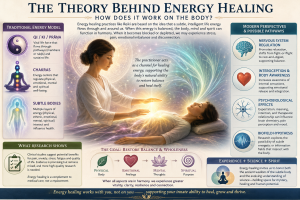
The Theory Behind Energy Healing:  How Does It Work on the Body? | Victoria Generao, PhD

For thousands of years, healing traditions have proposed that the human being is more than a collection of organs, tissues, chemicals, and electrical impulses. Beneath—or perhaps interwoven with—the physical body, these traditions describe another dimension of human life: a vital, organizing force.

Chinese traditions speak of Qi. Indian philosophy describes Prāṇa. Japanese healing systems use the concept of Ki. Western esoteric traditions have spoken of the vital force, astral light, and subtle bodies. Contemporary practitioners may simply call it the human energy field or biofield.

From this worldview arises the basic theory of energy healing:

When the energetic organization of the person becomes disturbed, the physical, emotional, mental, or spiritual person may also experience disharmony. By supporting balance within that energetic system, the practitioner seeks to encourage the person’s own capacity for restoration.

But what does that actually mean?

And perhaps more importantly, what happens to the physical body during an energy-healing session?

The answer depends upon whether we approach the question metaphysically, physiologically, psychologically, or scientifically. Rather than forcing these perspectives into opposition, it is useful to examine them side by side.


The Human Being as an Energetic Organism

Even conventional physiology recognizes that the body is not merely mechanical.

Every heartbeat is initiated through electrical activity.

The nervous system communicates through electrochemical signals.

Muscle fibers contract through changes in electrical potential across cellular membranes.

The brain produces measurable electrical activity.

Cells maintain voltage differences across their membranes.

The heart produces an electromagnetic field measurable outside the body.

None of these established biological phenomena, however, automatically proves the existence of the subtle-energy fields described in Reiki, Qigong, Therapeutic Touch, or esoteric healing traditions. This distinction is important.

When an energy healer speaks of Ki, Prāṇa, chakras, meridians, or the aura, the word energy is being used within a traditional or metaphysical model. It should not automatically be equated with electromagnetic energy measured in joules, volts, or teslas.

The National Center for Complementary and Integrative Health describes Reiki as a complementary approach based upon the idea that an energy supports the body’s natural healing abilities, while also noting that the specific energy field proposed by Reiki has not been scientifically demonstrated. (NCCIH)

We therefore encounter two different languages describing the human organism.

One is the language of biology.

The other is the language of subtle energy.

Energy healing proposes that the two may interact.

Science has not yet established that this interaction occurs through a presently measurable external energy field.


The Traditional Theory: Illness as Disturbance of Flow

Most energy-healing systems do not regard the practitioner as literally “curing” another person.

The healer instead attempts to create conditions in which greater balance can emerge.

Imagine a river.

When the river moves freely, water continually circulates through the landscape. But if debris accumulates, currents become diverted, areas stagnate, and pressure develops elsewhere.

Traditional energetic systems use remarkably similar imagery.

Energy may be described as:

  • deficient,
  • excessive,
  • stagnant,
  • blocked,
  • scattered,
  • depleted,
  • congested,
  • or unbalanced.

Healing therefore involves restoring flow, coherence, and equilibrium.

A Reiki practitioner might describe this as allowing universal life-force energy to move where it is required.

A practitioner of Chinese energetic medicine might speak of harmonizing Qi.

A yogic healer might describe balancing Prāṇa through the nāḍīs and chakras.

An esoteric healer might speak of bringing the subtle bodies into greater alignment.

Although the terminology differs, the underlying principle is strikingly similar:

Life seeks organization, balance, and wholeness.

The healer attempts to cooperate with that tendency.


The Body’s Extraordinary Capacity for Self-Regulation

Here the metaphysical and biomedical perspectives begin to approach one another.

The body constantly attempts to maintain internal stability.

Temperature is regulated.

Blood chemistry is regulated.

Blood pressure is continually adjusted.

Tissues repair themselves.

Immune cells respond to injury.

Hormones shift according to changing circumstances.

The nervous system constantly evaluates whether the organism needs to mobilize, defend, digest, repair, sleep, reproduce, or recover.

Medicine calls this regulatory tendency homeostasis, while broader contemporary models also use concepts such as allostasis—the body’s ability to adapt its internal operations to changing demands.

Energy-healing philosophies often interpret healing similarly, although through another vocabulary.

The healer is therefore not necessarily imagined as supplying something the body completely lacks.

Rather, the session is intended to help the organism return to a state in which its own regulatory processes can function more effectively.

This idea becomes especially interesting when we examine the nervous system.


The Nervous System May Be One Important Bridge

Modern life frequently places human beings into prolonged states of vigilance.

The sympathetic nervous system—the portion associated with mobilization—prepares us to respond to challenge.

Heart rate may increase.

Muscles tense.

Attention narrows.

Stress hormones may rise.

Digestion and restorative functions may temporarily become secondary.

This response is not pathological. It is essential for survival.

The problem arises when the organism has difficulty returning from mobilization into restoration.

During many energy-healing sessions, however, the conditions are almost the opposite.

The recipient lies quietly.

External stimulation decreases.

Breathing may slow.

The eyes close.

Attention turns inward.

A trusted practitioner remains quietly present.

Touch, when used, is generally gentle and noninvasive.

The recipient is essentially being given permission to stop doing.

For some people this creates profound relaxation.

And relaxation is not merely psychological.

Changing psychological states can influence breathing, muscle tension, pain perception, cardiovascular activity, attention, endocrine activity, and autonomic regulation.

Thus one scientifically plausible component of energy healing is not necessarily the transfer of an unidentified energy at all.

It may involve helping the nervous system enter a physiological environment more compatible with rest, recovery, and self-regulation.


The Parasympathetic State: From Vigilance to Restoration

The parasympathetic nervous system participates in many of the body’s quieter functions—rest, digestion, energy conservation, and recovery.

People receiving Reiki and similar therapies frequently report experiences such as:

warmth,

heaviness,

lightness,

tingling,

slowed breathing,

sleepiness,

emotional release,

a sense of expansion,

or unusually deep calm.

Energetic traditions interpret some of these sensations as evidence that energy is moving.

Biomedical science cannot presently confirm that interpretation.

But many of these experiences are also compatible with shifts in attention, relaxation, autonomic activity, sensory processing, and emotional state.

This creates an intriguing possibility.

Perhaps some of what practitioners call energetic balancing corresponds phenomenologically to a person moving from physiological vigilance toward greater regulation.

That does not prove the metaphysical theory.

But neither does it make the experience meaningless.


Healing Through Attention

There is another mechanism that receives far less attention: awareness itself.

Most of us spend enormous portions of our lives cognitively projected outward.

We are thinking about what happened yesterday.

What we need to accomplish tomorrow.

What someone said.

What might go wrong.

During an energy-healing session, attention often returns to the body.

Suddenly the recipient notices breathing.

Heartbeat.

Muscle tension.

Warmth.

Cold.

Pressure.

Emotion.

Fatigue.

Areas of comfort.

Areas of discomfort.

This inward awareness is sometimes called interoception—the perception of signals arising from within the body.

A person who becomes more sensitive to internal states may begin recognizing tension before it becomes overwhelming, exhaustion before complete depletion, or emotional activation before it turns into reactive behavior.

From an energetic perspective, the person is becoming more aware of the subtle body.

From a physiological perspective, the person may simply be becoming more conscious of bodily signals.

These interpretations are not necessarily mutually exclusive as descriptions of subjective experience.


The Healing Relationship Itself Matters

There is another element that should not be underestimated:

human presence.

A compassionate therapeutic encounter can itself alter experience.

For thirty or sixty minutes someone is effectively communicating:

You are safe enough to rest.

You do not have to perform.

You may receive.

Your discomfort is being acknowledged.

Someone is present with you.

Human beings are profoundly social organisms. Perceived safety, supportive interaction, expectation, prior experience, and therapeutic context can all influence pain and other symptoms.

This is sometimes dismissed as “just placebo.”

That description misunderstands placebo physiology.

Placebo responses can involve genuine changes in neural processing and neurochemical systems. Research on placebo analgesia, for example, has demonstrated roles for expectation, conditioning, endogenous opioid systems, and other mechanisms involved in regulating pain. (PubMed)

If ritual, expectation, attention, touch, therapeutic relationship, and perceived safety influence physiology, their effects are not imaginary simply because they originate partly through the brain.

The brain is part of the body.


The Energetic Model of the Aura and Chakras

Within metaphysical healing systems, however, the explanation goes considerably further.

The physical body is often regarded as the densest expression of several interpenetrating levels of being.

Different traditions describe these levels differently, but a typical esoteric model might include:

Physical Body → Etheric or Vital Body → Emotional or Astral Body → Mental Body → Spiritual Levels of Consciousness

The etheric body is frequently described as the energetic matrix immediately underlying physical life.

Within yogic systems, major organizing centers within the subtle body are called chakras.

Rather than viewing chakras merely as colored disks located along the spine, it may be more useful to understand them as symbolic or subtle centers through which physical, psychological, emotional, and spiritual experiences are organized.

For example:

The root center concerns embodiment, survival, stability, and belonging.

The sacral center concerns feeling, sexuality, relationship, and creativity.

The solar plexus concerns identity, power, autonomy, and action.

The heart center concerns love, grief, compassion, relationship, and integration.

The throat center concerns communication and expression.

The brow center concerns perception, imagination, and insight.

The crown concerns transcendence and relationship with the Sacred.

In energy-healing theory, prolonged disturbance within one level of the human being may eventually influence another.

An emotional pattern may produce chronic muscular tension.

Fear may influence breathing.

Grief may profoundly alter sleep, appetite, and energy.

Chronic physical pain may alter mood and cognition.

The metaphysical model interprets these interactions as movements occurring between layers of the subtle and physical organism.

Modern medicine describes many of them through nervous, endocrine, immune, behavioral, and psychological pathways.

Different maps.

Sometimes remarkably similar territory.


What Is the Practitioner Actually Doing?

One of the greatest misconceptions concerning energy healing is that the healer is pouring personal energy into the recipient.

Most mature traditions explicitly discourage this interpretation.

In Reiki, for example, the practitioner ideally functions as a conduit rather than a battery.

The healer does not force the recipient into healing.

The healer establishes a therapeutic field or condition in which healing may occur.

This concept has parallels throughout mystical traditions.

The healer becomes quiet.

Attention becomes focused.

Intention becomes singular.

Personal concerns temporarily recede.

The practitioner attempts to become receptive rather than controlling.

In metaphysical language, the healer aligns with a greater organizing intelligence.

In psychological language, the healer enters a highly regulated state of sustained compassionate attention.

Whether those descriptions ultimately refer to one phenomenon or two remains an open philosophical question.


Resonance and Entrainment: An Attractive but Unproven Hypothesis

Energy healers frequently use the concept of resonance.

A well-known physical analogy is that of two tuning forks.

Strike one tuning fork near another tuned to the same frequency and the second may begin vibrating sympathetically.

Energy-healing traditions propose something analogous between living systems.

A coherent practitioner, according to this theory, creates conditions in which a dysregulated recipient can gradually move toward greater coherence.

This is sometimes described as entrainment.

The analogy is elegant.

But it should remain an analogy unless direct biological evidence demonstrates the proposed subtle-energy mechanism.

There is research investigating physiological changes during biofield practices, including EEG and heart-rate variability, but a systematic review found that results were inconsistent and did not establish a unique physiological signature of the healer’s state. (PubMed)

Thus, resonance remains an intriguing theoretical model rather than an established explanation of energy healing.


Does Science Show That Reiki Works?

This is where precision matters.

The scientific literature is neither equivalent to saying “energy healing has been proven” nor accurately summarized by saying “nothing ever happens.”

Recent clinical studies have reported reductions in symptoms such as pain, anxiety, and stress in some populations.

For example, a randomized study published in 2025 involving cancer patients reported greater improvements in several subjective outcomes among participants receiving Reiki, although cortisol did not differ significantly between groups. (PubMed)

Another recent randomized placebo-controlled trial reported improvements in pain, anxiety, heart rate, and some cardiovascular measures among mechanically ventilated patients receiving Reiki compared with sham Reiki. (PubMed)

A 2025 meta-analysis examining randomized trials also reported improvements in quality-of-life outcomes associated with Reiki. (PubMed)

Yet this must be balanced against the larger evidence base.

Research varies considerably in quality, intervention design, sample size, comparison groups, practitioner training, blinding procedures, and outcome measurement.

A recent systematic review examining Reiki and Therapeutic Touch in palliative care found some promising symptom reports but concluded that the overall evidence remained limited and heterogeneous. (PubMed)

NCCIH likewise states that Reiki has not been clearly demonstrated to be effective for a specific health purpose and that research results remain inconsistent. (NCCIH)

The fairest conclusion at present is therefore:

People can experience meaningful subjective and sometimes measurable physiological changes during energy-healing interventions, but science has not established that these effects occur because a distinct subtle energy is being transferred or manipulated.

That distinction is crucial.


Perhaps the Better Question Is Not “Is Energy Real?”

The conversation surrounding energy healing often becomes trapped between two extremes.

One side insists:

“Science hasn’t measured the energy, therefore the entire experience is meaningless.”

The other insists:

“People experience effects, therefore the metaphysical explanation must already be scientifically proven.”

Neither position is necessary.

A more intellectually useful position is:

Something may be happening during these healing encounters. We should carefully investigate what components produce the effects.

Perhaps relaxation matters.

Perhaps expectation matters.

Perhaps touch matters.

Perhaps meditative attention matters.

Perhaps human connection matters.

Perhaps changes in autonomic regulation matter.

Perhaps ritual matters.

Perhaps consciousness plays roles we do not yet fully understand.

And perhaps future research will identify additional mechanisms.

Science advances precisely because unanswered questions remain unanswered long enough to be investigated properly.


The Metaphysical Interpretation: Healing as Restoration of Coherence

From an esoteric perspective, healing is not simply the removal of symptoms.

It is the restoration of right relationship.

Body with mind.

Mind with emotion.

Personality with soul.

Individual with community.

Human being with nature.

Finite self with the Sacred.

Disease, in this wider philosophical model, does not necessarily represent punishment or spiritual failure. Nor should illness ever be blamed upon someone’s supposed “negative energy.”

Rather, healing becomes the continuing process by which fragmented aspects of ourselves are brought back toward integration.

The healer therefore does not battle the body.

The healer listens.

The healer does not command the life-force.

The healer cooperates with it.

The healer does not impose wholeness.

The healer creates space in which wholeness may reveal itself.


Where Reiki Fits Into This Model

Reiki provides one of the clearest expressions of this philosophy.

The word is commonly interpreted through the Japanese concepts Rei and Ki, broadly pointing toward spiritual or universal reality and vital life energy.

During a Reiki session, the practitioner places the hands lightly upon or just above various areas of the recipient’s body.

There is no massage.

There is no physical manipulation.

There is often very little conversation.

From the traditional perspective, Reiki moves according to the recipient’s need rather than according to the practitioner’s personal will.

The healer becomes the intermediary.

The recipient becomes receptive.

Healing becomes less an act of doing and more an act of allowing.

Whether interpreted spiritually or psychologically, that principle may be one of Reiki’s most profound teachings.

Modern humanity is extremely practiced at effort.

We are considerably less practiced at receptivity.


Energy Healing as Ritualized Stillness

There may therefore be another way of understanding these practices.

Energy healing creates ritualized stillness.

For a defined period of time:

the phone stops,

the conversation stops,

the demands stop,

the obligations stop,

the outward performance of identity stops.

The recipient enters a liminal space.

The practitioner enters focused presence.

The ordinary world becomes temporarily quieter.

Whatever else may or may not be happening energetically, this alone changes the conditions under which the nervous system is operating.

And sometimes healing begins not because something dramatic has been added—

but because something exhausting has finally been removed.


Healing Is Not the Same as Curing

Perhaps the most important distinction in any discussion of energy work is the difference between healing and curing.

Curing concerns the elimination or successful treatment of disease.

Healing is broader.

A person may experience healing while still living with illness.

Someone may find peace while receiving cancer treatment.

A grieving person may begin integrating loss.

Someone with chronic pain may discover moments of profound calm.

A dying person may experience reconciliation, meaning, or spiritual acceptance.

None of these experiences necessarily cures disease.

Yet few would call them insignificant.

Energy healing may therefore be best understood not as a replacement for medicine, but as a complementary practice concerned with the human dimensions that medicine does not always have sufficient time to address:

presence,

rest,

meaning,

touch,

attention,

relationship,

spirituality,

and the experience of wholeness.


The Mystery Behind the Mechanism

We ultimately arrive at a fascinating threshold.

Traditional healers say that life-force moves through us.

Biology says that the organism possesses extraordinarily complex mechanisms of regulation and repair.

Psychology demonstrates that expectation, perception, emotion, attention, and relationship influence bodily experience.

Neuroscience demonstrates that changing states of consciousness can alter pain processing and neurophysiology.

Medicine demonstrates that the body is continuously attempting to regulate itself.

Energy healing gathers all of these questions into a single encounter between practitioner and recipient.

Does an independent subtle biofield exist?

Science has not yet established that it does.

Can people nonetheless experience relaxation, comfort, altered pain perception, emotional release, and meaningful changes during energy-healing sessions?

Yes, such experiences are reported, and some clinical studies have observed measurable differences—although the evidence remains inconsistent and the mechanisms unresolved. (PubMed)

And so energy healing occupies an unusual territory.

It sits between ancient metaphysics and modern physiology.

Between subjective experience and objective measurement.

Between ritual and medicine.

Between what humanity has believed for millennia and what experimental science can presently demonstrate.

Perhaps that is precisely why the subject remains so compelling.

For underneath every system of healing lies essentially the same question:

What allows a living being to move from disorder toward greater wholeness?

Energy-healing traditions answer:

Restore the flow.

Physiology answers:

Restore regulation.

Psychology answers:

Restore safety and integration.

Mysticism answers:

Restore relationship with the Source.

Perhaps these are entirely different explanations.

Or perhaps, seen from a sufficiently broad perspective, they are different languages describing humanity’s ancient search for the same mystery:

the innate movement of life toward balance, coherence, and wholeness.


A Responsible Place for Energy Healing

Energy healing is most appropriately regarded as a complementary practice, not a substitute for evidence-based diagnosis or treatment. Persistent pain, infection, neurological symptoms, cardiovascular symptoms, unexplained weight loss, severe psychiatric symptoms, or other significant health concerns require appropriate professional medical evaluation.

Using Reiki or another contemplative healing practice alongside appropriate healthcare allows the metaphysical question to remain open without asking the practice to perform a medical role that current evidence cannot justify.

That approach leaves room for both discernment and mystery—and perhaps that is exactly where meaningful inquiry into healing should begin.


Annotated Bibliography

The Theory Behind Energy Healing — How Does It Work on the Body?

Introduction

The literature surrounding energy healing spans several very different intellectual traditions. Some sources approach healing through the traditional concepts of Qi, Ki, Prāṇa, chakras, subtle bodies, and the human energy field. Others attempt to formulate a scientific concept of the biofield, while still others investigate measurable outcomes such as pain, anxiety, quality of life, heart-rate variability, relaxation, or nervous-system regulation.

These categories should not be confused with one another. Biological electricity and electromagnetic activity are established physiological phenomena; their existence does not, by itself, prove the existence of the subtle energy proposed in Reiki and comparable systems. Likewise, clinical improvement following an energy-healing intervention does not necessarily identify the mechanism responsible for that improvement.

The following bibliography therefore intentionally brings together traditional sources, esoteric models, clinical research, physiology, psychology, and critical scientific evaluation.

I. Reiki and the Traditional Energy-Healing Model

Logan, B., & Stiene, F. (2024). The Reiki sourcebook: A timeless reference book for Reiki practitioners of all levels. O-Books.

This extensive reference work examines Reiki’s Japanese origins, practices, teachings, lineages, symbols, attunements, and subsequent development in the West. It is particularly useful for distinguishing historically grounded Reiki practice from many concepts that were later incorporated into Western Reiki culture. The work helps establish what practitioners mean by Ki, energetic balance, hands-on healing, and the practitioner’s role. It should be treated primarily as a historical and practitioner-oriented source rather than as biomedical evidence. For a blog addressing the theory behind energy healing, it provides valuable context concerning how Reiki itself understands the healing process.

Miles, P. (2008). Reiki: A comprehensive guide. Tarcher.

Pamela Miles presents Reiki from the perspective of a long-term practitioner who has worked to introduce the practice into conventional healthcare environments. The book describes Reiki as a gentle, nonmanipulative practice intended to support the body’s natural healing response rather than replace medical treatment. Miles is especially useful for explaining the distinction between the practitioner as a facilitator and the mistaken idea that the practitioner personally forces healing into another person. The book provides an accessible bridge between traditional Reiki philosophy and contemporary integrative-health language, though its therapeutic claims should be evaluated separately from controlled clinical research.

National Center for Complementary and Integrative Health. (n.d.). Reiki. U.S. Department of Health and Human Services, National Institutes of Health.

NCCIH provides an essential scientific and medical counterbalance to practitioner literature. It defines Reiki as a complementary practice in which practitioners place their hands lightly on or above a person with the intention of facilitating the person’s healing response. Importantly, NCCIH notes that research regarding Reiki’s effectiveness remains inconsistent and that there is currently no scientific evidence demonstrating the existence of the specific energy field proposed in Reiki theory. This source is particularly important for maintaining scholarly integrity when discussing Reiki as a metaphysical or complementary practice rather than presenting its traditional explanatory mechanism as established biomedical fact.

II. The Biofield Hypothesis and Energy Medicine

Rubik, B., Muehsam, D., Hammerschlag, R., & Jain, S. (2015). Biofield science and healing: History, terminology, and concepts. Global Advances in Health and Medicine, 4(Suppl.), 8–14. DOI: 10.7453/gahmj.2015.038.suppl

This article provides one of the most useful scholarly introductions to the modern concept of the biofield. The authors review historical ideas about vital forces and biological fields while attempting to develop terminology that can be used in scientific research. Of particular value is the distinction between known electromagnetic processes and proposed organizing fields that remain hypothetical. The article is useful for discussing attempts to build a conceptual bridge between traditional subtle-energy systems and biophysics. It should nevertheless be recognized as a theoretical framework within an emerging and controversial research area rather than evidence that a Reiki-like biofield has been conclusively demonstrated.

Oschman, J. L. (2015). Energy medicine: The scientific basis (2nd ed.). Churchill Livingstone/Elsevier.

Oschman explores biological electricity, electromagnetism, connective tissue, cellular signaling, resonance, regulatory processes, and proposed energetic mechanisms involved in healing. His work is influential within integrative and energy-medicine circles because it attempts to connect energy-healing theory with known principles of physiology and biophysics. Chapters addressing electrophysiology, bioelectromagnetism, acupuncture, resonance, and the body’s regulatory systems are particularly relevant to the present topic. However, readers should distinguish carefully between well-established biological phenomena discussed in the book and broader theoretical interpretations that remain debated. It is most useful as a hypothesis-generating interdisciplinary source, not as definitive proof of subtle-energy healing.

Jain, S., Hammerschlag, R., Mills, P., Cohen, L., Krieger, R., Vieten, C., & Lutgendorf, S. (2015). Clinical studies of biofield therapies: Summary, methodological challenges, and recommendations. Global Advances in Health and Medicine, 4(Suppl.), 58–66. DOI: 10.7453/gahmj.2015.034.suppl

This paper reviews clinical studies involving Reiki, Healing Touch, Therapeutic Touch, and related biofield therapies while also examining the methodological problems inherent in studying them. These include practitioner variability, treatment dose, sham-healing controls, blinding, small sample sizes, and uncertainty about what mechanism is actually being tested. The article is particularly useful because it neither simply dismisses biofield therapies nor assumes that their proposed mechanisms have been proven. It demonstrates how researchers can investigate patient outcomes even while the underlying mechanism remains unresolved. This makes it an excellent source for framing energy healing as an area of legitimate inquiry that still requires substantially better research.

Baldwin, A. L., & Hammerschlag, R. (2014). Biofield-based therapies: A systematic review of physiological effects on practitioners during healing. Explore, 10(3), 150–161. DOI: 10.1016/j.explore.2014.02.003

This systematic review asks an unusually important question: Does the healer enter a distinctive physiological state while performing biofield healing? The authors examined studies measuring variables such as electroencephalography and heart-rate variability. Findings were inconsistent, and the authors concluded that robust evidence of a unique physiological state characteristic of biofield healers had not emerged. This study is particularly valuable because it tests one aspect of the energetic hypothesis rather than merely measuring whether patients report feeling better. It provides an important caution against making unsupported claims concerning measurable “healing frequencies” or physiological signatures in practitioners.

III. Clinical Evidence for Reiki and Related Practices

Liu, K., Qin, Z., Qin, Y., Li, Y., Liu, Q., Gao, F., Zhang, P., & Wang, W. (2025). Effects of Reiki therapy on quality of life: A meta-analysis of randomized controlled trials. Systematic Reviews, 14(1), 72. DOI: 10.1186/s13643-025-02811-5

This 2025 meta-analysis examined randomized controlled trials investigating Reiki and quality of life. The combined sample included 661 participants, and the analysis found a statistically significant but modest improvement in quality-of-life measures associated with Reiki. The study is important because meta-analysis provides a broader view than individual trials. At the same time, positive pooled results do not establish that subtle-energy transfer caused the observed improvements. Factors such as relaxation, attention, expectancy, practitioner interaction, and treatment setting remain possible contributors. This source supports the position that Reiki deserves continued research while avoiding the stronger claim that its traditional mechanism has been proven.

Pontes-Gomes, R., & Reis-Pina, P. (2026). Reiki and Therapeutic Touch for symptom burden and quality of life in palliative settings: A systematic review. Palliative Medicine, 40(7), 958–970. DOI: 10.1177/02692163261437606

This recent systematic review examined Reiki and Therapeutic Touch in palliative and end-of-life care. Nine studies involving 415 participants were included. Some reported improvements in pain, anxiety, depression, fatigue, stress, sleep, relaxation, hope, and emotional well-being. However, the authors emphasized methodological limitations, heterogeneous interventions, risk of bias, and very low certainty of evidence, preventing firm conclusions about effectiveness. This is an especially valuable source because it illustrates the nuanced state of contemporary research: patient benefits are sometimes reported, yet stronger evidence is required. It reinforces the responsible use of energy healing as complementary supportive care rather than a substitute for established medical treatment.

Avci, A., & Gün, M. (2023). The effect of Reiki on pain applied to patients with cancer: A systematic review. Holistic Nursing Practice, 37(5), 268–276. DOI: 10.1097/HNP.0000000000000601

Avci and Gün reviewed seven experimental and quasi-experimental studies involving 572 cancer patients. Five studies reported reductions in pain following Reiki, while two did not demonstrate an effect. The authors therefore concluded that Reiki may have potential for pain management but emphasized the limited number of high-quality studies and the need for additional randomized controlled trials. The article is useful in discussing one of the most common reported benefits of energy-healing sessions: decreased pain or altered pain perception. Importantly, the findings establish neither cure nor proof of subtle-energy transmission; they concern reported clinical outcomes.

Jain, S., & Mills, P. J. (2010). Biofield therapies: Helpful or full of hype? A best evidence synthesis. International Journal of Behavioral Medicine, 17(1), 1–16. DOI: 10.1007/s12529-009-9062-4

This influential review examined dozens of clinical studies involving Reiki, Healing Touch, Therapeutic Touch, and related approaches. The authors reported evidence suggesting potential benefit for some outcomes, particularly pain and anxiety, while also noting substantial methodological limitations across the literature. The article remains important because it helped establish a framework for evaluating biofield therapies using conventional evidence standards. It is particularly useful when discussing why subjective symptom improvement should be taken seriously while simultaneously recognizing that improvements in symptoms do not prove a specific energetic mechanism.

Hammerschlag, R., Marx, B. L., & Aickin, M. (2014). Nontouch biofield therapy: A systematic review of human randomized controlled trials reporting use of only nonphysical contact treatment. Journal of Alternative and Complementary Medicine, 20(12), 881–892. DOI: 10.1089/acm.2014.0017

This review focuses specifically on energy-healing interventions performed without physical contact, making it particularly relevant to claims that energy can act independently of touch. Twenty-eight randomized controlled trials met the initial criteria, although several were excluded because of methodological quality concerns. Some of the better-quality studies reported beneficial outcomes, but the authors stressed that the small sample sizes and pilot nature of the research prevented strong conclusions. The study is useful because removing touch from the intervention helps researchers examine whether effects can be explained solely through tactile stimulation, although expectation, attention, context, and other variables remain difficult to eliminate completely.

Hammerschlag, R., Sprengel, M., & Baldwin, A. L. (2024). Biofield therapies: Guidelines for reporting clinical trials. Journal of Integrative and Complementary Medicine, 30(2), 133–145. DOI: 10.1089/jicm.2024.29128.rh

This methodological paper provides formal recommendations for improving research on External Qigong, Healing Touch, Reiki, Therapeutic Touch, and related therapies. Its importance lies not in proving or disproving energy healing but in establishing better standards for testing it. Detailed reporting of practitioner background, intervention procedures, treatment dose, controls, outcomes, and study design allows future trials to become more reproducible and scientifically interpretable. This source is excellent for demonstrating that energy healing remains a developing research area in which improved methodology is essential before strong conclusions concerning mechanisms can be reached.

IV. Nervous-System Regulation, Body Awareness, and Plausible Physiological Pathways

Khalsa, S. S., Adolphs, R., Cameron, O. G., Critchley, H. D., Davenport, P. W., Feinstein, J. S., Feusner, J. D., Garfinkel, S. N., Lane, R. D., Mehling, W. E., Meuret, A. E., Nemeroff, C. B., Oppenheimer, S., Petzschner, F. H., Pollatos, O., Rhudy, J. L., Schramm, L. P., Simmons, W. K., Stein, M. B., Stephan, K. E., Van den Bergh, O., Van Diest, I., von Leupoldt, A., & Paulus, M. P. (2018). Interoception and mental health: A roadmap. Biological Psychiatry: Cognitive Neuroscience and Neuroimaging, 3(6), 501–513. DOI: 10.1016/j.bpsc.2017.12.004

This major review explains interoception, the nervous system’s sensing and interpretation of signals arising from within the body. Interoception contributes to emotion, bodily awareness, homeostasis, cognition, and self-regulation. The concept is highly relevant to energy healing because recipients frequently become intensely aware of warmth, tingling, breathing, heartbeat, pressure, tension, relaxation, or other internal sensations during sessions. Interoceptive science provides a credible physiological framework for understanding such experiences without requiring that every sensation be attributed to an external subtle energy. It therefore creates an important conceptual bridge between subjective energetic experience and neuroscience.

Benedetti, F. (2008). Placebo effects: Understanding the mechanisms in health and disease. Oxford University Press.

Benedetti’s work is foundational for understanding why therapeutic context, expectation, conditioning, ritual, practitioner interaction, and belief can influence symptoms through genuine neurobiological mechanisms. Placebo effects are not equivalent to imaginary symptoms; they can involve measurable changes in pain-processing pathways, endogenous opioids, dopamine, expectation, and learning. This source is essential for a sophisticated discussion of energy healing because some benefits experienced during a session may arise through contextual and psychobiological pathways. Recognizing such mechanisms does not invalidate a person’s experience. Rather, it demonstrates how profoundly meaning, expectation, relationship, and consciousness can interact with physiology.

V. Traditional Concepts of Vital Energy

Kaptchuk, T. J. (2000). The web that has no weaver: Understanding Chinese medicine (Rev. ed.). Contemporary Books.

Kaptchuk provides one of the most influential Western-language introductions to the philosophical and diagnostic framework of Chinese medicine. Particularly relevant is his treatment of Qi, which should not be reduced simplistically to electricity or a Western physics concept of energy. In traditional Chinese medicine, Qi participates in a much broader model involving movement, function, pattern, relationship, transformation, and balance. This book is valuable for demonstrating that traditional energetic language exists within a complete medical-philosophical worldview. It helps prevent the common error of assuming that every traditional reference to “energy” means electromagnetic energy in the modern scientific sense.

VI. Western Esoteric Models of the Subtle Body

Brennan, B. A. (1988). Hands of light: A guide to healing through the human energy field. Bantam Books. (Original work published 1987)

Barbara Brennan’s work became one of the most influential modern Western presentations of the human energy field, aura, chakras, subtle bodies, and hands-on healing. Brennan proposes multiple layers of energetic organization corresponding to physical, emotional, mental, and spiritual aspects of the person. The work strongly influenced contemporary energy-healing culture and is especially relevant to the blog’s discussion of the etheric, emotional, mental, and spiritual bodies. It should, however, be identified explicitly as an experiential and metaphysical model, not as an established anatomical or biophysical description of the human organism.

Leadbeater, C. W. (1927). The chakras. Theosophical Publishing House.

Leadbeater’s text was instrumental in shaping the modern Western esoteric understanding of chakras. Drawing upon Theosophy, clairvoyant interpretation, Indian concepts, and Western occultism, he described chakras as subtle force centers interacting with vitality and consciousness. The book strongly influenced subsequent New Age, occult, and energy-healing representations of the chakra system. Historically, it is important because many contemporary Western assumptions about chakra colors, functions, and appearances owe as much to twentieth-century Theosophy as to classical Indian texts. It should therefore be used as a historical esoteric source rather than scientific evidence concerning human anatomy.

VII. Recommended Interpretive Framework

Taken collectively, these sources suggest that energy healing should be studied through several overlapping but distinct explanatory layers.

1. Traditional-Energetic Layer

Reiki, Chinese medicine, yogic systems, and Western esoteric traditions describe a vital principle—Ki, Qi, Prāṇa, vital force, or subtle energy—whose balanced movement is associated with health and vitality.

This model is metaphysical and traditional rather than established biophysical fact.

2. Biofield Hypothesis

Contemporary biofield researchers have proposed that living organisms may exhibit organizing energetic or informational processes that deserve systematic investigation.

Known biological electromagnetic phenomena clearly exist, but these should not automatically be equated with the proposed subtle biofield of Reiki and related practices.

3. Autonomic and Regulatory Layer

Quiet environments, reduced stimulation, meditative attention, breathing changes, gentle touch, and perceived safety can affect nervous-system activity.

The transition from heightened vigilance toward relaxation may therefore account for some of the restorative experiences reported during energy healing.

4. Interoceptive Layer

Healing sessions increase awareness of internal bodily sensations.

Warmth, tingling, heaviness, pulsing, pressure, emotional release, and changes in breathing may consequently reflect changes in interoceptive attention and sensory processing, whether or not a subtle-energy interpretation is also adopted.

5. Psychobiological Layer

Expectation, ritual, therapeutic relationship, meaning, conditioning, attention, and practitioner presence can alter pain and other symptoms through real neurobiological mechanisms.

These effects should not be dismissed as “imaginary.”

6. Clinical-Outcome Layer

Some clinical trials and reviews report improvements in pain, anxiety, stress, fatigue, relaxation, and quality of life following Reiki or related interventions.

The findings remain heterogeneous, and methodological limitations prevent the conclusion that a specific subtle-energy mechanism has been proven.

7. Metaphysical Layer

Within esoteric philosophy, healing represents more than symptom reduction.

It is the restoration of coherence and right relationship among the physical, vital, emotional, mental, and spiritual dimensions of the person.

This is best presented as a spiritual and philosophical model rather than a medical claim.


Conclusion

The bibliography demonstrates why the subject of energy healing cannot be responsibly reduced either to the statement “science has proven subtle energy” or to the statement “nothing happens.”

Current research occupies a more interesting middle ground.

Some recipients demonstrably report meaningful changes in pain, stress, relaxation, anxiety, and quality of life. Physiological mechanisms involving autonomic regulation, interoception, therapeutic context, expectation, attention, and human relationship offer plausible explanations for at least some of these effects.

At the same time, the traditional theory proposes something more: that the human being participates in an organizing field of life that extends beyond presently understood biochemical mechanisms.

That proposition remains scientifically unresolved.

For the student of energy healing, this distinction is not a weakness. It creates an important intellectual discipline:

experience may be honored without converting belief into scientific fact, and science may be respected without assuming that every mystery of human healing has already been solved.

The most fruitful position is therefore one of informed inquiry—placing ancient models of Qi, Ki, Prāṇa, chakras, subtle bodies, and vital force into conversation with contemporary research on the biofield, nervous system, homeostasis, interoception, psychobiology, consciousness, and therapeutic relationship.

In that conversation lies one of the most compelling questions in healing:

What allows a living organism to move from fragmentation and dysregulation toward coherence, adaptation, and wholeness?
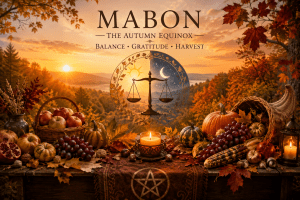
 

Mabon | The Autumn Equinox, the Harvest, and the Mystery of Balance | Victoria Generao, PhD

There comes a moment each year when summer loosens its hold upon the Earth.

The blazing fullness of the Sun begins to soften. Fields that only weeks before stood green and growing become gold, russet, amber, and brown. Fruit hangs heavily from branches. Grain bends upon its stalk. The air changes. Mornings become cooler, shadows grow longer, and evening seems to arrive a little sooner each day.

In the Northern Hemisphere, this threshold is marked astronomically by the September equinox, the point at which the Sun crosses the celestial equator as it journeys southward. It marks the beginning of astronomical autumn. Although the word equinox derives from the Latin for “equal night,” daylight and darkness are not literally identical in duration on the equinox because atmospheric refraction and the way sunrise and sunset are measured make daylight slightly longer. Symbolically, however, the image of light and darkness standing in equilibrium has become one of the defining themes of the season. (NOAA Satellites)

Within many contemporary Pagan traditions, this autumnal turning of the year is celebrated as Mabon.

Mabon is a festival of harvest, gratitude, balance, completion, preparation, and the recognition that every season of abundance must eventually give way to a season of rest.

Yet Mabon has an especially interesting history, because the festival as modern Pagans know it is both ancient in its seasonal symbolism and distinctly modern in its name.

Understanding that distinction does not diminish Mabon. In many ways, it makes the festival more fascinating.

The Harvest Before There Was “Mabon”

Long before the word Mabon was associated with the autumn equinox, agricultural peoples throughout Europe and elsewhere observed the harvest season with feasting, thanksgiving, offerings, communal labor, and preparation for winter.

For an agricultural society, harvest was not merely picturesque.

It was survival.

Grain stored in barns, fruit dried or preserved, livestock managed, seeds saved, and food successfully gathered determined whether a community could endure the approaching winter.

The harvest therefore carried both joy and solemnity.

There was gratitude because the Earth had provided.

There was relief because labor had produced its fruit.

But beneath that gratitude lay another awareness: winter was coming.

This combination of abundance and impermanence remains at the heart of Mabon today.

The laden harvest table contains within itself the memory of the empty field.

The ripe apple already carries its seeds.

The grain that is cut down becomes both bread and the promise of another planting.

Nature teaches a strange but beautiful truth at this season:

Fulfillment and ending often arrive together.

Is Mabon an Ancient Celtic Festival?

This is where historical precision becomes important.

It is common in popular books and websites to encounter statements suggesting that ancient Celts celebrated a festival called Mabon at the autumn equinox.

There is no good historical evidence for this.

The name Mabon, as a designation for the Pagan autumn equinox, is a product of the modern Pagan revival.

The term was introduced into modern Pagan usage by American Pagan scholar and ritualist Aidan Kelly while he was creating a Pagan calendar in 1974. Kelly later explained that he wanted the solstices and equinoxes to possess mythologically evocative names similar to the established Gaelic festival names such as Samhain and Beltane. For the autumn equinox he selected the name of the Welsh mythological figure Mabon ap Modron. (Patheos)

The name subsequently circulated through the influential Pagan publication Green Egg and gradually entered the vocabulary of American Paganism. By the late twentieth century, “Mabon” had become one of the commonly used names for the autumn equinox within Wiccan and Wicca-influenced traditions. (Patheos)

Historian Ronald Hutton has discussed this development as an example of the way modern Pagan traditions consciously create meaningful ritual forms by drawing upon older mythological, folkloric, and seasonal materials. (Taylor & Francis Online)

Thus the most historically accurate statement is:

Mabon is a modern Pagan festival built around a genuinely ancient seasonal reality.

People have celebrated harvests for millennia.

The autumn equinox is an astronomical event as old as the Earth’s seasonal cycle.

But calling the Pagan autumn equinox Mabon is a twentieth-century development.

Who Is Mabon ap Modron?

The name was not invented from nothing.

Mabon ap Modron belongs to medieval Welsh literary tradition.

His name is generally interpreted as “Mabon, son of Modron,” with Mabon associated etymologically with the idea of the divine youth or son and Modron with the mother.

Mabon appears prominently in the Welsh tale Culhwch and Olwen, preserved within the collection commonly called the Mabinogion. Medieval manuscripts such as the White Book of Rhydderch, copied during the fourteenth century, preserve these Welsh narratives, although many of the stories themselves derive from much older oral traditions. (National Library of Wales)

In Culhwch and Olwen, Mabon has been taken from his mother when he is only three nights old.

His whereabouts are unknown.

To find him, Arthur’s companions undertake a remarkable quest, questioning increasingly ancient creatures—the blackbird, stag, owl, eagle, and finally the great salmon.

Eventually Mabon is discovered imprisoned at Gloucester and is liberated.

The National Library of Wales’ Welsh Classical Dictionary describes the legendary Mabon as a figure of extraordinary antiquity whose rescue becomes essential to the later hunting of the magical boar Twrch Trwyth. The same source also notes the relationship scholars have proposed between Mabon and the older Celtic deity Maponos. (National Library of Wales)

The myth therefore contains powerful themes:

the divine child,

separation from the mother,

imprisonment,

the descent into hidden places,

the wisdom of ancient creatures,

discovery,

liberation,

and return.

Aidan Kelly saw in these themes an appropriate mythological image for the autumnal mystery and deliberately associated Mabon with the equinox. That connection is modern rather than a demonstrable survival of an ancient Welsh equinox festival. (Patheos)

But symbolically, the association is striking.

The Second Harvest

Within the contemporary eightfold Wheel of the Year, Mabon is often described as the Second Harvest.

The cycle commonly begins its harvest sequence with Lughnasadh or Lammas, around August 1, traditionally associated with grain and the first fruits of harvest.

Mabon follows at the autumn equinox.

Then comes Samhain, when the agricultural year reaches another profound threshold and the dark half of the year becomes dominant.

Seen in this way, the harvest does not occur in a single moment.

It unfolds.

First comes the grain.

Then come the fruits, vines, orchards, nuts, vegetables, and later crops.

Finally comes the preparation for winter.

Mabon therefore occupies an important position between abundance and withdrawal.

The Earth has given much.

But she is beginning to turn inward.

The Mystery of the Scales

The most recognizable spiritual symbolism of Mabon is balance.

Light and darkness appear poised at the threshold.

Neither dominates completely.

Summer stands behind us.

Winter waits ahead.

Mabon therefore occupies a liminal place—a doorway between worlds of experience.

This makes the autumn equinox an especially useful time for contemplation.

Where is there imbalance in my life?

Where have I given too much?

Where have I withheld too much?

What have I cultivated successfully?

What has failed to bear fruit?

What should be preserved?

What should be allowed to die away?

These are profoundly autumnal questions.

Balance, however, does not mean remaining motionless between opposites.

The equinox itself proves this.

The moment of equilibrium is fleeting.

Immediately afterward, the Northern Hemisphere continues its movement toward longer nights.

True equilibrium is therefore not stagnation.

It is the ability to remain centered while change is occurring.

That is a deeper spiritual teaching.

The Harvest as a Mirror of the Soul

The field offers one of humanity’s oldest metaphors for spiritual life.

Every thought is a seed.

Every repeated action becomes cultivation.

Every habit creates a field.

Eventually there is a harvest.

At Mabon, we may therefore look upon our lives as though standing before an inner field.

What did we plant earlier in the year?

What did we nourish?

What did we neglect?

What has now matured?

Some harvests are visible.

A finished project.

A relationship strengthened.

A skill learned.

A business built.

A student taught.

A promise fulfilled.

Other harvests are hidden.

Wisdom.

Patience.

Discernment.

Forgiveness.

Courage.

The ability to say no.

The ability to say yes.

The strength to leave something behind.

Mabon invites us to acknowledge both.

Gratitude as Sacred Reciprocity

Modern Mabon celebrations frequently emphasize gratitude, and this fits naturally with harvest symbolism.

But gratitude in older agricultural societies was not merely sentiment.

It arose from dependence.

Human beings knew that they did not create the rain.

They did not create sunlight.

They did not create fertile soil.

They cooperated with forces far greater than themselves.

That awareness can easily disappear in modern life, where food arrives packaged and seasons can seem distant from everyday survival.

Mabon restores perspective.

The loaf of bread represents soil, seed, rain, sunlight, farmer, miller, baker, transportation, labor, and time.

The apple contains tree, blossom, bee, rainfall, Earth, and season.

To eat consciously is therefore to participate in an enormous web of relationship.

Mabon asks us to remember the invisible hands and powers that sustain our visible lives.

The Descent Into Darkness

Mabon is not merely a festival of abundance.

It is also a preparation for darkness.

After the autumn equinox in the Northern Hemisphere, nights continue to lengthen until the winter solstice.

Symbolically, the descent begins.

Yet darkness need not mean evil.

In mystical traditions, darkness may represent gestation, mystery, incubation, dream, silence, unconsciousness, initiation, and the hidden womb from which new life eventually emerges.

Seeds germinate beneath soil.

Children develop within the darkness of the womb.

Dreams arise when the eyes close.

Mysteries are often discovered only when ordinary sight fails.

Mabon therefore teaches that the dark half of the year is not simply something to endure.

It is something to enter consciously.

The outward harvest eventually becomes an inward journey.

Symbols of Mabon

Contemporary Mabon practice has accumulated a rich vocabulary of seasonal symbols.

Apples are especially powerful.

When an apple is cut horizontally, its seeds frequently reveal a five-pointed pattern reminiscent of the pentagram. For many modern esoteric practitioners, the apple therefore becomes an emblem of hidden wisdom contained inside ordinary nature.

Grapes and wine symbolize transformation—the fruit crushed so that another substance may emerge.

Grain represents sacrifice, nourishment, regeneration, and the ancient mystery of seed becoming food and food sustaining life.

Cornucopias represent abundance.

Autumn leaves remind us that beauty does not disappear merely because something is ending.

Acorns carry enormous possibility within tiny forms.

Pomegranates, especially through the Greek myth of Persephone, evoke descent into the underworld and the cyclical return from darkness.

None of these symbols needs to belong exclusively to Mabon. Rather, contemporary practitioners gather them into a seasonal symbolic language through which autumn may be contemplated.

Mabon and the Wheel of the Year

The modern Pagan Wheel of the Year presents nature not as a straight line but as a circle.

Birth becomes growth.

Growth becomes maturity.

Maturity becomes harvest.

Harvest becomes decline.

Decline becomes death.

Death becomes gestation.

Gestation becomes birth again.

Within that cycle, Mabon represents the moment when we can finally see what our previous actions have produced.

It is therefore both a celebration and an accounting.

There is an old spiritual law hidden within every harvest:

We eventually meet what we have cultivated.

The farmer cannot harvest wheat from a field planted with barley.

Likewise, repeated choices eventually become character.

Repeated thoughts become patterns of consciousness.

Repeated acts become destiny.

Mabon therefore carries an ethical dimension.

The harvest does not judge us.

It simply reveals the nature of the seeds.

Celebrating Mabon Today

A contemporary Mabon observance may be elaborate or very simple.

One might prepare a meal from seasonal foods, bake bread, drink cider or wine, decorate an altar with apples and autumn leaves, walk through a forest, donate food, share a meal with friends, or simply watch the sunset.

One particularly meaningful practice is to create two lists.

On one, write:

What I Have Harvested.

Record achievements, insights, blessings, relationships, lessons, and growth from the previous year.

On the second write:

What I Am Releasing.

Record habits, resentments, fears, obligations, projects, or identities that have reached their natural conclusion.

The two lists represent the mystery of Mabon perfectly.

Gather.

Release.

Give thanks.

Prepare.

The Historical Significance of Mabon

Mabon’s historical significance lies not in being an unchanged survival from some remote Celtic antiquity.

Its significance is subtler.

It demonstrates how spiritual traditions evolve.

Modern Paganism inherited fragments from folklore, mythology, ceremonial magic, agricultural customs, Romanticism, occult revivalism, comparative religion, archaeology, and reconstructed pre-Christian traditions.

Those fragments were not merely preserved.

They were recombined.

Reinterpreted.

Ritualized.

Mabon is one result of that process.

The festival therefore stands at an interesting crossroads between history and living tradition.

Its name is modern.

Its Welsh mythological inspiration is medieval and probably contains older elements.

Its harvest symbolism is ancient.

Its astronomical foundation is universal.

Its spiritual meaning continues to evolve.

That does not make Mabon less authentic.

Traditions have always developed.

Every ritual was new once.

The more useful question may not be, “Is this custom ancient?”

The better question is:

“Does this practice truthfully connect us with the mystery it claims to honor?”

For Mabon, that mystery is unmistakable.

The harvest is real.

The shortening days are real.

The turning Earth is real.

The necessity of gratitude is real.

And the human need to pause at the threshold between abundance and darkness is very old indeed.

Standing at the Autumn Gate

Imagine standing at sunset beside a harvested field.

Behind you lies summer.

Before you lies winter.

In your hands rests whatever this year has given you.

Some of it came through labor.

Some through grace.

Some through suffering.

Some through circumstances you never expected.

Mabon asks you to look at all of it.

Not merely the pleasant harvest.

The whole harvest.

Give thanks for what nourished you.

Learn from what did not.

Preserve what should continue.

Return what has finished to the Earth.

And then stand for a moment at the place of balance.

The Sun is descending.

The darkness is increasing.

But the darkness is not the end of the Wheel.

Deep within autumn already sleeps the seed of spring.

This may be the deepest wisdom of Mabon:

Nothing is possessed forever.

Every harvest must eventually be released.

Every ending contains another beginning.

Every descent hides the possibility of return.

And when we learn to receive abundance without clinging to it, and enter darkness without fearing it, we begin to understand what the turning Wheel has been teaching humanity all along.

There is a time to sow.

There is a time to grow.

There is a time to gather.

And there is a sacred time to let go.

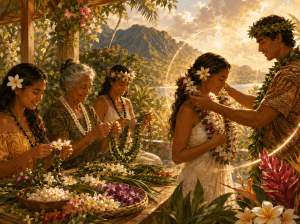
The Art of Making Lei and Giving Lei to Others | Victoria Generao, PhD

A Circle of Beauty, Intention, Relationship, and Aloha

There are gifts we purchase, gifts we select, and gifts we make with our own hands.

And then there is the lei.

A lei may be woven from flowers gathered at sunrise, fragrant leaves clipped carefully from a garden, ferns carried home from the forest, shells collected over many seasons, seeds polished until they gleam, or feathers painstakingly arranged by an accomplished artisan. Yet whatever its material, a lei becomes more than the sum of the things from which it is fashioned.

Someone has gathered.

Someone has prepared.

Someone has sat quietly—or perhaps laughed and talked with family and friends—while the materials passed repeatedly through the hands.

Someone has thought of the person who will eventually wear it.

This is one reason the art of lei making cannot be understood merely as floral design. Within Hawaiian culture, the making and giving of lei is a continuing cultural practice, associated with relationship, celebration, remembrance, hospitality, affection, and aloha. Kamehameha Schools describes the making and giving of lei as significant both to Hawaiians and to the wider community of people who call Hawaiʻi home, emphasizing the importance of good intention in the process. (Kamehameha Schools)

To make a lei, therefore, is to create something beautiful.

To give a lei is to give something more.

It is to say:

I see you.

I honor this moment.

I have prepared something for you.

Carry this beauty with you.

And sometimes, without speaking a word:

You are loved.


Lei Is a Verb as Much as It Is a Thing

We tend to think of a lei as an object: a garland placed around someone’s neck.

But the deeper beauty of lei emerges when we begin thinking relationally.

There is the person who gathers.

There is the land from which the materials arise.

There is the plant.

There are the hands of the maker.

There is the person who receives.

There is the occasion.

And there is the relationship connecting them all.

A University of Hawaiʻi cultural-resource description of hana lei—the practice of lei making—beautifully explains that lei can be made from many kinds of materials, including flowers, leaves, ferns, limu, shells, feathers, and other natural materials. It describes the lei as adorning the wearer with the kinolau of the land: the embodied forms or manifestations present within the natural world. (University of Hawaii)

That idea deserves contemplation.

When a person receives a lei of flowers, leaves, seeds, or other natural materials, the person is not simply being decorated.

Something of place has been placed upon them.

The fragrance of the garden accompanies them.

The greenery of the mountain rests upon their shoulders.

The colors of the blossoms surround their body.

The labor of the maker rests against their skin.

The lei becomes a meeting place between land, maker, receiver, and occasion.

This is why intention matters.


Before Making the Lei: Gathering

The making of a lei begins long before the first flower touches the needle.

It begins with gathering.

For the thoughtful lei maker, gathering is not simply an act of taking. It is an act of relationship.

One looks at what is available.

What is flowering?

What is abundant?

What belongs here?

What may appropriately be gathered?

What should be left alone?

Contemporary conservation guidance has emphasized that growing lei plants in home gardens can help perpetuate lei traditions while reducing gathering pressure on remaining native vegetation. (Hawaii DLNR)

This creates an important principle for anyone learning the art:

Beauty should not require careless taking.

Gather with permission.

Gather sustainably.

Learn which plants are culturally significant.

Learn which plants are native, rare, protected, cultivated, or invasive.

Take what is appropriate.

Leave enough for the plant, the ecosystem, and those who come after you.

In this way, the lei begins with gratitude rather than possession.


Preparing the Materials

Once gathered, the materials must be prepared.

Flowers may need to be sorted.

Leaves may need to be cleaned.

Stems may need trimming.

Certain materials benefit from being cooled, hydrated, wrapped, softened, or allowed to rest.

Damaged blossoms are set aside.

Leaves are examined.

Colors are arranged.

Textures are considered.

And gradually a pattern begins to reveal itself.

This is where lei making becomes meditative.

The hands repeat movements.

Select.

Place.

Pierce.

String.

Braid.

Wrap.

Turn.

Tighten.

Continue.

One cannot hurry certain kinds of beauty.

A beautiful lei teaches rhythm.


The Traditional Arts of Lei Construction

There is no single way to make a Hawaiian lei. The particular method often depends upon the material being used, and Hawaiian lei traditions include a rich vocabulary of techniques. University of Hawaiʻi resources identify styles including kui pololei, kui poepoe, wili, haku, hili, humupapa, and hilo, among others. (University of Hawaii)

Several fundamental techniques are especially useful for understanding the art.

Kui — Stringing

Kūʻi or kui lei are among the forms most immediately recognizable to beginners.

The materials are pierced and strung together. A University of Hawaiʻi description defines kui in this context as stringing pierced objects such as flowers. (University of Hawaii at Hilo)

There are variations.

In kui pololei, materials are strung in a relatively straight orientation.

In kui poepoe, materials are arranged so that they radiate around the cord, producing a fuller, rounded lei. Kapiʻolani Community College describes kui construction as stringing plant materials either through the center (pololei) or from the sides (poepoe). (Kapiolani Community College)

Plumeria, orchids, pīkake and other flowers may be used in forms of stringing lei, depending upon availability and the desired effect. (Hawaii Airports)

For many beginners, kui is an excellent doorway into lei making because the basic principle is simple while the possibilities for color, rhythm, fragrance, spacing, and pattern are nearly endless.


Haku — Braiding and Arranging

The word haku carries meanings associated with composing, arranging, inventing, and braiding. (University of Hawaii at Hilo)

That alone tells us something important.

The maker is not merely attaching flowers.

The maker is composing.

In lei haku, plant materials are incorporated through a braiding or plaiting technique. Kapiʻolani Community College identifies haku as the braiding of plant materials, while other University of Hawaiʻi educational resources distinguish it from methods involving only a single material. (Kapiolani Community College)

A haku lei can become wonderfully complex: blossoms, greenery, texture, shape, fragrance, and repetition appearing together like botanical music.

And an important distinction is worth remembering:

Haku describes a method.

It is not simply another word for every lei worn upon the head.

A head lei may appropriately be called a lei poʻo—literally a lei associated with the head—while haku refers to a particular construction technique.


Wili — Winding

Wili is the art of winding or wrapping materials securely around a foundation.

Kapiʻolani Community College describes this technique as placing plant materials against a backing and winding fiber or cord around both the material and the backing to bind them together. (Kapiolani Community College)

Wili allows the maker tremendous freedom.

A leaf.

Then a blossom.

Then fern.

Then another blossom.

Wrap.

Turn.

Add.

Wrap again.

Patterns gradually emerge.

From the front the viewer sees abundance.

Behind the beauty lies structure.

There is a lovely metaphor here.

What appears effortless often rests upon invisible discipline.


Hili — Braiding a Single Material

Hili involves braiding or plaiting and is particularly associated with lei created from a single kind of material. University of Hawaiʻi educational material distinguishes it from haku on this basis. (Leeward Community College Library)

Fern, vine, leaf, or another flexible material may become a continuous braided form.

Here the beauty does not necessarily arise from contrast.

It arises from repetition.

One material.

One rhythm.

One evolving line.

Hili demonstrates that simplicity can possess tremendous elegance.


Hīpuʻu — Knotting

Another fascinating technique is hīpuʻu, the joining of suitable plant materials through knotting.

Kapiʻolani Community College defines it as creating a chain by knotting plant stems together without cordage or a needle. (Kapiolani Community College)

Here the material itself becomes its own fastening.

The plant provides both beauty and structure.


Humupapa — Sewing to a Foundation

Humupapa involves sewing materials onto a backing. Kapiʻolani Community College describes the process as attaching plant materials to a foundation, and Bishop Museum documents humupapa as an important technique in Hawaiian featherwork as well. (Kapiolani Community College)

This method reminds us that the category “lei” reaches well beyond the familiar strand of tropical flowers.

Lei may represent extraordinary levels of craftsmanship.

Some are ephemeral.

Some may endure for generations.


A Simple Beginner’s Lei Kui

For someone learning lei making for the first time, a simple lei kui offers a beautiful introduction.

You will need fresh, suitable flowers; lei cord or strong thread; a lei needle; scissors; and a clean working surface.

Begin by examining your flowers.

Do not immediately start stringing.

Notice them.

Which are large?

Which are small?

Which have opened fully?

Which colors naturally belong beside one another?

Arrange them before you.

Then decide upon a rhythm.

Perhaps:

white — yellow — white — yellow.

Or:

three blossoms of one color followed by one blossom of another.

Or perhaps no formal pattern at all.

There is beauty in ordered repetition, but there is also beauty in organic variation.

Thread the lei needle carefully.

Pierce each blossom in a manner appropriate to that particular flower and gently guide it along the cord.

Do not crush the blossoms together.

Allow them to rest naturally.

Continue.

Flower after flower.

Movement after movement.

Soon something remarkable occurs.

Individual blossoms cease appearing as isolated flowers.

They become lei.

Multiplicity becomes unity.

One flower could never create the whole pattern.

Each flower contributes something.

This, too, is part of the teaching.


Make the Lei With the Receiver in Mind

There is a profound difference between making a lei and making a lei for someone.

When the receiver is known, every decision acquires another layer of meaning.

Perhaps you remember their favorite color.

Perhaps the fragrance reminds you of their childhood.

Perhaps a flower comes from a plant grown by their grandmother.

Perhaps greenery comes from your own garden.

Perhaps the lei is being made because a child has graduated.

A friend has arrived.

A loved one is departing.

A couple is marrying.

An elder is being honored.

A teacher is being thanked.

A life is being remembered.

Now the lei becomes biography.

Memory enters the pattern.

Relationship enters the pattern.

Intention enters the pattern.

The lei becomes a message that does not require paper.


Giving the Lei

Then comes the moment for which the lei has been created.

The giving.

A lei should never become merely an accessory tossed toward someone as though it were party decoration.

The meaningful act is relational.

You approach the person.

They receive you.

You receive them.

The lei passes from your hands to their body.

Across Hawaiʻi today, lei continue to mark welcomes, graduations, celebrations, commemorations, family occasions and other important transitions. The tradition is visible everywhere from community lei-making workshops to airport greetings and public memorial observances. (University of Hawaii)

The lei says:

Welcome.

Congratulations.

Thank you.

I honor you.

Remember us.

Carry our affection with you.

Depending upon relationship, family custom, and occasion, an embrace or honi may accompany a presentation, while in other circumstances a respectful offering is more appropriate. Cultural practices are best learned from the people and communities who carry them rather than reduced to a single rigid rule.

The central principle is simple:

Give with respect.


Receiving Lei

There is also an art to receiving.

Sometimes receiving gracefully is harder than giving.

We may instinctively say:

“Oh, you shouldn’t have.”

“This is too much.”

“I don’t deserve this.”

But imagine the hours represented by a handmade lei.

Someone gathered those flowers.

Someone prepared them.

Someone sat with them.

Someone used their hands to make something for you.

Receiving the lei respectfully honors that labor.

The gift is not merely the physical garland.

The gift includes the time.

And time, once given, can never be recovered.

That makes handmade gifts precious in a way money cannot measure.


Lei and the Great Passages of Life

Perhaps this explains why lei so naturally accompany thresholds.

Arrival.

Departure.

Graduation.

Marriage.

Achievement.

Birthday.

Reunion.

Commemoration.

Death.

Remembrance.

These are moments when one identity gives way to another.

The student becomes the graduate.

Two individuals become a married couple.

The traveler arrives.

The visitor departs.

The living gather around the memory of someone who has crossed from physical presence into ancestry and remembrance.

Lei making and giving therefore participate in something much larger than decoration.

They mark transition.

They say:

This moment matters.


May Day Is Lei Day

The modern public celebration of Lei Day began in Hawaiʻi in 1928, and May 1 subsequently became officially recognized in Hawaiʻi as Lei Day. (City and County of Honolulu)

Over the decades, Lei Day has helped celebrate both the artistry and cultural significance of lei through exhibitions, competitions, music, hula, ceremony, and community participation. (City and County of Honolulu)

Yet perhaps the greatest lei celebrations remain the quieter ones.

A grandmother teaching a grandchild.

Friends sitting around a table.

Hands sorting flowers.

Stories being told while fingers work.

Someone arriving with boxes of blossoms.

Someone else preparing food.

A lei slowly lengthening across a table while conversation flows around it.

Here culture is not merely being remembered.

It is being practiced.

The Spiritual Lesson Hidden in the Lei

There is a metaphysical teaching within the making of lei that need not be imposed upon Hawaiian tradition to be recognized.

Consider what happens.

Separate things are gathered.

Each retains its own identity.

The fern remains fern.

The flower remains flower.

The leaf remains leaf.

The shell remains shell.

Yet through relationship they become something greater.

The lei does not destroy individuality.

It creates harmony among differences.

And so the lei becomes an extraordinary image of community.

Every person is a blossom.

Every life carries its own fragrance.

Every individual possesses a color, shape, history, strength, and season.

None need become identical.

They need only discover how to belong together.

This may be one reason the image of the lei possesses such emotional power.

A lei is a circle made from many.

A family is a circle made from many.

A community is a circle made from many.

A lineage is a circle made from many.

Even memory becomes a lei: moment joined to moment, person joined to person, generation joined to generation.


Lei as Prayer

There is historical evidence that lei making was accompanied by mele and prayer. Bishop Museum preserves, for example, a pule kui lei—a lei-making prayer—within its collections of Hawaiian mele. (Bishop Museum Blog)

This should cause us to reconsider what the hands may be doing while they work.

Perhaps making something beautiful can itself become prayer.

Not because every lei must be treated as ritual.

But because focused human attention transforms ordinary actions.

Threading flowers can become gratitude.

Braiding leaves can become remembrance.

Gathering can become stewardship.

Giving can become blessing.

Receiving can become humility.

And so the lei teaches that sacredness is not always found far away.

Sometimes sacredness is sitting at the kitchen table with flowers scattered everywhere.


The Lei Eventually Fades

There is one final teaching.

A fresh lei will not remain fresh forever.

Its perfume fades.

Its blossoms soften.

Colors change.

Leaves dry.

And eventually the physical form that seemed so vibrant begins returning toward the earth from which it came.

This does not make the lei less valuable.

It makes it more valuable.

Its beauty was never based upon permanence.

Its beauty existed because, for one particular moment, someone gathered living things and fashioned them into an expression of relationship.

That moment existed.

The lei was made.

The lei was given.

The lei was received.

And afterward, even when the flowers disappeared, the giving remained.


To Give Lei Is to Say: You Belong Within My Circle

Perhaps this is the heart of the entire tradition.

A lei surrounds.

It encircles without imprisoning.

It rests upon the body without demanding anything in return.

It adorns the receiver while simultaneously revealing something about the giver.

The lei says:

I gathered this.

I made this.

I carried this to you.

I place it around you.

And for this moment, I surround you with beauty.

That is why the art of lei making deserves to be preserved not merely as craft, but as relationship.

Learn the names of the plants.

Learn where they come from.

Learn the proper ways to gather.

Learn kui.

Learn haku.

Learn wili.

Learn hili.

Learn the stories.

Learn from practitioners.

Teach the next person.

Grow the plants.

Share the flowers.

Sit together.

Make lei.

And when the lei is finished, do not think only about whether it is perfect.

Look instead at the person for whom it was made.

Place it into their hands or gently around them.

And let the lei speak.

Because perhaps the deepest meaning of giving lei has always been very simple:

I remembered you while my hands were working.

And now I give that remembrance to you.

Aloha kekahi i kekahi.

May we love and care for one another.


The Spiritual and Metaphysical Symbolism of Lei

There is another dimension of lei that becomes visible when we move beyond asking, “What is the lei made from?” and begin asking:

What is being joined together?

What is being transferred?

What relationship is being created?

Traditional Hawaiian sources already give us a foundation for approaching these questions carefully. The University of Hawaiʻi’s Kahoʻiwai cultural knowledge resource describes lei as adorning the wearer with the kinolau of the land—the embodied forms of the ʻāina represented in flowers, leaves, ferns, shells, feathers, limu, and other materials.

The City and County of Honolulu’s description of Lei Day goes further, explaining that as a lei is gathered, prepared, and fashioned, the mana of the maker becomes woven or sewn into it; therefore giving a lei is, symbolically, giving something of oneself.

This gives us an important doorway into the spiritual meaning of lei.

But a distinction should be made.

The interpretation that follows is a comparative metaphysical contemplation inspired by Hawaiian lei traditions. It should not be taken to mean that Hawaiian spirituality is simply another form of Hermeticism, Qabalah, chakra theory, or Western occultism. Hawaiian concepts deserve to be understood first within their own cultural and linguistic world. The Hawaiian term mana, for example, carries meanings of supernatural or divine power, authority, potency, and efficacy; reducing it merely to the Western esoteric idea of “energy” would flatten a much richer concept.

With that respect firmly established, the lei can nevertheless become a profound object of metaphysical contemplation.

The Lei as Sacred Circle

The most immediately apparent symbolic feature of a lei is its circularity.

It has no obvious beginning and no obvious end.

For the contemplative mind, the circle naturally suggests continuity, relationship, return, completeness, and the joining together of what was previously separate.

A flower by itself is a flower.

A leaf by itself is a leaf.

A shell by itself is a shell.

But when these individual forms are gathered and joined intentionally, they become lei.

The mystery is not that individuality disappears.

It does not.

Each blossom remains itself.

Each leaf preserves its shape.

Each shell retains the marks of its own formation.

Yet together they participate in another identity.

This makes the lei a beautiful image of unity without uniformity.

A family functions this way.

A community functions this way.

A lineage functions this way.

The ancestors, the living, and those yet to be born may likewise be contemplated as individual lives threaded upon a greater continuum.

Seen in this way, the lei becomes an image of relationship itself.


The Thread as the Invisible Bond

Most people notice the flowers.

Few notice the thread.

Yet without the thread, the lei falls apart.

This hidden cord offers one of the most compelling metaphysical images within the craft.

The visible blossoms may be compared to the visible circumstances of life: bodies, personalities, places, events, relationships, and memories.

The thread remains largely unseen.

Yet it passes through everything.

Metaphysically, we may contemplate that hidden thread as aloha, memory, intention, ancestry, relationship, or spiritual continuity.

One could even ask:

What is the invisible thread running through my own life?

What joins childhood to adulthood?

What joins student to teacher?

What joins grandparent to grandchild?

What joins one generation to another?

What joins those who have departed with those who continue to speak their names?

Like the cord inside the lei, these bonds may not always be visible.

Yet they hold the pattern together.


Lei as Embodied Intention

The making of lei requires repeated acts of attention.

A flower is selected.

A stem is prepared.

A leaf is folded.

A blossom is pierced.

A cord is tightened.

Another element is added.

Then another.

And another.

Through repetition, intention becomes physical form.

This gives lei making a quality familiar to many contemplative traditions: the hands eventually begin expressing what the mind and heart have been holding.

A lei made hurriedly and carelessly is physically different from one made attentively.

But there is also a relational difference.

The maker has spent time with the gift.

Time has entered the lei.

Attention has entered it.

Thought of the receiver has entered it.

The Honolulu Lei Day tradition explicitly speaks of the maker’s mana becoming incorporated into the process of creating the lei. Bishop Museum also preserves a traditional pule kui lei—a lei-making prayer—in which the gathering, piercing, stringing, and assembling of flowers appear within a sacred poetic context.

The act of making can therefore become more than production.

It can become devotion embodied through the hands.


Gathering as Communion With ʻĀina

Before there can be a lei, there must be material.

And before there is material, there is ʻāina.

Flower.

Fern.

Leaf.

Seed.

Shell.

Fiber.

All arise from a world that existed before the maker touched them.

The University of Hawaiʻi description of lei as adorning the wearer with the kinolau of the land is especially significant here.

From a metaphysical perspective, this changes the relationship between maker and material.

The flower is not merely “craft supply.”

The leaf is not merely decoration.

They originate within a living network of place.

Rain touched them.

Sunlight fed them.

Soil sustained them.

Wind moved across them.

Human hands eventually gathered them.

The resulting lei therefore brings together place and person.

When the lei is placed upon the receiver, something gathered from the landscape has quite literally been placed upon the human body.

The person becomes adorned by place.

This is one reason lei can communicate belonging so powerfully.

The land is no longer merely beneath one’s feet.

It rests upon one’s shoulders.


The Metaphysics of Giving

There is a profound difference between possessing a lei and giving one away.

The lei reaches completion through relationship.

The maker has gathered and assembled it, but the gift has not yet fulfilled its purpose.

Then comes the encounter.

One person stands before another.

The lei passes between them.

The giver releases possession.

The receiver accepts.

Something changes.

The lei becomes a bridge.

The Hawaiian dictionary tradition itself identifies lei not merely as garland or ornament but also as something given as a symbol of affection. Contemporary Hawaiian cultural sources likewise continue to associate lei with aloha, connection, honor, celebration, and relationship.

Seen metaphysically, the giving of lei creates a threefold movement:

Intention becomes form.

Form becomes gift.

Gift becomes relationship.

This is why a handmade lei possesses a quality that cannot be measured by the monetary value of its flowers.

The giver has transferred time.

Attention.

Labor.

Memory.

Beauty.

And intention.

The physical lei carries an invisible offering.


Lei and the Mystery of Blessing

To place something around another person’s shoulders is an intimate act.

The lei surrounds without binding.

It rests without imprisoning.

It beautifies without obscuring the wearer.

In this sense, the lei offers a compelling image of blessing.

A blessing does not possess another person.

It surrounds them with a wish.

May you prosper.

May you travel safely.

May you remember where you came from.

May you know that you are loved.

May you carry the affection of those who cannot accompany you.

May this threshold in your life be marked with beauty.

The lei therefore becomes almost like a visible circumference of goodwill around the receiver.

Not a wall.

A circle of aloha.


Lei as Memory and Ancestral Continuity

Lei are also given in remembrance.

At Honolulu’s Lei Day observances, lei from the annual contest are taken to Mauna ʻAla, the Royal Mausoleum, and Kawaiāhaʻo Church and placed upon the resting places of Hawaiian aliʻi as expressions of mahalo and aloha.

Here the lei crosses another boundary.

It is no longer simply a gift between two living people.

It becomes an offering of memory.

The deceased cannot physically return the gift.

Yet the relationship remains.

This reveals something profound about remembrance:

Love continues to make offerings even when reciprocity is impossible.

The lei becomes testimony that relationship can extend beyond physical absence.

For the metaphysical contemplative, the circle again becomes significant.

Birth and death.

Arrival and departure.

Presence and memory.

Ancestor and descendant.

The circle does not erase death.

It places death within continuity.

The Lei as a Living Mandala

In comparative metaphysical language, one might describe a carefully made lei as a kind of living mandala.

Not because this is a traditional Hawaiian designation, but because the comparison illuminates its contemplative structure.

A mandala gathers many elements around relationship and order.

So does the lei.

Color follows color.

Flower follows flower.

Pattern repeats.

Difference enters harmony.

The maker moves gradually from fragments toward wholeness.

The finished lei may therefore be contemplated as a physical representation of a fundamental metaphysical principle:

the Many becoming One without ceasing to be Many.

One lei.

Many flowers.

One family.

Many persons.

One community.

Many voices.

One ancestry.

Many generations.

One living world.

Countless forms.


The Impermanence of the Flower

Perhaps the deepest teaching of the flower lei is that it will die.

A fresh lei is extraordinarily beautiful precisely because its beauty cannot be permanently possessed.

The blossom opens.

It releases fragrance.

It begins to fade.

Eventually it returns to the elements.

This gives the lei a contemplative relationship with impermanence.

The gift cannot be preserved exactly as it was.

Neither can the moment.

The graduation ends.

The wedding day passes.

The visitor eventually leaves.

Children grow.

Elders become ancestors.

Photographs remain, but the moment itself moves onward.

The lei quietly teaches:

Do not demand permanence before allowing something to be sacred.

Some sacred things are sacred precisely because they occur only once.

The flowers fade.

The giving remains.


The Lei as a Teaching of Aloha

Ultimately, the metaphysical symbolism of lei returns us not to abstraction, but to relationship.

The circle is meaningless without the flowers.

The flowers do not become lei without the thread.

The thread serves no purpose without the maker.

The maker’s work remains incomplete without the receiver.

The receiver eventually returns the organic materials to the earth.

And the earth produces flowers again.

So the pattern continues:

ʻĀina → material → maker → lei → receiver → memory → ʻāina.

A circle.

Perhaps this is why lei can carry such extraordinary emotional power.

It gives physical form to something ordinarily invisible.

Affection becomes flowers.

Gratitude becomes leaves.

Memory becomes fragrance.

Honor becomes a circle.

Aloha becomes something that can be placed gently upon another person’s shoulders.

And for one beautiful moment, the unseen becomes visible.

Annotated Bibliography

Bishop Museum. “He Pule Kui Lei.” Welo Hou, June 10, 2019.

This Bishop Museum resource presents a lei-making prayer from the Roberts Mele Collection, with translation by renowned Hawaiian scholar Mary Kawena Pukui. The composition describes Hiʻiaka gathering flowers, piercing them, stringing them, and assembling a lehua lei. It is especially valuable for this blog because it demonstrates that lei making appears within Hawaiian poetic and prayer traditions and therefore cannot be reduced merely to decorative handicraft. The Museum also identifies mele as an important primary resource for Hawaiian scholarship and cultural connection.

City and County of Honolulu, Department of Parks and Recreation. “Lei Day.”

This official cultural resource provides one of the clearest explanations of the relational spirituality associated with making and giving lei. It describes the lei as a symbol of aloha and states that the mana of the maker becomes incorporated into the lei through gathering, preparation, and construction. It also documents the continuation of lei traditions through Honolulu’s Lei Day celebration and the offering of lei at Mauna ʻAla and Kawaiāhaʻo Church in remembrance of Hawaiian aliʻi. This source is particularly important to the blog’s discussion of intention, reciprocity, remembrance, and ceremonial giving.

Kahoʻiwai, University of Hawaiʻi. “Hana Lei.”

Kahoʻiwai identifies lei making as an enduring Hawaiian cultural practice and catalogs numerous forms, including kui pololei, kui poepoe, wili, haku, hili, humupapa, and hilo. Most important for the spiritual interpretation developed in this blog is its description of a lei as adorning its wearer with the kinolau of the land. This idea provides an important Indigenous Hawaiian foundation for understanding the relationship among lei, wearer, natural material, and ʻāina.

Kamehameha Schools. “Nā ʻAno Hana Lei: Types of Lei-Making.” 2021.

This accessible educational article gives practical descriptions of major lei-making methods, including kui, haku, wili, hili, hīpuʻu, and humupapa. It is especially useful for readers who wish to move from cultural appreciation into actual practice, because it discusses construction methods and appropriate materials while situating lei making within the living culture of Hawaiʻi. It supports the technical portions of the blog and demonstrates the diversity hidden behind the English phrase “making a lei.”

Pukui, Mary Kawena, and Samuel H. Elbert. Hawaiian Dictionary: Hawaiian-English, English-Hawaiian. Revised and Enlarged Edition. Honolulu: University of Hawaiʻi Press, 1986.

Pukui and Elbert’s Hawaiian Dictionary remains a foundational linguistic reference for serious study of Hawaiian words and concepts. University of Hawaiʻi Press describes the revised edition as containing nearly 30,000 Hawaiian-English entries together with material relating to folklore, poetry, and ethnology. For this blog, the dictionary is essential because terms such as lei, mana, aloha, and the vocabulary of lei construction possess meanings that cannot safely be reconstructed from English translations alone.

Pukui, Mary Kawena, E. W. Haertig, and Catherine A. Lee. Nānā I Ke Kumu: Look to the Source. Volume 1. Honolulu: Hui Hānai / University of Hawaiʻi Press, 2014 edition.

Nānā I Ke Kumu is a major source for understanding Hawaiian cultural practices, concepts, beliefs, family relationships, spirituality, healing, dreams, symbolism, and social values. The work grew from years of study by the Culture Committee of the Queen Liliʻuokalani Children’s Center, with Mary Kawena Pukui serving as kumu. Its greatest value for the present blog is methodological: it reminds the student to understand Hawaiian concepts from Hawaiian cultural foundations rather than forcing them prematurely into foreign philosophical categories.

Wehewehe Wikiwiki / Hawaiian Dictionaries. “Lei” and “Mana,” drawing upon Pukui and Elbert.

The online Hawaiian dictionary collections make foundational lexical material readily accessible. The entry for lei includes meanings associated with garland, wreath, ornament, and a gift expressing affection, while the Pukui-Elbert material for mana includes supernatural or divine power, authority, potency, and power. These entries are especially useful in guarding against overly simplistic translations. In a metaphysical discussion, they help prevent mana from being casually equated with an undifferentiated New Age concept of “energy.”

A Note on Metaphysical Interpretation

Readers approaching lei through Western Mystery traditions, Hermeticism, Qabalah, Reiki, ceremonial magic, or other metaphysical systems may naturally perceive parallels: the circle as wholeness, the thread as an invisible bond, the act of construction as intention made manifest, and the giving of the completed lei as transmission or blessing.

Such comparisons can be fruitful when they remain comparisons.

The more respectful approach is:

first Hawaiian understanding, then comparative contemplation.

Rather than claiming that Hawaiian lei traditions secretly encode Hermetic, Qabalistic, or other Western doctrines, we may allow each tradition to remain itself while noticing where human spiritual experience produces resonant symbols.

The lei then becomes not evidence that all traditions are identical, but something much more beautiful:

a meeting place where distinct spiritual languages can recognize one another without losing their own names.


Usui Teate Reiki | Introducing Reiki Sensei Shinpiden Chrystian Guardado-Lopez!

Chrystian Sensei is a member of the original Hālau located at Vallejo, California, where he also resides. He is a licensed Massage Therapist on staff at Orcanit Wellness in Oakland, California; a Chi Gung practitioner, and a student of the Western Mysteries Tradition. Aloha e komo mai, Chrystian!

La’au Lapa’au | 9 Best Indoor Plants That Bring Good Things For Your Home

There are many different ways that indoor plants work in a household, from purifying the air around it to bringing more nature to home or even just serving as home décor. They can offer even more, like bring fortune and positive energy. According to science, like humans, plants also have energy and it can make […]

Source: 9 Best Indoor Plants That Bring Good Things For Your Home

La’au Lapa’au | No matter how small your house is, you must grow this plant in your house 

Did you know that Vietnamese coriander (Persicaria odorata) flowers and bears fruit annually, especially on plants that are regularly pruned and harvested? This versatile herb is not only a staple vegetable but also a valuable medicinal plant. Here’s why you should consider having a Vietnamese coriander plant at home. Medicinal Properties of Vietnamese Coriander According […]

Source: No matter how small your house is, you must grow this plant in your house.

La’au Lapa’au | Reviving Ancestral Wisdom: The Orange Peel and Clove Elixir

Ingredients:

The peels of 2 oranges
5 whole cloves
1 cup (approximately 250ml) of water

Instructions:

Begin by thoroughly washing the orange peels to remove any pesticides or impurities. Gently pat them dry.
In a small saucepan, bring the water to a rolling boil.
Carefully add the cleaned orange peels and cloves to the boiling water, then immediately lower the heat to a simmer.
Allow the mixture to gently infuse over low heat for about 15 minutes, unlocking the full spectrum of flavors and benefits.
Once the infusion has reached the desired strength, strain the tea into a cup, discarding the peels and cloves.

The Multitude of Benefits

This infusion is not just a delight to the senses but a boon to health, offering:

Enhanced immune function due to the high vitamin C content in orange peels.
Protection against oxidative stress and cellular damage, thanks to the abundance of antioxidants in both orange peels and cloves.
Natural antibacterial and anti-inflammatory support, making it a great choice for combating infections and soothing inflammation.
Digestive health benefits, with cloves helping to stimulate digestion and alleviate digestive discomfort.

Personalizing Your Infusion

While the basic recipe offers a wealth of benefits, there’s ample room for customization to cater to personal tastes and health needs:

Add a cinnamon stick or a few slices of fresh ginger for an extra warming effect.
A slice of apple or a few lemon rounds can introduce a new layer of fruity complexity.
Sweeten the brew naturally with a spoonful of honey or maple syrup, or choose a sugar substitute for a calorie-free option.
This ancient concoction not only connects us to the wisdom of our grandmothers but also offers a simple, effective way to incorporate natural health boosters into our daily routine

Enjoy!

Philppine Folklore | The Legend of the Guava

Learn the story behind how the guava got its crown.

The Folktale of the Guava Tree

Philippine culture is rich in folklore. One tale I enjoyed during my childhood was the legend of the guava fruit, which comes with a moral lesson. A guava tree or fruit is called bayabas in Tagalog, the Philippines’ language.

The story goes like this:

A long time ago, a king ruled a rich, prosperous island. He had all the things a king could ever ask for: the power, the wealth, and all the delicious foods one could only imagine. The king’s name was King Barabas.  […]

Read on:  Legend of the Guava

Health | How to Eat Papaya Seeds Raw & Dried

The next time you slice into a colorful papaya, don’t discard its tiny round seeds! Believe it or not, these little morsels are tasty, easy to prepare, and can add medicinal properties to practically any dish.[1] In this article, we’ll teach you how to eat, dry, and grind papaya seeds to improve your intestinal health and boost your daily dose of vitamins. So, what are you waiting for? Grab a spoon, and let’s get scooping!  […]

https://fb.watch/r0vk41sX4d/ 

Source: How to Eat Papaya Seeds Raw & Dried

La’au Lapa’au | What are the benefits of sea moss?

What is sea moss and what are the benefits of eating it? Read on to the learn more about its uses, benefits, side effects, and more.

Sea moss is a type of sea algae that people may add to food or take as a nutritional supplement. Sea moss benefits may include supporting the immune system, thyroid function, and hair and skin health.

In this article, we will discuss the nutritional information of sea moss, how to prepare it, and any potential benefits and side effects.  […]

Where Does Sea Moss Come From? - Drug Genius

Source: What are the benefits of sea moss?

La’au Lapau | Mullein Leaf: Benefits, Side Effects and How to Take It

Growing Mullein in the Herb Garden

Mullein  (Verbascum ) is a common weed used for centuries in herbal medicine. Herbalists often use mullein flowers and leaves to treat respiratory problems, digestive issues, and skin conditions, among other health concerns.1

Mullein contains numerous active ingredients, including flavonoids and saponins with proven anti-inflammatory, antioxidant, and antihypertensive properties, among others. But, there is very little evidence in support of using mullein to treat any medical condition.1

This article explains the traditional uses of mullein in herbal medicine, how it is commonly administered, and what you need to know about side effects, precautions, and interactions when taking it. […]


Mullein: Top 15 Health Benefits [Insane List] - urbol.com


Source:  All About Mullein

Astronomy | The full ‘Beaver Moon’ rises next to bright Jupiter this weekend. Here’s how to watch.

The full ‘Beaver Moon’ will be best viewed as it rises in the east at dusk on Monday, Nov. 27, though it will appear full on Sunday and Tuesday as well.

Source: The full ‘Beaver Moon’ rises next to bright Jupiter this weekend. Here’s how to watch.

Spirit Totem | Praying Mantis

Click here to read more!

The praying mantis is a spiritual creature that is revered in many cultures. It is believed to bring good luck and prosperity, and is often used in religious ceremonies. The mantis is also said to be able to commune with the spirit world, and is considered to be a powerful ally in the fight against evil. […]

Kahu Kahealani Satchitananda | The Sacred Hawaiian Way

Picture

Kahu Kahealani Satchitananda is a loving dynamic woman of power, purpose, passion, prosperity and inner peace. She imbibes the True Spirit of Living Aloha. She is a Hawaiian metaphysical minister, Healy Resonance and Ho’oponopono practitioner, TimeWaver Analyst, Science of Mind practitioner, consultant and one of a council of eleven respected elders who were chosen, initiated, and given the sacred duty of offering an ancestral ho’omanamana blessing to the world, an amazing process that must be experienced. She was first taught ho’oponopono by her mother, auntie Ku’ualohaemaliakalawaianui and her kupuna, tutuwahine Kawaiolamanaloapa’akaula from the island of Molokai.

Her very deep love is supporting the healing process for individuals, couples, parents and children. Her focus Is family & business wealth, health & happiness. […]


Read on:  Kahu Kahealani Satchitananda

Daniel DeGuzman | 6 Guidelines for Becoming a Filipino Shaman

A painting of Filipino natives seen burning their idols.  A woman in the foreground holds a wooden figure above her head, while a cross looms in the background.

What if, one day,  an Anito from the sky world delivered a message claiming that you are one of the chosen to become a part of a long sacred lineage of men and women that stands between the mortals and gods?  That you will guide and aid your community by playing numerous roles such as  doctor/healer, priest, counsellor, and leader?  Even the best ‘jack of all trades’ would have a hard time pulling that off.

What if you’ve received the power to travel to the realm of the dead to save trapped souls?

Becoming a shaman transcends profession and passion. Regardless of their many names around the Philippines  (Babaylan, Katalonan, Diwatera, Tambalan etc.) the way of the shaman is more than just the superficial old tribe men or women chanting languages beyond our comprehension.  They transcend the schizoid that throws themselves on the ground while under extreme fits of seizure that synchronize with the beat of gongs and drums and the image of the wild looking worshipper of crude, wooden statues. It is a vocation that demands devotion, sincerity and knowledge of both men and spirits.  […]

Read on:  Becoming A Filipino Shaman

Ayahuasca compilation – Shamanic meditation music #music #meditation #shaman #egodeath #healing

** What is actually Ayahuasca and what its ceremony includes **

An Ayahuasca Ceremony is an opportunity to receive treatment for the spirit and take part in your own healing. Ayahuasca ceremony participants arrive in the early evening, as ceremonies are held at night. Participants arrive before the ceremony begins to show respect for the healer, or curanderos, leading the ceremony. The Maestro curanderos first prepares for the ceremony, after introductions, if necessary. Preparation includes cleaning of the space and implements with mapacho tobacco, prayers, and other blessings. The ceremony begins after preparation of the space and ceremonial tools.


** Music in ceremony **

Songs are an important part of healing experience, and curanderos use healing songs called “icaros”. These songs help curanderos to communicate with spirits and ask for help in healing treatments for the patients. Each icaro has a specific purpose in the healing process. Curanderos sing to open every ceremony, inviting spirits to be present in the ceremony in order to perform healings. The curandero sings throughout the ceremony as the patients navigate their own experiences. The curanderos also use the icaros to raise and lower the intensity of the experience.


** Closing the Ayahuasca Ceremony **

The ceremony ends with an icaro to close the healing circle. The curandero also provide patients with protection from spiritual vulnerability before they leave the ceremony. After the end of the ceremony, lights are lit and brief discussion takes place before people leave to go to sleep.

A Rainy Day at The Temple – Japanese Zen Music – Japanese Flute Music For Soothing, Meditation

Ambient With Flute is a Japanese-style channel where you can find the most diverse and rich Japanese landscapes with the aim of bringing moments of peace, relaxation and tranquility. Did you know that you can use these music to combat distraction, increase work performance, study or use them as a method to support sleep, relaxation, etc.

Crows are self-aware just like us, says new study

Crows have their own version of the human cerebral cortex.

KEY TAKEAWAYS
  • Crows and the rest of the corvid family keep turning out to be smarter and smarter.
  • New research observes them thinking about what they’ve just seen and associating it with an appropriate response.
  • A corvid’s pallium is packed with more neurons than a great ape’s.  […]

Source: Crows are self-aware just like us, says new study

La’au Lapa’au | 10 Herbs You Can Grow Indoors in Water All Year Long

Herbs often have medicinal, relaxation, and culinary properties, and it is great if we can have them throughout the entire year in the home. In fact, we can! We will reveal a way to grow certain herbs in the kitchen and provide a pleasant flavor in it. What best about it all is that you […]

Source: 10 Herbs You Can Grow Indoors in Water All Year Long