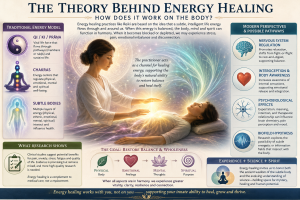
The Theory Behind Energy Healing:  How Does It Work on the Body? | Victoria Generao, PhD

For thousands of years, healing traditions have proposed that the human being is more than a collection of organs, tissues, chemicals, and electrical impulses. Beneath—or perhaps interwoven with—the physical body, these traditions describe another dimension of human life: a vital, organizing force.

Chinese traditions speak of Qi. Indian philosophy describes Prāṇa. Japanese healing systems use the concept of Ki. Western esoteric traditions have spoken of the vital force, astral light, and subtle bodies. Contemporary practitioners may simply call it the human energy field or biofield.

From this worldview arises the basic theory of energy healing:

When the energetic organization of the person becomes disturbed, the physical, emotional, mental, or spiritual person may also experience disharmony. By supporting balance within that energetic system, the practitioner seeks to encourage the person’s own capacity for restoration.

But what does that actually mean?

And perhaps more importantly, what happens to the physical body during an energy-healing session?

The answer depends upon whether we approach the question metaphysically, physiologically, psychologically, or scientifically. Rather than forcing these perspectives into opposition, it is useful to examine them side by side.


The Human Being as an Energetic Organism

Even conventional physiology recognizes that the body is not merely mechanical.

Every heartbeat is initiated through electrical activity.

The nervous system communicates through electrochemical signals.

Muscle fibers contract through changes in electrical potential across cellular membranes.

The brain produces measurable electrical activity.

Cells maintain voltage differences across their membranes.

The heart produces an electromagnetic field measurable outside the body.

None of these established biological phenomena, however, automatically proves the existence of the subtle-energy fields described in Reiki, Qigong, Therapeutic Touch, or esoteric healing traditions. This distinction is important.

When an energy healer speaks of Ki, Prāṇa, chakras, meridians, or the aura, the word energy is being used within a traditional or metaphysical model. It should not automatically be equated with electromagnetic energy measured in joules, volts, or teslas.

The National Center for Complementary and Integrative Health describes Reiki as a complementary approach based upon the idea that an energy supports the body’s natural healing abilities, while also noting that the specific energy field proposed by Reiki has not been scientifically demonstrated. (NCCIH)

We therefore encounter two different languages describing the human organism.

One is the language of biology.

The other is the language of subtle energy.

Energy healing proposes that the two may interact.

Science has not yet established that this interaction occurs through a presently measurable external energy field.


The Traditional Theory: Illness as Disturbance of Flow

Most energy-healing systems do not regard the practitioner as literally “curing” another person.

The healer instead attempts to create conditions in which greater balance can emerge.

Imagine a river.

When the river moves freely, water continually circulates through the landscape. But if debris accumulates, currents become diverted, areas stagnate, and pressure develops elsewhere.

Traditional energetic systems use remarkably similar imagery.

Energy may be described as:

  • deficient,
  • excessive,
  • stagnant,
  • blocked,
  • scattered,
  • depleted,
  • congested,
  • or unbalanced.

Healing therefore involves restoring flow, coherence, and equilibrium.

A Reiki practitioner might describe this as allowing universal life-force energy to move where it is required.

A practitioner of Chinese energetic medicine might speak of harmonizing Qi.

A yogic healer might describe balancing Prāṇa through the nāḍīs and chakras.

An esoteric healer might speak of bringing the subtle bodies into greater alignment.

Although the terminology differs, the underlying principle is strikingly similar:

Life seeks organization, balance, and wholeness.

The healer attempts to cooperate with that tendency.


The Body’s Extraordinary Capacity for Self-Regulation

Here the metaphysical and biomedical perspectives begin to approach one another.

The body constantly attempts to maintain internal stability.

Temperature is regulated.

Blood chemistry is regulated.

Blood pressure is continually adjusted.

Tissues repair themselves.

Immune cells respond to injury.

Hormones shift according to changing circumstances.

The nervous system constantly evaluates whether the organism needs to mobilize, defend, digest, repair, sleep, reproduce, or recover.

Medicine calls this regulatory tendency homeostasis, while broader contemporary models also use concepts such as allostasis—the body’s ability to adapt its internal operations to changing demands.

Energy-healing philosophies often interpret healing similarly, although through another vocabulary.

The healer is therefore not necessarily imagined as supplying something the body completely lacks.

Rather, the session is intended to help the organism return to a state in which its own regulatory processes can function more effectively.

This idea becomes especially interesting when we examine the nervous system.


The Nervous System May Be One Important Bridge

Modern life frequently places human beings into prolonged states of vigilance.

The sympathetic nervous system—the portion associated with mobilization—prepares us to respond to challenge.

Heart rate may increase.

Muscles tense.

Attention narrows.

Stress hormones may rise.

Digestion and restorative functions may temporarily become secondary.

This response is not pathological. It is essential for survival.

The problem arises when the organism has difficulty returning from mobilization into restoration.

During many energy-healing sessions, however, the conditions are almost the opposite.

The recipient lies quietly.

External stimulation decreases.

Breathing may slow.

The eyes close.

Attention turns inward.

A trusted practitioner remains quietly present.

Touch, when used, is generally gentle and noninvasive.

The recipient is essentially being given permission to stop doing.

For some people this creates profound relaxation.

And relaxation is not merely psychological.

Changing psychological states can influence breathing, muscle tension, pain perception, cardiovascular activity, attention, endocrine activity, and autonomic regulation.

Thus one scientifically plausible component of energy healing is not necessarily the transfer of an unidentified energy at all.

It may involve helping the nervous system enter a physiological environment more compatible with rest, recovery, and self-regulation.


The Parasympathetic State: From Vigilance to Restoration

The parasympathetic nervous system participates in many of the body’s quieter functions—rest, digestion, energy conservation, and recovery.

People receiving Reiki and similar therapies frequently report experiences such as:

warmth,

heaviness,

lightness,

tingling,

slowed breathing,

sleepiness,

emotional release,

a sense of expansion,

or unusually deep calm.

Energetic traditions interpret some of these sensations as evidence that energy is moving.

Biomedical science cannot presently confirm that interpretation.

But many of these experiences are also compatible with shifts in attention, relaxation, autonomic activity, sensory processing, and emotional state.

This creates an intriguing possibility.

Perhaps some of what practitioners call energetic balancing corresponds phenomenologically to a person moving from physiological vigilance toward greater regulation.

That does not prove the metaphysical theory.

But neither does it make the experience meaningless.


Healing Through Attention

There is another mechanism that receives far less attention: awareness itself.

Most of us spend enormous portions of our lives cognitively projected outward.

We are thinking about what happened yesterday.

What we need to accomplish tomorrow.

What someone said.

What might go wrong.

During an energy-healing session, attention often returns to the body.

Suddenly the recipient notices breathing.

Heartbeat.

Muscle tension.

Warmth.

Cold.

Pressure.

Emotion.

Fatigue.

Areas of comfort.

Areas of discomfort.

This inward awareness is sometimes called interoception—the perception of signals arising from within the body.

A person who becomes more sensitive to internal states may begin recognizing tension before it becomes overwhelming, exhaustion before complete depletion, or emotional activation before it turns into reactive behavior.

From an energetic perspective, the person is becoming more aware of the subtle body.

From a physiological perspective, the person may simply be becoming more conscious of bodily signals.

These interpretations are not necessarily mutually exclusive as descriptions of subjective experience.


The Healing Relationship Itself Matters

There is another element that should not be underestimated:

human presence.

A compassionate therapeutic encounter can itself alter experience.

For thirty or sixty minutes someone is effectively communicating:

You are safe enough to rest.

You do not have to perform.

You may receive.

Your discomfort is being acknowledged.

Someone is present with you.

Human beings are profoundly social organisms. Perceived safety, supportive interaction, expectation, prior experience, and therapeutic context can all influence pain and other symptoms.

This is sometimes dismissed as “just placebo.”

That description misunderstands placebo physiology.

Placebo responses can involve genuine changes in neural processing and neurochemical systems. Research on placebo analgesia, for example, has demonstrated roles for expectation, conditioning, endogenous opioid systems, and other mechanisms involved in regulating pain. (PubMed)

If ritual, expectation, attention, touch, therapeutic relationship, and perceived safety influence physiology, their effects are not imaginary simply because they originate partly through the brain.

The brain is part of the body.


The Energetic Model of the Aura and Chakras

Within metaphysical healing systems, however, the explanation goes considerably further.

The physical body is often regarded as the densest expression of several interpenetrating levels of being.

Different traditions describe these levels differently, but a typical esoteric model might include:

Physical Body → Etheric or Vital Body → Emotional or Astral Body → Mental Body → Spiritual Levels of Consciousness

The etheric body is frequently described as the energetic matrix immediately underlying physical life.

Within yogic systems, major organizing centers within the subtle body are called chakras.

Rather than viewing chakras merely as colored disks located along the spine, it may be more useful to understand them as symbolic or subtle centers through which physical, psychological, emotional, and spiritual experiences are organized.

For example:

The root center concerns embodiment, survival, stability, and belonging.

The sacral center concerns feeling, sexuality, relationship, and creativity.

The solar plexus concerns identity, power, autonomy, and action.

The heart center concerns love, grief, compassion, relationship, and integration.

The throat center concerns communication and expression.

The brow center concerns perception, imagination, and insight.

The crown concerns transcendence and relationship with the Sacred.

In energy-healing theory, prolonged disturbance within one level of the human being may eventually influence another.

An emotional pattern may produce chronic muscular tension.

Fear may influence breathing.

Grief may profoundly alter sleep, appetite, and energy.

Chronic physical pain may alter mood and cognition.

The metaphysical model interprets these interactions as movements occurring between layers of the subtle and physical organism.

Modern medicine describes many of them through nervous, endocrine, immune, behavioral, and psychological pathways.

Different maps.

Sometimes remarkably similar territory.


What Is the Practitioner Actually Doing?

One of the greatest misconceptions concerning energy healing is that the healer is pouring personal energy into the recipient.

Most mature traditions explicitly discourage this interpretation.

In Reiki, for example, the practitioner ideally functions as a conduit rather than a battery.

The healer does not force the recipient into healing.

The healer establishes a therapeutic field or condition in which healing may occur.

This concept has parallels throughout mystical traditions.

The healer becomes quiet.

Attention becomes focused.

Intention becomes singular.

Personal concerns temporarily recede.

The practitioner attempts to become receptive rather than controlling.

In metaphysical language, the healer aligns with a greater organizing intelligence.

In psychological language, the healer enters a highly regulated state of sustained compassionate attention.

Whether those descriptions ultimately refer to one phenomenon or two remains an open philosophical question.


Resonance and Entrainment: An Attractive but Unproven Hypothesis

Energy healers frequently use the concept of resonance.

A well-known physical analogy is that of two tuning forks.

Strike one tuning fork near another tuned to the same frequency and the second may begin vibrating sympathetically.

Energy-healing traditions propose something analogous between living systems.

A coherent practitioner, according to this theory, creates conditions in which a dysregulated recipient can gradually move toward greater coherence.

This is sometimes described as entrainment.

The analogy is elegant.

But it should remain an analogy unless direct biological evidence demonstrates the proposed subtle-energy mechanism.

There is research investigating physiological changes during biofield practices, including EEG and heart-rate variability, but a systematic review found that results were inconsistent and did not establish a unique physiological signature of the healer’s state. (PubMed)

Thus, resonance remains an intriguing theoretical model rather than an established explanation of energy healing.


Does Science Show That Reiki Works?

This is where precision matters.

The scientific literature is neither equivalent to saying “energy healing has been proven” nor accurately summarized by saying “nothing ever happens.”

Recent clinical studies have reported reductions in symptoms such as pain, anxiety, and stress in some populations.

For example, a randomized study published in 2025 involving cancer patients reported greater improvements in several subjective outcomes among participants receiving Reiki, although cortisol did not differ significantly between groups. (PubMed)

Another recent randomized placebo-controlled trial reported improvements in pain, anxiety, heart rate, and some cardiovascular measures among mechanically ventilated patients receiving Reiki compared with sham Reiki. (PubMed)

A 2025 meta-analysis examining randomized trials also reported improvements in quality-of-life outcomes associated with Reiki. (PubMed)

Yet this must be balanced against the larger evidence base.

Research varies considerably in quality, intervention design, sample size, comparison groups, practitioner training, blinding procedures, and outcome measurement.

A recent systematic review examining Reiki and Therapeutic Touch in palliative care found some promising symptom reports but concluded that the overall evidence remained limited and heterogeneous. (PubMed)

NCCIH likewise states that Reiki has not been clearly demonstrated to be effective for a specific health purpose and that research results remain inconsistent. (NCCIH)

The fairest conclusion at present is therefore:

People can experience meaningful subjective and sometimes measurable physiological changes during energy-healing interventions, but science has not established that these effects occur because a distinct subtle energy is being transferred or manipulated.

That distinction is crucial.


Perhaps the Better Question Is Not “Is Energy Real?”

The conversation surrounding energy healing often becomes trapped between two extremes.

One side insists:

“Science hasn’t measured the energy, therefore the entire experience is meaningless.”

The other insists:

“People experience effects, therefore the metaphysical explanation must already be scientifically proven.”

Neither position is necessary.

A more intellectually useful position is:

Something may be happening during these healing encounters. We should carefully investigate what components produce the effects.

Perhaps relaxation matters.

Perhaps expectation matters.

Perhaps touch matters.

Perhaps meditative attention matters.

Perhaps human connection matters.

Perhaps changes in autonomic regulation matter.

Perhaps ritual matters.

Perhaps consciousness plays roles we do not yet fully understand.

And perhaps future research will identify additional mechanisms.

Science advances precisely because unanswered questions remain unanswered long enough to be investigated properly.


The Metaphysical Interpretation: Healing as Restoration of Coherence

From an esoteric perspective, healing is not simply the removal of symptoms.

It is the restoration of right relationship.

Body with mind.

Mind with emotion.

Personality with soul.

Individual with community.

Human being with nature.

Finite self with the Sacred.

Disease, in this wider philosophical model, does not necessarily represent punishment or spiritual failure. Nor should illness ever be blamed upon someone’s supposed “negative energy.”

Rather, healing becomes the continuing process by which fragmented aspects of ourselves are brought back toward integration.

The healer therefore does not battle the body.

The healer listens.

The healer does not command the life-force.

The healer cooperates with it.

The healer does not impose wholeness.

The healer creates space in which wholeness may reveal itself.


Where Reiki Fits Into This Model

Reiki provides one of the clearest expressions of this philosophy.

The word is commonly interpreted through the Japanese concepts Rei and Ki, broadly pointing toward spiritual or universal reality and vital life energy.

During a Reiki session, the practitioner places the hands lightly upon or just above various areas of the recipient’s body.

There is no massage.

There is no physical manipulation.

There is often very little conversation.

From the traditional perspective, Reiki moves according to the recipient’s need rather than according to the practitioner’s personal will.

The healer becomes the intermediary.

The recipient becomes receptive.

Healing becomes less an act of doing and more an act of allowing.

Whether interpreted spiritually or psychologically, that principle may be one of Reiki’s most profound teachings.

Modern humanity is extremely practiced at effort.

We are considerably less practiced at receptivity.


Energy Healing as Ritualized Stillness

There may therefore be another way of understanding these practices.

Energy healing creates ritualized stillness.

For a defined period of time:

the phone stops,

the conversation stops,

the demands stop,

the obligations stop,

the outward performance of identity stops.

The recipient enters a liminal space.

The practitioner enters focused presence.

The ordinary world becomes temporarily quieter.

Whatever else may or may not be happening energetically, this alone changes the conditions under which the nervous system is operating.

And sometimes healing begins not because something dramatic has been added—

but because something exhausting has finally been removed.


Healing Is Not the Same as Curing

Perhaps the most important distinction in any discussion of energy work is the difference between healing and curing.

Curing concerns the elimination or successful treatment of disease.

Healing is broader.

A person may experience healing while still living with illness.

Someone may find peace while receiving cancer treatment.

A grieving person may begin integrating loss.

Someone with chronic pain may discover moments of profound calm.

A dying person may experience reconciliation, meaning, or spiritual acceptance.

None of these experiences necessarily cures disease.

Yet few would call them insignificant.

Energy healing may therefore be best understood not as a replacement for medicine, but as a complementary practice concerned with the human dimensions that medicine does not always have sufficient time to address:

presence,

rest,

meaning,

touch,

attention,

relationship,

spirituality,

and the experience of wholeness.


The Mystery Behind the Mechanism

We ultimately arrive at a fascinating threshold.

Traditional healers say that life-force moves through us.

Biology says that the organism possesses extraordinarily complex mechanisms of regulation and repair.

Psychology demonstrates that expectation, perception, emotion, attention, and relationship influence bodily experience.

Neuroscience demonstrates that changing states of consciousness can alter pain processing and neurophysiology.

Medicine demonstrates that the body is continuously attempting to regulate itself.

Energy healing gathers all of these questions into a single encounter between practitioner and recipient.

Does an independent subtle biofield exist?

Science has not yet established that it does.

Can people nonetheless experience relaxation, comfort, altered pain perception, emotional release, and meaningful changes during energy-healing sessions?

Yes, such experiences are reported, and some clinical studies have observed measurable differences—although the evidence remains inconsistent and the mechanisms unresolved. (PubMed)

And so energy healing occupies an unusual territory.

It sits between ancient metaphysics and modern physiology.

Between subjective experience and objective measurement.

Between ritual and medicine.

Between what humanity has believed for millennia and what experimental science can presently demonstrate.

Perhaps that is precisely why the subject remains so compelling.

For underneath every system of healing lies essentially the same question:

What allows a living being to move from disorder toward greater wholeness?

Energy-healing traditions answer:

Restore the flow.

Physiology answers:

Restore regulation.

Psychology answers:

Restore safety and integration.

Mysticism answers:

Restore relationship with the Source.

Perhaps these are entirely different explanations.

Or perhaps, seen from a sufficiently broad perspective, they are different languages describing humanity’s ancient search for the same mystery:

the innate movement of life toward balance, coherence, and wholeness.


A Responsible Place for Energy Healing

Energy healing is most appropriately regarded as a complementary practice, not a substitute for evidence-based diagnosis or treatment. Persistent pain, infection, neurological symptoms, cardiovascular symptoms, unexplained weight loss, severe psychiatric symptoms, or other significant health concerns require appropriate professional medical evaluation.

Using Reiki or another contemplative healing practice alongside appropriate healthcare allows the metaphysical question to remain open without asking the practice to perform a medical role that current evidence cannot justify.

That approach leaves room for both discernment and mystery—and perhaps that is exactly where meaningful inquiry into healing should begin.


Annotated Bibliography

The Theory Behind Energy Healing — How Does It Work on the Body?

Introduction

The literature surrounding energy healing spans several very different intellectual traditions. Some sources approach healing through the traditional concepts of Qi, Ki, Prāṇa, chakras, subtle bodies, and the human energy field. Others attempt to formulate a scientific concept of the biofield, while still others investigate measurable outcomes such as pain, anxiety, quality of life, heart-rate variability, relaxation, or nervous-system regulation.

These categories should not be confused with one another. Biological electricity and electromagnetic activity are established physiological phenomena; their existence does not, by itself, prove the existence of the subtle energy proposed in Reiki and comparable systems. Likewise, clinical improvement following an energy-healing intervention does not necessarily identify the mechanism responsible for that improvement.

The following bibliography therefore intentionally brings together traditional sources, esoteric models, clinical research, physiology, psychology, and critical scientific evaluation.

I. Reiki and the Traditional Energy-Healing Model

Logan, B., & Stiene, F. (2024). The Reiki sourcebook: A timeless reference book for Reiki practitioners of all levels. O-Books.

This extensive reference work examines Reiki’s Japanese origins, practices, teachings, lineages, symbols, attunements, and subsequent development in the West. It is particularly useful for distinguishing historically grounded Reiki practice from many concepts that were later incorporated into Western Reiki culture. The work helps establish what practitioners mean by Ki, energetic balance, hands-on healing, and the practitioner’s role. It should be treated primarily as a historical and practitioner-oriented source rather than as biomedical evidence. For a blog addressing the theory behind energy healing, it provides valuable context concerning how Reiki itself understands the healing process.

Miles, P. (2008). Reiki: A comprehensive guide. Tarcher.

Pamela Miles presents Reiki from the perspective of a long-term practitioner who has worked to introduce the practice into conventional healthcare environments. The book describes Reiki as a gentle, nonmanipulative practice intended to support the body’s natural healing response rather than replace medical treatment. Miles is especially useful for explaining the distinction between the practitioner as a facilitator and the mistaken idea that the practitioner personally forces healing into another person. The book provides an accessible bridge between traditional Reiki philosophy and contemporary integrative-health language, though its therapeutic claims should be evaluated separately from controlled clinical research.

National Center for Complementary and Integrative Health. (n.d.). Reiki. U.S. Department of Health and Human Services, National Institutes of Health.

NCCIH provides an essential scientific and medical counterbalance to practitioner literature. It defines Reiki as a complementary practice in which practitioners place their hands lightly on or above a person with the intention of facilitating the person’s healing response. Importantly, NCCIH notes that research regarding Reiki’s effectiveness remains inconsistent and that there is currently no scientific evidence demonstrating the existence of the specific energy field proposed in Reiki theory. This source is particularly important for maintaining scholarly integrity when discussing Reiki as a metaphysical or complementary practice rather than presenting its traditional explanatory mechanism as established biomedical fact.

II. The Biofield Hypothesis and Energy Medicine

Rubik, B., Muehsam, D., Hammerschlag, R., & Jain, S. (2015). Biofield science and healing: History, terminology, and concepts. Global Advances in Health and Medicine, 4(Suppl.), 8–14. DOI: 10.7453/gahmj.2015.038.suppl

This article provides one of the most useful scholarly introductions to the modern concept of the biofield. The authors review historical ideas about vital forces and biological fields while attempting to develop terminology that can be used in scientific research. Of particular value is the distinction between known electromagnetic processes and proposed organizing fields that remain hypothetical. The article is useful for discussing attempts to build a conceptual bridge between traditional subtle-energy systems and biophysics. It should nevertheless be recognized as a theoretical framework within an emerging and controversial research area rather than evidence that a Reiki-like biofield has been conclusively demonstrated.

Oschman, J. L. (2015). Energy medicine: The scientific basis (2nd ed.). Churchill Livingstone/Elsevier.

Oschman explores biological electricity, electromagnetism, connective tissue, cellular signaling, resonance, regulatory processes, and proposed energetic mechanisms involved in healing. His work is influential within integrative and energy-medicine circles because it attempts to connect energy-healing theory with known principles of physiology and biophysics. Chapters addressing electrophysiology, bioelectromagnetism, acupuncture, resonance, and the body’s regulatory systems are particularly relevant to the present topic. However, readers should distinguish carefully between well-established biological phenomena discussed in the book and broader theoretical interpretations that remain debated. It is most useful as a hypothesis-generating interdisciplinary source, not as definitive proof of subtle-energy healing.

Jain, S., Hammerschlag, R., Mills, P., Cohen, L., Krieger, R., Vieten, C., & Lutgendorf, S. (2015). Clinical studies of biofield therapies: Summary, methodological challenges, and recommendations. Global Advances in Health and Medicine, 4(Suppl.), 58–66. DOI: 10.7453/gahmj.2015.034.suppl

This paper reviews clinical studies involving Reiki, Healing Touch, Therapeutic Touch, and related biofield therapies while also examining the methodological problems inherent in studying them. These include practitioner variability, treatment dose, sham-healing controls, blinding, small sample sizes, and uncertainty about what mechanism is actually being tested. The article is particularly useful because it neither simply dismisses biofield therapies nor assumes that their proposed mechanisms have been proven. It demonstrates how researchers can investigate patient outcomes even while the underlying mechanism remains unresolved. This makes it an excellent source for framing energy healing as an area of legitimate inquiry that still requires substantially better research.

Baldwin, A. L., & Hammerschlag, R. (2014). Biofield-based therapies: A systematic review of physiological effects on practitioners during healing. Explore, 10(3), 150–161. DOI: 10.1016/j.explore.2014.02.003

This systematic review asks an unusually important question: Does the healer enter a distinctive physiological state while performing biofield healing? The authors examined studies measuring variables such as electroencephalography and heart-rate variability. Findings were inconsistent, and the authors concluded that robust evidence of a unique physiological state characteristic of biofield healers had not emerged. This study is particularly valuable because it tests one aspect of the energetic hypothesis rather than merely measuring whether patients report feeling better. It provides an important caution against making unsupported claims concerning measurable “healing frequencies” or physiological signatures in practitioners.

III. Clinical Evidence for Reiki and Related Practices

Liu, K., Qin, Z., Qin, Y., Li, Y., Liu, Q., Gao, F., Zhang, P., & Wang, W. (2025). Effects of Reiki therapy on quality of life: A meta-analysis of randomized controlled trials. Systematic Reviews, 14(1), 72. DOI: 10.1186/s13643-025-02811-5

This 2025 meta-analysis examined randomized controlled trials investigating Reiki and quality of life. The combined sample included 661 participants, and the analysis found a statistically significant but modest improvement in quality-of-life measures associated with Reiki. The study is important because meta-analysis provides a broader view than individual trials. At the same time, positive pooled results do not establish that subtle-energy transfer caused the observed improvements. Factors such as relaxation, attention, expectancy, practitioner interaction, and treatment setting remain possible contributors. This source supports the position that Reiki deserves continued research while avoiding the stronger claim that its traditional mechanism has been proven.

Pontes-Gomes, R., & Reis-Pina, P. (2026). Reiki and Therapeutic Touch for symptom burden and quality of life in palliative settings: A systematic review. Palliative Medicine, 40(7), 958–970. DOI: 10.1177/02692163261437606

This recent systematic review examined Reiki and Therapeutic Touch in palliative and end-of-life care. Nine studies involving 415 participants were included. Some reported improvements in pain, anxiety, depression, fatigue, stress, sleep, relaxation, hope, and emotional well-being. However, the authors emphasized methodological limitations, heterogeneous interventions, risk of bias, and very low certainty of evidence, preventing firm conclusions about effectiveness. This is an especially valuable source because it illustrates the nuanced state of contemporary research: patient benefits are sometimes reported, yet stronger evidence is required. It reinforces the responsible use of energy healing as complementary supportive care rather than a substitute for established medical treatment.

Avci, A., & Gün, M. (2023). The effect of Reiki on pain applied to patients with cancer: A systematic review. Holistic Nursing Practice, 37(5), 268–276. DOI: 10.1097/HNP.0000000000000601

Avci and Gün reviewed seven experimental and quasi-experimental studies involving 572 cancer patients. Five studies reported reductions in pain following Reiki, while two did not demonstrate an effect. The authors therefore concluded that Reiki may have potential for pain management but emphasized the limited number of high-quality studies and the need for additional randomized controlled trials. The article is useful in discussing one of the most common reported benefits of energy-healing sessions: decreased pain or altered pain perception. Importantly, the findings establish neither cure nor proof of subtle-energy transmission; they concern reported clinical outcomes.

Jain, S., & Mills, P. J. (2010). Biofield therapies: Helpful or full of hype? A best evidence synthesis. International Journal of Behavioral Medicine, 17(1), 1–16. DOI: 10.1007/s12529-009-9062-4

This influential review examined dozens of clinical studies involving Reiki, Healing Touch, Therapeutic Touch, and related approaches. The authors reported evidence suggesting potential benefit for some outcomes, particularly pain and anxiety, while also noting substantial methodological limitations across the literature. The article remains important because it helped establish a framework for evaluating biofield therapies using conventional evidence standards. It is particularly useful when discussing why subjective symptom improvement should be taken seriously while simultaneously recognizing that improvements in symptoms do not prove a specific energetic mechanism.

Hammerschlag, R., Marx, B. L., & Aickin, M. (2014). Nontouch biofield therapy: A systematic review of human randomized controlled trials reporting use of only nonphysical contact treatment. Journal of Alternative and Complementary Medicine, 20(12), 881–892. DOI: 10.1089/acm.2014.0017

This review focuses specifically on energy-healing interventions performed without physical contact, making it particularly relevant to claims that energy can act independently of touch. Twenty-eight randomized controlled trials met the initial criteria, although several were excluded because of methodological quality concerns. Some of the better-quality studies reported beneficial outcomes, but the authors stressed that the small sample sizes and pilot nature of the research prevented strong conclusions. The study is useful because removing touch from the intervention helps researchers examine whether effects can be explained solely through tactile stimulation, although expectation, attention, context, and other variables remain difficult to eliminate completely.

Hammerschlag, R., Sprengel, M., & Baldwin, A. L. (2024). Biofield therapies: Guidelines for reporting clinical trials. Journal of Integrative and Complementary Medicine, 30(2), 133–145. DOI: 10.1089/jicm.2024.29128.rh

This methodological paper provides formal recommendations for improving research on External Qigong, Healing Touch, Reiki, Therapeutic Touch, and related therapies. Its importance lies not in proving or disproving energy healing but in establishing better standards for testing it. Detailed reporting of practitioner background, intervention procedures, treatment dose, controls, outcomes, and study design allows future trials to become more reproducible and scientifically interpretable. This source is excellent for demonstrating that energy healing remains a developing research area in which improved methodology is essential before strong conclusions concerning mechanisms can be reached.

IV. Nervous-System Regulation, Body Awareness, and Plausible Physiological Pathways

Khalsa, S. S., Adolphs, R., Cameron, O. G., Critchley, H. D., Davenport, P. W., Feinstein, J. S., Feusner, J. D., Garfinkel, S. N., Lane, R. D., Mehling, W. E., Meuret, A. E., Nemeroff, C. B., Oppenheimer, S., Petzschner, F. H., Pollatos, O., Rhudy, J. L., Schramm, L. P., Simmons, W. K., Stein, M. B., Stephan, K. E., Van den Bergh, O., Van Diest, I., von Leupoldt, A., & Paulus, M. P. (2018). Interoception and mental health: A roadmap. Biological Psychiatry: Cognitive Neuroscience and Neuroimaging, 3(6), 501–513. DOI: 10.1016/j.bpsc.2017.12.004

This major review explains interoception, the nervous system’s sensing and interpretation of signals arising from within the body. Interoception contributes to emotion, bodily awareness, homeostasis, cognition, and self-regulation. The concept is highly relevant to energy healing because recipients frequently become intensely aware of warmth, tingling, breathing, heartbeat, pressure, tension, relaxation, or other internal sensations during sessions. Interoceptive science provides a credible physiological framework for understanding such experiences without requiring that every sensation be attributed to an external subtle energy. It therefore creates an important conceptual bridge between subjective energetic experience and neuroscience.

Benedetti, F. (2008). Placebo effects: Understanding the mechanisms in health and disease. Oxford University Press.

Benedetti’s work is foundational for understanding why therapeutic context, expectation, conditioning, ritual, practitioner interaction, and belief can influence symptoms through genuine neurobiological mechanisms. Placebo effects are not equivalent to imaginary symptoms; they can involve measurable changes in pain-processing pathways, endogenous opioids, dopamine, expectation, and learning. This source is essential for a sophisticated discussion of energy healing because some benefits experienced during a session may arise through contextual and psychobiological pathways. Recognizing such mechanisms does not invalidate a person’s experience. Rather, it demonstrates how profoundly meaning, expectation, relationship, and consciousness can interact with physiology.

V. Traditional Concepts of Vital Energy

Kaptchuk, T. J. (2000). The web that has no weaver: Understanding Chinese medicine (Rev. ed.). Contemporary Books.

Kaptchuk provides one of the most influential Western-language introductions to the philosophical and diagnostic framework of Chinese medicine. Particularly relevant is his treatment of Qi, which should not be reduced simplistically to electricity or a Western physics concept of energy. In traditional Chinese medicine, Qi participates in a much broader model involving movement, function, pattern, relationship, transformation, and balance. This book is valuable for demonstrating that traditional energetic language exists within a complete medical-philosophical worldview. It helps prevent the common error of assuming that every traditional reference to “energy” means electromagnetic energy in the modern scientific sense.

VI. Western Esoteric Models of the Subtle Body

Brennan, B. A. (1988). Hands of light: A guide to healing through the human energy field. Bantam Books. (Original work published 1987)

Barbara Brennan’s work became one of the most influential modern Western presentations of the human energy field, aura, chakras, subtle bodies, and hands-on healing. Brennan proposes multiple layers of energetic organization corresponding to physical, emotional, mental, and spiritual aspects of the person. The work strongly influenced contemporary energy-healing culture and is especially relevant to the blog’s discussion of the etheric, emotional, mental, and spiritual bodies. It should, however, be identified explicitly as an experiential and metaphysical model, not as an established anatomical or biophysical description of the human organism.

Leadbeater, C. W. (1927). The chakras. Theosophical Publishing House.

Leadbeater’s text was instrumental in shaping the modern Western esoteric understanding of chakras. Drawing upon Theosophy, clairvoyant interpretation, Indian concepts, and Western occultism, he described chakras as subtle force centers interacting with vitality and consciousness. The book strongly influenced subsequent New Age, occult, and energy-healing representations of the chakra system. Historically, it is important because many contemporary Western assumptions about chakra colors, functions, and appearances owe as much to twentieth-century Theosophy as to classical Indian texts. It should therefore be used as a historical esoteric source rather than scientific evidence concerning human anatomy.

VII. Recommended Interpretive Framework

Taken collectively, these sources suggest that energy healing should be studied through several overlapping but distinct explanatory layers.

1. Traditional-Energetic Layer

Reiki, Chinese medicine, yogic systems, and Western esoteric traditions describe a vital principle—Ki, Qi, Prāṇa, vital force, or subtle energy—whose balanced movement is associated with health and vitality.

This model is metaphysical and traditional rather than established biophysical fact.

2. Biofield Hypothesis

Contemporary biofield researchers have proposed that living organisms may exhibit organizing energetic or informational processes that deserve systematic investigation.

Known biological electromagnetic phenomena clearly exist, but these should not automatically be equated with the proposed subtle biofield of Reiki and related practices.

3. Autonomic and Regulatory Layer

Quiet environments, reduced stimulation, meditative attention, breathing changes, gentle touch, and perceived safety can affect nervous-system activity.

The transition from heightened vigilance toward relaxation may therefore account for some of the restorative experiences reported during energy healing.

4. Interoceptive Layer

Healing sessions increase awareness of internal bodily sensations.

Warmth, tingling, heaviness, pulsing, pressure, emotional release, and changes in breathing may consequently reflect changes in interoceptive attention and sensory processing, whether or not a subtle-energy interpretation is also adopted.

5. Psychobiological Layer

Expectation, ritual, therapeutic relationship, meaning, conditioning, attention, and practitioner presence can alter pain and other symptoms through real neurobiological mechanisms.

These effects should not be dismissed as “imaginary.”

6. Clinical-Outcome Layer

Some clinical trials and reviews report improvements in pain, anxiety, stress, fatigue, relaxation, and quality of life following Reiki or related interventions.

The findings remain heterogeneous, and methodological limitations prevent the conclusion that a specific subtle-energy mechanism has been proven.

7. Metaphysical Layer

Within esoteric philosophy, healing represents more than symptom reduction.

It is the restoration of coherence and right relationship among the physical, vital, emotional, mental, and spiritual dimensions of the person.

This is best presented as a spiritual and philosophical model rather than a medical claim.


Conclusion

The bibliography demonstrates why the subject of energy healing cannot be responsibly reduced either to the statement “science has proven subtle energy” or to the statement “nothing happens.”

Current research occupies a more interesting middle ground.

Some recipients demonstrably report meaningful changes in pain, stress, relaxation, anxiety, and quality of life. Physiological mechanisms involving autonomic regulation, interoception, therapeutic context, expectation, attention, and human relationship offer plausible explanations for at least some of these effects.

At the same time, the traditional theory proposes something more: that the human being participates in an organizing field of life that extends beyond presently understood biochemical mechanisms.

That proposition remains scientifically unresolved.

For the student of energy healing, this distinction is not a weakness. It creates an important intellectual discipline:

experience may be honored without converting belief into scientific fact, and science may be respected without assuming that every mystery of human healing has already been solved.

The most fruitful position is therefore one of informed inquiry—placing ancient models of Qi, Ki, Prāṇa, chakras, subtle bodies, and vital force into conversation with contemporary research on the biofield, nervous system, homeostasis, interoception, psychobiology, consciousness, and therapeutic relationship.

In that conversation lies one of the most compelling questions in healing:

What allows a living organism to move from fragmentation and dysregulation toward coherence, adaptation, and wholeness?
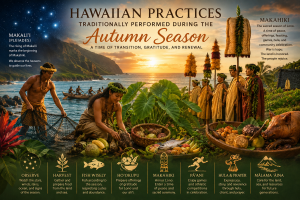
 

Hawaiian Practices Traditionally Performed During the Autumn Season From the Last Months of Kau to the Sacred Season of Makahiki | Victoria Generao, PhD

When people in Europe or North America speak of autumn, the imagination naturally turns toward falling leaves, shortening days, harvest fields, and preparations for winter. In Hawaiʻi, however, the seasonal story is different. The islands do not traditionally organize the year according to the familiar four-season cycle of spring, summer, autumn, and winter.

For Native Hawaiians, time was read through the movements of the heavens, the phases of the Moon, the appearance of stars, rainfall, winds, ocean conditions, the flowering and fruiting of plants, the migrations and spawning of fish, and countless other signs within the living environment.

Traditionally, the Hawaiian year was broadly understood through two great seasonal movements: Kau, the warmer and generally drier season, and Hoʻoilo, the cooler and wetter season. Historical Hawaiian accounts describe six lunar months belonging to each. The transition into Hoʻoilo occurred around what the Western calendar calls late autumn. (University of Hawaii)

Therefore, when we ask what Hawaiian people traditionally practiced during “autumn,” we are really asking about something more interesting:

What happened during the closing months of Kau, the preparation for Hoʻoilo, and the approach and opening of Makahiki?

The answer reveals a season concerned with observation, harvesting, food preservation, redistribution, gratitude, ritual offering, peace, physical competition, communal celebration, and the renewal of the relationship between humanity, the ʻāina, the sea, the ancestors, and the akua.


Autumn in Hawaiʻi Was a Time of Transition

The Gregorian months of approximately September through November overlap several traditional lunar months, although the correspondence is never exact because the Hawaiian calendar follows lunar and environmental observations rather than fixed Gregorian dates.

Older Hawaiian calendrical traditions identify the latter portion of Kau with months such as Mahoe Hope and ʻIkuwā, followed by Welehu, which marks the transition toward Hoʻoilo. David Malo’s nineteenth-century account describes ʻIkuwā as the final month of Kau and Welehu as the first month of Hoʻoilo. (University of Hawaii at Hilo)

The University of Hawaiʻi’s Hawaiian lunar-calendar resources similarly present ʻIkuwā as a period of increasing rain, thunder, wind, environmental change, and preparation for Makahiki, while Welehu opens the wetter season. (University of Hawaii)

This transitional quality is important.

Traditional Hawaiian seasonal activity was not governed by a printed date announcing that “autumn has begun.” A knowledgeable observer watched the world.

The sky announced the season.

The ocean announced the season.

The plants announced the season.

The winds announced the season.

The behavior of animals announced the season.

And eventually, Makaliʻi—the Pleiades—announced one of the most sacred transitions of the year.


Watching the Heavens: The Rising of Makaliʻi

Among the most important autumn practices was simply one of the most profound: observation.

The night sky served as calendar, clock, navigational map, agricultural guide, and ceremonial indicator.

The star cluster known in Hawaiian as Makaliʻi, commonly identified with the Pleiades, became especially significant as the year approached the season of Makahiki.

According to the National Park Service, Makahiki traditionally began when Makaliʻi became visible rising on the eastern horizon after sunset, generally around late October or early November, although timing and practice varied between islands and communities. (National Park Service)

This was not casual stargazing.

It was kilo—careful observation of natural phenomena.

Celestial and environmental signs helped knowledgeable practitioners determine the resetting of the lunar and ritual calendar. At Puʻuhonua o Hōnaunau, the National Park Service describes Kau Makaliʻi as a period during which traditional practitioners observed astronomical and environmental signs associated with the annual cycle of ritual. (National Park Service)

The autumn sky therefore became a sacred text.

Instead of reading the changing season from a calendar hanging upon a wall, one could read it in the stars.


Harvesting and Preparing Food

The months immediately preceding Makahiki were closely connected with the harvesting and securing of resources.

Fishing, gathering, farming, drying, salting, and storing foods were not merely economic activities. They formed part of a sophisticated system in which human consumption was coordinated with ecological cycles.

Traditional Hawaiian lunar knowledge connected particular phases and months with appropriate times for planting, harvesting, fishing, resting gardens, and allowing marine resources to replenish. The University of Hawaiʻi’s Hawaiian Lunar Calendar emphasizes that generations of Hawaiians used lunar observation to guide both agricultural and fishing practices. (University of Hawaii)

During the later months before Makahiki, fishing activity could increase specifically so that fish might be harvested, prepared, and stored before the coming wet season and ceremonial period. (University of Hawaii)

Foods such as kalo (taro), ʻuala (sweet potato), fish, and other locally available foods were central to community subsistence. Pigs, cultivated crops, and crafted goods could later become part of Makahiki tribute and ceremonial offerings. (National Park Service)

Thus, the Hawaiian autumn harvest was not simply a moment of taking abundance from the earth.

It existed within a larger rhythm:

observe → cultivate → harvest → preserve → offer → redistribute → rest → begin again.


Fishing According to the Season

The sea was just as much a part of the seasonal calendar as the land.

Fish behavior, ocean temperature, tides, spawning cycles, currents, moon phases, winds, and rainfall were carefully observed. Certain species became plentiful during particular months, while other species might be protected or avoided.

The Hawaiian lunar-calendar tradition records periods when particular fish were spawning, when certain fisheries were especially productive, and when restrictions or kapu were placed or removed. Such practices demonstrate an intimate connection between subsistence and ecological observation. (University of Hawaii)

One recorded tradition associates ʻIkuwā and Welehu with changing fishing responsibilities, including women and children gathering or catching freshwater and nearshore resources such as ʻoʻopu, hinana, hīhīwai, and ʻōpae. (University of Hawaii)

These details should not necessarily be treated as universal rules practiced identically on every island. Hawaiian ecological practices were intensely place-based. What was appropriate in Kona might differ from what was appropriate on Molokaʻi, Oʻahu, Maui, or Kauaʻi.

That principle itself is deeply Hawaiian.

Knowledge belongs to place.


Preparing Hoʻokupu: Offerings of Gratitude and Obligation

As Makahiki approached, communities prepared hoʻokupu, ceremonial offerings presented in connection with Lono, the aliʻi, and the ritual obligations of the season.

Historical descriptions of Makahiki offerings include valuable foods and goods such as:

  • puaʻa — pigs
  • kalo — taro
  • ʻuala — sweet potatoes
  • hulu — feathers
  • moena — woven mats
  • kapa — bark cloth

(National Park Service)

These offerings represented more than what a modern person might call taxation.

They participated in a ritual economy.

The productivity of the land was acknowledged. The relationship between people, aliʻi, land, and divine powers was reaffirmed. The abundance generated within an ahupuaʻa became visible through what it could ceremonially present.

The University of Hawaiʻi’s Kahoʻiwai resource describes ʻAha Makahiki as involving offerings of food harvested from the various lands, presented in honor of Lono. (University of Hawaii)

The act of giving therefore became one of the great spiritual gestures of the season.

One received from the ʻāina.

One returned something to the sacred order.


The Beginning of Makahiki

The defining traditional observance overlapping the later part of what Western calendars call autumn was, of course, Makahiki.

Makahiki was a major ceremonial season associated particularly with Lono, an akua closely connected with rain, agriculture, fertility, atmospheric forces, peace, and abundance.

Depending upon island and period, customs differed. The surviving written record is especially rich for Hawaiʻi Island, and modern summaries should therefore avoid assuming that every community practiced precisely the same rites. The National Park Service explicitly notes that individual islands had their own ways of observing Makahiki. (National Park Service)

Yet several broad themes recur.

Makahiki represented a shift away from ordinary political and productive activity toward ceremony, renewal, tribute, recreation, and peace.

War became kapu.

Labor patterns changed.

Offerings were gathered.

Lono was honored.

Communities feasted.

Athletic competitions were held.

Hula and celebration accompanied the sacred season.

For a time, the rhythm of society itself changed. (National Park Service)


The Procession of Lono

One of Makahiki’s most dramatic ceremonies involved an image or emblem of Lono known as the Akua Loa.

According to traditions documented by the National Park Service, the Akua Loa traveled through districts in a ritual circuit, visiting the lands and receiving offerings. A related form called the Akua Poko also participated in the ritual complex. (National Park Service)

At Puʻuhonua o Hōnaunau, this circuit is described as something like a ritual survey of the wealth and productivity of the land. (National Park Service)

Imagine the meaning of such a procession.

The god does not remain hidden within a distant temple.

The sacred presence moves through the land.

The productivity of each district is encountered.

Offerings are presented.

Human communities publicly acknowledge their dependence upon forces greater than themselves.

The sacred travels through the inhabited world.

This is one reason Makahiki should not be reduced simply to “the Hawaiian Thanksgiving.”

Gratitude and harvest are certainly present, but Makahiki is considerably larger: it is a political, ecological, agricultural, religious, social, and cosmic season of renewal.


A Time of Peace

Among the most striking features of Makahiki was the suspension of warfare.

During the season dedicated to Lono, war was traditionally prohibited. (National Park Service)

Symbolically, this represents one of the most powerful transitions of the Hawaiian ceremonial year.

Weapons that might otherwise defend territory or advance political power were temporarily subordinated to another principle.

The community entered a sacred interval.

One might call it an annual rebalancing between human ambition and cosmic order.

The season declared, in effect:

There must be times for striving.

There must also be times for peace.

There must be times to cultivate.

There must also be times to enjoy what has been cultivated.

There must be times to compete for power.

There must also be times to remember that all power ultimately depends upon land, rain, ocean, community, and the unseen forces sustaining life.


Feasting and Communal Celebration

Once appropriate ritual restrictions were lifted, feasting became an important part of Makahiki observance.

The ʻAha Makahiki tradition preserved in University of Hawaiʻi cultural resources describes the ceremonial acceptance of offerings, after which the period of enjoyment could begin with feasting and games. (University of Hawaii)

Eating together had social significance.

Food demonstrated the prosperity of the land.

It expressed hospitality.

It strengthened relationships.

It redistributed abundance.

It also transformed the results of months of agricultural and fishing labor into communal experience.

Harvest became feast.

Work became celebration.

Abundance became relationship.


Pāʻani Makahiki: The Games of the Season

Autumn’s movement into Makahiki also brought one of the most joyful dimensions of Hawaiian ceremonial culture: pāʻani, games and athletic contests.

Traditional Makahiki competitions could include activities such as:

ʻUlu maika — rolling a shaped stone between stakes, sometimes compared loosely with bowling.

Mokomoko — boxing.

Hakoko — wrestling.

ʻŌʻō ihe — spear or javelin throwing.

Kūkini — foot racing.

Other traditions included surfing, sledding, canoe racing, and various contests of physical ability. (University of Hawaii)

These were not merely diversions.

Athletic skill demonstrated discipline, balance, endurance, courage, coordination, and bodily intelligence.

In this sense, Makahiki celebrated the prosperity not only of the land but of the human body.

A healthy community required strong land.

Strong land nourished strong people.

Strong people could then celebrate the abundance of the land.

The relationship was reciprocal.


Hula, Prayer, and Sacred Celebration

Makahiki festivities also included hula, prayer, religious ceremony, and communal celebration. (University of Hawaii)

Hula in traditional Hawaiian culture cannot be reduced simply to entertainment.

It can carry genealogy, history, prayer, praise, memory, environmental knowledge, and spiritual relationship.

Within a sacred seasonal setting, chant and movement help join the visible community with the invisible dimensions of memory and divine presence.

Thus, during this season, celebration itself could become an act of reverence.

Joy and holiness did not have to be opposites.

They could be expressions of the same sacred abundance.


Hōʻihi: Entering Sacred Places With Reverence

Another important principle connected with Makahiki observance is hōʻihi—reverence, respect, and dignified conduct.

At Puʻuhonua o Hōnaunau, contemporary cultural practitioners continue to present hoʻokupu during Makahiki ceremonies, and the National Park Service describes hōʻihi as the attitude with which sacred places and ceremonial actions are approached.

This principle gives us a deeper way of understanding Hawaiian seasonal spirituality.

The important question was not simply:

“What ritual should I perform?”

It was also:

“How should I stand in relationship with this place?”

Sacredness required appropriate behavior.

The land was not scenery.

The ocean was not merely a resource.

The heavens were not merely astronomical objects.

The season itself was not merely weather.

Each participated in relationship.


Mālama ʻĀina: Caring for What Sustains Life

Although the expression mālama ʻāina is used widely today, the underlying principle of reciprocal care is clearly reflected in traditional Hawaiian resource management.

The lunar calendar demonstrates a system in which people observed when to fish, when to harvest, when to plant, and when certain resources should be left alone. (University of Hawaii)

This is a profoundly different attitude from extracting as much as possible whenever an opportunity arises.

The traditional ecological question was often closer to:

What is the appropriate action at this particular time?

The answer changed according to the Moon.

It changed according to rain.

It changed according to spawning cycles.

It changed according to currents.

It changed according to place.

It changed according to season.

What modern people call sustainability was embedded within a broader discipline of attention and reciprocity.


Autumn as a Spiritual Threshold

Seen through Hawaiian seasonal consciousness, the autumn months represent a threshold.

The dry season approaches its conclusion.

The Sun moves southward.

Rain increases.

The winds change.

The sea changes.

Foods are harvested and preserved.

Makaliʻi returns to prominence in the evening sky.

Makahiki approaches.

Lono returns ceremonially.

Offerings are made.

War falls silent.

Work gives way, at least temporarily, to rest.

Games replace battle.

Feasting replaces accumulation.

The community pauses within the turning of the year.

And this may be the deepest spiritual teaching of the Hawaiian autumn:

A people cannot live only by producing.

There must also be a time for acknowledging.

A time for giving.

A time for remembering.

A time for observing.

A time for peace.

A time for celebration.

And a time for recognizing that human prosperity exists only because human life participates within a much greater living system.


The Spiritual Meaning of the Hawaiian Autumn

For a modern spiritual practitioner, the greatest lesson of this season may not be to imitate ceremonies belonging to Native Hawaiian cultural lineages without proper understanding or relationship.

The deeper invitation is to learn from their underlying wisdom.

Observe before acting.

Know the land upon which you stand.

Understand what the season is actually doing.

Give something back when you receive.

Allow periods of restraint to accompany periods of abundance.

Honor those who came before.

Cultivate peace deliberately.

Recognize that food is sacred because life produced it.

Understand that celebration can itself become prayer.

And remember that the natural world is not merely happening around us.

We are happening within it.

Makahiki expresses this beautifully.

Humanity pauses long enough to recognize the powers that sustain it.

The rain.

The soil.

The cultivated field.

The ocean.

The Moon.

The stars.

The ancestors.

The akua.

The community.

All are woven together.


Autumn in Hawaiʻi: Not a Season of Falling Leaves, but of Returning Relationship

The Hawaiian autumn is therefore best understood not as a tropical version of a European harvest festival, but as the closing movement of one seasonal cycle and the opening of another.

It is a time of kilo, careful observation.

A time of harvesting and preserving.

A time of responsible fishing and agricultural management.

A time of preparing hoʻokupu.

A time of watching for Makaliʻi.

A time of entering Hoʻoilo.

And ultimately, a time of Makahiki—of Lono, peace, feasting, games, hula, prayer, gratitude, redistribution, and renewal.

The leaves may not turn crimson and gold across Hawaiʻi as they do in temperate forests.

But the season nevertheless changes.

The heavens change.

The rains change.

The waters change.

Human responsibilities change.

And within those changes is an ancient lesson:

To know the season is to know when to work, when to gather, when to give, when to refrain—and when to celebrate the sacred abundance of life.


Annotated Bibliography

Hawaiian Practices Traditionally Performed During the Autumn Season

Research Note

The concept of “autumn” should be used cautiously when discussing traditional Hawaiian culture. The Hawaiian calendar was not historically divided into the four temperate seasons of spring, summer, autumn, and winter. Rather, Hawaiian communities followed lunar months, celestial observations, rainfall, winds, ocean conditions, agricultural cycles, and broader seasonal divisions such as Kau and Hoʻoilo. The Western autumn months overlap especially with ʻIkuwā, Welehu, and the opening of the Makahiki season. The sources below are therefore selected for their usefulness in understanding Makahiki, Lono, Makaliʻi, lunar calendrics, agriculture, fishing, hoʻokupu, seasonal games, environmental observation, and Hawaiian relationships with ʻāina.

1. Malo, David. Hawaiian Antiquities (Moolelo Hawaii). Translated by Nathaniel B. Emerson. Honolulu: Bishop Museum Press, 1951.

David Malo’s Hawaiian Antiquities is one of the foundational sources for the study of traditional Hawaiian society. Malo (c. 1795–1853) was a Native Hawaiian historian and scholar whose knowledge came from a period when substantial elements of the older religious and social systems remained within living memory. The work discusses Hawaiian social organization, gods, religious observances, calendrical concepts, agriculture, fishing, government, kapu, and ceremonies. A 1951 Bishop Museum edition is widely cited, while the English translation had appeared much earlier. (Department of Hawaiian Home Lands)

Relevance to this topic: Malo is particularly valuable for establishing that Hawaiian seasonal reckoning cannot simply be mapped onto the European four-season calendar. His descriptions help situate Makahiki within the broader annual religious and social cycle.

Research value: ★★★★★ — Essential historical source.

2. Kamakau, Samuel Mānaiakalani. Ruling Chiefs of Hawaii. Rev. ed. Honolulu: Kamehameha Schools Press, 1992.

Samuel Mānaiakalani Kamakau (1815–1876) was one of the most important nineteenth-century Native Hawaiian historians. Much of his historical work originally appeared in Hawaiian-language newspapers before being collected and translated. Ruling Chiefs of Hawaii records political history, chiefly institutions, ceremonial practices, religion, warfare, and social organization. The revised 1992 edition includes additional editorial and reference material. (WorldCat)

Relevance to this topic: Makahiki was not only an agricultural observance but also part of the political and chiefly order. Kamakau provides crucial background for understanding the relationship among aliʻi, makaʻāinana, tribute, religious authority, warfare, and ceremonial cycles.

Research value: ★★★★★ — Especially important for the political and historical dimensions of Makahiki.

3. Kamakau, Samuel Mānaiakalani. Ka Poʻe Kahiko: The People of Old. Translated by Mary Kawena Pukui. Arranged and edited by Dorothy B. Barrère. Honolulu: Bishop Museum Press, 1964; later reprints.

This volume gathers Kamakau’s Hawaiian-language writings concerning the lives, beliefs, practices, and social organization of earlier generations of Hawaiians. Bishop Museum describes the work as documenting fundamental principles underlying everyday Hawaiian life, with particular attention to spiritual and religious dimensions. (Bishop Museum Press)

Relevance to this topic: The volume provides cultural context for interpreting activities such as prayer, offerings, kapu, work, communal responsibilities, and relationships with supernatural powers. It helps prevent Makahiki from being treated merely as a harvest festival divorced from the religious worldview within which it operated.

Research value: ★★★★★ — Strong Native Hawaiian historical foundation.

4. “Ka Hoomana Kahiko. Helu 30 / Old Worship. Number 30.” Ka Nupepa Kuokoa, December 9, 1865. IHLRT Hawaiian Newspaper Archive, University of Hawaiʻi at Mānoa.

This Hawaiian-language newspaper article is an especially significant primary historical source. It describes a Makahiki manifestation of Lono, including the ceremonial image carried from place to place, its movement between lands, sacred restrictions surrounding it, and the presentation of pigs, food, and other hoʻokupu by commoners and chiefs. The University of Hawaiʻi archive provides both transcription and English translation. (University of Hawaii at Manoa)

Relevance to this topic: This source directly supports descriptions of the procession of Lono and the gathering of ceremonial offerings during Makahiki.

Research value: ★★★★★ — One of the strongest primary sources for Makahiki ritual.

5. Handy, E. S. Craighill, and Elizabeth Green Handy, with Mary Kawena Pukui. Native Planters in Old Hawaii: Their Life, Lore, and Environment. Honolulu: Bishop Museum Press, 1972.

This substantial ethnographic work examines Hawaiian agriculture, land use, irrigation, cultivated plants, environmental adaptation, mythology, rituals, and agricultural knowledge. Bishop Museum notes that the work arose from extensive research and collaboration with Hawaiian cultural authority Mary Kawena Pukui. A major portion of the study also addresses the Makahiki harvest festival. (Bishop Museum Press)

Relevance to this topic: This is perhaps the single most useful secondary reference for explaining the connection among harvest, agriculture, land productivity, religious observance, and Makahiki. It also demonstrates how agricultural practices differed according to local environments across the islands.

Research value: ★★★★★ — Essential for agriculture, harvest, and land-based seasonal practices.

6. Abbott, Isabella Aiona. Lāʻau Hawaiʻi: Traditional Hawaiian Uses of Plants. Honolulu: Bishop Museum Press, 1992.

Renowned Hawaiian ethnobotanist Isabella Aiona Abbott assembled this study of traditional Hawaiian relationships with plants. It addresses food, medicine, clothing, shelter, cordage, religion, recreation, cultivated crops, aquatic plant foods, kalo, ʻuala, hula, and other forms of plant knowledge. Bishop Museum describes it as a broad account connecting Hawaiian flora directly with Hawaiian cultural practice. (Google Books)

Relevance to this topic: Abbott’s work provides botanical and cultural depth for discussions of harvest foods, cultivated plants, offerings, lei and ritual plant materials, and the relationship between seasonal abundance and Hawaiian religious life.

Research value: ★★★★☆ — Excellent ethnobotanical companion to Native Planters in Old Hawaii.

7. Kanahele, Pualani Kanakaʻole. Ka Honua Ola: ʻEliʻeli Kau Mai—The Living Earth: Descend, Deepen the Revelation. Honolulu: Kamehameha Publishing, 2011.

Cultural scholar and practitioner Pualani Kanakaʻole Kanahele explores Hawaiian relationships with the living earth through twenty-five mele associated with Pele and Hiʻiaka. The work draws together genealogy, land, divine presence, hula, ancestral memory, and environmental relationships. (Kamehameha Publishing)

Relevance to this topic: Although not a manual of Makahiki ritual, this work provides a valuable Hawaiian-centered philosophical foundation for understanding why ʻāina, weather, growth, water, genealogy, human activity, and divine powers cannot easily be separated in traditional Hawaiian thought.

It is especially useful when discussing the deeper spiritual meaning of seasonal observance without reducing Hawaiian ecological knowledge to modern environmental terminology alone.

Research value: ★★★★☆ — Excellent for Hawaiian metaphysics, sacred ecology, and worldview.

8. University of Hawaiʻi. “Hawaiian Lunar Calendar.” Hawaiʻi Climate Data Portal.

This University of Hawaiʻi resource presents the Hawaiian lunar calendar as an environmental knowledge system developed through generations of observation. It explains how lunar phases were used alongside the observation of organisms, weather, marine conditions, agriculture, and fishing to determine appropriate periods for resource use and rest. (University of Hawaii)

Of particular importance to the autumn topic are its descriptions of the lunar months Mahoe Hope, ʻIkuwā, and Welehu. The resource notes that fishing effort could increase before Makahiki in order to prepare and store food, while ʻIkuwā brought rain, thunder, wind, and preparations for Makahiki. It also connects the season with the rising of Makaliʻi. (University of Hawaii)

Relevance to this topic: This is one of the strongest accessible sources for explaining why a Hawaiian discussion of “autumn” must be based on lunar months and ecological indicators rather than simply September, October, and November.

Research value: ★★★★★ — Essential for the seasonal framework of the blog.

9. University of Hawaiʻi. “ʻAha Makahiki.” Kahoʻiwai.

This cultural knowledge resource describes ʻAha Makahiki as ceremony associated with the coming of Lono and the rainy season. It discusses the movement of Lono through the ahupuaʻa, the gathering of harvested food offerings, the lifting of kapu, feasting, and traditional games including mokomoko, ʻulu maika, ʻōʻō ihe, kōnane, kūkini, and related activities. (University of Hawaii)

Importantly, the resource cites major Hawaiian cultural references such as Native Planters in Old Hawaii, helping connect contemporary Hawaiian educational interpretation with established historical scholarship.

Relevance to this topic: Excellent support for sections concerning hoʻokupu, Lono, feasting, games, prayer, agriculture, and ceremonial procession.

Research value: ★★★★★ — Particularly useful for a public-facing blog.

10. National Park Service. “Makahiki.” Haleakalā National Park.

The National Park Service’s Makahiki overview provides a concise account of the ceremonial season associated with Lono. It identifies the appearance of Makaliʻi near the eastern horizon after sunset as a traditional indicator of the beginning of Makahiki and describes the season as involving rest, religious festivities, feasting, games, dancing, offerings, and the prohibition of warfare. (National Park Service)

The page also identifies traditional offerings including pigs, kalo, ʻuala, feathers, mats, and kapa and describes the Akua Loa procession connected with Lono. Importantly, it cautions that individual Hawaiian islands possessed their own forms of Makahiki observance and that much surviving documentation relates particularly to Hawaiʻi Island. (National Park Service)

Relevance to this topic: An excellent source for establishing the basic structure of Makahiki while retaining the important warning against presenting one island’s customs as universally Hawaiian.

Research value: ★★★★★ — Highly useful synthesis for general readers.

11. National Park Service. “Kau Makaliʻi—Season of the Makahiki Ritual.” Puʻuhonua o Hōnaunau National Historical Park.

This resource provides one of the clearest contemporary cultural explanations of Kau Makaliʻi, connecting celestial observation, environmental phenomena, Hawaiian lunar reckoning, Lono, games, agricultural abundance, and seasonal renewal. It identifies ʻIkuwā, Welehu, and Makaliʻi as lunar months associated with this ritual period and places them approximately between November and January. (National Park Service)

The page also explains that the Akua Loa traveled through the moku as part of a ritualized assessment of the productivity and wealth of the land. It emphasizes renewal and the maintenance of balance among people, land, water, and natural resources. (National Park Service)

Relevance to this topic: Particularly important for the blog’s themes of kilo, celestial observation, Makaliʻi, seasonal transition, Lono, ritual procession, environmental productivity, and renewal.

Research value: ★★★★★ — One of the best modern interpretive sources for the subject.

12. National Park Service. “Kau Makahiki.” Video presentation by Kahakaiʻo Ravenscraft. Puʻuhonua o Hōnaunau National Historical Park, November 5, 2021.

In this cultural presentation, Park Ranger and cultural demonstrator Kahakaiʻo Ravenscraft discusses the changing Hawaiian seasons and their relationship with management of the ahupuaʻa. The presentation emphasizes that Makahiki also involved assessments of ʻāina, land productivity, population, and distribution of resources. (National Park Service)

Relevance to this topic: This source adds an important dimension sometimes absent from popular descriptions: Makahiki was simultaneously religious, ecological, economic, social, and political. Seasonal observance helped communities evaluate the actual productivity and condition of their lands.

Research value: ★★★★☆ — Excellent supplemental cultural interpretation.

Additional Contemporary Resource

University of Hawaiʻi. “Makahiki Column.” Ka Huli Ao Center for Excellence in Native Hawaiian Law, William S. Richardson School of Law.

This short interpretive article connects the rising of Nā Huihui o Makaliʻi, the Pleiades, with the traditional Makahiki season and describes Makahiki as a time associated with harvest, rest, spiritual renewal, and thanksgiving. (University of Hawaii at Manoa)

Relevance to this topic: Helpful for discussing the continued importance of Makahiki within contemporary Native Hawaiian institutions.

Research value: ★★★☆☆ — Useful supplemental reading rather than a primary historical authority.

Recommended Research Hierarchy

For the strongest historical treatment of Hawaiian autumnal practices, the sources should not all be weighted equally.

The most authoritative foundation should begin with Native Hawaiian historical voices, particularly David Malo and Samuel Mānaiakalani Kamakau. The nineteenth-century Hawaiian-language newspaper material preserved through the University of Hawaiʻi should likewise receive special attention because it brings the researcher close to Hawaiian-language accounts created during a period when knowledge of the older traditions remained comparatively immediate.

For agriculture and subsistence, Handy, Handy, and Pukui’s Native Planters in Old Hawaii should be a principal reference, supplemented by Isabella Abbott’s Lāʻau Hawaiʻi.

For understanding how the lunar and environmental calendar functioned, the University of Hawaiʻi Hawaiian Lunar Calendar is particularly valuable.

For contemporary Hawaiian interpretation and the continued cultural life of Makahiki, the resources from Kahoʻiwai, Puʻuhonua o Hōnaunau National Historical Park, and Hawaiian cultural practitioners are especially useful.

Taken together, these sources reveal that what we call the Hawaiian “autumn season” was not simply a harvest period. It represented a complex transition involving:

kilo — careful observation;

mahina — lunar reckoning;

Makaliʻi — celestial seasonal indication;

mahiai — cultivation and harvest;

lawaiʻa — fishing according to ecological cycles;

hoʻokupu — ceremonial giving;

Lono — rain, fertility, abundance, and Makahiki;

kapu — sacred regulation and restraint;

pāʻani — games and athletic competition;

ʻahaʻaina — feasting and communal sharing;

maluhia — a sacred interval of peace;

and mālama ʻāina — the continuing responsibility to care for the lands and waters that sustain human life.

The resulting picture is therefore much richer than a Hawaiian equivalent of a Western harvest festival. Kau Makaliʻi and Makahiki reveal an entire system of seasonal consciousness in which astronomy, ecology, religion, governance, agriculture, community, and spiritual renewal converge.


Mabon | The Autumn Equinox, the Harvest, and the Mystery of Balance | Victoria Generao, PhD

There comes a moment each year when summer loosens its hold upon the Earth.

The blazing fullness of the Sun begins to soften. Fields that only weeks before stood green and growing become gold, russet, amber, and brown. Fruit hangs heavily from branches. Grain bends upon its stalk. The air changes. Mornings become cooler, shadows grow longer, and evening seems to arrive a little sooner each day.

In the Northern Hemisphere, this threshold is marked astronomically by the September equinox, the point at which the Sun crosses the celestial equator as it journeys southward. It marks the beginning of astronomical autumn. Although the word equinox derives from the Latin for “equal night,” daylight and darkness are not literally identical in duration on the equinox because atmospheric refraction and the way sunrise and sunset are measured make daylight slightly longer. Symbolically, however, the image of light and darkness standing in equilibrium has become one of the defining themes of the season. (NOAA Satellites)

Within many contemporary Pagan traditions, this autumnal turning of the year is celebrated as Mabon.

Mabon is a festival of harvest, gratitude, balance, completion, preparation, and the recognition that every season of abundance must eventually give way to a season of rest.

Yet Mabon has an especially interesting history, because the festival as modern Pagans know it is both ancient in its seasonal symbolism and distinctly modern in its name.

Understanding that distinction does not diminish Mabon. In many ways, it makes the festival more fascinating.

The Harvest Before There Was “Mabon”

Long before the word Mabon was associated with the autumn equinox, agricultural peoples throughout Europe and elsewhere observed the harvest season with feasting, thanksgiving, offerings, communal labor, and preparation for winter.

For an agricultural society, harvest was not merely picturesque.

It was survival.

Grain stored in barns, fruit dried or preserved, livestock managed, seeds saved, and food successfully gathered determined whether a community could endure the approaching winter.

The harvest therefore carried both joy and solemnity.

There was gratitude because the Earth had provided.

There was relief because labor had produced its fruit.

But beneath that gratitude lay another awareness: winter was coming.

This combination of abundance and impermanence remains at the heart of Mabon today.

The laden harvest table contains within itself the memory of the empty field.

The ripe apple already carries its seeds.

The grain that is cut down becomes both bread and the promise of another planting.

Nature teaches a strange but beautiful truth at this season:

Fulfillment and ending often arrive together.

Is Mabon an Ancient Celtic Festival?

This is where historical precision becomes important.

It is common in popular books and websites to encounter statements suggesting that ancient Celts celebrated a festival called Mabon at the autumn equinox.

There is no good historical evidence for this.

The name Mabon, as a designation for the Pagan autumn equinox, is a product of the modern Pagan revival.

The term was introduced into modern Pagan usage by American Pagan scholar and ritualist Aidan Kelly while he was creating a Pagan calendar in 1974. Kelly later explained that he wanted the solstices and equinoxes to possess mythologically evocative names similar to the established Gaelic festival names such as Samhain and Beltane. For the autumn equinox he selected the name of the Welsh mythological figure Mabon ap Modron. (Patheos)

The name subsequently circulated through the influential Pagan publication Green Egg and gradually entered the vocabulary of American Paganism. By the late twentieth century, “Mabon” had become one of the commonly used names for the autumn equinox within Wiccan and Wicca-influenced traditions. (Patheos)

Historian Ronald Hutton has discussed this development as an example of the way modern Pagan traditions consciously create meaningful ritual forms by drawing upon older mythological, folkloric, and seasonal materials. (Taylor & Francis Online)

Thus the most historically accurate statement is:

Mabon is a modern Pagan festival built around a genuinely ancient seasonal reality.

People have celebrated harvests for millennia.

The autumn equinox is an astronomical event as old as the Earth’s seasonal cycle.

But calling the Pagan autumn equinox Mabon is a twentieth-century development.

Who Is Mabon ap Modron?

The name was not invented from nothing.

Mabon ap Modron belongs to medieval Welsh literary tradition.

His name is generally interpreted as “Mabon, son of Modron,” with Mabon associated etymologically with the idea of the divine youth or son and Modron with the mother.

Mabon appears prominently in the Welsh tale Culhwch and Olwen, preserved within the collection commonly called the Mabinogion. Medieval manuscripts such as the White Book of Rhydderch, copied during the fourteenth century, preserve these Welsh narratives, although many of the stories themselves derive from much older oral traditions. (National Library of Wales)

In Culhwch and Olwen, Mabon has been taken from his mother when he is only three nights old.

His whereabouts are unknown.

To find him, Arthur’s companions undertake a remarkable quest, questioning increasingly ancient creatures—the blackbird, stag, owl, eagle, and finally the great salmon.

Eventually Mabon is discovered imprisoned at Gloucester and is liberated.

The National Library of Wales’ Welsh Classical Dictionary describes the legendary Mabon as a figure of extraordinary antiquity whose rescue becomes essential to the later hunting of the magical boar Twrch Trwyth. The same source also notes the relationship scholars have proposed between Mabon and the older Celtic deity Maponos. (National Library of Wales)

The myth therefore contains powerful themes:

the divine child,

separation from the mother,

imprisonment,

the descent into hidden places,

the wisdom of ancient creatures,

discovery,

liberation,

and return.

Aidan Kelly saw in these themes an appropriate mythological image for the autumnal mystery and deliberately associated Mabon with the equinox. That connection is modern rather than a demonstrable survival of an ancient Welsh equinox festival. (Patheos)

But symbolically, the association is striking.

The Second Harvest

Within the contemporary eightfold Wheel of the Year, Mabon is often described as the Second Harvest.

The cycle commonly begins its harvest sequence with Lughnasadh or Lammas, around August 1, traditionally associated with grain and the first fruits of harvest.

Mabon follows at the autumn equinox.

Then comes Samhain, when the agricultural year reaches another profound threshold and the dark half of the year becomes dominant.

Seen in this way, the harvest does not occur in a single moment.

It unfolds.

First comes the grain.

Then come the fruits, vines, orchards, nuts, vegetables, and later crops.

Finally comes the preparation for winter.

Mabon therefore occupies an important position between abundance and withdrawal.

The Earth has given much.

But she is beginning to turn inward.

The Mystery of the Scales

The most recognizable spiritual symbolism of Mabon is balance.

Light and darkness appear poised at the threshold.

Neither dominates completely.

Summer stands behind us.

Winter waits ahead.

Mabon therefore occupies a liminal place—a doorway between worlds of experience.

This makes the autumn equinox an especially useful time for contemplation.

Where is there imbalance in my life?

Where have I given too much?

Where have I withheld too much?

What have I cultivated successfully?

What has failed to bear fruit?

What should be preserved?

What should be allowed to die away?

These are profoundly autumnal questions.

Balance, however, does not mean remaining motionless between opposites.

The equinox itself proves this.

The moment of equilibrium is fleeting.

Immediately afterward, the Northern Hemisphere continues its movement toward longer nights.

True equilibrium is therefore not stagnation.

It is the ability to remain centered while change is occurring.

That is a deeper spiritual teaching.

The Harvest as a Mirror of the Soul

The field offers one of humanity’s oldest metaphors for spiritual life.

Every thought is a seed.

Every repeated action becomes cultivation.

Every habit creates a field.

Eventually there is a harvest.

At Mabon, we may therefore look upon our lives as though standing before an inner field.

What did we plant earlier in the year?

What did we nourish?

What did we neglect?

What has now matured?

Some harvests are visible.

A finished project.

A relationship strengthened.

A skill learned.

A business built.

A student taught.

A promise fulfilled.

Other harvests are hidden.

Wisdom.

Patience.

Discernment.

Forgiveness.

Courage.

The ability to say no.

The ability to say yes.

The strength to leave something behind.

Mabon invites us to acknowledge both.

Gratitude as Sacred Reciprocity

Modern Mabon celebrations frequently emphasize gratitude, and this fits naturally with harvest symbolism.

But gratitude in older agricultural societies was not merely sentiment.

It arose from dependence.

Human beings knew that they did not create the rain.

They did not create sunlight.

They did not create fertile soil.

They cooperated with forces far greater than themselves.

That awareness can easily disappear in modern life, where food arrives packaged and seasons can seem distant from everyday survival.

Mabon restores perspective.

The loaf of bread represents soil, seed, rain, sunlight, farmer, miller, baker, transportation, labor, and time.

The apple contains tree, blossom, bee, rainfall, Earth, and season.

To eat consciously is therefore to participate in an enormous web of relationship.

Mabon asks us to remember the invisible hands and powers that sustain our visible lives.

The Descent Into Darkness

Mabon is not merely a festival of abundance.

It is also a preparation for darkness.

After the autumn equinox in the Northern Hemisphere, nights continue to lengthen until the winter solstice.

Symbolically, the descent begins.

Yet darkness need not mean evil.

In mystical traditions, darkness may represent gestation, mystery, incubation, dream, silence, unconsciousness, initiation, and the hidden womb from which new life eventually emerges.

Seeds germinate beneath soil.

Children develop within the darkness of the womb.

Dreams arise when the eyes close.

Mysteries are often discovered only when ordinary sight fails.

Mabon therefore teaches that the dark half of the year is not simply something to endure.

It is something to enter consciously.

The outward harvest eventually becomes an inward journey.

Symbols of Mabon

Contemporary Mabon practice has accumulated a rich vocabulary of seasonal symbols.

Apples are especially powerful.

When an apple is cut horizontally, its seeds frequently reveal a five-pointed pattern reminiscent of the pentagram. For many modern esoteric practitioners, the apple therefore becomes an emblem of hidden wisdom contained inside ordinary nature.

Grapes and wine symbolize transformation—the fruit crushed so that another substance may emerge.

Grain represents sacrifice, nourishment, regeneration, and the ancient mystery of seed becoming food and food sustaining life.

Cornucopias represent abundance.

Autumn leaves remind us that beauty does not disappear merely because something is ending.

Acorns carry enormous possibility within tiny forms.

Pomegranates, especially through the Greek myth of Persephone, evoke descent into the underworld and the cyclical return from darkness.

None of these symbols needs to belong exclusively to Mabon. Rather, contemporary practitioners gather them into a seasonal symbolic language through which autumn may be contemplated.

Mabon and the Wheel of the Year

The modern Pagan Wheel of the Year presents nature not as a straight line but as a circle.

Birth becomes growth.

Growth becomes maturity.

Maturity becomes harvest.

Harvest becomes decline.

Decline becomes death.

Death becomes gestation.

Gestation becomes birth again.

Within that cycle, Mabon represents the moment when we can finally see what our previous actions have produced.

It is therefore both a celebration and an accounting.

There is an old spiritual law hidden within every harvest:

We eventually meet what we have cultivated.

The farmer cannot harvest wheat from a field planted with barley.

Likewise, repeated choices eventually become character.

Repeated thoughts become patterns of consciousness.

Repeated acts become destiny.

Mabon therefore carries an ethical dimension.

The harvest does not judge us.

It simply reveals the nature of the seeds.

Celebrating Mabon Today

A contemporary Mabon observance may be elaborate or very simple.

One might prepare a meal from seasonal foods, bake bread, drink cider or wine, decorate an altar with apples and autumn leaves, walk through a forest, donate food, share a meal with friends, or simply watch the sunset.

One particularly meaningful practice is to create two lists.

On one, write:

What I Have Harvested.

Record achievements, insights, blessings, relationships, lessons, and growth from the previous year.

On the second write:

What I Am Releasing.

Record habits, resentments, fears, obligations, projects, or identities that have reached their natural conclusion.

The two lists represent the mystery of Mabon perfectly.

Gather.

Release.

Give thanks.

Prepare.

The Historical Significance of Mabon

Mabon’s historical significance lies not in being an unchanged survival from some remote Celtic antiquity.

Its significance is subtler.

It demonstrates how spiritual traditions evolve.

Modern Paganism inherited fragments from folklore, mythology, ceremonial magic, agricultural customs, Romanticism, occult revivalism, comparative religion, archaeology, and reconstructed pre-Christian traditions.

Those fragments were not merely preserved.

They were recombined.

Reinterpreted.

Ritualized.

Mabon is one result of that process.

The festival therefore stands at an interesting crossroads between history and living tradition.

Its name is modern.

Its Welsh mythological inspiration is medieval and probably contains older elements.

Its harvest symbolism is ancient.

Its astronomical foundation is universal.

Its spiritual meaning continues to evolve.

That does not make Mabon less authentic.

Traditions have always developed.

Every ritual was new once.

The more useful question may not be, “Is this custom ancient?”

The better question is:

“Does this practice truthfully connect us with the mystery it claims to honor?”

For Mabon, that mystery is unmistakable.

The harvest is real.

The shortening days are real.

The turning Earth is real.

The necessity of gratitude is real.

And the human need to pause at the threshold between abundance and darkness is very old indeed.

Standing at the Autumn Gate

Imagine standing at sunset beside a harvested field.

Behind you lies summer.

Before you lies winter.

In your hands rests whatever this year has given you.

Some of it came through labor.

Some through grace.

Some through suffering.

Some through circumstances you never expected.

Mabon asks you to look at all of it.

Not merely the pleasant harvest.

The whole harvest.

Give thanks for what nourished you.

Learn from what did not.

Preserve what should continue.

Return what has finished to the Earth.

And then stand for a moment at the place of balance.

The Sun is descending.

The darkness is increasing.

But the darkness is not the end of the Wheel.

Deep within autumn already sleeps the seed of spring.

This may be the deepest wisdom of Mabon:

Nothing is possessed forever.

Every harvest must eventually be released.

Every ending contains another beginning.

Every descent hides the possibility of return.

And when we learn to receive abundance without clinging to it, and enter darkness without fearing it, we begin to understand what the turning Wheel has been teaching humanity all along.

There is a time to sow.

There is a time to grow.

There is a time to gather.

And there is a sacred time to let go.

Arts and Crafts | Creating Hemp-and-Bead Bracelets

If you want hemp-and-bead bracelets that last for years instead of weeks, the biggest factors are the cord you choose, the knots you use, and how you finish the ends. Natural hemp is beautiful, but untreated hemp alone will eventually fray. Many professional makers either wax the hemp or use polished hemp cord.

Here are several durable styles, from easiest to most advanced.

1. Simple Spiral Knot Bracelet (Best for Beginners)

Image

Image

Image

Image

Materials

  • 1 mm polished hemp cord
  • 6–10 mm gemstone or wooden beads
  • Scissors
  • Beeswax
  • Lighter (optional)

Construction

  • Cut four strands about 4 feet long.
  • Tie a loop at one end.
  • Work repeated half-square knots around the center cords.
  • Add a bead every inch or two.
  • Finish with a sliding knot.

Why it’s durable

  • Spiral knots distribute tension evenly.
  • Little stress is placed on the beads.
  • Sliding closures are less likely to fail than metal clasps.

2. Square Knot Macramé Bracelet

Image

Image

Image

Image

Image

Image

This is probably the strongest traditional hemp bracelet.

The square knot alternates left and right half knots so the bracelet stays flat.

Good bead choices:

  • Jasper
  • Tiger’s Eye
  • Rose Quartz
  • Lava Stone
  • Hematite
  • Wood

This style is excellent for heavier stones.


3. Ladder Bead Bracelet

Image

Image

Image

Instead of placing beads randomly, each bead is locked between knots.

Pattern:

Square knot
Bead
Square knot
Bead
Square knot

Because every bead is trapped by knots, nothing slides around.


4. Wrapped Stone Bracelet

Image

Image

Image

Image

Image

Perfect for crystal lovers.

Instead of drilling the stone:

  • Create a tiny macramé net.
  • Capture the stone.
  • Attach the net to the bracelet.

No glue required.


5. Braided Hemp Bracelet

Image

Image

Image

Image

Image

Use:

  • 4 strands
  • 6 strands
  • 8 strands

Add beads onto one strand before braiding.

This style is extremely resistant to pulling.


6. Cobra Knot Bracelet (Paracord Style in Hemp)

Image

Image

Image

Image

Image

A cobra weave is thicker than ordinary macramé.

Advantages:

  • Very strong
  • Comfortable
  • Doesn’t stretch much
  • Looks substantial

Making Bracelets That Don’t Break

Use these practices regardless of the design:

  • Choose polished hemp (1 mm or 1.2 mm) instead of rough craft hemp.
  • Wax the cord lightly with beeswax before knotting to reduce fraying and help knots stay tight.
  • Pre-stretch the hemp by pulling firmly before you begin.
  • Tie every knot snugly and consistently.
  • Use beads with smooth, rounded holes; sharp-edged holes can cut natural fibers over time.
  • Secure end knots with a tiny drop of flexible jewelry adhesive (such as G-S Hypo Cement or a flexible fabric adhesive), then trim the tails after it cures.
  • For adjustable bracelets, use a double sliding knot rather than metal clasps, since it has fewer failure points.

Best Beads for Hemp

Natural materials complement hemp beautifully and are generally gentle on the cord:

  • Gemstones (amethyst, labradorite, jasper, agate, quartz)
  • Sandalwood
  • Olive wood
  • Coconut shell
  • Bone or horn (where ethically sourced)
  • Brass or copper accent beads
  • Matte glass beads

Avoid inexpensive metal beads with rough interior edges, as they can wear through hemp over time.

A Rosicrucian or Esoteric Series

Given your interest in the Western Mystery Tradition, you could even create a symbolic bracelet collection where each design corresponds to a spiritual theme:

  • Earth (Malkuth): green hemp with moss agate and wooden beads.
  • Air (Yesod/Mercury): blue-gray hemp with sodalite and silver spacers.
  • Fire (Tiphareth/Solar): golden hemp with tiger’s eye and citrine.
  • Water (Netzach/Venus): burgundy hemp with rose quartz and copper accents.
  • Spirit (Kether): natural hemp with clear quartz and white sandalwood.

Each bracelet could incorporate knot counts, bead numbers, or color correspondences that reflect Qabalistic, planetary, or elemental symbolism while remaining attractive as everyday jewelry.

With good-quality polished hemp, proper waxing, secure knotting, and smooth-hole beads, a handcrafted hemp bracelet can withstand daily wear for years.

New Learning Series | Astra Prima™ Astrology for Novices, and Tarot 101

I have been approached by many of my Reiki students expressing their desire to learn more about metaphysical subject matters. It appears there is an avid interest in learning more about Astrology and learning to read the Tarot proficiently. I was delighted to hear their enthusiasm and see their eagerness to learn about these occult areas of knowledge, and decided to write about both topics, since I have been teaching on such topics on other platforms for the better part of 25 years.

I ended up writing a series of manuals for use and reference alongside my live lectures. These publications are now available for purchase online.

The new training courses I’m offering through the Hālau are called Astra Prima™ Astrology for Novices and the Arcana Institute’s Tarot 101. I’m engaged in a project where I’m lecturing on both subjects concurrently, with students using my books as their course textbooks. We are seven weeks into our coursework, and so far, feedback has been positive, and the material has been enthusiastically received. Well, that is, until they engage in our first round of midterms, scheduled for the first two weeks of August. I won’t gloss over the fact that I am a strict instructor, but then again, proof of the success of my approach continues to manifest in the quality of my students’ acumen and proficiency.

I’m now extending an invitation to the Halau’s readership to consider and join me in these new opportunities for growth in learning the basic concepts of Astrology and the foundational bridges it shares with Tarot, and learning how to read the Tarot proficiently and beyond the ken of a soothsayer. Both courses will become paths toward deeper innerstanding of yourself, who you are, and realizing your life purpose … insights often characterized as achieving your Great Work, accomplishing your Magnum Opus.

I will list these specific course offerings through the pull-down menus above.

For now, I leave you with a sample of my work. This linked MP3 is my brief introduction to astrology and my learning approach. Enjoy, and I hope to see you in class soon!

Ko Aloha la ‘ia … Always keep your Love of Self and each other,

Kumu Akahi Lana Generao

Astrology | Mutable Energies Lead to Gemini Clarity: Expect a Uranus Bolt ♒️🌬️⚡️

Miracles Abound As the North Node in Pisces continues slowly retrograding its way through Pisces until July 26, 2026. Pisces is the sign of Miracles and with the North Node here this Miracle factor…


Source: Mutable Energies Lead to Gemini Clarity: Expect a Uranus Bolt ♒️🌬️⚡️

Happy New Year 2025 | Year of the Snake: 2025 Is the Year of the Wood Snake, A Time for Personal Evolution

year of the snake wood snake

The Year of the Snake: 2025 Chinese Zodiac

The Year of the Snake slinks in on January 29, 2025, at the Aquarius new moon, bringing with it 12 months of renewal and growth. Known for its stealthiness and wisdom, the Snake wants you to move with purpose and precision. Relinquish what no longer serves you so you can evolve. […]

Read on:  Wood Snake 2025

Meditation Session | Enchanting – Japanese Zen Music (Flute, Koto, Tribal Drums)

Welcome to Athena IV – your serene escape to the enchanting world of Japanese Zen music. Immerse yourself in enchanting melodies featuring the flute, koto, and tribal drums. This music is designed to transport you to the tranquil and mystical world of traditional Japan.

Japanese Zen music, with its serene and meditative qualities, creates a peaceful environment that promotes mental clarity and emotional balance. The harmonious blend of the flute, koto, and tribal drums provides a unique and enchanting soundscape, perfect for relaxation, meditation, or focused work.

Aloha Spirit | Living Like A Hawaiian 🌺

A deep immersive journey into the heart of the Hawaiian islands. Through the stewards of ‘aina, Kanaka Maoli.

Aloha! In this video I spend the day with Unko I and do a catch and cook. Alot of people were curious about why only Hawaiian’s can live in this area so he talks about it.

Contact Ben for hunts, fishing & adventures on Molokai: florendoben84@gmail.com or 808-269-1149

Out in the Hawaiian islands is a place that stands out on its own. Molokai is the island (outside of unaccessible Niihau) that’s kept development away. This is old Hawaii, a place without traffic lights or bustle. Here, time stands still, and the locals have fought hard to keep it this way. Join me on an epic adventure with a Molokai local into a Hawaiian island that has stayed true to its roots.

Lotus Tarot | Four of Cups – Lost in Thoughts

The Four of Cups indicates that we are lost in the working of our own mind rather than trusting our connection with the universal heart.

While the universal heart tenderly ensures our protection, we remain self-absorbed in irrelevant contemplation. This contemplation is taking us deeper into the illusion that we are helping ourselves.

We convince ourselves that our being contemplative is helping us solve an emotional problem.

Are you trying to think your way out of a challenge and actually exacerbating it? Take a deep look. Is all this internal philosophizing a way to distract you from feelings? It’s okay to take a break from hardship, but thoughts won’t solve this particular predicament.

Eventually you will need to sit with your emotions which will neutralize, become calmed, from your love. This will bring you back to the universal heart. Guidance will be profound.

Right now you are not receiving the guidance as you are determined to run your own show, use your own mental apparatus to control, feel like you are the one who knows. This need to control has isolated you while the problem continues to fester inside.

The universe compassionately holds you, reminding you that waters of healing and wellness are yours when you are ready to face your own vulnerability.

It is possible that you got in this predicament by saying an imbalanced yes to people too many times. You may need to learn how to hold the loving force of a healthy no when you come out of your mental retreat.

What feeling propelled you into your excessive thinking? What emotion was unbearable? Can you identify where that emotion is in your body? Aim to be so present with this feeling that it takes you to new waters! It is suggested that you work with a healer or therapist to do this process as it can bring up a lot of vulnerability.

When you are ready to experience the emotions that have taken you into your mind, great liberation and freedom awaits. It will feel like drinking and bathing in deeply healing waters. The Lemurian Hawaii waters are yours from within when you are ready. Relief will then come.

When you reject the Four of Cups consciousness, you are cleverly distracting yourself with excessive mental activity that entices others. You are being a funny clown or entertainer who takes yourself far away from your heart and soul. While others are clapping, headed toward distracting rides themselves, your self-imposed sham will vanish or crash. In time, you will be forced to look into the gifts that call you more deeply!

The Four of Cups appears when growth is on hold, an emotion is purposefully blocked and you are taking a time out, looking for false solutions. It’s okay. When you are ready for your bounty, you will do the work-play required!

Contemplation

Which emotions am I running from or fighting?

Meditation

What feeling is in my heart? Go through the layers of what you find in your own heart. It is recommended that you do this with the help of a trustworthy healer or therapist.

May your happiest dreams be actualized and may your life be full of miracles!

Laurie

Lotus Tarot | Ten of Pentacles – You have Wealth and also know the joke!

With the Ten of Pentacles experience, you know the virtue of wealth but you also know the joke of life. It feels great to have far more than enough. It feels great to laugh. It’s good to seriously thank life for gifts.

It’s good to see how arbitrary and self-propagated all human dramas are. You created the wealth from knowing what it does and doesn’t mean, so now you sit in gleeful enjoyment. You give joyous thank with a wink to the divine!

You have lived too many lifetimes in the cycles to glorify self-imposed poverty in hopes of enlightenment. You know the neutral. You see the whole world is a comical play. You don’t give undeserved power to your thoughts or anyone else’s. Yet you do use your thoughts well.

You construct wealth from air, mental wisdom and proper action. You stay aware of the nothing out of which all something happens. You laugh a lot. And of course, little can perturb you. You have the balance of the inside openness, the awakened consciousness and the duality street wisdom. You pay no heed to others’ dogmas.

The Ten of Pentacles is a very blessed card. You have compassion for people. You give to others. Your wealth is intricately related to all your tithing or service in one form or another! No guilt. No embarrassment,. No shame. You passed on those long ago,

You feel grateful to receive and grateful to give. Natural to you. You don’t take the merry-go-round of life too seriously but you give thanks non-stop. And so you invite richness in as you take it all with a light laugh, forever willing to lend a hand and having the ability to steer clear of other’s dramatically self-created agendas.

Ten of Pentacles consciousness lives in completion with loved ones. Family, animals, nature are all valued. Beauty abounds. Fullness is the norm. Focus is on what is good, genuine contentment. Good for all which includes self is your only care. Light shines straight out of your heart and into your yard. Your family members generate balanced bright auras.

When you reject the energy of this card, you just don’t comprehend how wealth or enlightenment work. You sure think you do. You betray the generosity of wealth with self-aggrandizement for your vows of poverty. You pretend you are enlightened when you are very attached to your ego trip. Give it up already. Who are your pleasing?

The Ten of Pentacles is the love of material wealth used for a foundation of warm, happy environment to support the deep union of love, health, family, community of all species, and contentment. You don’t create problems to solve. You don’t escalate difficulty to be a hero. You don’t intensify difficulty to get sympathy. You don’t escalate challenges to build false philosophies, medical establishments, spiritual paths, or religions. You don’t entertain yourself with trouble.

You let life be deeply good. You maintain an equilibrium of care and non-attachment, empathic love and individual protection, gratitude and laughter in ideal balance. If the rest of the world wants to dance in chaos, so be it. You gave up the heal-the-world routine seven lifetimes back. You lend a hand and generously share your wealth to anyone with a good heart or a genuine need. You fund artists, the hungry, and the garden growers.

You feel very at home being your partially-conservative, partly-quirky and slightly-eccentrically green self.

Good for you!

Contemplation

You are done. Nothing to contemplate. Maintain your observational devotion and subtle sense of humor about it all.

Meditation

Nothing new to mediate upon. Life is your meditation.

May your happiest dreams be actualized and may your life be full of miracles!

Laurie

Cymatics | Supergiant Wind Chimes Sound Bath

Allow yourself to relax into Supergiant Wind Chimes Sound Bath. This recording is intended to give you Maximum Relaxation and Relief from Stress and Tension. Imagine yourself immersed in a Sonic Bath. One that Submerges you in Waves of Pure Sound. One that Cleanses your Soul and Detoxifies Your Body. Close your eyes and imagine you are the best version of you. Listen to the Chimes as your Higher Mind gives you evidence that you are perfect in this moment. Peace, Love and Joy to You. ❤️🙏🏻👍🏻

Lotus Tarot | Cooming To An End – Judgment

There are times in our lives when we must accept inevitable change and allow things to come to a natural end.

The Judgment card is often referred to as a time of resurrection and awakening, a time when a phase or period of our life comes to an absolute end making way for dynamic new beginnings.

It may be that a long-term relationship or marriage has had its time and whilst it may feel painful to accept this finality, the Judgment card is saying try and accept that this is a time of fast-moving, positive change and action for you.

Whether it’s the end of a career, a time when your children have flown the nest, or a turn of events that make you wish your life was different, this card represents karmic change and it indicates that bigger and better things are yet to come into your life.

Quite often, fantastic events and opportunities follow sad and difficult challenges and this card can represent any events that may feel like ‘Judgment Day’ has come. Changes that may be indicated upon the appearance of this card can be significant, so this would not be a time for regret and fear but a time for courage and rejoicing in what you have achieved and what you are yet to achieve.

Your life may well pick up a pace when this card appears, so whatever future possibilities are indicated in your reading, these events may happen quite quickly.

If the Judgment card comes up in a reading about legal issues, it is a positive sign that any ruling will be in your favor. However, if this card is surrounded by negative cards, it may indicate legal battles ahead and the possibility of having a ruling made against you.

In general readings, if this card is surrounded by negative cards, it could be that the swift conclusions foretold by the positive aspect of this card may be delayed. This can mean that you are fearful of such significant change and may be ignoring opportunities that may well promise a brighter future.

I also feel that when this card comes up, it’s important to use your own judgment wisely and not to judge yourself too harshly. It is a signal for you to open your heart and mind to accept that all things come to an end and nothing lasts forever, yet for each ending there is always a new beginning.

Embrace such significant and inevitable change and a whole new world of opportunity can unfold for you – the Judgment card is a calling for you to be all that you can be.

Best wishes
LT

Lotus Tarot | King of Pentacles, The Lord of Earthly Possessions

You arrive at the path of achieving and enjoying success…

The King of Pentacles represents someone who is unusually successful in business dealings and acquiring material possessions. I call this Pentacle “The Midas Touch” or “The Husband Card” in my deck. This King could represent you, a friend, family member, father figure, boss, lawyer, businessman, mentor, potential lover, potential marriage partner, or even an open enemy.

The Court Cards represent significant people who will enter your life. The Minor Arcana represents your choices and actions throughout the realization of your destiny. The Tarot card Kings represent authority, sound judgment, control, and strongly influence your current situation. The Pentacles represent your desire for material success, good health, and a happy home life.

Astrologically the King of Pentacles is related to the earth sign of Capricorn, the ambitious hardworking user of people and lover of things whose mind rules the heart and who is serious, traditional, economical, cautious and business-like, or domineering, egotistical, unforgiving, fatalistic, stubborn, inhibited and status-seeking.

The King of Pentacles astrological relatives are the planets Saturn (the structured teacher, lord of karma and lessons to be learned through trial and error), Venus (the morning and evening star that guides you to higher ideals. However, Venus is beauty or the beast. The beauty of a relationship that grows, or the beast of a relationship contract that could not achieve resolution and balance), and Mercury (the speed with how you gather information and think).

Symbolism

The King of Pentacles wears a golden crown decorated with red roses, yellow lilies, and a yellow and blue knotted laurel braid. The red roses represent the King’s passions, desires and actions, and the yellow lilies represent that the archetype is inspired with every step he takes. The tightly-knotted laurel braid indicates the King’s dedication, education, experience, and the status of his business achievements.

The King’s throne is decorated with goats (determination). Goats like to explore high vistas and climb the mountains of success.

The castle in the background represents goals and the solid foundation built to support these goals. The flag (announcement) flying over the blue (thought) roof may indicate that the archetype is thinking about announcing that a new business contract is in the works.

The King’s robe is decorated with grapevine leaves (growth) and red berries (the harvest of wealth). In one hand this archetype holds a globe scepter (indicating a businessperson who works worldwide). In the other hand the King holds one pentacle (new business opportunity).

The King shows only one steel boot, a sign that he would trample his would-be enemies if needed. The other boot is hidden because this King would never reveal all his cards.

My Interpretation of the King of Pentacles

The King of Pentacles has the Midas touch, is wealthy and loves the finer things in life. He embodies the combined royal qualities of the Tarot Kings with the earth-based qualities of the ambitious Capricorn mountain goat. He uses his authority, sound judgment, discipline, and his desire for structure to obtain status, social acceptance, a distinguished position, and financial security.

He is a financial genius, a business-savvy wizard, and a comfort seeking pleasure-lover. He is willing to work hard and may suffer many hardships in order to reach his goals and realize his dreams. Once he has obtained what he was pursuing, he is content to enjoy his well-earned rewards.

The King of Pentacles is a dedicated family man who follows tradition and expects the same from his partner and family members. He is the poster-boy of proper social behavior. He is solid as a rock and a good provider.

However, the King is always in control of his of environment or his castle. He handles conflicts by getting to the root of the problem to find the solution, and will also hold others accountable for their actions.

Positive Position: You may make solid business decisions and wise investments for yourself, a friend, family member, father figure, boss, lawyer, businessman, or mentor. The King may represent a potential lover or potential marriage partner, someone who is trusted, honest and dedicated and may sweep you off your feet. You may deal with an open enemy who has hidden intentions. See Note below.

Negative Position: You might be controlling, inflexible, rigid, nasty, and narrow minded. If you consider people to be unequal or of a lower social status, you may treat them badly. You may have trouble with a love relationship or your marriage may be in trouble. You could receive a bad performance review at work or lose your job. You may meet an open enemy who goes out of the way to ruin your reputation. See Note:

Note: You need to pull a clarifying card and cross the King of Pentacles to see if the energies are positive or negative to understand their intentions. Crossing cards indicate energies that need resolution. Swords = conflicts and challenges, Pentacles = growth and development, Wands = taking action with what you desire to achieve, Cups = love, feelings and emotions.

Timing is unpredictable and unknown.

With Love,
Safina

Lotus Tarot | The World (or Universe)

The World points you towards a path of initial completion as you continue your journey through the seventy-eight passageways of growth. This is the next level up on your continuous cycle of change and is the final Major Arcana path.

Starting with the path of the Fool, you had to attend “The School of Hard Knocks” and learn very hard lessons to gain wisdom from mistakes and to become a stronger person. Today is a graduation.

Congratulations on climbing the last mountain of setbacks and struggles! You are receiving your diploma and standing at the gate of a fresh new start. The past does not hold you back anymore because you tied up all your loose ends and will not wander back in time and repeat old patterns that got you in trouble.

You are at the end of your journey, placing the final touches that allow the forging of new beginnings – the end of a cycle and the time of completion. You closed the doors to the past and are now opening the new doors to the future.

Remember, all endings bring new beginnings and this card reveals that yours will come very soon. When you reach the World on your journey, you will realize that you have finally reached an important point in your life’s education. Having grown, you should be proud of what you have accomplished and acknowledge the distance and time that it exacted.

Numerical Number 21: This number is related to working hard to achieve your goals and having learned the necessary lessons, closing the doors to the past. You will feel inspired and optimistic about the future and the new goals that are waiting for you to explore.

The World, enumerated 21, consists of: 2 (making a choice) + 1 (a new beginning) = 3 (rebirth, creating something new. You will expand, give birth to life and create something beautiful with people who are close to you).

The Element of Earth: The World is associated with the planet Saturn (wisdom received from making mistakes and rolling up your sleeves to do the hard work to complete your education).

Probable Outcome: You are experiencing self-completion and success. You are the commander and chief of your life, no longer ruled by old thoughts because you live in the now. You have tied up loose ends and everything is starting to fall in place.

You might receive recognition from others and feel respected and appreciated.

Possible Outcome: Things from the past rule your mind, or you still have loose ends that need to be tied up. This might be a time of frustration, delayed completion, or a stagnated situation, but not failure. Things are not moving as fast as you wanted.

It’s possible that you are not receiving recognition from others, or do not feel respected and appreciated.

Then again, you might not be able to channel the World’s energies into your life. If this is the case, then you are not willing to make changes because you are too structured.

It’s also possible that you unwilling to end a situation and your resistance to make this change indicates a delayed completion to achieve your dreams. You are still a student in the “School of Hard Knocks” because there is still more work to be done.

Timing: The World predicts that an important event may occur within the next 30 days.

With Love,
Safina

Lotus Tarot | Strength

The Strength card signifies mental, physical, and emotional power over trying circumstances. It frequently appears as a comforting omen when the querent feels as though they are being buffeted by the vicissitudes of life and need the inner resources to confront the trials set before them.These trials may take the form of an illness, hostility from others, or perhaps even the querent’s idiosyncratic foibles. Whatever difficulty Strength represents in a reading, it is a call to action to fortify one’s personal reserves and meet challenges with courage and integrity.

Strength is numbered 8 in the Major Arcana and, in accordance with Kabbalistic principles, the number 8 is the number of miracles and transcending the limitations of the physical world. The number 8 also bears a striking similarity to the occult symbol of the moebius which represents the interminable flow of the universe and the transmutation of energy from one form to another. From these observations, we can understand that the Strength card signifies that the querent is being urged to loose themselves from the fetters of their present limitations by using the firm knowledge that they have the ability to be more than what they currently are.The Strength card is associated with the sign of Leo which is ruled by the sun in astrology. The sun governs personal vitality, ego, and reputation. The sign of Leo rules the fifth house of the zodiac wheel which encompasses creative talents, romance, children, theatre, and artistic endeavours. These associations cement the principle that the Strength card symbolises transcending current constraints through the astute use of one’s personal resources and ingenuity.In the Rider Waite deck a female figure dressed in white is shown taming a lion. The Lion represents ego, pride, vanity and brute force, while the colour white symbolises moral purity and integrity of character. Through this imagery we can understand that by being upstanding and virtuous, a number of pitfalls can be overcome. The archetypes of the lion and the virtuous individual remaining unharmed by the lion is one that has recurred throughout history in various cultural mythologies. Androcles in Greek mythology and Daniel in the Old Testament are two notable examples, demonstrating that purity of character will protect one from the most savage circumstances. In energetic terms this is also true as it is said that the more morally upright and loving a person is, the less that strife and violence in their outer reality will be able to affect them, or even arise in the first place.In a love reading the Strength card can represent that a person of interest is a difficult creature to tame and that the querent is continually having to “be the bigger person” and use gentle but subversive tactics to entice them. More negatively, the Strength card can be indicative of a person of interest who has a bloated ego and expects the other partner to put all the effort into the relationship. In its most positive aspect, the Strength card can show that the querent will win over the object of their affections because of the purity of their character, and that their moral integrity will induce their love interest to lower their guard and be receptive to love.In a work or career reading Strength signifies persistence and extinguishing one’s inner critic to reach goals. It does not foretell guaranteed success but that the querent will battle any obstacles to the best of their ability and will draw on personal reserves to do so. In a negative context, the Strength card can foretell physical and emotional burnout because of a heavy work load.

Timing: Timing is dependent on card position within a spread but the period governing Leo may be pertinent.

Major Arcana: Card 8

Planetary Influence: Leo, 5th house of astrological wheel

Element: Water

Quality: Cardinal

Positive Aspects: inner resources, taming one’s darker side, persistence, moral purity, integrity, courage, breaking personal limitations

Negative Aspects: manipulation, physical burnout, failing health, one-sided effort in a relationship

Kind Regards
Medusa

Pohaku La’au | The Mystical World of Jade: A Gem of Beauty and Spirituality

In the realm of gemstones, few captivate the imagination quite like jade. Renowned for its stunning beauty and deep cultural significance, jade has been revered by civilizations for millennia. From ancient rituals to modern adornments, this gemstone continues to hold a special place in both the material and spiritual […]


Source: The Mystical World of Jade: A Gem of Beauty and Spirituality

Lotus Tarot | The Hanged Man

The Hanged Man can signify some delays with something you are trying to do, and letting go.With delays, it’s very important to be able to distinguish the things you have control over in this life, and things you do not. When talking about creative work, David Lynch, the famed auteur and proponent of Transcendental Meditation, says “You concentrate on your work, you do the best you can, and when it comes time you release control, realizing it’s in the hands of fate.”
This idea isn’t only applied to creative work, though as a writer, I’m also well-versed in the art of waiting. Waiting for people to read my work, to publish it, waiting for that next-level career moment to come.Again, this is not strictly applicable only to people in the arts. We all want to get ahead in our careers, be at the end result, or get the end result of a situation, but right now this card says to learn to let go of the outcome.This also includes love and relationships. When you aren’t at the result you want, focus on the present and what you have control over. As a writer, I just keep producing more work, or try to spend time filling myself out more, trying to live a full life. I advise you to do the same in your own way.Control by letting go, and you’ll return to a more balanced state. Remember, everything in its own time.My mentor always says, the twilight zone between where we are and where we will be can be a time when we mentally get ourselves into trouble if we aren’t careful. So be aware, and trust.

As far as another version of letting go – a lot of us like to hold onto outdated ideas, thoughts, feelings for people who don’t belong to us.
We torture ourselves, because when we release into the unknown, we are doing just that. The unknown isn’t easily defined, but with a little faith that it could hold something better, something that makes us new, something that expands our worlds, by focusing on possibility, that might make everything a little easier.

Don’t be afraid to let go of certain things so you can be exactly who you want to become. To try things that are new and what you might currently deem out of character. Let go, be you, be new.

All the best,
Libby

Philppine Folklore | The Legend of the Guava

Learn the story behind how the guava got its crown.

The Folktale of the Guava Tree

Philippine culture is rich in folklore. One tale I enjoyed during my childhood was the legend of the guava fruit, which comes with a moral lesson. A guava tree or fruit is called bayabas in Tagalog, the Philippines’ language.

The story goes like this:

A long time ago, a king ruled a rich, prosperous island. He had all the things a king could ever ask for: the power, the wealth, and all the delicious foods one could only imagine. The king’s name was King Barabas.  […]

Read on:  Legend of the Guava

Matt Kahn |  All For Love – March 4, 2024

Mental Health Tips for Meditation and Prayer | OneShare Health Blog
At this pivotal time in history, may we accelerate our evolutionary progress by aligning with Divinity in a more deliberate and inspired way. As the world ebbs and flows, may we see it as a chance to anchor the vibration of peace, expanding access points into higher timelines and realities for all sentient beings.

May our hearts become portals of prayerful response. May our words be expressed as the power of intention continually set into motion.

May our choices be offered as demonstrations of the change we wish to see—regardless of how the collapsing of collective ego structures continues to play out. May we remember the malleable nature of the fabric of time that can be accelerated into new chapters of grace and resolve as we dare to live in greater alignment with heart-centered consciousness.

These are the moments we’ve all been preparing for. Now is the time to allow the light worker in you to step forward and shine brightly for the sovereignty of all.

All for life. All for light. All for love,

image

La’au Lapa’au | What are the benefits of sea moss?

What is sea moss and what are the benefits of eating it? Read on to the learn more about its uses, benefits, side effects, and more.

Sea moss is a type of sea algae that people may add to food or take as a nutritional supplement. Sea moss benefits may include supporting the immune system, thyroid function, and hair and skin health.

In this article, we will discuss the nutritional information of sea moss, how to prepare it, and any potential benefits and side effects.  […]

Where Does Sea Moss Come From? - Drug Genius

Source: What are the benefits of sea moss?

La’au Lapau | Mullein Leaf: Benefits, Side Effects and How to Take It

Growing Mullein in the Herb Garden

Mullein  (Verbascum ) is a common weed used for centuries in herbal medicine. Herbalists often use mullein flowers and leaves to treat respiratory problems, digestive issues, and skin conditions, among other health concerns.1

Mullein contains numerous active ingredients, including flavonoids and saponins with proven anti-inflammatory, antioxidant, and antihypertensive properties, among others. But, there is very little evidence in support of using mullein to treat any medical condition.1

This article explains the traditional uses of mullein in herbal medicine, how it is commonly administered, and what you need to know about side effects, precautions, and interactions when taking it. […]


Mullein: Top 15 Health Benefits [Insane List] - urbol.com


Source:  All About Mullein

Welcoming the Year of the Dragon: Chinese New Year 2024 Predictions and Horoscope | Buddha Prayer Shop

In Chinese astrology, the Year of the Dragon holds a special place, embodying power, wisdom, and unparalleled success. This article delves into the essence of this iconic zodiac sign, exploring its historical significance and its relevance in the upcoming Year 2024. The Dragon in Chinese Zodiac The Chinese Zodiac opera […]

Source: Welcoming the Year of the Dragon: Chinese New Year 2024 Predictions and Horoscope | Buddha Prayer Shop