What does love mean, exactly? We have applied to it our finest definitions; we have examined its psychology and outlined it in philosophical frameworks; we have even devised a mathematical formula for attaining it. And yet anyone who has ever taken this wholehearted leap of faith knows that love remains a mystery – perhaps the mystery of the human experience.
Learning to meet this mystery with the full realness of our being – to show up for it with absolute clarity of intention – is the dance of life.
Indeed, in accordance with the general praxis of Buddhist teachings, Nhat Hanh delivers distilled infusions of clarity, using elementary language and metaphor to address the most elemental concerns of the soul. To receive his teachings one must make an active commitment not to succumb to the Western pathology of cynicism, our flawed self-protection mechanism that readily dismisses anything sincere and true as simplistic or naïve – even if, or precisely because, we know that all real truth and sincerity are simple by virtue of being true and sincere.
At the heart of Nhat Hanh’s teachings is the idea that “understanding is love’s other name” – that to love another means to fully understand his or her suffering. (“Suffering” sounds rather dramatic, but in Buddhism it refers to any source of profound dissatisfaction – be it physical or psychoemotional or spiritual.) Understanding, after all, is what everybody needs – but even if we grasp this on a theoretical level, we habitually get too caught in the smallness of our fixations to be able to offer such expansive understanding. He illustrates this mismatch of scales with an apt metaphor:
If you pour a handful of salt into a cup of water, the water becomes undrinkable. But if you pour the salt into a river, people can continue to draw the water to cook, wash, and drink. The river is immense, and it has the capacity to receive, embrace, and transform. When our hearts are small, our understanding and compassion are limited, and we suffer. We can’t accept or tolerate others and their shortcomings, and we demand that they change. But when our hearts expand, these same things don’t make us suffer anymore. We have a lot of understanding and compassion and can embrace others. We accept others as they are, and then they have a chance to transform.
The question then becomes how to grow our own hearts, which begins with a commitment to understand and bear witness to our own suffering:
When we feed and support our own happiness, we are nourishing our ability to love. That’s why to love means to learn the art of nourishing our happiness.
Understanding someone’s suffering is the best gift you can give another person. Understanding is love’s other name. If you don’t understand, you can’t love.
And yet because love is a learned “dynamic interaction,” we form our patterns of understanding – and misunderstanding – early in life, by osmosis and imitation rather than conscious creation. Echoing what Western developmental psychology knows about the role of “positivity resonance” in learning love, Nhat Hanh writes:
If our parents didn’t love and understand each other, how are we to know what love looks like? … The most precious inheritance that parents can give their children is their own happiness. Our parents may be able to leave us money, houses, and land, but they may not be happy people. If we have happy parents, we have received the richest inheritance of all.
Nhat Hanh points out the crucial difference between infatuation, which replaces any real understanding of the other with a fantasy of who he or she can be for us, and true love:
Sometimes we feel empty; we feel a vacuum, a great lack of something. We don’t know the cause; it’s very vague, but that feeling of being empty inside is very strong. We expect and hope for something much better so we’ll feel less alone, less empty. The desire to understand ourselves and to understand life is a deep thirst. There’s also the deep thirst to be loved and to love. We are ready to love and be loved. It’s very natural. But because we feel empty, we try to find an object of our love. Sometimes we haven’t had the time to understand ourselves, yet we’ve already found the object of our love. When we realize that all our hopes and expectations of course can’t be fulfilled by that person, we continue to feel empty. You want to find something, but you don’t know what to search for. In everyone there’s a continuous desire and expectation; deep inside, you still expect something better to happen. That is why you check your email many times a day!
Real, truthful love, he argues, is rooted in four elements – loving kindness, compassion, joy, and equanimity – fostering which lends love “the element of holiness.” The first of them addresses this dialogic relationship between our own suffering and our capacity to fully understand our loved ones:
The essence of loving kindness is being able to offer happiness. You can be the sunshine for another person. You can’t offer happiness until you have it for yourself. So build a home inside by accepting yourself and learning to love and heal yourself. Learn how to practice mindfulness in such a way that you can create moments of happiness and joy for your own nourishment. Then you have something to offer the other person.
[…]
If you have enough understanding and love, then every moment – whether it’s spent making breakfast, driving the car, watering the garden, or doing anything else in your day – can be a moment of joy.
This interrelatedness of self and other is manifested in the fourth element as well, equanimity, the Sanskrit word for which – upeksha – is also translated as “inclusiveness” and “nondiscrimination”:
In a deep relationship, there’s no longer a boundary between you and the other person. You are her and she is you. Your suffering is her suffering. Your understanding of your own suffering helps your loved one to suffer less. Suffering and happiness are no longer individual matters. What happens to your loved one happens to you. What happens to you happens to your loved one.
[…]
In true love, there’s no more separation or discrimination. His happiness is your happiness. Your suffering is his suffering. You can no longer say, “That’s your problem.”
Supplementing the four core elements are also the subsidiary elements of trust and respect, the currency of love’s deep mutuality:
When you love someone, you have to have trust and confidence. Love without trust is not yet love. Of course, first you have to have trust, respect, and confidence in yourself. Trust that you have a good and compassionate nature. You are part of the universe; you are made of stars. When you look at your loved one, you see that he is also made of stars and carries eternity inside. Looking in this way, we naturally feel reverence. True love cannot be without trust and respect for oneself and for the other person.
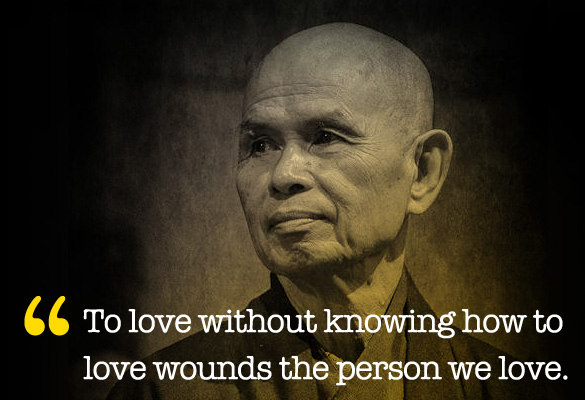
To love without knowing how to love wounds the person we love. To know how to love someone, we have to understand them. To understand, we need to listen.
[…]
When you love someone, you should have the capacity to bring relief and help him to suffer less. This is an art. If you don’t understand the roots of his suffering, you can’t help, just as a doctor can’t help heal your illness if she doesn’t know the cause. You need to understand the cause of your loved one’s suffering in order to help bring relief.
[…]
The more you understand, the more you love; the more you love, the more you understand. They are two sides of one reality. The mind of love and the mind of understanding are the same.
Echoing legendary Zen teacher D.T. Suzuki’s memorable aphorism that“the ego-shell in which we live is the hardest thing to outgrow,” Nhat Hanh considers how the notion of the separate, egoic “I” interrupts the dialogic flow of understanding – the “interbeing,” to use his wonderfully poetic and wonderfully precise term, that is love:
Often, when we say, “I love you” we focus mostly on the idea of the “I” who is doing the loving and less on the quality of the love that’s being offered. This is because we are caught by the idea of self. We think we have a self. But there is no such thing as an individual separate self. A flower is made only of non-flower elements, such as chlorophyll, sunlight, and water. If we were to remove all the non-flower elements from the flower, there would be no flower left. A flower cannot be by herself alone. A flower can only inter-be with all of us… Humans are like this too. We can’t exist by ourselves alone. We can only inter-be. I am made only of non-me elements, such as the Earth, the sun, parents, and ancestors. In a relationship, if you can see the nature of interbeing between you and the other person, you can see that his suffering is your own suffering, and your happiness is his own happiness. With this way of seeing, you speak and act differently. This in itself can relieve so much suffering.
 Na tena paṇḍito hoti








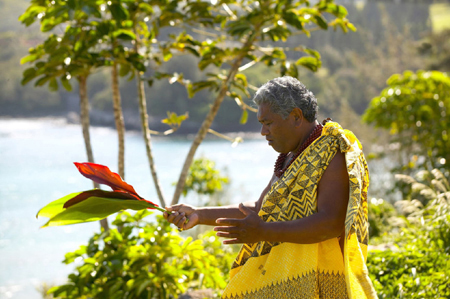













 Hālau 'Aha Hui Lānākila