Theosophy ~ “The Illogic of the Evolutionists,” from The Secret Doctrine by H.P. Blavatsky

frequency_vibe

THE ILLOGIC OF THE EVOLUTIONISTS


Instead of keeping to this, what does many a so-called man of science do in these days? He rushes into the domains of pure metaphysics, while deriding it. He delights in rash conclusions and calls it “a deductive law from the inductive law” of a theory based upon and drawn out of the depths of his own consciousness: that consciousness being perverted by, and honeycombed with, one-sided materialism. He attempts to explain the “origin” of things, which are yet embosomed only in his own conceptions. He attacks spiritual beliefs and religious traditions millenniums old, and denounces everything, save his own hobbies, as superstition. He suggests theories of the Universe, a Cosmogony developed by blind, mechanical forces of nature alone, far more miraculous and impossible than even one based upon the assumption of fiat lux out of nihil – and tries to astonish the world by such a wild theory; which, being known to emanate from a scientific brain, is taken on blind faith as very scientific and the outcome of SCIENCE.

Are those the opponents Occultism would dread? Most decidedly not. For such theories are no better treated by real (not empirical) Science than our own. Hæckel, hurt in his vanity by du Bois-Reymond, never tires of complaining publicly of the latter’s onslaught on his fantastic theory of descent. Rhapsodizing on “the exceedingly rich storehouse of empirical evidence,” he calls those “recognised physiologists” who oppose every speculation of his drawn from the said “storehouse” – ignorant men. “If many men,” he declares – “and among them even some scientists of repute – hold that the whole of phylogeny is a castle in the air, and genealogical trees (from monkeys?) are empty plays of phantasy, they only in speaking thus demonstrate their ignorance of that wealth of empirical sources of knowledge to which reference has already been made” (“Pedigree of Man,” p. 273).

We open Webster’s Dictionary and read the definitions of the word “empirical”: “Depending upon experience or observation alone, without due regard to modern science and theory.“This applies to the Occultists, Spiritualists, Mystics, etc., etc. Again, “an Empiric –One who confines himself to applying the results of his own observations” (only) (which is Hæckel’s case); “one wanting Science . . . . an ignorant and unlicensed practitioner; a quack; a CHARLATAN.”

No Occultist or “magician,” has ever been treated to any worse epithets. Yet the Occultist remains on his own metaphysical grounds, and does not endeavour to rank his knowledge,the fruits of his personal observation and experience, among the exact sciences of modern learning. He keeps within his legitimate sphere, where he is master. But what is one to think of a rank materialist, whose duty is clearly traced before him, who uses such an expression as this:

“The origin of man from other mammals, and most directly from the catarrhine ape, is a deductive law that follows necessarily from the inductive law of the THEORY OF DESCENT.” (“Anthropogeny,” p. 392).

A “theory” is simply a hypothesis, a speculation, and no law. To say otherwise is only one of the many liberties taken now-a-days by scientists. They enunciate an absurdity, and then hide it behind the shield of Science. Any deduction from theoretical speculation is no better than a speculation on a speculation. Now Sir W. Hamilton has already shown that the word theory is now used “in a very loose and improper sense” . . . . ” that it is convertible intohypothesis, and hypothesis is commonly used as another term for conjecture, whereas the terms ‘theory’ and ‘theoretical’ are properly used in opposition to the term practice andpractical.

But modern Science puts an extinguisher on the latter statement, and mocks at the idea. Materialistic philosophers and Idealists of Europe and America may be agreed with the Evolutionists as to the physical origin of man – yet it will never become a general truth with the true metaphysician, and the latter defies the materialists to make good their arbitrary assumptions. That the ape-theory theme 1 of Vogt and Darwin, on which the Huxley-Hæckelians have composed of late such extraordinary variations, is far less scientific – because clashing with the fundamental laws of that theme itself – than ours can ever be shown to be, is very easy of demonstration. Let the reader only turn to the excellent work on “Human Species” by the great French naturalist de Quatrefages, and our statement will at once be verified.

Moreover, between the esoteric teaching concerning the origin of man and Darwin’s speculations, no man, unless he is a rank materialist, will hesitate. This is the description given by Mr. Darwin of “the earliest ancestors of man.”

“They were without doubt once covered with hair; both sexes having beards; their ears were pointed and capable of movement; and their bodies were provided with a tail, having the proper muscles. Their limbs and bodies were acted on by many muscles which now only occasionally reappear in man, but which are still normally present in the quadrumana . . . . The foot, judging from the condition of the great toe in the fœtus, was then prehensile, and our progenitors, no doubt, werearboreal in their habits, frequenting some warm forest-clad land, and the males were provided with canine teeth which served as formidable weapons. . . .” 2

Darwin connects him with the type of the tailed catarrhines, “and consequently removes him a stage backward in the scale of evolution. The English naturalist is not satisfied to take his stand upon the ground of his own doctrines, and, like Hæckel, on this point places himself in direct variance with one of the fundamental laws which constitute the principal charm of Darwinism . . . ” And then the learned French naturalist proceeds to show how this fundamental law is broken. “In fact,” he says, “in the theory of Darwin, transmutations do not take place, either by chance or in every direction. They are ruled by certain laws which are due to the organization itself. If an organism is once modified in a given direction, it can undergo secondary or tertiary transmutations, but will still preserve the impress of the original. It is the law of permanent characterization, which alone permits Darwin to explain the filiation of groups, their characteristics, and their numerous relations. It is by virtue of this law that all the descendants of the first mollusc have been molluscs; all the descendants of the first vertebrate have been vertebrates. It is clear that this constitutes one of the foundations of the doctrine . . . . It follows that two beings belonging to two distinct types can be referred to a common ancestor, but the one cannot be the descendant of the other” (p. 106).

“Now man and ape present a very striking contrast in respect to type. Their organs . . . correspond almost exactly term for term: but these organs are arranged after a very different plan. In man they are so arranged that he is essentially a walker, while in apes they necessitate his being a climber . . . . There is here an anatomical and mechanical distinction . . . . A glance at the page where Huxley has figured side by side a human skeleton and the skeletons of the most highly developed apes is a sufficiently convincing proof.”

The consequence of these facts, from the point of view of the logical application of the law of permanent characterizations, is that man cannot be descended from an ancestor who is already characterized as an ape, any more than a catarrhine tailless ape can be descended from a tailed catarrhine. A walking animal cannot be descended from a climbing one.

1 The mental barrier between man and ape, characterized by Huxley as an “enormous gap, a distancepractically immeasurable“!is, indeed, in itself conclusive. Certainly it constitutes a standing puzzle to the materialist, who relies on the frail reed of “natural selection.” The physiological differences between Man and the Apes are in realitydespite a curious community of certain featuresequally striking. Says Dr. Schweinfurth, one of the most cautious and experienced of naturalists:
“In modern times there are no animals in creation that have attracted more attention from the scientific student than the great quadrumana (the anthropoids), bearing such a striking resemblance to the human form as to have justified the epithet of anthropomorphic being conferred on them. . . . But all investigation at present only leads human intelligence to a confession of its insufficiency; and nowhere is caution more to be advocated, nowhere is premature judgment more to be deprecated than in the attempt to bridge over theMYSTERIOUS CHASM which separates man and beast.” “Heart of Africa” i., 520.
2 A ridiculous instance of evolutionist contradictions is afforded by Schmidt (“Doctrine of Descent and Darwinism,” on page 292). He says, “Man’s kinship with the apes is not impugned by the bestial strength of the teeth of the male orang or gorilla.” Mr. Darwin, on the contrary, endows this fabulous being with teeth used as weapons!

The Secret Doctrine, ii 664–667
H. P. Blavatsky

Theosophy ~ Races of Giants, excerpted from Blavatsky’s “The Secret Doctrine”

TTS-logo

That which is known and accepted is, that several races of gigantic men have existed and left distinct traces. In the journal of the Anthropological Institute (Vol. 1871, art. by Dr. C. Carter Blake) such a race is shown as having existed at Palmyra and possibly in Midian, exhibiting cranial forms quite different from those of the Jews. It is not improbable that another such race existed in Samaria, and that the mysterious people who built the stone circles in Galilee, hewed neolithic flints in the Jordan valley and preserved an ancient Semitic language quite distinct from the square Hebrew character — was of a very large stature. The English translations of the Bible can never be relied upon, even in their modern revised forms. They tell us of the Nephilim, translating the word by “giants,” and further adding that they were “hairy” men, probably the large and powerful prototypes of the later satyrs so eloquently described by the patristic fancy; some of the Church Fathers assuring their admirers and followers that they had themselves seen these “Satyrs” — some alive, others pickled and preserved. The word “giants” being once adopted as a synonym of Nephilim, the commentators have since identified them with the sons of Anak. The filibusters who seized on the Promised Land, found a pre-existing population far exceeding their own in stature, and called it a race of giants. But the races of really gigantic men had disappeared ages before the birth of Moses. This tall people existed in Canaan, and even in Bashan, and may have had representatives in the Nabatheans of Midian. They were of far greater stature than the undersized Jews. Four thousand years ago their cranial conformation and large stature separated them from the children of Heber. Forty thousand years ago their ancestors may have been of still more gigantic size, and four hundred thousand years earlier they must have been in proportion to men in our days as the Brobdingnagians were to the Lilliputians. The Atlanteans of the middle period were called the Great Dragons, and the first symbol of their tribal deities, when the “gods” and the Divine Dynasties had forsaken them, was that of a giant Serpent.
The mystery veiling the origin and the religion of the Druids, is as great as that of their supposed fanes is to the modern Symbologist, but not to the initiated Occultists. Their priests were the descendants of the last Atlanteans, and what is known of them is sufficient to allow the inference that they were eastern priests akin to the Chaldeans and Indians, though little more. It may be inferred that they symbolized their deity as the Hindus do their Vishnu, as the Egyptians did their Mystery God, and as the builders of the Ohio Great-Serpent mound worshipped theirs — namely under the form of the “mighty Serpent,” the emblem of the eternal deity TIME (the Hindu Kala). Pliny called them the “Magi of the Gauls and Britons.” But they were more than that. The author of “Indian Antiquities” finds much affinity between the Druids and the Brahmins of India. Dr. Borlase points to a close analogy between them and the Magi of Persia1; others will see an identity between them and the Orphic priesthood of Thrace: simply because they were connected, in their esoteric teachings, with the universal Wisdom Religion, and thus presented affinities with the exoteric worship of all.

Like the Hindus, the Greeks and Romans (we speak of the Initiates), the Chaldees and the Egyptians, the Druids believed in the doctrine of a succession of worlds, as also in that of seven “creations” (of new continents) and transformations of the face of the earth, and in a seven-fold night and day for each earth or globe (See “Esoteric Buddhism“). Wherever the Serpent with the egg is found, there this tenet was surely present. Their Dracontia are a proof of it. This belief was so universal that, if we seek for it in the esotericism of various religions, we shall discover it in all. We shall find it among the Aryan Hindus and Mazdeans, the Greeks, the Latins, and even among the old Jews and early Christians, whose modern stocks hardly comprehend now that which they read in their Scriptures. See what Seneca says in Epistle 9, and Quaest. Nat. III., c., ult.: “The world being melted and having re-entered the bosom of Jupiter, this god continues for some time to remain absorbed in himself and concealed, wholly immersed in contemplation. After which a new world springs from him. . . . An innocent race of men and animals are produced anew . . . etc.” Then again when speaking of periodical mundane dissolution involving universal death, he (Seneca) says that “when the laws of nature shall be buried in ruin, and the last day of the world shall come, the southern pole shall crush, as it falls, all the regions of Africa, and the North pole shall overwhelm all the countries beneath its axis. The affrighted sun shall be deprived of its light; the palace of heaven falling to decay shall produce at once both life and death, and some kind of dissolution shall equally seize upon all deities, who thus shall return into their original chaos” (Quoted in “Book of God,” p. 160.)

One might imagine oneself reading the Purânic account by Parasâra of the greatPralaya. It is nearly the same thing, idea for idea. Has Christianity nothing of the kind? It has, we say. Let the reader open any English Bible and read chapter iii. of the Second Epistle of Peter, from verse iii. till the xivth, and he will find there the same ideas. . . . “There shall come in the last days scoffers . . . saying, ‘where is the promise of his coming? . . . . Since the fathers fell asleep all things continue as they were from the beginning of creation.’ For, they are ignorant . . . . that by the word of God the heavens were of old, andthe earth standing out of the water and in the water: whereby the world that then was, being overflowed with water, perished. But the heavens and the earth that are now, are reserved unto the fire . . . . wherein the heavens . . . . shall be dissolved, and the elements shall melt with fervent heat . . . . we nevertheless look for new heavens and new earth, etc., etc.” If the interpreters chose to see in this a reference to creation, the deluge, and the promised coming of Christ, when they will live in a new Jerusalem in heaven, this is no fault of “Peter.” What the writer of the Epistles meant was the destruction of this Fifth Race of ours by subterranean fires and inundations, and the appearance of new continents for the Sixth Root-Race. For the writers of these Epistles were all learned in symbology if not in the sciences.

1 But the Magi of Persia were never Persians — not even Chaldeans. They came from a far-off land, the Orientalists being of opinion that the said land was Media. This may be so, but from what part of Media? To this we receive no answer.

The Secret Doctrine, ii 755–757
H. P. Blavatsky

Theosophy ~ from The Book of Dzyan, by H.P. Blavatsky

sunset-photographs_02


A moment’s thought shows that such a state can only be symbolized; to describe it, is impossible. Nor can it be symbolized except in negatives; for, since it is the state of Absoluteness per se, it can possess none of those specific attributes which serve us to describe objects in positive terms. Hence that state can only be suggested by the negatives of all those most abstract attributes which men feel rather than conceive, as the remotest limits attainable by their power of conception.

— Stanza 1, The Book of Dzyan, H.P. Blavatsky

Theosophy ~ GIANTS AND THE ASTOUNDING CONTRADICTIONS OF ARCHÆOLOGY

TTS-logo

The modern archæologist, though speculating ad infinitum upon the dolmens and their builders, knows, in fact, nothing of them or their origin. Yet, these weird, and often colossal monuments of unhewn stones — which consist generally of four or seven gigantic blocks placed together — are strewn over Asia, Europe, America, and Africa, in groups or rows. Stones of enormous size are found placed horizontally and variously upon two, three, four, and as in Poitou, upon six and seven blocks. People name them “devil’s altars,” druidic stones, and giant tombs. The stones of Carnac in the Morbihan, Brittany — nearly a mile in length and numbering 11,000 ranged in eleven rows — are twin sisters of those at Stonehenge. The Conical menhir of Loch-Maria-ker in Morbihan, measures twenty yards in length and nearly two yards across. The Menhir of Champ Dolent (near St. Malo) rises thirty feet above the ground, and is fifteen feet in depth below. Such dolmens and prehistoric monuments are met with in almost every latitude. They are found in the Mediterranean basin; in Denmark (among the local tumuli from twenty-seven to thirty-five feet in height); in Shetland, and in Sweden, where they are called ganggriften (or tombs with corridors); in Germany, where they are known as the giant tombs (Hunengraben); in Spain (see the dolmen of Antiguera near Malaga), and Africa; in Palestine and Algeria; in Sardinia (see the Nuraghi and Sepolture dei giganti, or tombs of giants); in Malabar, in India, where they are called the tombs of the Daityas (giants) and of the Râkshasas, the men-demons of Lanka; in Russia and Siberia, where they are known as the Koorgan;in Peru and Bolivia, where they are termed the chulpas orburial places, etc., etc., etc.

There is no country from which they are absent. Who built them? Why are they all connected with Serpents and Dragons, with Alligators and Crocodiles? Because remains of “palæolithic man” were, it is thought, found in some of them, and because in the funeral mounds of America bodies of later races were discovered with the usual paraphernalia of bone necklaces, weapons, stone and copper urns, etc., hence they are declared ancient tombs. But surely the two famous mounds — one in the Mississippi valley and the other in Ohio — known respectively as “the Alligator Mound” and “the Great Serpent Mound,” were never meant for tombs 1 (Vide infra). Yet one is told authoritatively that the Mounds, and the Mound or Dolmen Builders, are all “Pelasgic” in Europe, antecedent to the Incas, in America, yet of “not extremely distant times.” They are built by “no race of Dolmen Builders,” which never existed (opinion of De Mortillet, Bastian, and Westropp) save in the earlier archæological fancy. Finally Virchow’s opinion of the giant tombs of Germany is now accepted as an axiom: “The tombs alone are gigantic, and not the bones they contain” — says that German biologist; and archæology has but to bow and submit to the decision. 2

That no gigantic skeletons have been hitherto found in the “tombs” is yet no reason to say there never were the remains of giants in them.Cremation was universal till a comparatively recent period — some 80, or 100,000 years ago. The real giants, moreover, were nearly all drowned with Atlantis. Nevertheless, the classics, as shown elsewhere, often speak of giant skeletons still excavated in their day. Besides this, human fossils may be counted on the fingers, as yet. No skeleton ever yet found is older than between 50, or 60,000 years, 3 and man’s size was reduced from 15 to 10 or 12 feet, ever since the third sub-race of the Aryan stock, which sub-race — born and developed in Europe and Asia Minor under new climates and conditions — had become European. Since then, as said, it has steadily been decreasing. It is truer therefore to say, that the tombs alone are archaic, and not necessarily the bodies of men occasionally found in them; and that those tombs, since they are gigantic, must have contained giants, 4 or rather the ashes of generations of giants.

Nor were all such cyclopean structures intended for sepulchres. It is with the so-called Druidical remains, such as Carnac in Brittany and Stonehenge in Great Britain, that the travelling Initiates above alluded to had to do. And these gigantic monuments are all symbolic records of the World’s history. They are not Druidical, but universal. Nor did the Druids build them, for they were only the heirs to the cyclopean lore left to them by generations of mighty builders and — “magicians,” both good and bad.

It will always be a subject of regret that history, rejecting a priori the actual existence of giants, has preserved us so little of the records of antiquity concerning them. Yet in nearly every mythology — which after all is ancient history — the giants play an important part. In the old Norse mythology, the giants, Skrymir and his brethren, against whom the sons of the gods fought, were potent factors in the histories of deities and men. The modern exegesis, that makes these giants to be the brethren of the dwarfs, and reduces the combats of the gods to the history of the development of the Aryan race, will only receive credence amongst the believers in the Aryan theory, as expounded by Max Müller. Granting that the Turanian races were typified by the dwarfs (Dwergar), and that a dark, round-headed, and dwarfish race was driven northward by the fair-faced Scandinavians, or Æsir, the gods being like unto men, there still exists neither in history nor any other scientific work any anthropological proof whatever of the existence in time or space of a race of giants. Yet that such exist, relatively and de facto side by side with dwarfs, Schweinfurth can testify. The Nyam-Nyam of Africa are regular dwarfs, while their next neighbours (several tribes of comparatively fair-complexioned Africans) are giants when confronted with the Nyam-Nyams, and very tall even among Europeans, for their women are all above 6 ½ feet high. (Vide Schweinfurth’s latest works.)

In Cornwall and in ancient Britain the traditions of these giants are, on the other hand, excessively common; they are said to live even down to the time of King Arthur. All this shows that giants lived to a later date amongst the Celtic than among the Teutonic peoples.

If we turn to the New World, we have traditions of a race of giants at Tarija on the eastern slopes of the Andes and in Ecuador, who combated gods and men. These old beliefs, which term certain localities “Los campos de los gigantes“the fields of giants,” are always concomitant with the existence of pliocene mammalia and the occurrence of pliocene raised beaches. “All the giants are not under Mount Ossa,” and it would be poor anthropology indeed that would restrict the traditions of giants to Greek and Bible mythologies. Slavonian countries, Russia especially, teem with legends about the bogaterey (mighty giants) of old; and their folklore, most of which has served for the foundation of national histories, their oldest songs, and their most archaic traditions, speak of the giants of old. Thus we may safely reject the modern theory that would make of the Titans mere symbols standing for cosmic forces. They were real living men, whether twenty or only twelve feet high. Even the Homeric heroes, who, of course, belonged to a far more recent period in the history of the races, appear to have wielded weapons of a size and weight beyond the strength of the strongest men of modern times.

“Not twice ten men the mighty bulk could raise,
Such men as live in these degenerate days.”

If the fossil footprints from Carson, Indiana, U.S.A., are human, they indicate gigantic men. Of their genuineness there can remain no doubt. It is to be deplored that the modem and scientific evidence for gigantic men should rest on footprints alone. Over and over again, the skeletons of hypothetical giants have been identified with those of elephants and mastodons. But all such blunders before the days of geology, and even the traveller’s tales of Sir John Mandeville, who says that he saw giants 56 feet high, in India, only show that belief in the existence of giants has never, at any time, died out of the thoughts of men.

1 We take the following description from a scientific work. “The first of these animals (the alligator) designed with considerable skill, is no less than 250 ft. long. . . . . The interior is formed of a heap of stones, over which the form has been moulded in fine stiff clay. The great serpent is represented with open mouth, in the act of swallowing an egg of which the diameter is 100 ft. in the thickest part; the body of the animal is wound in graceful curves and the tail is rolled into a spiral. The entire length of the animal is 1,100 ft. This work is unique . . . . and there is nothing on the old continent which offers any analogy to it.” Except its symbolism, however, of the Serpent — the cycle of Time — swallowing Kosmos, the egg.
2 It might be better, perhaps, for FACT had we more Specialists in Science and fewer “authorities” on universal questions. One never heard that Humboldt gave authoritative and final decisions in the matter of polypi, or the nature of an excrescence.
3 57,000 years is the date assigned by Dr. Dowler to the remains of the human skeleton, found buried beneath four ancient forests at New Orleans on the banks of the Mississippi river.
4 Murray says of the Mediterranean barbarians that they marvelled at the prowess of theAtlanteans. “Their physical strength was extraordinary (witness indeed their cyclopean buildings), the earth shaking sometimes under their tread. Whatever they did, was done speedily. . . . . . They were wise and communicated their wisdom to men” (Mythology, p. 4).

The Secret Doctrine, ii 752–755
H. P. Blavatsky

Random Thoughts: Unparalleled Elegance …

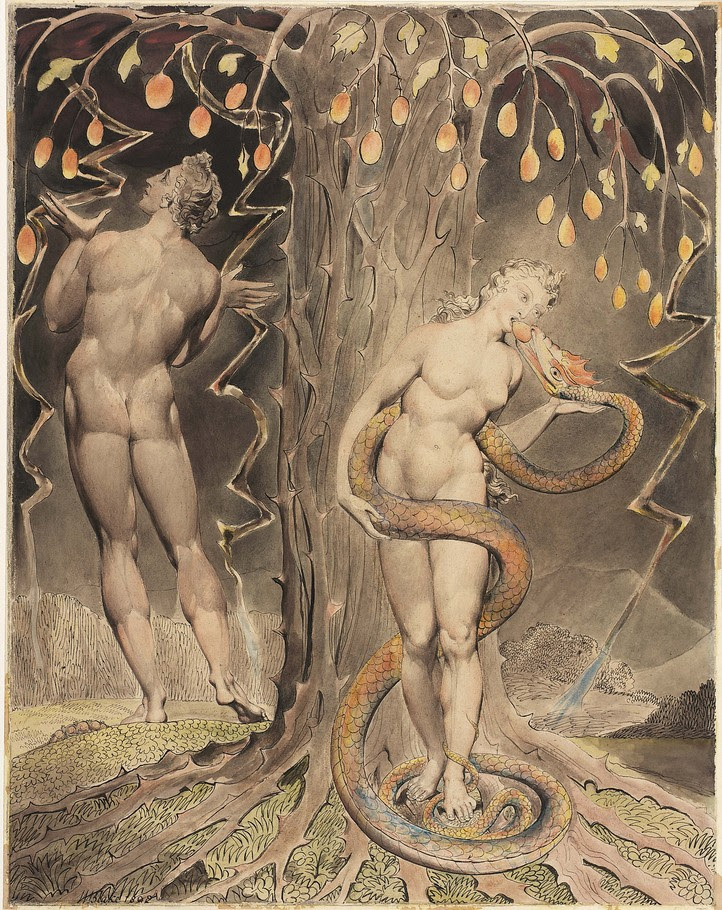
Art by William Blake for John Milton's Paradise Lost
Art by William Blake for John Milton’s Paradise Lost

The biological machinery behind each of our senses can be regarded as a function of consciousness, folding the physical into the poetic in order to transcend it and enter the realm of the spiritual.  It is therefor befitting to call to mind Thoreau’s defiant defense of “useful ignorance”:


Deep down, we know our devotion to reality is just a marriage of convenience, and we leave it to the seers, the shamans, the ascetics, the religious teachers, the artists among us to reach a higher state of awareness, from which they transcend our rigorous but routinely analyzing senses and become closer to the raw experience of nature that pours into the unconscious, the world of dreams, the source of myth.

[…]

Our several senses, which feel so personal and impromptu, and seem at times to divorce us from other people, reach far beyond us. They’re an extension of the genetic chain that connects us to everyone who has ever lived; they bind us to other people and to animals, across time and country and happenstance. They bridge the personal and the impersonal, the one private soul with its many relatives, the individual with the universe, all of life on Earth. In REM sleep, our brain waves range between eight and thirteen hertz, a frequency at which flickering light can trigger epileptic seizures. The tremulous earth quivers gently at around ten hertz. So, in our deepest sleep, we enter synchrony with the trembling of the earth. Dreaming, we become the Earth’s dream.

[…]

It began in mystery, and it will end in mystery. However many of life’s large, captivating principles and small, captivating details we may explore, unpuzzle, and learn by heart, there will still be vast unknown realms to lure us. If uncertainty is the essence of romance, there will always be enough uncertainty to make life sizzle and renew our sense of wonder. It bothers some people that no matter how passionately they may delve, the universe remains inscrutable. “For my part,” Robert Louis Stevenson once wrote, “I travel not to go anywhere, but to go. I travel for travel’s sake. The great affair is to move.” The great affair, the love affair with life, is to live as variously as possible, to groom one’s curiosity like a high-spirited thoroughbred, climb aboard, and gallop over the thick, sun-struck hills every day. Where there is no risk, the emotional terrain is flat and unyielding, and, despite all its dimensions, valleys, pinnacles, and detours, life will seem to have none of its magnificent geography, only a length. It began in mystery, and it will end in mystery, but what a savage and beautiful country lies in between.

— Dianne Ackerman, A Natural History of the Senses (1990)

Theosophy ~ THE EUROPEAN PALÆOLITHIC RACES

TTS-logo

IS Science against those who maintain that down to the Quaternary period the distribution of the human races was widely different from what it is now? Is Science against those who, further, maintain that the fossil men found in Europe – although having almost reached a plane of sameness and unity from the fundamental physiological and anthropological aspects which continues till this day – still differ, sometimes greatly, from the type of the now existing populations. The late Littre confesses it in an article published by him on the Memoir calledAntiquités Celtiques et Antediluviennes by Boucher de Perthes (1849) – in theRevue des Deux Mondes (March1, 1859). He says in it (a) that in these periods when the Mammoths, exhumed with the hatchets in Picardy, lived in the latter region, there must have been an eternal spring reigning over all the terrestrial globe 1; nature was the contrary of what it is now – thus leaving an enormous margin for the antiquity of those periods” and then adds: (b) “Spring, professor of the Faculty of Medicine at Liege, found in a grotto near Namur, in the mountain of Chauvaux, numerous human bones ‘of a race quite distinct from ours.‘”

Skulls exhumed in Austria offered a great analogy with those of African negro races, according to Littre, while others, discovered on the shores of the Danube and the Rhine, resembled the skulls of the Caribs and those of the ancient inhabitants of Peru and Chili. Still, the Deluge,whether Biblical or Atlantean, was denied. But further geological discoveries having made Gaudry write conclusively: “Our forefathers were positively contemporaneous with the rhinoceros tichorrhinus, thehippopotamus major“,and add that the soil called diluvial in geology “was formed partially at least after man’s apparition on earth” – Littre pronounced himself finally. He then showed the necessity, before “the resurrection of so many old witnesses,” of rehandling all the origins, all the durations, and added that there was AN AGE hitherto unknown to study “either at the dawn of the actual epoch or, as I believe, at the beginning of the epoch which preceded it.

The types of the skulls found in Europe are of two kinds, as is well known: the orthognathous and the prognathous, or the Caucasian and the negro types, such as are now found only in the African and the lower savage tribes. Professor Heer – who argues that the facts of Botany necessitate the hypothesis of an Atlantis – has shown that the plants of the Neolithic lake-villagers are mainly of African origin. How did the latter come to be in Europe if there was no former point of union between Africa and Europe? How many thousand years ago did the seventeen men live whose skeletons were exhumed in the Department of the Haute Garonne, in a squatting posture near the remains of a coal fire, with some amulets and broken crockery around them, and in company with the bearspelæus, the Elephas primigenius, the aurochs (regarded by Cuvier as a distinct species), the Megaceros hibernicus – all antediluvian mammals? Certainly at a most distant epoch, but not one which carries us further back than the Quaternary. A much greater antiquity for Man has yet to be proved. Dr. James Hunt, the late President of the Anthropological Society, makes it 9,000,000 years. This man of science, at any rate, makes some approach to our esoteric computation, if we leave the first two semi-human, ethereal races, and the early Third Race out of the computation.

The question, however, arises – who were these Palæolithic men of the European quaternary epoch? Were they aboriginal, or the outcome of some immigration dating back into the unknown past? The latter is the only tenable hypothesis, as all scientists agree in eliminating Europe from the category of possible “cradles of mankind.” Whence, then, radiated the various successive streams of “primitive” men?

The earliest Palæolithic men in Europe – about whose origin Ethnology is silent, and whose very characteristics are but imperfectly known, though expatiated on as “ape-like” by imaginative writers such as Mr. Grant Allen – were of pure Atlantean and “Africo”-Atlantean stocks. 2 (It must be borne in mind that by this time the Atlantis continent itself was a dream of the past.) Europe in the quaternary epoch was very different from the Europe of to-day, being then only in process of formation. It was united to N. Africa – or rather what is now N. Africa – by a neck of land running across the present Straits of Gibraltar – N. Africa thus constituting a species of extension of Spain, while a broad sea washed the great basin of the Sahara. Of the great Atlantis, the main bulk of which sank in the Miocene, there remained only Ruta and Daitya and a stray island or so. The Atlantean connections of the forefathers 3 of the Palæolithic cave-men are evidenced by the upturning of fossil skulls (in Europe) reverting closely to the West Indian Carib and ancient Peruviantype – a mystery indeed to all those who refuse to sanction the “hypothesis” of a former Atlantic continent to bridge the ocean (Cf. “Scientific and geological proofs of the reality of several submerged continents”). What are we also to make of the fact that while de Quatrefages points to that “magnificent race,” the TALL Cro-Magnon cave-men and the Guanches ofthe Canary Islands as representatives of one type – Virchow also allies the Basques with the latter in a similar way? Professor Retzius independently proves the relationship of the aboriginalAmerican dolichocephalous tribes and these same Guanches. The several links in the chain of evidence are securely joined together. Legions of similar facts could be adduced. As to the African tribes – themselves diverging offshoots of Atlanteans modified by climate and conditions – they crossed into Europe over the peninsula which made the Mediterranean an inland sea. Fine races were many of these European cave-men; the Cro-Magnon, for instance. But, as was to be expected,progress is almost non-existent through the whole of the vast period allotted by Science to the Chipped Stone-Age. 4 The cyclic impulse downwardsweighs heavily on the stocks thus transplanted – the incubus of theAtlantean Karma is upon them. Finally, Palæolithic man makes room for his successor – and disappears almost entirely from the scene. Professor Lefevre asks in this connection:

“Has the Polished succeeded the Chipped Stone-Age by an imperceptible transition, or was it due to an invasion of brachycephalous Celts? But whether, again, the deterioration produced in the populations of La Vezere was the result of violent crossings, or of a general retreat northwards in the wake of the reindeer, is of little moment to us.” He continues:

“Meantime the bed of the ocean has been upheaved, Europe is now fully formed, her flora and fauna fixed. With the taming of the dog begins the pastoral life. We enter on those polished stone and bronze periods, which succeed each other at irregular intervals, which even overlap one another in the midst of ethnical fusions and migrations. . . . The primitive European populations are interrupted in their special evolution and, without perishing, become absorbed in other races, engulfed . . . by successive waves of migration overflowing from Africa, possibly from a lost Atlantis [?? far too late by æons of years] and from prolific Asia . . . all FORERUNNERS OF THE GREAT ARYAN INVASION” (Fifth Race).

——-

1 Scientists now admit that Europe enjoyed in the Miocene times a warm, in the Pliocene or later Tertiary, a temperate climate. Littre’s contention as to the balmy spring of theQuaternary – to which deposits M. de Perthes’ discoveries of flint implements are traceable (since when the Somme has worn down its valley many scores of feet) – must be accepted with much reservation. The Somme-valley relics are post-glacial, and possibly point to the immigration of savages during one of the more temperate periods intervening betweenminor ages of Ice.
2 “Whence they (the old cave-men) came, we cannot tell” (Grant Allen).
The palæolithic hunters of the Somme Valley did not originate in that inhospitable climate, but moved into Europe from some more genial region – (Dr. Southall, “Epoch of the Mammoth“, p. 315).
3 The pure Atlantean stocks – of which the tall quaternary cave-men were, in part, the direct descendants – immigrated into Europe long prior to the Glacial Period; in fact as far back as the Pliocene and Miocene times in the Tertiary. The worked Miocene flints of Thenay, and the traces of Pliocene man discovered by Professor Capellini in Italy, are witnesses to the fact. These colonists were portions of the once glorious race, whose cycle from the Eocene downwards had been running down the scale.
4 The artistic skill displayed by the old cave-men renders the hypothesis which regards them as approximations to the “pithecanthropus alalus” – that very mythical Hæckelian monster – an absurdity requiring no Huxley or Schmidt to expose it. We see in their skill in engraving a gleam of Atlantean culture atavistically re-appearing. It will be remembered that Donnelly regards modern European as a renaissance of Atlantean civilization. (“Atlantis,” pp. 237-264.)

———

The Secret Doctrine, ii 737–741
H. P. Blavatsky

Theosophy ~ Wisdom In Action – Part I

TTS-logo

   The atoms emanated from the Central Point emanate in their turn new centres of energy, which, under the potential breath of Fohat, begin their work from within without, and multiply other minor centres. These, in the course of evolution and involution, form in their turn the roots or developing causes of new effects, from worlds and ‘man-bearing’ globes, down to the genera, species, and classes of all the seven kingdoms (of which we know only four). For ‘the blessed workers have received the Thyan-kam, in the eternity’ (Book of The Aphorisms of Tson-ka-pa).

   ‘Thyan-kam‘ is the power or knowledge of guiding the impulses of cosmic energy in the right direction.

The Secret Doctrine, i 635

Every human soul is an apprentice in the sacrificial art of applying cosmic energies for the sake of universal good. Thus, all human evolution is a record of lessons learnt, lost and rediscovered in the arduous practice of Karma Yoga. The ragged and uneven tale of recorded history and the glamour of current events are nothing but the distorted image of the pilgrimage of humanity reflected in the inverted lens of egotism. As a result, individuals oscillate between a sense of starvation for meaning in events and a sense of being overwhelmed by their magnitude. Nevertheless, there must be true Karma Yogins in disguise on the stage of the world’s theatre, individuals with a measure of maturity, from whose sacrificial examples earnest students of human life may learn. Unfortunately, the energy of action is most easily stimulated by egotism, engendering a momentum that is sometimes linked to a grandiose conception of the world and of history, seemingly independent of self. Then through subsuming one’s false sense of identity under some vague notion like national destiny, one can view one’s life in terms of a false drama. Very often figures in public life are caught up in just such a melodramatic response to chaotic events; they regard their own choices as unique, unprecedented, momentous, fraught with extreme consequences for the future. There is in all of this, of course, an absurd element of unreality. Such illusion is conveyed in the story of the French writer who imagined a poignant meeting of some of the great women of history, including Cleopatra. Gathering together in their old age, and looking back upon their lives, they recognize their relative irrelevance. Plato in his dialogues made much the same point by putting into perspective the presumed importance of what happened in Troy.

In a world of imperfect beings, certain events and actions inevitably assume a much greater magnitude than they truly deserve in the longer view of history. Nature moves gradually, working silently and gestating invisibly under the soil. This is true of the work of sun and fire, sky and earth, air and water; all mirror in time the archetypal realm of Aether-Akasha. As Kropotkin pointed out, one could hardly recognize from a study of earthquakes and volcanic explosions the vast geological changes that take place over millions of years, proceeding through minute imperceptible increments. These almost invisible changes can accumulate to set off a shifting in the continents. Thus, massive volcanic eruptions, for example, are the result of a long series of tremors, though they come about as abrupt precipitations filled with fury and force. So long as human beings remain trapped in the realm of effects, seeing only with the physical eye and considering only a very narrow view of time, they will have no sense of the majesty and symphonic resonance of Nature, nor will they feel its resonance in their lives. Instead, they will be caught in what Thoreau called a life of quiet desperation. They will react only to whatever seems to be titanic, dramatic or volcanic, and so reinforce their subservience to the illusion of effects.

Although true of human beings in general, it is especially true of those figures in history who are powerful in a conventional sense. Whether one considers a figure like Alexander or a Genghis Khan, or a more contemporary figure like General Douglas MacArthur, one can see that it is easy for such dedicated and determined individuals to become suddenly caught in the maya of the magnification of importance of events. There may have been an element of truth in what General MacArthur saw, at the time of the Korean War, as the tremendous effect upon China of the actions of the United States. At the same time, his judgement isolated China and the United States from the rest of the world. Unlike the more discerning Lord Louis Mountbatten, he was insensitive to the aspirations of millions of souls in many burgeoning nations, great and small.

Whatever the details of an historical judgement, once one leaves out of account large portions of humanity, one can be right at a certain level, though at the expense of being caught in an exaggeration. Yet it was this same sense of the enormity of events that made MacArthur the man he was, a man capable of rendering a far greater service to the nation of Japan than he himself ever realized. As a nation stultified by its immense but wounded pride, Japan required extraordinarily delicate handling. Not only that, it needed to be shown a way out. In doing this, it was necessary to act with a true humanitarian instinct, free from any taint of racism and based on a genuine love for the Japanese people. Out of his soldier’s ability to distinguish between the Japanese people and their defeated generals, it was possible for MacArthur to assist in the greatest transformation of Japanese history since the Meiji restoration. If this was evident at the time to some, though perhaps less so now to many observers, its long run and fundamental importance will not emerge until after the end of the present century, when Japan shall have fully worked out all the implications of the route it has taken – breaking with elements of its own tradition, gaining an unprecedented economic ascendancy, and yet feeling itself weighed down by the anxiety that accompanies frenetic success.

The karmic lesson to be drawn is that even the most remarkable figures in history, whether statesmen, military figures or politicians, often cannot gauge the significance of the events they seem to initiate. That man is wise in his time who, without exaggerating or underestimating his own role, understands something of Tolstoy’s view in War and Peace – that the commanding generals are irrelevant and that in a sense even the vast masses of soldiers are acted upon. There is a mighty force at work in history, moving in mysterious ways through myriad wills. How they all clash and combine and resolve themselves is difficult indeed to know. It certainly cannot be understood if one subscribes to some simplistic Great Man theory of history or military strategy. Here one may learn from the example of General George C. Marshall. As a man, he no doubt took his profession as seriously as did General MacArthur; yet he was fortunate not to have had any other advantage save loyalty to his family, loyalty to what had been done before and loyalty to his teachers. Working hard and well, he at no point found spectacular success, yet he acquired a considerable wisdom in action. For a general or anyone involved in strategic planning, wisdom in action is crucial, less in regard to one’s own sphere than in reference to understanding other human beings and in choosing and drawing out their hidden potential. The ability to groom talent innately presupposes some measure of self-confidence and selflessness.

This may be seen clearly in the extraordinary choice made silently and far-sightedly by Marshall of his supreme commander in Europe. At the time Marshall’s eye fell on him, Dwight D. Eisenhower was in a position to become the commandant of a military college, in which capacity he could have developed his own deep interest in the profession of military strategy. Marshall wrote to him, suggesting that he might, if he liked, come to Washington and serve in a thoroughly unimportant role as a kind of attache; Eisenhower wrote frankly of this, remarking that the position of commandant was extremely tempting, but that, out of pure and simple respect for General Marshall, he would take up his offer. What Marshall knew relatively early in the war, but kept to himself, was that there would one day come an extraordinary challenge to selfless coordination among the different allied nations. It would require a quality for which America does not prepare its people – letting others take the credit while standing behind the visible scene. It requires the ability in repetitious and protracted arenas of conflict to be cool and constructive. Marshall knew that any officer who could eventually play this role in the most crucial engagements at the end of the war would have to be trained in anonymity.

If it required a certain karmic insight on the part of Marshall to choose Eisenhower, it required a certain Buddhic intuition on the part of Eisenhower to respond to the call. Hence, he embarked upon a long apprenticeship which featured little of the excitement that he would have enjoyed had he been commandant of a college teaching military strategy. In fact, most of his duties were chores. In effect, Eisenhower merely polished the shoes of his commander, but he was happy to stay put, to watch and learn. Marshall knew that it would require an extraordinary wisdom, when the time came, to match up to the brilliance and force of personality of men like Harold Alexander, Alanbrooke and the other English generals. Most of them were well schooled in a philosophy of true sportsmanship, selflessness and disinterestedness; but at the same time it would also be necessary to cope with MacArthur-like figures on the British side such as General Bernard Law Montgomery. Remarkably, when Eisenhower was appointed as supreme commander, he quickly won the respect of Alexander and all the others, who saw that he could not be drawn into competitive games, let alone the nationalistic rivalries that were part of the high command.

Instead, they found in Eisenhower someone who was willing to learn, willing to stay quiet, but at the same time extremely strong; he was waiting to act and to act with a decisiveness born of deliberation. Eisenhower worked as karma works. When there were critical choices to be made at the end of the war, decisions affecting millions of lives and the concerted effort to bring the war to a close, the last-minute freedom of decision was left in Eisenhower’s hands. Under karma he was able to initiate the final move so that World War II in Europe ended on the eighth of May, White Lotus Day, 1945. Here one may discern theNirmanakaya influence at work, affecting selfless and open-minded individuals through their dreams and intuitions, their imagination and ideals. That larger force may also be discerned in the closure of World War II in Asia on the twelfth of August, 1945, the birth anniversary of H.P. Blavatsky. Thus one finds the most remarkable karma quietly at work; for those who were truly awake and alive to the meaning of events in 1945, it was a time of extraordinary tension, far greater than anything that has taken place since. In the intervening years lesser persons have been dislodged by relatively minor crises. None of them had had a preparation in living through crises, making distinctions and learning from events. Such is the mark of the Karma Yogin in the realm of public affairs.

Hermes, June 1985
Raghavan Iyer

Theosophy ~ THE MAHAMUDRA OF VOIDNESS – II

TTS-logo

In describing the preparation for mahamudra meditation, Geshe Rabten compares these negative tendencies to seeds. It is as if one wished to build a beautiful building, but could not do so without preparing clean ground for its foundations. Before laying the foundations, one must clear away rocks and weeds, cleansing the ground of all obstructions and removing seeds that spring up and interfere with the building. At the same time, this work of purification must be coupled with the collection of materials that will be helpful in setting up the foundations. In the long run, one’s fundamental attention must be directed towards the constructive end of serving universal enlightenment. There is little or no essential interest in the obstructions and tendencies that come in the way of the release of this higher motivation. All these tendencies can be classified into certain broad types which are, in the end, both banal and boring. Most of them have to do with attraction and aversion, anger and pride, greed and delusion, and, above all, a false conception of the self. Owing to this false conception of a fake ego, reinforcing it through unconscious habit and semi-conscious patterns of reaction, a persistent aggregate of tendencies has originated.

Instead of becoming preoccupied with the melodramatic history of this aggregate of tendencies, one should merely note them as they arise and mark them for elimination. They will inevitably appear when one starts to engage in meditation, and one should note them only with a view to removing them through the setting up of counter-tendencies drawn from positive efforts to visualize spiritual strengths. Hence the connection, in the Tibetan practice, between the visualization of vajrasattva and the elimination of negative tendencies. Each individual must learn to select the appropriate counter-forces necessary to negate the particular strong negative tendencies that arise. In drawing upon these counter-forces from within, one will discover that one can bring to one’s aid many an element in one’s own being that can serve to one’s spiritual advantage. Every human being has a number of elements which represent a certain ease, naturalness, decency and honesty as a human being. Sometimes there is a debilitating tendency to overlook these or take them for granted. The spiritual path requires a progressively heightened degree of self-awareness. One should give oneself full credit for whatever positive tendencies one has, whether they have to do with outward energies on the physical plane, mental energies, moral tenacity or metaphysical insight. In order to find that in oneself which can work in one’s favour, and can help in counteracting negative tendencies, one should engage in regular recitation and frequent reflection upon sacred scriptures. Thus one will discover points of resonance in one’s individual karmic inheritance that can help release purifying energies flowing from the ideation of Buddhas and Bodhisattvas.

If this practice is going to prosper, one must bring to it a moral insight rooted in an understanding of metaphysics. The mind must be focussed upon general ideas. One must reflect upon the relationship of insight and compassion. Insight is not merely intellectual, but rather arises through the recognition of what skill in action means in specific contexts. Insight involves a perception of how wisdom is reflected within action, and which can come about only through a deep reflection upon the process of how such insight is released. On the other side, before one can truly generate a conscious current of compassion, one must create a state of calm abiding. One must find out one’s resources and potentials for calmness and for generating the maximum field of patience, peacefulness, gentleness and steadfastness. Then one must combine in practice one’s capacity for calmness with one’s capacity for discerning what is essential. Inevitably, this will involve a protracted study lasting over lifetimes, and include enquiry into the fundamental propositions of Gupta Vidya, the study of karma and the study of what Buddhist thought refers to as the chain of dependent origination.

In essence, this entire course of study is aimed at bringing about a meta-psychological encounter with a false view of the self that must be confronted and dispelled. Ultimately, this complex matter goes to the core of the mahamudra meditation. But at a preliminary level and in the course of preparation for that meditation, one must come to grips with the confused notion of oneself that is identified with bodily desire, proclivities towards pleasure and avoidance of pain. At subtler levels one must confront one’s conception of oneself that is bound up with the entire chaotic series of thoughts, all of which have particular histories and form associative chains of memory that have been built up over lifetimes of indulgence. All take a variety of forms and leave discernible tracks, all are connected with certain fantasies, wishes, hopes and expectations. They are designated in various ways in different analytic traditions, but always at the root there is the protean force of self-grasping. It is not easy either to confront or to abandon, and hence The Voice of the Silence warns that even when one is very close to attaining dhyana, one may be completely disrupted by a sudden eruption of self-grasping.

“Ere the gold flame can burn with steady light, the lamp must stand well-guarded in a spot free from all wind.” Exposed to shifting breeze, the jet will flicker and the quivering flame cast shades deceptive, dark and ever-changing, on the Soul’s white shrine.
And then, O thou pursuer of the truth, thy Mind-Soul will become as a mad elephant, that rages in the jungle. Mistaking forest trees for living foes, he perishes in his attempts to kill the ever-shifting shadows dancing on the wall of sunlit rocks.
Beware, lest in the care of Self thy Soul should lose her foothold on the soil of Deva-knowledge.
Beware, lest in forgetting SELF,thy Soul lose o’er its trembling mind control, and forfeit thus the due fruition of its conquests.
Beware of change! For change is thy great foe. This change will fight thee off, and throw thee back, out of the Path thou treadest, deep into viscous swamps of doubt.

The Voice of the Silence

This passage from The Voice of the Silence refers primarily to an extremely high state of consciousness and an advanced stage along the Path. It refers to a point at which the very core of self-grasping must be let go. Long before one has earned the privilege of such an archetypal confrontation with the false self, one will have to win many minor skirmishes with the force of self-grasping. For this purpose, The Voice of the Silence gives a specific recipe that is indispensable. It is emphasized in every authentic spiritual tradition and it is central to the New Cycle and the Aryanization of the West. It is put in terms of the metaphor of the mango fruit. One must become as tender as the pulp of the mango towards the faults of others, feeling with them their suffering and pain. Yet one must also learn to be as hard as the mango stone towards one’s own faults. One must give no quarter to excuse-making or shilly-shallying. Instead, one must fully accept what one thinks to be one’s own particular pain, while recognizing that it is, at its core, nothing but a manifestation of delusive self-grasping.

The mango metaphor sums up all the elements involved in the preparation for deep dhyana – continuous, uninterrupted meditation. Geshe Rabten points to a specific preparatory exercise called “taking and giving”, which is a beautiful and profound instantiation of the mango metaphor. One begins by visualizing all the ignorance and all the suffering of the world. Then one must consciously take in with every inhalation of breath everything that is ugly, unsatisfactory, violent and disturbing. For the purpose of understanding and contemplation, the world’s mess may be thought of as sticks of fuel burning with a thick black smoke. One must inhale this dense black smoke and let it flow through one’s body, permeating every nerve and cell, penetrating to the centre of one’s heart, where it destroys all traces of self-concern. Then as one exhales, one should visualize sending out light-energy towards all beings, acting through one’s positive tendencies and serving to eliminate their sufferings.

This exercise of taking and giving should be conjoined with one’s adoration and prostration before the Buddhas and before one’s Ishtaguru. Indeed, Guru Yoga is the fifth and quintessential element of the preparation for mahamudra meditation. One may, at first, contemplate theIshtaguru as a drop of light, or, at a more advanced stage, one may actually contemplate the essential form of the Ishtaguru in the space before one’s mind. It is implicit in the very conception of the Ishtaguru that the individual must choose whichever form of contemplation will be most beneficial. Once a choice is made, however, it is crucial that one persistently and with full fidelity bring the distracted mind back, again and again, to the object of its contemplation. The test of this devotion is that one will find a deepening, and yet spontaneous, longing to be of service to others. More and more, one’s motivation will be that the black smoke of human ignorance and suffering should pass through oneself and become converted, through persistence in dhyana, into a healing light that will radiate, brightening and helping the lives of others. In other words, one will become an instrument through which a great sacrifice is made consciously, a channel through which a great redemptive force can proceed. At that point, of course, there can be no separative self.

Hermes, May 1985
Raghavan Iyer

Theosophy ~ SCIENCE AND THE ESOTERIC PHYLOGENY

TTS-logo
    Having dealt almost exclusively with the question of the origin of Man in the foregoing criticism of Western Evolutionism, it may not be amiss to define the position of the Occultists with regard to the differentiation of species. The pre-human fauna and flora have been already generally dealt with in the Commentary on the Stanzas, and the truth of much of modern biological speculation admitted, e.g., the derivation of birds from reptiles, the partial truth of “natural selection,” and the transformation theory generally. It now remains to clear up the mystery of the origin of those first mammalianfauna which M. de Quatrefages so brilliantly endeavours to prove as contemporary with the Homo primigenius of the Secondary Age.

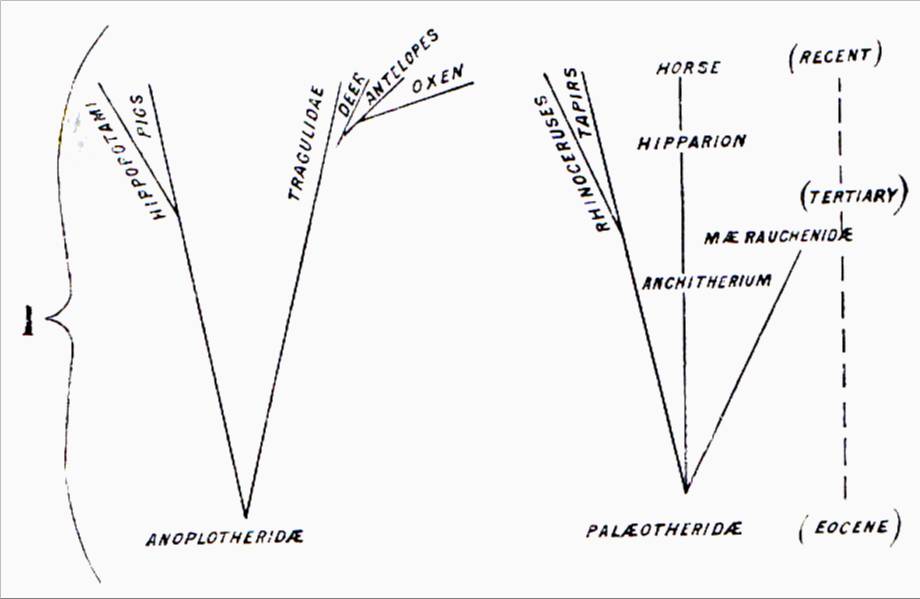
The somewhat complicated problem relating to the “Origin of Species” –  more especially of the varied groups of fossil or existing mammalian fauna – will be rendered less obscure by the aid of a diagram. It will then be apparent to what extent the “Factors of Organic Evolution,” relied upon by Western biologists, 1 are to be considered as adequate to meet the facts. The line of demarcation between etherospiritual, astral and physical evolution must be drawn. Perhaps, if Darwinians deigned to consider the possibility of the second process, they would no longer have to lament the fact that “we are referred to conjecture and inference for the origin of the Mammals”!! (The Doctrine of Descent and Darwinism, p. 268, by Professor O. Schmidt.) At present the admitted chasm between the systems of reproduction of the oviparous vertebrates and mammalia, constitutes a hopeless crux to those thinkers who, with the Evolutionists, seek to link all existing organic forms in a continuous line of descent.

Let us take – exempli gratia – the case of the ungulate mammals. “In no other division,” it is said, “do we possess such abundant fossil material.” So much progress has been made in this direction, that in some instances the intermediate links between the modern and Eocene ungulates have been unearthed; a notable example being that of the complete proof of the derivation of the present one-toed horse from the three-toed Anchitherium of the old Tertiary. This standard of comparison between Western Biology and the Eastern doctrine could not, therefore, be improved upon. The pedigree here utilized, as embodying the views of scientists in general, is that of Schmidt based on the exhaustive researches of Rutimeyer. Its approximate accuracy – from the standpoint of evolutionism – leaves little to be desired:

UNGULATE MAMMALS

blavatsky1

The midway point of evolution. Science comes to a standstill. “The root to which these two families lead back IS UNKNOWN” (Schmidt).

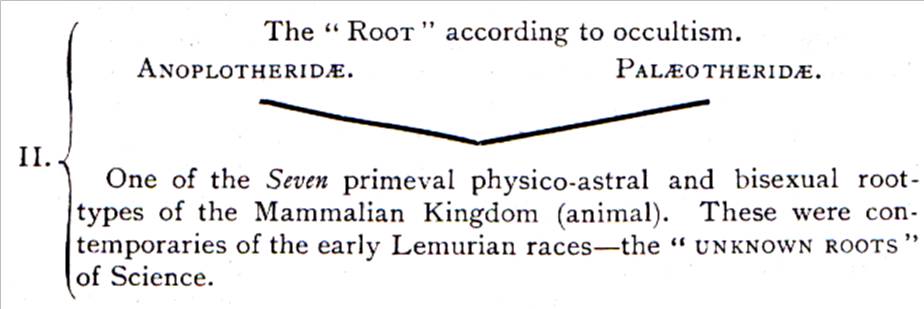
blavatsky2

No. I. represents the realm explored by Western Evolutionists, the area in which climatic influences, “natural selection,” and all the other physical causes of organic differentiation are present. Biology and palæontology find their province here in investigating the many physical agencies which contribute so largely, as shown by Darwin, Spencer and others, to the segregation of species. But even in this domain the sub-conscious workings of the Dhyan-Chohanic wisdom are at the root of all the “ceaseless striving towards perfection,” though its influence is vastly modified by those purely material causes which de Quatrefages terms the “milieux” and Spencer the “Environment.”

The “midway point of evolution” is that stage where the astral prototypes definitely begin to pass into the physical, and thus become subject to the differentiating agencies now operative around us. Physical causation supervenes immediately on the assumption of “coats of skin” – i.e., the physiological equipment in general. The forms of Men and mammalia previous to the separation of sexes 2 are woven out of astral matter, and possess a structure utterly unlike that of the physical organisms, which eat, drink, digest, etc., etc., etc. The known physiological contrivances in organisms were almost entirely evolved subsequently to the incipient physicalization of the 7 Root-Types out of the astral – during the “midway halt” between the two planes of existence. Hardly had the “ground-plan” of evolution been limned out in these ancestral types, than the influence of the accessory terrestrial laws, familiar to us, supervened, resulting in the whole crop of mammalian species. Æons of slow differentiation were, however, required to effect this end.

No. II. represents the domain of the purely astral prototypes previous to their descent into (gross) matter. Astral matter, it must be noted, is fourth state matter, having, like our gross matter, its own “protyle.” There are several “protyles” in Nature, corresponding to the various planes of matter. The two sub-physical elemental kingdoms, the plane of mind (manas, the fifth state matter), as also that of Buddhi (sixth state matter), are each and all evolved from one of the six “protyles” which constitute the basis of the Object-Universe. The three “states,” so-called of our terrestrial matter, known as the “solid,” “liquid,” and “gaseous,” are only, in strict accuracy, SUB-states. As to the former reality of the descent into the physical, which culminated in physiological man and animal, we have a palpable testimony in the fact of the so-called spiritualistic “materializations.”

In all these instances a complete temporary mergence of the astral into the physical takes place. The evolution of physiological Man out of the astral races of early Lemurian age – the Jurassic age of Geology – is exactly paralleled by the “materialization” of “spirits” (?) in the seance-room. In the case of Professor Crookes’ “Katie King,” the presence of a physiological mechanism – heart, lungs, etc. – was indubitably demonstrated!!

This, in a way, is the ARCHETYPE of Goethe. Listen to his words: “Thus much we should have gained . . . all the nine perfect organic beings . . . (are) formed according to an archetype which merely fluctuates more or less in its very persistent parts and, moreover, day by day, completes and transforms itself by means of reproduction.” This is a seemingly imperfect foreshadowing of the occult fact of the differentiation of species from the primal astral root-types. Whatever the whole posse comitatus of “natural selection,” etc., etc., may effect, the fundamental unity of structural plan remains practically unaffected by all subsequent modifications. The “Unity of Type” common, in a sense, to all the animal and human kingdoms, is not, as Spencer and others appear to hold, a proof of the consanguineity of all organic forms, but a witness to the essential unity of the “ground-plan” Nature has followed in fashioning her creatures.

To sum up the case, we may again avail ourselves of a tabulation of the actual factors concerned in the differentiation of species. The stages of the process itself need no further comment here, being the basic principles underlying organic development, than to enter on the domain of the biological specialist.

——-

1 The Darwinian theory has been so strained, that even Huxley was forced at one time to deprecate its occasional degeneration into “fanaticism.” Oscar Schmidt presents a good instance of a thinker who unconsciously exaggerates the worth of an hypothesis. He admits (“The Doctrine of Descent and Darwinism,” p. 158), that “natural selection” ” is in some cases . . . inadequate, . . . in others . . . not requisite, as the solution of the formation of species is found in other natural conditions.” He also asserts the “intermediate grades are . . . wanting, which would entitle us to infer with certainty the direct transition from unplacental to placental mammals” (p. 271); that “we are referred entirely to conjecture and inference for the origin of the mammals” (p. 268); and the repeated failures of the framers of “hypothetical pedigrees,” more especially of Hæckel. Nevertheless he asserts on p. 194, that “what we have gained by the Doctrine of Descent based on the theory of selection is the KNOWLEDGE of the connection of organisms as ‘consanguineous beings.’ ” Knowledge in the face of the above-cited concessions, is, then, the synonym for conjecture and theory only?
2 Bear in mind, please, that though the animals – mammalians included – have all been evolved after and partially from man’s cast-off tissues, still, as a far lower being, the mammalian animal became placental and separated far earlier than man.

The Secret Doctrine, ii 734–737
H. P. Blavatsky

Theosophy ~ Dhayana Marga — III

TTS-logo


One must be willing to become fearless in the spirit of virya, the dauntless energy and unwavering courage to enter into the realm of unconditional Truth – SAT. The root teaching of voidness has to do with the emptiness of the notion of self-sufficiency and independence, the falsity of the notion that there is anything that is disconnected from the entire chain. All of this has got to be negated. It is a delusion that arises from linguistic tricks and convention, lax mental habits, refusal to confront the fact of death, unwillingness to confront the life process as it works in Nature. Ultimately, it is a refusal to recognize that conscious immortality means entering the light beyond all forms and conditions. It is, as The Secret Doctrine shows, a fundamental abrogation of one’s destiny as an evolving human being:

   … as long as we enjoy our five senses and no more, and do not know how to divorce our all-perceiving Ego (the Higher Self) from the thraldom of these senses – so long will it be impossible for the personal Ego to break through the barrier which separates it from a knowledge of things in themselves (or Substance). That Ego, progressing in an arc of ascending subjectivity, must exhaust the experience of every plane. But not till the Unit is merged in the ALL, whether on this or any other plane, and Subject and Object alike vanish in the absolute negation of the Nirvanic State (negation, again, only from our plane), is scaled that peak of Omniscience – the Knowledge of things-in-themselves; and the solution of the yet more awful riddle approached, before which even the highest Dhyan Chohan must bow in silence and ignorance – the unspeakable mystery of that which is called by the Vedantins, the PARABRAHMAM.

The Secret Doctrine i 329-330

Only when one can prepare oneself through degrees of dhyana rooted in supreme detachment – vairagya – can one enter the light of unconditioned Truth or SAT and remain there in ceaseless contemplation. Wherever there is conditionality, there is the inevitability of discontinuity. Conditionality and discontinuity go together. Instead of becoming disturbed by them, however, one should rejoice in the lesson. The more one becomes unconditional, the more one can confront latent conditionality. Thus, one may begin to discern the persistent origins and causes of distortion, discontinuity and tension. The neophyte should understand at the outset that even when one attains to dhyana in its true sense, as a confirmed chela on the Path, there are still seven lives of the most vigorous self-training yet ahead. Once one understands this, one can let go of all the tension that comes from taking on false burdens. Instead of cluttering the mind with mere words and shadows, the undigested cuds of unchewed ideas, one should learn how to take a phrase, a sentence, an idea from the Teaching, and chew on it as thoroughly as possible. In every ancient tradition of dhyana, it is impossible to dispense with higher analysis. Skill lies in striking the right balance – neither too much nor too little. As one engages in the process of dhyana, various hard knots will emerge. It is necessary to stand back and subject them to analysis. One must see the components, the causes, the combinations that form the knot. Along Dhyana Marga there will be a periodic need for such analysis – a kind of self-administered open mind and open heart surgery. It can be done when the need arises if one has prepared adequately and honestly and if one is surcharged by a tremendous love of one’s fellow beings and an ardent desire to become a meditator.

In time, one will begin to generate a continuous rhythm of meditation, broken occasionally by passing thoughts, but fundamentally flowing as ceaselessly as a current in the heart. When it is interrupted in a more serious way, one will immediately strive to repair one’s foundations through some detailed analysis of the problem so that one may be purged and freed of a particular impediment. Once a momentum of meditation is established, these interruptions become a much rarer occurrence than expected. Depending upon one’s earnestness in meditation, which can only be understood in relation to love of the whole human race, one’s own so-called pain and difficulties will become trifling in relation to the world’s pain. Unless one gets these balances right early on, one will have a distorted importance of the preparatory phase of one’s own quest. That could stall the whole voyage. But once one is truly moved by that fire of universal feeling that exists in everyone, one will find the courage needed to maintain the quest. Taking advantage of the rhythms of the seasons, of Nature, of the Teachings and the Cycle, one will become more assured and so more able to stay, for longer periods, in an uninterrupted state of meditation.

One will probably not attain the higher stages of dhyana in waking meditation for quite a while, perhaps a lifetime. Nonetheless, one is invited to think about these stages, to visualize and resonate to them. This is extremely important and has to do with the release of the powers of the soul. One should completely forget about whether one can or cannot do some particular thing right now. One should not be afraid to contemplate any of the glorious possibilities of the very greatest human beings and Masters of meditation. One should take every opportunity to adore perfected human beings; in adoring them one will give life to the seeds and germs of dhyana in oneself. This does not amount to some mechanical and harsh doctrine of pseudo-equality. Rather, it depends upon recognizing that every human being has an exact karmic degree in relation to dhyana and prajna. Paradoxically, it is only by recognizing this that one can truly understand what it means to say that all human beings stand in the same sacred unmanifest ground of the unmodified, impartite Divine Spirit. Thus, as one grows in understanding of these soul powers, one may enjoy reflecting upon higher states of meditation, as represented by the portraits of perfected beings in the sacred texts and scriptures of all traditions. It is irrelevant and counter-productive to be bothered by the inevitable fact that one will not immediately experience these high states of consciousness.

One may, for example, reflect upon that state of dhyana likened to the calm depths of the ocean, recognizing in the metaphor the freedom of the universal Self. To abide in that is like remaining in the Egg of Brahma. Though this high state of true self-government may seem very distant, one may nevertheless deeply reflect upon it. One may ask what it would be like to have a mind that is so oceanic and so cosmic, so profoundly expansive and inclusive of all things in all minds, that it is capable of reverberating to everything in the mind of Nature. Certainly one should include such lofty thoughts in one’s horizon. In this way, one will come to recognize that what at first seemed a burdensome and laborious task is in fact a joyous working out, stage by stage, of clusters of karma. It is also a lightening and a loosening, in each context, so that there may be a flow from the subtler ethereal vestures into the grosser vestures. How this will actually affect the visible vesture in this life will vary from one individual to the next. Many meditators become wizened, but they have no regrets because they have no attachment to the external skin and shell. Instead, they rejoice in the inner purification that has taken place. Even one’s perspective changes in regard to what is truly helpful to the immortal soul and what is harmful. Once one touches the current of this supreme detachment and begins to enter the light of the void through efforts atdhyana, one may begin to make one’s own honest and yet heroic, courageous and cheerful way towards gaining greater continuity, control and proficiency in meditation. Blending the mind and heart, one may enter the way that leads to the dhyana haven:


   The Dhyana gate is like an alabaster vase, white and transparent; within there burns a steady golden fire, the flame of Prajna that radiates from Atma.
Thou art that vase.

The Voice of the Silence
What is it the aspirant of Yoga Vidya strives after if not to gain Mukti by transferring himself gradually from the grosser to the next more ethereal body, until all the veils of Maya being successively removed, his Atma becomes one withParamatma? Does he suppose that this grand result can be achieved by a two or four hours” contemplation? For the remaining twenty or twenty-two hours that the devotee does not shut himself up in his room for meditation – is the process of the emission of atoms and their replacement by others stopped? If not, then how does he mean to attract all this time – only those suited to his end? From the above remarks it is evident that just as the physical body requires incessant attention to prevent the entrance of a disease, so also the inner man requires an unremitting watch, so that no conscious or unconscious thought may attract atoms unsuited to its progress. This is the real meaning of contemplation. The prime factor in the guidance of the thought is WILL.

D.K. Mavalankar


Hermes, April 1985
Raghavan Iyer

Theosophy ~ Dhayana Marga – II

TTS-logo


The present period is one of those watersheds in human evolution that represent the end of a complex series of events in recorded history. It involves the end of the old monastic orders, including the Hindu, Tibetan, Chaldean, Egyptian, Jewish and Christian. All of these will disappear in their older forms. If one is attached to these forms, this will seem to be a great loss, a sort of spiritual discontinuity in human affairs. If, on the other hand, one is detached and therefore able to penetrate to the core of the cycle, one will understand the continuity of the transition and sense that which will tap the quintessence of these old orders and yet transcend them. At the end of every long epoch of human evolution, at the dawning of a new epoch, there is inevitably a night of disintegration. Even if one is able to overcome one’s doubts, fears and anxieties in the face of the necessary dissolution of forms, it is still difficult to envisage in advance which of the inexhaustible possibilities of Divine Wisdom will be realized in a subsequent period of development. The wisest of beings are truly agnostic about the future. All neophytes would be wise in their turn not to attempt to extrapolate on the basis of what they think they know about recorded history and the tragedies of the twentieth century. Most human beings are so self-absorbed in their petty personal concerns that they know almost nothing even of the little story called recorded history over three thousand years, much less the broader global developments that have taken place in the first five thousand years of the Kali Yuga.
So long as one is worried about what has happened, is happening and will happen – so long as one is caught up in the illusions of the past, present and future – one cannot hope to understand or assimilate the perspective of meta-history. It is possible, nonetheless, in golden moments to glimpse the presence of the powerful vibration that was predominant in the golden age of humanity a million years ago at the dawn of the Fifth Root Race, an epoch hearkening back to that which existed eighteen and three-quarters million years ago in the Third Root Race. Manifestation itself is a complex-seeming superimposition of derivative vibrations upon the primal Soundless Sound. Moments in history such as the present should not be understood in terms of the seemingly static, though exceedingly ephemeral, images that waver on the surface of space but rather in terms of the vibrant impulsions behind these transitory forms. Thus, at present, the vibration of the Third Root Race may be felt as superimposed upon the process in which there is an inevitable end of all that has become degraded in recorded history. Everything in historical time eventually becomes unusable to the spirit, becomes warped and distorted, attracts lower elementals – forces bound up with human failure, greed, exploitation, self-righteousness, moralism and also universal human ignorance. Buddha put this simply in saying that existence is suffering. Put in another way, most human beings would agree that whatever specific form of happiness they might envisage, they will find it a torment to be condemned to the eternal experience of this form of happiness. Bondage to form is inconsistent with the freedom and immortality of the spirit; it is not in the order of Nature.

The vibration of the Logos associated with Hermes-Mercury-Budha which rejoices in the void anticipates, encompasses and transcends all historical parameters. This vibration represents the reverberation ofBrahma Vach, unaffected and unmodified by the great vicissitudes of the historical process and the cycles of manifestation. It is archetypally and magnificently summed up in the figure of Sage Bhusunda in Valmiki’sYoga Vasishtha. When asked by Sage Vasishtha how he had remained untouched by the dissolution of worlds, Bhusunda replied:

   When at the end of a kalpa age the order of the world and the laws of Nature are broken and dissolved, we are compelled to forsake our abode, like a man departing from his best friend.
We then remain in the air, freed from all mundane conceptions, the members of our bodies becoming devoid of their natural functions, and our minds released from all volitions.
When the zodiacal suns blaze forth in their full vigour, melting down the mountains by their intense heat, I remain with intellect fixed in the Varuna mantram.
When the diluvian winds burst with full force, shattering and scattering the huge mountains all around, it is by attending to the Parvati mantram that I remain as stable as a rock.
When the earth with its mountains is dissolved into the waters, presenting the face of a universal ocean, it is by the volatile power of the Vayu mantram that I bear myself aloft.
I then convey myself beyond this perceptible world and rest in the holy ground of Pure Spirit. I remain as if in profound sleep, unagitated in body or mind.
I abide in this quiescence until the lotus-born Brahma is again employed in his work of creation, and then I re-enter the confine of the re-created world.

Yoga Vasishtha Maharamayana
Nirvana Prakarana XXI


Surveying vast worlds, epochs, civilizations and historical eras, Bhusunda stood apart, rooted in dharana and dhyana. He represents the eternal spectator, unaffected and unmodified by the vicissitudes of the process of history. It is this supreme detachment rooted in meditation that may be called the Hermes current. When that Logoic current is self-consciously sounded at the level of SAT – Truth-Wisdom – it becomes the mirroring in time, on the lower planes of manifested existence, of the eternal vibration of Brahma Vach. To understand this is to see that everything emerging from that Hermes current is a preparation for dhyana– irreversible and boundless meditation. Thus there is already in the rich resources of the New Cycle nourishment available for earnest souls eager to learn how to engage in deep, strong and firm meditation, so as to become lenses for the light of Divine Wisdom.

If this is the nature of the great undertaking of dhyana, and if some individuals confront many difficulties in rising to meet the opportunities of the Cycle, it ultimately must be due to a lack of sufficient motivation. No explanation of deficiency in meditation owing to this or that circumstance can ever be adequate. It is illogical to attempt to explain an inability to maintain continuity of consciousness in the formless realm by pointing to any collection of circumstances in the derivative regions of form. Hence there is strong emphasis in every authentic spiritual tradition upon the purification and cleansing of the heart. Before one can really master the mind, one must cleanse the heart. It is necessary to see all the distorted, complex and awkward elements in one’s feeling nature. And yet there is hardly a human being alive who does not know what it is to care for another, who does not know what it is to suffer, and who does not want to relieve the suffering of others. In fact, the very sense of the hideousness of the deformities of one’s feeling nature is nothing but a reflection of the soul’s awareness of its intrinsic beauty and purity. Like a craftsman with the highest standard of excellence, the soul surveys its self-evolved vestures with an objective and critical eye.

Rather than becoming fascinated with that in oneself, much less in others, which must be let go because it does not measure up to the best in oneself, one must learn to hold fast to those authentic elements that represent, in every human heart, the vibration of a minute point of universal life, light and love. This dharma-energy can be used to purify the heart so that one can bring not just part of oneself but the whole of one’s being into line with a single strong motivation so as to be of help to all living beings. One may release the will to be of service in the relief of human ignorance and the alleviation of the deeper cause of all human pain that is the false notion of the self. One may begin to learn the positive joy of bringing down the light of wisdom and letting that light diffuse into as many beings as it possibly can. When such motivation begins to pervade one’s being, becoming strong and firm, it gives a buoyancy and lightness, an incentive and resolve to keep going.

Once this current is established, one sees that one’s past failures stemmed from either the inability to commit oneself completely and irrevocably to the quest, or a neglect of the detailed and difficult task of burning out every impure element in the heart. In any event, through the release of heart energy, one is prepared to begin burning out all the corrosive motivations that arise from fear, self-protection, body identification, identification with the astral form, with tanha – the clinging to forms in general. Clinging to the realm of sensations is at the root of the hardness and impermeability of the lower mind. Once one begins to understand how much pain obscurity of the mind produces within and without, one can bring a greater honesty and maturity, a greater intensity, to the task of self-purification. One will find it easier if one lets go of the notions of personal salvation, progress and enlightenment, discarding all elements of fascination with the ups and downs of the personal nature. All these represent only the outer rind of human life; they are of little consequence at the moment of death.

Hermes, April 1985
Raghavan Iyer

Theosophy ~ Dhyana Marga – 1

LOGO-TTS


      Ere thou canst settle in Dhyana-Marga and call at thine, thy Soul has to become as the ripe mango fruit: as soft and sweet as its bright golden pulp for others” woes. as hard as that fruit’s stone for thine own throes and sorrows, O Conqueror of Weal and Woe.
Make hard thy Soul against the snares of Self; deserve for it the name of “Diamond-Soul”.
For, as the diamond buried deep within the throbbing heart of earth can never mirror back the earthly lights, so are thy mind and Soul; plunged in Dhyana-Marga, these must mirror nought of Maya’s realm illusive.

The Voice of the Silence


Every authentic system of spiritual discipline indicates different stages upon the path of progressive mastery over the mind. The path of progressive awakening to supreme unconditional universal Truth is an arduous course of intensified practice leading to serene contemplation.Dhyana Marga – the Path of Meditation – is an inward fusion of mentality and morality that releases the mystical energies of enlightenment. Transcending ratiocinative analysis and ethical endeavour, though yielding to the full fruition of both, dhyana is the mysterious catalyst spoken of by Jesus which “leavens the whole”. It is the living presence of the Dhyani energies vital to any lasting nucleus of universal brotherhood formed by sincere aspirants and neophytes on the Path. Like the fabulous wish-fulfilling gem or the pearl of great price,dhyana is one of the priceless treasures of the Path which must, at a certain stage of development, be earned by the disciple before there can be any further advance. If this is true of the cyclic process of individual growth, it is even more true of the evolutionary stream of humanity.

From the beginning of the New Cycle emphasis has been laid upon reaching beyond discursive reasoning and analytic study. Though skilful analysis can be helpful, it is no more efficacious than one wing of a bird in flight. The other wing is ethical practice, purification of motive and steadfastness in reference to one’s deepest integrity and fidelity of commitment. The balance between these two aspects of development has been stressed from the start, but as in the life of a bird a definite stage comes at which further development of the wings is neither possible nor desirable, so too in the growth of a committed group of sincere individuals, many of whom have bound themselves by commitments to the spirit of the Pledge of Kwan-Yin. Touched by the potent vibration of the Cycle, a strong nucleus of seekers has persisted, despite ups and downs, in creating a distinct current of direction in their lives. In ways known and unknown to themselves, they have resonated to the current Seventh Cycle of the Theosophical Movement, the last of the series initiated by Tsong-Kha-Pa in the fifteenth century in Tibet. It is deeply fitting that all aspirants upon the path of The Voice of the Silenceshould now seek to become more firm and steadfast with regard todhyana – meditation.

True meditation begins with intense concentration or dharana – bringing the mind to a clear focus, which then gives way to the uninterrupted contemplation that is the beginning of dhyana. In its full unfoldment it can lead to true wisdom – prajna – complete absorption in one’s higher consciousness with universal self-consciousness, a state of being marked by the attunement of Atma-Buddhi-Manas to the Cosmic Triad. The actual level of attainment reached by anyone attempting this meditation and the pace of his or her development are relatively unimportant. Whatever doubts, anxieties or ambitions some may bring to such attempts are largely irrelevant. What is significant is that a definite and increasing number of human beings should make an attempt, at whatever pace, to learn the practice of true meditation. The simple fact that a number of human beings recognize this common undertaking and obligation, sensing the common joy in the quest for gaining greater proficiency in dhyana, is propitious and encouraging to the alchemical work of the Theosophical Movement. It is a positive contribution to the profound impact of the New Cycle, to the elevation of human consciousness in the world as a whole, and to the careful preparation of the ground for the Mystery Temples of the future.

The apprentice on the path of Dhyana Marga must learn that the senses are liars; it is precisely at that moment when one seems outwardly to be most alone and engaged in the difficult task of acquiring mental concentration that one is in fact most directly related to humanity. Once one sees this clearly, it becomes possible to insert one’s honest and humble efforts in the practice of dhyana into a larger effort by a number of people. If they bind themselves together by invisible threads spun through firmness and contemplation and by a continuous current of meditation, they can leaven up the world, in the metaphor of Jesus. This has nothing to do with any individualistic accomplishment. Rather, through their meditation, they can create a magnetic field into which can be focussed the wisdom of Avalokiteshvara, the wisdom of the collective Hosts of Dhyani Buddhas, Mahatmas and Bodhisattvas. Metaphysically, it is the totality of actual and invisible wisdom behind the whole of this system of worlds, which is itself a partial emanation of the primal Adi-Buddha. The aggregate sum-total of actual and potential wisdom forming the radiant core of the system of worlds is nothing but a spark of that absolute and infinite ocean of purely transcendental Wisdom from which arises the possibility of all worlds and all periods of manifestation

Wisdom is neither created nor destroyed, neither increased nor decreased, but is universal, inexhaustible and vast. It is already self-existent on a primordial plane and is in fact the very ground of the possibility of existence. It may be represented in thought and in collective manifestation as a Host of beings called the Army of the Voice. This is merely a metaphor to intimate something of the virtually inconceivable grandeur and precision of the array of divine elements and beings that constitute the living cosmos. It is possible to focus that light of universal wisdom, continual contemplation and eternal ideation within a matrix created by the love, unity and joint heroic efforts of a nucleus of human beings formed over a period of time. Thus, it is possible to bring down onto the plane of mundane human existence glimpses and rays, sparks and flashes, of that divine light of wisdom that is all-potent on its own plane but is otherwise latent and unavailable. Collectively, a group of human beings can become like a great lens for the drawing down of the light of unmanifest wisdom into our globe to meet the cries of pain, the hungers and the longings of myriads of minds and hearts.

To begin to become an apprentice of eternal wisdom in time, one must gain some minimal understanding of cycles. There can be no practice of concentration and meditation, dharana and dhyana, unless one can rise above the sequence of alternating states of consciousness involved in the breath, the pulse, sleeping and waking, the passage of seasons, septenates of years, life and death and rebirth. Whilst it would be a false and self-imposed burden to expect to comprehend complex evolutionary cycles, one may, nonetheless, bring a minimal sense of the marriage of continuity and detachment to one’s understanding of the collective human pilgrimage. The New Cycle of the Theosophical Movement, its Seventh Impulsion, marks its anniversary on November 17, a date that is significant not only in the nineteenth and twentieth centuries of the Christian era, but in relation to human consciousness on this earth in general. According to Clement of Alexandria, it was the true birthday of Jesus. Historically, it was the birthday of Pico della Mirandola, the light of the Renaissance. It is also the anniversary of many extraordinary events in history, both recorded and unrecorded. It is one of a series of occult points in the year that may be thought of as birthdays of theDhyanis, points of intersection in cyclic time of aspects of Avalokiteshvarawith manifested humanity. Thus, whilst the Seventh Impulsion of the Theosophical Movement is directly linked to this particular aspect of the manifestation of Avalokiteshvara, it cannot be separated from the other manifestations of the Logos present at other cyclic intervals.

Hermes, April 1985
Raghavan Iyer

Using Space To Find Oneself ~ Alan Watts

http://www.youtube.com/watch?v=2oRp6Tu5Sz8

USING SPACE TO FIND ONESELF | Alan Watts ~ Is it possible to act at all times without a purpose?

Questioner: For truth to come, you advocate action without idea. Is it possible to act at all times without idea, that is, without a purpose in view?

Krishnamurti: I am not advocating anything. I am not a propagandist, political or religious. I am not inviting you to any new experience. All that we are doing is trying to find out what action is. You are not following me to find out. If you do, then you will never find out. You are only following me verbally. But if you want to find out, if you as an individual want to find out what idea and action are, you have to inquire into it, and not accept my definition or my experience, which may be utterly false. As you have to find out, you have to put aside the whole idea of following, pursuing, advocating, propagandist, leader or example.

Let us therefore find out together what we mean by action without idea. Please give your thought to it. Don’t say, ‘I do not understand what you are talking about.’ Let us find out together. It may be difficult, but let us go into it.

Theosophy ~ The Gospel According To St. John ~ Raghavan Iyer

TTS-logo

    Let us beware of creating a darkness at noonday for ourselves by gazing, so to say, direct at the sun . . . , as though we could hope to attain adequate vision and perception of Wisdom with mortal eyes. It will be the safer course to turn our gaze on an image of the object of our quest.

The Athenian Stranger
Plato

Every year more than three hundred and fifty Catholic and Protestant sects observe Easter Sunday, celebrating the Resurrection of Jesus, the Son of God who called himself the Son of Man. So too do the Russian and Greek Orthodox churches, but on a separate calendar. Such is the schism between East and West within Christendom regarding this day, which always falls on the ancient Sabbath, once consecrated to the Invisible Sun, the sole source of all life, light and energy. If we wish to understand the permanent possibility of spiritual resurrection taught by the Man of Sorrows, we must come to see both the man and his teaching from the pristine perspective of Brahma Vach, the timeless oral utterance behind and beyond all religions, philosophies and sciences throughout the long history of mankind.

The Gospel According to St. John is the only canonical gospel with a metaphysical instead of an historical preamble. We are referred to that which was in the beginning. In the New English Bible, the recent revision of the authorized version produced for the court of King James, we are told: Before all things were made was the Word. In the immemorial, majestic and poetic English of the King James version, In the beginning was the Word and the Word was with God, and the Word was God. This is a bija sutra, a seminal maxim, marking the inception of the first of twenty-one chapters of the gospel, and conveying the sum and substance of the message of Jesus. John, according to Josephus, was at one time an Essene and his account accords closely with the Qumran Manual of Discipline. The gospel attributed to John derives from the same oral tradition as the Synoptics, but it shows strong connections with the Pauline epistles as well as with the Jewish apocalyptic tradition. It is much more a mystical treatise than a biographical narrative.

Theosophically, there is no point or possibility for any man to anthropomorphize the Godhead, even though this may be very touching in terms of filial devotion to one’s own physical father. The Godhead isunthinkable and unspeakable, extending boundlessly beyond the range and reach of thought. There is no supreme father figure in the universe. In the beginning was the Word, the Verbum, the Shabdabrahman, the eternal radiance that is like a veil upon the attributeless Absolute. If all things derive, as St. John explains, from that One Source, then all beings and all the sons of men are forever included. Metaphysically, every human being has more than one father, but on the physical plane each has only one. Over a thousand years or thirty generations, everyone has more ancestors than there are souls presently incarnated on earth. Each one participates in the ancestry of all mankind. While always true, this is more evident in a nation with mixed ancestries. Therefore it is appropriate here that we think of him who preached before Jesus, the Buddha, who taught that we ask not of a man’s descent but of his conduct. By their fruits they shall he known, say the gospels.

There is another meaning of the ‘Father’ which is relevant to the opportunity open to every human being to take a decision to devote his or her entire life to the service of the entire human family. The ancient Jews held that from the illimitable Ain-Soph there came a reflection, which could never be more than a partial participation in that illimitable light which transcends manifestation. This reflection exists in the world as archetypal humanity – Adam Kadmon. Every human being belongs to one single humanity, and that collectivity stands in relation to the Ain-Soph as any one human being to his or her own father. It is no wonder that Pythagoras – Pitar Guru, ‘father and teacher,’ as he was known among the ancient Hindus – came to Krotona to sound the keynote of a long cycle now being reaffirmed for an equally long period in the future. He taught his disciples to honour their father and their mother, and to take a sacred oath to the Holy Fathers of the human race, the ‘Ancestors of the Arhats.’

We are told in the fourth Stanza of Dzyan that the Fathers are the Sons of Fire, descended from a primordial host of Logoi. They are self-existing rays streaming forth from a single, central, universal Mahatic fire which is within the cosmic egg, just as differentiated matter is outside and around it. There are seven sub-divisions within Mahat – the cosmic mind, as it was called by the Greeks – as well as seven dimensions of matter outside the egg, giving a total of fourteen planes, fourteen worlds. Where we are told by John that Jesus said, In my Father’s house are many mansions, H.P. Blavatsky states that this refers to the seven mansions of the central Logos, supremely revered in all religions as the Solar Creative Fire. Any human being who has a true wakefulness and thereby a sincere spirit of obeisance to the divine demiurgic intelligence in the universe, of which he is a trustee even while encased within the lethargic carcass of matter, can show that he is a man to the extent to which he exhibits divine manliness through profound gratitude, a constant recognition and continual awareness of the One Source. All the great Teachers of humanity point to a single source beyond themselves. Many are called but few are chosen by self-election. Spiritual Teachers always point upwards for each and every man and woman alive, not for just a few. They work not only in the visible realm for those immediately before them, but, as John reminds us, they come from above and work for all. They continually think of and love every being that lives and breathes, mirroring “the One that breathes breathless” in ceaseless contemplation, overbrooding the Golden Egg of the universe, theHiranyagarbha.

Such beautiful ideas enshrined in magnificent myths are provocative to the ratiocinative mind and suggestive to the latent divine discernment of Buddhic intuition. The only way anyone can come closer to the Father in Heaven – let alone come closer to Him on earth Who is as He is in Heaven – is by that light to which John refers in the first chapter of the Gospel. It is the light that lighteth every man who cometh into the world, which the darkness comprehendeth not. Human beings are involved in the darkness of illusion, of self-forgetfulness, and forgetfulness of their divine ancestry. The whole of humanity may be regarded as a garden of gods but all men and women are fallen angels or gods tarnished by forgetfulness of their true eternal and universal mission. Every man or woman is born for a purpose. Every person has a divine destiny. Every individual has a unique contribution to make, to enrich the lives of others, but no one can say what this is for anyone else. Each one has to find it, first by arousing and kindling and then by sustaining and nourishing the little lamp within the heart. There alone may be lit the true Akashic fire upon the altar in the hidden temple of the God which lives and breathes within. This is the sacred fire of true awareness which enables a man to come closer to the one universal divine consciousness which, in its very brooding upon manifestation, is the father-spirit. In the realm of matter it may be compared to the wind that bloweth where it listeth. Any human being could become a self-conscious and living instrument of that universal divine consciousness of which he, as much as every other man or woman, is an effulgent ray.

This view of man is totally different from that which has, alas, been preached in the name of Jesus. Origen spoke of the constant crucifixion of Jesus, declaring that there is not a day on earth when he is not reviled. But equally there is not a time when others do not speak of him with awe. He came with a divine protection provided by a secret bond which he never revealed except by indirect intonation. Whenever the Logos becomes flesh, there is sacred testimony to the Great Sacrifice and the Great Renunciation – of all Avatars, all Divine Incarnations. This Brotherhood of Blessed Teachers is ever behind every attempt to enlighten human minds, to summon the latent love in human hearts for all humanity, to fan the sparks of true compassion in human beings into the fires of Initiation. The mark of the Avatar is that in him the Paraclete, the Spirit of Eternal Truth, manifests so that even the blind may see, the deaf may hear, the lame may walk, the unregenerate may gain confidence in the possibility and the promise of Self-redemption.

In one of the most beautiful passages penned on this subject, the profound essay entitled “The Roots of Ritualism in Church and Masonry,” published in 1889, H.P.Blavatsky declared:

Most of us believe in the survival of the Spiritual Ego, in Planetary Spirits and Nirmanakayas, those great Adepts of the past ages, who, renouncing their right to Nirvana, remain in our spheres of being, not as ‘spirits’ but as complete spiritual human Beings. Save their corporeal, visible envelope, which they leave behind, they remain as they were, in order to help poor humanity, as far as can he done without sinning against Karmic Law. This is the ‘Great Renunciation,’ indeed; an incessant, conscious self-sacrifice throughout aeons and ages till that day when the eyes of blind mankind will open and, instead of the few,all will see the universal truth. These Beings may well be regarded as God and Gods – if they would but allow the fire in our hearts, at the thought of that purest of all sacrifices, to be fanned into the flame of adoration, or the smallest altar in their honour. But they will not. Verily, ‘the secret heart is fair Devotion’s (only) temple,’ and any other, in this case, would be no better than profane ostentation.

Let a man be without external show such as the Pharisees favoured, without inscriptions such as the Scribes specialized in, and without arrogant and ignorant self-destructive denial such as that of the Sadducees. Such a man, whether he be of any religion or none, of whatever race or nation or creed, once he recognizes the existence of a Fraternity of Divine Beings, a Brotherhood of Buddhas, Bodhisattvas and Christs, an Invisible Church (in St. Augustine’s phrase) of living human beings ever ready to help any honest and sincere seeker, he will thereafter cherish the discovery within himself. He will guard it with great reticence and grateful reverence, scarcely speaking of his feeling to strangers or even to friends. When he can do this and maintain it, and above all, as John says in the Gospel, be true to it and live by it, then he may make it for himself, as Jesus taught, the way, the truth and the light. While he may not be self-manifested as the Logos came to be through Jesus – the Son of God become the Son of Man – he could still sustain and protect himself in times of trial. No man dare ask for more. No man could do with less.

Jesus knew that his own time of trial had come – the time for the consummation of his vision – on the Day of Passover. Philo Judaeus, who was an Aquarian in the Age of Pisces, gave an intellectual interpretation to what other men saw literally, pointing out that the spiritual passover had to do with passing over earthly passions. Jesus, when he knew the hour had come for the completion of his work and the glorification of his father to whom he ever clung, withdrew with the few into the Garden of Gethsemane. He did not choose them, he said. They chose him. He withdrew with them and there they all used the time for true prayer to the God within. Jesus had taught, Go into thy closet and pray to thy father who is in secret, and that, The Kingdom of God is within you. This was the mode of prayer which he revealed and exemplified to those who were ready for initiation into the Mysteries. Many tried but only few stayed with it. Even among those few there was a Peter, who would thrice deny Jesus. There was the traitor, Judas, who had already left the last supper that evening, having been told, That thou doest, do quickly. Some among the faithful spent their time in purification. Were they, at that point, engaged in self-purification for their own benefit? What had Jesus taught them? Could one man separate himself from any other? He had told those who wanted to stone the adulteress, Let him who is without sin cast the first stone. He had told them not to judge anyone else, but to wait for true judgment. Because they had received a sublime privilege, about which other men subsequently argued for centuries and produced myriad heresies and sects, in their case the judgment involved their compassionate concern to do the sacred Work of the Father for the sake of all. The Garden of Gethsemane is always here. It is a place very different from the Wailing Wall where people gnash their teeth and weep for themselves or their tribal ancestors. The Garden of Gethsemane is wherever on earth men and women want to cleanse themselves for the sake of being more humane in their relations with others.

Nor was the crucifixion only true of Jesus and those two thieves, one of whom wanted to have a miracle on his behalf while the other accepted the justice of the law of the day, receiving punishment for offences that he acknowledged openly. Every man participates in that crucifixion. This much may be learnt from the great mystics and inspired poets across two thousand years. Christos is being daily, hourly, every moment crucified within the cross of every human being. There are too few on earth who are living up to the highest possibility of human god-like wisdom, love and compassion, let alone who can say that in them the spirit of Truth, theParaclete, manifests. Who has the courage to chase the money-changers of petty thoughts and paltry desires from the Temple of the universal Spirit, not through hatred of the money-changers, but through a love in his heart for the Restoration of the Temple? Who has the courage to say openly what all men recognize inwardly when convenient, or when drunk, or when among friends whom they think they trust? Who is truly a man? How many men are there heroically suffering? Not only do we know that God is not mocked and that as we sow, so shall we reap, but we also realize that the Garden of Gethsemane is difficult to reach. Nonetheless, it may be sought by any and every person who wants to avoid the dire tragedy of self-annihilation. Indeed, there are many such people all around who barely survive from day to day because of their own self-hatred, self-contempt and despair, and who tremble on the brink of moral death. We live in terribly tragic times, and therefore there is no one who cannot afford to take a little pause for the sake of making the burden of one’s presence easier for one’s wife or husband, for one’s children, or for one’s neighbours. Each needs a time of re-examination, a time for true repentance, a time for Christ-like resolve. The Garden of Gethsemane is present wherever there is genuineness, determination and honesty. Above all, it is where there is the joyous recognition that, quite apart from yesterday and tomorrow, right now a person can create so strong a current of thought that it radically affects the future. He could begin now, and acquire in time a self-sustaining momentum. But this cannot be done without overcoming the karmic gravity of all the self-destructive murders of human beings that he has participated in on the plane of thought, on the plane of feeling, especially on the plane of words, and also, indirectly, on the plane of outward action.

If the Garden of Gethsemane did not exist, no persecuting Saul could ever become a Paul. Such is the great hope and the glad tiding. As Origen said, Saul had to be killed before Paul could be born. The Francis who was a simple crusader had to die before the Saint of Assisi could be born. Because all men have free will, no man can transform himself without honest and sincere effort. Hence, after setting out the nature of the Gods, the Fathers of the human race, H.P. Blavatsky, in the same article quoted, spoke of the conditions of probation of incarnated souls seeking resurrection:

. . . every true Theosophist holds that the divine HIGHER SELF of every mortal man is of the same essence as the essence of these Gods. Being, moreover, endowed with free-will, hence having, more than they, responsibility, we regard the incarnated EGO as far superior to, if not more divine than, any spiritual INTELLIGENCE still awaiting incarnation. Philosophically, the reason for this is obvious, and every metaphysician of the Eastern school will understand it. The incarnated EGO has odds against it which do not exist in the case of a pure divine Essence unconnected with matter; the latter has no personal merit, whereas the former is on his way to final perfection through the trials of existence, of pain and suffering.

It is up to each one to decide whether to make this suffering constructive, these trials meaningful, these tribulations a golden opportunity for self-transformation and spiritual resurrection.

If this decision is not made voluntarily during life, it is thrust upon each ego at death. Every human being has to pass at the moment of death, according to the wisdom of the ancients, to a purgatorial condition in which there is a separation of the immortal individuality. It is like a light which is imprisoned during waking life, a life which is a form of sleep within the serpent coils of matter. This god within is clouded over by the fog of fear, superstition and confusion, and all but the pure in heart obscure the inner light by their demonic deceits and their ignorant denial of the true heart. Every human being needs to cast out this shadow, just as he would throw away an old garment, says Krishna, or just as he would dump into a junkyard an utterly unredeemable vehicle. Any and every human being has to do the same on the psychological plane. Each is in the same position. He has to discard the remnants, but the period for this varies according to each person. This involves what is called ‘the mathematics of the soul.’ Figures are given to those with ears to hear, and there is a great deal of detailed application to be made.

Was Jesus exempt from this? He wanted no exception. He had taken the cross. He had become one with other men, constantly taking on their limitations, exchanging his finer life-atoms for their gross life-atoms – the concealed thoughts, the unconscious hostilities, the chaotic feelings, the ambivalences, the ambiguities, the limitations of all. He once said, My virtue has gone out of me, when the hem of his garment was touched by a woman seeking help, but does this mean that he was exposed only when he physically encountered other human beings? The Gospel according to John makes it crisply clear, since it is the most mystical and today the most meaningful of the four gospels, that this was taking place all the time. It not only applies to Jesus. It takes place all the time for every person, often unknown to oneself. But when it is fully self-conscious, the pain is greater, such as when a magnanimous Adept makes a direct descent from his true divine estate, leaving behind his finest elements, like Surya the sun in the myth who cuts off his lustre for the sake of entering into a marriage withSanjna, coming into the world, and taking on the limitations of all. The Initiator needs the three days in the tomb, but these three days are metaphorical. They refer to what is known in the East as a necessary gestation state when the transformation could be made more smoothly from the discarded vehicle which had been crucified.

People tend to fasten upon the wounds and the blood, even though, as Titian’s painting portrays clearly, the tragedy of Jesus was not in the bleeding wounds but in the ignorance and self-limitation of the disciples. He had promised redemption to anyone and everyone who was true to him, which meant, he said, to love each other. He had washed the feet of the disciples, drawn them together, given them every opportunity so that they would do the same for each other. He told them that they need only follow this one commandment. We know how difficult it is for most people today to love one another, to work together, to pull together, to cooperate and not compete, to add and not subtract, to multiply and serve, not divide and rule. This seems very difficult especially in a hypocritical society filled with deceit and lies. What are children to say when their parents ask them to tell the truth and they find themselves surrounded by so many lies? In the current cycle the challenge is most pointed and poignant. More honesty is needed, more courage, more toughness – this time for the sake of all mankind. One cannot leave it to a future moment for some pundits in theological apologetics and theosophical hermeneutics to say this cycle was only for some chosen people. Every single part of the world has to be included and involved.

The teaching of Jesus was a hallowed communication of insights, a series of sacred glimpses, rather than a codification of doctrine. He presented not asumma theologica or ethica, but the seminal basis from which an endless series of summae could be conceived. He initiated a spiritual current of sacred dialogue, individual exploration and communal experiment in the quest for divine wisdom. He taught the beauty of acquiescence and the dignity of acceptance of suffering – a mode appropriate to the Piscean Age. He showed salvation – through love, sacrifice and faith – of the regenerated psyche that cleaves to the light of no us. He excelled in being all things to all men while remaining utterly true to himself and to his ‘Father in Heaven.’ He showed a higher respect for the Temple than its own custodians. At the same time he came to found a new kind of kingdom and to bring a message of joy and hope. He came to bear witness to the Kingdom of Heaven during life’s probationary ordeal on earth. He vivified by his own luminous sacrifice the universal human possibility of divine self-consecration, the beauty of beatific devotion to the Transcendental Source of Divine Wisdom – the Word Made Flesh celebrating the Verbum In the Beginning.

Above all, there was the central paradox that his mission had to be vindicated by its failure, causing bewilderment among many of his disciples, while intuitively understood only by the very few who were pure in heart and strong in devotion, blessed by the vision of the Ascension. After three days in the tomb, Jesus, in the guise of a gardener, said to a poor, disconsolate Mary Magdalene, Mary! At once she looked back because she recognized the voice, and she said, Rabboni – “My Master” – and fell at his feet. Then he said, Touch me not. Here is a clue to his three days in the tomb. The work of permanent transmutation of life-atoms, of transfiguration of vehicles, was virtually complete. He then said, Go to my brethren, and say unto them, I ascend unto my Father and your Father; and to my God and your God.Subsequently he appeared three times to his disciples.

Jesus gave the greatest possible confidence to all his disciples by ever paying them the most sacred compliment, telling them that they were children of God. But, still, if a person thinks that he is nothing, or thinks that he is the greatest sinner on earth, how can the compassion and praise of Jesus have meaning for him? Each person has to begin to see himself undramatically as one of many sinners and say, “My sins are no different from those of anyone else.” The flesh is weak but pneuma, the spirit, is willing. And pneuma has to do with breath. The whole of the Gospelaccording to John is saturated with the elixir of the breathing-in and breathing-out by Jesus of the life-infusing current that gives every man a credible faith in his promise and possibility, and, above all, a living awareness of his immortality, which he can self-consciously realize when freed from mis-identification with his mortal frame.

The possibility of resurrection has to do with identification and mis-identification. This is the issue not for just a few but for all human beings who, in forgetfulness, tend to think that they are what their enemies think, or that they are what their friends want them to be. At one time men talked of the imago Christi. We now live in a society that constantly deals in diabolical images and the cynical corruption of image-making, a nefarious practice unfamiliar in simpler societies which still enjoy innocent psychic health. Even more, people now engage in image-crippling – the most heinous of crimes. At one time men did it openly, with misguided courage. They pulled down statues and defaced idols. They paid for it and are still paying. Perhaps those people were reborn in this society. That is sad because they are condemning themselves to something worse than hell – not only the hell of loneliness and despair – but much worse. The light is going out for many a human being. The Mahatmas have always been with us. They have always abundantly sent forth benedictory vibrations. They are here on earth where they have always had their asylums and their ashrams. Under cyclic law they are able to use precisely prepared forums and opportunities to re-erect or resurrect the mystery temples of the future. Thus, at this time, everybody is stirred up by the crucial issue of identity – which involves the choice between the living and the dead, between entelechy and self-destruction.

The central problem in the Gospel according to John, which Paul had to confront in giving his sermon on the resurrection, has to do with life and with death. What is life for one man is not life to another. Every man or woman today has to raise the question, “What does it mean for me to be alive, to breathe, to live for the sake of others, to live within the law which protects all but no one in particular?” Whoever truly identifies with the limitless and unconditional love of Jesus and with the secret work of Jesus which he veiled in wordless silence, is lit up. Being lit up, one is able to see the divine Buddha-nature, the light vesture of the Buddha. The disciples in the days of the Buddha, and so again in the days of Jesus, were able to see the divine raiment made of the most homogeneous pure essence of universalBuddhi. Immaculately conceived and unbegotten, it is daiviprakriti, the light of the Logos. Every man at all times has such a garment, but it is covered over. Therefore, each must sift and select the gold from the dross. The more a person does this truly and honestly, the more the events of what we call life can add up before the moment of death. They can have a beneficent impact upon the mood and the state of mind in which one departs. A person who is wise in this generation will so prepare his meditation that at the moment of death he may read or have read out those passages in theBhagavad Gita, The Voice of the Silence, or The Gospel According to St. John, that are exactly relevant to what is needed. Then he will be able to intone the Word, which involves the whole of one’s being and breathing, at the moment when he may joyously discard his mortal garment. It has been done, and it is being done. It can be done, and it will be done. Anyone can do it, but in these matters there is no room for chance or deception, for we live in a universe of law. Religion can be supported now by science, and to bring the two together in the psychology of self-transformation one needs true philosophy, the unconditional love of wisdom.

The crucifixion of Jesus and his subsequent resurrection had little reference to himself, any more than any breath he took during his life. Thus, in the Gospel, we read that Jesus promises that when he will be gone from the world, he will send the Paraclete. This archaic concept has exercised the pens of many scholars. What is the Paraclete? What does it mean? ‘Comforter’? ‘The Spirit of Truth’? Scholars still do not claim to know. The progress made in this century is in the honest recognition that they do not know, whereas in the nineteenth century they quarrelled, hurled epithets at each other out of arrogance, with a false confidence that did not impress anyone for long. The times have changed, and this is no moment for going back to the pseudo-complacency of scholasticism, because today it would be false, though at one time it might have had some understandable basis. Once it might have seemed a sign of health and could have been a pardonable and protective illusion. Today it would be a sign of sickness because it would involve insulting the intelligence of many young people, men and women, Christian, Jewish, Protestant, Catholic, but also Buddhist, Hindu, Moslem, Sikh, and every other kind of denomination. No one wants to settle for the absurdities of the past, but all nonetheless want a hope by which they may live and inherit the future, not only for themselves or their descendants, but for all living beings.

This, then, is a moment when people must ask what would comfort the whole of mankind. What did Jesus think would be a way of comforting all? Archetypally, the Gospel according to John is speaking in this connection of the mystery temple, where later all the sad failures of Christianity took place. This is the light and the fire that must be kept alive for the sake of all. Who, we may ask, will joyously and silently maintain it intact? Who will be able to say, as the dying Latimer said in Oxford in 1555, “We shall this day light such a candle . . . as I trust shall never be put out.” Jesus was confident that among his disciples there were those who had been set afire by the flames that streamed through him. He was the Hotri, ‘the indispensable agent’ for the universal alkahest, the elixir of life and immortality. He was the fig tree that would bear fruit, but he predicted that there would be fig trees that would bear no fruit. He was referring to the churches that have nothing to say, nothing real to offer, and above all, do not care that much for the lost Word or the world’s proletariat, or the predicament and destiny of the majority of mankind.

His confidence was that which came to him, like everything in his life, from the Father, the Paraguru, the Lord of Libations, who, with boundless love for all, sustains in secret the eternal contemplation, together with the two Bodhisattvas – one whose eye sweeps over slumbering earth, and the other whose hand is extended in protecting love over the heads of his ascetics. Jesus spoke in the name of the Great Sacrifice. He spoke of the joy in the knowledge that there were a few who had become potentially like the leaven that could lift the whole lump, who had become true Guardians of the Eternal Fires. These are the vestal fires of the mystery temple which had disappeared in Egypt, from which the exodus took place. They had disappeared from Greece, though periodically there were attempts to revive them, such as those by Pythagoras at Delphi. They were then being poured into a new city called Jerusalem. In a sense, the new Comforter was the New Jerusalem, but it was not just a single city nor was it merely for people of one tribe or race.

Exoterically, the temple of Jerusalem was destroyed in 63 B.C. by Pompey and was rebuilt. Later it was razed to the ground again in 70 A.D. Since the thirteenth century no temple has been in existence there at all because that city has been for these past seven hundred years entirely in the hands of those who razed the old buildings and erected minarets and mosques. Now, people wonder if there really ever was a true Jerusalem, for everywhere is found the Babylon of confusion. Today it is not Origen who speaks to us, but Celsus, on behalf of all Epicureans. Everyone is tempted, like Lot’s wife, to be turned into salt by fixing their attention upon the relics and memories of the past long after they have vanished into the limbo of dissolution and decay.

Anyone, however, who has an authentic soul-vision is El Mirador. Jesus knew that the vision, entrusted to the safekeeping of a few, would inspire them to lay the basis of what would continue, because of what they did, despite all the corruption and the ceaseless crucifixion. Even today, two thousand years later, when we hear of the miracle of the limitless love of Jesus, when we hear the words he spoke, when we read about and find comfort in what he did, we are deeply stirred. We are abundantly grateful because in us is lit the chela-light of true reverential devotion to the Christoswithin. This helps us to see all the Christs of history, unknown as well as renowned, as embodiments of the One and Only – the One without a Second,in the cryptic language of the Upanishads. When this revelation takes place and is enjoyed inwardly, there are glad tidings, because it is on the invisible plane that the real work is done. Most people are fixated on the visible and want to wait for fruits from trees planted by other men. There are a few, however, who have realized the comfort to be derived in the true fellowship of those who seek the kingdom of God within themselves, who wish to become the better able to help and teach others, and who will be true in their faith from now until the twenty-first century. Some already have been using a forty-year calendar.

There have been such persons before us. Pythagoras called them Heroes. The Buddha called them Shravakas, true listeners, and Shramanas, true learners. Then there were some who became Srotapattis, ‘those who enter the stream,’ and among them were a few Anagamin, ‘those who need never return on earth again involuntarily.’ There were also those who were Arhansof boundless vision, Perfected Men, Bodhisattvas, endlessly willing to re-enter the cave, having taken the pledge of Kwan-Yin to redeem every human being and all sentient life.     Nothing less than such a vow can resurrect the world today. These times are very different from the world at the time of John because in this age outward forms are going to give no clues in relation to the work of the formless. Mankind has to grow up. We find Origen saying this in the early part of the third century and Philo saying the same even in the first century. Philo, who was a Jewish scholar and a student of Plato, was an intuitive intellectual, while Origen, who had studied the Gnostics and considered various philosophical standpoints, was perhaps more of a mystic or even an ecstatic. Both knew that the Christos could only be seen by the eye of the mind. If therefore thine eye be single, Jesus said, thy whole body shall be full of Light. Those responding with the eyes of the body could never believe anything because, as Heraclitus said, “Eyes are bad witnesses to the soul.” The eyes of the body must be tutored by the eye of the mind. Gupta Vidya also speaks of the eye of the heart and the eye in the forehead – the eye of Wisdom-Compassion. Through it, by one’s own love, one will know the greater love. By one’s own compassion one will know the greater compassion. By one’s own ignorance one will recognize the ignorance around and seek the privilege of recognition of the Paraclete. Then, when the eye becomes single in its concentration upon the welfare of all, the body will become full of the light of the Christos. Once unveiled at the fundamental level of causality, it makes a man or woman an eternal witness to the true resurrection of the Son of Man into the highest mansions of the Father.

Hermes, April 1977
Raghavan Iyer

Theosophy ~ Light, Love and Hope (part 3)

TTS-logo


In whatever one does and in whatever way one releases the higher will, one is merely drawing a certain portion from an inexhaustible and universal source. If one understands this, one will not ask to draw more from it than one in fact can use, or more than one can properly sustain. In other words, one will begin to see through the tricks played by the human mind, which is the great deceiver and the adversary in man, when it tries to escape from what can be done by demanding more. When the mind insists that it must know whether its share of love and light is adequate in relation to its aim or self-conception, it becomes the great deceiver and obscurer of the light and love that are latent in every human soul. Many supposedly philosophical questions and spiritual concerns are really nothing but what the Buddhists call attavada, the dire heresy of separateness. They reflect the philosophic error of assuming that all one’s tendencies, desires and thoughts make up some kind of entity which is cohesive and persistent and, above all, cut off from the rest of humanity. This is an illusion. There is no such entity. No true sense of selfhood can be located in this aggregate of ever-changing, and second-hand, chaotic tendencies.
Instead, this aggregate of the skandhas represents one’s karmic share in the collective accumulations of tendencies of all humanity. All human beings, one might say, have contributed to the growing of weeds, and every human being has got his or her share of the world’s weeds to take in hand and to cut down. At the same time, every human being has got to find and sow the seeds of wisdom and compassion. This can be done only through cultivating patience and the power of waiting, rooted in the willingness to work with the cycles of Nature. As the prophet teaches inEcclesiastes, there are different seasons, times for sowing and times for reaping, times for living and times for dying. That is true with regard to all the manifestations of love, and the wisest know that the deepest love is beyond manifestation. As Maeterlinck wrote, there are in love silences with so profound a depth that the unexpressed flows with uninterrupted continuity across the barriers of time and space. This deeper love is often forfeited because of a concern with what can be demonstrated, what can be increased, mitigated or compared. To recover the lost potential of the soul, one must rethink what is real. On the one side, there is that which is universal and includes all that is potential. On the other, there is the entire collection of particular, episodic, finite expressions and manifestations. Vast though they are, they are in the end limited in relation to the inexhaustible content of love and light within the immortal soul of every human being and at the heart of the whole cosmos.

By learning to think in this way, one can begin to discern immense beauty in the idea that every human being is, in the simple act of breathing, both living and loving. Most of this is unconscious or unrelated to any particular desires or demands. But in the case of the wisest beings, the most enlightened masters of compassion, this breathing is self-consciously benevolent and universal. Having become conscious of the enormous potential energy within the heart of the cosmos, they are able skilfully to direct and channel that energy to vast numbers of souls. They have learnt how to help particular persons at particular times only through lifetimes of trial and error. They have recognized the proliferating consequences of doing too much or not doing enough. Through practice, over millions of years and myriads of lives, Bodhisattvas become intelligent and skilful in the application of wisdom and compassion, light and love.

To be able even to understand such possibilities in such beings, much less to be able to move in that direction, one must shake off conventional divisions between the head and the heart. Often it is assumed that it is a great thing for the mind to become sharper, smarter and more intelligent. It is also conventional to think of the heart as sentimental. Both these notions are based upon misconceptions. In the subtle vestures of human beings, in what is called the spiritual heart, lies the basis of the highest intelligence, ideation and creativity. Therefore, from the spiritual point of view, one cannot activate any of the higher centres in the brain unless one has first aroused a spark of fire in the spiritual heart. Many human beings are able, sporadically, to release extraordinary powers, skills and flashes of genius. These intermittent abilities represent an unbalanced condition that is a reflection of excess and deficiency in previous lives. They are accompanied by a karmic frustration at not being able to tap and recover knowledge self-consciously, and such individuals have got hard lessons to learn before they can create new and better balances within themselves.

Hence the importance, especially with children, of withdrawing undue emphasis upon the mind and developing instead a sense of the heart. Instead of fostering an obsessive inclination to grade the mind, one should encourage an evolving conception of excellence in relation to the heart. This does not happen automatically; unless one becomes fearless and courageous, one cannot release the potency and spiritual strength in the heart. One must educate the heart in the best truth that one knows. This truth includes the mortality of one’s body, the immortality of the soul, and the means of making that immortal soul function within a mortal body. It is crucial to give children some of the fundamental truths of the Divine Wisdom, and in particular to teach them not merely to look at things in terms of today and tomorrow, but rather in terms of their finest impulses and most generous urges. Over a lifetime of learning, these can provide the basis of authentic fearlessness and true universality in compassion and love. One must include in one’s heart people whom one does not see. To do this requires an active imagination, ultimately a capacity to visualize the whole of humanity. This involves a dynamic balance between one’s contemplation of all the beings that exist on this earth and one’s relationships with those who are nearby.

In practice, this requires simplification and a development of precision, which is at the origin of all etiquette and manners. One must learn not to overdo with people who are immediately around oneself. To do less is to do more. Thus one will have a great opportunity to keep oneself intact, without getting into syndromes of excessive expectation and rapid disillusionment. While maintaining a greater steadiness in relationships to those around oneself, one will, at the same time, see beyond them. One will develop a concern to take one’s place in the family of man and to become what is called in the Buddhist tradition a son of the Buddha family. Like the Bodhisattvas and Buddhas, one becomes willing to think in terms of serving all beings on earth. This is not something that one can contemplate or emulate in a short time. Instead, it will require a repeated renewal. It will have some impact at the moment of death and also a distinct effect upon the kind of birth one will have in the next life. Not immediately, but eventually, it will change the current and tropism, the tonality and colouring, of one’s varied relationships to the vestures and their use.

By gaining this precision, one will become more free, and at the same time the better able to help other human beings. One’s mind becomes more willing, vibrant and versatile by becoming an obedient servant of a heart that has found deep peace within itself. Once the heart has discovered within itself its own secret fire, it can, through various forms of daily meditation and oblation, activate that fire. Whether one calls this the fire of devotion, of tapas, of wisdom or truth, these are only different aspects of that which is ultimately the fire of the Mysteries. It is the fire that represents the immortal self-subsisting sovereignty of the individual human soul. It is capable in principle of becoming a self-conscious mirror of the whole cosmos. Therefore it is also capable of reaching out from within the inmost sanctuary and affecting, learning from, teaching and helping everything that exists. This requires deliberate and systematic training because of the diverse kinds, speeds and levels of communication between beings based upon the vibrations of the heart realm. The more skilful one becomes in using karmic opportunities to participate in the partial modes of love and learning of this world, the more one learns how to shed a little light for a few human beings upon a few things, while at the same time ceaselessly looking beyond one’s horizon towards the limitless potential within all.

Eventually, one can reach a point where one has the great privilege of seeing no more evil and limitation because they have lost their fascination. They are really nothing more than a grotesque representation of muddle, error and delusion, ultimately based upon captivity to illusion. They are futile and short-sighted, they are short-lived. But so long as there are elements in so many beings that are caught up in short-term considerations, evil and limitation are compounded. While at first they may look like an awesome all-potent monster, one later sees that this is not true. This is a form of protection for those who are on the Path and concerned with the real work of the human race. That work is continuous, though hidden by a stream of invisibility, because most people are simply caught up in the external sights and sounds of reality. They are captives to exaggerations of form, limitation and evil. Hence the importance, at the individual level, for each human being to say, like Jesus, “Get thee behind me, Satan.” One cannot say this for others; one must do it for oneself.

As long as there is light, there will be shadow. Yet every human being can at any moment turn his face away from the shadow and towards the light of the sun. Whenever one is with other souls, one can ask oneself, “Do I love others more than myself? Do I take less and give more to others? Do I actually reach out within myself, within my mind and heart, and also in my acts, towards other human beings? In the way I look at other human beings, can I salute the Divine within them? Can I shed light and also be grateful for the light that I daily receive from others?” By asking questions of this kind, one will find that all increments of change become significant. Life becomes not only worth living, but worth consecrating. The mind and the heart recapture the immanence of the ideal of boundless Love and Light.

Hermes, March 1985
Raghavan Iyer

Alan Watts ~ Black and White View of the World

http://www.youtube.com/watch?v=Z_1TYrW5vEA

DEDICATE THIS EXPERIMENT TO OTHERS

We can begin anything we do—start our day, eat a meal, or walk into a meeting—with the intention to be open, flexible, and kind. Then we can proceed with an inquisitive attitude. As my teacher Chögyam Trungpa Rinpoche used to say, “Live your life as an experiment.”

At the end of the activity, whether we feel we have succeeded or failed in our intention, we seal the act by thinking of others, of those who are succeeding and failing all over the world. We wish that anything we learned in our experiment could also benefit them.

Theosophy ~ Light, Love and Hope (Part 2)

TTS-logo


Each human being must individually come to a deep reflection upon the meaning of death and its connection with the moment of birth. And each must make for himself or herself a decision which enables one to undertake a freely chosen set of spiritual practices. These self-chosen exercises will, now and again, prove extremely taxing, and they can be sustained only by the momentum of a tremendous motivation. As all the greatest benefactors of humanity have taught, we must be ready to give up everything for the sake of the whole. Unless one releases a motivation which is universal, rooted in a love for all humanity, one cannot keep oneself upon the spiritual Path. It is fatal to rush into any pretence that one loves all humanity. Instead, though it will take time, one should dwell again and again upon the sublime and extraordinary nature of that fundamental and all-embracing motivation which is represented by the Kwan-Yin Pledge and the Bodhisattva Vow. Only through that motivation, authentically released and maintained intact, can there be an awakening of the spark of bodhichitta.

The redemptive love of the part for the whole springs from the immortal soul. It is deathless in origin and is the individual’s share in what is universal and immortal. Behind all the modifications and manifestations of prakriti there is Purusha – the single indivisible universal Spirit known by many names. It is indestructible, beginningless and endless. It is itself a pristine reflection of the very essence of the Divine Darkness. The spark or ray of that Spirit within every human soul is the power of love. It can illuminate the mind and enlighten the heart so long as one is ready to give up all, willing to be alone and whole-hearted, single-minded and one-pointed. Then that love becomes a form of wisdom, a ray of light, assuring one in the hour of need and seeming gloom and doom that there is hope. It tells one where to go and what to do, it advises whether one should stand and wait. It gives one immense patience whereby one may recognize those tendencies that come in the way of releasing that spiritual energy. There is that in the lower nature which wants to grab and seize, which also at the same time is insecure and fickle, uncertain of itself and desirous of something from outside. One must learn to wait, to relinquish and wear down that side of oneself which is the weaker, if one is to release the stronger.

Meanwhile, before one is able to release the true strength of the heart, and while one is still in the grip of that which is weaker, one can learn. One can discover the patterns, the instabilities and the vulnerabilities of one’s nature. This process of diagnostic learning cannot, however, come to fruition unless it is balanced by a deep adoration of those Dhyani Buddhas who sustain the cosmos. One must deliberately place the mind and the heart within the magnetic field of attraction of the ideal, the mighty Host of Dhyanis and Bodhisattvas. One can think of them as galaxies of enlightened beings who are cosmic forces, living facts in invisible Nature, and at the same time shining exemplars to humanity in the visible world. Through hearing about them and through studying the sacred texts and noble traditions that have preserved their Teachings, one may begin to assimilate the way of life exemplified by such beings. Thus one can learn to live in a state of learning and letting go – learning joyously and vigorously while at the same time letting go slowly of the fickle, fearful and furtive self. After a point, one cannot even conceive of living in any other way. One finds a profound satisfaction in this way of life, and as a result one is able to look upon the world not as a receiver but as a giver. In the solitude of one’s own contemplation, one will naturally think of hungry hearts and neglected souls to whom one may try to reach out through an ardent longing of the heart and through intense thought.

Breathing on behalf of the world’s disinherited, one can become a messenger of hope to others. Everyone has had the experience, in dark periods of doubt and despair, of receiving a sudden bright flash of inspiration and hope. Gratitude for this light mysteriously received can become the basis of a faith and confidence that one may give light to others. If one persists in one’s solitude in thinking of all those beings who are disinherited, yet worthy of one’s compassion, one can reach to them in their deep sleep and in their dreams. Through the strength of what George William Russell called the Hero in Man, one can give to them that hope or saving grace that will sustain them, whatever their condition. Thus one forms invisible magnetic bonds with other human beings, channels of transmission that can move in every direction. To do this is to go beyond any conception of individual salvation or progress based upon a personalized and localized notion of love or light. One learns how to move towards the sun so that one’s shadow declines, and one begins to understand what it is to stand directly under the sun and cast no shadow. By freeing oneself from self-concern, one becomes truly confident in one’s capacity to reach out and help human beings no matter at what distance. Letting go of all external labels, tokens and pseudo-proofs of love and light, one is prepared to bask, so to speak, in the supernal light and truth, the boundless wisdom and compassion, of the Spiritual Sun.

The entry into this light is to be understood not only in terms of a mystical metaphor. It is also linked up to the presence of actual beings who have become Bodhisattvas of Compassion, rays flowing from a cosmic energy such as Avalokiteshvara. As the lord who looks down from on high, Avalokiteshvara may be envisaged as seated in total contemplation and calmness, wrapped in an extraordinary golden halo of perfect purity and love. He holds within the gaze of his overseeing eye all humanity. To meditate upon this paradigm of all the Tathagatas and Predecessors, Buddhas and Bodhisattvas, is to restore one’s sense of the ontological plenty of the spiritual realm. Thus one may transcend confining conceptions of the evolutionary history of humanity or the false notion that human spirituality is entirely dependent upon localized events in the past. Rather, one will come to know humanity as extremely old, extending over millions upon millions of years and sustained throughout in myriads of ways by countless saviours and helpers and teachers. Many of them were humble wanderers in villages who had no external marks, bore no labels and made no claims. Nonetheless, they helped and uplifted the human heart, giving hope to others, and then moving on. Their lives are an uninterrupted and living testimony to the ubiquitous force and presence on earth of the Tribe of Sacred Heroes.

To raise one’s sights to this extraordinarily universal perspective is to begin to see that many questions which once were bothersome are no longer difficult. As soon as one thinks of love separatively or in terms of bilateral contexts, one thinks in terms of particularized intentions and externalized concepts of the will. This concretized will is bound up with proving something, showing determination in a context, mostly through verbalizing and acting out. Whereas, if one thinks in terms of vast collective hosts of beings, uniting all humanity through invisible ties, one is drawing closer to an idea of will as a universal and impersonal force. By inserting oneself within the invisible brotherhood of true helpers of humanity, one can learn to do what one can, according to the measure, degree and depth of one’s knowledge and feeling, without engendering any false conception of the will.

Hermes, March 1985
Raghavan Iyer

Theosophy ~ LIGHT, LOVE AND HOPE – I … by Raghavan Iyer

TTS-logo


   Light is the first begotten, and the first emanation of the Supreme, and Light is Life, says the Evangelist and the Kabalist. Both are electricity – the life principle, the anima mundi, pervading the universe, the electric vivifier of all things. Light is the great Protean magician, and under the divine will of the architect, or rather the architects, the “Builders” (called One collectively), its multifarious, omnipotent waves gave birth to every form as well as to every living being. From its swelling electric bosom, spring matter and spirit. Within its beams lie the beginnings of all physical and chemical action, and of all cosmic and spiritual phenomena; it vitalizes and disorganizes; it gives life and produces death, and from its primordial point gradually emerged into existence the myriads of worlds, visible and invisible celestial bodies.

The Secret Doctrine, i 579


The metaphysical mantram “Light is Life and both are electricity” intimates a profound insight that is realized only at the highest levels of meditation. Empty the mind of all objects and subjects, all contrasts and contours, in a world of names and forms and colours, and one can plunge into absolute Divine Darkness. Once in this realm of pure potential, one may apprehend the hidden noumenon of matter, that ultimate substance or primordial substratum which is the sum-total of all possible objects of perception by all possible beings. At the same time, one may apprehend Spirit as the totality of all the possible expressions, manifestations and radiations of one central divine energy or Light. In that Divine Darkness, the realm of boundless potential where no one thing exists, love is like the Light that is hidden in the Darkness. That Light is the origin of all that is latent, of all that will ever emerge and persist, all that will depart from form and yet remain as immaculate rays.

This primordial realm of potential Light and potential Life is also the realm of potential energy. In this pregenetic realm, wherein there is no manifestation, one may apprehend a wholly potential energy which does not produce any interaction between the latent Spirit and noumenal matter. This is not electricity in any manifest sense, nor any force that can be construed in terms of ordinary language or common sense-perception; it is a primordial current. Even the most abstract conceptions of pure science cannot reach this realm, wherein there is a cosmic electrical vibration so fundamental and all-pervasive that it cannot be localized or characterized in any particular way. Out of this Divine Darkness – out of this potential Light, latent Life and hidden energy – there is a coming into manifestation. There is a process of radiation and emanation in which myriad sparks fly. There is a coalescence of the initial primordial ray of light-energy and the latent life-currents which releases pulsations, radiations and currents that flow forth in every direction.

At this stage of the incipient cosmos, Gupta Vidya affirms the presence of great beings, great minds and hearts, great souls perfected in prior periods of evolution. Remaining awake during the long night of non-manifestation – yet having no particular object of reference and no particular conception in the state of Mahapralaya – they abided in a state of vigilant, ceaseless, harmonious contemplation of all that was potential. These beings emerge with the burgeoning of primordial Light and Life, the primal reverberation of divine energy throughout the glassy essence of space. They become the focussing instrument in what then comes to be known as Universal Mind or Mahat. They become the living lens through which all that is latent within the night of non-manifestation is stirred into active life. These perfected beings, who are later mythified in all the religions of the world as Dhyani Buddhas, Archangels, Lords of Light, become self-conscious agents for the direction and focussing into an emerging world of primary particularizations of an essence that is otherwise universal, purely potential and entirely homogeneous. For the sake of meditation, they may be thought of as shooting out rays of colour and emitting sounds within transcendental musical scales. One may then, in turn, think of them as belonging to seven classes, each corresponding to a subliminal note or a colour. Each of them corresponds to a particular number or degree of differentiation, and they all work in unison. They may be imagined as having their own differentiated notes, colours and numbers but also as uniting and synthesizing the multiple potencies of the manifested Logos. In that ontogenetically prior state, just before manifestation, there is a tremendous subtle field, a pre-cosmic electrical energy that is sometimes called Daiviprakriti – the noumenal Light of the Logos.

In the world of visible manifestation, the phenomena which are identified as electricity and magnetism, light and heat, are observable effects of this primary Logoic radiation. Gigantic and titanic as they are, they are nonetheless nothing but shadows of supersensuous matter in motion on a noumenal plane prior to the realm of phenomena. The study of light-energy in manifestation involves complex curves and relationships and requires the use of many categories and instruments. This is the realm of diffraction and diffusion, of reflection and refraction, wherein there are complex possibilities owing to the interference and overlapping of waves upon waves of light-energy. It is simultaneously the realm of photons, particles of light-energy travelling at an incredible speed, such that light from the moon arrives at the earth within a second. The notion of light as a complex, though virtually instantaneous, agency having an impact at every level of the cosmos stirs the heart long before it can be truly grasped by the mind. The heart understands the vital significance of life because it resonates to that which is primordial, all-pervasive and instantaneous. Within every human heart there burns a fire of light-wisdom and love-compassion, Prajna and Mahakaruna. This spark of the One Fire flickers fitfully in the neophyte at first, but it can be stoked into a powerful flame which burns vigorously, steadily and ceaselessly. In its fullness it directs and guides individuals in the expansive and wise application of the boundless energy flowing from the fathomless love-compassion and light-wisdom within the spiritual heart. The monadic heart of every human being is an exact mirror of the heart of the cosmos, that swelling electric bosom from which the dual stream of spirit-matter emerges.


   The Sixth principle in Man (Buddhi, the Divine Soul) though a mere breath, in our conceptions, is still something material when compared with divine “Spirit” (Atma) of which it is the carrier or vehicle. Fohat, in his capacity of DIVINE LOVE(Eros), the electric Power of affinity and sympathy, is shown allegorically as trying to bring the pure Spirit, the Ray inseparable from the ONE absolute, into union with the Soul, the two constituting in Man the MONAD, and in Nature the first link between the ever unconditioned and the manifested.

The Secret Doctrine, i 119


The presence of this divine Light, Fire and Flame within the secret heart means that every human being is capable of seeing and illuminating a much vaster sphere of existence than he or she is typically prepared to inhabit self-consciously. Similarly, every single human being has a much richer and more profound capacity for effortless love than he or she imagines, love that is spontaneous and selfless, asking nothing and willing to give freely, graciously and generously to all. Yet little of that immense love and light-energy has a chance to come forth in a world of masks and shadows, a world of lies and fears and personal loneliness. Such is the predicament of humanity. Yet this same orphaned humanity, which has barely begun to draw upon a minute fraction of its fathomless boundless potential, can do so if it seeks to sustain a conception of existence that goes beyond all habitual divisions and dichotomies. One must transcend distinctions such as youth and old age, social roles and external labels. Even though the mind has become blunted and the heart tainted, one must unlearn all stifling habits and become able to withdraw the mind and heart from false and fleeting allegiances. Only so can one restore plasticity and resilience to the mind and heart.

In diverse societies at different times in recorded history, seekers have tried to meet this challenge by undertaking systematic monastic discipline. They have tried to be helpful to each other and to bind themselves by self-chosen and inexorable rules, vows and pledges. Through a repeated reinforcement of those fundamental resolves, they have sought to develop a way of life aimed at spiritual self-regeneration. Yet in spite of this, again and again in history these monastic institutions, having flourished for a time, invariably degenerated. The vital impulse went out of them and people came to be caught up merely in imitation, in game-playing and in ritual, hollow mimetics. The lesson of this repetitive pattern is that no amount of regimentation on the outside can work unless it is matched by sufficient concentration and continuity of ideation through meditation from within. One cannot force another human being to become a man or woman of meditation. A human being has to sustain a desire to do this which is sufficiently strong to permit him or her to see through the masquerade of that which is false and deceptive in this world.

Hermes, March 1985
Raghavan Iyer

Theosophy ~ The Pilgrimage of Humanity (part 1), by Sri Raghavan Iyer

TTS-logo

THE PILGRIMAGE OF HUMANITY – I

    Paranirvana is that supreme state of unconditioned consciousness which connotes freedom from the entire process of becoming, the vast range of cosmic evolution, and the mathematical limits of the manvantara. The soul’s pilgrimage over eighteen million years of self-conscious existence, and for a much longer period in the future, is truly an alchemical journey through the great Circle of Necessity. Each immortal soul has been repeatedly embodied in the seven kingdoms of nature, and participated in every possible form through a collective monadic host. Each individual monad has at some remote time experienced the myriad modes of mineral, vegetable and animal life, as well as the variegated centres of consciousness of the three elemental kingdoms. In more recent manvantaric time every human being has traversed the tremendous gamut of contrasting states of mind that are induced by the polarities of self-conscious existence. All this is possible and necessary, according to arcane metaphysics, because “every atom in the Universe has the potentiality of self-consciousness in it, and is, like the Monads of Leibnitz, a Universe in itself, and for itself. It is an atom and an angel.” The Paranirvanic consummation of the soul’s pilgrimage presupposes the existential realization that the self-consciousness of human beings is the reflection of the universal self-consciousness of the Dhyanis. These are the Buddhas of Contemplation, such as Amitabha overbrooding Gautama Sakyamuni, “manifesting through him whenever this great Soul incarnates on earth, as He did in Tzon-kha-pa”.

Since the enormous potentiality for divine regeneration is present in every atom, the conventional distinction between animate and inanimate matter is extremely misleading. Everything is alive through awareness; all is consciousness. A few people know intuitively, and many sense psychically, what the ancient Schools of Wisdom openly taught – that spiritual growth involves the interaction of incipiently self-conscious invisible centres of energy with already perfected human monads. The Hindu teachings about the thirty-three crores of devas and devatas, echoed in alchemical allusions to sylphs, salamanders, undines and gnomes, are all references to elementals. In every single elemental life and in every point of invisible space there is potential self-consciousness and some degree of active intelligence. Owing to this ubiquitous presence throughout the panorama of evolution, the deeper the self-consciousness of human beings, the more effectively they can quicken the intellectual unfoldment of what is potential in the whole of life. In occultism there are strict rules about magnetic specialization, an essential prerequisite to the creation through meditation of beneficent channels for consciousness. Nourished by meditation and protected by magnetic purity, consciousness becomes so charged with universal light that it can exercise complete control over the entire sphere of perception and activity.

There is a sum-total of potentials in consciousness, perception and energy that pertains to each self-conscious human monad over eighteen million years. This sum-total has a necessary connection with the spectrum of possibilities in any given lifetime for any human being. Because of the immersion of consciousness in illusory time, the real person does not consist solely of what is seen at any particular moment, but is constituted by the sum of all the varied and changing conditions from the initial appearance in material form to eventual disappearance from the earth. From birth till death each human incarnation is a series of transformations that is seemingly endless, but which may be approximated in understanding by considering the permutations and combinations of the seven sacred planets and twelve zodiacal signs acting through a variety of aspects and angles. Yet the myriads of transformations a human being undergoes on earth from birth to death are all encompassed by the small circle of time within which a single life is lived. Therefore there is a sum-total, which in turn is included within a much vaster sum-total, unknown to human beings in general, but which exists from eternity in the future and passes by degrees through matter to exist for eternity in the past. To intuit this existence is to awaken to the immense potential of self-consciousness as the guiding force of evolution; to sense its presence in each event is to embark on the path of Paranirvana. To witness its universal dimensions, so that the past and future lie before one like an open book, is to become a Mahatma for whom the grand sum-total is archetypally reflected in the earthly existence of every human soul.

It is possible in principle for the immortal soul to draw into the realm of self-conscious awareness any portion of the experience and knowledge that is already summed up in its immemorial pilgrimage. This would have been very difficult to conceive in the nineteenth century, but is more comprehensible in the age of DNA and the microprocessor. One needs little familiarity with electronics to recognize that millions of items of information can be registered in minute devices, and little awareness of contemporary biology to apprehend that every possible transformation of a human body over a lifetime is potentially present in the embryonic germ cell. Ancient wisdom teaches that by the end of the seventh month of development much more than can be grasped by modern biology is already inscribed in the foetal vesture as a set of possibilities. Crucial among these is the noetic capacity to make a decisive difference in the extent to which one draws upon and experiences the sum-total of possible configurations. By deep thought and study, by the daily use of true knowledge, by meditation and calm contemplation, by creative interaction with nature and with other minds, human beings can affect the degree to which they self-consciously experience what is actually going on in all the vestures from the moment of birth to the moment of death.

Maya or illusion is inextricably involved in the idea of separate existence as a monad. From the philosophical perspective of universal self-consciousness, the immense pilgrimage of the human soul is somewhat unreal. Even from the standpoint of the monad enduring over eighteen million years, a hundred lives in succession is mayavic, rather like glancing through a few slides. A single life on earth is barely an instant, if entire solar systems which emerge and disappear over millions upon millions of years are mere winks in the Eye of Self-existence. What then is the meaning and value of a single human life? While there is an extraordinary range in potential human awareness, most beings are “living and partly living”, in the phrase of T.S. Eliot. They are hardly aware of the dynamic processes behind incarnate existence, and from the perspective of the immortal soul they are not awake and scarcely alive. One has to come out of the psychic sleep of a lifetime for there to be a moment of true spiritual awakening to universal causation, human solidarity and the reality of a law-governed universe working ceaselessly through thought, will and feeling, on a cosmic plane but also in and through every single human being on earth. Spiritual awakening is not merely a shift in one’s plane of consciousness, but a fundamental alteration of perspective regarding consciousness itself beyond all its planes of embodiment and manifestation.

Maya or illusion is an element which enters into all finite things, for everything that exists has only a relative, not an absolute, reality, since the appearance which the hidden noumenon assumes for any observer depends upon his power of cognition. To the untrained eye of the savage, a painting is at first an unmeaning confusion of streaks and daubs of colour, while an educated eye sees instantly a face or a landscape. Nothing is permanent except the one hidden absolute existence which contains in itself the noumena of all realities. The existences belonging to every plane of being, up to the highest Dhyan-Chohans, are, in degree, of the nature of shadows cast by a magic lantern on a colourless screen; but all things are relatively real, for the cogniser is also a reflection, and the things cognised are therefore as real to him as himself.

The Secret Doctrine, i 39

Hermes, July 1980
Raghavan Iyer

Silence, by Eckhart Tolle

lake_portal

To listen to the silence, wherever you are, is an easy and direct way of becoming present. The transformation of human consciousness is a shift from time to presence, from thinking to pure consciousness. Presence is needed to become aware of the beauty, the majesty, the sacredness of nature – the mind needs to be still.  ~ Eckhart Tolle


Seeds for Meditation ~

2hummersIs it possible to act at all times without a purpose?


Questioner:  For truth to come, you advocate action without idea. Is it possible to act at all times without idea, that is, without a purpose in view?

Krishnamurti:  I am not advocating anything. I am not a propagandist, political or religious. I am not inviting you to any new experience. All that we are doing is trying to find out what action is. You are not following me to find out. If you do, then you will never find out. You are only following me verbally. But if you want to find out, if you as an individual want to find out what idea and action are, you have to inquire into it, and not accept my definition or my experience, which may be utterly false. As you have to find out, you have to put aside the whole idea of following, pursuing, advocating, propagandist, leader or example.

Let us therefore find out together what we mean by action without idea. Please give your thought to it. Don’t say, ‘I do not understand what you are talking about.’ Let us find out together. It may be difficult, but let us go into it.


“Suffering Leads to Grace” — by Ram Dass

From our SoCal Halau ~ Harmony Blossom, Reiki Grandmaster and an Initiate of the A&O Order of Melchizedek

For most people, when you say that suffering is Grace it seems off the wall to them. And we’ve got to deal now with our own suffering and other people’s suffering. That is a distinction that is very real, because we may see our suffering as Grace but it’s quite a different thing to look at somebody else’s suffering and say it’s Grace.

Grace is something that an individual can see about their own suffering and then use it to their advantage. It is not something that can be a rationalization for allowing another human being to suffer. You have to listen to the level at which another person is suffering. When somebody is hungry, you give them food. As my guru used to say, God comes to the hungry person in the form of food. You give them food and then when they’ve had their belly filled then they may be interested in questions about God. To give somebody a dharma lecture when they are hungry is just inappropriate methodology in terms of ending suffering.

So, the hard answer for seeing suffering as Grace, and this is a stinker really, is that you have to have consumed suffering into yourself. There is a tendency in us to find suffering aversive, and so we want to distance ourselves from it. Like if you have a toothache, it becomes that toothache. It’s not us any more. It’s that tooth. And so if there are suffering people, you want to look at them on television or meet them but then keep a distance from them. Because you are afraid you will drown in it. You are afraid you will drown in a pain that will be unbearable. And the fact of the matter is you have to. You finally have to. Because if you close your heart down to anything in the universe, it’s got you. You are then at the mercy of suffering.

To have finally dealt with suffering is to consume it into yourself. Which means you have to, with eyes open, be able to keep your heart open in hell. You have to look at what is, and say Yea, Right. And what it involves is bearing the unbearable. And in a way, who you *think* you are can’t do it. Who you *really* are, can do it. So that who you think you are has to die in the process.

Like, right now, I am counseling a couple who went to a movie and when they came home their house had burned down and their three children had burned to death. Three, five and seven. And she is Mexican Catholic and he is a Caucasian Protestant. And they are responding entirely different to it. She is going in to deep spiritual experiences and talking with the children and he is full of denial and anger and feelings of inadequacy. In a way, that situation is so unbearable and you wouldn’t ever lay that on another human being but there it is. What may happen is she may come out of this a much deeper, spiritual and a more profound, more evolved person. And he, because the way he dealt with it was through denial, may end up contracted and tight because he couldn’t embrace the suffering. He couldn’t go towards it. He pushed it away in order to preserve his sanity.

There is a process of suffering that requires you to die into it or to give up your image of yourself. When you say, “I can’t bear it”, who is that? In India, they talk about their saints as being the living dead, because they have died to who they thought they were. And they talk about the saints for whom all people are their children, so that everybody that is dying is their child dying. In that way, suffering leads to Grace.

——-

Ram Dass first went to India in 1967. He was still Dr. Richard Alpert, a prominent Harvard psychologist and psychedelic pioneer with Dr. Timothy Leary. He continued his psychedelic research until that fateful Eastern trip in 1967, when he traveled to India. In India, he met his guru, Neem Karoli Baba, affectionately known as Maharajji, who gave Ram Dass his name, which means “servant of God.”

Everything changed then – his intense dharmic life started, and he became a pivotal influence on a culture that has reverberated with the words “Be Here Now” ever since. Ram Dass’ spirit has been a guiding light for three generations, carrying along millions on the journey, helping to free them from their bonds as he works through his own.

Theosophy ~ AS ABOVE, SO BELOW – Part I ~ by Sri Raghavan Iyer

as above

    Thus is repeated on Earth the mystery enacted, according to the Seers, on the divine plane. The ‘Son’ of the immaculate Celestial Virgin (or the undifferentiated cosmic protyle, Matter in its infinitude) is born again on Earth as the Son of the terrestrial Eve – our mother Earth, and becomes Humanity as a total – past, present, and future – for Jehovah or Jod-he-vau-he is androgyne, or both male and female. Above, the Son is the whole KOSMOS; below, he is MANKIND.

The Secret Doctrine, i 60

The mystery of immaculate conception is inherently inseparable from the magic of the Tetraktis, which, Pythagoras taught, is too sacred to be spoken of and should rather be the subject of profound meditation over a lifetime. “The triad or triangle becomes Tetraktis, the Sacred Pythagorean number, the perfect Square, and a 6-faced cube on Earth.” The Tetraktis is incarnated by the enlightened being, the Initiate, who is more than Atma-Buddhi-Manas. If the Initiate were only Atma-Buddhi-Manas, he would be on so high a plane of universal consciousness that he would hardly be able to incarnate. The Initiate is Atma-Buddhi-Manas plus the visualized essence extracted from all the lower principles and planes so as to serve as a stable focus for the immortal Triad in space and time. The Initiate permanently synthesizes individuation and universalization. The universal principles are brought together through Buddhi in an individuated, perfected instrument, which exemplifies the Tetraktis. This exalted condition is founded upon the metaphysical axiom in all spiritual growth that the higher one ascends, the more one’s sense of being is essentially a mode of participation in cosmic principles.

Atma-Buddhi-Manas cannot incarnate in personal consciousness as long as its dominant concerns are almost entirely bound up with pleasure and pain, fame and shame, gain and loss. These evanescent if hectic preoccupations bind together the skandhas and colour the composite vestures, producing an illusory panorama which people commonly call life, but which is viewed by the Adept as the night of nescience.

The only way one can activate the higher faculties is by a conscious and continuous attunement to universal principles. Atman is an unconditionally universal essence, while Buddhi is connected with Mahabuddhi and Manas derives from Mahat. The Mahatma is one whose mind has become “like a becalmed and boundless ocean” – the ocean of cosmic ideation – and whose heart has become the hebdomad, the Dhyan Chohanic heart that pulses at the core of all manifestation. The uninitiated cannot understand this owing to the tenacious sense of separateness that attaches to the personality but which is entirely inapplicable to the Adept. The Adept cannot be sundered from the whole of Nature, but is truly, as in Leonardo’s diagram, the man within the man, the enlightened cosmic man that overbroods man as a unit and whose unity is mirrored in that unit. The Atma-Buddhi-Manas of the Adept is necessarily inseparable from the Atma-Buddhi-Manas of individual human beings. The Adept is verily the spiritual soul of all humanity.

Human beings represent varying degrees of self-consciousness in inverse proportion to their personal attachment to the limited modes of life available in the world of sensation. Like assertive adolescents, they are engrossed in the Mahamaya, partly because they wholly identify with name and form and pant with thirst for embodied life and an ever-present fear of pain and deprivation. Yet, while the human condition is characterized by avidya, all individuals are fundamentally light-rays from the same luminous source. They are most likely to experience their essential humanity in deep sleep, where even those who are demons by day become like little children. According to the Upanishadic teachings, all phenomenal distinctions disappear in deep sleep. There is no father and no mother; there is no husband and no wife, no brother and no sister, no enemy and no friend; there is neither young nor old, neither male nor female. The distinctions that people make entirely disappear in sushupti. During deep sleep the soul is able to speak its own language, what Erich Fromm called “the forgotten language”, which was once known as the language of the gods. This is the language of unconditioned consciousness in which our pristine humanity comes into its own. Human beings are most assured when they are least deluded. The Mahatma is totally free from all delusion and can fathom the secret heart, the pulsing reverberation of the whole of humanity that gives its forward impulse to evolution.

When spiritual knowledge becomes conscious awareness, wisdom through use, Gupta Vidya becomes Paramarthasatya. Paramartha is the ultimate comprehension of Satya, the truth of all things, of Sat, pure being, the ideal universe. Paramarthasatya is consummate comprehension of the noumenal universe that does not manifest but is the Divine Ground spoken of by mystics, which is latent in Hiranyagarbha, the divine bosom, and animated by Mahat, divine thought. The mystery of immaculate conception has to do with the paradox that the most fully incarnated being is also the least incarnated. While this is too enigmatic to reduce to discursive logic, it is intuitively clear that the more complete the incarnation, the less is the being involved in incarnation in the sense of attachment to so-called living. The paradox is deeply enshrined in the mystery of the immaculate conception:

    The Primordial Substance had not yet passed out of its precosmic latency into differentiated objectivity, or even become the (to man, so far,) invisible Protyle of Science. But, as the hour strikes and it becomes receptive of the Fohatic impress of the Divine Thought (the Logos, or the male aspect of the Anima Mundi, Alaya) – its heart opens. It differentiates, and the THREE (Father, Mother, Son) are transformed into four. Herein lies the origin of the double mystery of the Trinity and the immaculate Conception.

The Secret Doctrine, i 58

At the dawn of manifestation, Mulaprakriti, the Germ, which is the Father-Mother potentially and the point in every atom, is latent in cosmic substance. When the Germ is awakened by the descending ray, Divine Thought becomes the inseminating force which activates the sleeping energy within every life-atom. Then the three become the four through the transformation of the primordial Triad in a pure state of Parabrahmic latency into a creative Logos that lights up and makes Mulaprakriti radiant. It thereby becomes Daiviprakriti. also known as Brahma Vach, Divine Wisdom, the Verbum, the Word, the Light of the Logos. This gives rise to the manifest universe. The same idea is found in Aryasanga ‘s Precepts for Yoga in a metaphorical form, indicating that absolute Unity may not be comprehensible to the individual unless that absolute Unity is seen in relation to primordial, indestructible matter and also in relation to eternal duration:

    If thou wouldest believe in the Power which acts within the root of a plant, or imagine the root concealed under the soil, thou hast to think of its stalk or trunk and of its leaves and flowers. Thou canst not imagine that Power independently of these objects. Life can be known only by the Tree of Life.

The Secret Doctrine, i 58

To visualize the invisible Root, it is easier to think as well of the massive trunk and its many branches. This is a cosmic analogue to something that can be actualized within the human constitution, as suggested by Bhavani Shankar in his Commentary on the Gita. It is veiled in the sacred teaching of the lotus, which is “the product of heat (fire) and water (vapour or Ether)”. Lotus plants are phanerogamous, containing in their seeds complete representations, as prototypes, of the future plant. The lotus is a representation in the vegetable kingdom of a sacred macrocosmic mystery, which is why the spiritual centres in the human constitution have from the most ancient times been compared to lotuses. Bhavani Shankar speaks of the thousand-petalled lotus in the brain, which is also referred to in the Bhagavad Gita and which symbolizes the radiance and the richness of the energy-field that is latent in human beings. The Guru can activate the spiritual seed in the disciple who is ready. This would also have a bearing upon the mystery of the caduceus. When a disciple has reached a moment of ripeness in inward development, it is possible for active Buddhi, or what is called in The Voice of the Silence, Kundalini, that mysterious energy which flows through two alternating currents intertwined, to become a reality. Thus a creative fusion of consciousness can be attained wherein the Third Eye may open, the eye for which there is no past, present or future, the eye of spiritual vision, of universal wisdom and of inner enlightenment, the eye of Shiva, the eye of Dangma.

Hermes, April 1980
Raghavan Iyer


Theosophy ~ Quotes from The Secret Doctrine by HP Blavatsky ~ THE OCCULT AND THE MODERN DOCTRINES

alchemical weird   Those purely secondary causes of differentiation, grouped under the head of sexual selection, natural selection, climate, isolation, etc., etc., mislead the Western Evolutionist and offer no real explanation whatever of the “whence” of the “ancestral types” which served as the starting point for physical development. The truth is that the differentiating “causes” known to modern science only come into operation after the physicalization of the primeval animal root-types out of the astral. Darwinism only meets Evolution at its midway point – that is to say when astral evolution has given place to the play of the ordinary physical forces with which our present senses acquaint us. But even here the Darwinian Theory, even with the “expansions” recently attempted, is inadequate to meet the facts of the case. The underlying physiological variation in species – one to which all other laws are subordinate and secondary – is a sub-conscious intelligence pervading matter, ultimately traceable to a REFLECTION of the Divine and Dhyan-Chohanic wisdom. 1 A not altogether dissimilar conclusion has been arrived at by so well known a thinker as Ed. von Hartmann, who, despairing of the efficacy of unaided Natural Selection, regards evolution as intelligently guided by the UNCONSCIOUS (the Cosmic Logos of Occultism). But the latter acts only mediately through FOHAT, or Dhyan-Chohanic energy, and not quite in the direct manner which the great pessimist describes.

It is this divergence among men of Science, their mutual, and often their self-contradictions, that gave the writer of the present volumes the courage to bring to light other and older teachings – if only as hypotheses for future scientific appreciation. Though not in any way very learned in modern sciences, so evident, even to the humble recorder of this archaic clearing, are the said scientific fallacies and gaps, that she determined to touch upon all these, in order to place the two teachings on parallel lines. For Occultism, it is a question of self-defence, and nothing more.

So far, the “Secret Doctrine” has concerned itself with metaphysics, pure and simple. It has now landed on Earth, and finds itself within the domain of physical science and practical anthropology, or those branches of study which materialistic Naturalists claim as their rightful domain, coolly asserting, furthermore, that the higher and more perfect the working of the Soul, the more amenable it is to the analysis and explanations of the zoologist and the physiologist alone. (Hæckel on “Cell-Souls and Soul-Cells.“) This stupendous pretension comes from one, who, to prove his pithecoid descent, has not hesitated to include among the ancestors of man the Lemuridæ, which have been promoted by him to the rank of Prosimiæ, indeciduate mammals, to which he very incorrectly attributes a decidua and a discoidal placenta. 2 For this Hæckel was taken severely to task by de Quatrefages, and criticised by his own brother materialists and agnostics, as great, if not greater, authorities than himself, namely, by Virchow and du Bois-Reymond. 3

Such opposition notwithstanding, Hæckel’s wild theories are, to this day, called scientific and logical by some. The mysterious nature of Consciousness, of Soul, Spirit in Man being now explained as a mere advance on the functions of the protoplasmic molecules of the lively Protista, and the gradual evolution and growth of human mind and “social instincts” toward civilization having to be traced back to their origin in the civilization of ants, bees, and other creatures, the chances left for an impartial hearing of the doctrines of archaic Wisdom, are few indeed. The educated profane is told that “the social instincts of the lower animals have, of late, been regarded as being clearly the origin of morals, even of those of man” (!) and that our divine consciousness, our soul, intellect, and aspirations have “worked their way up from the lower stages of the simple cell-soul” of the gelatinous Bathybius – (See Hæckel’s “Present Position of Evolution” Notes)and he seems to believe it. For such men, the metaphysics of Occultism must produce the effect that our grandest orchestral and vocal oratorios produce on the Chinaman: a sound that jars upon their nerves.

Yet, are our esoteric teachings about “angels,” the first three pre-animal human Races, and the downfall of the Fourth, on a lower level of fiction and self-delusion than the Hæckelian “plastidular,” or the inorganic “molecular Souls of the Protista“? Between the evolution of the spiritual nature of man from the above Amœbian Souls, and the alleged development of his physical frame from the protoplastic dweller in the Ocean slime, there is an abyss which will not be easily crossed by any man in the full possession of his intellectual faculties. Physical evolution, as modern Science teaches it, is a subject for open controversy; spiritual and moral development on the same lines is the insane dream of a crass materialism.

Furthermore, past as well as present daily experience teaches that no truth has ever been accepted by the learned bodies unless it dovetailed with the habitual preconceived ideas of their professors. “The crown of the innovator is a crown of thorns” – said G. St. Hilaire. It is only that which fits in with popular hobbies and accepted notions that as a general rule gains ground. Hence the triumph of the Hæckelian ideas, notwithstanding their being proclaimed by Virchow, du Bois-Reymond, and others as the “testimonium paupertatis of natural Science.”

Diametrically opposed as may be the materialism of the German Evolutionists to the spiritual conceptions of Esoteric philosophy, radically inconsistent as is their accepted anthropological system with the real facts of nature – the pseudo-idealistic bias now colouring English thought is almost more pernicious. The pure materialistic doctrine admits of a direct refutation and appeal to the logic of facts. The idealism of the present day, not only contrives to absorb, on the one hand, the basic negations of Atheism, but lands its votaries in a tangle of unreality, which culminates in a practical Nihilism. Argument with such writers is almost out of the question. Idealists, therefore, will be still more antagonistic to the Occult teachings now given than even the Materialists. But as no worse fate can befall the exponents of Esoteric Anthropo-Genesis than being openly called by their foes by their old and time-honoured names of “lunatics” and “ignoramuses,” the present archaic theories may be safely added to the many modern speculations, and bide their time for their full or even partial recognition. Only, as the existence itself of these “archaic theories” will probably be denied, we have to give our best proofs and stand by them to the bitter end.

In our race and generation the one “temple in the Universe” is in rare cases – within us; but our body and mind have been too defiled by both Sin and Science to be outwardly now anything better than a fane of iniquity and error. And here our mutual position – that of Occultism and Modern Science – ought to be once for all defined.

We, Theosophists, would willingly bow before such men of learning as the late Prof. Balfour Stewart, Messrs. Crookes, Quatrefages, Wallace, Agassiz, Butlerof, and several others, though we may not agree, from the stand-point of esoteric philosophy, with all they say. But nothing could make us consent to even a show of respect for the opinions of other men of science, such as Hæckel, Carl Vogt, or Ludwig Buchner, in Germany; or even of Mr. Huxley and his co-thinkers in materialism in England – the colossal erudition of the first named, notwithstanding. Such men are simply the intellectual and moral murderers of future generations; especially Hæckel, whose crass materialism often rises to the height of idiotic naivetes in his reasonings. One has but to read his “Pedigree of Man, and Other Essays” (Aveling’s transl.) to feel a desire, in the words of Job, that his remembrance should perish from the earth, and that he “shall have no name in the streets.” Hear him deriding the idea of the origin of the human race “as a supernatural (?) phenomenon,” as one “that could not result from simple mechanical causes, from physical and chemical forces, but requires the direct intervention of a creative personality . . . ”
—–

1 The”principle of perfectibility“of Nägeli; von de Baer’s “striving towards the purpose“; Braun’s “Divine breath as the inward impulse in the evolutionary history of Nature”; Professor Owen’s “tendency to perfectibility, etc.,” are all veiled manifestations of the universal guiding FOHAT, rich with the Divine and Dhyan-Chohanic thought.

2 Vide infra, M. de Quatrefages’ expose of Hæckel, in § ii., “The Ancestors Mankind is offered by Science.”

3 Strictly speaking du Bois-Reymond is an agnostic, and not a materialist. He has protested most vehemently against the materialistic doctrine, which affirms mental phenomena to be merely the product of molecular motion. The most accurate physiological knowledge of the structure of the brain leaves us “nothing but matter in motion,” he asserts; “we must go further, and admit the utterly incomprehensible nature of the psychical principle which it is impossible to regard as a mere outcome of material causes.”


The Secret Doctrine, ii 648–652
H. P. Blavatsky


Alan Watts ~ The Book: The Taboo Against Knowing Who You Are (full, audio book)

http://www.youtube.com/watch?v=dJzUug6qlNg

Alan Watts’ seminal text first published in 1966, here read/narrated by author Ralph Blum (who in 1982 wrote the Book of Runes and kick-started interest in runic magic). Of all his brilliant texts, this one just… nails it, over and over again. Ouch.

Chapters:

1. Inside Information
2. The Game Of Black-and-White
3. How To Be A Genuine Fake
4. The World Is Your Body
5. So What?
6. It


Theosophy ~ The Sun

GD TAROT_Sun

Let us adore the supremacy of that divine sun who illuminates all, from whom all proceed, to whom all must return, whom we invoke to direct our understandings aright in our progress towards his holy seat.  ~ THE GAYATRI

Where is the birthplace of the radiant sun that the Greeks rose to meet at dawn with a kiss upon their upraised hands? From whence came Helios, son of Hyperion “The High Going” and Euryphaëssa “The Far Shining”? What is the source of the light that shines from Loka Chakshuh, the Vedic “Eye of the World”?


The Egyptians symbolized the birth of the sun through descriptions of the infant sun-god Horus, who arose from within the petals of a sacred blue lotus floating upon an endless sea. This sun was the “Eye of Ra,” the “good eye of heaven” as the Samoyeds say. The idea of the eye of god was and is very widespread in the world. The fact that many people have conceived of the sun as both a youthful hero and an aged father merely suggests the cyclic rebirth of the orb’s penetrating gaze.


Loka Chakshuh or Surya is depicted in the Vedas as the Godhead. of Supreme Truth and Knowledge, the Lord of Light. His two functions are luminous vision and luminous creation, suggesting that the vision of Truth and Knowledge is followed by the creation of Light. The medieval alchemists spoke of the sol niger, the black or invisible sun which they related to prime matter and the unconscious. The visible sun is at the nadir, out of which depths it must ascend toward its zenith, the invisible apex that oversees the creation of light.


“Chaos ceases at the effulgence of the Ray of Primordial Light helped on by the Word of the Central Sun.” During the active periods of being, this central, invisible source gives rise to a stream of ceaseless energy whose vibrating currents become more active at each descending rung of the sevenfold ladder of being. The equinoxes and various other cyclic phases and periods of the visible solar course are only symbols of the singular truth which remains hidden. The activity of this energy, increasingly involuting into gross matter, can be seen as a demonstration of numerical patterns which are arcane hieroglyphs containing the keys that yield an ever greater abstract knowledge of solar reality. The Secret Doctrine describes the Central Sun as an unseen point in sidereal space which constantly attracts our solar system. It is the Centre of Rest to which all motion is ultimately referable. It is the “reservoir within which divine radiance, already differentiated at the beginning of every creation, is focused.” This focal point is everywhere and yet – like the logos – it is somewhere. As the earth is attracted to the sun in our solar system (though obviously the centripetal forces in the system are counterbalanced by the centrifugal), so our sun is a servant to a more remote centre around which it revolves. One may imagine increasingly expanded systems ultimately resolving themselves within a solar centre which encompasses all but which exists on an inconceivably homogeneous plane of matter. One may analogically imagine all systems resolving themselves into an essential, primordial point in endless space. In our cogitations, we are wise to remember the admonition that not even the Dhyan Chohans can penetrate the mysteries of the boundaries separating the milliards of solar systems from the Central Invisible Sun.


In The Book of Dzyan the Central Sun is portrayed as causing the mysterious force called Fohat to collect primordial matter into globules and impel them to converge together as aggregates. This recommencement of spiralling motion, brought on by the heat of the Great Breath, creates the conditions necessary for the birth of the first ‘primitive family,’ the differentiation of matter into elements and sub-elements or what Occultism calls “temporary appearances.” Such heterogeneous and temporary appearances are the prototypes of the visible suns and systems of planets as well as all the various combinations of life that they sustain. The principle activating and extending this process is the centrifugal energy of the universe – Lucifer, Lux, the light made visible in our solar system. It conveys the radiant energy flowing from the Central Sun which thus called into being and electrified the visible sun and earth and created the tension responsible for the revolution of the latter around the former. The activating principle of the earth can be traced through the physical sun to an energy that rises on a less mundane plane of existence.


In this vast and multifarious universe, there are grades of solar bodies which are like ‘organs’ acting in the whole process of creation in conjunction with electrical channels that convey their collective influence to the earth. The Fiery Breath which resides beyond manifested nature emanates the Central Spiritual Sun, parent of electricity, the fire of life and the manifested universe. Through seven planes of being, like the many-storied universe envisioned by Siberian people, the suns beget sons which become solar centres of life energy at progressively more concretized levels. The Dhyan Chohans, the Seven Divine Sons of the One Light, are luminous suns existing in an incorporeal condition like divine parents of subsequent septenate life. These Holy Ones embody the emerging primal elements in their most pristine essence and harmonious balance. Like rays from a virginal fire, they give of their essence, instilling divine intelligence into the progeny of their sovereign lineage.


It was the descendants of these Lords of Light who took on increasingly material garb and eventually walked upon the earth among men of many races and conditions. These great Heroes, like the rising sun, always came from the East. As Divine Races among men, they gave out sacred teachings and provided the foundations for the development of all the great civilizations that have existed in human history. These were the Solar Races around whom religious cults developed in every inhabited part of the world. These cults reached great heights in India, Egypt, Africa and the Americas, including the complex form which developed in Peru. There the Ynca, the first children of the sun, were placed by their Father in Lake Titicaca, one of the highest lakes in the world. From this solar brother and sister issued a lineage of royal descendants who were all known as children of the sun and called ynca. They ruled as Divine Kings and through elaborate ritual maintained a living link between the Sun as Godhead and the people of the mountainsides. In India the Surya Vansa or ‘race of the sun’ laid down its dynasty in Ayodhya. The Rig Veda speaks of them as solar kings. Later these kings became deified and their worship was the earliest anthropomorphization of the great primeval faith which considered the sun as Master of Life and Death. From this early and inspired devotion eventually arose ancestor worship which, wherever it exists in the world, is usually associated with a cult of the sun. As the sun is eternally reborn, so men are inspired to seek the source of their own rebirth and immortality. In allegorical fashion they achieve a sort of lineal immortality by keeping alive the psychic link with ancestors who are reborn again in the children of devout worshippers.


The sun is sometimes symbolically described as the ‘heart’ and ‘brain’ of the solar system. From it sensations radiate into “every nerve center of the great body.” But it is only a “window cut into the real Solar Presence” which reflects the interior work. From within there is a circulation of vital fluid that passes through our solar system like the circulation of blood within an organism. The sun contracts and expands like the human heart, its systolic and diastolic phases marking the eleven-year sun-spot cycles which are intimately connected with solar eruptions affecting the earth and other planets. Each year the solar ‘blood’ passes through its ‘auricles’ and ‘ventricles’ before washing out the lungs’ and passing into the ‘veins’ and ‘arteries’ of the system to complete the eleven-year cycle.


Through a telescope, the appearance of the physical sun is that of a disk with sharply defined edges, its brightest area being at its centre. During a solar eclipse, the corona may be seen to radiate out from this edge like a luminous halo, its shape varying with the phases of the sun-spot cycle. Spectroscopic findings reveal that sun-spots are merely indicators of activity going on within the sun. Like tubes, they penetrate through the convection zones toward the central zone. Here atomic radiations, which are largely reabsorbed due to tremendous gravitational pressures, counterbalance the centripetal force by a steady radiation pressure. One could say that the work of the centre is ‘pushing out,’ which is significantly reflected in the Sanskrit word Surya, whose root su means ‘to press out’ and is compounded in the term asu meaning ‘to breathe.’


During solar storms great streams of highly ionized particles spiral in colossal arcs out from the sun’s surface. These predominantly hydrogenate particles rush through space and impinge upon the earth’s atmosphere, vastly affecting its climate, stirring up its atmosphere and affecting rates of change and growth around the globe. These currents run along the ‘nerves’ described in occult doctrine and recharge the system, breaking down and refining material with their fiery sharpness. The hidden ‘heart’ of the sun expands with this ionized ‘blood’ and washes clean the lungs’ of space within the solar system. With electrifying power it fills the ‘veins’ and ‘arteries,’ revitalizing all aggregates of life within its system. Despite their enormous effect upon the earth, these ‘storms’ are really minor aspects of the sun’s own colossal cyclic scale. Given the amazingly balanced reserve of energy that the sun continually maintains, it is, relative to this larger perspective, almost calm and unchanging, as the poets and mathematicians say. At the solar centre, mass is extremely concentrated and, due to enormously high temperatures, only the most ‘elemental’ forms of matter could exist there. Chemical modification occurs as energy is convected out towards the surface of the sun where conversion to light energy takes place. The ‘heat’ in the dense solar centre is quite different from that which is produced by the radiating rays at its surface where the density of matter is less than that of air. This central heat, which continually maintains itself, involves a concentration of matter that suggests activities of incalculable power, controlled by an arcane principle of complete equilibrium at a primal level. To put it in terms of the solar ‘heart’ and ‘brain,’ the massive and thunderous beating of that ‘organ’ is contained by an autonomic system, as it were, which reflects the dictates of a highly synthesized and anterior light. This is directly analogous with the function of the pineal gland within the human brain which synthesizes light and regulates the performance of all the bodily rhythms. It is also the basis, intuitively or cognitively, of the frequent reference made by classical writers to man as a sun.


The Puranas tell how the Devas asked the Rishis to bring the Sun into Satya Loka. The Sun-God warned them that if he left his place the world would be destroyed. One of the Rishis offered to put his ‘red cloth’ in the place of the Sun’s disk and thus originated the visible shell of the sun. In fact, the sun is thickly surrounded by a red shell of matter, and it is only during a solar eclipse that we can gain the “indisputable evidence” of the real sun. This ‘robe’ of the sun, as the ancients called it, is made up of all the chemical elements to be found on earth and on every other planet but they exist in a more ‘developed’ state of matter, and our globe must necessarily become far more ‘refined’ before its elements could match the condition of those within that chromosphere. The whole magnificent process, involving the replacement of our earthly molecules with the ‘giant atoms’ from the Infinitude ‘above,’ is a grand symbol of what takes place microcosmically along the Guruparampara chain between teacher and disciple. Like the magnetic sun, the teacher attracts the chela, but the very centrifugal force of his luminous power forces the disciple to discover his own orbit, that he may eventually become a source of light himself. And just as the ‘storms’ upon the sun’s surface seem to almost overwhelm the humble planet, so the forces surrounding the Guru must be slowly approached and assimilated by the disciple. An infinite process of exchange and refinement must take place.


We are advised that in order to acquire an understanding of the refined condition of the solar photosphere and chromosphere we must possess a knowledge of the sixth state of matter. In man this would correlate with the lighting up of buddhi. To achieve this one must work backward from the kama rupic vehicle to the awakening of manas which, The Secret Doctrine states, is endowed by the “spirit of our Visible Sun.” In wedding manas to buddhi, man approaches the “Equatorial Sun” at the third level of manifestation. Beyond this radiates the “Polar Sun” which gives to man the spark of Atman from the Central Spiritual Sun. In pursuing upward along this vital channel within his being, man gradually realizes the Kshetrajna within, “The Soul’s Spiritual Sun.”


At all levels the sun is the most perfect symbol for this divine process. It not only points to the source of all process itself but commands the central position of omniscience in the universe. As the Vedas teach, all the gods attain to vastness by following Surya. Being exalted, He sees all and therefore knows all and, as one who takes in the whole world at a glance, He was invoked by the ancient Greeks in taking oaths. Not only does He make clear the path of goodness and purity to those who seek to walk in it, but He is pure Himself. As Kepler understood, He is physically at the spatial centre of the solar system and is symbolically representative of abstract Oneness. He is Sol, Solar, the absolute ‘Good’ overbrooding Plato’s Divided Line. Like the seed of the arcane ancestor, the sun never dies but is always reborn. The transformation of a mere one percent of its mass from hydrogen to helium supplies enough energy to insure radiation and life-breath for at least a billion years. The extinction of our sun lies so far in the future that countless stages of refinement shall have affected all life within the entire solar system, producing forms and levels of consciousness few men have dreamed of on this earth. “Before the hour of the ‘Solar Pralaya’ strikes on the Watchtower of Eternity, all the other worlds of our system will be gliding in their spectral shells along the silent paths of Infinite Space.” All the compassionate and stormy exchanges between spirit and matter that will have produced the perfected harvest of this solar system will be completed and their refined essence will have moved on to other arenas of universal evolution.


The Tarot relates the sun to purification and tribulation, “the sole purpose of which is to render transparent the opaque crust of the senses so that they may perceive the higher truths.” Man, in his efforts to purify himself, unites himself by degrees to his prototype in heaven. As he does, he is drawn higher and higher, into successive rays, each of which supersedes the one lower, causing it to break away, until he is at last drawn into the highest beam of the Parent-Sun. It is taught that upon the death of one who has attained moksha, the soul goes from the heart of the body to the crown of the head, traversing the sushumna nerve. Thence it goes to the region of Surya Mandala along the solar rays and, entering into the Sun, is released into Paramapadha, the realm of the essence of the body of Ishwara. Tat tvam asi – THAT THOU ART.


Of Interest ~ Hildegard of Bingen (1098-1179)

hildegard of BingenHildegard of Bingen (1098-1179) mystic and Prophet of her time, excelled in medicine and botany.  She was also a musician, painter, and writer.  During her time, she was recognized as a conscience in Europe thanks to its boards of health with these visions.  In the 12th century, she already explained the “subtle influence of thoughts on the health of the body, residence of the sensible.”  “In man are together heaven and Earth, and all that has been created is hidden in him.”