 Self-power starts with owning your power to choose. In Pono, you are more powerful than you can possibly imagine. The power to living a life of “magic” is based on an inherent understanding that you create your own reality.
Self-power starts with owning your power to choose. In Pono, you are more powerful than you can possibly imagine. The power to living a life of “magic” is based on an inherent understanding that you create your own reality.
 Sukhā virāgatā loke
kāmānaṃ samatikkamo
asmimānassa yo vinayo
etaṃ ve paramaṃ sukhaṃ.
Freedom from lust is happiness in the world,
the going beyond all sensual desires.
But the crushing out of the conceit “I am”–
this is the highest happiness.
Udāna 2.11
Gemstones of the Good Dhamma,
compiled and translated by Ven. S. Dhammika

“Tell me and I forget. Teach me and I remember. Involve me and I learn.” ~ Benjamin Franklin
While meditation practices are usually associated with adults, there is a growing movement focused on implementing mindfulness practices to optimize the health, well-being and happiness of children. From helping kids thrive in school, to being an effective intervention with autism, to even serving kids that are suffering from cancer and other serious health conditions, meditation is showing that it can have a significant long-term positive affect on child development.
In the growing conversation around mindfulness, we’re constantly hearing about meditation in the workplace and tech CEOs who swear by the practice. But less attention is being paid to the quietly growing movement for mindfulness in the family, and the use of meditation to optimize the health, well-being and happiness of children.
It’s not just adults that can stand to benefit from cultivating a focused awareness on the present moment. Research is beginning to shed light on the power of mindfulness as an intervention for a number of behavioral challenges that children face. We’re also starting to recognize that mindfulness practices could be beneficial for children for the same reasons it helps adults, contributing to reduced stress, improved sleep quality and heightened focus.
At increasingly younger ages, kids are facing higher levels of stress, and it may be taking a significant toll on their health. Stressful events in childhood can increase the risk of developing health problems as an adult, but the impact may hit much earlier. A recent University of Florida study found that stressful events can impact a child’s health and well-being almost immediately, and can contribute to the development of physical and mental health problems and learning disabilities.
Sonia Sequeira, Ph.D., a clinical researcher specialized in Investigational Therapies and director of the Institute for Meditation Sciences, has been practicing yoga and meditation for nearly 20 years, and has practiced with her own children for years. Now in her work as a mindfulness researcher, she’s brought contemplative practices to children ages 3-18 who are struggling with autism, cancer, and other physical and mental health problems. Currently, she’s using meditation and chanting to help relieve pain in children with cancer.
It may seem like a tall order to ask your kid to meditate — given that it can be a struggle just to get a child to sit down or eat breakfast — but Sequeira insists that in her years of working with children, she’s found just the opposite.
“There’s an initial resistance, which I think is cultural, and usually it occurs in the presence of the parent,” Sequeira told The Huffington Post. “But it extinguishes very quickly. Teaching mindfulness to children has always been the easiest for me because there’s no set patterns, or at least they’re not set in stone yet. With adults its much more difficult.”
Learning mindfulness practices — including meditation, breathing exercises, yogaasana (postures) and chanting — can have a significant long-term affect on a child’s development.
“[In my research], what really mattered was finding practical tools that were not an on-off or intermittent practice for children, but something they could really grow with and that could affect their physiology as they grow from their young childhood into adolescence,” says Sequeira.
Here’s proof that children need mindfulness just as much as adults do.

Most of the research on mindfulness for children has been conducted in the school setting. Recent studies have shown school mindfulness programs to be effective in reducing symptoms of depression, stress and anxiety among secondary-school children for up to six months after the program. Such programs can also help students focus during exams, as well as reducing stress and boosting happiness among high school students.
Susan Kaiser Greenland, author of The Mindful Child, is one of increasingly many parents fighting for a “mindful revolution in education,” explaining mindfulness programs can aid kids in developing good habits that will help make them happier and more compassionate.
More and more of these programs are beginning to crop up. The Mindful Moment program in Maryland high schools has students start and end each day with a 15-minute yoga and meditation session, and provides a mindfulness room available for personal use throughout the day. The program aims to reduce stress among students and teachers, and to increase four-year graduation rates.
Recent research, conducted by Sequeira and colleagues and published in the journal Autism Research and Treatment, has suggested that meditation has a great deal of potential as a treatment option for children with autism.
“Meditation is one of a few interventions that have been shown to effectively strengthen self-control and character development simultaneously,” the researchers write in a report. “There is much to be gained by exploring meditation as a strategy to override impaired brain synchronicity and debilitating symptoms arising in early years of persons with autism.”
In autism and many other psychological imbalances, the connecting thread is a lack of rhythm, says Sequeira. There’s a challenge of balancing the inner and outer world, and this can distort relationships and interactions with others. In the case of autism, environmental cues become so augmented that the child shuts down from the world to protect themselves. Mantra meditation in particular (a type of meditation that involves the repetition of a word or sound) can help restore a sense of rhythm.
“When you create internal rhythm, there’s a harmonizing and balancing effect,” explains Sequeira. “It facilitates communication, incubation of thoughts… it tells you that you’re in a safe environment and there’s no threat.” “It truly is a top-to-bottom response, and with the children, it restores a natural ability to respond inside to rhythm.”
Children with autism respond well to mantra because it facilitates response, she says.
Being mindful is, at its core, the ability to sustain a focused awareness on the present moment, and practicing mindfulness has been proven to help boost our powers of focus and attention. And it may be just as effective for children as it is for adults.
A 2011 study published in the Journal of Child and Family Studies demonstrated the effectiveness of an eight-week mindfulness program for children ages 8-12 with ADHD, along with a mindful parenting program for their parents. The researchers found that the program reduced parent-reported ADHD behavior. It also increased mindful awareness among both parents and children, and reduced parental stress.
Such programs may be a highly effective intervention either alongside or in the place of traditional ADD and ADHD medications, which come with side effects and may lose their effectiveness over time.
“There are no long-term, lasting benefits from taking A.D.H.D. medications,” James M. Swanson, a psychologist at the University of California, Irvine, told the New York Times. “But mindfulness seems to be training the same areas of the brain that have reduced activity in A.D.H.D… “That’s why mindfulness might be so important. It seems to get at the causes.”
Sequeira has been hard at work for over a year now on a pilot program bringing mantra meditation to children with cancer as a way to reduce pain. While the study is still underway and the results have not yet been finalized, she’s seen an overwhelming positive reaction from both the children and their parents.
“Frequently the children remark that they want to continue beyond the time that’s scheduled, even beyond the point where they had heightened pain,” says Sequeira. “They wanted us to stay there chanting with them for a while. Parents from all over the world speaking different languages are united by mantra that doesn’t have a language meaning but that touches their heart. They felt an enormous sense of peace and did feel that they were contributing to the healing of their children.”
The kids Sequeira works with at Sloan-Kettering also use what she calls a “worrywart waste basket,” in which they make a practice of writing down their concerns on a piece of paper and throwing them away. “They know to do that, and to chant and resolve some of the tension that arises,” says Sequeira.

Mindful parenting, as defined by Mindfulness-Based Stress Reduction founder Jon Kabat-Zinn, consists of “paying attention to your child and your parenting in a particular way: intentionally, here and now, and non-judgmentally.” As Sequeira puts it, creating a mindful family is about “healing the environment and healing the relationships.”
To begin to create a more mindful family and incorporate mindfulness into their children’s lives, parents can start with a daily meditation, yoga or breathing practice. Family dinners can also become mindful by not allowing phones at the table and having a moment of gratitude for the food. Even simple things like positive affirmations and encouraging children to think before they speak can foster an environment of calmness, presence and compassion.
“A child is imprinted with many influences… and all of this shapes a personality” says Sequeira. “When there’s a mindfulness approach to living, it ultimately becomes the personality of the child to truly manifest and become who they are — not trying to become a doctor or a lawyer, but trying to discover their gifts. At the same time, it allows the parents to wean themselves from this very analytical, competitive, linear thinking in life, trying to carry children towards certain goals, which ultimately is stressful for the parent.”
This “group healing,” says Sequeira, will hopefully one day become the basis for a more mindful society.
—–
Syndicated from huffingtonpost.com, Sep 21, 2014
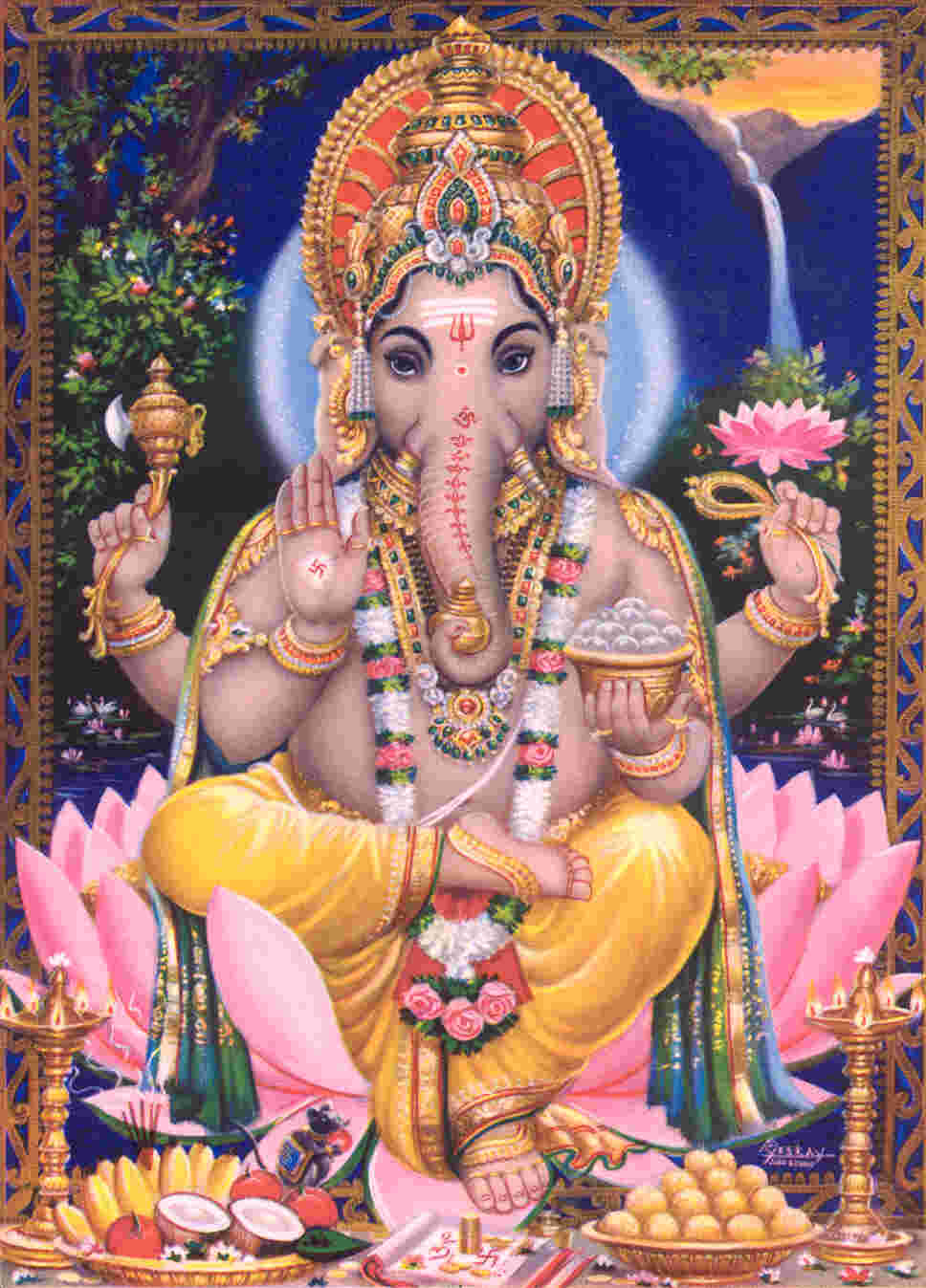
Yoga philosophy is often fleshed out with characters from Hindu mythology. Some people find this off-putting as it rings a distant note of religiosity. This often happens because these colorful characters and stories are viewed as concrete deities, rather than as representations of different aspects of ourselves. Of course, there are sectors of society that regard these archetypes as material divinities, but it is also possible to separate Hindu mythology from a particular religious view point and to use it to illuminate deep seated aspects of ourselves.
One of the most well-known figures in Hindu mythology is Ganesha, the elephant god. His anthropomorphic image is widespread in India, its prominence dating back to the 6th century AD. He is portrayed in a wide variety of situations, from valiantly fighting demons to domestic portraits invoking a sense of familial harmony. While Ganesha is also known as a patron of the arts and sciences, he is most widely revered as the remover of obstacles and the symbol of wisdom. However, Ganesha is also thought to place obstacles in the path of those that need to learn a particular lesson. In this sense, obstacles are regarded as positive forces fostering new perspectives. This encapsulates the deeper sense of wisdom which Ganesha represents.
A traditional way of invoking the Ganesha archetype is through mantra. In many yoga schools, mantras are chanted as a way of getting in touch with those aspects of ourselves we need most in our journey of spiritual realization. The Ganesha mantra translates as the following:
O Mighty Ganesha of Large body, curved trunk, with the brilliance of a million suns, please make all my work free of obstacles, always.
Our internal Ganesha oversees obstacles on material and spiritual planes. Obstacles in our lives occur on many levels, and often simultaneously, from the grossest manifestations of the body to the subtlest impressions of the mind. Yoga philosophy does not differentiate between these levels of being as body is regarded merely as gross mind and mind as subtle body.
This becomes an interesting perspective when we consider the compound ways in which obstacles often seem to manifest in our lives. When we are dealing with extreme mental issues, such as obstacles in our professional lives or relationship dynamics, we often experience concurrent physical ailments. Similarly, serious health problems deeply impact our state of mind. Obstacles resonate on all our levels of being in chorus. To truly start removing these obstacles requires a deeper and more inclusive concept of wisdom – which Ganesha represents.
This sort of wisdom occurs when we manage, through practice, to align our rational faculties with our intuitive ones. Yoga and meditation techniques all aid the process of achieving a state of balance in which this true sense of wisdom becomes more accessible. In this sense, we are all Ganesha’s capable of removing the obstacles in our lives. It is this wisdom which gives birth to the creative insights that resolve our problems.
So next time you are faced with what feels like an insurmountable obstacle, smile as you call to mind the image of the wise and powerful elephant god. Know that he resides within you and that through practice, whichever form works for you, you can achieve the sort of balanced insight that enables you to remove any obstacle in your path. Furthermore, by invoking Ganesha’s wisdom, be reminded that all obstacles are teachers on your journey toward yourself and are in fact your biggest opportunities for growth.
 Everything is going to work out for my highest good.
 Aloha kakahiaka oukou. Hau’oli aloha Po’akahi. I lā nani nou.
Greetings and Good Morning to all. Happy Aloha Monday. Enjoy a beautiful day!
“Control of the mind is said to be the highest Yoga. It is like control of an unruly horse, which must be made to obey its rider.” — Bhagavata Purana, XI.20
Energy is part of the fabric of matter. To some it is Chi (from Chinese), Ki (Japanese) or Prana (Indian). To others it is the life force or breath of the Gods.
Energy is sacred. It is a part of all things. When energy is in a proper state of balance, it moves smoothly through the space it occupies (our homes, our workspace even our bodies). Balancing this energy is a crucial part of living a healthy and calm life.
A healthy lifestyle which includes moderation in all things: eating right, daily exercise and a normal sleeping pattern is key to balanced energy. One trick to healthy living is making small changes. Make wise choices (skip the chips choose raw fruit or vegetables) Eating healthy snacks will make you feel awake and alive. Free yourself from a bad diet in simple steps: add fruit to your cereal, have an extra glass of water instead of soda, limit your alcohol and caffeine consumption. It is possible to ease into a healthier lifestyle just by making conscious choices.
The famous American psychic, Edgar Cayce, recommended this detoxifying diet to a client what has become ” the Edgar Cayce Apple Diet.” It was intended by him as a three-day detox diet.
“But don’t go without the apples – eat them – all you can – at least five or six apples each day. Chew them up, scrape them well. Drink plenty of water, and follow the three-day diet with the big dose of Olive Oil.” He also recommended rest while on this fast (specifically, he said “don’t work like a horse …” or it would be more detrimental than helpful.) The “big dose” of olive oil is around two teaspoons.
Daily exercise, the practice of yoga and daily meditation are also wonderful vehicles to a healthier life.
Our bodies are so much more than meets the eye. Of course we are flesh, blood and bone but we are also Spirit and within our body lies and an amazing network of energy centers or chakras.
This energy system ensures that our organs, cells, and tissues stay strong and healthy. When there is a block in an energy pathway, the organ system that the pathway corresponds with will also become blocked. Through meditation we can move energy through the body and heal it. Not only can we eliminate stress but we can heal and balance our own bodies by drawing energy to the energy center or chakra point that is not functioning to its fullest potential.
There are seven main chakras, or energy centers, located in our body, five of which are located along the spine, the upper two on our head. Each chakra is associated with a different energy level. Begin with the lowest, the root chakra, which stands for the pure matter, to the highest, the crown chakra, which represents pure consciousness.
Energy flows through these centers and the flow of energy affects our health. Through meditation we can balance and aligned each energy centers setting the chakra to glow and spin.
The practice of meditation is a large part of psychic development and spiritual work. Meditation is the practice of focusing and quieting your mind to achieve a heightened awareness of your inner spirit and release your inner wisdom whereby you are attempting to merge the desires of the subconscious mind with the desires of the conscious mind in order to work toward a common goal.
When you shift your attention to each breath slowly and deeply drawn and released, you shift your mind into a quiet mode, releasing your mind clutter and silencing the “monkey mind” that constantly tries to invade our thoughts and emotions. The result of this shift is peace, serenity, calmness and inspiration.
Through Meditation Practices one can improved mental functioning, achieve greater intuition as well as greater access to unconscious resources and abilities.

“Look not mournfully into the past. It comes not back again. Wisely improve the present. It is thine. Go forth to meet the shadowy future, without fear.“ ~ Henry Wadsworth Longfellow

Aloha kakahiaka oukou. Hau’oli aloha Lapule. He la nani keia la oukou. ‘Ohoihoi!
Good morning and Happy Aloha Sunday. Today is a beautiful day. Enjoy it!
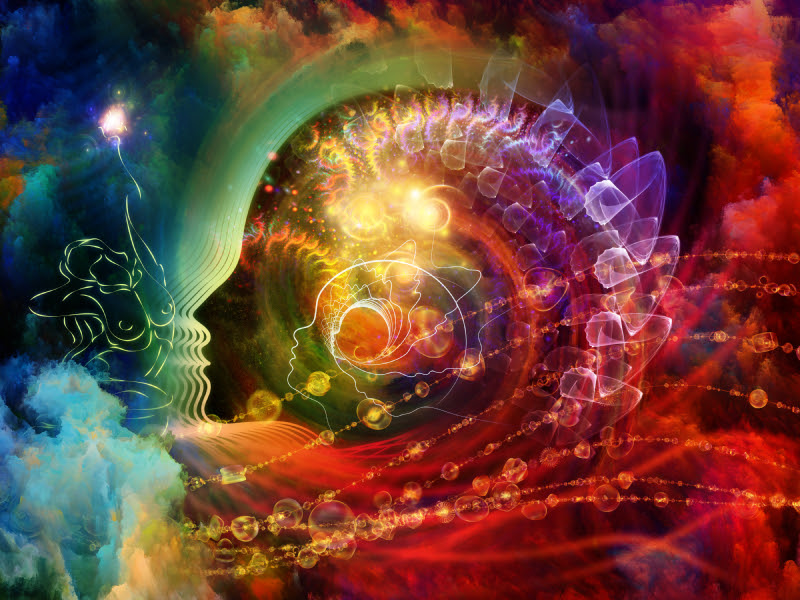
The Body always exists in the moment. Pono, connection to Spirit, can only occur in the moment. Thus, you are in Pono when Mana’o and Pu’uwai are in agreement with Na’au because when they are, you are in alignment with ‘Uhane.

Taṃ nadīhi vijānātha:
sobbhesu padaresu ca,
saṇantā yanti kusobbhā,
tuṇhīyanti mahodadhī.
Learn this from the waters:
in mountain clefts and chasms,
loud gush the streamlets,
but great rivers flow silently.
Sutta Nipāta 3.725
Gemstones of the Good Dhamma,
compiled and translated by Ven. S. Dhammika

Your thoughts are your reality. Every thought you have, every word your say is either life-giving or death- dealing. Two thoughts cannot occupy the same space. Your emotions follow your thoughts, so be vigilant. Focus on the Pono … Now!!
 paṇītaṃ — excellent, precious

Sabbapāpassa akaraṇaṃ,
kusalassa upasampadā,
sacittapariyodapanaṃ –
etaṃ buddhāna sāsanaṃ.
Abstain from all unwholesome deeds,
perform wholesome ones,
purify your mind –
this is the teaching of the Buddhas.
Dhammapada 14.183
The Discourse Summaries by S.N. Goenka
 Love one another, but make not a bond of love
Let it rather be a moving sea between the shores of your souls.
Fill each other’s cup, but drink not from one cup.
Give one another of your bread, but eat not from the same loaf.
Sing and dance together and be joyous,
but let each one of you be alone,
Even as the strings of a lute are alone
though they quiver with the same music.
Give your hearts, but not into each other’s keeping;
For only the hand of Life can contain your hearts.
And stand together yet not too near together;
For the pillars of the temple stand apart,
And the oak tree and the cypress grow not in each other’s shadow.
~ Khalil Gibran
 Never attach a temporary human condition to your Spirit Greatness. When you find yourself out of your canoe, listen to what you are saying: If what you’re saying does not represent Spirit Greatness, then do not attach an “I” to it!!
 Aloha Kakahiaka oukou. Hau’oli aloha Poʻaono. Maikaʻi la iā oukou.
Greetings and Good Morning; happy Aloha Saturday. May you all have a great day!

Any true wisdom, as ethereal as it may be, sits above your head as a massive reservoir of living waters. Provide it only a small opening, and it will burst into your reality and pour down into your life.
Whatever wisdom you learn, whatever you know, do something with it. Make it real.
That is the purpose of meditation and prayer—to be that bridge from wisdom to action.
—
Based on letters and talks of the Rebbe, Rabbi M. M. Schneerson
Sefer HaSichot 5704, p. 122; Igrot Kodesh, vol. 4, p. 269.
 Life’s energies move upward.

“The earth recognizes people whom Source flowers. There is a sensuousness, a centeredness, a grace to their movement. There is a relaxed gentility of power flowing quietly within and beneath their action. There is a humble assuredness about them, a reverence, a sense of humor and a sense of the sacred entwined. They are the magical people, for whom the earth has longed.” ~ Ken Carey
Artwork: “A Moment In Time”, by John Kolenberg
 Aloha kakahiaka oukou e hau’oli aloha Po’alima … I lā nani nou oukou. Hoihoi!
Good morning and Happy Aloha Friday to all … Enjoy a wonderful day!
This is a deeply reflective poem by Rumi (1207-1273) exploring the deep self of what some call the “soul”.
Above and Below was shot by Stefan Werc for the Bagong Silang documentary directed by Zena Merton and produced by Giselle Santos.
Setting: Navotas Cemetery, Manila, The Philippines.
Manila is one of the most overpopulated places on Earth.
There are over 2000 families living above the dead in the Navotas Cemetery. Babies are born and the dead are buried in the same place.
Life goes on.
“All day I think about it, then at night I say it.
Where did I come from, and what am I supposed to be doing?
I have no idea.
My soul is from elsewhere, I’m sure of that,
And I intend to end up there.
This drunkenness began in some other tavern.
When I get back around to that place,
I’ll be completely sober. Meanwhile,
I’m like a bird from another continent, sitting in this aviary.
The day is coming when I fly off,
But who is it now in my ear who hears my voice?
Who says words with my mouth?
Who looks out with my eyes? What is the soul?
I cannot stop asking.
If I could taste one sip of an answer,
I could break out of this prison for drunks.
I didn’t come here of my own accord, and I can’t leave that way.
Whoever brought me here will have to take me home.
This poetry. I never know what I’m going to say.
I don’t plan it.
When I’m outside the saying of it, I get very quiet and rarely speak at all.
We have a huge barrel of wine, but no cups.
That’s fine with us. Every morning
We glow and in the evening we glow again.”
– Rumi
Om Sai Eeshwaraya Veedmahe
Sathya Devaya Dhimahi
Tanna Sarva Prachodayat
We contemplate the glory of Light illuminating the three worlds: gross, subtle, and causal.
I am that vivifying power, love, radiant illumination, and divine grace of universal intelligence.
We pray for the divine light to illumine our minds.

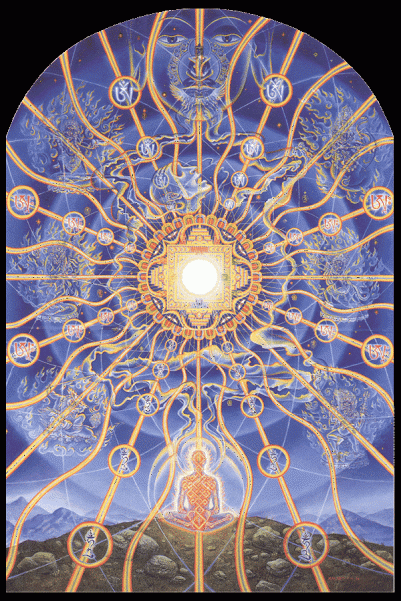
Beginning on the Equinox
Sept 23, 28 & October 5, 12
REGISTER HERE – it’s FREE to participate:
http://childrenofthesun.org/middle-east-transmissions-registration/
The Middle East transmission team is building strong! There is still time to get more people linked in though, so let’s keep the publicity energy really high!
Thank you in advance for liking and sharing our campaign posts on Facebook and Twitter. This is very helpful and appreciated.
Starting on September 23, our group force field will deliver a transference to the entire Middle Eastern region, likened to a walloping love vaccine, purposed to trigger eradication of a most deadly, hate empowered virus and its contagious influence.
If you haven’t signed up yet, please take a moment to complete the free registration process. Everyone of us is needed to make a transforming difference.
Let’s show the world what the power of unified love can do!
OUR GROUP LOVE IS A KEY TO PLANETARY PEACE
 I live a healthy, positive lifestyle.

Treat today like an epic journey. Whether you are walking to work or cycling to the market, notice something new or subtle and take a picture of it.
“Empty pockets never held anyone back. Only empty heads and empty hearts can do that.” ~ Norman Vincent Peale
 Atthamhi jātamhi sukhā sahāyā;
tuṭṭhī sukhā yā itarītarena;
puññaṃ sukhaṃ jīvitasaṅkhayamhi,
sabbassa dukkhassa sukhaṃ pahānaṃ.
Good are friends when need arises;
good is contentment with just what one has;
good is merit when life is at an end,
and good is the abandoning of all suffering.
Dhammapada 23.331
The Dhammapada: The Buddha’s Path of Wisdom,
translated from the Pali by Acharya Buddharakkhita
 Aloha kakahiaka oukou. Hauʻoli aloha Poʻaha. Maikaʻi iā oukou.
Good morning and Happy Aloha Thursday, everyone. Enjoy your day!
 Committing to a healthy lifestyle does not mean committing to a life that is void of fun, delicious, satisfying treats. In fact, we eat just as much amazing food as the average person.
The difference between what we are doing and what the rest of the population is doing comes down to the quality of the ingredients that go into our treat foods.
Eating healthy should be delicious, and we are never going to compromise on that – either for ourselves or for you. That is why we are firm believers in substitutions.
For instance, when we are making a pie – we use whole nuts, seeds and pseudo grains instead of processed flour. We use cashews for making thick creams rather than processed diary. We use dates, coconut sugar and maple syrup in place of processed white sugar… You get the idea!
For us, eating healthy should never mean deprivation. It should simply mean you still get to eat everything you crave, you just use healthy, whole foods ingredients to make your favourite dishes in place of processed ones!
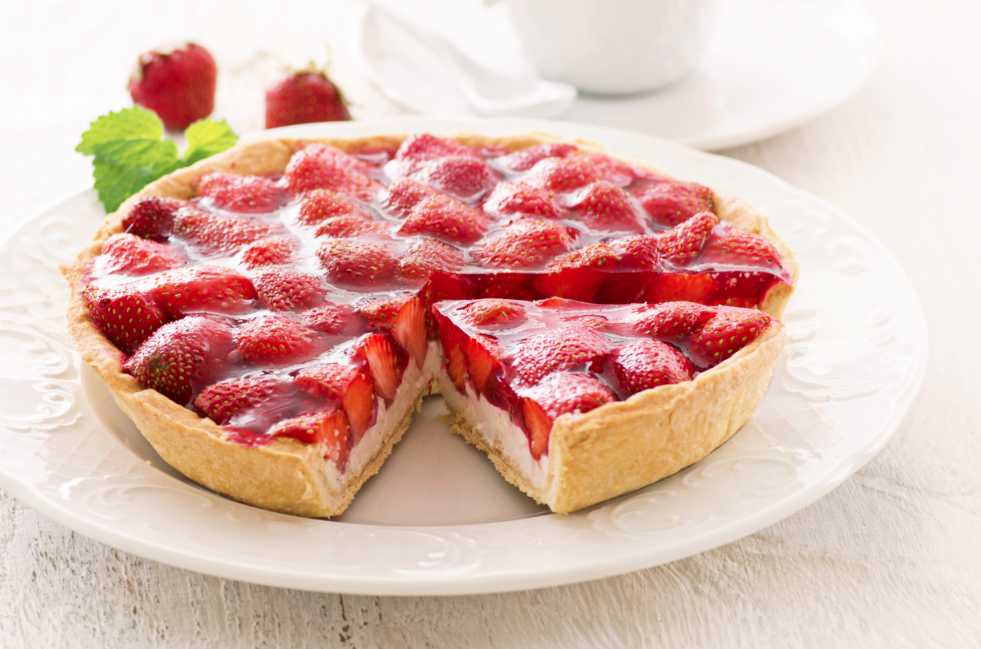
To get you started, here is an amazing Strawberry Pie recipe that you will be proud to serve guests – not only because it looks beautiful, but because it is absolutely delicious AND nutritious!
Of course if you want to keep the whole thing to yourself, we won’t tell anyone 😉
For the crust: Place unsweetened coconut in a blender or food processor and blend until a fine powder is created. Remove from blender and place in a large mixing bowl. Repeat this process with sunflower seeds, buckwheat and coconut sugar. Add salt and mix together with your hands until well combined. Add enough orange juice so that your crust sticks together. Press into a lined pie dish and set in the freezer.
For the strawberry cream: Drain and rinse cashews. Place all ingredients in a high speed blender and blend until smooth. Pour over crust and place back in the freezer.
For the strawberry topping: Set aside your sliced strawberries. Place remaining ingredients in a blender and blend until smooth. Arrange sliced strawberries over the strawberry creme layer of your pie, and pour your glaze on top. Freeze for an hour or until set. Enjoy!
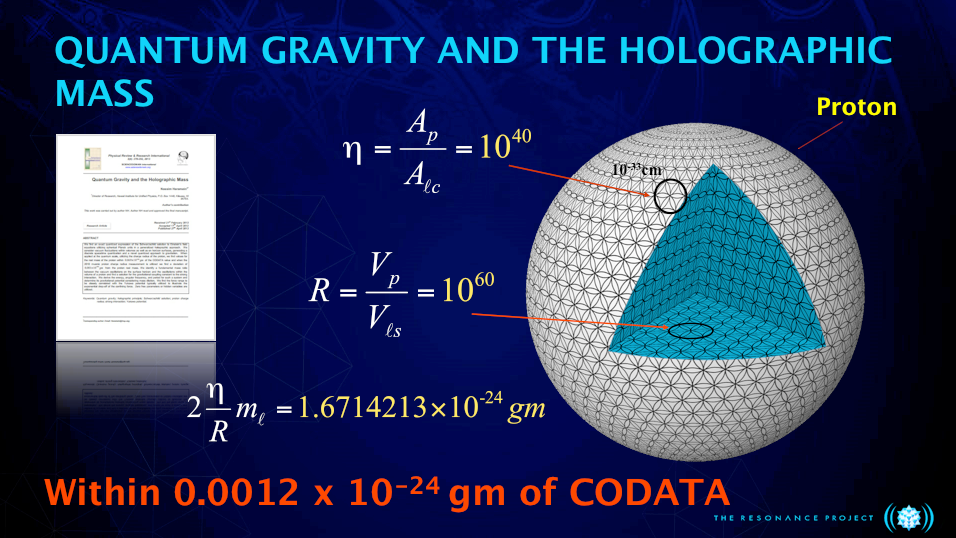 Nassim Haramein has calculated a geometric solution for the gravitational field. In his latest paper “Quantum Gravity and the Holographic Mass” he describes gravity in a classical algebraic way by calculating the density of the space both within and on the outside of the event horizon of a proton.
The seemingly “empty” vacuum of space is actually a nearly infinitely dense super-fluid medium made of tiny tiny tiny little frothing bubbles of energy. Sometimes called the “quantum foam”, each of these miniscule vibrations represents a spherical wave form, or quanta, that is the diameter of the smallest possible measurable distance, the Planck length. Haramein calls these tiny spherical information bits Planck spherical units or PSUs. The PSUs on the interior of the proton’s event horizon pack together in a perfectly space-filling overlapping “3D” Flower of Life structure with each sphere’s center being connected by a tetrahedral lattice geometry. The PSUs within the proton volume holographically project on the proton surface event horizon as “flat” equatorial circles in a “2D” flower of life tiling pattern.
In this image, the first equation describes the ratio between the proton surface area and the surface Planck circles showing that the number of equatorial circles on the Proton surface equals 10↑40 (10 to the 40 or 1000000000000000000000000000000000000000 Planck length diameter circles)
The second equation shows the number of Planck spherical units contained within the proton, which is 10↑60. In the third equation, the external surface horizon is divided by the internal volume and then multiplied by the Planck mass to give the total value of the proton mass. With a simple classical geometric calculation, Haramein obtains the mass of the proton according to the standard model, as measured from the outside, in the laboratory: 10↑-24 gm.
Haramein then calculates the external Planck circles divided by the internal Planck spheres to obtain the gravitational mass of the proton, which equals 10↑14 which is the exact amount of mass needed for the proton to obey what is called the the Schwarzschild condition of a black hole.
Protons are quantum scale black holes.
Gravity is a ratio of volume to surface area.
More info.: http://resonance.is/explore/quantum-gravity-and-the-holographic-mass-trailer-and-press-release/
 Lack of focus is a serious worldwide problem in this age of multiple distractions: multi-tasking and constant connectivity. Call it the other edge of the double-edged sword of technology. With the explosion of technology and communication, humans, always a social species, have scaled new peaks of virtual social interactions – from phones to electronic mails to instant chats to the ever-mushrooming web-based social sharing platforms. With uninterrupted 24×7 reach to technology we mostly lack some quiet time with our own selves.
In such a scenario, it’s hardly surprising to see a lack of focus becoming a common problem. But one can beat this challenge of lack of focus by applying some simple Zen habits.
Zen philosophy of inner calm
Let us first understand what Zen means. Zen stands for inner peace, focus, emotional balance, and happiness that emanates from within. It emphasizes on what it terms as the ‘Buddha-nature’ and its expression in every act of one’s daily life as opposed to philosophies that stress on doctrines and rituals.
Over the years, Zen practices have gained immense global appreciation for their effectiveness in clearing away mental distractions and winning back lost focus. Zen habits are based on quieting inner turmoil and focusing on the task at hand with silence and determination.
Let’s take a look at some Zen habits that improve your ability to focus:
Eliminate Distractions
Before setting out on any important task, resolutely eliminate all distraction. Nothing great can be achieved till you give it your complete attention. So, put your phone on silent, shut down unnecessary browser windows and tabs, close your doors and immerse yourself in the job. Not only will you get good results but you’ll also most certainly complete the said task within shorter time duration than you would have in the presence of distracting elements like text pings, e-mail notifications, television noises from the adjoining room, etc.
Practice silence and meditation
If you’ve been constantly struggling with regaining focus, start practicing silence and meditation every day. The best times are usually early morning or right before going to bed in the evening. In this way, you would cut out the worries of the daily chores lined up for the day and struggling with each other for your attention. You should also take out sometime when you’ll be your only company. A lot of people prefer to go out on nature walks, where they spend some time amidst natural beauty and quiet. Again early morning hours in a public garden or your own terrace could be the perfect time and place for such an activity.
Focus on your breath
Just before undertaking anything important, retire to a quiet corner and take a few moments to focus on your breathing. Breathe in and out slowly, concentrating on each inhalation and exhalation. Do this for two to five minutes. This will instantly calm your mind and increase your focus.
Don’t lose sight of the target
A famous Zen story talks about a Zen master’s lesson to his students on the importance of never losing sight of one’s target in order to score a hit. As the anecdote goes, the Zen master would never miss a single target. One day, he summoned his students and asked them to cover his eyes with a cloth. With his vision blocked, he aimed at the target and missed it. The students were surprised to see their master miss. The Zen master then told them that what he wanted to convey to them though that exercise was the importance of always having one’s sight on one’s goals for success.
So, whenever you feel your focus shifting from your target, take some quiet time to realign and reassert your goals to yourself. If needed, write them down on paper and pin it up where you can see them often.
Go for calming walks
Often in the midst of difficult and time consuming assignments, you can feel our mind beginning to drift away. This is a cue for you to take a break right then to relax your mind and pump up some energy. A good way would be to go for a walk. A walk will increase your heart rate, clear away your mind as you focus on the repetitive motion of your legs, up your alertness, and also give you the time to internally mull on the problem in a stress-free environment.
Begin your day with yoga and exercise
Yoga and exercise have a way of calming your mind. The Zen philosophy says that there’s a lot of pent up energy in the body. If we lead a sedentary life, this accumulated energy tries to find a way out by channelizing our minds towards fruitless, distracting thoughts and pursuits like aimless internet surfing, repetitive chat session with friends or simply loitering around and dissipating our energy and focus. On the other hand, a good invigorating yoga and exercise session in the morning will set your mind straight and channelize your body’s energy is a positive direction, helping you stay focused all day long.
 Sukhakāmāni bhūtāni,
yo daṇḍena na hiṃsati
attano sukhamesāno,
pecca so labhate sukhaṃ.
One who, while oneself seeking happiness,
does not oppress with violence other beings,
who also desires happiness,
will find happiness hereafter.
Dhammapada 10.132
The Dhammapada: The Buddha’s Path of Wisdom,
translated from the Pali by Acharya Buddharakkhita

We don’t think of sesame seed paste as a ‘life saver,’ but new research shows it is capable of reducing blood markers of cardiovascular disease risk by 39% within only six weeks.
Sadly, in the Western world, when the average Joe thinks of protecting himself from heart disease, aspirin and statin drugs are often as high on the list – if not higher – than exercise and eating better. Through decades of intense marketing and miseducation millions have been made to think of the #1 killer as an inevitable force; one against which we fling pills and various pharmaceutical potions to ‘minimize risk,’ never to strike to the core of the problem and resolve it permanently.
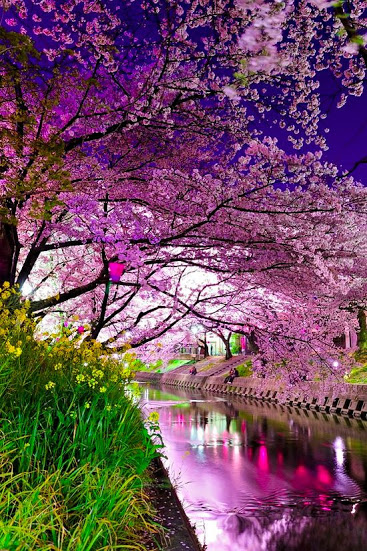 Aloha kakahiaka oukou e Hau’oli la Po’akolu
Lawe i ka maʻalea a kuʻu ono. A me puʻuwai.
Mahalo Ke Akua no na mea a pau.
Good morning and Happy Wednesday to all.
Take wisdom and make it deep. Be generous, open hearted.
Enjoy what you have, give gladly from the heart.
Thank you, Lord, for everything.
 We are constantly trying to restrict what we eat. Every day we hear about yet another food we should cut out completely, or we get berated for not catching onto the latest food fad fast enough. One of the recurring stories in the food tabloids is the evil of sugar, and while it is true that in general the overall sugar consumption of the human race has increased exponentially and no doubt has adverse effects of our health, it has also meant the defamation of less guilty subject, chocolate.
Mmm. Chocolate.
Unfortunately much of the chocolate that we find on the market today is not chocolate at all, but rather a flimsy syrupy substitute masquerading as the real thing. This trite treat has lost all of its original zest and surely too its mystique. Chocolate originated in the foothills of the Andes, in the Amazon and Orinoco basins of South America. The cocoa bean was deemed so valuable that it was used as a common currency before the Spanish conquest. Montezuma the Second, Emperor of the Aztec civilization (the story goes) drank nothing but chocolate. He enjoyed his royal beverage in a golden goblet, whipped into a mouth-watering froth and flavored with vanilla and spices. It wasn’t long before chocolate was introduced to the Europe, and it was soon revered as the delicacy among delicacies. Revered isn’t too strong a word either: chocolate’s Latin name, Theobroma Cacao literally means “food of the gods”.
The reason why chocolate was so highly regarded was the titillating sense of elevation that people originally experienced when partaking (and its ability to act as a powerful aphrodisiac was presumably also well noted). Today we know that the stimulating effects of chocolate come from the compound Theobromin, and that chocolate is a rich source of antioxidants which may well have anti-aging properties. Chocolate also contains high levels of flavonoids which are said to have a positive effect on the heart.
Recent studies done on the Kuna people, who consume large amounts of cocoa as part of their daily lives, found that they have significantly lower rates of heart disease and cancer, which should be unsurprising, as it has been linked to a reduction in blood pressure. The benefits of cocoa are even believed to extend to the brain’s abilities to learn and remember.
With all these incredible benefits at our chocolaty fingertips, it’s a wonder we don’t consume more of this charmed stuff. And after you tire of the cheap imitations, you’ll find that raw cocoa and dark chocolate products are readily available, and that they open up a whole new range of decadent culinary experiences. For instance, try adding a scoop of raw chocolate to your morning porridge. Chocolate can even be grated over salads, and adds a sensuous depth of flavor to a humble stew.
And the moral of this decadent tale? Don’t deprive yourself of the chance to savoir this godly delicacy, and say yes to the magic that is chocolate.
Find Your Magic
Tarot Readings, Inspiration, and Self-Empowerment
Making life on earth magick one moon phase at a time.
Astrologer ~ Mystic ~ Writer
of the Collegium Spiritus Sancti, a Golden Dawn Society
An affiliate of the Alpha et Omega Order of Melchizedek
All Knowledge Is Not Contained In Only One School
Connecting the grant community to #LearnGrants
Channelings & Articles
Magic Spell Books & Grimoires
Native Hawaiian Language Revitalization
Poetry & Tales of Love, Mystery, Magic and Spirituality
Organic Herbs, Herbals, Sustainable Gardening
Mother Nature: Feeding The Mind, Body & Soul, with Food, Medicine & Skincare.
"Inheritor of a Dying World, we call thee to the Living Beauty. Wanderer in the Wild Darkness, we call thee to the Gentle Light..."
Time is the most important thing we've been given
Embracing the Divine Within.
"...That I should bear witness to the truth." - John 18:37 // David E. Robinson, Publisher
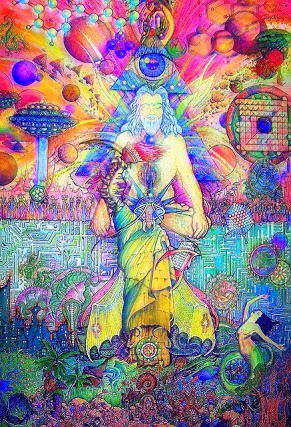
 Hālau 'Aha Hui Lānākila