Most human beings are unable to attain the seed idea of enlightenment which is fructified in the form of an imperishable vesture by those who have fully prepared before death to enter into the state of immortality. For most people, even the seed idea of immortality cannot be grasped, and therefore they are quickly drawn to all the various samskaras or attributes which come back to them. There is a persisting matrix made up of all these attributes, revivified by one’s own newly-formed desire or attachment. Then one begins to make one’s first entry into physical life through having formed a line of attachment with particular parents. Such people dream about mating couples and get so involved with the purely physical side of life that they are very soon caught in the illusory process of birth. They cannot expect to know what birth means because they did not know what death meant.
So, this whole teaching is highly significant if we can see its practical implications and various facets. By reading The Tibetan Book of the Dead, or by looking at Tibetan pictures of the visions of the dead, one could accumulate a vast amount of detail about the symbolic forty-nine days of the bardo with all its day-to-day visions. But merely accumulating a great deal of fantastic knowledge does not add anything to our meditation on death. The moment we start with ourselves and ask not why we are afraid of death but why we hold on to life, the moment we begin to see significant connections, it will be possible for us to discern that at all times we have available to us either the standpoint of nirvana or the standpoint of samsara. If we are ready to see this, we can come to understand those who have gained or can gain immortality in this scheme of things.
Ordinarily, according to Tibetan teachings, people will not incarnate immediately. When someone has died, that person will not linger or be drawn back to earth-life except in three cases. First are those Bodhisattvas, those enlightened sages who deliberately linger, having renounced nirvana, to assist and help other human beings to gain the knowledge that they have of the meaning of all these states. Secondly, there are those people who die with a total obsession with one line of thinking, not necessarily bad or sinful beings, but those with an idée fixe. These people will also linger. They will prolong the entry into the bardo state, and the more they prolong it, the more difficult it will be for them to pass from the swoon into the state of awakening, into a new consciousness, and benefit front it. The third class of beings who are drawn back and hover around earth-life are those who had so intense a love — like a mother’s love for children — a sense of unfulfilled or uncompleted love, or a love which, however much fulfilled, is still so powerful and so personal that it binds people and draws them back to earthly life. But even these will not appear as bhuts or ghosts unless they are galvanized into activity by adepts in the art of necromancy, a practice strongly condemned in pure Buddhist teaching.
Such nefarious practices do go on in the name of Buddhist tradition among several Red Cap sects, especially in places like Bhutan. They have actually been put forward as Tibetan Buddhist, in the name of scholarship, by people who have quoted supposed authorities who have never even visited Lhasa, let alone had the privilege of some kind of initiation into the pure teachings of the Panchen Lama and the Dalai Lama. It is not therefore a question of considering all the various forms which possession could take that would constitute a true understanding of the Tibetan teaching of death, let alone of immortality. That there must be such demonic usurpers is not difficult to conceive. But they are unnatural. Tibetan teachings do refer to the victims of suicides and murders, people who are in the state of swoon and could be used by other beings who function freely on subtle planes of consciousness, using subtle vestures for their own foul purpose. But this is not something that need concern us.
The crucial insight that we gain from Tibetan teaching is that immortality is not something to be achieved or won, not a prize to be awarded to a favoured few. Immortality is nothing but another aspect of mortality. Even now we either live immortally or live mortally. We either die every moment or we live and thirst, depending on whether we are focused upon the nirvanic or upon the samsaric aspect of embodied consciousness. If we are constantly able to sift the meaning of experiences and to see our formal vestures for what they are and pass from one plane of perception to another, then indeed it may be possible, when blessed with the vision of clear, pure light — the great vision of sunyata — to enter straightaway into that vesture which enables us to remain free from the compulsion of return to earthly life. But this cannot happen unless it flows naturally out of the line of life’s meditation. It cannot happen all of a sudden. It is not some kind of special dispensation. It is itself a product of the working of Karma.
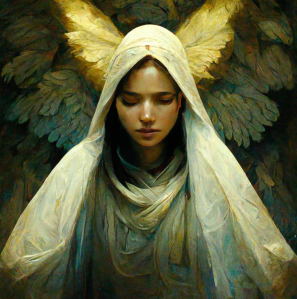
Beings who have undergone this condition of final illumination have either chosen to remain immortal but in the Dharmakaya vesture, unrelated to manifested beings and humanity, or they have chosen the Nirmanakaya vesture and deliberately chosen to enter into relationships with human beings. These Nirmanakayas ceaselessly point to the basic truths concerning the meaning of death and the perpetual possibility of immortality. They teach people that within themselves they are Buddhas without knowing it. Now, the Prajnaparamita states that the Buddhas are themselves only personifications and therefore they could become illusions for us. What is it that we are going to meditate upon when we consider the immortals? Are we going to think of them as glorified physical personalities, archangels in radiant raiment, somehow idealized and more beautiful but related to our own physical conception of physical life? Or are we going to think of them as minds, a great gathering of extraordinary and powerful minds who collectively constitute the great mind of the universe? Or are we going to look upon them simply as beings who have become aware of their true Buddha nature and have therefore become instruments for the working of consciousness, instruments that will be helpful and unifying, because that is the nature of consciousness, whereas the nature of form is divisive.
Thus the whole doctrine, even of the Lha, those gods seemingly tucked away in a limbo, refers to beings who not merely work in relation to the world but also by their ceaseless collective ideation maintain in the world the force of the Buddha nature. The Buddha nature is not some abstract principle. It is actually embodied in the collective consciousness of such beings perpetually in the universe. We come to see that the various phases in the process of the concretization of the universe from an absolute realm, through archetypes, through individualized forms of thought, and ultimately to material forms, that this whole process is re-enacted in the bardo state, between death and rebirth. A great re-enactment has taken place. Who knows what re-enactment takes place within the embryo especially during the first seven months in the mother’s womb? Science and medicine know almost nothing about what happens then or why. These are the great mysteries connected with the primal facts of birth and death. If we can consider that there is available in Buddhist teaching the knowledge that there is regular re-enactment of a continuous cosmic process before the eye of the soul, then we can see that enlightenment is not the great terminus to a laborious and boring process of striving, but a ceaseless opportunity which inheres in this very world of woe and delusion, which we call samsara, and to which we cling like blind fools, knowing not Life and afraid of death.
Raghavan Iyer
The Gupta Vidya II
They who are on the summit of a mountain can see all men; in like manner they who are intelligent and free from sorrow are enabled to ascend above the paradise of the Gods; and when they there have seen the subjection of man to birth and death and the sorrows by which he is afflicted, they open the doors of the immortal. — TCHED-DU BRJOD-PAI TSOMS
. . . as ‘there is more courage to accept being than non-being, life than death,’ there are those among the Bodhisatwas and the Lha — ‘and as rare as the flower of udambara are they to meet with’ — who voluntarily relinquish the blessing of the attainment of perfect freedom, and remain in their personal selves, whether in forms visible or invisible to mortal sight — to teach and help their weaker brothers.
— A Gelung Of The Inner Temple















 Hālau 'Aha Hui Lānākila