Daily Words of the Buddha for December 09, 2022

Uṭṭhānenappamādena,
saṃyamena damena ca,
dīpaṃ kayirātha medhāvī
yaṃ ogho nābhikīrati.

By effort and heedfulness,
discipline and self-mastery,
let the wise one make for oneself
an island which no flood can overwhelm.

Dhammapada 2.25
The Dhammapada: The Buddha’s Path of Wisdom, translated from Pāli by Acharya Buddharakkhita

Daily Words of the Buddha for December 08, 2022

Sabhaggato vā parisaggato vā
ekassa veko na musā bhaṇeyya.
Na bhāṇaye bhaṇataṃ nānujaññā.
Sabbaṃ abhūtaṃ parivajjayeyya.

Having entered a royal court or a company of people
one should not speak lies.
One should not speak lies (oneself) nor incite others to do so.
One should completely avoid falsehood.

Sutta Nipāta 2.399
The Discourse Collection: Selected Texts from the Sutta Nipāta, translated by John D. Ireland

Daily Words of the Buddha for December 07, 2022

Saddhīdha vittaṃ purisassa seṭṭhaṃ
Dhammo suciṇṇo sukhamāvahāti.
Saccaṃ have sādutaraṃ rasānaṃ.
Paññājīviṃ jīvitamāhu seṭṭhaṃ.

Conviction is a person’s highest wealth.
Dhamma, when well-practiced, brings bliss.
Truth is the highest of tastes.
Living with discernment, one’s life is called best.

Sutta Nipāta 1.184
Translated from Pāli by Thanissaro Bhikkhu

Daily Words of the Buddha for December 06, 2022


Sukhakāmāni bhūtāni
yo daṇḍena vihiṃsati,
attano sukhamesāno,
pecca so na labhate sukhaṃ.

Sukhakāmāni bhūtāni
yo daṇḍena na hiṃsati,
attano sukhamesāno,
pecca so labhate sukhaṃ.

Whoever takes a stick
to beings desiring ease,
when one is looking for ease,
will meet with no ease after death.

Whoever doesn’t take a stick
to beings desiring ease,
when one is looking for ease,
will meet with ease after death.

Udāna 2.13
Translated from Pāli by Thanissaro Bhikkhu

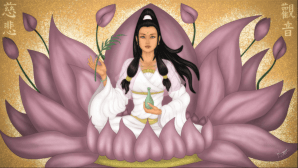
Theosophy |  THE PLEDGE OF KWAN YIN – I

Never will I seek nor receive private, individual salvation; never will I enter into final peace alone; but forever and everywhere will I live and strive for the redemption of every creature throughout the world from the bonds of conditioned existence.

Kwan Yin

 Unconditional affirmation of the Kwan Yin pledge can only come from the unconditional core of the human being. Words are uttered in time, and usually delimit meaning. They express thought, but they also obscure thought. To be able to use words in a manner that reaches beyond limits is to recognize prior to the utterance and to realize after the utterance, that one is participating only on the plane of that which has a beginning and an end, though in emulation and celebration of that which is beginningless and endless. Every word and each day is like an incarnation. Silence and deep sleep convey an awareness of duration that cannot be inserted into ordinary time, but indicate the return to a primal sense of being where one is neither conditioned by nor identified with external events, memories, anticipations, likes and dislikes, hopes and fears, possibilities and limitations. Common speech and ordinary wakefulness, for most individuals, are but clouded mirrors dimly reflecting the resonance and radiance of spiritual wakefulness. Any sacred pledge may be uttered by a human being with a wavering mind and a fickle heart, but it can also be authentically affirmed in the name of the larger Self that is far beyond the utterance and the formulation, yet immanent in both.

 This is the time-honoured basis of religious rites, as well as the original source of civil laws. Émile Durkheim explained how early in the evolution of societies human beings learnt to transfer the potency of religious oaths to secular restraints and thereby established a high degree of reliability in human relationships. Mohandas Gandhi spoke of the sun, the planets and the mighty Himalayas as expressing the ultimate reliability of the universe, and taught that when human beings bind themselves by the power of a vow, they seek to become wholly reliable. If reliability essentially connotes a consistent standard of unqualified and unconditional success, then in taking a vow one is necessarily seeing beyond one’s limitations. If one is wise one allows for the probability of failure and the possibility of forgetfulness, but somewhere deep in oneself one still wants to be measured and tested by that vow. Thereby a vow which is unconditional, which releases the spiritual will, calibrates one’s highest self-respect and is vitally relevant to the mystery of self-transformation.

 The Kwan Yin pledge is a Bodhisattvic vow taken on behalf of all living beings. It is closely connected with the Bodhichitta, wisdom-seeking mind, the seed of enlightenment. The idea that an unenlightened human being can effectively generate a seed of enlightenment is the central assumption behind the compassionate teaching of Mahatmas and Bodhisattvas, of the Buddhas and Christs. A drop of water is suggestive of an ocean; a flashing spark or single flame is analogous to an ocean of light; the miniscule mirrors the large. Herein lies the hidden strength of the Kwan Yin pledge. What may seem small from the standpoint of the personal self, when it is genuinely offered on behalf of the limitless universe of living beings and of all humanity past, present and future, can truly negate the finality of finitude, the ultimacy of what seems urgent, the immensity of what appears immediate. The human mind ceaselessly creates false valuations, giving ephemera an excessive sense of reality, to uphold itself in a world of flux. To negate this tendency in advance and to assign reality only to the whole requires a profound mental courage. It requires, while one is alive, a recognition of the connection between the moment of birth and the moment of death, of the intimate relationship between the pain of one human being and the sorrow of all humanity. But it also involves a recognition that greater beings than oneself have taken precisely such a vow, have affirmed this pledge again and again. Therefore, one can invite oneself, however frail, however feeble, into the family of those who are the self-chosen, unacknowledged but unvanquished friends of the human race.

 The prospect of such a vow is naturally perplexing to the lower mind which is almost totally ignorant of the priorities of the immortal soul, and knows very little about even this life, let alone about previous lives. On what basis could the personality assume a gnostic authority in regard to its own limitations? If one simply looks at the last ten years of one’s life, one will readily see that many things which looked irrelevant, remote, even impossible in the past, unexpectedly become part of one’s way of thinking, one’s depth of feeling. If a human being does not truly know himself, merely to be aware of himself at the personal level in terms of persisting limitations is frustrating. This does not take into account in oneself that which is ineffable and unexpressed, whatever cannot come through the confining parameters of thought, the truncating crudities of speech and the stultifying restrictions of action.

 The Kwan Yin pledge can be taken by anyone at any time, but the level of thought and intensity with which it is taken will determine the degree and reliability of response of the whole of one’s being. Shantideva puts this in the form of an ordination:


 When the Sugatas of former times committed themselves to the Bodhichitta, they gradually established themselves in the practice of a Bodhisattva. So, I too commit myself to the Bodhichitta for the welfare of all beings and will gradually establish myself in the practice of a Bodhisattva.

 Today my birth has become fruitful; my birth as a human being is justified.

 Today I am born in the Buddha Family; I am now a son of the Buddha.

 Now I am determined to perform those acts appropriate to my Family; I will not violate the purity of this faultless, noble Family.

To be able to take one’s place in the glorious company of Bodhisattvas is not to assume that one can, purely on one’s own, fulfil this exalted aim. But once one has truly affirmed it, no other aim has any comparable significance. This recognition would be critical to a timely taking of the mighty vow of the Buddha, the sacred pledge of Kwan Yin, the Bodhisattva ordination of Shantideva. Timeliness in this sense would mean that one simply cannot imagine an alternative. If a person were to take the pledge prematurely, lacking this sense of necessity, it would precipitate difficulties, making that person guilty, tortured with anxiety, involved even more in futile comparisons and contrasts with other human beings, more depressed, more desolate. But out of all these failures there may come some sense of timeliness at a later moment of ripeness.  Timeliness does not occur all at once. Timeliness, like all wisdom, must be the ripe fruit of time-bound experiments and time-bound errors. Because these are time-bound, they are evanescent; they are not enduring. In the same way in which one stumbled and learnt to walk, or mumbled the multiplication tables, one may rediscover something about grace in movement or the deep logic of elementary numbers. So also one may rediscover the higher stage, the fuller meaning, the larger significance for the whole of one’s life, of the pledge one took. Suppose a person truly resolves to injure no human being and wishes to release love in every direction. If one is deeply attracted by this affirmation, what does it matter if there is something imperfect and inconclusive in one’s repeated efforts to embody it? Mature individuals, who have done this again and again, know that soon after one has made such an affirmation one is going to be tested. One has invited the Light of the Logos to shine upon the dark corners of one’s being. Through heightened awareness one sees unconscious elements in one’s nature which one did not even imagine were apt to give offense, but are now discerned as obscurations of one’s deepest feelings, one’s finest nature, one’s truest, profoundest sense of brotherhood. These discoveries are significant, but the hardest lesson at all times is the paramount necessity of patience and persistence. This is a pledge in favour of selfless service, and it cannot ever be premature. It will always be timely, though compelling timeliness can only come when there is serene insight, supported by the strength of personal invulnerability.

 It is the immemorial teaching that the pristine seed of enlightenment, however small, may germinate far in the future into a flowering tree of wisdom, a mighty trunk of enlightenment. Inherent to the pure seed is a potency that represents the complete disavowal of considerations of success and failure for oneself, separate from the whole world. There is a fundamental abnegation of all the earthly criteria of happiness, power and achievement. For the immortal soul, the pledge could never be premature. Nevertheless, every sacred utterance should be the result of deep thought and true feeling, and should be renewed in silence, enriched by contemplation, and carried over from waking through dreamless sleep into the day of daily manifestation. If a person knows this much, then that person knows what is the essential nature of the task of self-transformation. As the task also involves self-forgetfulness and reaching out to all human beings, a point must surely come when the very thought of one’s own progress or lack of it in relation to the pledge will shrink into insignificance simply because one’s consciousness becomes so occupied with the greater growth, the larger welfare of the human race. If a person thought this out carefully, he or she could safeguard against the greatest danger, ignoring which is the mark of immaturity: the cold forgetfulness that arises from the initial unwisdom or psychic heat in taking a vow. A vow is sacred; it must germinate in silence. It invokes sacred speech, but it must ripen through suffering. Where the vow involves a recognition of the ubiquity of human suffering and where one chooses to make one’s own suffering meaningful and creative for a larger purpose, the vow has self-correction built into it. Those who have received this great teaching and have been inspired by the very highest ideal, will be wise to take the Kwan Yin pledge at some level. In the words of Buddha, “Anyone who even hears about Kwan Yin begins the search then and there for enlightenment.”

Raghavan Iyer
The Gupta Vidya II

Daily Words of the Buddha for December 05, 2022

Uṭṭhānavato satīmato
sucikammassa nisammakārino,
saññatassa dhammajīvino, appamattassa yasobhivaḍḍhati.

Ever grows the glory of one
who is energetic, mindful and pure in conduct,
discerning and self-controlled, righteous and heedful.

Dhammapada 2.24
The Dhammapada: The Buddha’s Path of Wisdom, translated from Pāli by Acharya Buddharakkhita

Daily Words of the Buddha for December 04, 2022

Te jhāyino sātatikā, niccaṃ daḷhaparakkamā,
phusanti dhīrā nibbānaṃ, yogakkhemaṃ anuttaraṃ.

The wise ones, ever meditative and steadfastly persevering,
alone experience Nibbana, the incomparable freedom from bondage.

Dhammapada 2.23
The Dhammapada: The Buddha’s Path of Wisdom, translated from Pāli by Acharya Buddharakkhita

Daily Words of the Buddha for December 03, 2022


Appamādo amatapadaṃ.
Pamādo maccuno padaṃ.
Appamattā na mīyanti.
Ye pamattā yathā matā.

Heedfulness is the path to the Deathless.
Heedlessness is the path to death.
The heedful die not.
The heedless are as if dead already.

Dhammapada 2.21
The Dhammapada: The Buddha’s Path of Wisdom, translated from Pāli by Acharya Buddharakkhita

Daily Words of the Buddha for December 02, 2022


Uṭṭhahatha! nisīdatha!
Daḷhaṃ sikkhatha santiyā.
Mā vo pamatte viññāya,
maccurājā amohayittha vasānuge.

Rouse yourself! Sit up!
Resolutely train yourself to attain peace.
Do not let the king of death, seeing you are careless,
lead you astray and dominate you.

Sutta Nipāta 2.334
The Discourse Collection: Selected Texts from the Sutta Nipāta, translated by John D. Ireland

Daily Words of the Buddha for November 25, 2022

Idha socati pecca socati;
pāpakārī ubhayattha socati.
So socati so vihaññati,
disvā kammakiliṭṭhamattano.

The evil-doer grieves here and hereafter;
one grieves in both the worlds.
One laments and is afflicted,
recollecting one’s own impure deeds.

Dhammapada 1.15
The Dhammapada: The Buddha’s Path of Wisdom, translated from Pāli by Acharya Buddharakkhita

Daily Words of the Buddha for November 22, 2022


Asāre sāramatino
sāre cāsāradassino,
te sāraṃ nādhigacchanti,
micchāsaṅkappagocarā.

Those who mistake the unessential to be essential
and the essential to be unessential,
dwelling in wrong thoughts,
never arrive at the essential.

Dhammapada 1.11
The Dhammapada: The Buddha’s Path of Wisdom, translated from Pāli by Acharya Buddharakkhita

Daily Words of the Buddha for November 17, 2022

Muñca pure, muñca pacchato,
majjhe muñca, bhavassa pāragū.
Sabbattha vimuttamānaso,
na punaṃ jātijaraṃ upehisi.

Let go of the past, let go of the future,
let go of the present, and cross over to the farther shore of existence.
With mind wholly liberated,
you shall come no more to birth and death.

Dhammapada 24.348
The Dhammapada: The Buddha’s Path of Wisdom, translated from Pāli by Acharya Buddharakkhita

Daily Words of the Buddha for November 15, 2022

Attā hi attano nātho,
attā hi attano gati.
Tasmā saṃyamamattānaṃ
assaṃ bhadraṃva vāṇijo.

One is one’s own protector,
one is one’s own refuge.
Therefore, one should control oneself,
even as a trader controls a noble steed.

Dhammapada 25.380
The Dhammapada: The Buddha’s Path of Wisdom, translated from Pāli by Acharya Buddharakkhita

Daily Words of the Buddha for November 12, 2022

Sace labhetha nipakaṃ sahāyaṃ
saddhiṃ caraṃ sādhuvihāridhīraṃ,
abhibhuyya sabbāni parissayāni,
careyya tenattamano satīmā.

If for company you find a wise and prudent friend
who leads a good life,
you should, overcoming all impediments,
keep their company joyously and mindfully.

Dhammapada 23.328
The Dhammapada: The Buddha’s Path of Wisdom, translated from Pāli by Acharya Buddharakkhita

Daily Words of the Buddha for November 11, 2022

Yo ca dhammamabhiññāya
dhammamaññāya paṇḍito,
rahadova nivāte ca
anejo vūpasammati.

Thoroughly understanding the Dhamma
and freed from longing through insight,
the wise one rid of all desire
is calm as a pool unstirred by wind.

Itivuttaka 3.92
Gemstones of the Good Dhamma, compiled and translated by Ven. S. Dhammika

Daily Words of the Buddha for November 10, 2022

Appamādaratā hotha!
Sacittamanurakkhatha!
Duggā uddharathattānaṃ,
paṅke sannova kuñjaro.

Delight in heedfulness!
Guard well your thoughts!
Draw yourself out of this bog of evil,
even as an elephant draws itself out of the mud.

Dhammapada 23.327
The Dhammapada: The Buddha’s Path of Wisdom, translated from Pāli by Acharya Buddharakkhita

Daily Words of the Buddha for November 04, 2022

Yo ca vassasataṃ jīve
apassaṃ udayabbayaṃ
ekāhaṃ jīvitaṃ seyyo
passato udayabbayaṃ.

Better it is to live one day
seeing the rise and fall of things
than to live a hundred years
without ever seeing the rise and fall of things.

Dhammapada 8.113
The Dhammapada: The Buddha’s Path of Wisdom, translated from Pāli by Acharya Buddharakkhita

Daily Words of the Buddha for October 31, 2022

Yo sahassaṃ sahassena
saṅgāme mānuse jine,
ekañca jeyyamattānaṃ
sa ve saṅgāmajuttamo.

Though one may conquer
a thousand times a thousand people in battle,
yet one indeed is the noblest victor
who conquers oneself.

Dhammapada 10.103
The Dhammapada: The Buddha’s Path of Wisdom, translated from Pāli by Acharya Buddharakkhita

Theosophy | A Sufi Story from Rumi

Once in a village, Woman saw three old Men sitting outside her house. They were sitting there for quite a while.

Woman went outside and said,
I saw that you are sitting here for long, you must be hungry. Please come in and have something to eat.

Men asked,
Is the man of the house at home ?

Woman replied, No.

Men replied,
Then we cannot come in.

Woman went inside. In the evening when her husband came, she told him about people sitting outside and all that had happened.

The husband told his wife to go and ask those Men to come in and have some food.

Woman went out and said,
My husband is home. He is inviting you all. Please come inside and have food.

They replied,
We do not go inside a house together.

Woman questioned, Why ?

Then one of those old Men explained.

Pointing to one of his friends, he said :
His name is Wealth.
If he goes with you, your home will be filled with wealth always.

Then pointing to another old Man he said :
He is Success.
If he goes with you, you will always be successful in any endeavor you start.

He then introduced himself as Love.
If I go with you, then your home will be filled with love always.

Then he said,
Now you go in and discuss with your husband which one of us you want in your home.

Woman went inside and told her husband about what the old Man said.
Her husband was overjoyed hearing about it and said,
Let’s invite Wealth.
Let him come and fill our home with wealth.

Wife disagreed and said, Why don’t we invite Success ?

Their daughter-in-law was listening to this.
She came to them and suggested,
Wouldn’t it be better if we invite Love in our home ?
Then our home will be filled with love forever.

Husband and wife agreed to this advice.

Woman again went out and said,
Which one of you is Love ? Please come in and be our guest.

Love got up and started walking toward the house. Just then the other two also got up and started following him.

Woman asked,
You said that not all can come together.
I invited only Love.
Why are you all coming in ?

The old Men replied,
If you had invited Wealth or Success then the other two would have stayed outside, but since you invite Love, wherever he goes, we go with him.

Wherever there is Love, Wealth and Success will follow.

Sufi Story 💙

Daily Words of the Buddha for October 21, 2022

Kāyena saṃvutā dhīrā,
atho vācāya saṃvutā manasā saṃvutā dhīrā.
Te ve suparisaṃvutā.

The wise are controlled in bodily action,
controlled in speech and controlled in thought.
They are truly well-controlled.

Dhammapada 17.234
The Dhammapada: The Buddha’s Path of Wisdom, translated from Pāli by Acharya Buddharakkhita

Daily Words of the Buddha for October 19, 2022

Manopakopaṃ rakkheyya;
manasā saṃvuto siyā.
Manoduccaritaṃ hitvā,
manasā sucaritaṃ care.

Let one guard oneself against irritability in thought;
let one be controlled in mind.
Abandoning mental misconduct,
let one practice good conduct in thought.

Dhammapada 17.233
The Dhammapada: The Buddha’s Path of Wisdom, translated from Pāli by Acharya Buddharakkhita

Daily Words of the Buddha for October 17, 2022

Yesaṃ dhammā asammuṭṭhā
paravādesu na nīyare;
te sambuddhā sammadaññā,
caranti visame samaṃ.

Those to whom the Dhamma is clear
are not led into other doctrines;
perfectly enlightened with perfect knowledge,
they walk evenly over the uneven.

Saṃyutta Nikāya 1.8
Gemstones of the Good Dhamma, compiled and translated by Ven. S. Dhammika

Daily Words of the Buddha for October 16, 2022

Kāyappakopaṃ rakkheyya;
kāyena saṃvuto siyā.
Kāyaduccaritaṃ hitvā,
kāyena sucaritaṃ care.

Let one guard oneself against irritability in bodily action;
let one be controlled in deed.
Abandoning bodily misconduct,
let one practice good conduct in deed.

Dhammapada 17.231
The Dhammapada: The Buddha’s Path of Wisdom, translated from Pāli by Acharya Buddharakkhita

Daily Words of the Buddha for October 14, 2022

Yadūnakaṃ taṃ saṇati,
yaṃ pūraṃ santameva taṃ.
Aḍḍhakumbhūpamo bālo,
rahado pūrova paṇḍito.

Things that are empty make a noise,
the full is always quiet.
The fool is like a half-filled pot,
the wise one is like a deep still pool.

Sutta Nipāta 3.726
Gemstones of the Good Dhamma, compiled and translated by Ven. S. Dhammika

Daily Words of the Buddha for October 13, 2022

Anupubbena medhāvī, thokaṃ thokaṃ, khaṇe khaṇe,
Kammāro rajatasseva,
niddhame malamattano.

One by one, little by little, moment by moment,
a wise one should remove one’s own impurities,
as a smith removes dross from silver.

Dhammapada 18.239
The Dhammapada: The Buddha’s Path of Wisdom, translated from Pāli by Acharya Buddharakkhita

Daily Words of the Buddha for October 09, 2022


Mattāsukhapariccāgā
passe ce vipulaṃ sukhaṃ,
caje mattāsukhaṃ dhīro,
sampassaṃ vipulaṃ sukhaṃ.

If by renouncing a lesser happiness
one may realize a greater happiness,
let the wise one renounce the lesser,
having regard for the greater.

Dhammapada 21.290
The Dhammapada: The Buddha’s Path of Wisdom, translated from Pāli by Acharya Buddharakkhita

Daily Words of the Buddha for October 06, 2022

Dosaggiṃ pana mettāya,
nibbāpenti naruttamā.
Mohaggiṃ pana paññāya
yāyaṃ nibbedhagāminī.

By love they will quench the fire of hate,
by wisdom the fire of delusion.
Those supreme ones extinguish delusion
with wisdom that breaks through to truth.

Itivuttaka 3.93
Gemstones of the Good Dhamma, compiled and translated by Ven. S. Dhammika

Daily Words of the Buddha for October 05, 2022

Sabbadā sīlasampanno,
paññavā susamāhito;
ajjhattacintī satimā,
oghaṃ tarati duttaraṃ.

In every virtue all-accomplished,
with wisdom full and mind composed,
looking within and ever mindful–
thus one crosses the raging flood.

Sutta Nipāta 1.176
Gemstones of the Good Dhamma, compiled and translated by Ven. S. Dhammika

Daily Words of the Buddha for September 23, 2022

Attadīpā viharatha,
attasaraṇā;
anaññasaraṇā.
Dhammadīpā,
dhammasaraṇā;
anaññasaraṇā.

Make an island of yourself,
make yourself your refuge;
there is no other refuge.
Make Dhamma your island,
make Dhamma your refuge;
there is no other refuge.

Dīgha Nikāya 2.165
The Discourse Summaries by S.N. Goenka

Daily Words of the Buddha for September 20, 2022

Sabbadānaṃ dhammadānaṃ jināti;
sabbarasaṃ dhammaraso jināti;
sabbaratiṃ dhammarati jināti;
taṇhakkhayo sabbadukkhaṃ jināti.

The gift of Dhamma triumphs over all other gifts;
the taste of Dhamma triumphs over all other tastes;
the happiness of Dhamma triumphs over all other pleasures;
the eradication of craving triumphs over all suffering.

Dhammapada 24.354
The Discourse Summaries by S.N. Goenka