Theosophy | KNOWLEDGE AND NEGLIGENCE – II

 The persistent asking of the question “Who am I?” raises a person beyond the boundaries of the personality. The lower mind is typically trapped in the realm of external differentiation, of comparison and contrast. It is fragmented through the fleeting succession of states of consciousness which produces the illusion of time. It is delusively dependent through its polarization between past and future, regrets and anticipations, fears and fantasies. Through deep meditation it is indeed possible to silence the lower mind and initiate a state of true calm. It is essential to release the serene awareness of the higher mind, which is inherently capable of abstraction, universalization and thinking through particulars (dianoia). By repeated and regular efforts in meditation and self-scrutiny, one could correct the more glaring discontinuities. One might make it a daily practice to prepare before sleep by reflecting upon the Anahata, the deathless vibration in the secret heart, the ceaseless pulsation of the AUM. This could be fused with a true feeling of compassion for all beings, as evoked by The Voice of the Silence in its poignant lament:

 Alas, alas, that all men should possess Alaya, be one with the Great Soul, and that possessing it, Alaya should so little avail them! Behold how like the moon, reflected in the tranquil waves, Alaya is reflected by the small and by the great, is mirrored in the tiniest atoms, yet fails to reach the heart of all. Alas, that so few men should profit by the gift, the priceless boon of learning truth, the right perception of existing things, the knowledge of the non-existent!

 All rays of light emanate from a single source. Once one has abstracted from habitual identification with a name and a form and assumed the mental posture of an individual ray of light, one may experience the effulgence of the Atman. Self-knowledge will spontaneously arise through active contemplation, which will be food for the soul. If one found that despite proper preparation at night, one still woke up with no lucid recollection in the mind, intense self-questioning is needed. Who is the ‘I’ that entered sushupti and what is the ‘I’ that cannot remember? One has to make daily experiments with truth. All of this is valuable and valid as a process of knowing, though it is only the partial awareness of a partly self-conscious being of dim reflections of a deeper realm. Nothing learnt is ever lost by the immortal soul. It is important to see the painful process of progressive knowing as constructive and continuous. It is helpful to lose the thraldom and tension of effort by devotedly meditating upon the invisible form of the Guru, the Atmajnani in whom the knower, knowing and the known are all one. This is uplifting because it elevates one’s level of consciousness to meditate on the Self as incarnated in a fully self-conscious Sage, who is outside time and yet in contact with the temporal, who is beyond visible space yet omnipresent, and always accessible on subtler planes of manifestation.

 One is only partly awake when asking questions about the true Self; one is more awake when one actively meditates and even more awake when one ardently seeks the Knower of the AtmanThe Atmajnani is in a steady state of turiyacontinuous spiritual wakefulness. Total wakefulness is only possible on the plane of the Atman, wherein no distinctions made by the mind have any meaning. It is a pure, primordial state of consciousness which is incommunicable. It can neither be described nor characterized but it is approached to some extent when emptying out, when negating and questioning. It is the miniature light in the eyes of every human being. To kindle the small spark of light into the blazing fire of divine wisdom is the task of many lifetimes. The yogin is fully consumed, says Shankaracharya, in the fire of true knowledge. The important thing for each and every person is to make an honest effort to keep moving towards an ideal state of inward freedom. One must grasp all available opportunities for greater knowing, for deeper self-knowledge, profounder knowledge of the Self and pure selflessness.

 The feeling of responsibility is the first step towards selflessness. All spiritual Teachers promulgate what everyone already knows at some level – that everything adds up, that nothing is lost, that no one can evade anything. The homilies and proverbs of all traditions only point to the accumulated wisdom of humanity. The half-asleep individual has lost the key and does not know how to use the heritage of universal truth. Great Teachers descend amidst humanity so that a second birth is possible for the disciples who are ready. This profound awakening of spiritual consciousness takes place among many at critical thresholds in human evolution. The karma of the whole of humanity for the duration of an epoch is nobly assumed by one of the Brotherhood of Sages, who comes into the world and becomes responsible for the progress of humanity during a cycle of awakening. The Bodhisattva elevates the idea of responsibility to its greatest height. What does it mean to be responsible for an age and to be responsible for the whole of humanity? This is an awesome and staggering conception. How can it be even sensed by those who refuse to recognize their errors and the future consequences to be faced?

 In general, an awareness of individual responsibility is the mark of a Manasa, a thinking being and moral agent. Though one cannot put everything right in this life and all the people one has affected are no longer around or alive, still some things can be rectified right now. It is possible to clean up one’s copybook significantly without any clues to the complex mathematics of the cosmos. It is a waste of energy to fret and fume over the past, which is already part of our present make-up. Every cell of one’s being carries the imprint of every thought, feeling, emotion, word and deed that one emanated in this life. At least, one can be responsible in relation to what one can see. At the present point of history the sense of responsibility has been enormously heightened for the whole of humanity. Never before have there been so many millions of human beings in search of divine wisdom, the science of self-regeneration. The Voice of the Silence instructs the disciple: “Look not behind or thou art lost.” It is an exercise in futility to look behind because what has receded will recur. Instead of idle regret, it is possible to use the gospel of gratitude to transmute every precipitation of Karma into an avenue for fundamental growth through courageous self-correction.

 Gratitude is no longer a threatening term, even in the United States. Many people everywhere respond to the beauty of reverence as it is truly innate to the human soul. Miseducation may foster mental presumption but it cannot extinguish the immortal spark of devotion. In all human beings there are natural feelings and intuitions which can be awakened and quickened. It would indeed be wrong to think that purely by penitence one could wipe out the consequences of past irresponsibility. This is a costly failure to understand the law of ethical causation. If one already has wronged others wilfully or thoughtlessly, feelings of remorse or empathy cannot erase past debts. This untenable doctrine of moral evasion did much harm over two thousand years. It was a travesty of true religion, an arbitrary breach of natural harmony. The irresponsible dogma of vicarious atonement traduced the exalted ethical teaching of Jesus. He taught that the Divine is not mocked: as ye sow, so shall ye reap. This is a central tenet in the teachings of all Initiates, and the erosion of the idea of responsibility is everywhere the consequence of priestcraft and ceremonialism. There are myriad ways in which people run away from the mature acceptance of full responsibility for past misdeeds. The Aquarian sees that true responsibility begins in the realm of thought and must include every thought. Surely one can appreciate the profound integrity of the teaching that every thought connects each human being with every other. The intuitive recognition of universal interdependence and of human solidarity is the basis of an ever-expanding conception of moral responsibility, renewed and refined through successive lives of earthly probation by a galaxy of immortal souls in a vast pilgrimage of self-discovery reaching towards universal self-consciousness.

Raghavan Iyer
The Gupta Vidya III

Divine Feminine Oracle | Mother Mary, for Juneteenth – June 19, 2025

7d3ca9db-ee8a-4db2-b884-f64378580c28.f1a990ccfc579a3cacf92efb503c8977

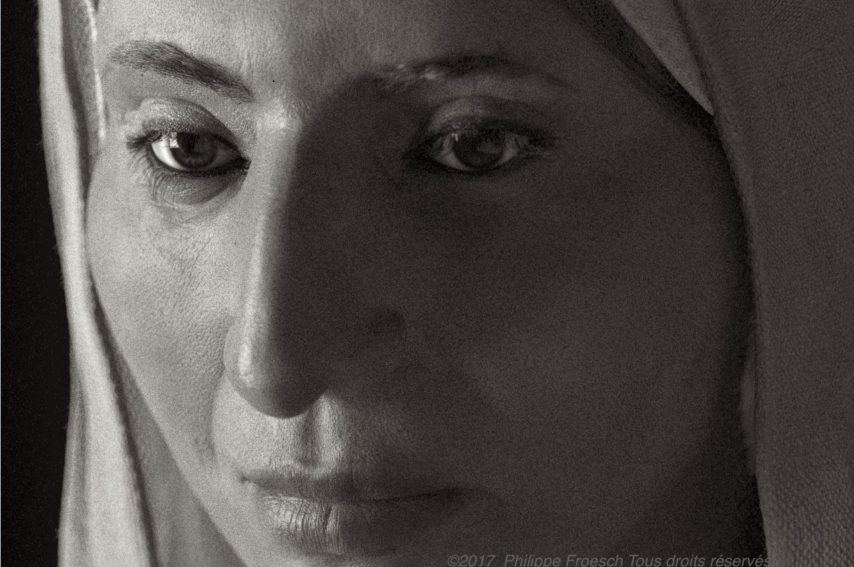
Mother Mary’s message for you

You are free to achieve anything you wish to, my beloved one! You can move mountains because you have my power within you. You are not a slave to anything or anyone because you are a divine being. By using your creative choice you can make your mark on the world in little and huge ways. Remember that even the tiniest decision relies on your creative power.


Have faith in yourself, dear one. With my help, love and guidance, you have all the resources you need to succeed. You can positively touch so many lives with your creative choices. I will assist you to connect with the passion that lies within your heart so do not ever feel that you need to cast your ambitions aside to put other things first. You can have it all!

What you need to know

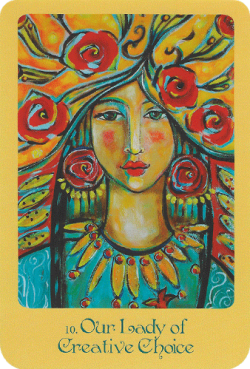
Your choices have a far greater impact than you might expect. You are important. Don’t ever forget that, dear one. Today, Our Lady of Creative Choice comes to you with a strong and clear message. No matter what’s going on in your life and how powerless or empowered you feel, you can take control of the situation via your own choices.


If something is upsetting you, you have the power within you to move forward from this even though this decision may cause temporary upset. If there is something that you wish to do or to try, you have the innate potential to have a go! What’s the worst that can happen? Remember that Mother Mary is holding your hand always so that you can walk confidently forward!

Prayer for healing

Sit quietly as you see yourself sitting by a beautiful blue lake. The sun is setting as you look at the pebbles dotted around your feet. As you take a closer look, you notice that each one has a word painted on it. Kindness. Courage. Peace. Honesty. Just think of any word you choose, then pick up the corresponding pebble. Hold it in your hands as you feel the energy of your chosen word then say the following.


“Our Lady of Creative Choice, my dearest Mother Mary, I revel in your unconditional love! I thank you for reminding me of my divine power of creative choice. I understand that there are many routes ahead of me that I can choose from. I trust myself to go down the ones that serve my highest good. I ask that you bless me as I become more creative with my choices along my personal path.”

Usui Teate Reiki | Introducing Reiki Sensei Shinpiden Chrystian Guardado-Lopez!

Chrystian Sensei is a member of the original Hālau located at Vallejo, California, where he also resides. He is a licensed Massage Therapist on staff at Orcanit Wellness in Oakland, California; a Chi Gung practitioner, and a student of the Western Mysteries Tradition. Aloha e komo mai, Chrystian!

Theosophy | AQUARIAN SPIRITUALITY – I

It is argued that the Universal Evolution, otherwise, the gradual development of species in all the kingdoms of nature, works by uniform laws. This is admitted, and the law enforced far more strictly in Esoteric than in modern Science. But we are told also, that it is equally a law that ‘development works from the less to the more perfect, and from the simpler to the more complicated, by incessant changes, small in themselves, but constantly accumulating in the required direction.’ . . . Esoteric Science agrees with it but adds that this law applies only to what is known to it as the Primary Creation – the evolution of worlds from primordial atoms, and the pre-primordial ATOM, at the first differentiation of the former; and that during the period of cyclic evolution in space and time, this law is limited and works only in the lower kingdoms . . . . As the Hindu philosophy very justly teaches, the ‘Aniyamsam Aniyasam,’ can be known only through false notions. It is the ‘many’ that proceed from the ONE – the living spiritual germs or centres of forces – each in a septenary form, which first generate, and then give the PRIMARY IMPULSE to the law of evolution and gradual slow development.

The Secret Doctrine, ii 731-732

 Viewed from the impersonal standpoint of collective Karma and cyclic evolution, Nature suffers fools not unkindly but with compassion. Nature will not indefinitely indulge or underwrite human folly, for as Cicero observed, time destroys the speculations of man whilst it confirms the judgement of Nature. Through cyclic opportunities, Nature actually affords individuals innumerable occasions for the clarification and purification of perception and intention. If human judgement and design are to have adequate leverage on Nature, they must have as their stable fulcrum an intuitive apprehension of law. At the most fundamental level, human judgement and natural law alike stand upon a common ground, a single transcendental source of Being. It is only by rejecting all dualisms, mediaeval or modern, and by refusing to absolutize polarities that the designs of men and the differentiations of Nature may be brought into self-conscious harmony. In Gupta Vidya, there is no cleavage between the aim of Self-knowledge (Atma Vidya) and the practical ideal of helping Nature and working on with her (Ahimsa Yagna). To the perfected will of the yogin of Time’s circle (Kalachakra), Nature is the ally, pupil and servant. Fully comprehending that man is the key to the lock of Nature, the wise yogin finds no intrinsic tension been obeisance to the judgement of Nature in Time and obedience to Shiva, the good gardener of Nature in Eternity.

 This philosophic fusion of science and religion, of vidya and dharmais essential to the structure of the Aquarian civilization of the future and enshrined in the axiom that there is no religion higher than Truth. In accordance with this evolutionary programme and in tune with the Avataric vibration of the age, the Brotherhood of Bodhisattvas has actively sought to dispel the delusive dichotomy between science and religion. Krishna conveyed the beautiful synthesis of jnana and bhakti in his classic portrait of the Self-governed Sage in the Bhagavad Gita. Spiritual teachers have repeatedly warned against the degrading effects upon the mind-principle of ahankaric greed and atavistic fear working through materialism and superstition. From the therapeutic standpoint of the ancient Rishis, the murky ferment of the twentieth century is not to be viewed as a creative tension between two viable cultures, the one religious and traditional, the other modern and scientific. Rather, it is to be seen as the ignorant and schizophrenic clash of two largely moribund inversions of authentic culture. Neither secular religion, with its crude demonolatry and selfish salvationism, nor materialistic science, with its cowardly conformity and slavish hedonism, still less the mutual recriminations and denunciations of one by the other, can offer human beings an assured basis for fulfilment and growth. Just as two wrongs do not make a right, no compound of these costly inversions can rectify the malaise of modern civilization. Neither fight nor flight nor unholy alliance can correct the deficiencies of two waning schemes of thought that do little justice to Man or Nature.

 In order to participate freely in the regenerative, not the destructive, tendencies of the Aquarian Age, one must recognize that true religion and science do not need to be rescued from contemporary chaos by messianic crusaders. On the contrary, creative individuals must learn to cultivate moral courage and cool magnanimity so that they may plumb the depths of pure science and true religion within themselves. This cannot be done without assuming some degree of responsibility for the intense karmic precipitations during the present period of rapid transition. Without self-confidence based upon inviolable integrity, the bewildered individual will regrettably fall prey to the contagion of despairing diagnoses, sanctimonious effusions and evasive rationalizations offered by self-appointed pundits and critics alike. No shallow conceit, cynical or complacent, can substitute for the mental discernment and spiritual strength required of pathfinders in the Aquarian Age. Rather than sitting in idle judgement upon contemporary history and humanity, wise individuals will seek to insert themselves into the tremendous rethinking initiated by scattered pioneers in regard to the essential core of Man and Nature and the vital relationship between them. If through earnestness, simplicity and dianoia one can radically revise one’s conception of Nature and Man, then one may powerfully assist that silent revolution and subtle healing taking place today behind the clutter of competing slogans and chaotic events.

 As individuals increasingly recognize that the faults which bedevil them lie in themselves and not in the stars, they will progressively discern the Aquarian design woven in the heavens. Through the religion of renunciation of the personal self and the science of Buddhic correlation, one can begin the difficult ascent in consciousness towards comprehension of the mysteries of heaven and earth.

 As above, so below. Sidereal phenomena, and the behaviour of the celestial bodies in the heavens, were taken as a model, and the plan was carried out below, on earth. Thus, space, in its abstract sense, was called ‘the realm of divine knowledge,’ and by the Chaldees or Initiates Ab Soo, the habitat . . . of knowledge, because it is in space that dwell the intelligent Powers which invisibly rule the Universe.

The Secret Doctrine, ii 502


 Conceptions of space have varied significantly over the centuries, depending largely upon cognate conceptions of time, matter and energy. The arcane conception of space as at once an infinite void and an invisible plenum, replete with intelligence, offers a profound challenge not only to post-Einsteinian science but also to post-Gandhian religion. It demands an entirely fresh view of causality and consciousness, of activity and time. From the standpoint of contemporary physics, any object, including the human form, is almost entirely empty space devoid of anything that might be considered matter. Even without studying particle physics, perceptive individuals are prepared to accept that if they could visualize what an X-ray would show, they would find that only about one quadrillionth of any object is constituted of a few particles and that all the rest is seemingly empty space. Similarly, if they could visualize what various detectors operating over the visible and invisible spectrum reveal, they would find that every point in space is the intersection of myriad vibrating fields of energy. Again, if one were prepared to penetrate beneath the surface of personal and collective habits and institutions, through the discerning power of the disciplined conscience and awakened intuition, one would find an array of Monadic individuals suspended like stars in the boundless void of the unmanifest. To the resonant heart, this immense void would reveal itself as alive at every point with the vibration of the Great Breath in its complex rhythmic differentiations. Through such reflection one may recognize that the seeming solidity of things is mayavic. Their surfaces and contours as they appear to the physical senses and the perception of the psyche are enormously deceptive and strangely confining. By using the mind’s eye one can come to see that what is seemingly full is void and that what is seemingly void is extremely full of Atma-Buddhi-Manasic or noumenal aspects of invisible atoms.

Raghavan Iyer
The Gupta Vidya III

Theosophy | AQUARIAN CIVILIZATION – I

Our races . . . have sprung from divine races, by whatever name they are called . . . . Every nation has either the seven and ten Rishis-Manus and Prajaptis . . . . One and all have been derived from the primitive Dhyan-Chohans of the Esoteric doctrine, or the ‘Builders’ of the Stanzas. From Manu, Thot-Hermes, Oannes-Dagon, and Edris-Enoch, down to Plato and Panadores, all tell us of seven divine Dynasties, of seven Lemurian, and seven Atlantean divisions of the Earth; of the seven primitive and dual gods who descend from their celestial abode and reign on Earth, teaching mankind Astronomy, Architecture, and all the other sciences that have come down to us. These Beings appear first as ‘gods’ and Creators; then they merge in nascent man, to finally emerge as ‘divine-Kings and Rulers’ . . . . There were five Hermes – or rather one, who appeared – as some Manus and Rishis did – in several different characters . . . . But under whichever of these characters, he is always credited with having transferred all the sciences from latent to active potency, i.e., with having been the first to teach magic to Egypt and to Greece, before the days of Magna Graecia, and when the Greeks were not even Hellenes.

The Secret Doctrine, ii 764-765

 To take the entire subject of cosmic hierarchies at the human level to its sublime heights, one must start with the momentous recognition that many of the ‘gods’ of the ancient theogonies belonged to the First Race of humanity. Human beings in that First Race were gods or devas, and in the Second Race they were demi-gods – celestial spirits still too ethereal to occupy the human form that was being gestated by the lunar Pitris. Then, in the Third Race, with the lighting-up of Manas and the incarnation of the Manasaputras into human form, humanity underwent an evolution which passed through several stages. Beginning with the androgynous and bisexual, it proceeded through the protracted dual-sexed epoch of the human race. There was the legendary era of great heroes and giants. The seven divine dynasties were thereafter to be found in the Third Race and again in the Fourth Race, the Lemurian and Atlantean periods. Instructing humanity in diverse arts and sciences, they laid the primeval foundations of human culture and civilization around the globe.

 Within this broad framework, the extraordinarily evocative power of the name and presence of Hermes is especially relevant to the 1975 Cycle and to the civilization of the future. Hermes is a generic name, associated with potent thought, and linked to Mercury-Buddha – a Dhyani – as well as with multiple incarnations in the history of humanity. As the god Hermes-Thot, he is the pristine archetype of Initiators in ancient Egypt, where he was reverenced as Hermes Trismegistus, a name applying to an entire lineage of Initiators. This solar line of spiritual Teachers can be traced back to Shiva as Dakshinamurti, the Initiator of Initiates. The hoary tradition which holds that Hermes taught all sciences to the nascent Mediterranean civilization suggests that he instructed those ready for divine theurgy. The arcane sciences transferred by Hermes from latent to active potency collectively constitute divine gnosis, a precise and comprehensive knowledge of the complex laws governing the seven kingdoms of Nature. These laws encompass the planes of matter, both visible and invisible, the planes from which noumenal prototypes become precipitated or projected into the phenomenal realm. Science in its essence is concerned with primary causes and is rooted in a mature apprehension of noetic consciousness. This is the true and noble meaning of science, vidya in the old sense, which was mysteriously intimated by the Mahatmas to European civilization in the seventeenth and eighteenth centuries to counteract the corruption of creedal religion.

 Modern science is a recent flower, emerging sporadically after the Renaissance, and, in particular, after Giordano Bruno’s activities in Germany and his historic visit to Oxford. The Royal Society was founded by heretical and courageous clergymen, men like the Warden of Wadham, who recognized that Aristotelian scholasticism was throttling the growth of human thought, that theology had become nothing more than a corrosive word-game. Together with bold patrons in the discreetly pagan aristocracy, these pioneering heretics founded a small club in London which they called the Royal Society. It was concerned from the beginning with the systematic support of all earnest experimental investigation into the natural world. In this, its purest sense, early modern science is one of the minor contributions of the Brotherhood of Bodhisattvas to the post-Renaissance world. Yet, in the context of the ancient meaning of science, it is a limited thing indeed, shadowy and modest. Originally, ‘science’ referred to a system of laws capable of application by human consciousness to what later came to be cherished by a few reticent brotherhoods as true magic or divine wisdom. Magic is an exact and definite knowledge of the noumenal laws of invisible Nature. Through the proper use of that carefully transmitted knowledge, one can affect the rates of growth and primary structures of energy on the Akashic and astral planes, and so affect conditions and combinations on the physical plane. Modern science, through its neglect of the primacy of consciousness, can hardly approach such a universal synthesis, fusing meta-geometry, meta-biology and meta-psychology.

 In the ancient and archetypal view of noetic magic, there is a summoning from latency to active potency of arcane knowledge that was originally impressed in the imperishable soul-memory of all humanity. Going all the way back to the middle of the Third Root Race, when self-consciousness had been attained, human beings were in astral vestures that were capable of effortless and benevolent use of the spiritual senses. Human beings, therefore, through their intuitive knowledge of the correlations of sound, colour and number, were able to communicate effortlessly. In that Golden Age, shrouded in the myths and mists of antiquity, they showed spontaneous reverence to Magus-Teachers, Hierophant-Adepts moving openly among human beings, teaching in fabled “concord groves” all over the earth. Seated under banyan trees (varieties of ficus religiosa), they bestowed divine wisdom upon those who were ready to learn. In that idyllic time the vast human inheritance of spiritual wisdom and scientific magic was assimilated into the karana sharira, the permanent vesture of the monad. It is in that inmost vesture, which is the container of all soul-memories, that the original wisdom and theurgy of humanity lie latent to this day.

Raghavan Iyer
The Gupta Vidya II

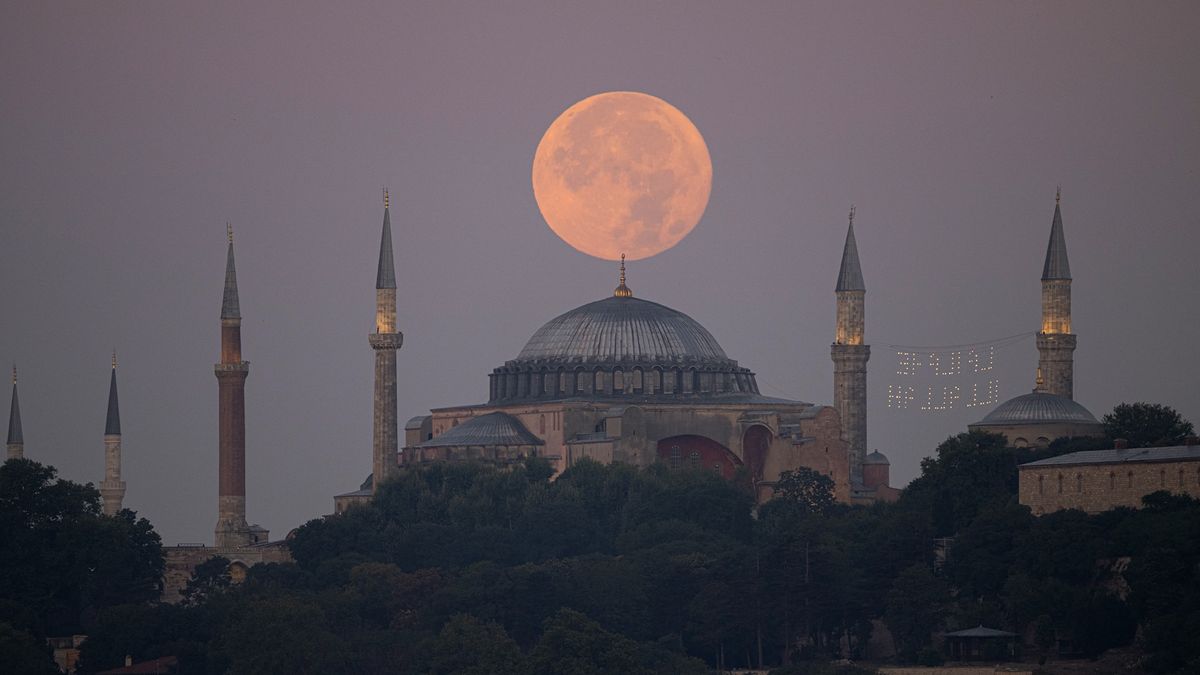
Cosmology | 1st ‘blue supermoon’ of 2024 rises Monday: How to see the ‘Sturgeon Moon’ at its biggest and best

The year’s first supermoon is also the third full moon in a summer that includes four, making it a ‘blue supermoon’. Here’s how to see August’s full Sturgeon Moon rise.  […]

Source: 1st ‘blue supermoon’ of 2024 rises Monday: How to see the ‘Sturgeon Moon’ at its biggest and best

Theosophy | DHYANA MARGA – III

 One must be willing to become fearless in the spirit of virya, the dauntless energy and unwavering courage to enter into the realm of unconditional Truth — SAT. The root teaching of voidness has to do with the emptiness of the notion of self-sufficiency and independence, the falsity of the notion that there is anything that is disconnected from the entire chain. All of this has got to be negated. It is a delusion that arises from linguistic tricks and convention, lax mental habits, refusal to confront the fact of death, unwillingness to confront the life process as it works in Nature. Ultimately, it is a refusal to recognize that conscious immortality means entering the light beyond all forms and conditions. It is, as The Secret Doctrine shows, a fundamental abrogation of one’s destiny as an evolving human being:

 . . . as long as we enjoy our five senses and no more, and do not know how to divorce our all-perceiving Ego (the Higher Self) from the thraldom of these senses — so long will it be impossible for the personal Ego to break through the barrier which separates it from a knowledge of things in themselves (or Substance). That Ego, progressing in an arc of ascending subjectivity, must exhaust the experience of every plane. But not till the Unit is merged in the ALL, whether on this or any other plane, and Subject and Object alike vanish in the absolute negation of the Nirvanic State (negation, again, only from our plane), is scaled that peak of Omniscience — the Knowledge of things-in-themselves; and the solution of the yet more awful riddle approached, before which even the highest Dhyan Chohan must bow in silence and ignorance — the unspeakable mystery of that which is called by the Vedantins, the PARABRAHMAM.

The Secret Doctrine, i 329-330


 Only when one can prepare oneself through degrees of dhyana rooted in supreme detachment — vairagya — can one enter the light of unconditioned Truth or SAT and remain there in ceaseless contemplation. Wherever there is conditionality, there is the inevitability of discontinuity. Conditionality and discontinuity go together. Instead of becoming disturbed by them, however, one should rejoice in the lesson. The more one becomes unconditional, the more one can confront latent conditionality. Thus, one may begin to discern the persistent origins and causes of distortion, discontinuity and tension. The neophyte should understand at the outset that even when one attains to dhyana in its true sense, as a confirmed chela on the Path, there are still seven lives of the most vigorous self-training yet ahead. Once one understands this, one can let go of all the tension that comes from taking on false burdens. Instead of cluttering the mind with mere words and shadows, the undigested cuds of unchewed ideas, one should learn how to take a phrase, a sentence, an idea from the teaching, and chew on it as thoroughly as possible. In every ancient tradition of dhyana, it is impossible to dispense with higher analysis. Skill lies in striking the right balance — neither too much nor too little. As one engages in the process of dhyana, various hard knots will emerge. It is necessary to stand back and subject them to analysis. One must see the components, the causes, the combinations that form the knot. Along Dhyana Marga there will be a periodic need for such analysis — a kind of self-administered open mind and open heart surgery. It can be done when the need arises if one has prepared adequately and honestly and if one is surcharged by a tremendous love of one’s fellow beings and an ardent desire to become a meditator.

 In time, one will begin to generate a continuous rhythm of meditation, broken occasionally bypassing thoughts, but fundamentally flowing as ceaselessly as a current in the heart. When it is interrupted in a more serious way, one will immediately strive to repair one’s foundations through some detailed analysis of the problem so that one may be purged and freed of a particular impediment. Once a momentum of meditation is established, these interruptions become a much rarer occurrence than expected. Depending upon one’s earnestness in meditation, which can only be understood in relation to love of the whole human race, one’s own so-called pain and difficulties will become trifling in relation to the world’s pain. Unless one gets these balances right early on, one will have a distorted importance of the preparatory phase of one’s own quest. That could stall the whole voyage. But once one is truly moved by that fire of universal feeling that exists in everyone, one will find the courage needed to maintain the quest. Taking advantage of the rhythms of the seasons, of Nature, of the teachings of the Cycle, one will become more assured and so more able to stay, for longer periods, in an uninterrupted state of meditation.

 One will probably not attain the higher stages of dhyana in waking meditation for quite a while, perhaps a lifetime. Nonetheless, one is invited to think about these stages, to visualize and resonate to them. This is extremely important and has to do with the release of the powers of the soul. One should completely forget about whether one can or cannot do some particular thing right now. One should not be afraid to contemplate any of the glorious possibilities of the very greatest human beings and Masters of meditation. One should take every opportunity to adore perfected human beings; in adoring them one will give life to the seeds and germs of dhyana in oneself. This does not amount to some mechanical and harsh doctrine of pseudo-equality. Rather, it depends upon recognizing that every human being has an exact karmic degree in relation to dhyana and prajna. Paradoxically, it is only by recognizing this that one can truly understand what it means to say that all human beings stand in the same sacred unmanifest ground of the unmodified, impartite Divine Spirit. Thus, as one grows in understanding of these soul powers, one may enjoy reflecting upon higher states of meditation, as represented by the portraits of perfected beings in the sacred texts and scriptures of all traditions. It is irrelevant and counterproductive to be bothered by the inevitable fact that one will not immediately experience these high states of consciousness.

 One may, for example, reflect upon that state of dhyana likened to the calm depths of the ocean, recognizing in the metaphor the freedom of the universal Self. To abide in that is like remaining in the Egg of Brahmā. Though this high state of true self-government may seem very distant, one may nevertheless deeply reflect upon it. One may ask what it would be like to have a mind that is so oceanic and so cosmic, so profoundly expansive and inclusive of all things in all minds, that it is capable of reverberating to everything in the mind of Nature. Certainly one should include such lofty thoughts in one’s horizon. In this way, one will come to recognize that what at first seemed a burdensome and laborious task is in fact a joyous working out, stage by stage, of clusters of karma. It is also a lightening and a loosening, in each context, so that there may be a flow from the subtler ethereal vestures into the grosser vestures. How this will actually affect the visible vesture in this life will vary from one individual to the next. Many meditators become wizened, but they have no regrets because they have no attachment to the external skin and shell. Instead, they rejoice in the inner purification that has taken place. Even one’s perspective changes in regard to what is truly helpful to the immortal soul and what is harmful. Once one touches the current of this supreme detachment and begins to enter the light of the void through efforts at dhyana, one may begin to make one’s own honest and yet heroic, courageous and cheerful way towards gaining greater continuity, control and proficiency in meditation. Blending the mind and heart, one may enter the way that leads to the dhyana haven:

The Dhyana gate is like an alabaster vase, white and transparent; within there burns a steady golden fire, the flame of Prajna that radiates from Atma.

Thou art that vase.

The Voice of the Silence

What is it the aspirant of Yoga Vidya strives after if not to gain Mukti by transferring himself gradually from the grosser to the next more ethereal body, until all the veils of Maya being successively removed his Atma becomes one with ParamatmaDoes he suppose that this grand result can be achieved by a two or four hours’ contemplation? For the remaining twenty or twenty-two hours that the devotee does not shut himself up in his room for meditation — is the process of the emission of atoms and their replacement by others stopped? If not, then how does he mean to attract all this time — only those suited to his end? From the above remarks it is evident that just as the physical body requires incessant attention to prevent the entrance of a disease, so also the inner man requires an unremitting watch, so that no conscious or unconscious thought may attract atoms unsuited to its progress. This is the real meaning of contemplation. The prime factor in the guidance of the thought is WILL.

D.K. Mavalankar

Raghavan Iyer
The Gupta Vidya II

Theosophy | DHYANA MARGA – I

The Astounding Benefits of 'Atma-Dhyana' | Atmayoga

DHYANA MARGA  – I

Ere thou canst settle in Dhyana-Marga and call it thine, thy Soul has to become as the ripe mango fruit: as soft and sweet as its bright golden pulp for others’ woes, as hard as that fruit’s stone for thine own throes and sorrows, O Conqueror of Weal and Woe.

Make hard thy Soul against the snares of Self; deserve for it the name of ‘Diamond Soul’. For, as the diamond buried deep within the throbbing heart of earth can never mirror back the earthly lights, so are thy mind and Soul; plunged in Dhyana-Marga, these must mirror nought of Maya’s realm illusive.

The Voice of the Silence


 Every authentic system of spiritual discipline indicates different stages upon the path of progressive mastery over the mind. The path of progressive awakening to supreme unconditional universal Truth is an arduous course of intensified practice leading to serene contemplation. Dhyana Marga — the Path of Meditation — is an inward fusion of mentality and morality that releases the mystical energies of enlightenment. Transcending ratiocinative analysis and ethical endeavour, though yielding to the full fruition of both, dhyana is the mysterious catalyst spoken of by Jesus which “leavens the whole”. It is the living presence of the Dhyani energies vital to any lasting nucleus of universal brotherhood formed by sincere aspirants and neophytes on the Path. Like the fabulous wish-fulfilling gem or the pearl of great price, dhyana is one of the priceless treasures of the Path which must, at a certain stage of development, be earned by the disciple before there can be any further advance. If this is true of the cyclic process of individual growth, it is even more true of the evolutionary stream of humanity.

 From the beginning of the 1975 Cycle emphasis has been laid upon reaching beyond discursive reasoning and analytic study. Though skilful analysis can be helpful, it is no more efficacious than one wing of a bird in flight. The other wing is ethical practice, purification of motive and steadfastness in reference to one’s deepest integrity and fidelity of commitment. The balance between these two aspects of development has been stressed from the start, but as in the life of a bird a definite stage comes at which further development of the wings is neither possible nor desirable, so too in the growth of a committed group of sincere individuals, many of whom have bound themselves by commitments to the spirit of the Pledge of Kwan-Yin. Touched by the potent vibration of the Cycle, a strong nucleus of seekers has persisted, despite ups and downs, in creating a distinct current of direction in their lives. In ways known and unknown to themselves, they have resonated to the current Seventh Cycle of the Theosophical Movement, the last of the series initiated by Tsong-Kha-Pa in the fifteenth century in Tibet. It is deeply fitting that all aspirants upon the path of The Voice of the Silence should now seek to become more firm and steadfast with regard to dhyana or meditation.

 True meditation begins with intense concentration or dharana — bringing the mind to a clear focus, which then gives way to the uninterrupted contemplation that is the beginning of dhyana. In its full unfoldment it can lead to true wisdom — prajna — complete absorption in one’s higher consciousness with universal self-consciousness, a state of being marked by the attunement of Atma-Buddhi-Manas to the Cosmic Triad. The actual level of attainment reached by anyone attempting this meditation and the pace of his or her development are relatively unimportant. Whatever doubts, anxieties or ambitions some may bring to such attempts are largely irrelevant. What is significant is that a definite and increasing number of human beings should make an attempt, at whatever pace, to learn the practice of true meditation. The simple fact that a number of human beings recognize this common undertaking and obligation, sensing the common joy in the quest for gaining greater proficiency in dhyana, is propitious and encouraging to the alchemical work of the Theosophical Movement. It is a positive contribution to the profound impact of the 1975 Cycle, to the elevation of human consciousness in the world as a whole, and to the careful preparation of the ground for the Mystery Temples of the future.

 The apprentice on the path of Dhyana Marga must learn that the senses are liars; it is precisely at that moment when one seems outwardly to be most alone and engaged in the difficult task of acquiring mental concentration that one is in fact most directly related to humanity. Once one sees this clearly, it becomes possible to insert one’s honest and humble efforts in the practice of dhyana into a larger effort by a number of people. If they bind themselves together by invisible threads spun through firmness and contemplation and by a continuous current of meditation, they can leaven up the world, in the metaphor of Jesus. This has nothing to do with any individualistic accomplishment. Rather, through their meditation, they can create a magnetic field into which can be focused the wisdom of Avalokiteshvara, the wisdom of the collective Hosts of Dhyani Buddhas, Mahatmas and Bodhisattvas. Metaphysically, it is the totality of actual and invisible wisdom behind the whole of this system of worlds, which is itself a partial emanation of the primal Adi-Buddha. The aggregate sum-total of actual and potential wisdom forming the radiant core of the system of worlds is nothing but a spark of that absolute and infinite ocean of purely transcendental Wisdom from which arises the possibility of all worlds and all periods of manifestation.

 Wisdom is neither created nor destroyed, neither increased nor decreased, but is universal, inexhaustible and vast. It is already self-existent on a primordial plane and is in fact the very ground of the possibility of existence. It may be represented in thought and in collective manifestation as a Host of beings called the Army of the Voice. This is merely a metaphor to intimate something of the virtually inconceivable grandeur and precision of the array of divine elements and beings that constitute the living cosmos. It is possible to focus that light of universal wisdom, continual contemplation and eternal ideation within a matrix created by the love, unity and joint heroic efforts of a nucleus of human beings formed over a period of time. Thus, it is possible to bring down onto the plane of mundane human existence glimpses and rays, sparks and flashes, of that divine light of wisdom that is all-potent on its own plane but is otherwise latent and unavailable. Collectively, a group of human beings can become like a great lens for the drawing down of the light of unmanifest wisdom into our globe to meet the cries of pain, the hungers and the longings of myriads of minds and hearts.

 To begin to become an apprentice of eternal wisdom in time, one must gain some minimal understanding of cycles. There can be no practice of concentration and meditation and dhyana unless one can rise above the sequence of alternating states of consciousness involved in the breath, the pulse, sleeping and waking, the passage of seasons, septenates of years, life and death and rebirth. Whilst it would be a false and self-imposed burden to expect to comprehend complex evolutionary cycles, one may, nonetheless, bring a minimal sense of the marriage of continuity and detachment to one’s understanding of the collective human pilgrimage. The 1975 Cycle of the Theosophical Movement, its Seventh Impulsion, marks its anniversary on November 17, a date that is significant not only in the nineteenth and twentieth centuries of the Christian era, but in relation to human consciousness on this earth in general. According to Clement of Alexandria, it was the true birthday of Jesus. Historically, it was the birthday of Pico della Mirandola, the light of the Renaissance. It is also the anniversary of many extraordinary events in history, both recorded and unrecorded. It is one of a series of occult points in the year that may be thought of as birthdays of the Dhyanis, points of intersection in cyclic time of aspects of Avalokiteshvara with manifested humanity. Thus, whilst the Seventh Impulsion of the Theosophical Movement is directly linked to this particular aspect of the manifestation of Avalokiteshvara, it cannot be separated from the other manifestations of the Logos present at other cyclic intervals.

Raghavan Iyer
The Gupta Vidya II

Science | Study finds fresh water and key conditions for life appeared on Earth a half-billion years earlier than thought

We need two ingredients for life to start on a planet: dry land and (fresh) water. Strictly, the water doesn’t have to be fresh, but fresh water can only occur on dry land.

Source: Study finds fresh water and key conditions for life appeared on Earth a half-billion years earlier than thought

Theosophy | THEURGY AND TRANSMUTATION – I

Transmutation circles and arrays on Alchemy-Junkies - DeviantArt

To those who knew that there was more than one key to theogonic symbolism, it was a mistake to have expressed it in a language so crude and misleading. For if the educated and learned philosopher could discern the kernel of wisdom under the coarse rind of the fruit, and knew that the latter concealed the greatest laws and truths of psychic and physical nature, as well as the origin of all things — not so with the uninitiated profane. For him the dead letter was religion; the interpretation — sacrilege. And this dead letter could neither edify nor make him more perfect, seeing that such an example was given him by his gods. . . . Now all the gods of Olympus, as well as those of the Hindu Pantheon and the Rishis, were the septiform personations (1) of the noumena of the intelligent Powers of nature; (2) of Cosmic Forces; (3) of celestial bodies; (4) of gods or Dhyan Chohans; (5) of psychic and spiritual powers; (6) of divine kings on earth (or the incarnations of the gods); and (7) of terrestrial heroes or men. The knowledge how to discern among these seven forms the one that is meant, belonged at all times to the Initiates, whose earliest predecessors had created this symbolical and allegorical system.

The Secret Doctrine, ii 764-765


 It is, according to Gautama Buddha, a greater feat to govern oneself than to command all the elements in Nature. All Nature and its powers bend heavenwards before the gentle, irresistible theurgy of the perfected Bodhisattva, the pilgrim-soul who has reached the summit of the Path and become the son of the Dhyanis, compassionator of the triple worlds, greater than all gods. The potential of pure swaraj or self-rule is latent in every Monad, and is quickened by the fiery ray of the Manasa Dhyanis. When first the dark fire of their formless intelligence ignited self-consciousness in the evolved forms of terrestrial humanity over eighteen million years ago, man became a living link between heaven and earth. Conscious of the divine presence within his preceptors, his companions and himself, he was governed by a natural impulse towards gratitude, devotion and benevolence. He lived in effortless sympathy with the hosts of bright devas and devatas that he found in and around himself and throughout the entire realm of Nature. Reflecting the Akashic ideation infused into him by the Manasa, his actions radiated a benign and spontaneous magic.

 Although the impress of that primordial time is ineradicable, human beings have descended so low in consciousness that they can scarcely believe, much less recall, their original estate. Emerson’s charitable characterization of man as God playing the fool cannot account for the awful process by which man has become spiritually self-orphaned and blinded, becoming a burden to himself and a parasite on Nature. What, one might ask, are the strange gods and alien altars towards which human beings have directed their pristine powers in degrading themselves? Since there is no power greater than that which made Monads self-conscious, one need not look beyond oneself to find the cause of one’s own impoverishment. Nor need one look anywhere but within to find the means whereby one may embody the divine impulsion towards its transcendent end. The regeneration and restoration of humanity requires individuals to heed the wisdom of Krishna’s teaching that all beings go to the gods they worship, and thereby awaken to self-conscious immortality in unison with the unmanifest godhead.

 Such an awakening can be neither metaphysically cheap nor psychologically simple; one must skillfully navigate between the Scylla of desperate salvationism and the Charybdis of cynical materialism. If man is potentially a self-conscious link between heaven and earth, one might ask how man is specifically connected with the earth and with heaven. The elements constituting the human vestures are indeed consubstantial with the fabric of Nature outside the human form. Thus, man is linked to the earth through the five sense-organs, each of which has its astral analogue, and also through a variety of classes of elementals. Through each of the astro-physical senses, and especially the sense of inner touch, man is continuously involved in complex processes of interaction with the elemental kingdoms. On the other side, he is connected with the Dhyanis and the devas through daimons, which are the invisible essences of the elements, elastic, ethereal and semi-corporeal, in Nature. These daimons are made up of a much more subtle matter than that which composes the astral form of the average human being. By consciously drawing upon them, one can bring about the progressive etherealization of one’s vestures. Just as the crucifixion of Jesus symbolizes the bondage of spirit on the cross of matter, so too the Eucharist signifies the spiritualization of material vestures and the liberation of the spirit. This process must be initiated through meditation, intensified through refinement in consciousness, through reverence, renunciation and compassion. If one can suffuse one’s whole being with benevolent and elevated thoughts and feelings, it is possible, over a period of seven years, to reform the life-atoms that constitute the astro-physical form. Such a radical renewal will be apparent in one’s hands, face, toes and tongue — indeed at every point in the body.

 This in itself is only one small application of the vast body of arcane and exact knowledge regarding the hosts and hierarchies of beings involved in human evolution. In neo-Platonic thought these beings were divided into three broad classes:

 According to the doctrine of Proclus, the uppermost regions from the Zenith of the Universe to the Moon belonged to the Gods or Planetary Spirits, according to their hierarchies and classes. The highest among them were the twelve Huperouranioi, or Supercelestial Gods, with whole legions of subordinate Daimons at their command. They are followed next in rank and power by the Egkosmioi, the Inter-cosmic Gods, each of these presiding over a great number of Daimons, to whom they impart their power and change it from one to another at will. These are evidently the personified forces of nature in their mutual correlation, the latter being represented by the third class, or the Elementals.

H.P. Blavatsky


In every aspect of life, human beings are intimately and immediately engaged with these ordered ranks and legions of daimons or elementals. The elementals are neither immortal spirits nor tangible bodies; they are merely astral forms of the celestial and super-celestial ideas that move them. They are a combination of sublimated matter and rudimentary mind, centres of force with instinctive desires but no consciousness in the human sense. Acting collectively, they are the nature-spirits — the gnomes and sylphs, salamanders and undines of alchemical tradition.

 All these daimons, together with the higher gods, are connected with the seven sacred elements. At the highest metaphysical level, these elements have nothing to do with what we call fire, air, earth and water. For, in essence, these elements are not material, nor may they be understood in terms of visible functions on the physical plane. Just as the hosts of celestial and super-celestial gods are guided from within by the power of formless spiritual essences, and act outwardly in their dominion over the daimons of the elements, so these daimons themselves preside directly over the elements of the four kingdoms of organic life, ensouling them and giving them their outward capacities of action. Thus, when human beings arouse Buddhi in kama, the reflection of the sixth principle in the fourth,Buddhi will transmute the lower Manas. In the antaskarana, in the channel of aspiration, the force of Buddhi in Manas will actually become manifest in the fingers, nostrils and lungs.Buddhi will be aroused in all the centres of the brain and the heart. It will then be possible to invite or invoke the chief controllers of the many classes of daimons. When this takes place, the teaching that man is a living link between heaven and earth takes on a concrete meaning in benevolent magic based upon arcane science.

Raghavan Iyer
The Gupta Vidya II

fma human transmutation circle

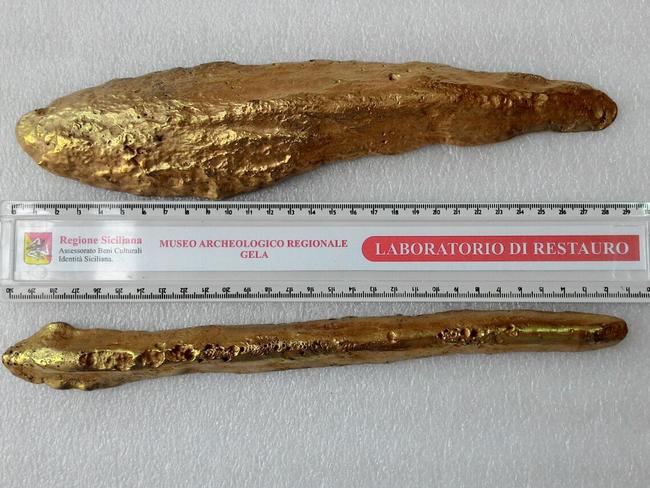
ORICHALCUM, THE LOST METAL OF ATLANTIS, MAY HAVE BEEN FOUND ON A SHIPWRECK OFF SICILY

Orichalcum, the lost metal of Atlantis, may have been found in a shipwreck off Sicily

MYSTERIOUS metal ingots linked to the mythical civilisation of Atlantis have been recovered from an ancient shipwreck off the coast of Sicily.

Archaeologists last month recovered a wealth of ingots of an unusual golden alloy from the wreck sitting in about 3m of water, 300m off the coast of Gela in southern Sicily.  […]

Source: Orichalcum

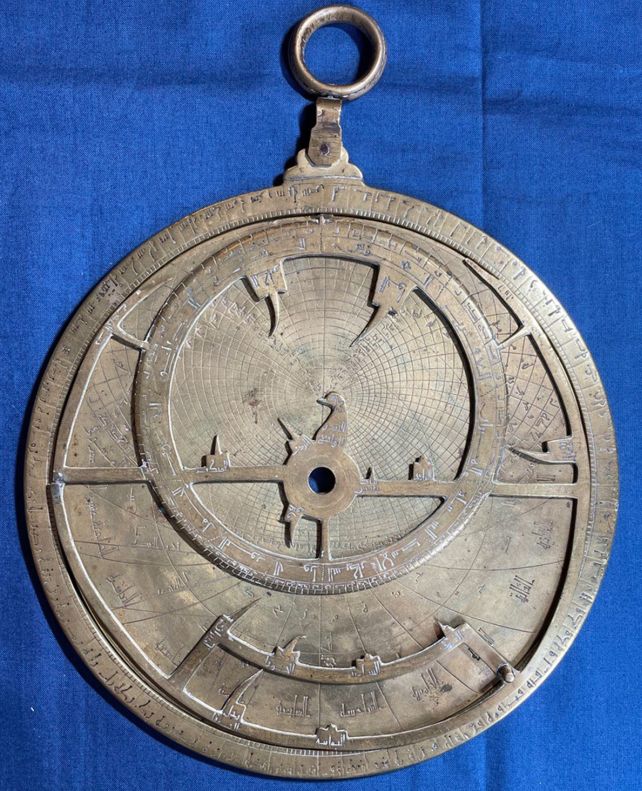
‘Incredibly Rare’ Astronomical Object Has Markings in Multiple Languages

A star chart across time and space.

A medieval astronomical instrument discovered entirely by accident has turned out to be a powerful record of cross-cultural scientific collaboration.

The brass astrolabe dates back to 11th century Spain – but was subsequently engraved with annotations and amendments over the centuries, in multiple languages, as changing owners adapted and updated it for their own use. […]

Source: ‘Incredibly Rare’ Astronomical Object Has Markings in Multiple Languages

Melchizedek Seminary | Terrence Howard explained by Jain 108

Science Redefined. Jain 108 explains the enigmatic work of Terrence Howard!

Does his technology based on the negative space of the 3-dimensional view of the Flower of Life, challenge the world of physics? Is he on the same level as Tesla?

Get ready to view science through a fresh lens, thanks to Howard’s incorporation of Walter Russell’s groundbreaking periodic table, which is founded on waves and octaves of light. This paradigm shift suggests that 1×1 may equal 2, and that straight lines are merely an illusion—only curves exist.

With 97 patents to his name, is Howard pioneering propulsion systems rooted in sacred geometry instead of harmful fossil fuels?

Are we ready to rethink our understanding of gravity, black holes and Creation itself?

Jain 108
http://www.jain108academy.com

Theosophy | THE INMOST SANCTUARY – I

The ‘Master’ in the sanctuary of our souls is ‘the Higher Self’ — the divine spirit whose consciousness is based upon and derived solely (at any rate during the mortal life of the man in whom it is captive) from the Mind, which we have agreed to call the Human Soul (the ‘spiritual soul’ being the vehicle of the Spirit). In its turn the former (the personal or human soul) is a compound in its highest form, of spiritual aspirations, volitions, and divine love; and in its lower aspect, of animal desires and terrestrial passions imparted to it by its associations with its vehicle, the seat of all these.

H.P. Blavatsky

 Restoration of the right relationship between the Master in the inmost sanctuary and the incarnated consciousness is gained only through a sacrificial process of self-purification. Obscuring and polluting tendencies nurtured in the mind through its misuse over many lives must be removed by a self-chosen and self-administered therapy. Like the Pandava brothers exiled from their kingdom through their own folly, or like the master held prisoner in his own house by those who should be his servants in the parable of Jesus, the pristine divine ray of the Logos in man is trapped and stripped of its sovereign place in human life unless consciously sought by the aspirant. This invocation of wisdom through the supplication of the mind to the spirit was seen by the ancient Greeks as the cultivation of sophrosyne — the subordination of the inferior element to the superior. It is shown in The Voice of the Silence as the shila virtue — the attunement of thought, will and feeling to the pulsation of divine harmony, Alaya-Akasha. The mind stands as the critical link between the divine and the animal nature. The recovery and right use of the privilege of human existence depend upon the subordination of the elements of the lower rupa existence to the spiritual ideation of Arupa Manas.

 The sacrificial posture and selfless motive required for this self-purification can be readily grasped through a telling analogy. There is not a modern metropolis which does not maintain the equipment needed to neutralize the effluvia of human waste and thereby reduce the danger of infection to its population. Similarly, a large number of devices are available, both to cities and to individuals, for the purpose of removing sediments and impurities from drinking water, through distillation, filtration and osmosis, to make it available in a purer and fresher form. With the human mind the same principles of public health and civic responsibility would require that each individual and every society strive to purify the muddy stream of human passions which pollute those coming into contact with it. Every human being has received the crystalline waters of life in a pure and unsullied condition, and therefore everyone has the karmic responsibility for every failure to return these waters to the ocean of life in a pristine condition. Insofar as this responsibility has been neglected by individuals, under karma in successive lives they are self-condemned to immersion in the waters they themselves have poisoned. Under the laws of karma affecting the processes of reincarnation and the transmigration of life-atoms, individuals owe it to their neighbours and their descendants, as well as to themselves, to purify their mental emanations.

 In practice, this implies a continuous cleansing of one’s thoughts, one’s words and one’s actions; these in turn fundamentally depend upon the purification of the will. Unfortunately, purification of the will, which is vital to the spiritual regeneration of humanity, is itself seriously misunderstood as a consequence of the process of pollution of consciousness and magnetism. Mired in the morbid obscuration of higher consciousness, too many people suppose that a bolstering of the lower will is a means to survival. Nothing could be farther from the truth. The higher spiritual will does not itself need to be strengthened, but it may be released through the removal of obscurations and hindrances. So long as the will is activated by the individual only on behalf of passions and the illusion of the persona, that will is not worth having. Hence, many people have discovered that the will cannot be released on behalf of lesser purposes. This predicament is conspicuous in those diseased societies which place an inordinate emphasis upon the personal will. Will itself is a pure colourless principle which cannot be dissociated from the energy of the Atman released through breathing. Thus when human beings breathe benevolently, blessing others with every breath, they can release the beneficent will-energy of the Atman. As soon as the will is released on behalf of the personal ego, however, against other human beings, it is blunted. This inevitable paralysis of the antagonistic lower will is indeed a beneficent and therapeutic aspect of karma.

 Viewed from a collective standpoint, many human beings can be seen as having been weakened because they have absorbed life-atoms from others who have misused spiritual knowledge and the potency of the higher will. Throughout the world perhaps one in ten persons has insistently used the will against other human beings in this or previous lives. This may have been for the sake of bolstering the insecure identity of the persona or, worse, through the misuse of spiritual knowledge connected with false meditation, indulgence in drugs and mediumistic practices. Since 1966 contemporary society has witnessed the emergence of a number of centres of pseudo-spiritual activity; now it is witnessing the inevitable psychological breakdown of many who were responsible for this moral pollution. The waves of spiritual influence initiated by the descent of Krishna offer golden opportunities to all souls, including those inverted natures self-blocked from inward growth by their own failures on the Path in previous lives. Amongst these there were some too cowardly to make a new beginning, who sought instead to compensate for their own weakness and delusion by cashing in on the currents of the 1975 Cycle. Having forfeited timely opportunities offered through compassion, they are self-destroyed when Krishna takes a firm stand on behalf of the entire human family because they are unable to generate a genuine concern for others. Never having generated an interest in the welfare of the vast majority of mankind, they are self-condemned. Sadly, they cast a long shadow over a much larger class of weaker souls who are affected by them, no doubt through their own delusions and vulnerabilities.

 Persons are sometimes drawn into dangerous orbits of misused knowledge through loose talk about such sacred subjects as kundalini, kriyashakti and the activation of the higher spiritual centres in man. Ordinary people who enjoy a normal measure of spiritual health wisely avoid those places where they are likely to hear profane chatter. Through a natural sense of spiritual good taste they simply shun those places where self-deluded con men congregate to make a living off the gullible. Today, because the moral and spiritual requirements for participation in the humanity of the future have become more evident to many people, the market for such deceptive opportunism has begun to diminish. The America of P.T. Barnum, who said that a sucker is born every moment, has been replaced to a large extent by the America of Abraham Lincoln, where, as is well known, one cannot fool all the people all the time. Although many souls have to travel a great distance along the path of self-integration, they have learnt enough not to be duped by pseudo-spiritual blandishments. Just as they have learnt not to believe everything conveyed by the mass media and not to leap at every free offer or supermarket discount, they have also learnt to pass up invitations for instant development of kundalini and every facile promise of spiritual development that dispenses with the judicious control of the emotions and passions.

 Even in the difficult area of sexuality the idea of strength through celibacy (e.g. Gabrielle Brown, The New Celibacy, 1980) has gained some currency amongst many people, young and old, who find the burden of ego-games and unequal experimentation intolerable. There is nothing wrong with the sacred act of communion and procreation, and as the ancient Jews believed, God is pleased when a man and a woman come together in true unison. Nor need this issue be obscured by pseudo-arguments concerning the Malthusian spectre of over-population. As the economist E.F. Schumacher pointed out, even if the entire population of the globe were concentrated in America, this would result in a population density no greater than that of Great Britain, a nation long noted for the spaciousness and greenery of its countryside. North America itself, over its ancient and almost entirely unwritten history, has supported many varied civilizations, some of which displayed a much greater spiritual maturity than is evidenced in its recent history. Broadly, one cannot understand the physical facts of life on earth, much less the spiritual facts of life, through a language of conflicting claims and counter-claims, rationalizations and compensatory illusions, or pseudo-sophisticated statistical arguments based upon a selfish and shallow view of the nature of the human psyche.

 The purification and release of the will must be comprehended in terms of human individuality, and therefore must be considered in the light of the mystery of every human soul. Since this mystery encompasses an entire series of reincarnations extending over eighteen million years, it can only begin to be appreciated through careful consideration of the motley evidence offered by one’s participation in varied states of consciousness in the present life. Any individual concerned to recover the spontaneity and benevolence of the spiritual will must be willing to examine courageously the manner and extent to which he or she has become the servant not of the divine Ego, but rather of the lower astral form and its attendant incubi and succubi.

For this ‘Astral’ — the shadowy ‘double’ (in the animal as in man) is not the companion of the divine Ego but of the earthly body. It is the link between the personal SELF, the lower consciousness of Manas and the Body, and is the vehicle of transitory, not of immortal life. Like the shadow projected by man, it follows his movements and impulses slavishly and mechanically, and leans therefore to matter without ever ascending to Spirit.

H.P. Blavatsky

Raghavan Iyer
The Gupta Vidya II

Theosophy | TO BE AND NOT TO BE – III

 Reflective human beings find that there is something that maintains and sustains systems, industries and institutions, something impersonal, unaffected by who comes and goes, arising out of collective need, articulation and incarnation, maintained in existence and given life by collective wills, minds and imaginations. When a person asks himself what in him is dying and relinquishes what is already passing, he releases a golden opportunity to re-create himself. When a person balances out in one’s own daily equations what is dying against what is opening out from within, one becomes a free human being who existentially discovers in time the secret of immortalityOne also discerns that the secret of immortality is merely a puzzling phrase in ordinary language. But where a person gains self-awareness through intensive self-knowledge of all the variables and sub-sets that constitute one’s emotional and psychic natures, one’s mind-being and one’s own sense of physical and mental selfhood, one may become a magician. By abstracting oneself away from all that in which one had contained one’s sense of self, one can attain an amazing capacity to see an expansive Self that has no relationship to events, persons or places, to yesterday and tomorrow, to bits and pieces of oneself emotionally, psychically or mentally. One begins to live with a new awareness actuated from deep within one’s consciousness. One begins to activate the Buddha-body of the Buddhist tradition, the light-body of mystical texts, the resurrection-body in Christian mysticism. This subtlest of all vestures is gestated by the primordial root causes which are ontologically prior to all the constellations of secondary and superficial causes. One’s critical decisions arise out of basic desires, ultimately rooted in a fundamental willingness to endorse a limited sense of reality.

 Between the unmanifested world and the SELF we find the truly ‘real’. What is real is prior both to what is latent and to what is active, and yet it is posterior to SELF. That SELF has nothing to do with what is usually called the self, collective or individual, wholly parasitic upon the process of manifestation. Everyone knows the differences among human beings arising from how they see themselves. To flee every intimation of one’s deeper Self out of fear for the manifesting and ever-dying self is not to live at all. This is the toughest aspect of the immemorial teaching of Theosophia — the ever-present beginning. The Theosophical Movement since 1875 seems to have made a relatively small difference to the scene of recorded history in modern civilization, and it even appears at times as if Krishna, Buddha, Shankara, Pythagoras, Plato and Christ came in vain. There is an essential sense in which they all came in vain in the midst of unregenerate humanity. The first step of initial detachment is the most difficult and threatening for disciples. It is a detachment in which a person is willing to put one’s entire sense of self upon the dissecting table and to renounce it while doing this with no promise, no guarantee, nothing to comfort one in relation to the great venture, a dark and unknown journey. It is a deeply private journey, and it is a journey where the first step is the most difficult. In recent years many people have been playing an intolerable game of talking ignorantly about this sacred journey, but suddenly they discover something painful about each other — that there is a new breed of cowards who lack the will of those with older illusions who put their frothy energies to practical use. These are weak-willed men and women wanting to be saved, dramatically and messianically, and they unconsciously engender a nefarious vampirism, stealing energy from those more vulnerable and susceptible. It is a ghoulish game of those who cannot go back to the old illusions and yet do not have the courage to commence the spiritual path in earnest.

Brahma Vidya is exacting because it instructs the individual who is truly serious about apprehending the meaning of death and discovering the secret of immortality — “Give up thy life, if thou would’st live.” Give up everything associated with so-called living. See it for what it is. Only after a sufficient period of courageous persistence can one begin to live. This painful recognition might well have the dignity and the power of a vow. It could summon a fresh release of creative energy from the inexhaustible, indescribable Self within, which has been repeatedly denied but which is relentlessly chasing one like the Hound of Heaven. It is oneself, one’s only friend, one’s best ally and invisible escort, one’s own priest and authentic prophet, the guru and the guide, the radiant Christos within. To hold firmly to this sovereign truth is to make a new beginning and a radical change in consciousness. A person cannot move from the first part of the injunction, “Give up thy life”, to the second, “if thou would’st live”, on individualistic and separative terms, because no personal life means anything to the passionless and ever-revolving universe. New life may be found only by those who can find some meaning in the lives of others, can throw themselves into a vaster vision of life which is universifiable, in which others can share and participate. It is elementary wisdom and commonsense that makes a human being recognize that the larger circle must prevail.

 Each and every person must go along with the ever-expanding circle or be left behind in the great pilgrimage of humanity. Many men and women cling to their own contracting circles of confining allegiances, limiting ideas, base and petty plans, prating about absurd delusions of self-importance — all because they are terrified of the uncharted Void which is the creative abyss from which tomorrow must spring. And for such people necessarily there is a Götterdämmerung: they are doomed through avoidable selfishness and there is no providential or accidental escape. But when, from the very intensity of one’s own concern with the Götterdämmerung, a human being really begins to extend out the radius of selfhood, then one suddenly begins to find that one lives in a radically new sense. In such a totally different way of life, one is apparently wholly involved, but only because one is always laughing, always voiding, always seeing through, without hurting the feelings of others, without denying to oneself the unsought opportunity of participating in the play.

 One gradually becomes a person for whom it is true that in giving up life, one begins to live. One has learned that it is possible to be and not to be — to be in space-time and yet not to be in space-time. This is to live infinitely, eternally, and immortally. It is to live the sovereign life of the king with the inward light of indissoluble consciousness focused through a continuous golden thread of mystic meditation, upon which could be strung, like so many beads, everything that is meaningful within the great reservoir of experience. This tremendous vista restores to life its fundamentally joyous optimism, its core of creativity. They are wise who say, even at the level of a slogan, that the person of tomorrow is mature in some sense that was not true of the people of the past. It requires a new kind of adult hope, a new kind of maturity, to live coolly in this new dimension in a manner that transcends past societies. To live is to maintain that kind of coolness which is sustained by an ever-expanding, living warmth for all beings on earth. One can only inherit the kingdom by claiming it. Hence the Biblical saying that the kingdom of God must be taken by force — the force of courage. This is the courage to be alone, to be a raja within one’s own realm, and to re-establish order among the insurgents that masquerade as unavoidable drives, basic necessities and necessary patterns. To restore order in the kingdom of one’s life is to attain the sovereignty of a truly free human being who is at once determining the value to put upon things and voiding them as well. One is living and not living, dying and not dying. One is constantly reclaiming the virgin nature of a boundless consciousness that flows through one in a stream, reclaiming it from the necessary process of disintegration that must characterize all forms and finitude.

 One finds out for oneself that immortality can have no meaning except in reference to a recognition and acceptance of mortality. Though the language is paradoxical, the experience is possible. Alas, many men and women fail to come closer to experiencing it because they are excessively afraid to die. Ascribing mortality to parts, one can consciously do what Nature does with organisms, thereby maintaining one’s individuality in the whole. Through letting go of particular things, one keeps the core of one’s identity beyond time and space, beyond flux and cessation, beyond form, colour and limitation. A person who attains to this point moves naturally in embodied consciousness into a condition of something like serenity, obeisance and discipleship. Such an individual is sufficiently on the threshold to want the full incarnation of the Triad that is above him, to seek it with the whole of his being. One makes room for it (because Nature abhors a vacuum) by expelling all lesser energies and persisting in silent mental obeisance to the god within. The Triad has begun to mirror itself. It has not yet fully incarnated in the disciple, but the Triad overbroods and its mirroring shows in the calm of one’s nature.

 The peace that passeth all understanding is like the calm of the depths of an infinite ocean. It is beyond description, but once experienced or realized, it can never be confounded with what the self-deluded call pleasure. There can be no ego-satisfaction, for this calm involves self-forgetfulness. It is a calm where there is no awareness of being calm. It is a flow that is not aware of itself as separate in the great process of life. The Triad can incarnate gradually. Every time it enters the soul there will be a kickback in the shadowy self. When it fully descends, it can maintain itself only by a self-conscious union with the Brahmā-Vishnu-Shiva Triad — pure creativity, patient preservation of the essential and meaningful, and passionless elimination of the redundant and irrelevant. When this is attained, it becomes a rhythmic process coeval with the whole of one’s life. Then it becomes as natural as breathing. As the Brihad Aranyaka intimates:

 Then the point of the heart grows luminous, and when it has grown luminous, it lights the soul upon its way: from the head or from the eye or from other parts of the body. And as the soul rises upwards the life-breath rises upwards with it; and as the life-breath rises upwards with it, the powers rise up with the Brahmā life-breath.  The soul becomes conscious and enters into Consciousness.

 Then his wisdom and works take him by the hand, and the knowledge gained of old.  Then as a caterpillar when it comes to the end of a leaf, reaching forth to another foothold, draws itself over to it, so the soul, leaving the body, and putting off unwisdom, reaching another foothold there, draws itself over to it.

 As a worker in gold, taking an ornament, moulds it to another form newer and fairer; so in truth the soul, leaving the body here, and putting off unwisdom, makes for itself another form newer and fairer: a form like the forms of departed souls, or of the seraphs, or of the gods, or of the creators, or of the Eternal, or of other beings.

 The soul of man is the Eternal.  It is made of consciousness, it is made of feeling, it is made of life, it is made of vision, it is made of hearing; it is made of the earth, it is made of the waters, it is made of the air, it is made of the ether, it is made of the radiance and what is beyond the radiance; it is made of desire and what is beyond desire, it is made of wrath and what is beyond wrath, it is made of the law and what is beyond the law; it is made of the All.  The soul is made of this world and of the other world . . .

 As they said of old: Man verily is formed of desire; as his desire is, so is his will; as his will is, so he works; and whatever work he does, in the likeness of it he grows.


Raghavan Iyer
The Gupta Vidya II

Melchizedek Seminary | HOW Sacred Geometry is embedded in YOUR DNA!

Geometric Art has fascinated me for a long time in many ways and in this video I wanted to demonstrate how geometric form connects the different layers of our realities and I wanted to inspire you to reflect upon the connections that are demonstrated in this video. It has been a long journey leading up to this video. This introduction video summarizes my understanding of Geometric Design & Art. Something that I wanted to do for a long time but was not yet capable of because of the vast amount of information related to this knowledge. I have finally finished a part of the challenge. Yet it essentially is nothing more than a short introduction of this subject. And this video is also in many ways an introduction to the course that I have been working on called “Journal Series’. If you are interested in signing up for the course then you can sign up for the course on the website below the video.

Samurai Wisdom: 10 Profound Quotes and Timeless Lessons for Life

1. “If you live in fear, you will not live long.” – Miyamoto Musashi
2. “Embrace death without fear, and you shall never truly die.” – Yamamoto Tsunetomo
3. “True strength lies not in the arm but in the soul.” – Samurai proverb
4. “A true hero is one who knows when to restrain and when to act.” – Minamoto Yoshitsune
5. “If you want to win, teach your opponent how to fight.” – Samurai proverb
6. “Do not let the past control your present, and do not let the fear of the future rob you of your ability to live in the present.” – Miyamoto Musashi
7. “A Samurai always keeps his word, no matter how small the promise.” – Samurai proverb
8. “Do not hesitate to face challenges, for it is through them that you can become the best version of yourself.” – Samurai saying
9. “The patience of a Samurai is not the acceptance of failure but the ability to improve step by step.” – Unknown
10. “If you do not have the courage to face yourself, how can you face the world?” – Samurai proverb

Spirit Totem | Praying Mantis

Click here to read more!

The praying mantis is a spiritual creature that is revered in many cultures. It is believed to bring good luck and prosperity, and is often used in religious ceremonies. The mantis is also said to be able to commune with the spirit world, and is considered to be a powerful ally in the fight against evil. […]

Theosophy |  CONTINUITY AND CHOICE – II

 The One Life comes into a world of differentiation through prismatically differentiated rays. We can sense in the gentle quality of dawn light something that does not participate in the opalescent colours of the day, something removed from what we call heat and light, cold and shade — a quality of virginal light that is a reminder of states of matter appropriate to states of consciousness which are created and held as potential by beings in general. Then we can begin to see that the whole point of human suffering in its collective meaning is to overcome pain and the false sense of separation. This is the point in consciousness where human beings as individuals could maintain a noetic and complete wakefulness — turiya, a profound awareness from a standpoint which transcends the greatest magnitudes of spacetime. It goes beyond solar systems and intimates that the depths of space represent in the very core of apparently nothing, a subtle creative gestation of matter. If one can see the whole world in terms of its plastic potency, as radiant material for a single universal spiritual sun, then one gains the dignity and the divinity of being a self-conscious individuating instrument of the universal Logos.

 This is the sacred teaching of all Initiates. It is the teaching of Jesus in the Gospel According to John, the teaching of Buddha in the Heart Sutra, and the teaching of Krishna in the Bhagavad Gita and in the Shrimad Bhagavatam. These beings, fully awake, see that all human life, including human suffering, is a projection of a false involvement in a false sense of self. They bear witness to the reality of universal consciousness, not as something potential but as that which can be used as plastic material for new forms of spiritual creation. Creative imagination is not an abstract immaterial force, but the most rarefied and subtle form of material energy that exists. It can be tapped by concentration. By repeated and regular attempts at concentration upon this conception of the One, negating the false sense of the self, one builds and gives coherence to one’s subtler vehicles, shaping what is now chaotic matter and forming a temple, a worthy vesture for a self-conscious being aware of the divinity of all beings and capable of maintaining that awareness through waking, dreaming and deep sleep. Having entered into the void, having entered into the light beyond these states of consciousness, the awakened soul remains in it by choice, while giving the impetus to other human beings to make the same attempt. Suffering and ignorance are collective; enlightenment and spiritual creativity are universal. This is the great hope of the timeless teaching concerning true continuity of consciousness.

 Within the limits of time, however, which is an illusion produced by the succession of states of consciousness, there is only a before and an after, and no full scope for creativity. Consider, for example, a moment of love. Suppose you suddenly come into contact with someone of whom you could say, like the poet Yeats, “I loved the pilgrim-soul in you.” There is a magical, intense flow between two pairs of eyes, and in one instant, a taste of eternity. If two individuals later tried to understand this in terms of what was there the day before and what was there the day after, they would have simply slipped onto another plane. If two people who have such a golden moment of co-awareness later on forget it or identify it with passing and contemporary illusions, then of course they might see it simply as a date in a calendar to be remembered by ceremonial tokens. That is not the same as re-enactment, because the essential quality of that moment was the absence of before and after, or any noticeable succession of states of consciousness. It was not as if they met calculatingly with anticipations and fears, and it was not as though soon after they thought of it as a memory of an event. They simply experienced in a moment of fusion of consciousness a freedom from the false division of eternal duration into a past, a present and a future. It was as if they stood not in one city, not in one street, not in one place, but in eternal space. This is an experience which by its very nature is so profound and beautiful that many people desperately look for it. This may be where the critical mistake is made. In the very attempt to look for it, one might overlook opportunities and arenas where it is more likely to happen. The very notion of seeking it, or wanting it, of maneuvering it, is stifling.

 Our experience of time involves craving and memory. Time is bound up with fragmented consciousness in a universe of change and a constantly moving world of process. At best, it is a deceptive device of convenience for gaining a sense of control in eternal duration, to serve purposes arising from the standpoint of the narrow needs of some particularized self in relation to other particularized selves, where it is useful to talk in terms of a before and an after. Consider a good physician who has seen you at different times and to whom you are more than a file. When receiving an examination, it is as if you are both friends looking together at a common medium which is the physical body you inhabit and which has certain cycles and a history. Two minds looking together at the same body can suddenly see connections between before and after. Patterns emerge and a serial view of time has practical convenience.

 We have, however, another view of time which allows us to discover other types of patterns and connections. If all patterns and connections had to be discovered exclusively by individual human beings, then the human predicament would be even more grave than it now seems. Because many patterns are already given, it is a case of looking for them with a deep detachment, so that one does not cut up and fragment the process. Suddenly one may see that there is a certain moment here and another point, tendency or characteristic there with which it connects. E.M. Forster employed this idea in his novels and expressed it as a mantram — “Let us connect.” To him, in pre-1914 England, the whole difference between human beings moving from the sheltered world of 1914 into the increasingly stormy and socially disordered world of Europe after the First World War, was in the extent to which they could survive the collapse of inherited identities and self-consciously create their own connections. Either human beings forge their own connections or connections will be made for them, but then they will sound arbitrary or malignant, suggesting that some dark, hostile Fate as in Thomas Hardy’s novels, is causing everything. When human beings can self-consciously make these connections, they begin to live with an increasing sense of freedom from time. Time may be seen in terms of eternal duration, which is prior to it, and hence there are golden moments. Time may also be seen in terms of mere convenience, according to a calendar, to help facilitate a limited involvement between human beings, in limited roles and contexts, to take place in a reliable manner. This mode of time may even be made to approximate some broader concept of distributive justice. Time must be seen as an illusion, must be seen for what it is, if a person is to gain the real continuity of consciousness connected with true creativity.

 Today there are various fascinating studies of creativity, which cite examples such as Kekule’s dream that was critical in biology. Kekule dreamt one night of a serpent eating its tail and when he woke up, he got a flashing insight into the circular rather than linear nature of certain processes of growth which are fundamental in molecular biology. The more one looks at such cases, the more one comes to see that truly creative beings cannot be programmed. Even in a society fearfully hostile to creativity, creative minds can still use available resources compassionately. Typically, creativity is difficult to attain because there is too much desire to have it programmed and delivered according to a schedule set by personal consciousness. This comes out in capitalist society in its most extreme form when people feel that there must be a kind of pre-established, controlled, and mechanistic way in which one could have creativity by numbers. By emphasizing substitutability and measurability, by regarding human beings as labour-units who are convertible terms, one can evolve an aggregated view of output and product which is truly dead for the creative artist. A great potter has no sense of excitement in looking at a pot. It is already dead. What was alive was the process of visualization and the process of taking that mental image, while the potter’s wheel was moving, and seeing the shape emerging. The magical moment of emergence is real. Human beings in general have a parasitic attachment to the products of creativity but the vital process of creativity eludes them because it defies ordinary modes of division of time.

 Here, then, is the most critical point, both in relation to continuity of consciousness and in relation to the Demiurge. The Demiurge in the old myths and in many a rustic Hindu painting, is like Vishnu asleep, from whose navel a lotus emerges which is the universe. Mahavishnu is floating upon the great blue waters of space. Around the serpent on which this Great Being rests there is a circle within which a whitish milky curdling is taking place. Intense activity surrounds the periphery of the great wheel of eternity, on which is resting in a state of supreme, pure inactivity, the divine Demiurge, itself only an aspect of the Logos. The great Rig Vedic hymn states, “The One breathed breathless.” It was alone and there was no second. Alone it breathed breathless. There is a transcending sense of boundless space, in relation to which all the notions of space that we have — of an expanding universe, of a closed universe, of solar systems, and galaxies — all of these are like maps and diagrams relating points that are already conceptually separated out and which have boundaries, but are merely partial representations or surface appearances upon the depths of a space which has no boundaries or contours, and which is never delineated in diagrams.

 If continuity of consciousness is to be seen not as something individual but rather universal, embedded in the very process of the manifestation of the One in and through the many, then it is necessary to think away from conceptions of time that are arbitrary and to a view of space which is boundless. Metaphysically, the reason why the Demiurge can both be involved in space fashioning many systems, and also witness all of these like bubbles upon a surface, is because space is not empty. After three hundred years of thought and experiment, modern science is catching up with ancient wisdom and is beginning to see that there is no such thing as empty space, that the content of space is not dependent on other categories of measurement or upon other standpoints of perception. What looks like pitch-black darkness could in fact be enormously full from another and more profound understanding. In one of the great passages in the early part of The Secret Doctrine, the commentary upon the Stanzas of Dzyan says that what to the Initiate is full is very different from what appears full to the ordinary man. The more human beings self-consciously expand awareness, the more they can free their deeply felt conceptions of the world, of reality, and of themselves from the notions of part and limit, from future anticipations and a present cut up into separate particular events, and the more they can bring a conscious sense of reality to their own mental awareness of space as a void — what the Buddha called sunyata, Emptiness — and the more they can replace the ordinary conception of form by the Platonic, which is not bound up with anything fixed.

Raghavan Iyer
The Gupta Vidya II

Theosophy | CONTINUITY AND CHOICE – I

 Suffering arises out of exaggerated involvement in a world of colour, forms and objects, maintained by a false sense of personal identity. As long as people persist in this pseudo-continuum of existence, they necessarily forfeit the exercise of their inner creative capacities and cannot fully seize the opportunities of self-conscious evolution. Human beings produce a false sense of self out of a series of intense particularizations of will, thought and feeling, all of which become the tokens of selfhood. As a result, in the very process of fragmenting oneself into a diversity of desires and conflicting and colliding aims, or of limiting oneself by conceptions which must be concretized in some narrow programme in space and time, suffering is built into one’s life. All exaggerations of the void and illusory ego, all failures to recognize the overarching One, all attempts to live as if one were the centre of the world and without any self-conscious awareness of the beyond, mean that one can only gain happiness, pleasure or fulfilment at a cost. An obscuring shadow follows all pleasure — a compulsive feedback, a necessary negation, an unavoidable depression. When people do not detach themselves and negate excessive involvement in advance of every thought, the negation must come from outside, and after a point people lose their hold over the central thread of unifying or synthesizing awareness.

 Suffering is the obscuration of the light of universal understanding. As long as we live in terms of narrow conceptions of ourselves, shrunken conceptions of space and of time, and with an exaggerated intensity that will necessarily be followed by an external negation, suffering is built into our life. It is coeval with that ignorance of the real which makes what we call human life possible. Human life is a passing shadow-play in which human beings identify with roles and, like candles, are eventually snuffed out. It is a play with a brief intensity focused upon a paltry role and based upon identifications with name and form. One who experiences great suffering, or who reflects deeply upon the relationships at the very root of this process, may come to see that the world and oneself are not apart.

 The world is at least partly of one’s own making but it is also made by the limiting conceptions of other human beings. They have become involved in the creation of a world in which limitation is a necessary part, and they too have forgotten what they innately knew. All human beings begin life by sounding the OM. They all have a cool awareness of the ineffable when they are little children, before they begin to lisp and to speak. In the youth of their sense-organs they experience wonder in relation to the whole of life. In the process of growing up, however, they take on the illusions of others — of parents, elders, teachers, and a variety of people around them — and then they become forgetful of what they already knew. We may reawaken awareness only by self-conscious self-renewal. Awareness is like a colourless universal light for which there are as many focusing media as there are metaphysical points in abstract space. Each human being is a ray of that light. To the extent to which that ray projects out into a world of differentiated light and shade, and limitations of form and colour, it is tinctured by the colouring that comes to it from a mental environment. Philosophically, the mental environment is far more important than the external physical environment.

 When one sees this process archetypally, one recognizes that there is no separation between oneself and the world except in language, reactive gestures, and in certain uncriticized assumptions. Most importantly, there is no separation of oneself from other human beings as centres of consciousness. The notions of ‘mine’ and ‘thine’, attached to pleasure and pain, to joy and suffering, are arbitrary and false. Is that which gives one great joy exclusively one’s own? And, on what grounds do we assume that the suffering of human beings in numerous states of acute self-limitation is purely theirs? Does each one have his own exclusive property rights in collective human suffering and thereby have nothing to do with us? Suffering is intrinsic to the universal stream of conditioned existence. Most living is a kind of pseudo-participation in what seem to be events, but which are merely arbitrary constructions of space-time, and are largely non-events. When a human being comes to see that involvement of a single universal consciousness in a single homogeneous material medium, the very notion of the individual ‘I’ has dissolved.

 We are all aware when we go to the dentist and submit ourselves to something that seems physically painful, through our very awareness of what is happening and our deliberate attempt to think away from our identified involvement with the part of the physical body which is suffering, we can control our sensations to some extent rather than being wholly controlled by them. If this insight could be extended, we might see that the stream of universal consciousness is like an ever-flowing river — in which all conceptions of ‘I’ and ‘you’ and ‘this’ and ‘that’ are mere superimpositions — and then we could begin to stand consciously at some remove from the process of life. Suppose a person came to listen to a discourse of the Buddha with petty expectations, because somebody said it would be quite good, or worth hearing, or fairly interesting. Someone else might have come with a deeper idea because he or she was awake as a soul and had the thought that it is a tremendous privilege to be in the magnanimous presence of a Mahatma, and hence he or she might be lit up. If one is truly lit up, one’s wakefulness makes the greatest difference to the whole of one’s life. It could be gathered up self-consciously at the moment of death. But even a person who comes with so profound a thought into a collective orbit where there are many souls in states of only relative wakefulness and caught up in residual illusions, may forget the original moment.

 The suffering of human life is a jolt which the whole gives the part, the individual ray, to re-awaken in it a memory and awareness of the original moment. Here we can see the significance of certain meditations undertaken by Bhikshus. In Buddhist philosophy there are references to meditations on the moment of birth. Yet how are we to meditate on it when it is an event that has no sense of reality for us? It is simply a certain date on the calendar. The mystery of individuality lies in the privilege and the possibility of making one’s own connections within what otherwise would be a vast, fragmented chaos of events. One could make these connections simply by habit, in terms of one’s first thoughts, or in terms of the reactions of the world and the opinions of others. Or one could make them self-consciously from the standpoint of the whole. This, of course, is very difficult to experience immediately, but every human being can begin to grow in this direction.

 A fearless and dispassionate examination of the past shows that a lot of what once seemed extremely important was utterly insignificant and a lot of what looked impossible to go through was relatively easy. One could take stock of one’s awareness independent of external events and focus it upon intense periods in the past which seemed to be especially painful, meaningless, or terrifying, but which one came through. Then one can ask whether, just as one now feels a kind of remoteness from past events, so too at the very moment of birth, did one feel a kind of remoteness from future events? Was one really involved, or only involved in one part of oneself? Then one can shift to the moment of death and raise the difficult question whether one can see oneself dying. Can one actually see a certain moment where there is an abandonment of a corpse which, through the natural processes of life, must decay and disintegrate and, while seeing this, still hold to an immense awareness of the whole? A person who is able to imagine what it would have been like to stand at a distance from the foetus that became the baby boy or girl can also imagine being at a distance from the corpse which is being discarded. He or she can also see that there is a thread that links these moments, and that the succession is no more arbitrary than the pattern of a necklace when seen from the standpoint of the whole.

Raghavan Iyer
The Gupta Vidya II