
Category: Newsletter
Aloha mai kakou e komo mai! Greetings and Welcome To Hālau ‘Aha Hui Lanakila!
Reiki Music, Emotional, Physical, Mental & Spiritual Healing, Natural Energy, Meditation Music
Let yourself go at the sound, turn your mind off and let the energy flow. Due to the delicacy of these sounds this music becomes very useful to re-harmonize our emotional part. It is very useful for stress management. This track is indicated for any Reiki treatment and for meditation. Namaste
2023 Leo Full Moon in Rabbit Year


Feb 5, 2023 at 10:28 am PT is a full Moon in Leo. Fire sign Leo rules the 5th house of romance, creativity, and children. This is the first full Moon in Rabbit year, with parades and celebrations all over the world for the lunar new year of the Rabbit. Thank you to everyone who attended my Rabbit year talk. Recordings are available here, and contact me for your astrology forecast featuring your Rabbit year highlights.
Rabbit year begins smoothly with no planets in retrograde until mid April.However, currently the Leonine full Moon and Sun in Aquarius both square Uranus in Taurus. There could be disruptions or sudden upsets because no one wants to follow a normal routine. It’s easy to chafe at restrictions placed on you by others. For many, it’s time to deliberately and carefully start to change routines and structures that are limiting.
Note that Venus…
View original post 101 more words

Quartz Crystals at Earth’s Core Power its Magnetic Field

The Earth’s core consists mostly of a huge ball of liquid metal lying at 3000 km beneath its surface, surrounded by a mantle of hot rock. Notably, at such great depths, both the core and mantle are subject to extremely high pressures and temperatures.
View original post 722 more words
Daily Words of the Buddha for February 03, 2023

Yathāpi pabbato selo,
acalo suppatiṭṭhito,
evaṃ mohakkhayā bhikkhu,
pabbatova na vedhatī.
Just as a mountain of rock,
is unwavering, well-settled,
so the monk whose delusion is ended,
like a mountain, is undisturbed.
Udāna 3.24
Translated from Pāli by Thanissaro Bhikkhu
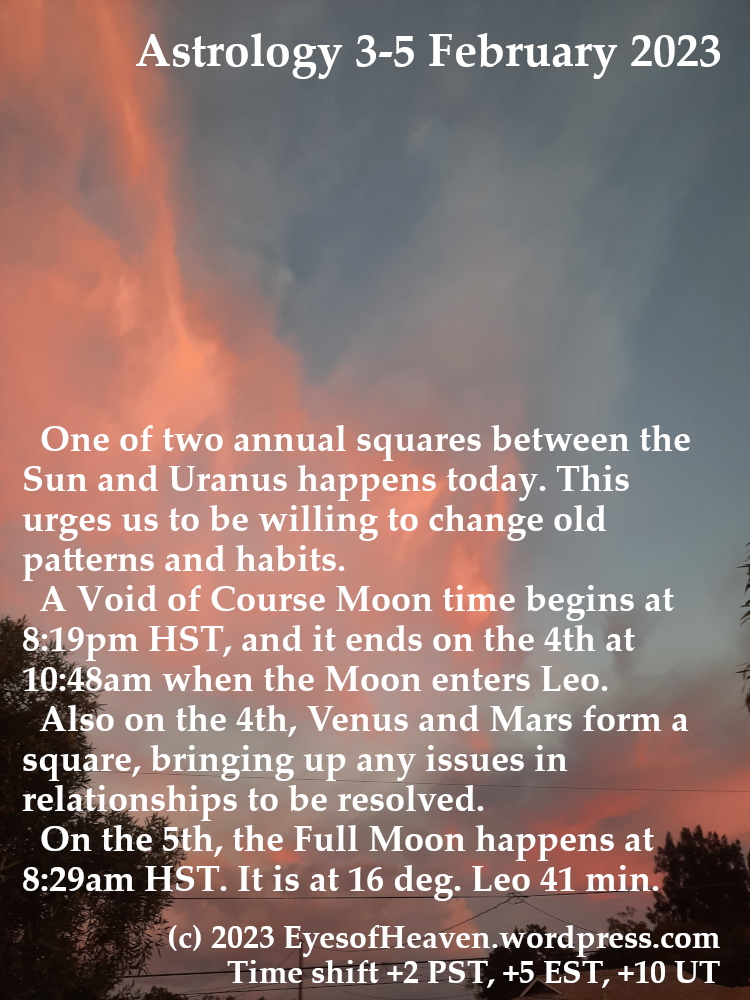
Sun Uranus square begins the day; Void Moon time is here again; Pay attention to relationship difficulties; Full Moon is here on the 5th

Theosophy | The Tempest – II

The tale of The Tempest is well-known but we shall briefly recapitulate its salient strands. It is, primarily, the story of Prospero, rightful Duke of Milan, and his charming child, Miranda, both banished by the usurper Antonio, his brother, and living unknown on a lonely island. Here, through a long period of successful study and practice, Prospero has matured into a master-magician, and Miranda has flowered into a marriageable maiden. The play opens with a violent storm and a resulting shipwreck, caused at the bidding of Prospero by the invisible hosts of the elements, of whom Ariel is the chief. The royal party involved in the shipwreck is saved according to Prospero’s plan, and is scattered on the shore, in three different parts of the island. Alonso, the King of Naples; Sebastian, his brother; Antonio, the usurper; Gonzalo, an honest old Councillor; and two Lords, Adrian and Francisco, land on one side of the island and most of them fall into an induced slumber, during which the vigilant and vile Antonio persuades the susceptible Sebastian to join in a plot to kill the King. Thanks to the intervention of the invisible Ariel, the plotters are prevented from fulfilling their purpose, and the entire party is led to look for Ferdinand, the son and successor of Alonso.
Meanwhile, Ferdinand has met Miranda and has been forced into her father’s service, which he patiently undergoes until Prospero is pleased to bestow on him his daughter. At the same time, in a third part of the island, Caliban, the deformed and savage slave of Prospero, has been met first by Trinculo, the King’s jester, and then by Stephano, a drunken butler, both of whom foolishly join the faithless Caliban in an abortive plot against his powerful master. These three groups are all, in the last Act, brought together near his cell by Prospero, after Antonio and Alonso and Sebastian have been made by strange and fearful sights and sounds to repent of their folly; after Ferdinand and Miranda have been treated to a visionary masque, played by spirits; and after Caliban and his companions have been brought to their senses — all of which is accomplished through the agency of Ariel. The play ends with the restoration of disturbed harmony, the recompense of the good and the repentance of the deluded, the release of Ariel from Prospero’s service, and the reconciliation of one and all to the new order ushered in by Prospero, who shows himself to be a man of wisdom and a master of destiny.
Let us first briefly consider different interpretations of the underlying theme of The Tempest. There is, first of all, the excellent but purely artistic interpretation of Dr. Tillyard whose thesis is that the play gives us the fullest sense of the different worlds within worlds which we can inhabit, and that it is also the necessary epilogue to the incomplete theme of the great tragedies.
A more ambitious and comprehensive attempt is that of Wilson Knight, who interprets the theme of the play from various points of view — poetical, philosophical, political and historical. Poetically, he considers the play artistic autobiography, its meanings revealing a wide range of universal values. Philosophically, he maintains that The Tempest portrays a wrestling of flesh and spirit. Politically, he interprets the play as the betrayal of Prospero, Plato’s philosopher-king and a representative of impractical idealism, by Antonio, Machiavelli’s Prince, and a symbol of political villainy. Lastly, the play is regarded historically as a myth of the national soul, Prospero signifying Britain’s severe, yet tolerant, religious and political instincts, Ariel typifying her inventive and poetical genius, and Caliban her colonizing spirit.
Another serious attempt at interpretation is that of Colin Still, whose study of the ‘timeless theme’ of The Tempest has not attracted the attention it deserves. He regards this ‘Mystery play’ as a deliberate allegorical account of those psychological experiences which constitute Initiation, its main features resembling those of every ceremonial ritual based upon the authentic mystical tradition of all mankind, but especially of the pagan world. Still takes Prospero as the Hierophant, and in one aspect, as God Himself; Ariel as the Angel of the Lord, Caliban as the Tempter or the Devil, and Miranda as the Celestial Bride.
The comedians, Stephano and Trinculo, led on by the Devil, constitute a failure to achieve Initiation; the experiences of the Court Party, which is of purgatorial status, constitute the Lesser Initiation, its attainment being self-discovery; while Ferdinand attains to Paradise, to the goal of the Greater Initiation which consists in receiving a ‘second life.’ The wreck is considered symbolic of the imaginary terrors of the candidate for Initiation, and the immersion in the water as symbolic of his preliminary purification. The Masque is regarded as apocalyptic in character, and the cell is taken to represent the Sanctum Sanctorum, only to be entered after full initiation. And so Still goes on giving every detail the status of a semi-esoteric symbol drawn mainly from pagan ritual.
Still’s thesis, though basically sound, is obscured by theological terminology, and its detailed application often leads to a certain forcing of analogy. Prospero, for instance, is a man, not God, and Caliban is too clearly a thing of Nature to be called a Devil, or Satan. Still’s centre of reference is altogether less in the poetry or in the philosophy than in a rigid system of pagan symbolism applied to the play.
In theosophical terms, we can approach The Tempest from at least three angles — the psychological, the cosmic and the occult. Of these, we shall adopt the last for detailed interpretation of the characters in the play. Before that, however, it will be worthwhile to indicate how the psychological and the cosmic keys may be applied.
The psychological key enables us to construe the theme of The Tempest in terms of the principles of the human constitution and the everyday experiences of the majority of mankind. In this line of interpretation, Prospero would represent Atman, the universal Self, which overbroods the remaining constituents of man, and allows for their rescue from all internal disequilibrium, thus producing that divine and unifying harmony which spells poise and proportion, as well as power and peace. Miranda, the daughter of Prospero, would be that specialization of Atman which we know as Buddhi, the spiritual and at present passive principle in man, the vehicle of Atman, and at once the expression and the essence of pure wisdom and of true compassion. It is in this sense that Miranda represents the fallen and Sleeping Soul of the uninitiated and deluded man. Ferdinand, the Prince who aspires to the companionship of Miranda, could be made to symbolize the higher Manas, the incarnated ray of the Divine in Man, while Antonio, the usurper who plans to secure personal power at the cost of his weakening conscience, could represent the kama manas, or the desire-mind. To complete the picture, Caliban could be taken as the kamarupa or the passional part of man in material form, and Ariel as the type of the assemblage of presiding deities, devatas or elementals, in the human personality. This, in silhouette form, would be the system of symbols that could be constructed on the basis of the psychological key — a system which, interesting as it is in its ramifying implications, it would not be difficult to develop.
The second interpretation, which we have called the cosmic, follows from a comprehensive view of the evolutionary stream in Nature, of the Great Ladder of Being. This interpretation is implied in H.P. Blavatsky’s oft-quoted statement that
the Ego begins his life-pilgrimage as a sprite, an ‘Ariel,’ or a ‘Puck’; he plays the part of a super, is a soldier, a servant, one of the chorus; rises then to ‘speaking parts,’ plays leading roles, interspersed with insignificant parts, till he finally retires from the stage as ‘Prospero,’ the magician.The Key to Theosophy, 34
In this line of interpretation, the play presents an image of the glorious supremacy of the perfected human soul over all other things and beings. At the peak of the evolutionary ascent stands Prospero, the representative of wise and compassionate god-manhood, in its true relation to the combined elements of existence — the physical powers of the external world — and the varieties of character with which it comes into contact. He is the ruling power to which the whole series is subject, from Caliban the densest to Ariel the most ethereal extreme. In Prospero we have the finest fruition of the co-ordinate development of the spiritual and the material lines of evolution.
Next to Prospero comes that charming couple, Ferdinand and Miranda, exquisite flowers of human existence that blossom forth under the benign care of their patriarch and Guru. From these we descend, by a most harmonious moral gradation, through the agency of the skilfully interposed figure of the good Gonzalo, to the representatives of the baser intellectual properties of humanity. We refer to the cunning, cruel, selfish and treacherous worldlings, who vary in their degrees of delusion from the confirmed villainy of Antonio to the folly of Alonso. Next, we have those representatives of the baser sensual attributes of the mass of humanity — the drunken, ribald, foolish retainers of the royal party, Stephano and Trinculo, whose ignorance, knavery and stupidity make them objects more of pity than of hate. Lowest in the scale of humanity comes the gross and uncouth Caliban, who represents the brutal and animal propensities of the nature of man which Prospero, the type of its noblest development, holds in lordly subjection. Lastly, below the human and the animal levels of life, in this wonderful gamut of being, comes the whole class of elementals, the subtler forces and the invisible nerves of nature, the spirits of the elements, who are represented by Ariel and the shining figures of the Masque who are alike governed by the sovereign soul of Prospero. Shakespeare obviously knew of these invisible spirits and recognized their place in the panorama of evolution.
Raghavan Iyer
The Gupta Vidya II
Gnosticism – The Apocryphon / Secret Writing of John – Introduction to Gnostic Texts Scriptures
Gnosticism has produced some of the richest and most difficult spiritual texts of the ancient world. With the discovery of the Nag Hammadi library one is confronted with numerous, often obscure and difficult texts – where to begin? This episode of Esoterica argues that the best first text is the Apocryphon / Secret Writing of John, a text found two recensions (long and short) in four manuscripts from antiquity. Here we introduce, summarize and discuss this amazing gnostic text.
Theosophy | The Tempest – I

The more one delves into the genius of Shakespeare, the greater is the realization that, as veil after veil is lifted, there will remain “veil upon veil behind.” Who was Shakespeare? What manner of man was he? What was the power behind his plays? These are questions more easily asked than answered. The vicissitudes of Shakespeare’s reputation and the vagaries of critical opinion alike substantiate H.P. Blavatsky’s statement that Shakespeare, like Aeschylus, “will ever remain the intellectual ‘Sphinx’ of the ages.”
The scattered hints in Theosophical literature, though few and far between, are sufficiently suggestive to indicate the protean and profound nature of Shakespeare and his message. “My good friend — Shakespeare,” wrote Mahatma K.H., quoting from him in a letter. In her editorial opening the first volume of Lucifer, H.P. Blavatsky declared that
Shakespeare’s deep and accurate science in mental philosophy’ (Coleridge) has proved more beneficent to the true philosopher in the study of the human heart — therefore, in the promotion of truth — than the more accurate but certainly less deep, science of any Fellow of the Royal Institution.
Again, we know from her letter to A.P. Sinnett that she wanted a student to write out “the esoteric meaning of some of Shakespeare’s plays” for inclusion in The Secret Doctrine. Lastly, we have W.Q. Judge’s statement: “The Adepts assert that Shakespeare was, unconsciously to himself, inspired by one of their own number.”
Shakespeare was a magnificent creative genius who, coming under Nirmanakayic influence, became a myriad-minded master of life and language. His amazing and expansive knowledge of the super-physical and the invisible, his penetrating and compassionate insight into human nature, his transcendent and kaleidoscopic imagination, his intuitive perception and his inspired passages — all these are at once the expression and the evidence of the deep inwardness of his plays, and of the luminous influence of Adepts.
What was the nature of Adept influence upon the mind of Shakespeare? It is not to be thought that Shakespeare was, from the first, under the special care and observation of the Great Lodge, but rather that the superior possibilities embedded within himself were what higher inspiration spurred into stronger activity. This was possible because of the largeness of his mind and the receptivity of his soul. The breadth of his Soul-Life could cause the offspring of his Fancy “to share richly in the vital Fire that burns in the higher (Image-making) Power.” Above all, he possessed the power, as John Masefield has written, to touch “energy, the source of all things, the reality behind all appearance,” and to partake of the storehouse of pure thought.
We will not, however, find it an easy task to unravel the mystery locked up in the allegory, symbol and character portrayal of the great plays. For, “the very fact that Shakespeare remained unconscious of the Nirmanakayic influence which his genius attracted shows that we must not expect the unadulterated expression of Divine Wisdom in all he created.”
There are two possible ways of studying any of Shakespeare’s plays in terms of Gupta Vidya. The first is the easier one of extracting hints of esoteric truth out of the significant lines and passages of the play. The second is the more difficult one of interpreting the entire tale and theme of the play according to one or more of the seven keys of symbolism suggested in The Secret Doctrine. We will use both methods, but concentrate on the second, which, if less easy, will be found more fascinating.
The group of plays to which The Tempest belongs and of which it is presumably the last, was written in the final period of Shakespeare’s life. All these plays are romances, neither tragic nor comic but both, full of unexacting and exquisite dreams, woven within a world of mystery and marvel, of shifting visions and confusing complications, “a world in which anything may happen next.” Strangely remote from ‘real’ life is this preternatural world of Shakespeare’s final period, and the universe of his invention is peopled with many creatures more or less human, beings belonging to different orders of life. The romantic character of these plays is reflected in the richness of their style. Here we have the primary facts of poetry, suggestion, colour, imagery, together with complicated and incoherent periods, softened and accentuated rhythms, tender and evanescent beauties. These plays reach the very apex of poetic art, revealing a matured magnificence of diction and the haunting magic of the purest lyricism, altogether appealing more to the imagination than the intellect.
The fundamental feature, however, of these plays of the final period is the archetypal pattern of prosperity, destruction and re-creation which their plots follow. Virtue is not only virtuous, but also victorious, triumphant, and villainy is not only frustrated, but also forgiven. These are dramas of reconciliation between estranged kinsmen, of wrongs righted through repentance, not revenge, of pardon and of peace. Tragedy is fully merged into mysticism, and the theme is rendered in terms of myth and music, reflecting the grandeur of true immortality and spiritual conquest within apparent death and seeming defeat.
Upon the firm foundation of the accepted conclusions regarding the chronological order of the plays of Shakespeare, and of the peculiar features of the final period, modern critics have been only too eager to build their plausible and picturesque interpretations.
We have, first, the Dowden doctrine, supported in different degrees by other critics, likening Shakespeare to a ship, beaten and storm-tossed, yet entering harbour with sails full-set to anchor in Stratford-on-Avon in a state of calm content and serene self-possession. This view gives the final period of the playwright the attractive appellation of “On the Heights”, and perceives in these last plays the charm of meditative romance and the peace of the highest vision. The Tempest is reverentially regarded as the supreme essence of Shakespeare’s final benignity.
Lytton Strachey’s contrary thesis, echoed partially by Granville-Barker, is that these faulty and fantastic last plays show that Shakespeare ended his days in boredom, cynicism and disillusionment. Dr. E.M.W. Tillyard and John Middleton Murry not only see no lack of vitality, no boredom with things, no poverty of versification in these later plays, but, in fact, evidences of the work of one whose poetical faculty was at its height.
The best interpretation is that of Wilson Knight in The Crown of Life. He regards Shakespeare as equivalent to the dynamic spiritual power manifest in his plays, and finds in the Shakespearean sequence the ring of reason, order and necessity. His plays spell the universal rhythm of the motion of the spirit of man, progressing from spiritual pain and despair through stoic acceptance and endurance to a serene and mystic joy. Whereas in the tragedies is expressed the anguish of the aspiring human soul, crying out from within its frail sepulchre of flesh against the unworthiness of the world, these last plays portray the joyous conquest of life’s pain.
It is, however, important to point out the danger of stereotyping the divisions of Shakespeare’s life, and the need to be wary how we apply our labels and demarcations to “so mobile a thing as the life and work of man.” In the last analysis, Shakespeare was all of one piece; he developed, but in his development cast nothing away; his attitude towards life deepened, but his essential outlook always remained the same.
We could attribute the surpassing majesty of the plays of the final period to the great expansion of the creative power and dramatic skill which had first begun to show themselves in their grandeur in the tragic productions of ‘the middle period.’ This expansion was the product, as it is the proof, of the Adept Inspiration from which Shakespeare progressively benefited and on which he increasingly drew. Thus, we are fully prepared to regard the final period as the culmination of a spiritual odyssey which found its consummation in The Tempest, his last and greatest of plays. In this view, then, The Tempest is a broader, deeper “embodiment of the qualities drawn from the higher planes of man’s being in which Imagination rules,” a perfect pattern of myth and magic as of music and marvel.
Raghavan Iyer
The Gupta Vidya II
Daily Words of the Buddha for January 25, 2023

Attanā hi kataṃ pāpaṃ, attanā saṃkilissati;
attanā akataṃ pāpaṃ, attanāva visujjhati.
Suddhī asuddhi paccattaṃ:
nāñño aññaṃ visodhaye.
By doing evil, one defiles oneself;
by avoiding evil, one purifies oneself.
Purity and impurity depend upon oneself:
no one can purify another.
Dhammapada 12.165
Astrology January 23-29 dreamy love time and breaking free

Happy Aquarius RARE Dark Moon and The Chinese New Year of the Black Water Rabbit because In Chinathe color of water is actually black. That’s why it’s a “Black Rabbit” year. Water means fortune and this year portends lots of fortune and fertility.
JAN. 22 URANUS TURNS DIRECT at 14 degrees 57’Taurus
and TECH stuff starts to work. I experienced it myself within 12 hours. The PayPal buttons which have been unfixable for months -a fter three calls with PayPAL managed to get them to work now YAY.
FROM THIS DATE UNTIL APRIL 21 FOR 3 MONTHS ALL PLANETS MOVE DIRECT
JAN. 24 AQUARIUS SUN SEXTILE JUPITER IN ARIES– expand your mind, wake up to the Revolution.
JAN. 26 VENUS ENTERS PISCESAT 6:33 pm PST /9:33 PM EST
READ ABOUT VENUS IN PISCES she was in the last idealistic, soul mate sign 2 years…
View original post 206 more words
Reiki | Energy Healing and Meditation Session
8 hours of music for the practice of Reiki and Meditation. This music was created to increase and facilitate thoughts control during reiki treatment or meditation. Namaste
00:00:00 Reiki Music, Energy Healing, Nature Sounds, Zen Meditation, Positive Energy, Healing Music https://youtu.be/x7e2Dm5WdNg
02:15:36 Reiki Music, Energy Healing, Zen Meditation, Reiki Healing, Positive Energy, Chakra, Relax https://youtu.be/A9yjPSbn4Qg
04:38:35 432 Hz Cleanse Negative Energy, Reiki Music, Healing Meditation, Energy Cleanse https://youtu.be/pF5xXy-6drI
06:39:41 Reiki Music, Physical, Mental, Emotional and Spiritual Healing, Spiritual Cleansing, Angelic Healing https://youtu.be/Igw32MXr28E
Matt Kahn | What Is Truth?

|

Divine Feminine Oracle | Mother Mary – January 22, 2023

Daily Words of the Buddha for January 22, 2023

Na jaccā vasalo hoti
na jaccā hoti brāhmaṇo.
Kammunā vasalo hoti,
kammunā hoti brāhmaṇo
One is not low because of birth
nor does birth make one holy.
Deeds alone make one low,
deeds alone make one holy.
Sutta Nipāta 1.136
Gemstones of the Good Dhamma, compiled and translated by Ven. S. Dhammika
Happy Chinese New Year of the Rabbit
Daily Words of the Buddha for January 20, 2023

Sabbe tasanti daṇḍassa.
Sabbesaṃ jīvitaṃ piyaṃ.
Attānaṃ upamaṃ katvā;
na haneyya na ghātaye.
All tremble at punishment.
Life is dear to all.
Put yourself in the place of others;
kill none nor have another killed.
Dhammapada 10.130
Gemstones of the Good Dhamma, compiled and translated by Ven. S. Dhammika
Good Eats | Peach Cobbler Cheesecake Cones

How to make Peach Cobbler Cheesecake Cones Ingredients : – 1 lb peaches – 2 cups heavy whipping cream – 1/4 cup sugar – 14 oz sweetened condensed milk – 2 tsp vanilla extract – 1/4 tsp ground cinnamon – 3 graham crackers, crumbled – Cones of your choice Directions : – Peel, slice & […]
Daily Words of the Buddha for January 14, 2023
Kodhaṃ jahe vippajaheyya mānaṃ,
saṃyojanaṃ sabbamatikkameyya.
Taṃ nāmarūpasmimasajjamānaṃ
akiñcanaṃ nānupatanti dukkhā.
One should give up anger, renounce pride,
and overcome all fetters.
Suffering never befalls one
who clings not to mind and body and is detached.
Dhammapada 17.221
The Dhammapada: The Buddha’s Path of Wisdom, translated from Pāli by Acharya Buddharakkhita
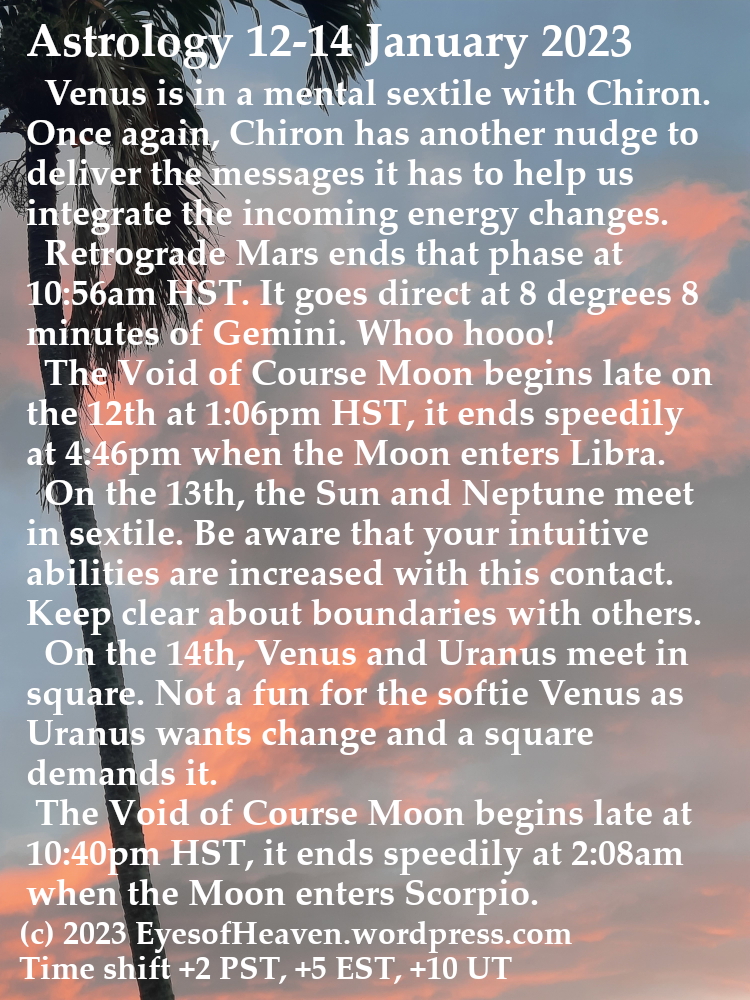
Venus connects to Chiron; Mars Retrograde ends on the 12th; Later in the day, a Void of Course Moon time begins; The Sun and Neptune connect harmoniously – use discernment with messages received; Venus is pounced on by Uranus – treat yourself kindly as change is demanded; Void Moon time again on the 14th
Good Eats | Lemon Blueberry Loaf

How to make Lemon Blueberry Loaf Ingredients 1 ½ cups plus 1 tbsp all purpose flour 2 tsp baking powder 3 large eggs 1 cup granulated sugar 1 cup plain yogurt or sour cream ½ tsp salt ½ tsp vanilla ½ cup vegetable oil 2 tsp lemon zest 1 ½ cups fresh or frozen blueberries […]
Daily Words of the Buddha for January 11, 2023

Imesu kira sajjanti,
Eke samaṇabrāhmaṇā;
Viggayha naṃ vivadanti
Janā ekaṅgadassino.
Some recluses and brahmins, so called,
Are deeply attached to their own views;
People who only see one side of things
Engage in quarrels and disputes.
Udāna 6.54
The Udāna and the Itivuttaka, trans. John D. Ireland
2023 Is The Year of the Rabbit

Good Eats | Tennessee Peach Pudding

How to make Tennessee Peach Pudding …
Ingredients:
Filling:
° 5 peach cups, peeled and cut into fresh or frozen cubes
° 2 cups flour for all purposes
° 1 cup sugar
° 1 cup full fat milk
° 4 teaspoons baking powder
° 1teaspoon sea salt
° 1 teaspoon cinnamon
° 1 teaspoon vanilla extract
° 1/4 teaspoon nutmeg
Topping:
° 3/4 cup brown […]
Daily Words of the Buddha for January 09, 2023
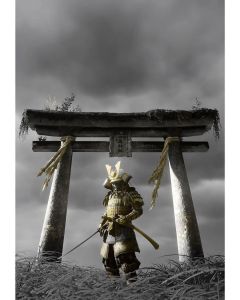
Attā hi attano nātho;
ko hi nātho paro siyā?
Attanā hi sudantena,
nāthaṃ labhati dullabhaṃ.
One truly is the protector of oneself;
who else could the protector be?
With oneself fully controlled,
one gains a mastery that is hard to gain.
Dhammapada 12.160
The Dhammapada: The Buddha’s Path of Wisdom, translated from Pāli by Acharya Buddharakkhita
Matt Kahn | Do You Ever Feel Invisible?

Lilith, drama in Fiery Leo, Venus Retrograde, patriarchy is toast
January 9- October 6 Lilith the Queen of the dark feminine, she of sacred menstrual blood, independent, refusing to be less than any man a true matriarchal queen most rejected of divine feminine energies will proudly pure roar like Durga and party on as the Scarlet woman, the lady in red, wearing her heart on her sleeve, and putting all mysogynist patriarchal assesses in their place with one fell swoop of her claws. Laughing all the way.
Just as Greta thundberg put that Twit whatever his name is Tate to shame in one fell tweet, in response to his verbose limp show of masculinity via a very expensive multi horse powered gas guzzler intended as a threat to miss climate change (greta bless her teenage soul works for the WEF) responded sardonically with please send me more pics, email me at little dickenergy@getalife.com
It was very funny. Tate then dozed…
View original post 570 more words
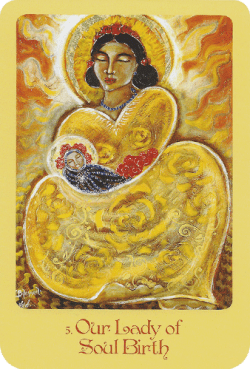
Divine Feminine Oracle | Mother Mary – January 8, 2023
Ayahuasca compilation – Shamanic meditation music #music #meditation #shaman #egodeath #healing
** What is actually Ayahuasca and what its ceremony includes **
An Ayahuasca Ceremony is an opportunity to receive treatment for the spirit and take part in your own healing. Ayahuasca ceremony participants arrive in the early evening, as ceremonies are held at night. Participants arrive before the ceremony begins to show respect for the healer, or curanderos, leading the ceremony. The Maestro curanderos first prepares for the ceremony, after introductions, if necessary. Preparation includes cleaning of the space and implements with mapacho tobacco, prayers, and other blessings. The ceremony begins after preparation of the space and ceremonial tools.
** Music in ceremony **
Songs are an important part of healing experience, and curanderos use healing songs called “icaros”. These songs help curanderos to communicate with spirits and ask for help in healing treatments for the patients. Each icaro has a specific purpose in the healing process. Curanderos sing to open every ceremony, inviting spirits to be present in the ceremony in order to perform healings. The curandero sings throughout the ceremony as the patients navigate their own experiences. The curanderos also use the icaros to raise and lower the intensity of the experience.
** Closing the Ayahuasca Ceremony **
The ceremony ends with an icaro to close the healing circle. The curandero also provide patients with protection from spiritual vulnerability before they leave the ceremony. After the end of the ceremony, lights are lit and brief discussion takes place before people leave to go to sleep.
Daily Words of the Buddha for January 08, 2023

Mettañca sabbalokasmi,
mānasaṃ bhāvaye aparimāṇaṃ:
Uddhaṃ adho ca tiriyañca,
asambādhaṃ averamasapattaṃ.
With good will for the entire cosmos,
cultivate a limitless heart:
Above, below, & all around,
unobstructed, without hostility or hate.
Sutta Nipāta 1.150
Translated from Pāli by Thanissaro Bhikkhu

Sweet Potato Muffins


We are absolutely killing it in gorgeous sweet potatoes this year! So much abundance….
This recipe is an adaptation of a Pumpkin Bread recipe I received from my friend Vicki some years ago. These muffins are a real crowd pleaser and are a great use of cooked sweet potatoes.

Sweet Potato Muffins
1 cup (two sticks) unsalted butter
2 cups granulated sugar
1 ½ cups brown sugar
1 ½ teaspoons salt
3 cups cooked, peeled sweet potato (roughly 3 medium sweet potatoes)
4 large eggs
1 tablespoon vanilla
3 ½ cups flour
2 teaspoons baking soda
¼ teaspoon baking powder
1 teaspoon ground cinnamon
1 teaspoon ground nutmeg
1 tablespoon pumpkin pie spice
Preheat oven to 350 degrees.
Line muffin tins with cupcake liners
Whisk together flour, baking soda, baking powder, cinnamon, nutmeg and pumpkin pie spice. Set aside.
On medium high speed, cream together sugars, salt and butter until…
View original post 147 more words
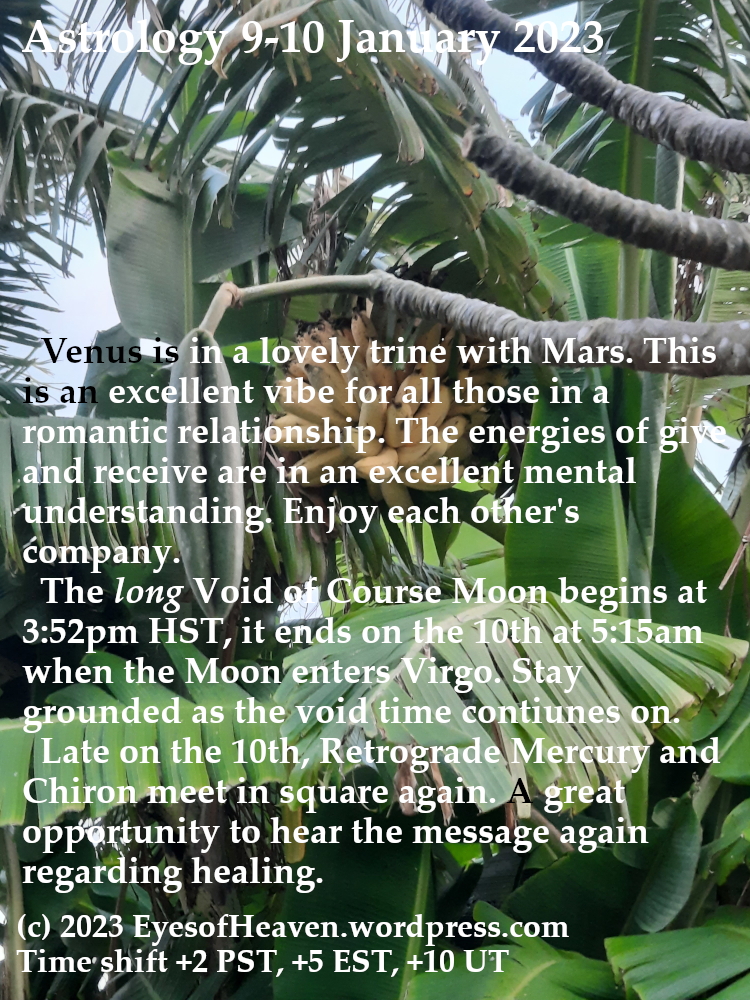
Venus and Mars in trine is beneficial for partnered connections; Have patience during the long Void Moon of Course and it drags on; Another contact between Retrograde Mercury and Chiron – make notes
Daily Words of the Buddha for January 07, 2023

Attānaṃ ce tathā kayirā;
yathāññamanusāsati,
sudanto vata dametha.
Attā hi kira duddamo.
One should do what one teaches others to do;
if one would train others,
one should be well controlled oneself.
Difficult, indeed, is self-control.
Dhammapada 12.159
The Dhammapada: The Buddha’s Path of Wisdom, translated from Pāli by Acharya Buddharakkhita
Theosophy | INDIVIDUATION AND INITIATION – II
In the ancient schools one would not be allowed to begin serious study of yoga until one had mastered one’s temper. In the school of Pythagoras candidates were tested from the first day in regard to their personal vulnerability. That was the stringent standard of all schools preparing for the mysteries of initiation. The laws have not changed even though the external rules may seem to have been modified. It remains an inescapable fact of Nature and karma that if one loses one’s temper even after a lifetime of spiritual development, one’s progress is destroyed in a single mood. Like a city or a work of art, the time to construct is long, but destruction can be swift. One has to think out one’s true internal and external state of being, even if one goes to the Tolstoyan extreme of seeing every kind of fault in oneself. Tolstoy did not do this out of pride but rather because he was so thoroughly honest that he simply could not think of a single fault in anyone else which he could not see present in himself. This sense of commonality, rooted in ethical self-awareness, leaves no room for judging anyone else or for running away from anyone because one sees that the whole army of human foibles is in oneself, and that every elemental is connected with internal propensities in one’s astral form. To think this out Manasically is crucial in the Aquarian Age. The wise disciple will recognize that thoroughness, urgency and earnestness are quite different from fatuous haste and impulsiveness. Even if it takes months and years to think out and learn to apply the elementary axioms of the Science of Spirituality, it is necessary to be patient and persistent, rather than revel in fantasies that leave residues in successive lives. When something so obvious which one can test and comprehend is taught, this is an opportunity for growth which demands honesty in thought and intelligence in response. To receive the timeless teaching in this way enables the self to be the true friend of the Self. Not to do this is one of the myriad ways in which the self becomes the enemy of the Self because it is afraid of facing the facts and the laws of nature connected with relations and patterns in the vestures. Self-regeneration is a precise science and it is possible to test oneself in a manner that fosters sophrosyne.
This spiritual intelligence test is not a matter of making some sweeping moral judgement about oneself, because that will have no meaning for the immortal soul. It would simply not be commensurate with eighteen million years of self-conscious existence. It is really a waste of time to say “I’m no good, I’m this kind of person, I’m bound to do this.” Such exclamations are absurd because they do not account for the internal complexity and psychological richness of sevenfold man, let alone the immensity of the human pilgrimage. It is more important to understand and recognize critical incipient causes, to see how the karmic process takes place, and to arrest the downward slide into fragmented consciousness. To do this firmly with compassion at the root, one has to meditate upon some fundamental idea. One might benefit from the golden example set by disciples who practise the precept: “All the time everything that comes to me I not only deserve but I desire.” This form of mental asceticism is the reverse of psychic passivity and self-indulgent fatalism. It is a clear and crisp recognition that there is karmic meaning to every single event, that nothing is unnecessary even though one may not yet know what its meaning is. Ignorance of the process of adjustment of internal and external relations is merely a reflection of the limitation of one’s own growth at the level of lower mind. To accept totally one’s karma is like a swimmer recognizing the necessity of accepting the tidal currents of the ocean. A swimmer is not doing a favour to the ocean by accepting its sway. Deliberate and intelligent acceptance of oceanic currents is the difference between drowning and surviving.
When it comes to karma on the causal plane with reference to human consciousness and invisible forces, the same principle applies. That is why Buddha said, “Ye who suffer, know ye suffer from yourselves.” Though the teaching seems obvious when stated, it must really be thought through at the core of one’s being if one is going to alter the karmic tendencies of the forces at work. One must ask whether the whole of one’s being is cooperating with the totality of one’s karma. Unless one engages in this meditation and willingly accepts all karma even though one does not understand most of it, no regrets or resolves will make any difference. The constant task of learning, which is a matter of activating and sensitizing all the centres of perception, has an intimate bearing upon diminishing the range and reach of the irrational in one’s responses to life. There is a direct connection between the kundalini force of adjustment of internal and external relations, which moves in a curved path, and the karmic predominance of the various elemental powers in the human constitution. In the words of Hermes Trismegistus:
All these Genii preside over mundane affairs, they shake and overthrow the constitution of States and of individuals; they imprint their likeness on our Souls, they are present in our nerves, our marrow, our veins, our arteries, and our very brain-substance . . . at the moment when each of us receives life and being, he is taken in charge by the genii (Elementals) who preside over births, and who are classed beneath the astral powers (Super-human astral Spirits). They change perpetually, not always identically, but revolving in circles.
Ibid., i 294
Throughout the cyclic development of each soul, the proportional composition of the vestures out of the five elements is continually being adjusted. Through the attraction and repulsion of their coessence to the vestures, certain elements become the dominant ruling factors in one’s life. Unless one engages in noetic mental asceticism, one will invariably remain passive to the psychic sway of these irrational forces. Without ratio, harmony and proportion, one cannot employ the vestures as channels for the benevolent transmutation of life-atoms: rather one will needlessly compound the karma of selfishness. The compassionate projection of the spiritual energies of the soul requires that the genii be made subordinate to the awakened Buddhi-Manasic reason. The genii
permeate by the body two parts of the Soul, that it may receive from each the impress of his own energy. But the reasonable part of the Soul is not subject to the genii; it is designed for the reception of (the) God, who enlightens it with a sunny ray. Those who are thus illumined are few in number, and from them the genii abstain: for neither genii nor Gods have any power in the presence of a single ray of God.
Ibid., i 294-295
By the “few in number” is meant those Initiates and Adepts for whom there is no ‘God’ but the one universal and unconditioned Deity in boundless space and eternal duration.
The truly reasonable part of the soul is extremely important in the Aquarian Age. To think clearly, logically and incisively must be the true purpose of education. To unfold the immense powers of pure thought, the reasonable part of the soul must be given every opportunity to develop so that the irrational side is reduced. Its false coherence must be broken by seeing it causally. One must begin with a willingness to acknowledge it readily, and see that there is no gain in merely pushing it aside. The development of the reasonable part of the soul, which is not subject to the genii, culminates in the reception of the god who enlightens it with a sunny ray, the Chitkala that is attracted by contemplation. Clear, pure reason characterizes the immortal ray which is connected with the star that has its genii, good and evil by nature. The use of reason and clarity of perception in the spiritual and metaphysical sense involves the heart as well as the mind because they cooperate in seeing and thinking clearly. Once this is grasped, one can make a decisive difference to the amount of unnecessary karma involved in one’s irrational emanations and wasteful emotions. One can begin to let go of all that and calmly cultivate the deepest feelings.
At a certain point it will become natural for the mind to move spontaneously to spiritual teachings and universal ideas whenever it has an opportunity. It would not have to be told, nor would one have to make rules, because that would be what it would enjoy. When it becomes more developed in the art of solitary contemplation, it will always see everything from the higher standpoint whilst performing duties in the lower realm, thus transforming one’s whole way of living. This will make a profound difference to the conservation of energy and the clarification of one’s karma. It will also strengthen the power of progressive detachment whereby one can understand what it means to say that the Sage, the Jivanmukta, the perfected Yogin, is characterized by the golden talisman of doing only what is truly necessary. He only thinks what is necessary. He only feels what is necessary. There is so powerful a sense of what is necessary in the small, but from the standpoint of the whole, that there is no other way of life that is conceivable or imaginable. This internal Buddhic logic can never be understood by reference to external rules and characteristics because one has to come to it from a high plane of meditation and total detachment from the realm of external expression.
When the disciple is sufficiently self-evolved from within without, then the further individuation of the soul through self-conscious initiations may proceed. Prepared by testing and by trials, the reasonable part of the soul may receive a sunny ray, communicated by its spiritual ancestors, themselves inseparable from the disciple’s own seventh principle. The parentless progenitors of spiritual intelligence or consciousness are known at one level as Bodhisattvas, at another level as Dhyani Buddhas, at still another level as Manushi Buddhas. All of these are spiritual ancestors of what is called Buddhi — individually one’s own intuitive principle, but in a strict philosophical sense the pure vehicle of one universal light. Buddhi as a principle is its emanation, a gift from a Dhyani Buddha or spiritual progenitor. Seen in this way, all the higher principles are pure emanations from spiritual instructors and parents, in the same way that until the age of seven a terrestrial parent is the spiritual and mental progenitor of the thinking of a child. The child’s own intelligence is involved, and children vary in their responses because of accumulated karma. So too with the chela on the Path. The language that parents use, the ideas that they evoke, and their mode of consciousness colour the child’s psyche during the day, giving a certain tone to the environment. Though most parents hardly think deliberately about what is at stake, owing to their lack of knowledge and insight, nonetheless they have the inimitable opportunity of initiating the child into the wise use of its latent powers. This is only an imperfect analogy on the lower plane of differentiated consciousness and everyday relationships between highly vulnerable personalities. It can scarcely intimate the magical privilege of communicating with Adepts and Initiates, and of participating in the compassionate ideation that permeates the magnetic field in which the chela grows. As an immortal soul, each individual is potentially an inheritor of the whole field of human consciousness over eighteen million years; as an initiated chela each may freely assume this sacred birthright as a spiritual inheritor of the parentless Anupadaka.
The Bodhisattva Path of self-regeneration and of initiation into the mysteries of the higher principles begins and ends with the quickening of the reverential feeling of devotion and gratitude for every single being who ever did anything for oneself. Those who are fortunate enough to perfect that power of endless, boundless gratitude and spontaneous reverence to every teacher they ever learnt from are in a better position to understand how to invoke the highest gift of self-consciousness from the greatest spiritual progenitors. In a fearless way but also in a proper posture of true devotion and reverence, one can invoke the Dhyani Buddhas in dawn meditation, during the day, in the evening and at night, whenever and how often one reaches out in consciousness to them. Before this can be done effectively, one must learn to cleanse the lunar vesture, calm the mind and purify the heart. Every thought or feeling directed against another being makes that heart unworthy to feel the hebdomadal vibration of the Dhyani Buddhas.
Self-concern pollutes rather than protects. Self-purification and self-correction strengthen the capacity to liberate oneself from the karmic accretions of lives of ignorance and foolish participation in the collective dross. Such are the laws of spiritual evolution that this purification can only proceed through the sacrificial invocation of the whole of one’s karma. Then one can begin to become truly self-conscious in one’s interior relationship to the Dhyani Buddhas, the Daimon, the Genius which can speak to one through the Kwan Yin, the Chitkala, the Inner Voice. Just as a vast portion of the world’s sublimest music is only theoretically available to the average person, the finest vibrations of Akasha-Alaya must remain of little avail to most mortals until they fit themselves to come and sit close to the Teachers of Brahma Vach. “To live to benefit mankind is the first step.”
Raghavan Iyer
The Gupta Vidya II
 Hālau 'Aha Hui Lānākila