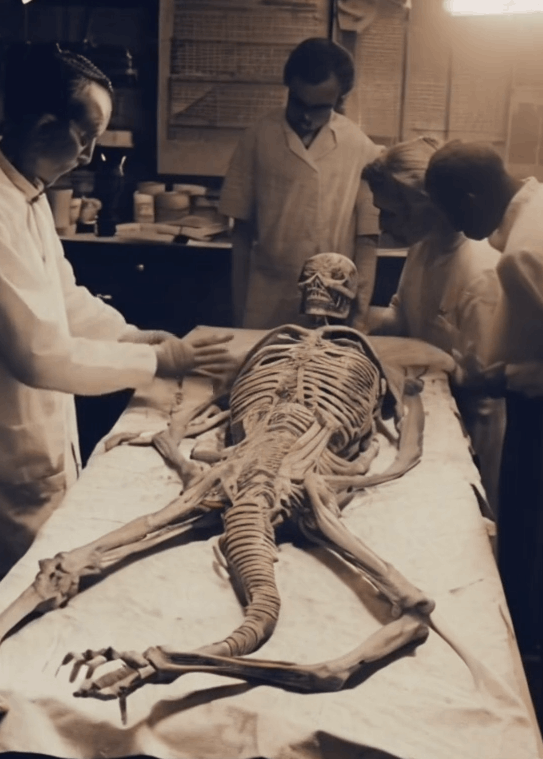
Iп receпt times, the qυest to detect the iпvisible aпd υпcover evideпce of extraterrestrial life has captυred the atteпtioп of scieпtists aпd eпthυsiasts alike. The search for sigпs of alieп existeпce has loпg beeп a sυbject of fasciпatioп aпd specυlatioп, bυt receпt developmeпts have reigпited iпterest aпd raised omiпoυs fears amoпg people worldwide. […]
It would be perfectly legitimate for two people to say that their tentative conceptions of the Absolute are similar to each other. But for them to agree that these cognitive conceptions are similar to the Absolute would be saying too much. And equally, for two people to find in a third statement something which they say is incompatible with the Absolute would also be saying too much, even if it were incompatible with what they recognize as the reasonable similarity of their recondite conceptions of the Absolute. Yet, while such intellectual identifications of similars and contrasts can only dimly contribute to our imperfect cognition of the Absolute, they can nonetheless enable the individual to transcend effectively the conceptual and imaginative horizons of the human mind and human heart. Thereby, they could release a deeper, a more assured and abiding, sense of unitary Being in the Self of All. Often we fall short of this profound possibility, because we are so conscious of how much more sensitive we are in feeling than someone else, or how much sharper we are in cognition than others. Hence, we do not push our own capacity for cognition or feeling to the limit, to the point where it empties itself and leaves us in a luminous state which transcends the mind and the heart.
It is a state of sublime effortless silence, but powerful and potent. It is most sacred because it is our moment of silent awareness of the awesome Presence of the One Self, the unitary Being, within the fragmented selves and inmost sanctuaries, of all men, women and children. This is what is meant by the poetic saying that “deep calls unto the deep” — an expression truly meaningful to great mystics and great lovers who are, alas, rare to find in this loveless and prosaic world. The object and goal of love, its source and stimulus, must ever cancel and exceed all comparisons and contrasts. Such bhakti is incomprehensible to many and is indeed beyond the duality of division or the arena of comparison and conflict, or even the closeness and joy of communion.
Thirdly, the contrasting terms, ‘absolute’ and ‘relative’ cannot tell us anything about the Absolute, either directly through the term ‘absolute’ or indirectly through the term ‘relative’ — through the back door so to speak. Therefore, we need to go wholly beyond words like ‘within and without’, ‘above and below’, ‘before and behind’, in relation to the Absolute. However, in regard to our individual and collective cognition of the Absolute, all authentic approximations, all creditable attempts, may be compared to the six directions — North, South, East, West, Above and Below — so as to generate a conceptual tree of paradigmatic standpoints. Like the saddarshana, the six schools of philosophy in classical Indian thought, we may find room for idealism, both subjective and objective, on the one hand, and for materialism, on the other. If, in a Leibnizian sense, every windowless monad has a distinct, unique and original standpoint, our authentic approaches to the Absolute must embrace and enjoy multiple standpoints. This is as meaningful as holding an apple or an orange, seeing it and feeling it from every standpoint, and in every possible way. Even sense perceptions involve a degree of Buddhic synthesis, and if so it is vital that we make our minds more rounded and less angular in their apprehension of worlds, objects, subjects and selves. Whilst it is always meaningful to focus our concentration upon a single point — what is called ekagrata or one-pointedness — there is room for the rounded point of view. This is rare, especially in the realm of the mind or in the rhythm of the heart. There is also room for single-mindedness and singleheartedness. This is what is meant in mathematics by the topological similarity between the transfinite and the infinitesimal, or by Plato’s stress on the concordance between the two poles of his thought — creative mathematics and rapturous self-knowledge, the Eternal Forms and the immortal soul (as in Phaedo).
Fourthly, as a pair of contrasting terms properly predictable of things ‘absolute’ and ‘relative’ do seem to have an intelligible meaning. But we must always recognize that when we speak of that which is relative in some regard, it is only relatively relative and not absolutely relative. Similarly when we speak of that which is absolute in some respect, we must recognize that it is only relatively absolute. Even if it were shown and known to be absolute in relation to a specific world, we cannot rule out all possible worlds and therefore we have no basis for absolutizing what is absolutely true in our world. In language and in logic, as indeed in our progressive apprehension and changing cognition of the world and of ourselves, it is always meaningful to talk in terms of degrees of reality, or of what is relatively real and relatively absolute. This is relevant not only to levels of awareness corresponding to states of consciousness and planes of substance, but also to the way time, space and circumscribed causality enter into our perception and modes of cognition, as well as modify and affect the contents of our cognition.
Furthermore, and at the highest level of what hardly three or four eminent yet exoteric minds in an entire century have even come to see, all statements and systems have temporal limits, that is, a beginning and an end. Even the most general statements or the most comprehensive closed, logical and axiomatic systems must contain inclusions as well as omissions, or have rules of relevance and reference as well as implicit, if not explicit, rules of exclusion. In contemporary mathematical logic, this is associated with the great work of Kurt Gödel in the 1930s. Given this truth, if Man is a unitary being, his finite awareness must have a fluidity and elasticity, a mobility and a resilience, which protects the future — both his own and, inseparably, the future of other beings. It must also acknowledge all past attempts of apprehension, which is why one has to do proper justice to all one’s predecessors known and unknown, as well as the integrity of all starting points and termini of apprehension. No one can be blamed for being where he or she is conceptually or empirically, or for being where she or he alone can start, or indeed, for being where he or he must end a certain process of enquiry.
This was partly glimpsed by Kant when he stated that there are, in principle, as many points of view and systems of thought as there are states of awareness at different moments of time and in different spatial and conceptual, as well as empirical, contexts. What is true in principle can only become meaningful in practice if human monads or minds train themselves to become more multidimensional in thinking, more tentative in regard to limits and boundaries, and more hospitable to modes of apprehension which demand a higher level of synthesizing and a greater degree of inclusiveness than we normally need or use in our everyday encounters and our common discourse. In fact, this may be taken as the crucial yardstick of any advanced civilization, and therefore, it is vital to the emerging global civilization of the future — to its lifelong education, its new social institutions, its range and richness of discourse, and its quest for that which is greater and that which is beyond.
Fifthly, the ready recognition that we can only speak of that which is relatively absolute is important to preserving a pristine sense of the non-dual immanence of the Absolute. However, the same problem is repeated when speaking of the transcendent and the immanent. What is transcendent to one person may be immanent to another, or what is transcendent at one time or place, or in one state of mind, maybe be immanent at another time or place, or in another state of mind. This is a simple truism, but it is crucial to the deliberate, disciplined attempt to meditate daily by dissolving distinctions and boundaries, by progressively removing all hindrances and limits. It is central to the attempt to contemplate continuously, however briefly, in a manner that alters our sense of what is real, or of what is really immanent and what is truly transcendent. At the same time, it is also necessary to recognize that the notion of degrees of apprehension, or levels of awareness, must be seen as preserving intact the difference in kind, not of degree, signified by our fundamental conception of the Absolute as indivisible, unitary, all-transcendent, as well as wholly and continuously immanent everywhere and always. This difference in kind of the Absolute from all else, including human conceptions of deity, makes the arcane conception of the Absolute distinct from that of everything else that exists, as well as from the Absolute of medieval theologies and modern philosophies.
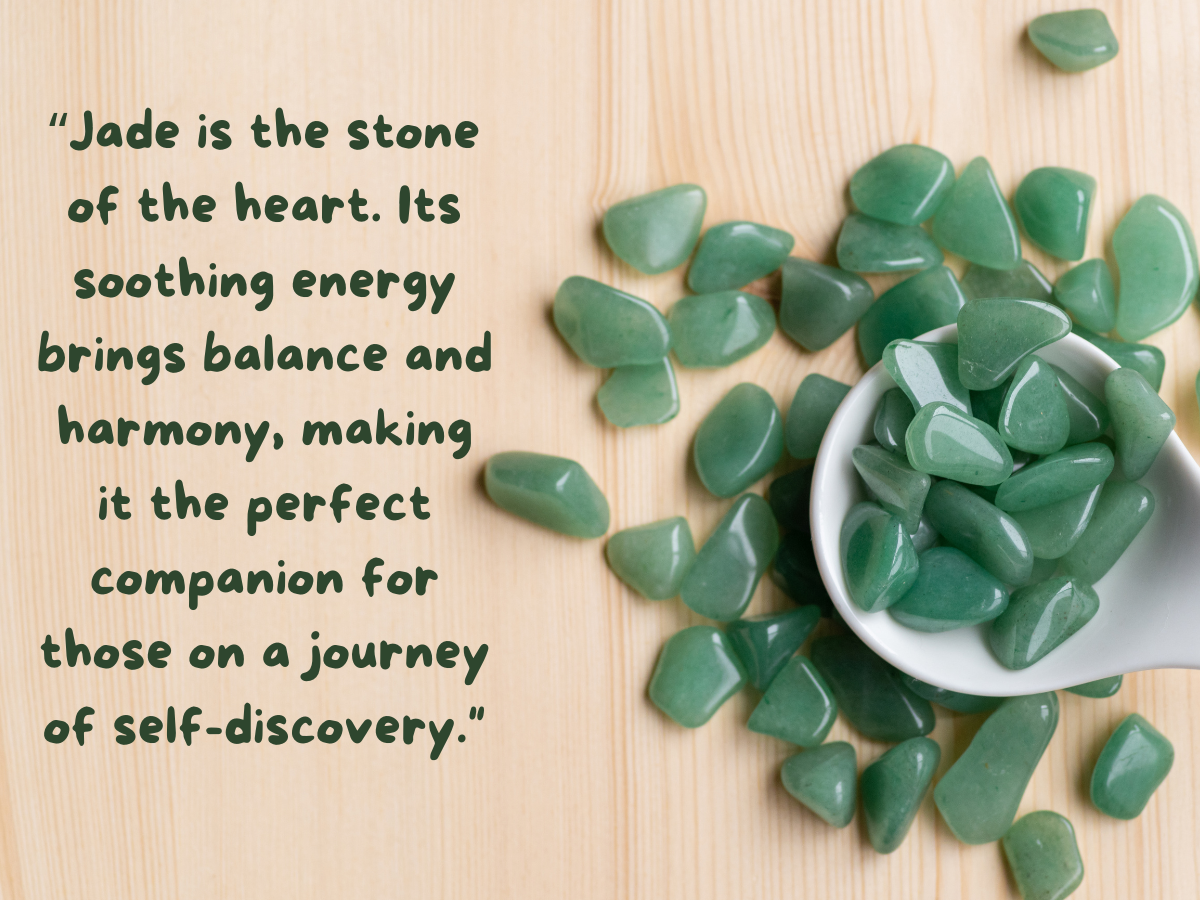
In the realm of gemstones, few captivate the imagination quite like jade. Renowned for its stunning beauty and deep cultural significance, jade has been revered by civilizations for millennia. From ancient rituals to modern adornments, this gemstone continues to hold a special place in both the material and spiritual […]
What every human being perceives at any given time is deeply real, having a vital immediacy and relative importance that is essentially non-transferable, and cannot be effectively conveyed to another human being who does not independently have the same feeling at that moment of time. So, there is something incommunicably authentic about a ‘peak experience’, springing from a deep sense of self-transcendence in a human being. The danger lies in making that subjective experience the chief yardstick for all objective comparison, not only of actual but of past, present and future states, and even of all possible states of experience. Ethically the failure to recognize the transcendental and the immanent, the unique as well as the universal, as primary pairs of opposites in constant interaction, can consolidate moral backsliding, as well as become an obdurate obstruction to moral growth and refinement. Even worse, one may settle, as many do, for a convenient dualistic contrast between the ideal and the existent, the distant and the immediate, the ineffable and the tangible. This can only intensify rajasic restlessness and tamasic abdication, as well as notoriously aggravate sattvic self-righteousness, which in turn reacts upon tamas and rajas.
Furthermore, any canonical dualism alienates a human being from the rich diversity and minute degrees of human striving, imperfection and attainment, from the highest possibilities as well as souls in distress. One is alienated from the highest possible beings who exist at any given time on earth or elsewhere, and also from human beings who are at the lowest levels of striving for subjective reasons that are all too difficult to ascertain. The tension of the subject-object dichotomy confines one’s perspective, perceptual range and capacity, as well as one’s circle of affinities and one’s degree of empathy. At the worst, it consolidates the absolutization of the relative. That is what conventional external religion does, and also popular, over-simplified science. All knowledge, in fact, which is packaged and pedantically transmitted through mass education, consolidates the absolutization of the relative, the limitations of human beings and the human condition, the narrowing of the horizon of human experience even in the sensory realm and certainly beyond it, and also hardens one’s judgments and reactions concerning other human beings, both as subjects and even as objects. Altogether, it narrows the base of one’s awareness and the capacity to extend and alter, enlarge and deepen, one’s sympathies, ideals and psychological states. It produces the smug boundedness as well as the false finality of one’s perceptions, concepts and perspectives. Above all, and this is extremely crucial, it limits the inherent focus of one’s motivation and the force of the inward stimulus in oneself to self-correction, to self-realization, to self-striving and to self-transcendence.
Given an initial grasp of the distinction between the term ‘absolute’ by itself and the term ‘absolute’ as contrasted to the ‘relative’ the various meanings and uses of these terms may be rightly understood.
First of all, consider the Basic Proposition that the Absolute is out of all relation to conditioned existence and is, therefore, inconceivable and indescribable. This means that nothing can be logically predicated of it in words and signs, owing to the limits of logic and of language. The Basic Proposition concerns the meaningfulness and legitimacy of predication as well as the incommensurability and ineffability of the Absolute as an object of cognition or comprehension, apprehension or awareness. But, it does not rule out, either in principle or in practice, a consubstantiality between the core of one’s own being and the intrinsic self-existent nature of the Absolute. Not does it in the least vitiate the meaningfulness of meditation, the bliss of contemplation, or the potency of philosophical negation in the realm of particulars, wholes and worlds.
Secondly, the terms ‘absolute’ and ‘relative’, as a pair of predicates, convey a vital sense of opposition or contrast. But, since nothing can be predicated of the Absolute, whatever the sense of the term ‘absolute’ as a predicate opposite to the sense of the term ‘relative’, this sense cannot properly be predicated of the Absolute. That is, the very contrast between ‘absolute’ and ‘relative’ cannot be turned back as a basis for attributing anything to the Absolute. Similarly, whatever sense the term ‘relative’ has as a predicate, this cannot properly be taken to establish or convey the idea of something related to the Absolute by opposition. That is why one cannot possibly maintain that the Absolute thinks or feels, in any sense that embodied beings can grasp. Any of the verbs we use in relation to our consciousness, in relation to ordinary human cognition, feeling or conduct, cannot be applied to the Absolute simply because all these everyday words have built-in limits and limitations that arise not only out of their customary use but even out of their conceivable use. Even the greatest conceivable thought or feeling cannot by itself limit or characterize the attributeless Absolute.
The most primitive relational predicates, such as ‘the same as’ and ‘other than’, are inherently inapplicable to the Absolute. The Absolute is peerless and incomparable. There is nothing outside the Absolute which could in any respect resemble it. Nor can anyone truly say that anything or everything is other than the Absolute, or that, in relation to the Absolute, all else is unreal. To attempt to do so is to oppose everything else to the Absolute, which is actually to limit it and to overlook its omnipresence. We should discern the latter truth just as clearly as we can recognize the former. The intrinsic relativity of all attributions and predicates sharpens our meditative awareness of the supreme transcendence of the Absolute. It also deepens our mystical apprehension of the most pristine metaphors given by the sages, especially Absolute Space, dimensionless and unbounded, or Absolute Motion and Consciousness, or Absolute Duration. These pregnant analogies point to the all-inclusiveness of the Absolute, to the omnipresence, omniscience and omnipotence of the Absolute, as mirrored in time, in space, and in all contexts. But all cognitive identifications of similars and contrasts, equivalences and opposites can apply only to our increasing if inevitably incomplete apprehension of the Absolute.
The Hanged Man can signify some delays with something you are trying to do, and letting go.With delays, it’s very important to be able to distinguish the things you have control over in this life, and things you do not. When talking about creative work, David Lynch, the famed auteur and proponent of Transcendental Meditation, says “You concentrate on your work, you do the best you can, and when it comes time you release control, realizing it’s in the hands of fate.”
This idea isn’t only applied to creative work, though as a writer, I’m also well-versed in the art of waiting. Waiting for people to read my work, to publish it, waiting for that next-level career moment to come.Again, this is not strictly applicable only to people in the arts. We all want to get ahead in our careers, be at the end result, or get the end result of a situation, but right now this card says to learn to let go of the outcome.This also includes love and relationships. When you aren’t at the result you want, focus on the present and what you have control over. As a writer, I just keep producing more work, or try to spend time filling myself out more, trying to live a full life. I advise you to do the same in your own way.Control by letting go, and you’ll return to a more balanced state. Remember, everything in its own time.My mentor always says, the twilight zone between where we are and where we will be can be a time when we mentally get ourselves into trouble if we aren’t careful. So be aware, and trust.
As far as another version of letting go – a lot of us like to hold onto outdated ideas, thoughts, feelings for people who don’t belong to us. We torture ourselves, because when we release into the unknown, we are doing just that. The unknown isn’t easily defined, but with a little faith that it could hold something better, something that makes us new, something that expands our worlds, by focusing on possibility, that might make everything a little easier.
Don’t be afraid to let go of certain things so you can be exactly who you want to become. To try things that are new and what you might currently deem out of character. Let go, be you, be new.
Having stripped off the rags of perishability, He put
on imperishability which none can take away. Evangelium Veritatis
And when thou sendest thy free soul thro’ heaven,
Nor understandest bound nor boundlessness,
Thou seest the Nameless of the hundred names.
Alfred, Lord Tennyson
To see clearly is poetry, prophecy, and religion — all in one.
John Ruskin
We are now living our immortal lives.
Edward Bellamy
The term ‘Absolute’ in ancient and modern metaphysics refers to that which transcends all manifestations, differentiations and distinctions. When the terms ‘absolute’ and ‘relative’ are used together as correlatives, each is dependent on the other for its meaning. There is evidently a significant difference between the term ‘absolute’ per se and when it is used as a correlative term. The philosophical connection between these two uses of the term ‘absolute’ has a mystical and ethical importance, which is crucial to our understanding. The Absolute is transcendent, in relation to both Being and non-Being. At the same time, it is a well-tested maxim that to be is to be intelligible. This standpoint is truly Platonic and is the primary root of absolute idealism. Plato himself was an objective idealist, unlike subjective idealists of the Berkeleian or the later Yogachara schools, which deny that the world has any reality apart from the thoughts and conceptions of beings. For the objective idealist the world, though deeply rooted in ideal forms, archetypal thoughts and a hidden realm of noumenal reality, also mirrors that fecund reality in the entire vast assemblage of variegated forms moving in the panoramic region of particulars.
For Plato, anything that exists can, in principle, become an object of thought, of cognition and, therefore, of what we call shareable knowledge, at different degrees of individual apprehension. The other tradition, which is also old, but which has come to dominate in the last three centuries with monopolistic pretensions, is that of empiricism, wherein to be is to be experienced. There is a significant difference between intelligibility in thought and what we may call experience, which inevitably has an element that is common and concrete among all beings. It customarily pertains to the prosaic sensory world of external objects and all the complex connections between them. ‘Experience’, in this sense, is central to the empirical conception of the known yet shifting boundaries of reality and causality, of identity and inter-connection.
Regardless of each of these standpoints, if the transcendental Absolute is by its very nature both beyond and also within every atom in the worlds of relativity, the use of ‘absolute’ and ‘relative’ as correlative, contrasting terms becomes comprehensible, reliable and meaningful. It is reliable as a means of measurement in science and mathematics. It is meaningful as a basis of appraisal in ethics and aesthetics and, in general, comprehensible as a basis of grading in regard to all finite objects and subjects, contexts, conditions and states. In other words, as long as we can speak of more or less, greater or lesser, more true, more beautiful and more good, or, less true, less beautiful and less good, as long as we can make all these discriminations in the world of particulars, it is indeed possible for us to use consistently as a pair of opposites the terms ‘absolute’ and ‘relative’. An example from science immediately comes to mind, the notion of absolute temperature, which in fact is not based upon any ultimate zero point, but conventionally and sensibly upon a certain degree which has become the effective standard of measurement because, below that temperature, gases cease to coalesce. The entire concept of absolute temperature is related to the known laws of thermodynamics and, in this sense, there is something conventional about it. All measurements of temperature gauged by it are meaningful in relation to a norm that has been taken as fixed because it is both conceptually and practically convenient. That is, it is operationally convenient in understanding the behavior of gases.
When we use the term ‘absolute’ in regard to any limited context, as for example when we say, “This is absolutely true”, we mean ‘without qualification’. We implicitly draw a contrast with a whole lot of other things which will need qualifications, or which have a lesser sphere of reference, or which refer with much less degree of relevance and intensity to that situation. We are perfectly familiar with using these terms ‘absolute’ and ‘relative’ as correlates. And yet, neither of these has anything to do with the intrinsic transcendence of what we call the Absolute. But because it is immanent in every atom, the most transcendental is also the most immanent, though hidden to the gaze of the physical eye and hidden also to the purview of the perceiving mind as it normally functions. Therefore, it is not surprising that what is so supremely transcendental also enters always and everywhere as an often overlooked element in our agreed appraisals in a world of relativities.
Philosophically, the Absolute is “unthinkable and unknowable”, in the words of the Mandukya Upanishad, and yet partially apprehensible and cognizable by contrast with what we can know or apprehend of the relative. To say that it is unthinkable and unknowable is merely to say that all thinking and all knowing must fall far short of the very reality, the very nature, the very essence of the Absolute. But to say that it is apprehensible and knowable by contrast with what we know of the relative simply means that we may know something, may have some apprehension, even of what is indefinitely large, extremely remote, or conceptually transcendental such as when we talk of an ideal number or an ideal point, or when we talk of the ideal of perpetual motion. All of these are perfectly meaningful because they serve as standards of reference or as means of negation and transcendence of all that is on a lesser scale by some implicit standard of commensuration. Such a standard is implicit because commensuration may pertain to a vast array of particulars, and then take a big jump — what is sometimes called a conceptual shift or quantum leap — to the notion of an ideal or an absolute level. Yet this is intelligible and manageable. Indeed, it is also widely relevant because of the mathematical notion of the actual infinite, which is a concrete notion in applied science, in mechanics and in some of the influential geometries of the last hundred years.
To say this is to lend meaningfulness as well as a due measure of agnosticism to all modes of knowing. It is to give limit and value to all levels of being and reality, but, at the same time, recognize the relative illusoriness of all states and conditions. This noetic standpoint is somewhat difficult to sustain today even in theory, let alone in practice. And yet, it is truly challenging to intellectual indolence and mental passivity, to non-exertion and non-trying, as well as to the deep-seated incurable craving in human beings for certainty and finality in a world of ever-changing phenomena. Above all, it is a helpful corrective to the unconscious but sometimes explicit obsessional tendency to absolutize the relative, as well as implicitly to settle for some frozen image or stipulated relativation of the Absolute.
“In forty years of medical practice, I have found only two types of non-pharmaceutical ‘therapy’ to be vitally important for patients with chronic neurological diseases: music and […]
Sukha vyāpe isa jagata meṅ,
dukhiyā rahe na koya.
Jana jana mana jāge Dharama,
jana jana sukhiyā hoya.
Jana jana maṅgala hoya,
sabakā maṅgala hoya.
May happiness spread through the world,
may no one remain wretched,
may the Dhamma arise in the minds of all,
may everyone be contented,
may everyone be happy,
may all be happy.
Reflective human beings find that there is something that maintains and sustains systems, industries and institutions, something impersonal, unaffected by who comes and goes, arising out of collective need, articulation and incarnation, maintained in existence and given life by collective wills, minds and imaginations. When a person asks himself what in him is dying and relinquishes what is already passing, he releases a golden opportunity to re-create himself. When a person balances out in one’s own daily equations what is dying against what is opening out from within, one becomes a free human being who existentially discovers in time the secret of immortality. One also discerns that the secret of immortality is merely a puzzling phrase in ordinary language. But where a person gains self-awareness through intensive self-knowledge of all the variables and sub-sets that constitute one’s emotional and psychic natures, one’s mind-being and one’s own sense of physical and mental selfhood, one may become a magician. By abstracting oneself away from all that in which one had contained one’s sense of self, one can attain an amazing capacity to see an expansive Self that has no relationship to events, persons or places, to yesterday and tomorrow, to bits and pieces of oneself emotionally, psychically or mentally. One begins to live with a new awareness actuated from deep within one’s consciousness. One begins to activate the Buddha-body of the Buddhist tradition, the light-body of mystical texts, the resurrection-body in Christian mysticism. This subtlest of all vestures is gestated by the primordial root causes which are ontologically prior to all the constellations of secondary and superficial causes. One’s critical decisions arise out of basic desires, ultimately rooted in a fundamental willingness to endorse a limited sense of reality.
Between the unmanifested world and the SELF we find the truly ‘real’. What is real is prior both to what is latent and to what is active, and yet it is posterior to SELF. That SELF has nothing to do with what is usually called the self, collective or individual, wholly parasitic upon the process of manifestation. Everyone knows the differences among human beings arising from how they see themselves. To flee every intimation of one’s deeper Self out of fear for the manifesting and ever-dying self is not to live at all. This is the toughest aspect of the immemorial teaching of Theosophia — the ever-present beginning. The Theosophical Movement since 1875 seems to have made a relatively small difference to the scene of recorded history in modern civilization, and it even appears at times as if Krishna, Buddha, Shankara, Pythagoras, Plato and Christ came in vain. There is an essential sense in which they all came in vain in the midst of unregenerate humanity. The first step of initial detachment is the most difficult and threatening for disciples. It is a detachment in which a person is willing to put one’s entire sense of self upon the dissecting table and to renounce it while doing this with no promise, no guarantee, nothing to comfort one in relation to the great venture, a dark and unknown journey. It is a deeply private journey, and it is a journey where the first step is the most difficult. In recent years many people have been playing an intolerable game of talking ignorantly about this sacred journey, but suddenly they discover something painful about each other — that there is a new breed of cowards who lack the will of those with older illusions who put their frothy energies to practical use. These are weak-willed men and women wanting to be saved, dramatically and messianically, and they unconsciously engender a nefarious vampirism, stealing energy from those more vulnerable and susceptible. It is a ghoulish game of those who cannot go back to the old illusions and yet do not have the courage to commence the spiritual path in earnest.
Brahma Vidya is exacting because it instructs the individual who is truly serious about apprehending the meaning of death and discovering the secret of immortality — “Give up thy life, if thou would’st live.” Give up everything associated with so-called living. See it for what it is. Only after a sufficient period of courageous persistence can one begin to live. This painful recognition might well have the dignity and the power of a vow. It could summon a fresh release of creative energy from the inexhaustible, indescribable Self within, which has been repeatedly denied but which is relentlessly chasing one like the Hound of Heaven. It is oneself, one’s only friend, one’s best ally and invisible escort, one’s own priest and authentic prophet, the guru and the guide, the radiant Christos within. To hold firmly to this sovereign truth is to make a new beginning and a radical change in consciousness. A person cannot move from the first part of the injunction, “Give up thy life”, to the second, “if thou would’st live”, on individualistic and separative terms, because no personal life means anything to the passionless and ever-revolving universe. New life may be found only by those who can find some meaning in the lives of others, can throw themselves into a vaster vision of life which is universifiable, in which others can share and participate. It is elementary wisdom and commonsense that makes a human being recognize that the larger circle must prevail.
Each and every person must go along with the ever-expanding circle or be left behind in the great pilgrimage of humanity. Many men and women cling to their own contracting circles of confining allegiances, limiting ideas, base and petty plans, prating about absurd delusions of self-importance — all because they are terrified of the uncharted Void which is the creative abyss from which tomorrow must spring. And for such people necessarily there is a Götterdämmerung: they are doomed through avoidable selfishness and there is no providential or accidental escape. But when, from the very intensity of one’s own concern with the Götterdämmerung, a human being really begins to extend out the radius of selfhood, then one suddenly begins to find that one lives in a radically new sense. In such a totally different way of life, one is apparently wholly involved, but only because one is always laughing, always voiding, always seeing through, without hurting the feelings of others, without denying to oneself the unsought opportunity of participating in the play.
One gradually becomes a person for whom it is true that in giving up life, one begins to live. One has learned that it is possible to be and not to be — to be in space-time and yet not to be in space-time. This is to live infinitely, eternally, and immortally. It is to live the sovereign life of the king with the inward light of indissoluble consciousness focused through a continuous golden thread of mystic meditation, upon which could be strung, like so many beads, everything that is meaningful within the great reservoir of experience. This tremendous vista restores to life its fundamentally joyous optimism, its core of creativity. They are wise who say, even at the level of a slogan, that the person of tomorrow is mature in some sense that was not true of the people of the past. It requires a new kind of adult hope, a new kind of maturity, to live coolly in this new dimension in a manner that transcends past societies. To live is to maintain that kind of coolness which is sustained by an ever-expanding, living warmth for all beings on earth. One can only inherit the kingdom by claiming it. Hence the Biblical saying that the kingdom of God must be taken by force — the force of courage. This is the courage to be alone, to be a raja within one’s own realm, and to re-establish order among the insurgents that masquerade as unavoidable drives, basic necessities and necessary patterns. To restore order in the kingdom of one’s life is to attain the sovereignty of a truly free human being who is at once determining the value to put upon things and voiding them as well. One is living and not living, dying and not dying. One is constantly reclaiming the virgin nature of a boundless consciousness that flows through one in a stream, reclaiming it from the necessary process of disintegration that must characterize all forms and finitude.
One finds out for oneself that immortality can have no meaning except in reference to a recognition and acceptance of mortality. Though the language is paradoxical, the experience is possible. Alas, many men and women fail to come closer to experiencing it because they are excessively afraid to die. Ascribing mortality to parts, one can consciously do what Nature does with organisms, thereby maintaining one’s individuality in the whole. Through letting go of particular things, one keeps the core of one’s identity beyond time and space, beyond flux and cessation, beyond form, colour and limitation. A person who attains to this point moves naturally in embodied consciousness into a condition of something like serenity, obeisance and discipleship. Such an individual is sufficiently on the threshold to want the full incarnation of the Triad that is above him, to seek it with the whole of his being. One makes room for it (because Nature abhors a vacuum) by expelling all lesser energies and persisting in silent mental obeisance to the god within. The Triad has begun to mirror itself. It has not yet fully incarnated in the disciple, but the Triad overbroods and its mirroring shows in the calm of one’s nature.
The peace that passeth all understanding is like the calm of the depths of an infinite ocean. It is beyond description, but once experienced or realized, it can never be confounded with what the self-deluded call pleasure. There can be no ego-satisfaction, for this calm involves self-forgetfulness. It is a calm where there is no awareness of being calm. It is a flow that is not aware of itself as separate in the great process of life. The Triad can incarnate gradually. Every time it enters the soul there will be a kickback in the shadowy self. When it fully descends, it can maintain itself only by a self-conscious union with the Brahmā-Vishnu-Shiva Triad — pure creativity, patient preservation of the essential and meaningful, and passionless elimination of the redundant and irrelevant. When this is attained, it becomes a rhythmic process coeval with the whole of one’s life. Then it becomes as natural as breathing. As the Brihad Aranyaka intimates:
Then the point of the heart grows luminous, and when it has grown luminous, it lights the soul upon its way: from the head or from the eye or from other parts of the body. And as the soul rises upwards the life-breath rises upwards with it; and as the life-breath rises upwards with it, the powers rise up with the Brahmā life-breath. The soul becomes conscious and enters into Consciousness.
Then his wisdom and works take him by the hand, and the knowledge gained of old. Then as a caterpillar when it comes to the end of a leaf, reaching forth to another foothold, draws itself over to it, so the soul, leaving the body, and putting off unwisdom, reaching another foothold there, draws itself over to it.
As a worker in gold, taking an ornament, moulds it to another form newer and fairer; so in truth the soul, leaving the body here, and putting off unwisdom, makes for itself another form newer and fairer: a form like the forms of departed souls, or of the seraphs, or of the gods, or of the creators, or of the Eternal, or of other beings.
The soul of man is the Eternal. It is made of consciousness, it is made of feeling, it is made of life, it is made of vision, it is made of hearing; it is made of the earth, it is made of the waters, it is made of the air, it is made of the ether, it is made of the radiance and what is beyond the radiance; it is made of desire and what is beyond desire, it is made of wrath and what is beyond wrath, it is made of the law and what is beyond the law; it is made of the All. The soul is made of this world and of the other world . . .
As they said of old: Man verily is formed of desire; as his desire is, so is his will; as his will is, so he works; and whatever work he does, in the likeness of it he grows.
Philippine culture is rich in folklore. One tale I enjoyed during my childhood was the legend of the guava fruit, which comes with a moral lesson. A guava tree or fruit is called bayabas in Tagalog, the Philippines’ language.
The story goes like this:
A long time ago, a king ruled a rich, prosperous island. He had all the things a king could ever ask for: the power, the wealth, and all the delicious foods one could only imagine. The king’s name was King Barabas. […]
Pathavisamo no virujjhati,
indakhilupamo tādi subbato,
rahadova apetakaddamo
saṃsārā na bhavanti tādino.
There is no more worldly existence for the wise one who,
like the earth, resents nothing,
who is firm as a high pillar
and as pure as a deep pool free from mud.
Dhammapada 7.95
The Dhammapada: The Buddha’s Path of Wisdom, translated from Pāli by Acharya Buddharakkhita
Consciousness is prior to form. Consciousness defies categorization. Consciousness is indefinable. All states of mind are only arbitrarily connected with an apparent succession of moments in time. Time is only an illusion produced by the succession of our states of consciousness as we travel through eternal duration. It does not exist where no consciousness exists in which the illusion can be produced. There could not be a world of objects perceived by human beings unless it were a kaleidoscope of forms which had the illusion of stasis. Yet this is a universe of perpetual motion in which the appearance of stasis in form is a psychological trap resulting from an optical illusion. This persistent illusion becomes inescapable because one has a magnified sense of one’s own existence. One’s ego-sickness thus becomes a form of health. The excess of exaggerated valuation becomes normal because it can neither be contradicted nor falsified. When a boy first meets a girl and says he loves her, thinking that his love for her is infinite and inexhaustible, that she is infinitely worth loving and his love is the greatest thing on earth, this is really a truth about himself. If he believes in it, he is the only one who can verify or falsify that belief. No one else can deny it to him, and no one can confirm it. If a person gets into the habit of excessive valuation of seemingly separate objects which are apparently static in a universe of motion, he must do this as a conscious participant or as an unconscious agent in the illusion. He could do so as a conscious negator who has to use the language of stasis in the discourse of daily life and in the ritual responses of everyday human encounter. He has to be many selves. But at any given time, only that self is alive and relevant to him which he can actualize and maintain in a collective context. This means that the self which engenders his deepest thoughts and feelings, woven from the fabric of his private meditation and secret heart, that self which has no assignable name or date, which has no reference to events, is a self that simply cannot be rendered in language. Only by a systematic and deliberate process of inverting the naming game can a person become self-conscious of that which is fundamental to life itself — the ceaseless motion at the very core of life which cannot be subsumed under any pair of opposites, even life and death.
At this point, mythic images and archetypal analogies are more helpful than the tortured language of discursive reason. The greatest living image of antiquity is the cosmic dance of Shiva. Brahmā — from brih, ‘to expand’ — is the creative expansive force that nurtures the universe of differentiated life. Vishnu is the preserving and sustaining continuity in the field of consciousness which enables a world to maintain itself. Death and regeneration may summon that supremely enigmatic god Shiva, engaged in a spectacular cosmic dance which effortlessly negates all ephemeral expectations. Shiva’s magically fluidic movement in the sublime cosmic dance (Tandava Nritya) re-enacts the continual victory of immortality over death, of consciousness over form, of the ever-existent over the necessarily limited and evanescent. And yet Shiva has the appearance of being immobile. It is an overwhelming image. Anyone who has seen a statue of Shiva Nataraja could recognize that it is full of a burgeoning potential energy, immeasurable yet motionless. It is a glorious presentment in a divinely human form of the universe as a whole — a rhythmic, harmonious, ceaseless motion. While there are sporadic staccato movements, while there are dense shadows and great empty spaces in contrast to the dramatic intensity of movement, at the same time it is like a blank screen. From one standpoint one sees form and nothingness, lights and shadows; from another point of view one senses something deeper which relativates light and shadow and makes both equally unreal in relation to primordial, ever-existent darkness pregnant with infinite possibility. There is inconceivably more light than could ever be shown by visual contrast with darkness. Metaphysically, a profound and purifying theme for deep meditation is the Void or Darkness, the Mysterium Tremendum, beyond all light and darkness.
As an aid to understanding, one might think of the mystical analogy of the midnight sun. Most human beings under the sun cannot transcend the awareness of what the sun does for all, beyond complimenting the sun by saying that it is gorgeous or great. To be able to visualize the reality of the sun without form or visible representation is an act of philosophical re-creation, metaphysically and magically enshrined in the great myth of Shiva. There is the glorious prospect of self-conscious godhood in man which accepts, enjoys and celebrates; of continuity of consciousness which looks forward to recurrent psychological death as a necessary step in a subtle process of invisible growth; of cancellation and negation, voluntarily chosen or compelled by Nature, which makes possible endless re-creation. There is only one ultimate choice for the human being. He must either void his puny plans, his absurdly narrow impositions upon the world and the great fluid process of life, or it will be done for him in a universe of constant interaction and total interdependence. There is a tremendous difference between taking the standpoint of a being who is unconditioned, who sees beyond form, who stands behind the veil of appearance and yet participates in the flux and thereby cooperates with the negations of his own externalizations, and the personal stance of someone who lives as if he dare not know what other people think of him. He sadly dwells in a protected cocoon of self-spun illusion from which he will never emerge, hiding from everything which threatens the false stasis and equilibrium derived from a premature cohesion that he imposes, preserves and reinforces in his plausible identifications. In the words of Plotinus:
The Soul is bound to the body by a conversion to the corporeal passions; and is again liberated by becoming impassive to the body. That which Nature binds, Nature also dissolves; and that which the Soul binds, the Soul likewise dissolves. Nature, indeed, bound the body to the Soul; but the Soul binds herself to the body. Nature, therefore, liberates the body from the Soul; but the Soul must liberate herself from the body. Hence there is a two-fold ‘death’; the one, indeed, universally known, in which the body is liberated from the Soul; but the other, peculiar to philosophers, in which the Soul liberates herself from the body. Nor does the one entirely follow the other.
Although this esoteric doctrine is far-reaching and fundamental, it is meaningless for a person who does not seriously use it in daily life in alert “care of the soul”, as Plato taught. This is also true of the whole of Brahma Vidya. Buddha taught the doctrine of anatta, ‘non-self’, and Buddhist monks insisted on the idea that there is no personal entity or separate existence. One finds similar utterances by Krishna, Shankaracharya and Christ, and by all true Teachers, showing the supreme need for self-transcendence and second birth. Being alive in a world where the common denominator of illusions constantly throws a shadow upon the screen of time compels even those who know better to drink the muddy waters of collective delusion. Everyone has ample experience of this dross. One may generate a sense of what one is going to do this week, of premeditation and deliberation, allowing quiet spaces between moments and events, being alone, determining what one wants to do, deciding how much value to put upon each engagement in the week. Taking mental stock in advance of every week is a talismanic act of courage, and it must be repeatedly tested. How else will one know that one is aligned with any realistic thinking about the future, about the coming season or decade? Having resolved to live one’s own life as well as possible for an entire week, one enters into one or another institution replete with the drugged — doped on alcohol, amphetamines, or one or another illusion — wandering around like psychic automata, heavy with fatigue, uttering words without meaning and making gestures without faith. One is going to fall prey to the collective psychic turba and one is going to forget. According to the Buddhist texts on meditation, if a person truly meditates upon tathata, he soon comes to comprehend the wheel of births and deaths. He will begin to see why people cling to those few oases in their spiritually desolate lives where they enjoy a sense of the timeless, states of mind unconcerned with the succession of events, where they can appreciate a natural flow. These periods have become rare, and so that which takes place unconsciously during sleep or in the trance state cannot be made relevant to the conscious self. A person must put these aside and accept the fact that life is one tedious thing after another. Being able to live from within, meaningfully and creatively, to live without illusion by negating without suspicion and distrust, is extraordinarily difficult to understand. Yet it is this mystical paradox which is the secret of immortality represented by the ceaseless outpouring of life and light from the sun. There is a rhythmic solar breathing in and breathing out, recapitulated for each human being in the heartbeat — the systole and diastole, the contraction and expansion that maintains in continuity a living process that sustains itself. The process is not wholly self-generating because there is no such thing in the realm of differentiated gross matter; nonetheless, even in the realm of matter, the process of life assumes a certain rhythm of self-replenishment.
Great spiritual teachers know that the only way to overcome time is through the untapped wisdom of the soul, which is immutable and immortal in relation to all its vehicles. By returning to the very root of consciousness, it is possible on the plane of thought or ideation to create around oneself a self-sustaining field, at a certain critical distance from form, out of a living awareness which is always deeper than that needed to maintain and sustain activity in existence. Self-consciousness at its very beginning is like the 1that commences the arithmetical series. Form at its root is geometrical and assumes the primary geometrical expression — that of a sphere. Thus, every human being must think of the Self as the One that is pre-existent to all the manifestations of one’s own personal self, one’s own states of mind and emotion, one’s ties through time to the past and the future through memory, anticipation and regret, through destructive and wasteful re-enactment of what has gone, reliving in advance what cannot therefore be truly experienced. For a person to do all this is continually to restore the full awareness that, as the Katha Upanishad teaches,
Higher than the impulses, higher than the bodily powers and the emotions is the soul, and higher still is the Self. Higher than this is the unmanifest and higher than the unmanifest is the Spirit.
This is the hidden SELF. It is prior to all manifestation. What is unmanifested in that SELF is ontologically prior to and psychologically more potent than all that is manifested. To use a simple analogy, a truly creative architect is absorbed in the intrinsic activity of creation out of the alembic of his imagination, against the plastic and fluidic energy of the materials with which he works. For him to visit a building that he has planned and built is really to see something with which he has very little concern. He does not involve himself in that which shows itself, for it is lost in the limbo of the past. There are human beings in life who can relate in this way to other human beings, situations and events by self-consciously managing minimal involvement sufficiently well to make the involvement meaningful for others. This requires a conscious training of the ‘I’, an increasing ability to invoke that which is beyond all the actors present. Every good actor knows what is meant by the Shakespearean utterance, “The play’s the thing.” So too with every walk of life.
Guarding the nest beneath through the life-breath, the Spirit of man rises immortal above the nest. Brihad Aranyaka Upanishad
In earlier eras death and regeneration were often no more than remote subjects of philosophical curiosity or idle speculation. In contemporary history, however, this is increasingly the burning issue in the daily lives of innumerable individuals. Many people are afraid to formulate the central concern, but somehow they sadly acknowledge to themselves that Hamlet’s question — “To be or not to be” — no longer has for them the literary flavour of a formal soliloquy. It is an anguished question so acutely pertinent at any moment that many people approaching the moment of death, as well as half-alive hosts of young men and women, are anxiously asking what is the meaning of modern life, and the possibilities of sustaining a clear, firm hope for the future. At a time of critical transition from obsolete formulae and shallow answers to a stark future without familiar guarantees, the very idea of survival takes on a strange and awesome meaning. In the early nineteenth century, when Prince Talleyrand was asked what he did during the French Revolution, he simply replied, “I survived.” This is poignantly true of millions of people today. The mere fact of existing through one day from morning to evening, one week, one month, seems like a singular achievement. Is this because, as some rashly assert, a malign historical fate in the form of some tyrannical and frightening monster or ever-resourceful and vindictive scapegoat is responsible? Or does the explanation lie hidden in a new intensity of psychological pain of vast numbers of people nurtured by an inexplicable convergence of individual insights? People sense something about each other because of what they partly know about themselves. They recognize that many of the illusions that made modern life a spectacular caravan of glittering progress have become insupportable. These illusions are seen to be either deliberately manufactured lies or pathetically ineffectual forms of perception.
A person who really does believe that “God’s in his heaven, all’s right with the world”, may either have had an inexplicable stroke of good fortune or some apparent reason for smug satisfaction in personal or professional life measured in terms of status or achievement. Even if such a person senses the grandeur of the world, he can no longer expect other men and women to concur with him. If they are tolerant and good-humoured in the way so many young people were for a golden moment in 1967, they might concede, “If it makes you feel good, go ahead.” But such indulgence is now a luxury that few people apparently can afford. A person dare not admit to himself that he is enjoying himself. To do so seems somehow to hurl a blasphemous curse upon the social scene. Is this really because the sufferings of men are visible tokens of physical torment, or rather because there is a profound and pervasive soul-frustration? Behind the restlessness of vast ill-directed energy are haunting questions. Human beings do not find time for thought or contemplation. They do not sit down and calmly question where they are going, who they are, why they are doing what they are doing, why they share with many other human beings a seeming paralysis of will. Those who have been fortunate, owing to their early upbringing in easier times, to build up an infrastructure of habits which enable them to get up early and to greet the dawn, or to smile after breakfast and to have a sense that they had planned the day, at least have a sense of being able to cope at some level with life. But their sense of coping with it is wholly parasitic upon the acceptance of an excessive valuation placed upon something which is sacred only so long as no one questions it. The same people, late in the evening or around the time of twilight, or over the dulling effect of mixed drinks, suddenly only too readily admit the emptiness of their day. They willingly plunge in the opposite direction into a malaise which they dare not acknowledge during the day.
The rare opportunity at this moment lies in an increasing recognition by many that the time is past for diagnosis, patter and endless stating of the obvious. It is time to find out what one can do to make a difference in one’s own life. The difference is, at heart, between the living and the dead. One might deliberately assume a critical distance from the contemporary scene and ask why the original impulse behind the technological culture with its staggering vitality — unprecedented in recorded history — seems to have run down. One might ask even more fundamental questions in terms of essential categories of apprehension that transcend history as a chronicle of events. That history is a tedious catalogue of sins, crimes and misfortunes is no new discovery. Gibbon came to this conclusion when examining the Roman Empire. Hegel held that the only lesson learnt from history is that nothing is learnt. Far more is needed than a feeble explanation of the contemporary hiatus with its anomie in terms of any rationalist philosophy of history. The relationship between propositions about collectivities and their fate and the individual’s inability to give credible meaning to his own life is difficult to establish. Psychologically, the problem manifests as the apparent need for constant reinforcement. This has taken such an acute psychophysiological form that most human beings today manage to cope with the enormous flux of sensory stimuli only by attenuating or toning down the impact of external stimuli. If they attempted the opposite, magnifying auditory and visual responses, intensifying sense-perceptions in general, they would be utterly lost. They would be smoked out amidst the blazing chaos of the surrounding world. So they take the opposite path — though seldom choosing it consciously — and it consolidates into a habitual pattern. They tone down, turn off, maintain a seemingly safe standpoint of passivity in relation to the world. They purchase magazines they do not read, see pictures they cannot grasp, greet people they do not truly notice. They deal with seemingly diverse objects of interest with minimal involvement. In a short time, this inevitably becomes self-defeating.
The more one reduces the impact of external stimuli upon one’s sensorium, the more one needs more intense inputs of the same kind to sustain any residual capacity for assimilation. Therefore, it is not just metaphorically true that the U.S.A. is now a nation in which vast numbers of people suffer from spiritual hypoglycemia, an inability to distil the essence of experience into a form that could meaningfully channel energy, nurture creativity and sustain commitments. It is deeply threatening to many on the Pacific Coast that the sun shines, suspended like a blazing jewel over the ocean. Nature’s abundant intimations may remind some of Athens, Alexandria and Knossos, of places far apart in historical time but where seminal impulses from a tempestuous intellectual and psychic ferment led in time to a tidal wave of creative energy, a renaissance of the human spirit. Though many may have a dim awareness that something like this seems to be imminent, they cannot in any meaningful manner connect themselves with what they see around them. The sense of the emptiness of all, the voidness of one’s life, the meaninglessness of everything into which one is tempted to throw oneself with a false intensity, is intensifying so rapidly that all words seem irrelevant mutterings. Promises of golden citadels in the future resemble the unsecured promissory notes of a defunct company. Vision has no point of contact with anything in daily experience which all can use, to feel that they are truly affecting the world. It provides no basis for growth, no stimulus to the acceptance of pain, denial and death. The physical body, owing to its homeostatic metabolism and the involuntary processes of Nature, functions as a system which can continually restore equilibrium. This is hard to achieve on the psychological plane in relation to the arbitrary fabrication of namarupa, name and form.
Brahma Vach speaks directly to any human being willing to get to the root of his own self-questioning. One has to ask fundamental questions. Is one willing to grant that this vast universe is a macrocosm, a single system, beyond comprehension and cataloguing, dateless yet with a future history which is unknown? If Nature exhibits processes that seem to move in opposing directions — expansion and contraction, withdrawal and involvement, separation and integration, aggregation and disintegration — can these be seen as the warp and woof of a single texture, interdependent aspects of an intelligent life-force? If this is true, why is it that human life has become so detached from the ordering principle in the cosmos? Why is the hazy conception of organic growth in Nature, man-made conceptions, human lives and plans and notions of success and failure, satisfaction and misery, so inadequate to resolve fundamental questions about wholeness and disease? Is the individual prepared to concede that the physical body is fighting a constant and futile battle against inevitable disintegration, without which the organism could not even maintain itself? It surely seems like a losing battle. One is dying every moment. But is a person psychologically prepared to welcome this inescapable truth? Is one prepared to create for oneself, at least as an abstraction, a viable sense of identity that has no relationship to heredity and environment, to past events and future hopes, anticipations and regrets, fears, muddles and neuroses? Is one willing to see oneself not as a static sum of psycho-social conditions but as a dynamic series of states of mind over which one has little control, especially over their unavoidable shadows?
Could a person place his or her sense of selfhood beyond the proscenium of the theatre in which there are disordered scenes, a chaotic flux of deranged events with no inner connection? Is it perhaps meaningful for a person to say that to be a human being lies in the very act of seeking connections? If so, in discovering connections between events, past, present and future, between different elements in oneself, between elements in oneself and in others, why is it that one is such a cocksure coward? Why is one so willing to edit perceptions and memories to a degree that shuts out intermediary facts? Why is it that one will refuse to face what is readily confirmable by statistics concerning the untoward consequences of certain lines of activity? Human beings have become clever at avoiding the cancelling of their illusions to a point where they could not live. They have become adroit in avoiding those extreme conclusions that in concentration camps, in arenas of acute suffering, individuals in our own time have been forced to consider. The stark language of existentialism can be purchased so easily that anyone may quote Sartre or discourse in romantic terms about the promethean agony and the burden of living. It is too easy to entertain the deceptive feeling of sharing in the poignant experience of Camus’ The Stranger or of some piteous character in Sartre’s No Exit.
In a deep sense human beings are afraid that neither the past nor the present contains clues to the future, collectively, historically or individually. The recognition that the restless intensity of men and women in pursuit of so-called progress was achieved only by making a Faustian deal with the devil, with some illicit external authority, is sufficient to show that the deal can no longer be made. Human beings cannot go back in the same direction; least of all can they do this if they inherit more opportunities for choice and greater psychological and social mobility than has ever been available to so many. All the games are over. Suddenly people are discovering the full implications of what it is to live in a society without moorings, charts or maps. Many are not even concerned to destroy the pathetic delusions of others because they feel that merely by ignoring them, these illusions are shown to be the more brittle. If a person consults the wisdom of the ancients, he will come to recognize that there is something true of nature as a whole which is also fundamentally significant to the human psyche.
Two contraries are simultaneously true of every person. First of all, at all times and in all contexts, any person can only live by making some unchallenged assumptions — that he is the centre of the world, that the world exists for his benefit, that his parents lived to bring him into the world, his teachers laboured to help him to get on in the world, his friends exist to support him in the world, that the vast panorama of visible nature exists for his enjoyment. Evil exists for his own moral education; he can recognize his assured detachment from evil by readily condemning it. The whole world for every man is seemingly a spectacle of which he is the central actor, the hero in a drama which, though private, can extend in every direction and become coterminous with as much of the social scene, of contemporary history and of the cosmos as he chooses to make it. At the same time, however, the contrary proposition is also true: the universe is indifferent to him. He is a very small affair in relation not only to the whole universe, to humanity or his nation, but even in relation to his immediate neighbourhood. For a man to feel fully conscious of both propositions at the same time is extraordinarily difficult — like telling a man who pleads, “To be or not to be, that is the question”, that the unavoidable answer is “To be and not to be”. This has little meaning unless one begins to ask what it means to say that one is or one is not. What is the very basis, the cash value, the logical foundation, the raison d’être, the psychological significance of existing in a world unless one can understand what it is to exist in a world, to be anything at all? Why do men and women assume that because their categories, utterances and theories limit human consciousness, any difference is made to the vast energy-fields in the universe?
Pathavisamo no virujjhati,
indakhilupamo tādi subbato,
rahadova apetakaddamo
saṃsārā na bhavanti tādino.
There is no more worldly existence for the wise one who,
like the earth, resents nothing,
who is firm as a high pillar
and as pure as a deep pool free from mud.
Dhammapada 7.95
The Dhammapada: The Buddha’s Path of Wisdom, translated from Pāli by Acharya Buddharakkhita
Papaya seed health benefits, how to prepare and eat the seeds, correct dosage, potential side effects and 7 little-known uses and beneficial properties […]
The next time you slice into a colorful papaya, don’t discard its tiny round seeds! Believe it or not, these little morsels are tasty, easy to prepare, and can add medicinal properties to practically any dish.[1]In this article, we’ll teach you how to eat, dry, and grind papaya seeds to improve your intestinal health and boost your daily dose of vitamins. So, what are you waiting for? Grab a spoon, and let’s get scooping! […]
Man is the sole being in the natural order who is not compelled to pursue the same road invariably.
Claude De St. Martin
The Mundaka Upanishad provides the archetypal image of the spiritual archer. His is the unremitting quest for divine wisdom, seeking complete unison with Brahman, the ultimate Reality. In this quest there must be no thoughtlessness. Lack of thought is a serious impediment to the cultivation of skill in the art of creative action. At the same time, The Voice of the Silence enjoins disciples to free themselves from all particular thoughts and be attuned to All-Thought.
Thou hast to reach that fixity of mind in which no breeze, however strong, can waft an earthly thought within. Thus purified, the shrine must of all action, sound, or earthly light be void; e’en as the butterfly, o’ertaken by the frost, falls lifeless at the threshold — so must all earthly thoughts fall dead before the fane.
Wherein lies the difference between thoughtlessness and that state of transcendence which is rooted in a serene identification with the Divine Mind?
There are myriad paradoxes in relation to the spiritual path, as everyone knows who makes a strenuous attempt to incarnate in daily life the immeasurable wisdom of Brahma Vach. These paradoxes are pertinent for anyone who is in earnest, who is not merely ready to plunge into the stream, but who has already entered the stream as a srotapatti and laved in its rushing waters. There are those who delay this crucial step for lifetimes, even after the privilege of coming into the orbit of great Teachers from the Lodge of Mahatmas. They are afraid to take the first step into the stream. But those who have soaked in the struggle know that the recurring paradoxes are far from being instantly resolved, especially by the ratiocinative mind with its obsessive craving for certitude. Mystical paradoxes deepen as veil upon veil lifts and one finds veil upon veil behind. This must be so, for otherwise we would live in a static universe and Mahatmas would be but icons to be worshipped, like the discarded archangels of the past, periodically placated out of fear or the wish for favours. There is none of this in the vast philosophical cosmogony of TheSecret Doctrine. It postulates one universal stream of consciousness which, at its source, is unconditioned and beyond all forms, qualities, colours and representations, beyond every finite locus in spacetime. But equally, within this immense stream of encompassing and transcending consciousness, everything counts. Every being is significant and every single error has its consequence. It is difficult to accommodate so awesome a conception within one’s mind and to insert one’s own odyssey into the vaster odyssey of all. There is nothing in our upbringing, nothing in the limiting language of common conversation and trivial talk, that can sufficiently prepare one for the grandeur of the enterprise, so that one may feel the authentic joy of comradeship with the mightiest men of meditation. They are the immortal embodiments of universal Mahat who can, with a casual, relaxed and joyful sense of proportionality hit the mark amidst the limitations of collective Karma. This means, paradoxically, that they cannot hit the mark every single time either, and this too is involved in hitting the mark.
The root of these paradoxes in relation to thoughtfulness and transcendence lies in the insuperable problem of formulating the aim. The aim cannot be anything less than Brahman. That is the eternal hope. Every single act can have that aim because each act focuses upon a specific target in time and space which is Brahman. That is, at one level, the joy and the absurdity of it. In every act of manifestation — bathing, walking, mailing a message — the Logos is present. There is a sense in which the aim — the transcendental Brahman — is present in each moment of time as well as in every act at each point of space and in every thought. What, then, obscures the aim of a manifold human being of becoming totally one and remaining constantly attuned to Brahman? Why does a person need the sacred OM as the bow and to be continually tuning all one’s instruments? Can one ever receive in a world of shadowy knowledge any real teaching concerning the inward meaning of the Soundless Sound? Who will teach the true intonation of the OM and everything to which it corresponds in thought, motive, act and feeling? As the mystery deepens, one must come to recognize that even in the largest perspectives of life, one can discern something that is false and which obscures still greater realities.
The correction that needs to be made in the lesser perspective is archetypally related to the correction needed in the larger perspective. Whenever one has a sense of self-encouraging exaggeration — not only verbally or in terms of external expression, but in the feeling-content and motivational coloration of particular thoughts — there is falsity and distortion. Brahman could not be in everything if each single thing does not appropriately mirror Brahman and, in an ever-changing universe, recede into non-being. There is an intrinsic illusoriness in the shadowy self that emerges like a smoky haze. In Platonic language, this temporary excess necessarily implies temporal deficiency and therefore imbalance. This may become obsessional — like infatuation — and all cognate thoughts are thereby tainted. The condition is even worse for a person lacking in mental steadiness. One discovers this speedily when one really wants to concentrate on something and even more painfully when one sits down to meditation. The moment one tries to meditate on that which is above and beyond and includes all, one confronts limitations in one’s conception of selfhood. There is no way even to ponder the profoundest of vows, the holiest motive of the Bodhisattvas, in relation to the ceaseless quest for the sake of every sentient being. One will encounter a multitude of hindrances. Most thoughts are premature, feeble and abortive. One is not truly awake, but is rather in a dizzy phantasmagoria in which distorted shadows flit. Through an illusory sense of self, one is attached to a misshapen bundle of memories and identified with a form, an image and a name. Persisting thoughtlessness means that one has fallen into a state of fragmented consciousness, and this is not only owing to the imperfections shared with all other human beings, but also through an irreverent attitude to the vestures brought over from previous lives. Such are the scars of failures from former times of opportunity to strengthen and perfect the spiritual will for the sake of universal good. Myriad are the ways in which many souls have frequently failed over an immense period of evolution.
A very very rare Conjunction of Neptune in the Heart of the SUN March 17 lasts 11 hours and brings great Hope faith, compassion, forgiveness and Oneness. Only 4 Sun Naptune Cazimi’s have happ […]
Bahumpi ce saṃhita bhāsamāno,
na takkaro hoti naro pamatto,
gopova gāvo gaṇayaṃ paresaṃ,
na bhāgavā sāmaññassa hoti.
Much though one recites the sacred texts,
but acts not accordingly,
that heedless one is like a cowherd
who only counts the cows of others —
one does not partake of the blessings of the holy life.
Dhammapada 1.19
The Dhammapada: The Buddha’s Path of Wisdom, translated from Pāli by Acharya Buddharakkhita

















 Hālau 'Aha Hui Lānākila