Resonance, Rhythm, and the Medicine of Listening
There is a moment during a sound meditation when we cease merely to hear.
A singing bowl is struck. A bell trembles into silence. A drum repeats a slow pulse. A human voice sustains a single vowel until the distinction between singer and sound seems to disappear.
At first, we listen with the ears.
Then something else happens.
The breath changes. The muscles soften. The heartbeat seems less urgent. Thoughts that moments before demanded attention begin to recede. Sound is no longer something occurring outside us. It has entered the landscape of consciousness.
This experience has led spiritual traditions, healers, musicians, physicians, and—more recently—neuroscientists to ask essentially the same question:
What does sound actually do to the human being?
And an even more provocative question follows:
Can sound heal?
The answer is yes—but the word heal requires care.
Sound has not been shown to function as a universal cure for disease, nor is there evidence that a single musical frequency can somehow “retune” every organ of the body. Yet there is substantial and growing evidence that music and certain sound-based interventions can influence stress, pain perception, emotion, movement, autonomic physiology, and rehabilitation. Other approaches, including singing bowls, vibroacoustic stimulation, binaural beats, and particular tuning frequencies, are scientifically intriguing but remain less established. (NCCIH)
Perhaps, then, the real story of sound healing is more fascinating than the exaggerated claims sometimes made for it.
Sound does not simply act upon one organ.
It acts upon the human system.
The First Mystery: Sound Becomes Electricity
Imagine a single tone traveling toward you.
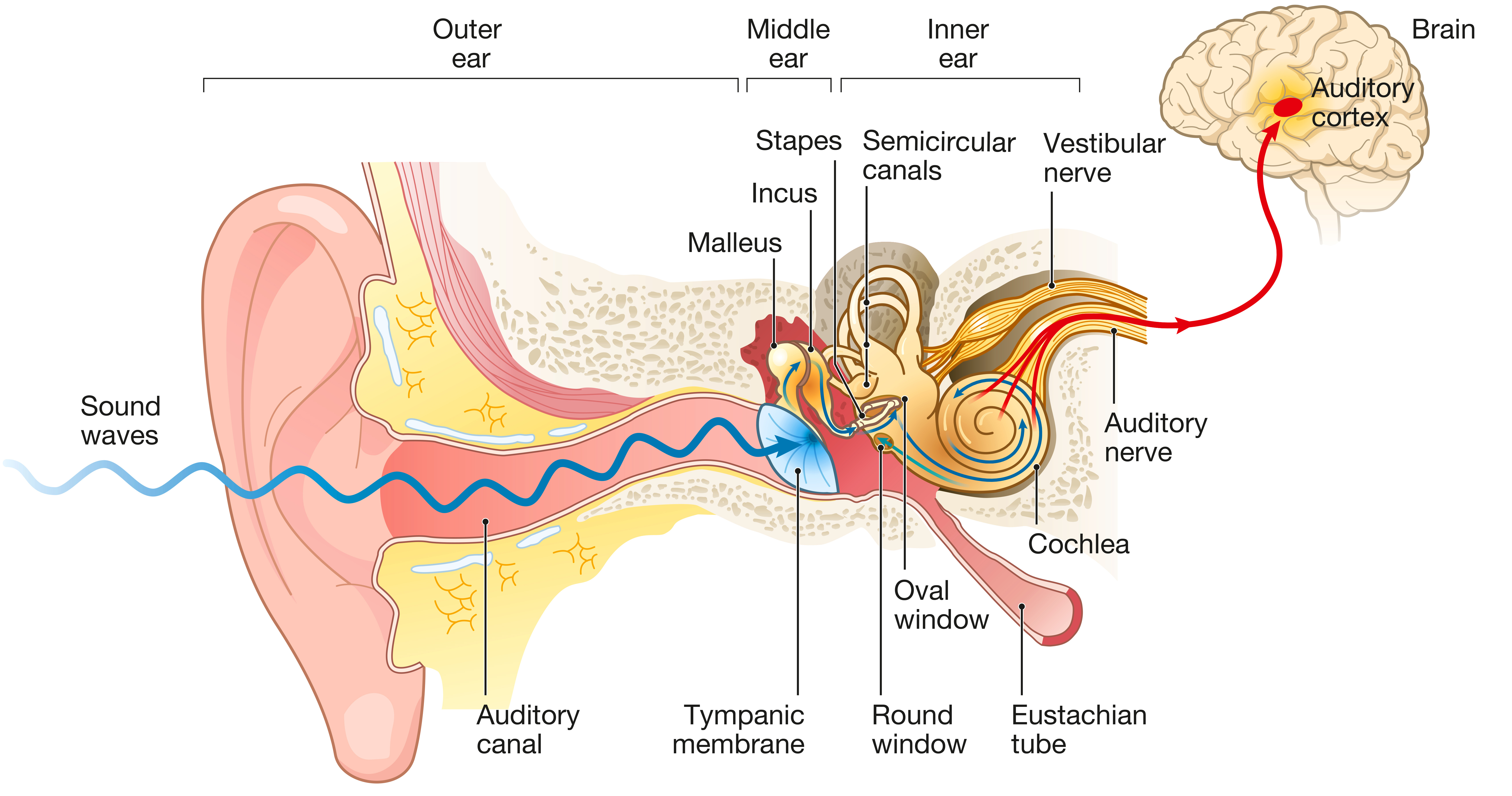
In physical terms, sound begins as mechanical vibration moving through a medium such as air. When those pressure waves reach the ear, they begin an extraordinary transformation.
The waves travel through the auditory canal and vibrate the eardrum. Three tiny middle-ear bones—the malleus, incus, and stapes—transmit and amplify those vibrations into the fluid-filled cochlea. Hair cells within the cochlea then convert mechanical movement into electrical signals. Those signals travel through the auditory nerve toward the brain, where they become what we consciously recognize as sound. (NIDCD)
Illustration I — From Vibration to Perception
Suggested placement: anatomical illustration of the outer ear, middle ear, cochlea, auditory nerve, and brain. Caption: “Sound begins as mechanical vibration and is transformed by the auditory system into neural information.”
This is our first clue.
Sound does not remain sound.
The moment we hear it, vibration has become neural activity.
And once sound reaches the brain, its influence can extend far beyond the auditory cortex. Music-based experiences may engage networks involved in attention, memory, emotion, movement, expectation, and physiological regulation. This is one reason music can evoke tears before we have consciously remembered what the song means—or cause the foot to begin tapping before we intentionally decide to move. NIH research programs are now specifically investigating the neurological and clinical mechanisms of music-based interventions. (NCCIH)
Sound therefore enters by the ear, but it does not remain there.

The Nervous System Listens Too
Consider what happens when danger appears.
Heart rate may increase. Breathing may become shallow. Muscles prepare for action. Attention narrows.
Now consider the opposite experience: lying comfortably while slow, predictable, nonthreatening sound unfolds around you.
Under appropriate conditions, music and sound may help shift the organism away from heightened arousal and toward regulation.
Large analyses of music interventions have found measurable effects on both psychological and physiological stress-related outcomes, including changes in anxiety, heart rate, blood pressure, and stress-related biomarkers. A meta-analysis devoted specifically to music therapy found an overall medium-to-large effect on stress-related outcomes across 47 studies involving 2,747 participants. (PubMed)
This does not mean that every relaxing song directly “stimulates the vagus nerve,” as is sometimes claimed in popular wellness language. Autonomic regulation is more complex than that. It is more accurate to say that auditory and musical experiences can influence physiological systems associated with arousal and relaxation, and some vibroacoustic studies have recorded changes in measures such as heart-rate variability. (Frontiers)
The distinction matters.
Good spirituality does not require bad physiology.
Indeed, the mystery becomes richer when we understand what the body is actually doing.
Rhythm: The Body’s Ancient Language
Before melody there is rhythm.
The heartbeat is rhythm.
Respiration is rhythm.
Walking is rhythm.
Sleeping and waking are rhythms.
Much of physiology is patterned in time, and the nervous system possesses a remarkable ability to coordinate movement with external rhythmic cues.
This phenomenon is especially visible in neurological rehabilitation. Rhythmic auditory stimulation has been studied in Parkinson’s disease, where externally presented rhythmic cues can assist movement. A landmark clinical study found that gait training with rhythmic auditory stimulation produced improvements in walking velocity, stride length, and cadence, and later research has continued to investigate this approach. (PubMed)
This gives us one of the clearest demonstrations of sound acting therapeutically upon the physical body.
A beat is heard.
The brain predicts the next beat.
Movement begins organizing itself around that prediction.
The external rhythm becomes an internal scaffold.
Here the word entrainment is useful when employed carefully. Entrainment does not mean that every cell mysteriously begins oscillating at the frequency of a drum. It means that biological or behavioral timing can synchronize, under appropriate circumstances, with an external rhythmic stimulus.
Sound becomes movement.
And movement becomes rehabilitation.

Sound and the Experience of Pain
Pain is physical, but pain is also neurological, emotional, and attentional.
This is why identical injuries can sometimes produce very different subjective experiences in different circumstances.
Music cannot simply erase the biological source of pain. Yet it can influence the way pain is experienced.
A large meta-analysis of music and pain found beneficial effects across multiple studies, and NIH’s National Center for Complementary and Integrative Health concludes that music-based interventions may help reduce pain intensity and emotional distress associated with pain in a variety of clinical circumstances. (PubMed)
Several mechanisms may contribute simultaneously.
Music can redirect attention. It can reduce anxiety surrounding pain. Familiar music may produce feelings of safety or control. Emotional engagement may compete with painful sensory information for attention. Relaxation can reduce the muscular guarding and psychological tension that often amplify suffering.
The important point is subtle:
Sound may not remove the wound, yet it may alter the human experience of the wound.
And relieving suffering is itself part of healing.
When Sound Is Felt Rather Than Merely Heard
There is another doorway into the body.
Touch.
Very low-frequency sound can sometimes be experienced as vibration through the body, particularly when transmitted through specialized chairs, beds, or transducers. This approach is generally called vibroacoustic therapy or vibroacoustic stimulation.
Illustration II — The Body as Listener
Suggested placement: person reclining on a vibroacoustic sound bed. Caption: “Low-frequency sound can be transmitted mechanically through a surface, creating a combined auditory and tactile experience.”
Early controlled research is intriguing but not yet definitive.
A 2022 pilot randomized trial investigated low-frequency sound vibration combined with music in university students experiencing acute stress. Researchers found differences in heart-rate variability measures, although several between-group outcomes were limited, leading the investigators themselves to call for larger studies. (Frontiers)
A 2024 study likewise investigated vibroacoustic stimulation in relation to psychological, physiological, and cognitive stress, adding to a developing body of research into the effects of sound that is simultaneously heard and physically felt. (MDPI)
This area is particularly interesting because it reminds us that hearing is not the only way vibration interacts with a human being.
Skin, connective tissue, muscle, bone, and sensory receptors respond to mechanical forces.
But caution is necessary here as well. The existence of mechanical vibration in tissue does not prove claims that particular frequencies selectively “heal the liver,” “repair DNA,” or “clear toxins.”
Those claims require evidence of their own.

The Singing Bowl and the Ritual Field
Then there is the singing bowl.
Few instruments illustrate the meeting of spirituality and physiology so beautifully.
A bowl is struck and produces not merely a pitch but a complex field of harmonics, beating patterns, decays, and subtle variations. Within a ritual setting, that sound is accompanied by expectation, stillness, posture, attention, symbolism, breathing, and intention.
Illustration III — The Sacred Acoustic Space
Suggested placement: practitioner seated with a metal singing bowl. Caption: “In contemplative practice, sound is experienced within a larger field of breath, attention, ritual, expectation, and meaning.”
Research on singing-bowl meditation is much smaller than the literature on music-based interventions generally, but results are beginning to accumulate.
An observational study of 62 adults reported decreases in tension, anger, fatigue, and depressed mood following a singing-bowl sound meditation, along with increased self-reported spiritual well-being. Because the research lacked a control condition, it cannot tell us how much of the effect came specifically from the bowls rather than resting, expectation, meditation, group environment, or other factors. (PubMed Central (PMC))
That limitation should not make the experience meaningless.
It simply changes the question.
Instead of asking, “What magical frequency produced the result?” we might ask:
What happens when sound, silence, expectation, attention, breath, ritual, and embodied presence all converge at once?
The answer may ultimately be more interesting than any single frequency.
The Healing Power of the Human Voice
Of all sound instruments, the oldest is carried within us.
The voice.
Chanting, humming, prayer, toning, song, and sustained vowels combine several processes at once: auditory stimulation, controlled respiration, muscular activity, emotional expression, vibration within the chest and skull, and focused attention.
When people sing together, another dimension appears: relationship.
Sound becomes communal.
Breaths begin to coordinate.
Individuals enter a shared temporal structure.
Memory, emotion, language, rhythm, and meaning converge.
This helps explain why professional music therapy is not merely “playing relaxing music.” Music therapy is a health profession in which trained practitioners use musical experiences within an individualized therapeutic relationship to address physical, cognitive, emotional, and social needs. (NCCIH)
Illustration IV — Music as Relationship
Suggested placement: credentialed music therapist working musically with a patient. Caption: “Clinical music therapy uses musical experience intentionally within a therapeutic relationship.”
The healer, in this context, is not the note alone.
The healing medium may be the relationship created through sound.
But What About 432 Hz, 528 Hz, and the “Healing Frequencies”?
Here we must tread carefully.
Within contemporary sound-healing communities, particular frequencies are sometimes assigned very specific properties. One frequency may be said to heal DNA, another to open the heart, another to regenerate tissue.
There is some legitimate scientific interest in specific tunings and frequencies.
Small human studies have compared music tuned around 432 Hz with conventional tuning. For example, a randomized pilot study in emergency nurses reported favorable anxiety and stress results associated with 432-Hz-tuned music. (Mattioli 1885 Journals)
But more recent controlled research makes the larger picture considerably more nuanced. A 2025 randomized crossover study in cancer patients found that both 432-Hz and 443-Hz sound interventions improved psychological outcomes. Although some cardiovascular measures appeared more favorable with 432 Hz, the difference between the tunings was not statistically significant for those objective outcomes. (Springer)
Claims about 528 Hz are even more preliminary. One frequently cited experimental study investigated biological and behavioral effects in rats rather than demonstrating disease healing in human beings. (PubMed)
So there is an important difference between saying:
“Specific acoustic frequencies are worthy of scientific investigation.”
and saying:
“Science has proven that 528 Hz repairs human DNA.”
The first statement is reasonable.
The second outruns the evidence.
An esoteric practitioner need not abandon sacred correspondences because of this. A tone may carry ritual, symbolic, contemplative, or magical significance without requiring us to make unsupported biomedical claims for it.
Science and sacred symbolism need not be enemies.
They are simply answering different questions.
Perhaps Resonance Is the Better Metaphor
We often say that something “resonates” with us.
The language is revealing.
A piece of music can suddenly awaken something buried for decades.
A hymn can return someone instantly to childhood.
A drum can awaken courage.
A lament can permit grief.
A chant can gather scattered attention into a single point.
A lullaby can communicate safety without argument.
The physical phenomenon of resonance is real, but human resonance is larger than acoustics. It includes memory, emotion, expectation, culture, relationship, and meaning.
This may be one of sound’s deepest therapeutic powers.
Sound gives invisible things a form in time.
Grief can become song.
Fear can become breath.
Chaos can become rhythm.
Isolation can become harmony.
Silence itself can become spacious rather than empty.
So, How Does Sound Heal the Human Body?
The best scientific answer is not a single mechanism.
Sound can influence the human organism through several overlapping pathways: auditory signals become neural activity; music can alter attention and emotional state; rhythmic cues can organize movement; musical experience can affect stress-related physiology; sound can alter the perception of pain; and low-frequency vibration can provide tactile as well as auditory stimulation. (NIDCD)
The best spiritual answer may be equally multidimensional.
Sound can gather consciousness.
It can mark sacred space.
It can give voice to what language cannot carry.
It can transform breathing into prayer and listening into contemplation.
And sometimes the deepest healing is not that sound has magically removed something from the body.
It is that, for a little while, the organism no longer experiences itself as fragmented.
Breath, body, emotion, memory, attention, and awareness begin moving together.
The person becomes, metaphorically speaking, more coherent.
Perhaps this is why sound has remained beside humanity in sanctuaries and hospitals alike.
We sing at births.
We chant in temples.
We play music beside the dying.
We beat drums in procession.
We whisper prayers.
We ring bells when ordinary time becomes sacred time.
The human being has always understood something that modern research is now learning how to measure:
We do not merely hear sound.
We participate in it.
And within that participation, under the right conditions, something within us can indeed begin to change.
A Note on Safety
Sound used therapeutically should remain comfortable rather than painfully loud. Excessive sound exposure can permanently damage hearing; NIDCD advises particular caution with prolonged or repeated exposure around or above 85 dBA, with risk increasing as intensity and duration increase. (NIDCD)
Sound practices are therefore best understood as complementary tools for relaxation, symptom management, contemplative practice, rehabilitation, or emotional support—not as substitutes for appropriate medical diagnosis or treatment. The scientific evidence is strongest for selected music-based interventions and substantially more preliminary for many practices marketed broadly as “frequency healing.” (NCCIH)
Annotated Bibliography
- National Center for Complementary and Integrative Health. “Music and Health: What You Need To Know.” National Institutes of Health.
This NIH resource provides one of the most useful evidence-based overviews of music-related health research. It reviews findings involving pain, anxiety, stress, Parkinson’s disease, dementia, stroke, sleep, and other conditions while repeatedly distinguishing promising findings from areas where evidence remains uncertain. It is particularly valuable for separating professional music therapy from the broader category of music-based interventions. (NCCIH) - National Institute on Deafness and Other Communication Disorders. “How Do We Hear?” National Institutes of Health.
A concise authoritative explanation of auditory physiology, following sound from the outer ear through the eardrum and ossicles into the cochlea, where hair-cell activity becomes electrical signaling carried to the brain. This source provides the physiological foundation for understanding how an external mechanical vibration becomes neurological information. (NIDCD) - de Witte, Martina, Ana da Silva Pinho, Geert-Jan Stams, Xavier Moonen, Arjan E. R. Bos, and Susan van Hooren. “Music Therapy for Stress Reduction: A Systematic Review and Meta-Analysis.” Health Psychology Review 16, no. 1 (2022): 134–159.
This meta-analysis examined 47 studies involving 2,747 participants and found an overall medium-to-large effect of music therapy on stress-related outcomes. It is especially important because it investigates music therapy specifically rather than treating every encounter with music as the same kind of intervention. (PubMed) - de Witte, Martina, Anouk Spruit, Susan van Hooren, Xavier Moonen, and Geert-Jan Stams. “Effects of Music Interventions on Stress-Related Outcomes: A Systematic Review and Two Meta-Analyses.” Health Psychology Review 14, no. 2 (2020): 294–324.
This broader analysis examines both psychological and physiological indicators of stress. It is useful for understanding why claims about sound and the nervous system should be discussed in terms of measurable stress-related outcomes rather than vague assertions about “raising vibration.” (PubMed) - Lee, Jin Hyung. “The Effects of Music on Pain: A Meta-Analysis.” Journal of Music Therapy 53, no. 4 (2016): 430–477.
Lee’s analysis evaluates research on music and pain across clinical settings. It provides an important empirical basis for discussing music as an adjunct to pain management while avoiding the stronger—and unsupported—claim that music necessarily removes the underlying pathological cause of pain. (PubMed) - Thaut, Michael H., Gerald C. McIntosh, Raymond R. Rice, Richard A. Miller, Jan Rathbun, and Jean M. Brault. “Rhythmic Auditory Stimulation in Gait Training for Parkinson’s Disease Patients.” Movement Disorders 11, no. 2 (1996): 193–200.
A classic study demonstrating a particularly concrete therapeutic use of rhythm. Patients training with rhythmic auditory stimulation demonstrated significant gait improvements. The paper remains an important example of auditory-motor entrainment being applied clinically rather than merely metaphorically. (Movement Disorders) - Kantor, Jiří, Zdeněk Vilímek, Martin Vítězník, et al. “Effect of Low Frequency Sound Vibration on Acute Stress Response in University Students—Pilot Randomized Controlled Trial.” Frontiers in Psychology 13 (2022): 980756.
This pilot randomized controlled trial explored vibroacoustic stimulation using low-frequency vibration and music. Although some heart-rate-variability findings were promising, the modest sample and limited between-group effects demonstrate why vibroacoustic therapy should presently be described as an emerging rather than conclusively established therapeutic field. (Frontiers) - Fooks, Charlotte, and Oliver Niebuhr. “Effects of Vibroacoustic Stimulation on Psychological, Physiological, and Cognitive Stress.” Sensors 24, no. 18 (2024): 5924.
A contemporary examination of vibroacoustic stimulation and multiple dimensions of stress. The study is useful for readers interested in the emerging boundary between audible sound and physically transmitted vibration and demonstrates the increasing sophistication with which these interventions are being investigated. (MDPI) - Goldsby, Tamara L., Michael E. Goldsby, Mary McWalters, and Paul J. Mills. “Effects of Singing Bowl Sound Meditation on Mood, Tension, and Well-being: An Observational Study.” Journal of Evidence-Based Complementary & Alternative Medicine 22, no. 3 (2017): 401–406.
This frequently cited observational investigation followed 62 adults through a singing-bowl sound meditation and reported improvements in several self-reported mood and well-being measures. Its absence of a control group means that specific causal effects cannot be assigned to the bowls themselves, but it provides useful preliminary evidence and a foundation for more rigorous research. (PubMed Central (PMC)) - Hohneck, Andreas, Á. M. Rodríguez, S. Weingärtner, et al. “Differential Effects of Sound Interventions Tuned to 432 Hz or 443 Hz on Cardiovascular Parameters in Cancer Patients: A Randomized Cross-Over Trial.” BMC Complementary Medicine and Therapies 25 (2025): 18.
Particularly valuable for evaluating popular claims about 432 Hz. Both tunings produced beneficial psychological effects, while the apparently greater cardiovascular effects of 432 Hz were not significantly different from those associated with 443 Hz. The study therefore supports continued research into tuning while simultaneously cautioning against declaring one pitch uniquely therapeutic. (Springer)
Educational note: This article discusses sound, music, meditation, and vibroacoustic practices as complementary approaches. It is not intended to diagnose disease or replace qualified medical care.

