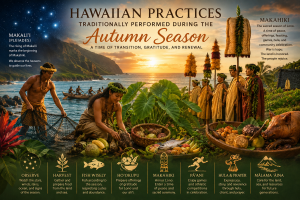
When people in Europe or North America speak of autumn, the imagination naturally turns toward falling leaves, shortening days, harvest fields, and preparations for winter. In Hawaiʻi, however, the seasonal story is different. The islands do not traditionally organize the year according to the familiar four-season cycle of spring, summer, autumn, and winter.
For Native Hawaiians, time was read through the movements of the heavens, the phases of the Moon, the appearance of stars, rainfall, winds, ocean conditions, the flowering and fruiting of plants, the migrations and spawning of fish, and countless other signs within the living environment.
Traditionally, the Hawaiian year was broadly understood through two great seasonal movements: Kau, the warmer and generally drier season, and Hoʻoilo, the cooler and wetter season. Historical Hawaiian accounts describe six lunar months belonging to each. The transition into Hoʻoilo occurred around what the Western calendar calls late autumn. (University of Hawaii)
Therefore, when we ask what Hawaiian people traditionally practiced during “autumn,” we are really asking about something more interesting:
What happened during the closing months of Kau, the preparation for Hoʻoilo, and the approach and opening of Makahiki?
The answer reveals a season concerned with observation, harvesting, food preservation, redistribution, gratitude, ritual offering, peace, physical competition, communal celebration, and the renewal of the relationship between humanity, the ʻāina, the sea, the ancestors, and the akua.
Autumn in Hawaiʻi Was a Time of Transition
The Gregorian months of approximately September through November overlap several traditional lunar months, although the correspondence is never exact because the Hawaiian calendar follows lunar and environmental observations rather than fixed Gregorian dates.
Older Hawaiian calendrical traditions identify the latter portion of Kau with months such as Mahoe Hope and ʻIkuwā, followed by Welehu, which marks the transition toward Hoʻoilo. David Malo’s nineteenth-century account describes ʻIkuwā as the final month of Kau and Welehu as the first month of Hoʻoilo. (University of Hawaii at Hilo)
The University of Hawaiʻi’s Hawaiian lunar-calendar resources similarly present ʻIkuwā as a period of increasing rain, thunder, wind, environmental change, and preparation for Makahiki, while Welehu opens the wetter season. (University of Hawaii)
This transitional quality is important.
Traditional Hawaiian seasonal activity was not governed by a printed date announcing that “autumn has begun.” A knowledgeable observer watched the world.
The sky announced the season.
The ocean announced the season.
The plants announced the season.
The winds announced the season.
The behavior of animals announced the season.
And eventually, Makaliʻi—the Pleiades—announced one of the most sacred transitions of the year.
Watching the Heavens: The Rising of Makaliʻi
Among the most important autumn practices was simply one of the most profound: observation.
The night sky served as calendar, clock, navigational map, agricultural guide, and ceremonial indicator.
The star cluster known in Hawaiian as Makaliʻi, commonly identified with the Pleiades, became especially significant as the year approached the season of Makahiki.
According to the National Park Service, Makahiki traditionally began when Makaliʻi became visible rising on the eastern horizon after sunset, generally around late October or early November, although timing and practice varied between islands and communities. (National Park Service)
This was not casual stargazing.
It was kilo—careful observation of natural phenomena.
Celestial and environmental signs helped knowledgeable practitioners determine the resetting of the lunar and ritual calendar. At Puʻuhonua o Hōnaunau, the National Park Service describes Kau Makaliʻi as a period during which traditional practitioners observed astronomical and environmental signs associated with the annual cycle of ritual. (National Park Service)
The autumn sky therefore became a sacred text.
Instead of reading the changing season from a calendar hanging upon a wall, one could read it in the stars.
Harvesting and Preparing Food
The months immediately preceding Makahiki were closely connected with the harvesting and securing of resources.
Fishing, gathering, farming, drying, salting, and storing foods were not merely economic activities. They formed part of a sophisticated system in which human consumption was coordinated with ecological cycles.
Traditional Hawaiian lunar knowledge connected particular phases and months with appropriate times for planting, harvesting, fishing, resting gardens, and allowing marine resources to replenish. The University of Hawaiʻi’s Hawaiian Lunar Calendar emphasizes that generations of Hawaiians used lunar observation to guide both agricultural and fishing practices. (University of Hawaii)
During the later months before Makahiki, fishing activity could increase specifically so that fish might be harvested, prepared, and stored before the coming wet season and ceremonial period. (University of Hawaii)
Foods such as kalo (taro), ʻuala (sweet potato), fish, and other locally available foods were central to community subsistence. Pigs, cultivated crops, and crafted goods could later become part of Makahiki tribute and ceremonial offerings. (National Park Service)
Thus, the Hawaiian autumn harvest was not simply a moment of taking abundance from the earth.
It existed within a larger rhythm:
observe → cultivate → harvest → preserve → offer → redistribute → rest → begin again.
Fishing According to the Season
The sea was just as much a part of the seasonal calendar as the land.
Fish behavior, ocean temperature, tides, spawning cycles, currents, moon phases, winds, and rainfall were carefully observed. Certain species became plentiful during particular months, while other species might be protected or avoided.
The Hawaiian lunar-calendar tradition records periods when particular fish were spawning, when certain fisheries were especially productive, and when restrictions or kapu were placed or removed. Such practices demonstrate an intimate connection between subsistence and ecological observation. (University of Hawaii)
One recorded tradition associates ʻIkuwā and Welehu with changing fishing responsibilities, including women and children gathering or catching freshwater and nearshore resources such as ʻoʻopu, hinana, hīhīwai, and ʻōpae. (University of Hawaii)
These details should not necessarily be treated as universal rules practiced identically on every island. Hawaiian ecological practices were intensely place-based. What was appropriate in Kona might differ from what was appropriate on Molokaʻi, Oʻahu, Maui, or Kauaʻi.
That principle itself is deeply Hawaiian.
Knowledge belongs to place.
Preparing Hoʻokupu: Offerings of Gratitude and Obligation
As Makahiki approached, communities prepared hoʻokupu, ceremonial offerings presented in connection with Lono, the aliʻi, and the ritual obligations of the season.
Historical descriptions of Makahiki offerings include valuable foods and goods such as:
- puaʻa — pigs
- kalo — taro
- ʻuala — sweet potatoes
- hulu — feathers
- moena — woven mats
- kapa — bark cloth
These offerings represented more than what a modern person might call taxation.
They participated in a ritual economy.
The productivity of the land was acknowledged. The relationship between people, aliʻi, land, and divine powers was reaffirmed. The abundance generated within an ahupuaʻa became visible through what it could ceremonially present.
The University of Hawaiʻi’s Kahoʻiwai resource describes ʻAha Makahiki as involving offerings of food harvested from the various lands, presented in honor of Lono. (University of Hawaii)
The act of giving therefore became one of the great spiritual gestures of the season.
One received from the ʻāina.
One returned something to the sacred order.
The Beginning of Makahiki
The defining traditional observance overlapping the later part of what Western calendars call autumn was, of course, Makahiki.
Makahiki was a major ceremonial season associated particularly with Lono, an akua closely connected with rain, agriculture, fertility, atmospheric forces, peace, and abundance.
Depending upon island and period, customs differed. The surviving written record is especially rich for Hawaiʻi Island, and modern summaries should therefore avoid assuming that every community practiced precisely the same rites. The National Park Service explicitly notes that individual islands had their own ways of observing Makahiki. (National Park Service)
Yet several broad themes recur.
Makahiki represented a shift away from ordinary political and productive activity toward ceremony, renewal, tribute, recreation, and peace.
War became kapu.
Labor patterns changed.
Offerings were gathered.
Lono was honored.
Communities feasted.
Athletic competitions were held.
Hula and celebration accompanied the sacred season.
For a time, the rhythm of society itself changed. (National Park Service)
The Procession of Lono
One of Makahiki’s most dramatic ceremonies involved an image or emblem of Lono known as the Akua Loa.
According to traditions documented by the National Park Service, the Akua Loa traveled through districts in a ritual circuit, visiting the lands and receiving offerings. A related form called the Akua Poko also participated in the ritual complex. (National Park Service)
At Puʻuhonua o Hōnaunau, this circuit is described as something like a ritual survey of the wealth and productivity of the land. (National Park Service)
Imagine the meaning of such a procession.
The god does not remain hidden within a distant temple.
The sacred presence moves through the land.
The productivity of each district is encountered.
Offerings are presented.
Human communities publicly acknowledge their dependence upon forces greater than themselves.
The sacred travels through the inhabited world.
This is one reason Makahiki should not be reduced simply to “the Hawaiian Thanksgiving.”
Gratitude and harvest are certainly present, but Makahiki is considerably larger: it is a political, ecological, agricultural, religious, social, and cosmic season of renewal.
A Time of Peace
Among the most striking features of Makahiki was the suspension of warfare.
During the season dedicated to Lono, war was traditionally prohibited. (National Park Service)
Symbolically, this represents one of the most powerful transitions of the Hawaiian ceremonial year.
Weapons that might otherwise defend territory or advance political power were temporarily subordinated to another principle.
The community entered a sacred interval.
One might call it an annual rebalancing between human ambition and cosmic order.
The season declared, in effect:
There must be times for striving.
There must also be times for peace.
There must be times to cultivate.
There must also be times to enjoy what has been cultivated.
There must be times to compete for power.
There must also be times to remember that all power ultimately depends upon land, rain, ocean, community, and the unseen forces sustaining life.
Feasting and Communal Celebration
Once appropriate ritual restrictions were lifted, feasting became an important part of Makahiki observance.
The ʻAha Makahiki tradition preserved in University of Hawaiʻi cultural resources describes the ceremonial acceptance of offerings, after which the period of enjoyment could begin with feasting and games. (University of Hawaii)
Eating together had social significance.
Food demonstrated the prosperity of the land.
It expressed hospitality.
It strengthened relationships.
It redistributed abundance.
It also transformed the results of months of agricultural and fishing labor into communal experience.
Harvest became feast.
Work became celebration.
Abundance became relationship.
Pāʻani Makahiki: The Games of the Season
Autumn’s movement into Makahiki also brought one of the most joyful dimensions of Hawaiian ceremonial culture: pāʻani, games and athletic contests.
Traditional Makahiki competitions could include activities such as:
ʻUlu maika — rolling a shaped stone between stakes, sometimes compared loosely with bowling.
Mokomoko — boxing.
Hakoko — wrestling.
ʻŌʻō ihe — spear or javelin throwing.
Kūkini — foot racing.
Other traditions included surfing, sledding, canoe racing, and various contests of physical ability. (University of Hawaii)
These were not merely diversions.
Athletic skill demonstrated discipline, balance, endurance, courage, coordination, and bodily intelligence.
In this sense, Makahiki celebrated the prosperity not only of the land but of the human body.
A healthy community required strong land.
Strong land nourished strong people.
Strong people could then celebrate the abundance of the land.
The relationship was reciprocal.
Hula, Prayer, and Sacred Celebration
Makahiki festivities also included hula, prayer, religious ceremony, and communal celebration. (University of Hawaii)
Hula in traditional Hawaiian culture cannot be reduced simply to entertainment.
It can carry genealogy, history, prayer, praise, memory, environmental knowledge, and spiritual relationship.
Within a sacred seasonal setting, chant and movement help join the visible community with the invisible dimensions of memory and divine presence.
Thus, during this season, celebration itself could become an act of reverence.
Joy and holiness did not have to be opposites.
They could be expressions of the same sacred abundance.
Hōʻihi: Entering Sacred Places With Reverence
Another important principle connected with Makahiki observance is hōʻihi—reverence, respect, and dignified conduct.
At Puʻuhonua o Hōnaunau, contemporary cultural practitioners continue to present hoʻokupu during Makahiki ceremonies, and the National Park Service describes hōʻihi as the attitude with which sacred places and ceremonial actions are approached.
This principle gives us a deeper way of understanding Hawaiian seasonal spirituality.
The important question was not simply:
“What ritual should I perform?”
It was also:
“How should I stand in relationship with this place?”
Sacredness required appropriate behavior.
The land was not scenery.
The ocean was not merely a resource.
The heavens were not merely astronomical objects.
The season itself was not merely weather.
Each participated in relationship.
Mālama ʻĀina: Caring for What Sustains Life
Although the expression mālama ʻāina is used widely today, the underlying principle of reciprocal care is clearly reflected in traditional Hawaiian resource management.
The lunar calendar demonstrates a system in which people observed when to fish, when to harvest, when to plant, and when certain resources should be left alone. (University of Hawaii)
This is a profoundly different attitude from extracting as much as possible whenever an opportunity arises.
The traditional ecological question was often closer to:
What is the appropriate action at this particular time?
The answer changed according to the Moon.
It changed according to rain.
It changed according to spawning cycles.
It changed according to currents.
It changed according to place.
It changed according to season.
What modern people call sustainability was embedded within a broader discipline of attention and reciprocity.
Autumn as a Spiritual Threshold
Seen through Hawaiian seasonal consciousness, the autumn months represent a threshold.
The dry season approaches its conclusion.
The Sun moves southward.
Rain increases.
The winds change.
The sea changes.
Foods are harvested and preserved.
Makaliʻi returns to prominence in the evening sky.
Makahiki approaches.
Lono returns ceremonially.
Offerings are made.
War falls silent.
Work gives way, at least temporarily, to rest.
Games replace battle.
Feasting replaces accumulation.
The community pauses within the turning of the year.
And this may be the deepest spiritual teaching of the Hawaiian autumn:
A people cannot live only by producing.
There must also be a time for acknowledging.
A time for giving.
A time for remembering.
A time for observing.
A time for peace.
A time for celebration.
And a time for recognizing that human prosperity exists only because human life participates within a much greater living system.
The Spiritual Meaning of the Hawaiian Autumn
For a modern spiritual practitioner, the greatest lesson of this season may not be to imitate ceremonies belonging to Native Hawaiian cultural lineages without proper understanding or relationship.
The deeper invitation is to learn from their underlying wisdom.
Observe before acting.
Know the land upon which you stand.
Understand what the season is actually doing.
Give something back when you receive.
Allow periods of restraint to accompany periods of abundance.
Honor those who came before.
Cultivate peace deliberately.
Recognize that food is sacred because life produced it.
Understand that celebration can itself become prayer.
And remember that the natural world is not merely happening around us.
We are happening within it.
Makahiki expresses this beautifully.
Humanity pauses long enough to recognize the powers that sustain it.
The rain.
The soil.
The cultivated field.
The ocean.
The Moon.
The stars.
The ancestors.
The akua.
The community.
All are woven together.
Autumn in Hawaiʻi: Not a Season of Falling Leaves, but of Returning Relationship
The Hawaiian autumn is therefore best understood not as a tropical version of a European harvest festival, but as the closing movement of one seasonal cycle and the opening of another.
It is a time of kilo, careful observation.
A time of harvesting and preserving.
A time of responsible fishing and agricultural management.
A time of preparing hoʻokupu.
A time of watching for Makaliʻi.
A time of entering Hoʻoilo.
And ultimately, a time of Makahiki—of Lono, peace, feasting, games, hula, prayer, gratitude, redistribution, and renewal.
The leaves may not turn crimson and gold across Hawaiʻi as they do in temperate forests.
But the season nevertheless changes.
The heavens change.
The rains change.
The waters change.
Human responsibilities change.
And within those changes is an ancient lesson:
To know the season is to know when to work, when to gather, when to give, when to refrain—and when to celebrate the sacred abundance of life.
Annotated Bibliography
Hawaiian Practices Traditionally Performed During the Autumn Season
Research Note
The concept of “autumn” should be used cautiously when discussing traditional Hawaiian culture. The Hawaiian calendar was not historically divided into the four temperate seasons of spring, summer, autumn, and winter. Rather, Hawaiian communities followed lunar months, celestial observations, rainfall, winds, ocean conditions, agricultural cycles, and broader seasonal divisions such as Kau and Hoʻoilo. The Western autumn months overlap especially with ʻIkuwā, Welehu, and the opening of the Makahiki season. The sources below are therefore selected for their usefulness in understanding Makahiki, Lono, Makaliʻi, lunar calendrics, agriculture, fishing, hoʻokupu, seasonal games, environmental observation, and Hawaiian relationships with ʻāina.
1. Malo, David. Hawaiian Antiquities (Moolelo Hawaii). Translated by Nathaniel B. Emerson. Honolulu: Bishop Museum Press, 1951.
David Malo’s Hawaiian Antiquities is one of the foundational sources for the study of traditional Hawaiian society. Malo (c. 1795–1853) was a Native Hawaiian historian and scholar whose knowledge came from a period when substantial elements of the older religious and social systems remained within living memory. The work discusses Hawaiian social organization, gods, religious observances, calendrical concepts, agriculture, fishing, government, kapu, and ceremonies. A 1951 Bishop Museum edition is widely cited, while the English translation had appeared much earlier. (Department of Hawaiian Home Lands)
Relevance to this topic: Malo is particularly valuable for establishing that Hawaiian seasonal reckoning cannot simply be mapped onto the European four-season calendar. His descriptions help situate Makahiki within the broader annual religious and social cycle.
Research value: ★★★★★ — Essential historical source.
2. Kamakau, Samuel Mānaiakalani. Ruling Chiefs of Hawaii. Rev. ed. Honolulu: Kamehameha Schools Press, 1992.
Samuel Mānaiakalani Kamakau (1815–1876) was one of the most important nineteenth-century Native Hawaiian historians. Much of his historical work originally appeared in Hawaiian-language newspapers before being collected and translated. Ruling Chiefs of Hawaii records political history, chiefly institutions, ceremonial practices, religion, warfare, and social organization. The revised 1992 edition includes additional editorial and reference material. (WorldCat)
Relevance to this topic: Makahiki was not only an agricultural observance but also part of the political and chiefly order. Kamakau provides crucial background for understanding the relationship among aliʻi, makaʻāinana, tribute, religious authority, warfare, and ceremonial cycles.
Research value: ★★★★★ — Especially important for the political and historical dimensions of Makahiki.
3. Kamakau, Samuel Mānaiakalani. Ka Poʻe Kahiko: The People of Old. Translated by Mary Kawena Pukui. Arranged and edited by Dorothy B. Barrère. Honolulu: Bishop Museum Press, 1964; later reprints.
This volume gathers Kamakau’s Hawaiian-language writings concerning the lives, beliefs, practices, and social organization of earlier generations of Hawaiians. Bishop Museum describes the work as documenting fundamental principles underlying everyday Hawaiian life, with particular attention to spiritual and religious dimensions. (Bishop Museum Press)
Relevance to this topic: The volume provides cultural context for interpreting activities such as prayer, offerings, kapu, work, communal responsibilities, and relationships with supernatural powers. It helps prevent Makahiki from being treated merely as a harvest festival divorced from the religious worldview within which it operated.
Research value: ★★★★★ — Strong Native Hawaiian historical foundation.
4. “Ka Hoomana Kahiko. Helu 30 / Old Worship. Number 30.” Ka Nupepa Kuokoa, December 9, 1865. IHLRT Hawaiian Newspaper Archive, University of Hawaiʻi at Mānoa.
This Hawaiian-language newspaper article is an especially significant primary historical source. It describes a Makahiki manifestation of Lono, including the ceremonial image carried from place to place, its movement between lands, sacred restrictions surrounding it, and the presentation of pigs, food, and other hoʻokupu by commoners and chiefs. The University of Hawaiʻi archive provides both transcription and English translation. (University of Hawaii at Manoa)
Relevance to this topic: This source directly supports descriptions of the procession of Lono and the gathering of ceremonial offerings during Makahiki.
Research value: ★★★★★ — One of the strongest primary sources for Makahiki ritual.
5. Handy, E. S. Craighill, and Elizabeth Green Handy, with Mary Kawena Pukui. Native Planters in Old Hawaii: Their Life, Lore, and Environment. Honolulu: Bishop Museum Press, 1972.
This substantial ethnographic work examines Hawaiian agriculture, land use, irrigation, cultivated plants, environmental adaptation, mythology, rituals, and agricultural knowledge. Bishop Museum notes that the work arose from extensive research and collaboration with Hawaiian cultural authority Mary Kawena Pukui. A major portion of the study also addresses the Makahiki harvest festival. (Bishop Museum Press)
Relevance to this topic: This is perhaps the single most useful secondary reference for explaining the connection among harvest, agriculture, land productivity, religious observance, and Makahiki. It also demonstrates how agricultural practices differed according to local environments across the islands.
Research value: ★★★★★ — Essential for agriculture, harvest, and land-based seasonal practices.
6. Abbott, Isabella Aiona. Lāʻau Hawaiʻi: Traditional Hawaiian Uses of Plants. Honolulu: Bishop Museum Press, 1992.
Renowned Hawaiian ethnobotanist Isabella Aiona Abbott assembled this study of traditional Hawaiian relationships with plants. It addresses food, medicine, clothing, shelter, cordage, religion, recreation, cultivated crops, aquatic plant foods, kalo, ʻuala, hula, and other forms of plant knowledge. Bishop Museum describes it as a broad account connecting Hawaiian flora directly with Hawaiian cultural practice. (Google Books)
Relevance to this topic: Abbott’s work provides botanical and cultural depth for discussions of harvest foods, cultivated plants, offerings, lei and ritual plant materials, and the relationship between seasonal abundance and Hawaiian religious life.
Research value: ★★★★☆ — Excellent ethnobotanical companion to Native Planters in Old Hawaii.
7. Kanahele, Pualani Kanakaʻole. Ka Honua Ola: ʻEliʻeli Kau Mai—The Living Earth: Descend, Deepen the Revelation. Honolulu: Kamehameha Publishing, 2011.
Cultural scholar and practitioner Pualani Kanakaʻole Kanahele explores Hawaiian relationships with the living earth through twenty-five mele associated with Pele and Hiʻiaka. The work draws together genealogy, land, divine presence, hula, ancestral memory, and environmental relationships. (Kamehameha Publishing)
Relevance to this topic: Although not a manual of Makahiki ritual, this work provides a valuable Hawaiian-centered philosophical foundation for understanding why ʻāina, weather, growth, water, genealogy, human activity, and divine powers cannot easily be separated in traditional Hawaiian thought.
It is especially useful when discussing the deeper spiritual meaning of seasonal observance without reducing Hawaiian ecological knowledge to modern environmental terminology alone.
Research value: ★★★★☆ — Excellent for Hawaiian metaphysics, sacred ecology, and worldview.
8. University of Hawaiʻi. “Hawaiian Lunar Calendar.” Hawaiʻi Climate Data Portal.
This University of Hawaiʻi resource presents the Hawaiian lunar calendar as an environmental knowledge system developed through generations of observation. It explains how lunar phases were used alongside the observation of organisms, weather, marine conditions, agriculture, and fishing to determine appropriate periods for resource use and rest. (University of Hawaii)
Of particular importance to the autumn topic are its descriptions of the lunar months Mahoe Hope, ʻIkuwā, and Welehu. The resource notes that fishing effort could increase before Makahiki in order to prepare and store food, while ʻIkuwā brought rain, thunder, wind, and preparations for Makahiki. It also connects the season with the rising of Makaliʻi. (University of Hawaii)
Relevance to this topic: This is one of the strongest accessible sources for explaining why a Hawaiian discussion of “autumn” must be based on lunar months and ecological indicators rather than simply September, October, and November.
Research value: ★★★★★ — Essential for the seasonal framework of the blog.
9. University of Hawaiʻi. “ʻAha Makahiki.” Kahoʻiwai.
This cultural knowledge resource describes ʻAha Makahiki as ceremony associated with the coming of Lono and the rainy season. It discusses the movement of Lono through the ahupuaʻa, the gathering of harvested food offerings, the lifting of kapu, feasting, and traditional games including mokomoko, ʻulu maika, ʻōʻō ihe, kōnane, kūkini, and related activities. (University of Hawaii)
Importantly, the resource cites major Hawaiian cultural references such as Native Planters in Old Hawaii, helping connect contemporary Hawaiian educational interpretation with established historical scholarship.
Relevance to this topic: Excellent support for sections concerning hoʻokupu, Lono, feasting, games, prayer, agriculture, and ceremonial procession.
Research value: ★★★★★ — Particularly useful for a public-facing blog.
10. National Park Service. “Makahiki.” Haleakalā National Park.
The National Park Service’s Makahiki overview provides a concise account of the ceremonial season associated with Lono. It identifies the appearance of Makaliʻi near the eastern horizon after sunset as a traditional indicator of the beginning of Makahiki and describes the season as involving rest, religious festivities, feasting, games, dancing, offerings, and the prohibition of warfare. (National Park Service)
The page also identifies traditional offerings including pigs, kalo, ʻuala, feathers, mats, and kapa and describes the Akua Loa procession connected with Lono. Importantly, it cautions that individual Hawaiian islands possessed their own forms of Makahiki observance and that much surviving documentation relates particularly to Hawaiʻi Island. (National Park Service)
Relevance to this topic: An excellent source for establishing the basic structure of Makahiki while retaining the important warning against presenting one island’s customs as universally Hawaiian.
Research value: ★★★★★ — Highly useful synthesis for general readers.
11. National Park Service. “Kau Makaliʻi—Season of the Makahiki Ritual.” Puʻuhonua o Hōnaunau National Historical Park.
This resource provides one of the clearest contemporary cultural explanations of Kau Makaliʻi, connecting celestial observation, environmental phenomena, Hawaiian lunar reckoning, Lono, games, agricultural abundance, and seasonal renewal. It identifies ʻIkuwā, Welehu, and Makaliʻi as lunar months associated with this ritual period and places them approximately between November and January. (National Park Service)
The page also explains that the Akua Loa traveled through the moku as part of a ritualized assessment of the productivity and wealth of the land. It emphasizes renewal and the maintenance of balance among people, land, water, and natural resources. (National Park Service)
Relevance to this topic: Particularly important for the blog’s themes of kilo, celestial observation, Makaliʻi, seasonal transition, Lono, ritual procession, environmental productivity, and renewal.
Research value: ★★★★★ — One of the best modern interpretive sources for the subject.
12. National Park Service. “Kau Makahiki.” Video presentation by Kahakaiʻo Ravenscraft. Puʻuhonua o Hōnaunau National Historical Park, November 5, 2021.
In this cultural presentation, Park Ranger and cultural demonstrator Kahakaiʻo Ravenscraft discusses the changing Hawaiian seasons and their relationship with management of the ahupuaʻa. The presentation emphasizes that Makahiki also involved assessments of ʻāina, land productivity, population, and distribution of resources. (National Park Service)
Relevance to this topic: This source adds an important dimension sometimes absent from popular descriptions: Makahiki was simultaneously religious, ecological, economic, social, and political. Seasonal observance helped communities evaluate the actual productivity and condition of their lands.
Research value: ★★★★☆ — Excellent supplemental cultural interpretation.
Additional Contemporary Resource
University of Hawaiʻi. “Makahiki Column.” Ka Huli Ao Center for Excellence in Native Hawaiian Law, William S. Richardson School of Law.
This short interpretive article connects the rising of Nā Huihui o Makaliʻi, the Pleiades, with the traditional Makahiki season and describes Makahiki as a time associated with harvest, rest, spiritual renewal, and thanksgiving. (University of Hawaii at Manoa)
Relevance to this topic: Helpful for discussing the continued importance of Makahiki within contemporary Native Hawaiian institutions.
Research value: ★★★☆☆ — Useful supplemental reading rather than a primary historical authority.
Recommended Research Hierarchy
For the strongest historical treatment of Hawaiian autumnal practices, the sources should not all be weighted equally.
The most authoritative foundation should begin with Native Hawaiian historical voices, particularly David Malo and Samuel Mānaiakalani Kamakau. The nineteenth-century Hawaiian-language newspaper material preserved through the University of Hawaiʻi should likewise receive special attention because it brings the researcher close to Hawaiian-language accounts created during a period when knowledge of the older traditions remained comparatively immediate.
For agriculture and subsistence, Handy, Handy, and Pukui’s Native Planters in Old Hawaii should be a principal reference, supplemented by Isabella Abbott’s Lāʻau Hawaiʻi.
For understanding how the lunar and environmental calendar functioned, the University of Hawaiʻi Hawaiian Lunar Calendar is particularly valuable.
For contemporary Hawaiian interpretation and the continued cultural life of Makahiki, the resources from Kahoʻiwai, Puʻuhonua o Hōnaunau National Historical Park, and Hawaiian cultural practitioners are especially useful.
Taken together, these sources reveal that what we call the Hawaiian “autumn season” was not simply a harvest period. It represented a complex transition involving:
kilo — careful observation;
mahina — lunar reckoning;
Makaliʻi — celestial seasonal indication;
mahiai — cultivation and harvest;
lawaiʻa — fishing according to ecological cycles;
hoʻokupu — ceremonial giving;
Lono — rain, fertility, abundance, and Makahiki;
kapu — sacred regulation and restraint;
pāʻani — games and athletic competition;
ʻahaʻaina — feasting and communal sharing;
maluhia — a sacred interval of peace;
and mālama ʻāina — the continuing responsibility to care for the lands and waters that sustain human life.
The resulting picture is therefore much richer than a Hawaiian equivalent of a Western harvest festival. Kau Makaliʻi and Makahiki reveal an entire system of seasonal consciousness in which astronomy, ecology, religion, governance, agriculture, community, and spiritual renewal converge.

