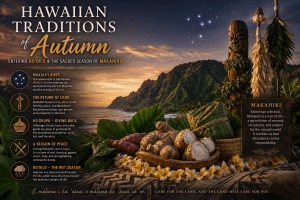
When autumn arrives in much of the Northern Hemisphere, the familiar imagery is of falling leaves, lengthening nights, harvest fields, and the gradual descent toward winter. Hawaiʻi experiences this turning of the year differently. There is no broad landscape of forests changing from green to gold, nor did traditional Hawaiian culture divide the year according to the familiar European pattern of spring, summer, autumn, and winter.
Instead, the Hawaiian seasonal worldview arose from careful observation of rain, wind, ocean, stars, plants, animals, lunar cycles, and the productivity of the ʻāina.
Thus, to ask what Hawaiian traditions belong to autumn is to enter a very different understanding of sacred time.
The months that roughly correspond to September through November form a threshold. The hotter and generally drier portion of the year begins yielding to Hoʻoilo, the wetter, cooler season. The winds change. Rains become increasingly significant. Ocean conditions shift. The lunar calendar moves onward. And eventually the star cluster Makaliʻi—the Pleiades—appears in the evening sky, announcing one of the most important ceremonial periods of old Hawaiʻi:
Makahiki.
Rather than a Hawaiian equivalent of a European autumn festival such as Mabon, Makahiki represents an indigenous seasonal system of its own—one concerned with renewal, abundance, peace, reciprocity, agricultural fertility, community, and the relationship between human beings, the gods, and the living land.
Hawaiʻi’s Year Was Read from Nature
Traditional Hawaiian timekeeping was ecological as much as chronological.
Rather than looking only at numbered dates on a fixed calendar, Hawaiian communities observed the relationships between the mahina, or Moon; the Sun; stars; rainfall; winds; tides; spawning cycles; plant growth; agricultural conditions; and fishing opportunities.
The traditional year is commonly described as having two broad seasons:
Kau or Kauwela — the warmer, generally drier season
and
Hoʻoilo — the cooler, wetter season.
University of Hawaiʻi sources describe Hoʻoilo as encompassing the wetter half of the year, while Hawaiian resource-management calendars connect specific lunar months with environmental conditions and appropriate agricultural and fishing activities. (University of Hawaii at Hilo)
This is important because Hawaiian seasonal spirituality cannot easily be separated from Hawaiian environmental knowledge.
The sacred calendar was written across the landscape.
Rain was part of the calendar.
Fish were part of the calendar.
The flowering and fruiting of plants were part of the calendar.
The movements of stars were part of the calendar.
The Moon was part of the calendar.
The human community lived within that greater clock.
The Hawaiian “Autumn” as a Threshold
The period Western calendars call autumn roughly overlaps the latter portion of the dry season and the transition into Hoʻoilo.
Individual Hawaiian month names and their alignment with Gregorian months could vary according to island and tradition; Hawaiian-language historical sources themselves preserve such regional differences. (Bishop Museum Blog)
For that reason, it is better not to imagine a universally fixed ancient Hawaiian calendar mapped neatly over September, October, and November.
Nevertheless, an important pattern emerges.
As the year moves toward ʻIkuwā and Welehu, environmental conditions begin changing. Hawaiian lunar-calendar sources associate ʻIkuwā with increasing rain, thunder, lightning, wind, and preparation for Makahiki. (University of Hawaii)
The season therefore carries something recognizable to many traditional cultures:
a sense of completion and transition.
The productive cycle has reached a turning point.
What has grown is acknowledged.
What has been received must be reciprocated.
The community prepares itself for another phase in its relationship with the land.
Makaliʻi: The Stars Announce the Sacred Season
Perhaps the most beautiful symbol of this transition is Makaliʻi, the Hawaiian name for the Pleiades.
The appearance of Makaliʻi in the eastern evening sky served as an important celestial sign connected with the beginning of Makahiki.
The National Park Service describes the traditional festival as beginning when Makaliʻi rises over Hawaiʻi around sunset, generally around late October or early November, although the precise reckoning depended upon traditional observation rather than an arbitrary Gregorian date. (National Park Service)
This gives Hawaiian autumn a celestial character.
Imagine standing beneath the Hawaiian night sky.
The heat of the dry season has begun to loosen its hold.
Clouds gather differently.
The smell of approaching rain moves across the land.
Then the small cluster of stars appears.
Makaliʻi has returned.
To those trained to read the heavens, this is not merely astronomy.
It is announcement.
The heavens and the ʻāina are speaking together.
A new sacred season is beginning.
Makahiki: The Great Season of Lono
At the center of this seasonal transition stands Lono, one of the principal akua of Hawaiian religious tradition.
Lono is strongly associated with rain, agricultural fertility, abundance, peace, music, and cultivated food. Hawaiian traditions connected his return with the rains of Hoʻoilo and the Makahiki season. (National Park Service)
Makahiki traditionally lasted for several lunar months.
During this period, the ordinary rhythms of society changed.
Certain forms of labor were restricted.
Warfare was prohibited.
Ceremonial processions occurred.
Offerings were made.
Athletic competitions were held.
People feasted.
Communities rested and celebrated.
Religious observances acknowledged the powers responsible for sustaining life.
It was therefore simultaneously an agricultural festival, religious cycle, political institution, period of recreation, and renewal of the reciprocal relationship between people and the sacred powers governing the land.
The Coming of Lono
One of the striking features of traditional Makahiki was the ceremonial movement of an image representing Lono through the districts of the island.
An important form was the akua loa, a tall ceremonial standard associated with Lono.
Accounts describe priests carrying the image through different ahupuaʻa, the traditional land divisions extending through ecological zones from uplands toward the sea.
The movement was therefore more than a procession.
It was, symbolically, a visitation.
Lono moved through the land.
At each place the relationship between land, people, ruler, and deity was recognized.
The National Park Service describes the akua loa traveling through districts in what functioned as a ritual survey of the land’s wealth and productivity. (National Park Service)
One might almost imagine the entire island becoming ceremonial ground.
Mountain.
Field.
Village.
Fishpond.
Shore.
Each existed within the same sacred ecology.
Hoʻokupu: Giving Back from What Has Been Given
Central to Makahiki was the practice of hoʻokupu, or offerings.
Communities presented agricultural and material goods associated with the productivity of their lands.
Traditional offerings could include:
- kalo, or taro;
- ʻuala, or sweet potato;
- puaʻa, or pigs;
- kapa;
- woven mats;
- feathers;
- and other products representing the abundance and craftsmanship of the community.
These offerings were connected both with religious devotion and with the political economy of chiefly society. (National Park Service)
Yet hoʻokupu carries an idea larger than simply paying tribute.
It embodies reciprocity.
The land gives.
The rains give.
Plants give.
The ocean gives.
The gods give.
Human beings therefore do not merely consume.
They return something.
This principle remains one of the most profound lessons that Makahiki can offer a modern reader.
Gratitude is incomplete when it remains only an emotion.
Gratitude becomes sacred when it becomes reciprocal action.
A Season in Which War Became Kapu
One of the most extraordinary characteristics associated with Makahiki was the restriction of warfare.
The season belonged to Lono and to renewal.
Military activities associated especially with the domain of Kū gave way to another sacred rhythm.
War became kapu.
The National Park Service describes ancient Makahiki as a period of rest, feasting, games, dancing, religious observance, and suspended warfare. (National Park Service)
This ceremonial interruption is deeply significant.
Society was being reminded that life could not consist perpetually of acquisition, conflict, expansion, labor, and conquest.
There must also be a season of restoration.
A time when the hand releases the weapon.
A time when productivity yields to gratitude.
A time when the community remembers that continued life depends upon relationships more fundamental than political struggle.
In that sense, the coming of Lono represented not weakness but balance.
Makahiki Games: Strength Expressed without War
The suspension of warfare did not mean inactivity.
Makahiki was famous for physical contests and games.
Historical descriptions include such activities as:
ʻulu maika — rolling a specially shaped stone between markers;
mokomoko — boxing;
hakoko — wrestling;
ʻōʻō ihe — spear or javelin throwing;
as well as sledding, surfing, canoe racing, and other demonstrations of physical skill.
Hula, feasting, and communal celebration accompanied the season as well. (National Park Service)
There is a fascinating transformation occurring here.
Competitive energy does not disappear.
It is redirected.
Instead of proving strength through warfare, people demonstrate strength through skill, discipline, endurance, coordination, play, and ceremony.
The warrior impulse becomes the athletic impulse.
Competition becomes festivity.
Power is allowed expression without requiring destruction.
Rain as Blessing
For cultures accustomed to temperate climates, rain during autumn may signify inconvenience or approaching cold.
Within the Hawaiian agricultural world, rain could carry a much more intimate spiritual significance.
Lono was associated with rain and agricultural fertility.
As the land entered Hoʻoilo, the arrival of wetter weather belonged to a great ecological cycle upon which food production depended.
The clouds gathering over the mountains were therefore not separate from spirituality.
Water falling upon ʻāina was life moving visibly through creation.
The Hawaiian word wai, water, appears in concepts associated with prosperity and abundance; freshwater was—and remains—fundamental to the productivity and health of the land.
The autumn threshold therefore invites attention upward toward the clouds and downward toward the soil simultaneously.
The heavens fertilize the earth.
The earth responds.
Humanity receives.
And humanity is consequently obligated to mālama—to care for what sustains life.
Preparing for the Wet Season
The approach of Makahiki was not concerned solely with ceremony.
Traditional Hawaiian environmental knowledge also involved careful preparation.
The University of Hawaiʻi’s Hawaiian lunar-calendar resource records that during the period preceding Makahiki, fishing activity could increase so that fish might be harvested and stored before the wetter season. It also describes changing fishing responsibilities and environmental conditions during ʻIkuwā and Welehu. (University of Hawaii)
Seasonal awareness therefore required prudence.
Sacred observance and practical survival were not opposites.
Knowing when to fish was spiritual knowledge.
Knowing when to plant was spiritual knowledge.
Knowing when storms might arrive was spiritual knowledge.
Knowing when not to harvest was spiritual knowledge.
Knowing when the land required rest was spiritual knowledge.
The sacred existed within competent relationship with place.
Rest Was Part of the Cycle
There is an old Hawaiian saying associated with Welehu recorded in Mary Kawena Pukui’s ʻŌlelo Noʻeau and discussed by Bishop Museum:
“Rest the head on the pillow; Welehu is the month.” (Bishop Museum Blog)
The statement is remarkably simple.
Yet behind it lies an entire philosophy of seasonal life.
There are times for work.
Times for fishing.
Times for planting.
Times for harvest.
And there are times for rest.
Modern culture often treats rest as the absence of productivity.
Traditional seasonal cultures frequently understood something different:
rest is one of the conditions that makes future productivity possible.
Land requires intervals.
Bodies require intervals.
Communities require intervals.
Even ritual calendars breathe.
Makahiki creates such a breathing space.
There Was No Hawaiian “Mabon”
For modern practitioners familiar with the Western esoteric or contemporary Pagan Wheel of the Year, an important distinction should be maintained.
There is no need to rename Makahiki as a “Hawaiian Mabon.”
Nor should the autumnal equinox automatically be treated as though it were the central ancient Hawaiian autumn festival.
The two traditions arise from different geographies, histories, cosmologies, agricultural systems, and celestial observations.
Mabon, as practiced within modern Pagan traditions, is commonly centered upon the autumn equinox.
Traditional Hawaiian seasonal observance was embedded within a lunar and ecological calendar and prominently marked the emergence of Makaliʻi and the commencement of Makahiki.
Recognizing similarities—harvest, gratitude, seasonal transition, communal feasting—can be illuminating.
Collapsing the traditions into one another is not.
Each deserves to retain its own voice.
The Deeper Spiritual Pattern
Seen through a contemplative lens, the Hawaiian autumn threshold presents several intertwined movements.
Observation.
Before people act, they watch.
They watch the Moon.
They watch the stars.
They watch the sea.
They watch the clouds.
They watch the crops.
The spiritual life begins in attention.
Then comes:
Recognition.
Something greater than the individual sustains life.
No farmer creates rain.
No fisherman commands the sea.
No chief causes the stars to rise.
Life exists inside relationships.
Then comes:
Gratitude.
Abundance is acknowledged.
But gratitude becomes meaningful through:
Reciprocity.
Hoʻokupu is given.
Resources are respected.
Relationships are renewed.
Then comes:
Restraint.
War ceases.
Ordinary activity changes.
The culture enters sacred time.
And finally:
Renewal.
Games are played.
People feast.
Bodies rest.
Communities reconnect.
The land receives rain.
Another cycle begins.
A Hawaiian Theology of Relationship
One of the most powerful ideas that emerges from these traditions is that humanity does not stand outside nature observing it.
Human beings participate within a larger network of relationships involving akua, ʻāina, wai, kai, plants, animals, ancestors, family, and community.
This makes seasonal consciousness fundamentally relational.
The question is not simply:
“What can I harvest?”
The deeper question becomes:
“What relationship made this harvest possible?”
And after that:
“What is my responsibility to that relationship?”
Such questions move beyond seasonal celebration into ethics.
If ʻāina feeds us, how do we care for ʻāina?
If water sustains us, how do we protect water?
If ancestors carried knowledge forward, how do we honor that knowledge?
If community sustains the individual, what does the individual return to community?
Makahiki answers through reciprocity.
Makahiki Today
Makahiki did not remain unchanged through Hawaiian history. Colonial transformation, suppression and displacement of Hawaiian religious institutions, and enormous political and social changes disrupted many traditional practices.
Yet Makahiki did not vanish.
The Hawaiian cultural renaissance of the twentieth century contributed strongly to its revitalization, and Makahiki observances are again found in Hawaiian communities, cultural organizations, schools, and public educational programs. The National Park Service notes that contemporary cultural revival has helped restore the tradition since the 1980s. (National Park Service)
Traditional Hawaiian games are taught.
Makaliʻi is watched.
Lunar calendars are studied.
Hoʻokupu is offered.
Hawaiian environmental knowledge is being perpetuated.
Most importantly, Native Hawaiian cultural practitioners continue defining what living Hawaiian tradition means within their own communities.
Makahiki therefore should not be approached merely as an artifact of a vanished past.
It is part of a living cultural inheritance.
Observing the Season Respectfully Today
For someone wishing to honor the wisdom of the Hawaiian autumn season without claiming practices that do not belong to them, perhaps the most meaningful approach is remarkably simple.
Observe.
Go outside.
Look toward the night sky.
Learn to recognize Makaliʻi.
Notice the wind.
Observe what plants are flowering or fruiting.
Notice changes in rain.
Watch the Moon.
Learn the names of the places around you.
Learn where your water originates.
Discover the traditional watershed or ahupuaʻa in which you live.
Consider where your food comes from.
Offer something—not necessarily ceremonially, but concretely—in gratitude.
Care for land.
Feed someone.
Clean a shoreline.
Share food.
Support Hawaiian cultural organizations.
Learn ʻōlelo Hawaiʻi correctly.
Listen to Native Hawaiian practitioners speaking about their own traditions.
And perhaps most importantly, ask:
What has sustained me this year, and what am I returning in gratitude?
That question belongs comfortably beside Makahiki.
When Makaliʻi Rises
There is something profoundly beautiful about a culture allowing a cluster of stars to tell it when sacred time has arrived.
No clock rings.
No printed calendar announces the holy day.
The universe itself gives the sign.
Makaliʻi rises.
Rain approaches.
Lono returns.
Weapons are set aside.
Offerings are gathered.
Games begin.
Food is shared.
The land and people enter a period of renewal.
This is the great Hawaiian lesson of the autumn threshold:
abundance carries responsibility.
Harvest calls forth gratitude.
Gratitude requires reciprocity.
Strength must sometimes yield to peace.
Work must sometimes yield to rest.
And humanity must periodically remember that the world is not merely a collection of resources surrounding us.
It is a web of relationships sustaining us.
So as the days of late Kau move toward Hoʻoilo and the little stars of Makaliʻi appear again in the Hawaiian sky, the season seems to whisper an ancient instruction:
Look carefully at what has been given.
Give thanks.
Give something back.
Make peace where peace can be made.
Care for the source of your abundance.
And prepare yourself to enter another turning of the sacred year.
Sources Consulted
National Park Service, Haleakalā National Park, “Makahiki.” An accessible overview of Makahiki, Lono, hoʻokupu, the Makahiki procession, traditional games, ceremonial observances, and the modern revival of the festival. (National Park Service)
National Park Service, Puʻuhonua o Hōnaunau National Historical Park, “Kau Makaliʻi — Season of the Makahiki Ritual.” Particularly useful for understanding Makaliʻi, celestial observation, ritual time, and the movement of the akua loa through Hawaiian districts.
University of Hawaiʻi, Hawaiʻi Climate Data Portal, “Hawaiian Moon Calendar.” Provides information about Hoʻoilo and Kauwela, lunar months, fishing practices, environmental observations, and traditional natural-resource management. (University of Hawaii)
University of Hawaiʻi at Hilo, “Kaulana Mahina vs. Gregorian Calendar.” Useful for understanding the broad division between Hoʻoilo and Kauwela and the relationship of Hawaiian lunar reckoning to seasonal activities. (University of Hawaii at Hilo)
Bishop Museum, Nūpepa / Traditional Knowledge resources. Preserves Hawaiian-language historical material concerning traditional month names, seasonal conditions, fishing, planting, rest, and regional variation in calendrical traditions. (Bishop Museum Blog)
University of Hawaiʻi Kawaihāpai, “ʻAha Makahiki.” Hawaiian-language cultural reference describing the rising of Makaliʻi, Lono, hoʻokupu, feasting, games, and Makahiki ceremonial practice. (University of Hawaii)

