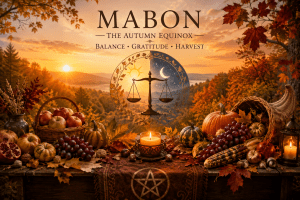
There comes a moment each year when summer loosens its hold upon the Earth.
The blazing fullness of the Sun begins to soften. Fields that only weeks before stood green and growing become gold, russet, amber, and brown. Fruit hangs heavily from branches. Grain bends upon its stalk. The air changes. Mornings become cooler, shadows grow longer, and evening seems to arrive a little sooner each day.
In the Northern Hemisphere, this threshold is marked astronomically by the September equinox, the point at which the Sun crosses the celestial equator as it journeys southward. It marks the beginning of astronomical autumn. Although the word equinox derives from the Latin for “equal night,” daylight and darkness are not literally identical in duration on the equinox because atmospheric refraction and the way sunrise and sunset are measured make daylight slightly longer. Symbolically, however, the image of light and darkness standing in equilibrium has become one of the defining themes of the season. (NOAA Satellites)
Within many contemporary Pagan traditions, this autumnal turning of the year is celebrated as Mabon.
Mabon is a festival of harvest, gratitude, balance, completion, preparation, and the recognition that every season of abundance must eventually give way to a season of rest.
Yet Mabon has an especially interesting history, because the festival as modern Pagans know it is both ancient in its seasonal symbolism and distinctly modern in its name.
Understanding that distinction does not diminish Mabon. In many ways, it makes the festival more fascinating.
The Harvest Before There Was “Mabon”
Long before the word Mabon was associated with the autumn equinox, agricultural peoples throughout Europe and elsewhere observed the harvest season with feasting, thanksgiving, offerings, communal labor, and preparation for winter.
For an agricultural society, harvest was not merely picturesque.
It was survival.
Grain stored in barns, fruit dried or preserved, livestock managed, seeds saved, and food successfully gathered determined whether a community could endure the approaching winter.
The harvest therefore carried both joy and solemnity.
There was gratitude because the Earth had provided.
There was relief because labor had produced its fruit.
But beneath that gratitude lay another awareness: winter was coming.
This combination of abundance and impermanence remains at the heart of Mabon today.
The laden harvest table contains within itself the memory of the empty field.
The ripe apple already carries its seeds.
The grain that is cut down becomes both bread and the promise of another planting.
Nature teaches a strange but beautiful truth at this season:
Fulfillment and ending often arrive together.
Is Mabon an Ancient Celtic Festival?
This is where historical precision becomes important.
It is common in popular books and websites to encounter statements suggesting that ancient Celts celebrated a festival called Mabon at the autumn equinox.
There is no good historical evidence for this.
The name Mabon, as a designation for the Pagan autumn equinox, is a product of the modern Pagan revival.
The term was introduced into modern Pagan usage by American Pagan scholar and ritualist Aidan Kelly while he was creating a Pagan calendar in 1974. Kelly later explained that he wanted the solstices and equinoxes to possess mythologically evocative names similar to the established Gaelic festival names such as Samhain and Beltane. For the autumn equinox he selected the name of the Welsh mythological figure Mabon ap Modron. (Patheos)
The name subsequently circulated through the influential Pagan publication Green Egg and gradually entered the vocabulary of American Paganism. By the late twentieth century, “Mabon” had become one of the commonly used names for the autumn equinox within Wiccan and Wicca-influenced traditions. (Patheos)
Historian Ronald Hutton has discussed this development as an example of the way modern Pagan traditions consciously create meaningful ritual forms by drawing upon older mythological, folkloric, and seasonal materials. (Taylor & Francis Online)
Thus the most historically accurate statement is:
Mabon is a modern Pagan festival built around a genuinely ancient seasonal reality.
People have celebrated harvests for millennia.
The autumn equinox is an astronomical event as old as the Earth’s seasonal cycle.
But calling the Pagan autumn equinox Mabon is a twentieth-century development.
Who Is Mabon ap Modron?
The name was not invented from nothing.
Mabon ap Modron belongs to medieval Welsh literary tradition.
His name is generally interpreted as “Mabon, son of Modron,” with Mabon associated etymologically with the idea of the divine youth or son and Modron with the mother.
Mabon appears prominently in the Welsh tale Culhwch and Olwen, preserved within the collection commonly called the Mabinogion. Medieval manuscripts such as the White Book of Rhydderch, copied during the fourteenth century, preserve these Welsh narratives, although many of the stories themselves derive from much older oral traditions. (National Library of Wales)
In Culhwch and Olwen, Mabon has been taken from his mother when he is only three nights old.
His whereabouts are unknown.
To find him, Arthur’s companions undertake a remarkable quest, questioning increasingly ancient creatures—the blackbird, stag, owl, eagle, and finally the great salmon.
Eventually Mabon is discovered imprisoned at Gloucester and is liberated.
The National Library of Wales’ Welsh Classical Dictionary describes the legendary Mabon as a figure of extraordinary antiquity whose rescue becomes essential to the later hunting of the magical boar Twrch Trwyth. The same source also notes the relationship scholars have proposed between Mabon and the older Celtic deity Maponos. (National Library of Wales)
The myth therefore contains powerful themes:
the divine child,
separation from the mother,
imprisonment,
the descent into hidden places,
the wisdom of ancient creatures,
discovery,
liberation,
and return.
Aidan Kelly saw in these themes an appropriate mythological image for the autumnal mystery and deliberately associated Mabon with the equinox. That connection is modern rather than a demonstrable survival of an ancient Welsh equinox festival. (Patheos)
But symbolically, the association is striking.
The Second Harvest
Within the contemporary eightfold Wheel of the Year, Mabon is often described as the Second Harvest.
The cycle commonly begins its harvest sequence with Lughnasadh or Lammas, around August 1, traditionally associated with grain and the first fruits of harvest.
Mabon follows at the autumn equinox.
Then comes Samhain, when the agricultural year reaches another profound threshold and the dark half of the year becomes dominant.
Seen in this way, the harvest does not occur in a single moment.
It unfolds.
First comes the grain.
Then come the fruits, vines, orchards, nuts, vegetables, and later crops.
Finally comes the preparation for winter.
Mabon therefore occupies an important position between abundance and withdrawal.
The Earth has given much.
But she is beginning to turn inward.
The Mystery of the Scales
The most recognizable spiritual symbolism of Mabon is balance.
Light and darkness appear poised at the threshold.
Neither dominates completely.
Summer stands behind us.
Winter waits ahead.
Mabon therefore occupies a liminal place—a doorway between worlds of experience.
This makes the autumn equinox an especially useful time for contemplation.
Where is there imbalance in my life?
Where have I given too much?
Where have I withheld too much?
What have I cultivated successfully?
What has failed to bear fruit?
What should be preserved?
What should be allowed to die away?
These are profoundly autumnal questions.
Balance, however, does not mean remaining motionless between opposites.
The equinox itself proves this.
The moment of equilibrium is fleeting.
Immediately afterward, the Northern Hemisphere continues its movement toward longer nights.
True equilibrium is therefore not stagnation.
It is the ability to remain centered while change is occurring.
That is a deeper spiritual teaching.
The Harvest as a Mirror of the Soul
The field offers one of humanity’s oldest metaphors for spiritual life.
Every thought is a seed.
Every repeated action becomes cultivation.
Every habit creates a field.
Eventually there is a harvest.
At Mabon, we may therefore look upon our lives as though standing before an inner field.
What did we plant earlier in the year?
What did we nourish?
What did we neglect?
What has now matured?
Some harvests are visible.
A finished project.
A relationship strengthened.
A skill learned.
A business built.
A student taught.
A promise fulfilled.
Other harvests are hidden.
Wisdom.
Patience.
Discernment.
Forgiveness.
Courage.
The ability to say no.
The ability to say yes.
The strength to leave something behind.
Mabon invites us to acknowledge both.
Gratitude as Sacred Reciprocity
Modern Mabon celebrations frequently emphasize gratitude, and this fits naturally with harvest symbolism.
But gratitude in older agricultural societies was not merely sentiment.
It arose from dependence.
Human beings knew that they did not create the rain.
They did not create sunlight.
They did not create fertile soil.
They cooperated with forces far greater than themselves.
That awareness can easily disappear in modern life, where food arrives packaged and seasons can seem distant from everyday survival.
Mabon restores perspective.
The loaf of bread represents soil, seed, rain, sunlight, farmer, miller, baker, transportation, labor, and time.
The apple contains tree, blossom, bee, rainfall, Earth, and season.
To eat consciously is therefore to participate in an enormous web of relationship.
Mabon asks us to remember the invisible hands and powers that sustain our visible lives.
The Descent Into Darkness
Mabon is not merely a festival of abundance.
It is also a preparation for darkness.
After the autumn equinox in the Northern Hemisphere, nights continue to lengthen until the winter solstice.
Symbolically, the descent begins.
Yet darkness need not mean evil.
In mystical traditions, darkness may represent gestation, mystery, incubation, dream, silence, unconsciousness, initiation, and the hidden womb from which new life eventually emerges.
Seeds germinate beneath soil.
Children develop within the darkness of the womb.
Dreams arise when the eyes close.
Mysteries are often discovered only when ordinary sight fails.
Mabon therefore teaches that the dark half of the year is not simply something to endure.
It is something to enter consciously.
The outward harvest eventually becomes an inward journey.
Symbols of Mabon
Contemporary Mabon practice has accumulated a rich vocabulary of seasonal symbols.
Apples are especially powerful.
When an apple is cut horizontally, its seeds frequently reveal a five-pointed pattern reminiscent of the pentagram. For many modern esoteric practitioners, the apple therefore becomes an emblem of hidden wisdom contained inside ordinary nature.
Grapes and wine symbolize transformation—the fruit crushed so that another substance may emerge.
Grain represents sacrifice, nourishment, regeneration, and the ancient mystery of seed becoming food and food sustaining life.
Cornucopias represent abundance.
Autumn leaves remind us that beauty does not disappear merely because something is ending.
Acorns carry enormous possibility within tiny forms.
Pomegranates, especially through the Greek myth of Persephone, evoke descent into the underworld and the cyclical return from darkness.
None of these symbols needs to belong exclusively to Mabon. Rather, contemporary practitioners gather them into a seasonal symbolic language through which autumn may be contemplated.
Mabon and the Wheel of the Year
The modern Pagan Wheel of the Year presents nature not as a straight line but as a circle.
Birth becomes growth.
Growth becomes maturity.
Maturity becomes harvest.
Harvest becomes decline.
Decline becomes death.
Death becomes gestation.
Gestation becomes birth again.
Within that cycle, Mabon represents the moment when we can finally see what our previous actions have produced.
It is therefore both a celebration and an accounting.
There is an old spiritual law hidden within every harvest:
We eventually meet what we have cultivated.
The farmer cannot harvest wheat from a field planted with barley.
Likewise, repeated choices eventually become character.
Repeated thoughts become patterns of consciousness.
Repeated acts become destiny.
Mabon therefore carries an ethical dimension.
The harvest does not judge us.
It simply reveals the nature of the seeds.
Celebrating Mabon Today
A contemporary Mabon observance may be elaborate or very simple.
One might prepare a meal from seasonal foods, bake bread, drink cider or wine, decorate an altar with apples and autumn leaves, walk through a forest, donate food, share a meal with friends, or simply watch the sunset.
One particularly meaningful practice is to create two lists.
On one, write:
What I Have Harvested.
Record achievements, insights, blessings, relationships, lessons, and growth from the previous year.
On the second write:
What I Am Releasing.
Record habits, resentments, fears, obligations, projects, or identities that have reached their natural conclusion.
The two lists represent the mystery of Mabon perfectly.
Gather.
Release.
Give thanks.
Prepare.
The Historical Significance of Mabon
Mabon’s historical significance lies not in being an unchanged survival from some remote Celtic antiquity.
Its significance is subtler.
It demonstrates how spiritual traditions evolve.
Modern Paganism inherited fragments from folklore, mythology, ceremonial magic, agricultural customs, Romanticism, occult revivalism, comparative religion, archaeology, and reconstructed pre-Christian traditions.
Those fragments were not merely preserved.
They were recombined.
Reinterpreted.
Ritualized.
Mabon is one result of that process.
The festival therefore stands at an interesting crossroads between history and living tradition.
Its name is modern.
Its Welsh mythological inspiration is medieval and probably contains older elements.
Its harvest symbolism is ancient.
Its astronomical foundation is universal.
Its spiritual meaning continues to evolve.
That does not make Mabon less authentic.
Traditions have always developed.
Every ritual was new once.
The more useful question may not be, “Is this custom ancient?”
The better question is:
“Does this practice truthfully connect us with the mystery it claims to honor?”
For Mabon, that mystery is unmistakable.
The harvest is real.
The shortening days are real.
The turning Earth is real.
The necessity of gratitude is real.
And the human need to pause at the threshold between abundance and darkness is very old indeed.
Standing at the Autumn Gate
Imagine standing at sunset beside a harvested field.
Behind you lies summer.
Before you lies winter.
In your hands rests whatever this year has given you.
Some of it came through labor.
Some through grace.
Some through suffering.
Some through circumstances you never expected.
Mabon asks you to look at all of it.
Not merely the pleasant harvest.
The whole harvest.
Give thanks for what nourished you.
Learn from what did not.
Preserve what should continue.
Return what has finished to the Earth.
And then stand for a moment at the place of balance.
The Sun is descending.
The darkness is increasing.
But the darkness is not the end of the Wheel.
Deep within autumn already sleeps the seed of spring.
This may be the deepest wisdom of Mabon:
Nothing is possessed forever.
Every harvest must eventually be released.
Every ending contains another beginning.
Every descent hides the possibility of return.
And when we learn to receive abundance without clinging to it, and enter darkness without fearing it, we begin to understand what the turning Wheel has been teaching humanity all along.
There is a time to sow.
There is a time to grow.
There is a time to gather.
And there is a sacred time to let go.

