Theosophy | CONTINUITY AND CHOICE – I

 Suffering arises out of exaggerated involvement in a world of colour, forms and objects, maintained by a false sense of personal identity. As long as people persist in this pseudo-continuum of existence, they necessarily forfeit the exercise of their inner creative capacities and cannot fully seize the opportunities of self-conscious evolution. Human beings produce a false sense of self out of a series of intense particularizations of will, thought and feeling, all of which become the tokens of selfhood. As a result, in the very process of fragmenting oneself into a diversity of desires and conflicting and colliding aims, or of limiting oneself by conceptions which must be concretized in some narrow programme in space and time, suffering is built into one’s life. All exaggerations of the void and illusory ego, all failures to recognize the overarching One, all attempts to live as if one were the centre of the world and without any self-conscious awareness of the beyond, mean that one can only gain happiness, pleasure or fulfilment at a cost. An obscuring shadow follows all pleasure — a compulsive feedback, a necessary negation, an unavoidable depression. When people do not detach themselves and negate excessive involvement in advance of every thought, the negation must come from outside, and after a point people lose their hold over the central thread of unifying or synthesizing awareness.

 Suffering is the obscuration of the light of universal understanding. As long as we live in terms of narrow conceptions of ourselves, shrunken conceptions of space and of time, and with an exaggerated intensity that will necessarily be followed by an external negation, suffering is built into our life. It is coeval with that ignorance of the real which makes what we call human life possible. Human life is a passing shadow-play in which human beings identify with roles and, like candles, are eventually snuffed out. It is a play with a brief intensity focused upon a paltry role and based upon identifications with name and form. One who experiences great suffering, or who reflects deeply upon the relationships at the very root of this process, may come to see that the world and oneself are not apart.

 The world is at least partly of one’s own making but it is also made by the limiting conceptions of other human beings. They have become involved in the creation of a world in which limitation is a necessary part, and they too have forgotten what they innately knew. All human beings begin life by sounding the OM. They all have a cool awareness of the ineffable when they are little children, before they begin to lisp and to speak. In the youth of their sense-organs they experience wonder in relation to the whole of life. In the process of growing up, however, they take on the illusions of others — of parents, elders, teachers, and a variety of people around them — and then they become forgetful of what they already knew. We may reawaken awareness only by self-conscious self-renewal. Awareness is like a colourless universal light for which there are as many focusing media as there are metaphysical points in abstract space. Each human being is a ray of that light. To the extent to which that ray projects out into a world of differentiated light and shade, and limitations of form and colour, it is tinctured by the colouring that comes to it from a mental environment. Philosophically, the mental environment is far more important than the external physical environment.

 When one sees this process archetypally, one recognizes that there is no separation between oneself and the world except in language, reactive gestures, and in certain uncriticized assumptions. Most importantly, there is no separation of oneself from other human beings as centres of consciousness. The notions of ‘mine’ and ‘thine’, attached to pleasure and pain, to joy and suffering, are arbitrary and false. Is that which gives one great joy exclusively one’s own? And, on what grounds do we assume that the suffering of human beings in numerous states of acute self-limitation is purely theirs? Does each one have his own exclusive property rights in collective human suffering and thereby have nothing to do with us? Suffering is intrinsic to the universal stream of conditioned existence. Most living is a kind of pseudo-participation in what seem to be events, but which are merely arbitrary constructions of space-time, and are largely non-events. When a human being comes to see that involvement of a single universal consciousness in a single homogeneous material medium, the very notion of the individual ‘I’ has dissolved.

 We are all aware when we go to the dentist and submit ourselves to something that seems physically painful, through our very awareness of what is happening and our deliberate attempt to think away from our identified involvement with the part of the physical body which is suffering, we can control our sensations to some extent rather than being wholly controlled by them. If this insight could be extended, we might see that the stream of universal consciousness is like an ever-flowing river — in which all conceptions of ‘I’ and ‘you’ and ‘this’ and ‘that’ are mere superimpositions — and then we could begin to stand consciously at some remove from the process of life. Suppose a person came to listen to a discourse of the Buddha with petty expectations, because somebody said it would be quite good, or worth hearing, or fairly interesting. Someone else might have come with a deeper idea because he or she was awake as a soul and had the thought that it is a tremendous privilege to be in the magnanimous presence of a Mahatma, and hence he or she might be lit up. If one is truly lit up, one’s wakefulness makes the greatest difference to the whole of one’s life. It could be gathered up self-consciously at the moment of death. But even a person who comes with so profound a thought into a collective orbit where there are many souls in states of only relative wakefulness and caught up in residual illusions, may forget the original moment.

 The suffering of human life is a jolt which the whole gives the part, the individual ray, to re-awaken in it a memory and awareness of the original moment. Here we can see the significance of certain meditations undertaken by Bhikshus. In Buddhist philosophy there are references to meditations on the moment of birth. Yet how are we to meditate on it when it is an event that has no sense of reality for us? It is simply a certain date on the calendar. The mystery of individuality lies in the privilege and the possibility of making one’s own connections within what otherwise would be a vast, fragmented chaos of events. One could make these connections simply by habit, in terms of one’s first thoughts, or in terms of the reactions of the world and the opinions of others. Or one could make them self-consciously from the standpoint of the whole. This, of course, is very difficult to experience immediately, but every human being can begin to grow in this direction.

 A fearless and dispassionate examination of the past shows that a lot of what once seemed extremely important was utterly insignificant and a lot of what looked impossible to go through was relatively easy. One could take stock of one’s awareness independent of external events and focus it upon intense periods in the past which seemed to be especially painful, meaningless, or terrifying, but which one came through. Then one can ask whether, just as one now feels a kind of remoteness from past events, so too at the very moment of birth, did one feel a kind of remoteness from future events? Was one really involved, or only involved in one part of oneself? Then one can shift to the moment of death and raise the difficult question whether one can see oneself dying. Can one actually see a certain moment where there is an abandonment of a corpse which, through the natural processes of life, must decay and disintegrate and, while seeing this, still hold to an immense awareness of the whole? A person who is able to imagine what it would have been like to stand at a distance from the foetus that became the baby boy or girl can also imagine being at a distance from the corpse which is being discarded. He or she can also see that there is a thread that links these moments, and that the succession is no more arbitrary than the pattern of a necklace when seen from the standpoint of the whole.

Raghavan Iyer
The Gupta Vidya II

11/11 PORTAL is NOW OPEN for SPIRITUAL MANIFESTATION

Step into the cosmic gateway of the 11/11 Portal with our transformative meditation music. Tuned to the frequencies of 111Hz, 444Hz, and 777Hz, this composition is designed to enhance your spiritual manifestation during this powerful alignment. Feel the energies aligning and manifesting positive change in your life. #1111 #1111portal #spiritualawakening

Solving Molecular Mysteries:  How Quantum Light “Hears” Quantum Sound

Scientists from the University of East Anglia have proposed a new way of using quantum light to ‘see’ quantum sound. A recent study recently published in the journal Physical Review Letters reveals the quantum-mechanical interplay between vibrations and particles of light, known as photons, in mo

Source: Solving Molecular Mysteries: How Quantum Light “Hears” Quantum Sound

Science and Philosophy | Quantum Breakthrough: Scientists Rethink the Nature of Reality

Whenever measurement precision nears the uncertainty limit set by quantum mechanics, the results become dependent on the interaction dynamics between the measuring device and the system. This finding may explain why quantum experiments often produce conflicting results and may contradict basic assum [… ]

Source: Quantum Breakthrough: Scientists Rethink the Nature of Reality

The Lost Library of Moscow: Uncovering Mystical Knowledge from Russia’s Golden Age — Ultra Unlimited

Explore the lost library of moscow, the mystical ancient repository of occult wisdom amassed by the occultist Tsar Ivan the Terrible. This library was said to contain the ancient world’s largest collection of esoteric wisdom and lore from the eastern and western world making its loss a great tragedy

Source: The Lost Library of Moscow: Uncovering Mystical Knowledge from Russia’s Golden Age — Ultra Unlimited

About the Human Heart … 

A human heart, showing the fractal arteries and veins that supply blood to the heart muscles.

The heart is much more than just a muscle that pumps blood and its intelligence continues to fascinate us.

Below is some information about the heart that you may not know:

• Did you know that the heart has the ability to generate the largest electromagnetic fields in the body, and that these fields change according to emotions, or that the human heart has a magnetic field that can be measured up to several meters away from the human body?

• Did you know that when we are in a positive/harmonic emotional state, the heart is able to generate a beautifully organized and highly coherent toroidal field that not only affects our own physiology, but also affects others around us?

• Did you know that positive emotions create physiological benefits in your body and that you can stimulate the immune system by evoking positive emotions?

• Did you know that negative emotions can create chaos in the nervous system and that positive emotions do quite the opposite?

• Did you know that the heart has a neuron system with short and long term memory and that the signals sent to the brain can affect our emotional experiences?

• Did you know that in fetal development, the heart forms and begins to beat before the brain develops?

• Did you know that the mother’s brain waves can be synchronized with the baby’s heartbeat?

• Did you know that the heart sends more information to the brain than the other way around?

• Did you know that the heart’s electric field is about 60 times greater in amplitude than brain waves and that the heart’s magnetic field is about 100 times stronger than that produced by the brain?

→ Comment here to let us know: which of these information you didn’t know yet? You can find all of these facts, published research articles and more on the HeartMath Institute website.

◆ Image: Science Photo Library

#geometryinnature #fractalsinnature #fractals #fractal #heart #didyouknow #photo #photography #nature #biology #veins #asabovesobelow #fractais #sacredgeometry #wow #geometriasagrada #geometry #fractalgeometry #life #science

HOW SINGING AFFECTS OUR HEALTH

* Singing informs the body the “right” vibrations that increase our vitality;
* During singing, special chemicals are produced in the human brain that help us feel peace and joy;
* Singing improves blood circulation in the throat area, which has a beneficial effect on the vocal cords, plums and numerous lymph nodes in the throat and therefore significantly increases local immunity (in other words, we less often get colds);
* Improving the blood supply while singing leads to an increase in brain activity: it begins to work more intensively, memory improves, any information is easier to perceive;
* Singing is very beneficial for lung diseases, as it works as a breathing gymnastics, which promotes chest development, proper breathing, and significantly reduces the number of acute lung conditions;
* With regular singing, the levels of immunoglobulin and hydrocortizone, which are signs of good immunity, increase in the body;
* Methods have been developed that treat hiccups through singing and help improve diction;
*Singing is even used in the fight against obesity: sometimes it is available to overweight people when they feel hungry instead of eating, sing two or three songs.
Attention, girls! Singing improves blood supply to the head area and generally rejuvenates the body, skin condition improves.
This is why experts recommend singing at least 5 minutes a day, equating singing to physical exercise.

Helen Demetriou | Venus, the Mother of Jerusalem, The Light Bringer

“According to Eusebius, Hadrian built a temple dedicated to the Roman goddess Venus to bury the cave in which Jesus had been buried. The Orthodox Church celebrates the Dedication of the Church of the Holy Sepulchre on September 26 (Gregorian), the same date as the ancient Roman festival of Venus.”
Melchizedek was the king of Shalem also known as Shalim. Shalim is a god in the Canaanite religion pantheon, mentioned in inscriptions found in Ugarit (Ras Shamra) in Syria. William F. Albright identified Shalim as the god of dusk, and Shahar as Goddess and sometimes known as god of the dawn. Shalim is also identified as the deity representing Venus or the “Evening Star”, and Shahar, the “Morning Star”.His name derives from the triconsonantal Semitic root S-L-M. Many scholars believe that the name of Shalim is preserved in the name of the city Jerusalem and both Shalim and Shahar were the patrons of Shalim.
This tells us that Melchizedek was the high priest of the most high God Shalim which is Venus yet when we look further back we see that Shalim and Shahar were indeed deities of Venus because they had been birthed from Venus herself whom we know to be Inanna, Ishtar, Aphrodite, Astarte, Asherah, Mary Magdalene, Mother Mary etc So in truth, Jerusalem is the city of Venus.
We call the planet Venus the morning star when it appears in the east at sunrise, and the evening star when it appears in the west at sunset, although the ancients called it Hesperus in the evening and Phosphorus, or Lucifer, in the morning. Because of the distances of the respective orbits of Venus and the Earth from the Sun, Venus is never visible more than three hours before sunrise nor three hours after sunset, and it may also surprise you that Venus can be seen in broad daylight, provided you know where, and when, to look after reference to an almanac.
-Masonic Library
After Jesus was born in Bethlehem in Judea, during the time of King Herod, Magi from the east arrived in Jerusalem, asking, “Where is the One who has been born King of the Jews? We saw His star in the east and have come to worship Him.”
-Matthew 2:2
The study of Phoenician gods revealed three goddesses to be different aspects of the planet Venus. A similar trilogy exists in the Norse pantheon, but with different names. It is believed that the Phoenicians, or Canaanites carried their beliefs with them when working on the Temple for Solomon and may have affected its ultimate design.
It is said that the first known name for the city of Jerusalem was Urushalim, “Uru’ founded by “Shalem”, the name of the Canaanite god of Venus in its evening setting, but Solomon’s Temple was facing in the opposite direction, towards Venus rising in its role as morning star. We can be certain that King Solomon’s Temple was built by Canaanites who were known to worship Venus, also we can understand that Solomon had no tradition of his own to give him the knowledge of how to build a temple that was properly constructed to interface with the heavens. However it is perplexing that these Venus worshipping Phoenicians were allowed to build the house of God.
Biblical scholars have noted from passages such as I Kings 11.5 that Venus was worshipped by Solomon in her special form as the deity of the Phoenicians and he fell out of favour with God. The official worship of Venus as Astarte, the Queen of Heaven continued in the Kingdom of Judah until circa 600 BCE.
Moses created Princes of the Tabernacle and the initiations took place when the Pentagram, or blazing star was to be seen in the east. A blazing star that is referred to as a Pentagram can only be a reference to Venus which had long been associated with the pentagram because of the planet’s apparent movement around the sun when observed from Earth. It is suggested that when the Romans destroyed Jerusalem and the Temple in year 70 of the Christian Era, a number of the Princes of the Tabernacle managed to escape to locations across Europe. It was from these families that the men came, who went on to found the Knights Templar.
-Masonic Library
Venus is represented by the pentagram, hexagram, heptagram and octagram. For a time, a pentagram was the official seal of the city of Jerusalem and it was also the symbol of the Pythagoreans.
In later times, it was used by medieval Christians to symbolize the five wounds of Christ, and figured in the heavily symbolic Arthurian romances. In medieval times, the pentagram represented the proportions of the human body.
In alchemical texts, the four elements (in Latin)- flatus, ignus, aqua, terra, superseded by light, or divine energy- illustrated the process of creation, and the biblical motto Fiat Lux, or, “let there be light.” Venus and the pentagram is the symbol of the Light Bringer, the Morning Star who is also known as Lucifer in Latin and Phosphorus in Greek.
This Venus, this Morning Star, is the same star the Jesus called himself and it is through Venus that all of the elements of Jerusalem, David and Melchizedek are connected. The star that rose out of the House of Jacob is both David and Jesus and that star is Venus and that scepter was passed on as the divine seed from the bloodlines of Jacob, through to David, through to Joseph and then to Jesus himself.
In many icons you will see Mother Mary associated with the star which symbolizes Venus. The church fathers were well aware that Mary manifested from her previous known names of Venus which grew out from ancient mesopotamia. Venus has always been the Queen of Heaven, Earth and the underworld and she has always been known as the mother of the sun, who is the dying and resurrected fertility god which is again, another connection with the original name of Bethlehem.
She is Venus herself who produces the messenger of light who comes to Earth to bring the Christ Logos which is the divine Word. As the Mother of the Mysteries, it is through her son that the world becomes enlightened should they choose to follow his Way which leads straight back to her, which is the soul.

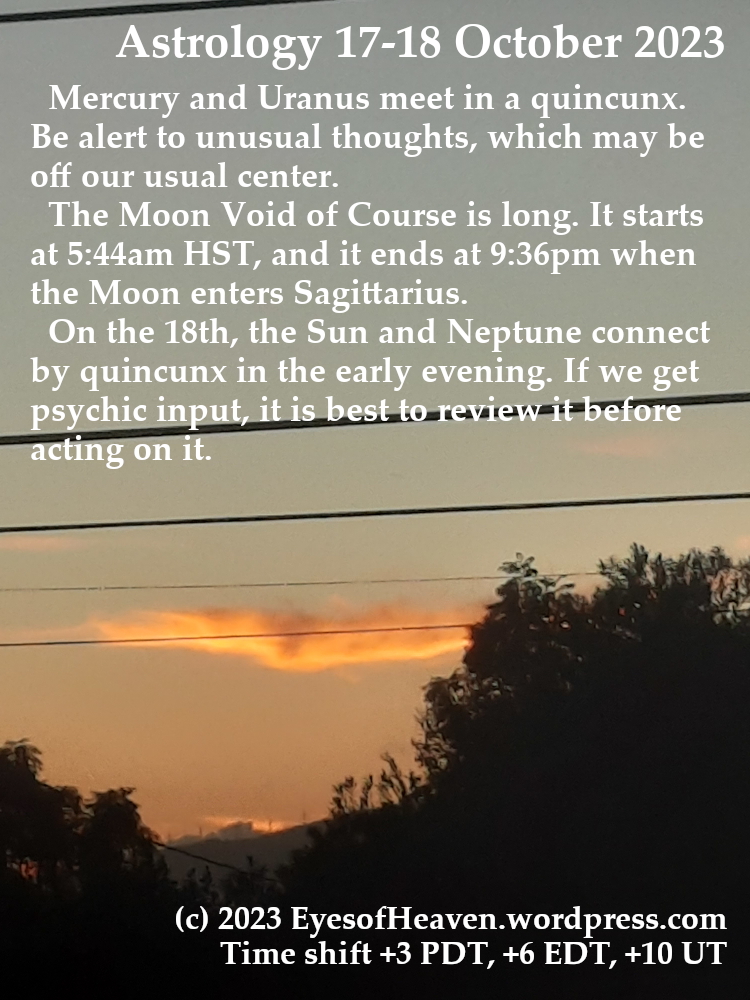
Astrology | We’re still off center due to the quincunx aspects – be sure you gather yourself; Void Moon is long, which urges us to ground to allow the flow to move through us; Another quincunx on the 18th – pay attention these days!

Visit the post for more.

Source: We’re still off center due to the quincunx aspects – be sure you gather yourself; Void Moon is long, which urges us to ground to allow the flow to move through us; Another quincunx on the 18th – pay attention these days!

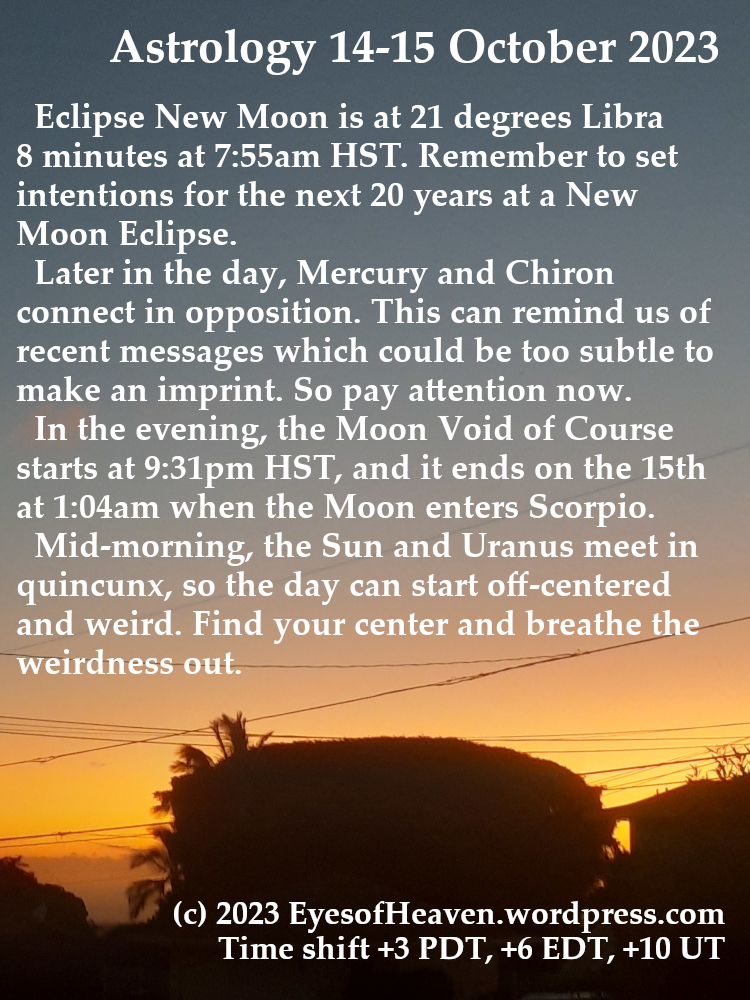
Astrology | Libra season eclipses are here; Mercury and Chiron offer clarification on healing processes; Moon Void time bridges the days; the Sun and Uranus pull us off center – breathe

Visit the post for more.

Source: Libra season eclipses are here; Mercury and Chiron offer clarification on healing processes; Moon Void time bridges the days; the Sun and Uranus pull us off center – breathe

Drunvalo Melchizedek | THE TEACHER NUMBERS

A long time ago, the angels taught me that seeing a triple number in Reality has a meaning related to what you are thinking or your environment. It has to do with music and the fact that all notes of an octave are separated from each other by intervals of eleven cycles per second. Therefore, the intervals between the notes are 11, 22, 33, 44, 55, 66, 77, 88 and 99 cycles per second, or multiple of those numbers, which presents us a harmonic tuning or moment in time, given that all Reality was created through the harmonics of music.

Therefore, when triple or repeated numbers appear more than once in any way, they physically represent a mathematical moment in time that contains the harmonicas of that number value. In human words, 444 could be described as the Mystery School, there where one learns about Reality. Alice Bailey was the first person to write about this meaning of numbers. Briefly, here are the meanings of triple numbers.

111= Energy Flow: any energetic flow, such as electricity, money, water, sexual energy, etc..

222 = New Cycle: the beginning of a new cycle whose nature depends on the next triple number you see.

333 = Decision: You must make a decision, which will lead you to 666, which means you must repeat it in some other way, or 999, which means culmination and you have learned the lesson.

444 = The Mystery School: What is happening in life is a lesson to learn about Reality. In this school it’s about learning, reading books or studying a subject, and not doing.

555 = Unity Consciousness: It is the number of someone who has achieved Unity Consciousness. He’s mastered every level of Mystery School. It’s the highest number. It is the number of Christ.

666 = Earth Consciousness: In the Bible it’s the number of the Beast, so it can represent pure evil, but it’s also the number of humanity and life. Carbon is its base, and this element has six protons, six neutrons, and six electrons. When we see this number, it usually means that we must be alert to the physical events that present themselves at that time, and that we must be careful.

777 = Mystery School: This is the part of school where you’re not just reading books about life, but putting them into practice.

888 = Culmination of a specific lesson in Mystery School.

999 = Culmination of a specific cycle of events.

000 = Lack of Value.

Excerpt from Book: Serpent of Light, Beyond 2012.

Theosophy | REINCARNATION AND SILENCE – III

 If we trace the English term ‘soul’ to its Greek antecedents and equivalents, we soon find a wide variety of meanings. Even before the time of Socrates, many accretions and materializations had already gathered around the concept. It was compared to the wind. It was also supposed to mean ‘that which breathes,’ ‘that which is alive.’ And it was given many other meanings and often couched in metaphorical terms through analogy with sparks and a central fire. It became crucially significant for Plato to enrich the notion of ‘soul’ and to give it an existentially human meaning to do with the very act of search, the very desire to know the good, the hunger to make distinctions — not only between the good and the bad but between the good and the attractive, not only between the true and the false but between the true and the plausible. The desire to make noetic discriminations becomes the basis for a functional definition of the soul. Plato taught that, metaphysically, the soul may be seen either as perpetual motion or as a self-moving agent. In one passage he refers to a particular kind of motion which is not visible in the material realm but may be properly ascribed to the hidden Logos, the invisible deity. Elsewhere, what he identifies as the soul is connected with volition. What would it avail a man who uses the word in a Socratic sense but does not come to terms with his own will-problem, or worse still, becomes identified intellectually with his weak-willed self?

 Language is very important here. The prolonged abuse of the term ‘soul’ in the Middle Ages resulted from a decisive shift in meaning. An active agent was replaced by something passive, something created. In a corruption of the Socratic-Platonic meaning, the ‘soul’ became merely something acted upon, a passive agent receiving reward or punishment. The term ‘soul’ almost became unusable, so that in the Renaissance humanists had to assert the dignity and divinity of man in ways that did not involve them once again in the debased coinage of the terminology of the past. In the twentieth century the term ‘self’ is coming into wide circulation, recovering some of the dignity of the classical conception of the soul.

 A person brought up in a corrupt language system could receive tremendous help by borrowing a term from Sanskrit and trying to recognize its open texture. The compassionate Teachers of the Theosophical Movement chose to introduce from that sacred language terms like Manas — the root of the word ‘man,’ from man, ‘to think’ — into the languages of the West. When Emerson eulogizes “man thinking” he is using two English words in a manner that confirms exactly the full glory of the idea of Manas. Yet we also know that both the words ‘man’ and ‘thinking’ can be so degraded in everyday usage that they do not convey the glory of manhood implied by Manas. The term Manas in Sanskrit means not only ‘to think,’ but also ‘to ideate,’ ‘to contemplate.’ To contemplate in this classical sense is to create, to sustain a continuous and controlled act of creative imagination enveloping more and more of the whole, while retaining that core of individuality which signifies responsibility for the consequences of all thoughts, all feelings, all words, and all acts. This is a kingly conception.

 It is often advantageous for a person to go outside his particular prison-house of debased language and explore classical concepts. As we grow in our awareness, we may make the beautiful discovery that even in the accents of common speech there are echoes of those pristine meanings. The literal meaning of words is less important than the tone of voice in which we use them. It is possible for a man in the street to say to another, “Hi, man” with unconscious contempt, and for a traveller in the Sierras to say, “Hi, man,” in a manner that expresses genuine fellow-feeling. Miranda in The Tempest, seeing human beings for the first time, exclaims:

O, wonder! How many goodly creatures are there here!
How beauteous mankind is! O brave new world,
That has such people in’t!

 Every word has a depth and beauty of feeling that makes ordinary English words rise like wingèd skylarks into the universal empyrean — generous, cosmic and free. Beyond all languages and concepts, the very act of articulation is of immense importance. Perhaps the most beautiful passage on the subject of reincarnation is to be found in The Human Situation by Macneile Dixon. This great lover of the literatures of the world, of Plato and Shakespeare, dared to suggest:

 What a handful of dust is man to think such thoughts! Or is he, perchance, a prince in misfortune, whose speech at times betrays his birth? I like to think that, if men are machines, they are machines of a celestial pattern, which can rise above themselves, and, to the amazement of the watching gods, acquit themselves as men. I like to think that this singular race of indomitable, philosophising, poetical beings, resolute to carry the banner of Becoming to unimaginable heights, may be as interesting to the gods as they to us, and that they will stoop to admit these creatures of promise into their divine society.

By speech a man can betray his divine birth, and just as this is true of speech in its most sacred and profound sense, it is also true of human gestures. The simple mode of salutation in the immemorial land of Aryavarta is filled with this beauty. When the two hands come together, they greet another human being in the name of that which is above both, which brings the two together, and includes all others. There is something cosmic, something that has built into it a calculation of the infinite in the expedient, even in this gesture.

 But what is true of gestures could be even more true of human utterance. The surest proof of the divinity and immortality of man is that through the power of sound he can create something that is truly magical. He can release vibrations that either bless or curse, heal or hinder other beings. This is determined by motivation, intensity of inmost feeling, and the degree of individual and universal self-consciousness, nurtured and strengthened through constant meditation and self-study.

 Suppose one were to ask of the gods, “Give me one of two gifts for all men. Give me first that gift which will suddenly enable all men to say that they know about reincarnation and the soul, and that they believe in immortality. Second, give me that gift which enables all men to help babies to grow with a feeling of dignity, deliberation, beauty and sanctity in regard to human speech.” The wise would know that the latter gift is much more valuable than the former, because mere beliefs will not save human beings even though truly philosophical reflection upon alternatives is part of the prerogative of a Manasic being, a man in Emerson’s sense. These beliefs can only be made to come alive through the exercise of conscious and deliberate speech, with a delicate sensitivity for the existence of other beings, and an immense inner compassion for all that is alive. If human speech were not constantly wasted and made into something so excessive and destructive, so mean and niggardly, we would not find so much of the self-hatred, mutual distrust, pessimism and despair that characterize our lot. We would not find ourselves in a society which is free but where, alas, the loudest voice is the most feared and tends to have the widest impact.

 Anyone who can existentially restore the alchemical and healing qualities of sound, speech and silence, to some limited extent, in the smallest contexts — in relations with little children, with all he encounters even in the most trivial situations — does a great deal for the Bodhisattvas. Those Illuminated Men, by their very power of thought and ceaseless ideation, continually benefit humanity by quickening any spark of authentic aspiration in every human soul into the fire which could help others to see. The truth of reincarnation requires much more than a casual scrutiny of our external lives and our spoken language. It must be pondered upon in the very silence of our souls. It is a theme for daily meditation. In the Bhagavad Gita Lord Krishna tells Arjuna that true wisdom is a meditation upon birth, death, decay, sickness, and error. To meditate upon each of these and all of these together is to begin to know more about the cosmic and the human significance of the truth of reincarnation.

Raghavan Iyer
The Gupta Vidya II

Podcast | Persistence in the Face of Non-Acceptance, with HPS Victoria Lana Generao

Aloha e mahalo nui for this session, Geraldine Convento!

Victoria Generao is an Imperator-General for a Golden Dawn Order, an 18th degree Reiki Grandmaster, and a High Priestess and Mother Abbess of the Magdalena Oedinis Venetae Rosae. Success for her is defined by attainment, accomplishment, and progress. As a practicing ceremonial magician, she’s had a long inner journey into identifying and developing the skills and resources she needs to to carry out her tasks. Also, coming from a bicultural background, she’s had to face a good number of roadblocks, the most important of them being persistence in the face of non-acceptance. In this new episode of The Three Pillars of Success, we discuss the importance of self-knowledge to achieve any accomplishment.

Sound Healing | 963 Hz Frequency of God, Return to Oneness, Spiritual Connection, Crown Chakra, Meditation Music

https://youtu.be/Pr-7S5ZuNGQhttps://youtu.be/Pr-7S5ZuNGQ

New Moon in Cancer on 17th July and Nodal Shift: nodes will shift out of Taurus and Scorpio and move into Aries and Libra. Fulfillment happens when you are light as a feather, Follow Your Path, The New Moon is an opportunity to reset and experience new, to enjoy the individual beauty we create. Let’s meditate together with this upcoming energies. Handpan Rav Mediation.

Theosophy | KARMA AND CHOICE – II

 Metaphysically, in relation to the three planes of the Unmanifested, there is no distinction in the Three-in-One between absolute, attributeless Compassion, absolute, dimensionless Truth, and absolute, unconditional Love. There is no difference because all three together constitute the invisible point in an ever-revolving mainspring that is the vital centre of the great wheel of universal harmony. Through the notion of harmony, a person might come to reflect upon the metaphysical relation between justice and mercy as centripetal and centrifugal forces. The starting point to gain this perspective is self-examination. Take a period in one’s life. A day might be too short for this for the average person — you might take a week, a month, a year — and actually list out on a sheet the number of occasions on which one either omitted or was fortunate to be able to exemplify justice to every other human being. Then on a separate sheet list the number of occasions on which one tried to be merciful to other human beings, or where through thoughtlessness and inconsideration rooted in self-worship — which is nothing but the insecurity of the shadow — one omitted to be merciful. Soon one will make an amazing discovery because one will find that these are two different aspects of a single truth. That truth is the degree to which ignorance was the pole star of one’s life centred in the personal mind, and the extent to which one’s highest ideation became manifest in one’s consciousness and conduct.

 No act is performed without a thought at its root, and this is the basis of karma for thinking beings. This is always the case. What it implies in strict elementary logic is that even the most apparently automatic act has a thought at its core, either at the time of performance or as leading to it. A being who is fully self-conscious, who has attained to universal self-consciousness, and therefore is totally aware of the Self, is incapable of ever engaging in any act at any time without an instantaneous and simultaneous awareness of the intention accompanying it. Because this idea is so sacred, a lot of harm is done by people who talk idly of ‘thought-forms’ and ‘vibrations.’ This is the sad result of dissemination, among the unready mass, of the delusions of the failed students of Philosophia Perennis.

 In ordinary language we all are aware of what it means to say, “Oh, that’s a good idea.” “Oh, that’s a good thought.” Everyone, at some time in his life, maybe at some season of the year, has had a good thought for someone else. “Oh, let me do this for someone else. Let me send this Christmas card. Let me express this goodwill.” Every human being has experienced the most natural form of occultism — having a good thought and seeking for it an appropriate form of expression. In this age where it is so rare, they are very privileged who, through the magic of the madness of love, spend a lot of time not just on the benevolent thought but on the manner and the appropriateness of the expression of the thought. Some people, by a kind of soul-intuition from previous lives, and especially when they are very young, realize that a good idea must have the total purity of privacy if it is to be preserved. There must be an insulation from uncongenial elementals in making that thought inviolate, wrapping it up within an invisible circle of secrecy and privacy, so that it becomes a point in metaphysical space and may find an appropriate form.

 When we begin to see this, we are better able to know what it means to earn the privilege of hearing the teaching that men are manifested gods, creative mind-beings; Manasaputras bearing the burden of the responsibility for raising all manifested matter; carriers of the divine mandate of helping the great architect, the collective demiurge behind the manifested universe. These thrice-blessed “fortune’s favoured soldiers” may suddenly begin to feel the immensity, the grandeur, the glory of the responsibility of being human, a thinking being, capable of choosing at will a thought and, by dwelling upon it and pouring over it the waters of selfless love, being able to find, out of the more subtle matrix of life-atoms which constitute the thought-vehicle, a form for its benevolent expression. In other words, a person who lives by an inner light begins to see that the real form of a true thought is wholly invisible. It has nothing to do with differentiated matter or the externalities of dependent origination in dependent relationships. He really comes to understand something about subtle matter.

 Two alternatives face such a person, and both alternatives apply to different classes of cases, so that he has a constant choice problem, like the choice problem of the Demiurge mentioned in the Timaeus. Out of many worlds is patterned only one world. This is the dilemma which the Demiurge must overcome. The human being, too, must be ready to grasp the fundamental problem of choice facing him. On the one hand, there are certain thoughts which are of such quality — impersonal, universal, unifying, beneficent — that where they are self-consciously generated or drawn from the Akasha, they do not need any form. They are like sparks or like shooting stars that descend with a speed much greater than that of light and they find an appropriate way of sparking off myriads of atoms. On the other hand, there are those thoughts which need to be encased in a purified, distilled essence, but fashioned out of a purified astral form, out of something more than differentiated matter but something less than the pure, undifferentiated, universal, homogeneous essence. Such thoughts, when they are given that kind of force, are deliberately chosen mental assets. They become available for all other human beings encountered in our lives and yet may also become embodied for a very long time to come so that others could draw upon them for almost an indefinite future.

 What a great privilege, then, is open to the human being who has had the good fortune to learn from Brahma Vach. No one should ignore the ideal as a fit object of meditation. Every person is equally entitled to make the attempt, and no one need fear that he is so unworthy that he cannot make it. On the other hand, he should be spared the terrible karma of the delusion that Everest may be climbed quickly. `Climbing Everest here means choosing every single thought. That is very hard. It requires lives. But one can begin right now choosing a few thoughts, having a little less passivity in relation to most thoughts every week, a little less of that disordered, unthinking, thoughtless, machine-like activity which is lower than that of the animal kingdom, and a little more of deliberate thought. One could, within three months, make amazing discoveries about the mystery of karma — more discoveries from three months of this practice than from a lifetime of mere use of the word ‘karma.’

 William Q. Judge pointed out that “the weak and mediocre furnish a weak focus for karma, and in them the general result of a lifetime is limited, although they may feel it all to be very heavy. But that person who has a wide and deep-reaching character and much force will feel the operation of a greater quantity of karma than the weaker person.” A character broad in vision, generous in sympathy, deep in motivation, firm in the degree of deliberation — this is the self-created product of thought ranging from calm consideration to continuous meditation. Whether a man will have “much force” will depend upon becoming one-pointed in the use of force. Kierkegaard spoke about the purity of heart that goes with a concentration of will when it is focused upon one thing at a time. This is the same idea as that expressed by Cardinal Newman in the line, “Lead kindly light, one step enough for me,” which was so much a favourite of Gandhi. These steps form a very beautiful kind of dance. The great pioneers of the future choose to learn this on the physical plane and in the moral realm, but with the intention of making themselves a bridge to other human beings who want to learn to do this dance, step by step by step.

 This means the will is very much involved. The will is weakened by obscurity of mind, by conflict of feelings, by lack of priorities in relation to purposes. The conservation of energy is the baseline upon which every man takes a stand. On this basis alone he determines the degree of intensity to the force that he can release. There have been many men of much force, but their vision was limited. Their motivation was not rooted in the depths of their being, and so they became like Ozymandias. They created huge thought-structures and towards the end of their lives a few wrote manuals for the benefit of others, telling them to do this, that, and the other thing. But the will was disproportionate in relation to the idea. What is most critical, then, in the formation of character is the food that a human being receives in the way of spiritual and mental diet.

Raghavan Iyer
The Gupta Vidya II

Theosophy | KARMA AND DESTINY – I

It is the Spiritual evolution of the inner, immortal man that forms the fundamental tenet in the Occult Sciences. To realize even distantly such a process, the student has to believe (a) in the ONE Universal Life, independent of matter (or what Science regards as matter); and (b) in the individual intelligences that animate the various manifestations of this Principle. . . .
The 
ONE LIFE is closely related to the one law which governs the World of Being — KARMA. Exoterically, this is simply and literally ‘action’, or rather an ‘effect-producing cause.’ Esoterically it is quite a different thing in its far-fetching moral effects. It is the unerring LAW OF RETRIBUTION.

The Secret Doctrine, i 634

 Karma is the universal law of the One Life in all its myriad manifestations from the cosmic to the atomic, spanning eternity and the present in each moment. Every evolving intelligence encapsulated in matter is unerringly subject to the ceaseless effects of Karma and must conform itself, at first unconsciously and then freely, to its inexorable decree of universal harmony. The doctrine of Karma unveils the metaphysical key to the mysteries of authentic human choice, free will and divine destiny, but it can be comprehended only when applied with Buddhic insight to the large experiences and small events of life on earth. To discern the karmic meanings of the complex details of daily life, whilst experiencing the elusive mystery of incarnation, one must begin with the vibratory rates of the simplest thoughts and feelings, words and deeds, linking them to levels of motivation, states of consciousness, fixity of mind and fidelity of heart. Each thoughtful or thoughtless impulse of the inner nature magnetizes one’s environment through the activity of the organs of the outer vestures, invoking exact compensation and ethical retribution. There is nothing mechanical in the karmic adjustment of magnetic differentials; it is an inward and moral process, an integral aspect of a continual choice between spiritualization and materialization. The distinction between distributive and collective Karma, like the difference between the raindrop and the storm, exists within a larger process of essential unity. Humanity and its units, its races, nations, tribes and individuals, embody a vital energy and share a common destiny which none may resist or repel. The eternally patient and compassionate teacher of mankind, Karma sternly instructs each and all in the supreme lesson that there is no individual enlightenment or welfare apart from sacrificial service to every sentient being, collectively constituting the One Life.

 This pivotal principle, the substratum of free will and destiny, may be understood in terms of the choice between the manvantaric star of one’s individuality and the personal star of a single lifetime. Throughout all possible variations in personal destiny over myriad lifetimes, this choice must be made again and again. The clarity and direction of one’s choices in previous lives shape the fabric of circumstances in which one chooses in this life and future lives. That fabric might be a refined tapestry in which may be etched the mystic emblems of the pilgrimage of the soul, or a coarsely knotted cloth of confused dreams and missed opportunities. Psychologically, there is the wayward choice between two voices: one is the voice of illusion and delusion, of the senses and of the separative personal consciousness which cannot embrace a holistic perspective encompassing many lives; the other is the voice of Krishna-Christos, the voice of God in man which speaks in the universal language of the soul. There is a direct relation between one’s recurrent choices in regard to these voices, and one’s readiness, in the realm of action, to ally oneself with Krishna, standing luminously alone, or his innumerable adversaries. In the Mahabharatan war fought on Kurukshetra, the field of external encounters, individuals are constantly making, mostly unconsciously or with partial self-consciousness, fateful choices between Krishna and his armies. This archetypal choice was offered by Krishna to the depraved Duryodhana, who rejected Krishna in favour of the armies trained by him, reflecting shortsighted empiricism. When Arjuna was offered the privilege of having Krishna as his charioteer, he happily and willingly chose Krishna, even though he did not fully fathom the invisible stature of Krishna, let alone his cosmic splendour.

 Philosophically, the Mahabharatan war is emblematic of the inevitable ethical and spiritual struggle to which every human soul is irreversibly committed by the fact of Manasic awareness, traceable to the sacrificial descent and benediction of the solar ancestors over eighteen million years ago. Each chooses, Krishna teaches, according to his lights, whatever seems best. Thereby the subtle threads of one’s self-devised destiny are fused, and one must pass below the throne of Necessity without looking back, like the pilgrims in the Myth of Er, to live out and learn from the karmic results of one’s choice. Recorded by the Lipikas, engraved in one’s vestures and reflected in surrounding circumstances, this destiny rises up to meet the soul at every turn in life. Yet, though it is ‘written in the stars’, destiny does not preclude the risks and possibilities of further choice.

 Only, the closer the union between the mortal reflection MAN and his celestial PROTOTYPE, the less dangerous the external conditions and subsequent reincarnations — which neither Buddhas nor Christs can escape. This is not superstition, least of all is it Fatalism. The latter implies a blind course of some still blinder power, and man is a free agent during his stay on earth. He cannot escape his ruling Destiny, but he has the choice of two paths that lead him in that direction, and he can reach the goal of misery — if such is decreed to him, either in the snowy white robes of the Martyr, or in the soiled garments of a volunteer in the iniquitous course; for, there are external and internal conditions which affect the determination of our will upon our actions, and it is in our power to follow either of the two.

The Secret Doctrine, i 639


 Even if through past actions one is destined to suffer miseries at the hands of various agencies, the power of choice remains. It is a constant factor throughout all the vagaries of karmic precipitation. As Plato taught, the gods are blameless for the inward condition of the soul in every situation, and each sufferer must choose between either preserving purity of consciousness or becoming stained by the iniquities of unthinking reaction, mental violence and a refusal to take responsibility.

Raghavan Iyer
The Gupta Vidya II


Melchizedek Seminary | The Sophia Frequencies. Divine Feminine Healing, Miracles, Abundance and the Schumann Resonances

How to properly listen to the Sophia Frequencies for maximum results:

Effects accumulate so daily for a minimum of 21 days may achieve noticeable transformational results, however research from MIT show that the optimum listening period is daily for 9-12 months.

Do not listen through phone speaker. Most phone speakers are piezo electric based, which means all frequencies below 130 HZ may be eliminated.

Do not listen through headphones. Because The Sophia Frequencies incorporate scalar waves, it is highly recommended that they are listened to through speakers with a good bass response (ideally with a frequency range below as 45 HZ).

Sound waves traveling through the atmosphere (or underwater) are longitudinal; as are plasma waves propagating through space (aka Birkeland currents). Longitudinal waves moving through the Earth’s interior are known as “telluric currents”. They can all be thought of as pressure waves of sorts.

Embedded into the piece are very precise Schumann differentials. It has been observed that these differentials are important to any healing process. They also induce a deep delta state which is conducive to sleep, profound meditation and experiencing 5th Jhana. We have proposed and can prove using anecdotal data, that it is in this state that the remarkable healing effects occur.

Ideally, listeners or listening parties will do so by playing this video, which will be the high resolution source file, through a speaker set up that allows space between the listener(s) and the speakers.

Observing | Esoteric Talks

We’ve got to build something in us that can see us, as we are, without going crazy with what it sees. An esoteric system is a way of guiding man to a right relationship to himself, others, and the Infinite Universe, of which he is a part. After we’ve accurately located ourselves in the big scheme of things we are ready to move forward to what we came here to do.

You were created to develop beyond what life offers you.

Theosophy | INDIVIDUATION AND INITIATION – I

  The Daimones are . . . the guardian spirits of the human race; ‘those who dwell in the neighbourhood of the immortals, and thence watch over human affairs,’ as Hermes has it. In Esoteric parlance, they are called Chitkala, some of which are those who have furnished man with his fourth and fifth Principles from their own essence; and others the Pitris so-called. . . .The root of the name is Chiti, ‘that by which the effects and consequences of actions and kinds of knowledge are selected for the use of the soul,’ or conscience, the inner Voice in man. With the Yogis, the Chiti is a synonym of Mahat, the first and divine intellect; but in Esoteric philosophy Mahat is the root of Chiti, its germ; and Chiti is a quality of Manas in conjunction with Buddhi, a quality that attracts to itself by spiritual affinity a Chitkala when it develops sufficiently in man. This is why it is said that Chiti is a voice acquiring mystic life and becoming Kwan-Yin.

The Secret Doctrine, i 288

 The integral relationship between initiation and individuation can be grasped through the essential logic of the entire process of evolution. From the standpoint of matter, the logic of transformation involves increasing heterogeneity, differentiation and complexity. At the same time, there is a commensurate withdrawal of subjective and spiritual faculties which cannot function freely through limited projections or distorted reflections. The degree of spiritual volition depends upon the texture of the reflecting medium. In the collective thrust of evolution every single life-atom in all the seven kingdoms of Nature is touched by the same primal universal impulse towards self-consciousness. Within the broad perspective and purpose of evolution as a whole, the possibilities of initiation are enriched by individuation at a high level of self-consciousness. Initiation, in its most hallowed meaning, must always involve the merging of minds of Guru and chela into a state of oneness with the ineffable Source of Divine Wisdom. This mystical and magical relation of Manas and Mahat was comprehended and transmitted in secret sanctuaries. It was intimated in the enigmatic etymology of the word Upanishad, ‘to come and sit close’, so that there could be direct communion of minds and hearts. Sacred teachings are conveyed and communicated through the eyes and not merely through words, although mantramic sounds have a sacred and vital function. In the Bhagavad Gita Arjuna’s earnest enquiries and Krishna’s cosmic affirmations and psychological adjustments bring to birth within the mind of the chela the seed of chit, a level of consciousness which negates, transcends, and also heightens individuality. Initiation is the highest mode of individual communication, and it necessarily involves a mystic rapport between one who has gone before and one who is to come after, rather like the magnetic transference between mother and child. Such a relation is inherent in the logic of evolution because, as a result of an extremely long period of evolution, it is impossible to find any mechanical sameness between all human beings. They are identical in their inmost essence but so markedly different in the internal relations of their vestures that there cannot be complete equivalence between any two persons. Hence experience and reflection reveal both the mystery of each individual human being and the commonality of what it is to be human.

 At one level of communication The Secret Doctrine is a metaphysical treatise on cosmic and human evolution. But at another level, for those who are Buddhic, it is not merely a book, but the initiatory presence of the compelling voice of the Verbum or Brahma Vach, reverberating in the society of sages, the Rishis who are of one mind and one lip. For the ardent seeker of Divine Wisdom, The Secret Doctrine is a series of stepping-stones, as the Upanishads and the great scriptures of all times have been, towards initiations into the mysteries of Selfhood. Through ever-renewed contact with the teaching, the chela begins to enact self-consciously and by degrees the realities which ordinary individuals sporadically experience at some level through deep sleep. This process comes alive through prolonged meditation for the sake of universal compassion, making one’s breathing more benevolent for the purpose of elevating all beings in all the kingdoms of Nature. When a person begins to do this, it is the awakening of Bodhichitta, the seed of enlightenment. It is the first step in translating knowledge into wisdom, words into realities, and resolves into actions. Having turned the key of compassion in the lock of the heart, the disciple will come to realize, through inward communication with the Teacher, the fuller meaning of the Upanishads:

Upa-ni-shad being a compound word meaning ‘the conquest of ignorance by the revelation of secret, spiritual knowledge’. . . They speak of the origin of the Universe, the nature of Deity, and of Spirit and Soul, as also of the metaphysical connection of mind and matter. In a few words: They CONTAIN the beginning and the end of all human knowledge. .

The Secret Doctrine, i 269-270

 The practical import of the metaphysical teaching of The Secret Doctrine lies in the fact that the highest spiritual powers are partly used by each human being every day but without fully knowing it. Light is universal, but it makes all the difference whether one has a blurred sense of perception and merely consumes light, or whether one can take a magnifying glass and concentrate light. There are also those who are like the laser beam which can direct a concentrated shaft of light to destroy cancerous cells and produce a range of extraordinary effects upon the physical plane. There is something of kundalini at work in every human being. Electricity and magnetism are sevenfold and work at the highest cosmic level of Akasha, but they also work at the most heterogeneous and diffusive level because everything is electrical and magnetic, from the occult standpoint. The aspirant must grasp, even at a preliminary level, the moral and psychological implications of this metaphysical “power or Force which moves in a curved path” in man and Nature.

 It is the Universal life-Principle manifesting everywhere in nature. This force includes the two great forces of attraction and repulsion. Electricity and magnetism are but manifestations of it. This is the power which brings about that ‘continuous adjustment of internal relations to external relations which is the essence of life according to Herbert Spencer, and that ‘continuous adjustment of external relations to internal relations’ which is the basis of transmigration of souls . . .

Ibid., i 293

The two aspects of this omnipresent power mentioned here have to be totally mastered by the initiated yogi in all their possible manifestations. Long before this stage is reached, the disciple must begin to learn to govern these internal and external relations through Buddhi Yoga in order to fulfil the prerequisite conditions of magnetic rapport with a true Teacher of Wisdom.

 The universal process of adjustment of the external to the internal, which leads to involuntary reincarnation for human beings, must be understood in terms of karma. At the most primary level, whenever human beings entertain and succumb to emotional reactions, they establish mental deposits and astral grooves which require many lives for proper adjustment. That is why over eighteen million years so many people approach the Path again and again but stumble and lose their track just as often. They cannot make a fundamental breakthrough even when in the presence of great teaching. For those who have made the teaching an internal living power in their consciousness, this is comprehensible as essential, just as the world seems clear to a child when its eyes are directed to the light of the sun. Whilst this is true for all human souls, the philosophical recognition of how this works is important. Every emotion registers an appropriate record in the astral vesture. It is wear and tear on the linga sharira and is at the expense of something or someone else. Thus selfishness is increased. This is true even if the emotion is benevolent for emotion itself is a form of passivity. Emotion is quite different from deep feeling which is unmodified by cyclic change or external event and is totally independent of outward demonstration. Emotion is like cashing a check: whilst it makes money available, it depletes the account. It is a way of demanding proof. As a form of external indulgence it is a passive fantasy which weighs heavily upon the astral vesture. To that extent it obscures one’s inmost feelings which are detached and compassionate. All the higher feelings are ontologically powerful and at the same time they constitute a pure negation psychologically. Though only an initial understanding of the problem, this is sufficient to explain why merely sitting down to postures and trying to control the external breath by hatha yoga exercises cannot make a significant difference to the inevitable adjustment of internal and external relations inherent in life itself. There is no substitute for facing oneself, asking what one is truly living for, how one is affected by likes and dislikes, and how one’s temper — or sophrosyne — is unbalanced through various irritations.

Raghavan Iyer
The Gupta Vidya II
Sound Healing | ULTIMATE SOLFEGGIO SOUNDBATH | The Complete Restoration | 9 Divine Frequencies

Immerse yourself in these mystical sound baths featuring 9 divine frequencies known for their healing and positive vibrations. Immerse yourself in these mystical sound baths featuring 9 divine frequencies known for their healing and positive vibrations.

♡ Find the frequency you resonate with

00:00 – 174Hz | Reduces Pain

09:09 – 285Hz | Tissue Regeneration

18:18 – 396Hz | Letting Go fear, anxiety

27:28 – 417Hz | Removing negative energy

36:37 – 528Hz | Brings positive transformation

45:46 – 639Hz | Attracts Love, Compassion

54:56 – 741Hz | Spiritual and Emotional Detox

01:04:05 – 852Hz | Third Eye & Intuition

01:13:15 – 963Hz | Pineal Gland Activation & Crown Chakra

Reiki Music, Emotional, Physical, Mental & Spiritual Healing, Natural Energy, Meditation Music

Let yourself go at the sound, turn your mind off and let the energy flow. Due to the delicacy of these sounds this music becomes very useful to re-harmonize our emotional part. It is very useful for stress management. This track is indicated for any Reiki treatment and for meditation. Namaste

Gnosticism – The Apocryphon / Secret Writing of John – Introduction to Gnostic Texts Scriptures

Gnosticism has produced some of the richest and most difficult spiritual texts of the ancient world. With the discovery of the Nag Hammadi library one is confronted with numerous, often obscure and difficult texts – where to begin? This episode of Esoterica argues that the best first text is the Apocryphon / Secret Writing of John, a text found two recensions (long and short) in four manuscripts from antiquity. Here we introduce, summarize and discuss this amazing gnostic text.

Ayahuasca compilation – Shamanic meditation music #music #meditation #shaman #egodeath #healing

** What is actually Ayahuasca and what its ceremony includes **

An Ayahuasca Ceremony is an opportunity to receive treatment for the spirit and take part in your own healing. Ayahuasca ceremony participants arrive in the early evening, as ceremonies are held at night. Participants arrive before the ceremony begins to show respect for the healer, or curanderos, leading the ceremony. The Maestro curanderos first prepares for the ceremony, after introductions, if necessary. Preparation includes cleaning of the space and implements with mapacho tobacco, prayers, and other blessings. The ceremony begins after preparation of the space and ceremonial tools.


** Music in ceremony **

Songs are an important part of healing experience, and curanderos use healing songs called “icaros”. These songs help curanderos to communicate with spirits and ask for help in healing treatments for the patients. Each icaro has a specific purpose in the healing process. Curanderos sing to open every ceremony, inviting spirits to be present in the ceremony in order to perform healings. The curandero sings throughout the ceremony as the patients navigate their own experiences. The curanderos also use the icaros to raise and lower the intensity of the experience.


** Closing the Ayahuasca Ceremony **

The ceremony ends with an icaro to close the healing circle. The curandero also provide patients with protection from spiritual vulnerability before they leave the ceremony. After the end of the ceremony, lights are lit and brief discussion takes place before people leave to go to sleep.

Theosophy | INDIVIDUATION AND INITIATION – II

 In the ancient schools one would not be allowed to begin serious study of yoga until one had mastered one’s temper. In the school of Pythagoras candidates were tested from the first day in regard to their personal vulnerability. That was the stringent standard of all schools preparing for the mysteries of initiation. The laws have not changed even though the external rules may seem to have been modified. It remains an inescapable fact of Nature and karma that if one loses one’s temper even after a lifetime of spiritual development, one’s progress is destroyed in a single mood. Like a city or a work of art, the time to construct is long, but destruction can be swift. One has to think out one’s true internal and external state of being, even if one goes to the Tolstoyan extreme of seeing every kind of fault in oneself. Tolstoy did not do this out of pride but rather because he was so thoroughly honest that he simply could not think of a single fault in anyone else which he could not see present in himself. This sense of commonality, rooted in ethical self-awareness, leaves no room for judging anyone else or for running away from anyone because one sees that the whole army of human foibles is in oneself, and that every elemental is connected with internal propensities in one’s astral form. To think this out Manasically is crucial in the Aquarian Age. The wise disciple will recognize that thoroughness, urgency and earnestness are quite different from fatuous haste and impulsiveness. Even if it takes months and years to think out and learn to apply the elementary axioms of the Science of Spirituality, it is necessary to be patient and persistent, rather than revel in fantasies that leave residues in successive lives. When something so obvious which one can test and comprehend is taught, this is an opportunity for growth which demands honesty in thought and intelligence in response. To receive the timeless teaching in this way enables the self to be the true friend of the Self. Not to do this is one of the myriad ways in which the self becomes the enemy of the Self because it is afraid of facing the facts and the laws of nature connected with relations and patterns in the vestures. Self-regeneration is a precise science and it is possible to test oneself in a manner that fosters sophrosyne.

 This spiritual intelligence test is not a matter of making some sweeping moral judgement about oneself, because that will have no meaning for the immortal soul. It would simply not be commensurate with eighteen million years of self-conscious existence. It is really a waste of time to say “I’m no good, I’m this kind of person, I’m bound to do this.” Such exclamations are absurd because they do not account for the internal complexity and psychological richness of sevenfold man, let alone the immensity of the human pilgrimage. It is more important to understand and recognize critical incipient causes, to see how the karmic process takes place, and to arrest the downward slide into fragmented consciousness. To do this firmly with compassion at the root, one has to meditate upon some fundamental idea. One might benefit from the golden example set by disciples who practise the precept: “All the time everything that comes to me I not only deserve but I desire.” This form of mental asceticism is the reverse of psychic passivity and self-indulgent fatalism. It is a clear and crisp recognition that there is karmic meaning to every single event, that nothing is unnecessary even though one may not yet know what its meaning is. Ignorance of the process of adjustment of internal and external relations is merely a reflection of the limitation of one’s own growth at the level of lower mind. To accept totally one’s karma is like a swimmer recognizing the necessity of accepting the tidal currents of the ocean. A swimmer is not doing a favour to the ocean by accepting its sway. Deliberate and intelligent acceptance of oceanic currents is the difference between drowning and surviving.

 When it comes to karma on the causal plane with reference to human consciousness and invisible forces, the same principle applies. That is why Buddha said, “Ye who suffer, know ye suffer from yourselves.” Though the teaching seems obvious when stated, it must really be thought through at the core of one’s being if one is going to alter the karmic tendencies of the forces at work. One must ask whether the whole of one’s being is cooperating with the totality of one’s karma. Unless one engages in this meditation and willingly accepts all karma even though one does not understand most of it, no regrets or resolves will make any difference. The constant task of learning, which is a matter of activating and sensitizing all the centres of perception, has an intimate bearing upon diminishing the range and reach of the irrational in one’s responses to life. There is a direct connection between the kundalini force of adjustment of internal and external relations, which moves in a curved path, and the karmic predominance of the various elemental powers in the human constitution. In the words of Hermes Trismegistus:

 All these Genii preside over mundane affairs, they shake and overthrow the constitution of States and of individuals; they imprint their likeness on our Souls, they are present in our nerves, our marrow, our veins, our arteries, and our very brain-substance . . . at the moment when each of us receives life and being, he is taken in charge by the genii (Elementals) who preside over births, and who are classed beneath the astral powers (Super-human astral Spirits). They change perpetually, not always identically, but revolving in circles.

Ibid., i 294

 Throughout the cyclic development of each soul, the proportional composition of the vestures out of the five elements is continually being adjusted. Through the attraction and repulsion of their coessence to the vestures, certain elements become the dominant ruling factors in one’s life. Unless one engages in noetic mental asceticism, one will invariably remain passive to the psychic sway of these irrational forces. Without ratio, harmony and proportion, one cannot employ the vestures as channels for the benevolent transmutation of life-atoms: rather one will needlessly compound the karma of selfishness. The compassionate projection of the spiritual energies of the soul requires that the genii be made subordinate to the awakened Buddhi-Manasic reason. The genii

permeate by the body two parts of the Soul, that it may receive from each the impress of his own energy. But the reasonable part of the Soul is not subject to the genii; it is designed for the reception of (the) God, who enlightens it with a sunny ray. Those who are thus illumined are few in number, and from them the genii abstain: for neither genii nor Gods have any power in the presence of a single ray of God.

Ibid., i 294-295

By the “few in number” is meant those Initiates and Adepts for whom there is no ‘God’ but the one universal and unconditioned Deity in boundless space and eternal duration.

 The truly reasonable part of the soul is extremely important in the Aquarian Age. To think clearly, logically and incisively must be the true purpose of education. To unfold the immense powers of pure thought, the reasonable part of the soul must be given every opportunity to develop so that the irrational side is reduced. Its false coherence must be broken by seeing it causally. One must begin with a willingness to acknowledge it readily, and see that there is no gain in merely pushing it aside. The development of the reasonable part of the soul, which is not subject to the genii, culminates in the reception of the god who enlightens it with a sunny ray, the Chitkala that is attracted by contemplation. Clear, pure reason characterizes the immortal ray which is connected with the star that has its genii, good and evil by nature. The use of reason and clarity of perception in the spiritual and metaphysical sense involves the heart as well as the mind because they cooperate in seeing and thinking clearly. Once this is grasped, one can make a decisive difference to the amount of unnecessary karma involved in one’s irrational emanations and wasteful emotions. One can begin to let go of all that and calmly cultivate the deepest feelings.

 At a certain point it will become natural for the mind to move spontaneously to spiritual teachings and universal ideas whenever it has an opportunity. It would not have to be told, nor would one have to make rules, because that would be what it would enjoy. When it becomes more developed in the art of solitary contemplation, it will always see everything from the higher standpoint whilst performing duties in the lower realm, thus transforming one’s whole way of living. This will make a profound difference to the conservation of energy and the clarification of one’s karma. It will also strengthen the power of progressive detachment whereby one can understand what it means to say that the Sage, the Jivanmukta, the perfected Yogin, is characterized by the golden talisman of doing only what is truly necessary. He only thinks what is necessary. He only feels what is necessary. There is so powerful a sense of what is necessary in the small, but from the standpoint of the whole, that there is no other way of life that is conceivable or imaginable. This internal Buddhic logic can never be understood by reference to external rules and characteristics because one has to come to it from a high plane of meditation and total detachment from the realm of external expression.

 When the disciple is sufficiently self-evolved from within without, then the further individuation of the soul through self-conscious initiations may proceed. Prepared by testing and by trials, the reasonable part of the soul may receive a sunny ray, communicated by its spiritual ancestors, themselves inseparable from the disciple’s own seventh principle. The parentless progenitors of spiritual intelligence or consciousness are known at one level as Bodhisattvas, at another level as Dhyani Buddhas, at still another level as Manushi Buddhas. All of these are spiritual ancestors of what is called Buddhi — individually one’s own intuitive principle, but in a strict philosophical sense the pure vehicle of one universal light. Buddhi as a principle is its emanation, a gift from a Dhyani Buddha or spiritual progenitor. Seen in this way, all the higher principles are pure emanations from spiritual instructors and parents, in the same way that until the age of seven a terrestrial parent is the spiritual and mental progenitor of the thinking of a child. The child’s own intelligence is involved, and children vary in their responses because of accumulated karma. So too with the chela on the Path. The language that parents use, the ideas that they evoke, and their mode of consciousness colour the child’s psyche during the day, giving a certain tone to the environment. Though most parents hardly think deliberately about what is at stake, owing to their lack of knowledge and insight, nonetheless they have the inimitable opportunity of initiating the child into the wise use of its latent powers. This is only an imperfect analogy on the lower plane of differentiated consciousness and everyday relationships between highly vulnerable personalities. It can scarcely intimate the magical privilege of communicating with Adepts and Initiates, and of participating in the compassionate ideation that permeates the magnetic field in which the chela grows. As an immortal soul, each individual is potentially an inheritor of the whole field of human consciousness over eighteen million years; as an initiated chela each may freely assume this sacred birthright as a spiritual inheritor of the parentless Anupadaka.

 The Bodhisattva Path of self-regeneration and of initiation into the mysteries of the higher principles begins and ends with the quickening of the reverential feeling of devotion and gratitude for every single being who ever did anything for oneself. Those who are fortunate enough to perfect that power of endless, boundless gratitude and spontaneous reverence to every teacher they ever learnt from are in a better position to understand how to invoke the highest gift of self-consciousness from the greatest spiritual progenitors. In a fearless way but also in a proper posture of true devotion and reverence, one can invoke the Dhyani Buddhas in dawn meditation, during the day, in the evening and at night, whenever and how often one reaches out in consciousness to them. Before this can be done effectively, one must learn to cleanse the lunar vesture, calm the mind and purify the heart. Every thought or feeling directed against another being makes that heart unworthy to feel the hebdomadal vibration of the Dhyani Buddhas.

 Self-concern pollutes rather than protects. Self-purification and self-correction strengthen the capacity to liberate oneself from the karmic accretions of lives of ignorance and foolish participation in the collective dross. Such are the laws of spiritual evolution that this purification can only proceed through the sacrificial invocation of the whole of one’s karma. Then one can begin to become truly self-conscious in one’s interior relationship to the Dhyani Buddhas, the Daimon, the Genius which can speak to one through the Kwan Yin, the Chitkala, the Inner Voice. Just as a vast portion of the world’s sublimest music is only theoretically available to the average person, the finest vibrations of Akasha-Alaya must remain of little avail to most mortals until they fit themselves to come and sit close to the Teachers of Brahma Vach. “To live to benefit mankind is the first step.”

Raghavan Iyer
The Gupta Vidya II