
Welina mai a Hau’oli Aloha Po’alima a me na kanaka! ‘Ua maika’i i no pule kikipani me ‘ohana a me na hoaloha. O ka maluhia no me ‘oe.
Warmest greetings and Happy Aloha Friday, People! Have a great weekend with family and friends. Peace be with you.
Welina mai a Hau’oli Aloha Po’alima a me na kanaka! ‘Ua maika’i i no pule kikipani me ‘ohana a me na hoaloha. O ka maluhia no me ‘oe.
Warmest greetings and Happy Aloha Friday, People! Have a great weekend with family and friends. Peace be with you.
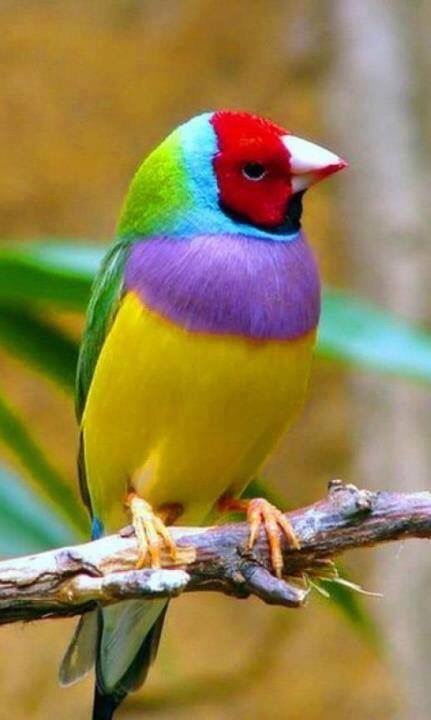
Aloha kakahiaka oukou. Hau’oli aloha Po’akolu. Ka maluhia a me ka maʻalahi a me na ‘ohana e hoaloha. I lā nani nou.

Greetings this beautiful day. Always remember to embrace the darkness because all creativity, all healing comes through darkness that is honored and embraced with love. Peace be with you.

Tonight’s Full Moon is in the fiery sign of Aries. This is a time of great change, the universe is giving us so many gifts and chances right now, don’t be afraid to take them and to dream of bigger and better things, ask for more, do more, be more. Look at what may be holding you back and get rid of it. The Aries Full Moon is about new starts, getting rid of the old and bringing in the new.
So much of what has been suppressed is coming to the light now and shining so brightly that we cannot ignore it any longer. This Full Moon is about truth and seeing what is really there and not what we want to see. In life we can often see illusions about ourselves, illusions about others and illusions about our world, all of these will start crumbling away so we can rebuild on what is real and true.
The Aries Full Moon is a time of healing and cleansing, of getting rid of our negative junk and moving ourselves into a new and positive direction, look at all the good things in your life and look at how to improve the bad things. It’s time to take a deep look within ourselves and to become more aware of what makes us feel comfortable and secure. With this potent Aries energy, we have the chance to make important changes in our lives. It’s time to make some solid yet realistic plans for the future.
Tonight’s Full Moon will be hot and passionate as we can feel the fire of the Aries element, yet we will feel a tranquil quality that can bring a new wave of calm and peace with it. The gentle dusting of energy bought by this Full Moon will allow us all to restore and recharge our batteries and perhaps even feel more comfortable with our situation and where we are at, we will see with clear clarity what we need to do to heal and grow. Let the fire of Aries wash over you and cleanse and heal you. Now is also the time to really get in touch with your passions and desires and work on making them a reality.
Have a blessed Full Moon, may the Goddess watch over you.
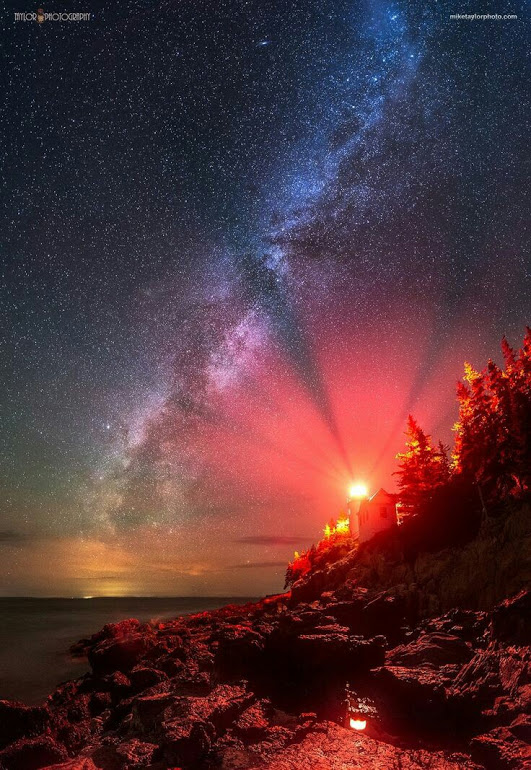 Aloha kākahiaka kākou a Hauʻoli lā Pōʻaono. Ō kā maluhia no me ʻoe.
Good morning to you all and Happy Saturday. Peace be with you!
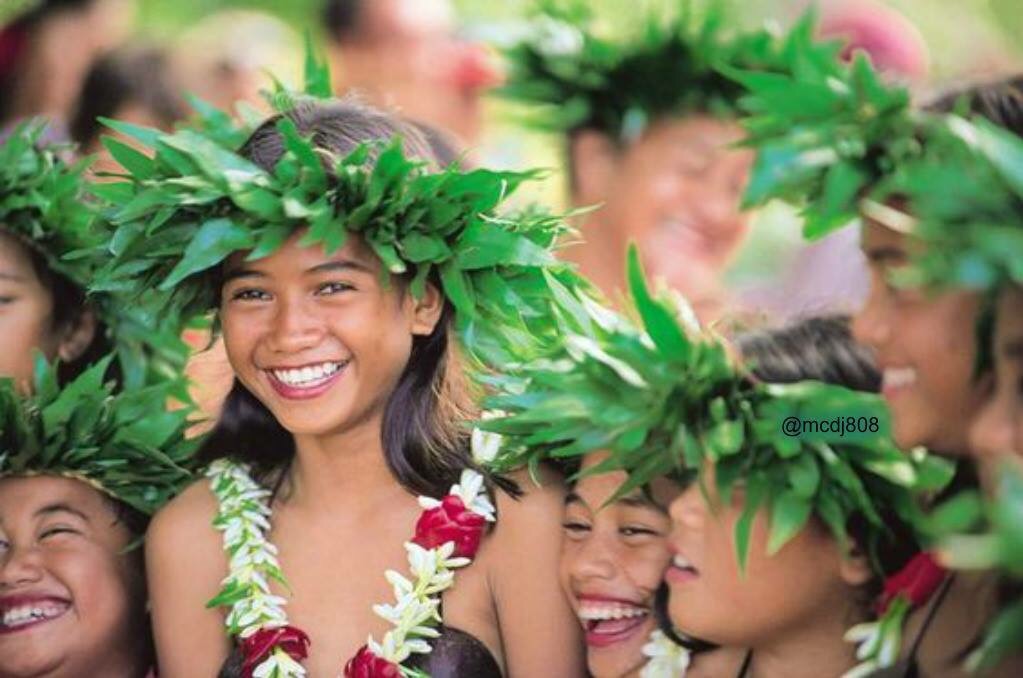
Aloha kakahiaka kakou e Hau’oli aloha Po’alima kakou. O ka maluhia no me ‘oe.
Good morning and a Happy aloha Friday to you all. Peace be with you.
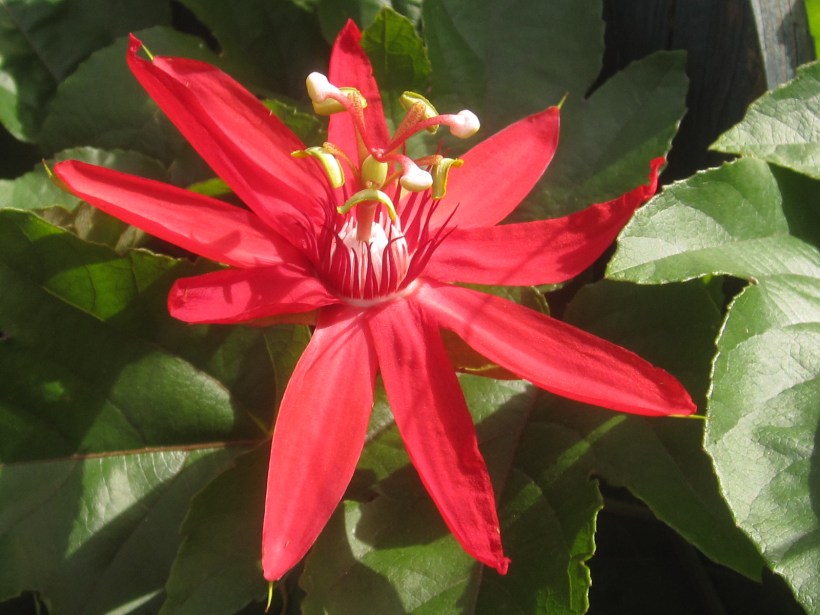 Aloha kākou e hauʻoli lā Pōʻaha. E hoʻomanaʻo kā hana pono e ʻonipaʻa. Ō kā maluhia no me ʻoe.
Greetings and Happy Thursday. Remember to always work at keeping your life balanced to stand firm. Peace be with you.
 Aloha kākahiāka a Hauʻoli Aloha Pō’akolu kākou. ‘Ua ke ALOHA ʻoe makemake ia ʻole ‘Ao. Ō kā maluhīa nō me ʻoe.
 Aloha kākou a hauʻoli lā Pōʻalua. ʻUa ōla loko i ke aloha. Ō kā maluhia no me ʻoe.
Greetings and Happy Tuesday to all. Love gives life within, so love yourself to be strong in body, mind and spirit. Peace be with you.
KALO (Taro): The life of Kanaka Maoli, the indigenous Hawaiian people, is linked closely with kalo, also known as the taro plant. Kalo is believed to have the greatest life force of all foods. According to the Kumulipo, the creation chant, kalo grew from the first-born son of Wakea (sky father) and Papa (earth mother), through Wakea’s relationship with his and Papa’s daughter, Ho`ohokulani. Haloa-naka, as the son was named, was stillborn and buried. Out of his body grew the kalo plant, also called Haloa, which means everlasting breath. Kalo and poi (pounded kalo) are a means of survival for the Hawaii people. By eating kalo as poi, one at a time as a ritual around the poi bowl (`umeke) at the center of the diners, the protocol of Hawaii is maintained. This is a ceremony of life that brings people together and supports a relationship of `ohana (family) and of appreciation with the `aumakua (ancestors).
Kalo From early times, kalo was the primary food of the Hawaii people, supplemented by other principal and traditional foods: breadfruit (`ulu), sweet potato (`uala), yams, greens, ferns, fruit, fish and seaweed (limu).

Taro came to Hawaii Nei with the earliest Polynesian settlers in their canoes and has been cultivated as a staple and staff of life from ancient times in the tropical and subtropical latitudinal band around the earth. Taro grows in tropical Africa, the West Indies, the Pacific nations and in countries bordering the Indian Ocean in South Asia. In Hawaii, where cultivation has been the most intense, in the early days there were more than 300 varieties of taro. Approximately 87 of these varieties are still recognized today, with slight differences in height, stalk color, leaf or flower color, size, and root type. Some of the local varieties are Mo`i, Lehua, Ha`akea and Chinese.
Taro, whose scientific name is Colocasia esculenta (or antiquorum) is cultivated both in the uplands as high as 4,000 feet, and in marshy land irrigated by streams. The plant is a hearty succulent perennial herb, with clusters of long heart or arrowhead-shaped leaves that point earthward. Taro grows on erect stems that may be green, red (lehua), black or variegated. The new leaf and stem push out of the innermost stalk, unrolling as they emerge. The stems are usually several feet high. Tiny new plants appear around the base of the root corm. The pua, inflorescence, is an open yellow-white tube, enclosing a spike covered with flowers.
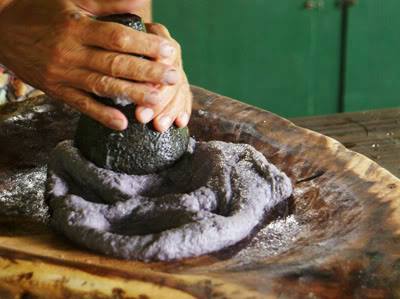
The whole plant: the kalo (corm) and luau (leaves) are eaten, and the huli are replanted. Depending on the variety, all parts of this sturdy and vital plant are eaten. The leaves are cooked as greens, similar to spinach. The tubers are eaten baked, boiled or steamed, or cooked and mashed with water to make poi. The fibrous flesh of the tubers is tough and spongy, ranging in color from white, yellow, lilac-purple and pink to reddish. Most important is the starchy root with enough glutinosity to make quality poi. The stiffest poi is called locally “one finger” and the most liquid “three finger”. “Two finger” poi is considered the best by some. The planters know which kind of taro makes the best poi, which variety has the most tender leaves and which has the necessary medicinal properties.
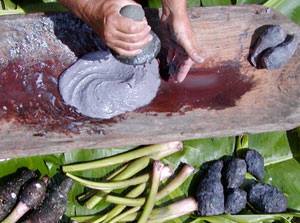
Taro is often fed to babies as their first whole and natural healthy food, as well as to the elderly, for its ease of digestion and high vitamin content. Some people call poi the “soul food” of Hawaii. Poi is eaten fresh or allowed to ferment for a few days, often for longer, creating a sour taste considered pleasant, acid, but not alcoholic. In the old days, a person might consume up to five pounds of poi per day. Several kinds of kalo had such special flavor and color that they were reserved only for the chiefs. It is said that Soviet astronauts ate dehydrated taro in space, adding water to the packets … instant poi!
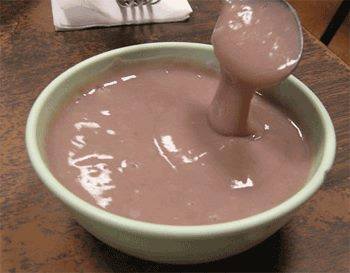
In the kalo and poi-based agricultural society, the people of ancient Hawaii were dependent on wetland taro. Great skills were needed to terrace, cultivate and irrigate the land along streams, as well as the social and political skills to maintain it. The planters of wetland taro were practicing engineers, building walls of earth reinforced with stone to enclose the lo`i (pond field). Along the banks of the lo`i were planted mai`a (banana), ko (sugarcane), ki (ti), and wauke (paper mulberry) for kapa cloth, also known as tapa. In the pond field, several varieties of fish were grown, such as `awa, `ama`ama, o`opu and aholehole. An acre of wet lo`i could produce 3 to 5 tons of food per year. Dryland taro was grown in the lower forests where the soil was rich and the rainfall sufficient. Stone borders surrounded these gardens and can still be found on a forest hike.
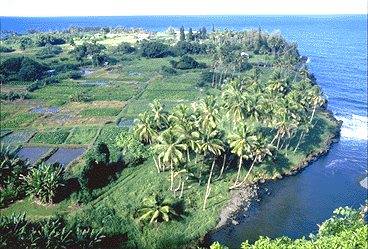
Today there are still functional lo`i along the Keanae, Wailua and Hana coastlines of Maui, as well as other locations throughout these Hawaiian Islands.

In planting both wetland and dryland taro, the huli, the planting material, consists of a 1/2 inch thick slice of the top of the kalo (corm, from which derives the plant’s name) attached to 6 to 10 inches of the leaf-stem. These protrude above the water or dryland where planted.
The bottom of the corm/root is saved for cooking and eating, making taro a recyclable plant. In 6 to 12 months, depending upon plant variety along with soil and water conditions, the taro should be ready to harvest. Each parent tuber produces from two to l5 `oha, side tubers of corms, up to 6 inches in diameter. `Oha means specifically the suckers or shoots concentrically growing from the corm of the kalo/taro plant. Knowing this, it is easy to understand why the Hawaii family as a group is termed `ohana, which literally means “all from the shoots”.
Before kalo can be eaten, all parts of the plant must be cooked, in order to break down the needle-like calcium oxalate crystals present in the leaves, stem and corm. These could be extremely irritating to the throat and mouth lining, causing an acrid burning and stinging sensation.

Lu`au – Taro Leaf Lu`au is the name of the edible taro leaf, from the word lau, leaf. The lu`au leaf is another kinolau of Lono. Lu`au supplies high amounts of vitamins A, B and C, as well as calcium, iron, phosphorus, thiamine and riboflavin. The cooked corm and poi have fewer vitamins, but are an excellent carbohydrate source and have the ability to balance the pH factor in the body, as they are an alkali producing food.
The following are a few of the medicinal uses of poi and the kalo plant. Poi is used to settle the stomach. Mixed with ripe noni fruit, it can be applied topically for boils. Poi can be mixed with pia (arrowroot starch) and taken for diarrhea. Undiluted poi is sometimes used as a poultice on infected sores. A piece of taro stem, haha, can be touched to the skin to stop surface bleeding. Some infections respond to the use of taro leaves mashed with Hawaii salt. This poultice can be applied to an injury, covered and wrapped with a large taro leaf. For a sting from an insect, the stem can be cut and rubbed on the afflicted area.
Mud from the taro patch was used as a black dye for lauhala and kapa cloth, while some leaf-stem juice yielded red dye. Also, diluted poi was used as a paste to glue together pieces of kapa cloth.
The kalo plant is said to be the hiapo, the number one sibling. It is also said to be the kinolau, the body form, of Kane, the procreator. The small round depression where the taro stalk meets the leaf surface is called the piko, from whence comes the name for the human belly button.
c: canoe plants of ancient hawaii
 Welina mai a me Hauʻoli aloha Lāʻpule oukou. Mai ʻena i ke kanaka i laka aku. Ō ka maluhia no me ʻoe.
My warmest greetings and a Happy Aloha Sunday, everyone. Treat a person who comes in kindness with kindness. Peace be with you.
 Aloha e Hau’ōli la Pō’aōno kakou. O ka maluhia nō me ‘oe.
Greetings and Happy Saturday to you all. Peace be with you.


Aloha mai e Hau’oli la Po’aha kakou. O ka maluhia no me ‘oe.
Greetings and a Happy Thursday to you. Peace be with you.
 Aloha kākahiaka kakou a hauʻoli aloha Pōʻalua. Ī lā nani nou. Ō kā maluhia nō me ʻoe.
Good morning and a Happy Aloha Tuesday, everyone! Have a beautiful day. Peace be with you.
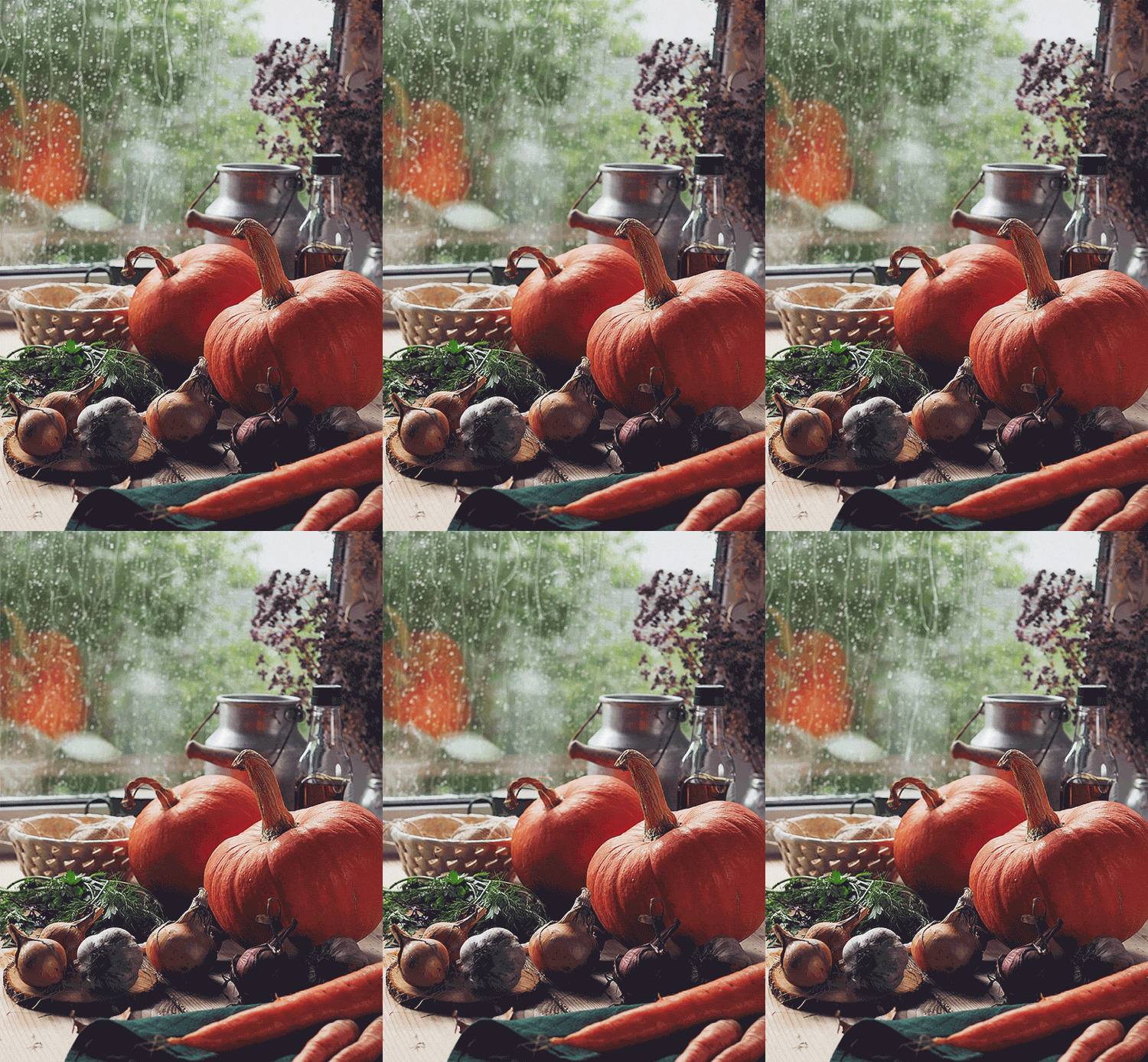
 Hauʻoli Aloha Lāʻpule oukou. Pupukahi i holomua. Ō kā maluhia no me ʻoe.
Happy Aloha Sunday, everyone. Unite in order to progress. Peace be with you.
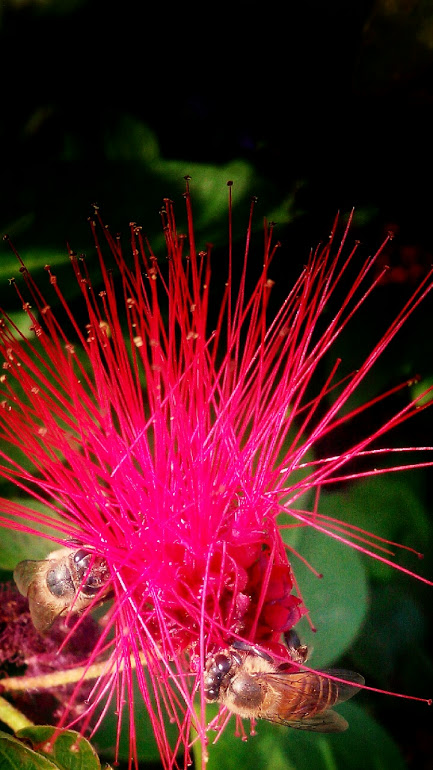 Welina mai e Hauʻoli Aloha Pōʻaono kākou. No ko ianei manao ia ōukou a pau i ka Āiwa lā. Ō ka maluhia no me ʻoe.
Greetings and Happy Aloha Saturday, everyone. Wishing you all a fantastic day. Peace be with you.
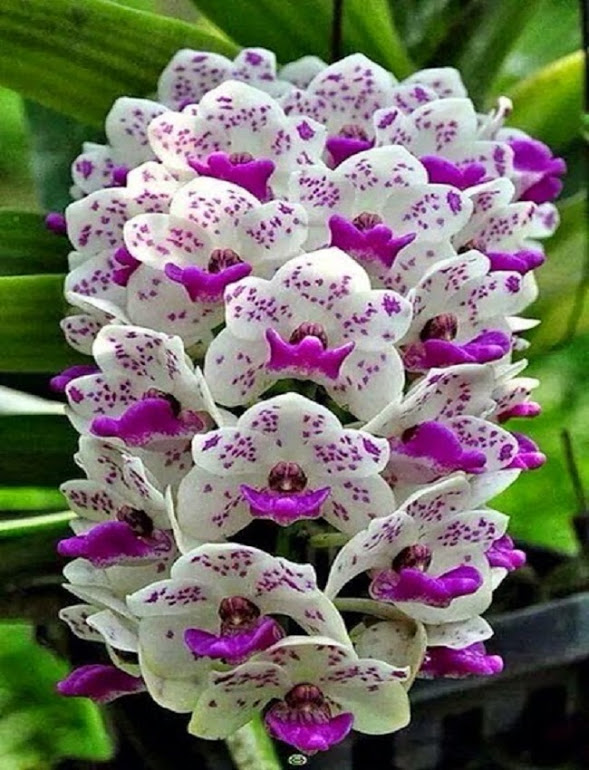 Hau’oli Aloha Po’alima, na ‘Ohana e Hoaloha … O ka maluhia no me ‘oe.
Happy Aloha Friday, my Family and Friends! Peace be with you.
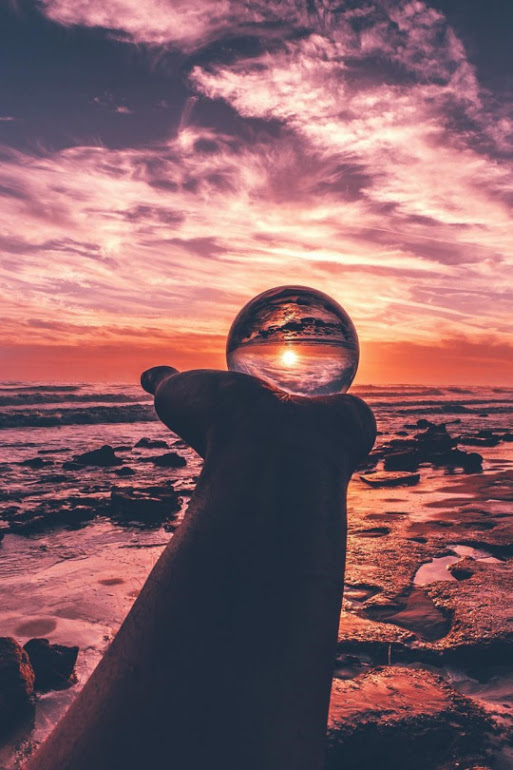 Aloha kākahiaka a me Hauʻoli lā Pō’aha kākou. ʻOhoihoi keia nani lā. Ō kā maluhīa nō me ʻoe.
Good morning and Happy Thursday to you all. Enjoy this beautiful day. Peace be with you.
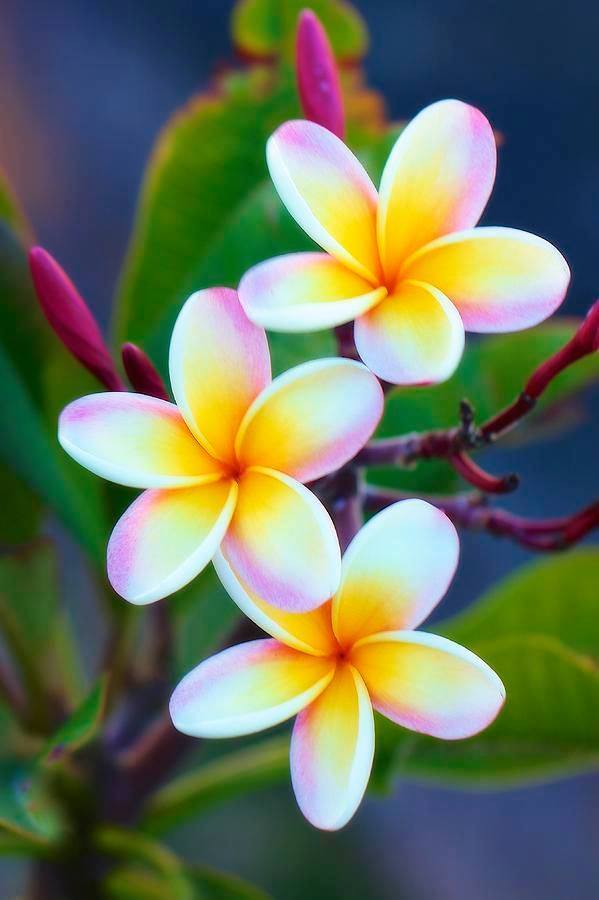 Aloha kākahiaka a me Hauʻoli lā Pō’akolu kākou. ʻOHoihoi keia nani lā. Ō kā maluhīa nō me ʻoe.
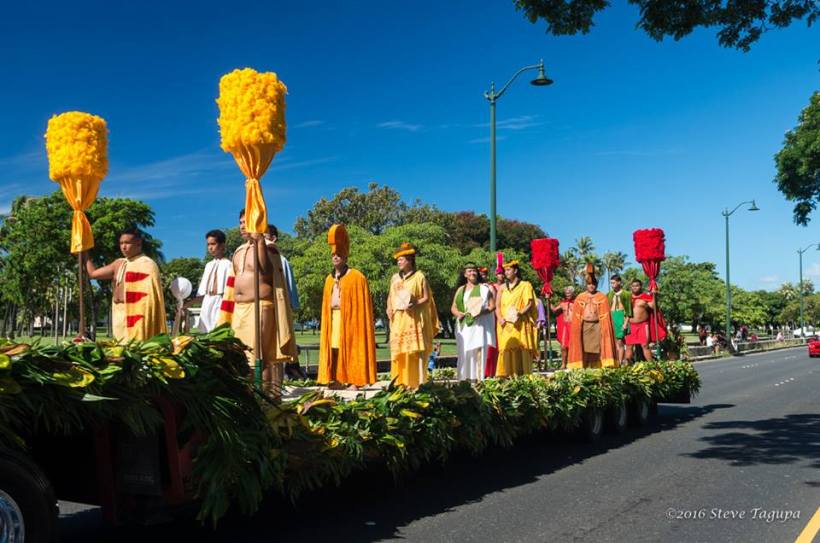 Aloha kākou a hauʻoli aloha Pōʻalua. ʻOhoihoi kou lā. Ō kā maluhia nō me ʻoe.
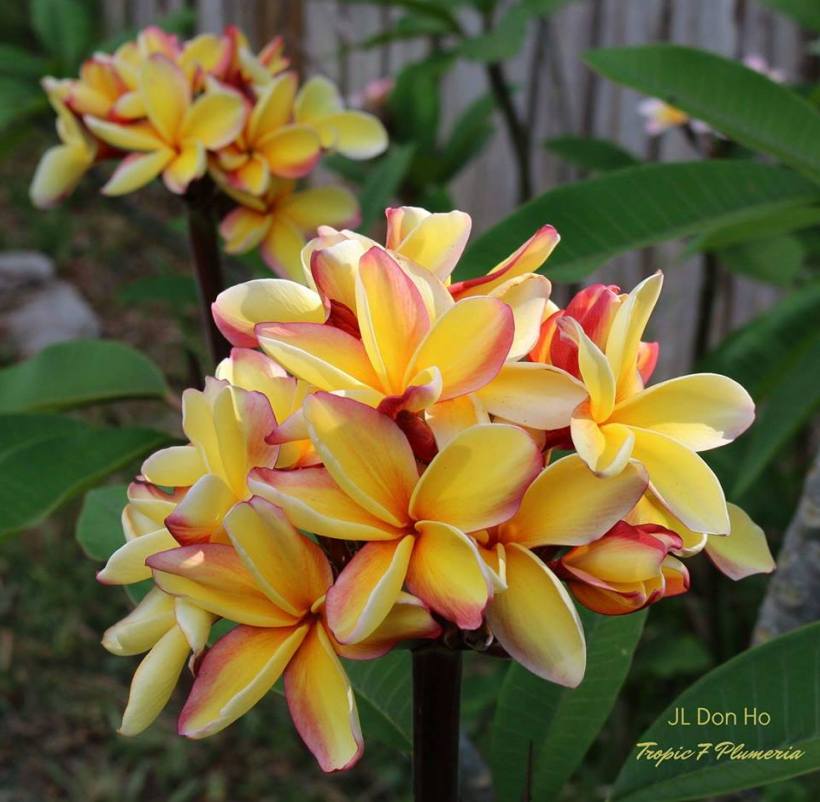 Welina e Hauʻoli aloha Pōʻakahi kākou. No ko ia nei manāo ia ōukou a pau i ka Āiwa lā. Ō ka maluhia no me ʻoe.
Greetings and Happy Aloha Monday, everyone. Wishing you all a fantastic day. Peace be with you.
Hau’ōli Aloha Lāʻpule nā Kanaka … Ō kā maluhia nō me ʻoe.
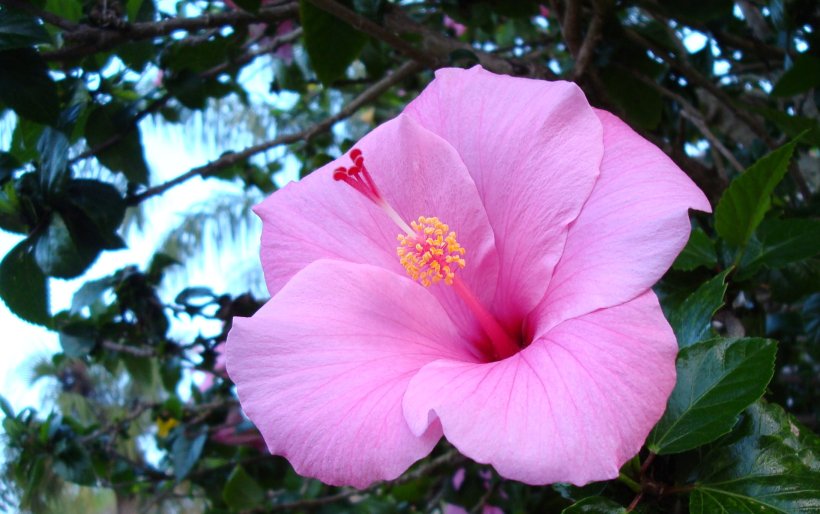 Welina mai a Hauʻoli Aloha Pōʻalima, nā Kānaka! Ō kā maluhia nō me ʻoe.
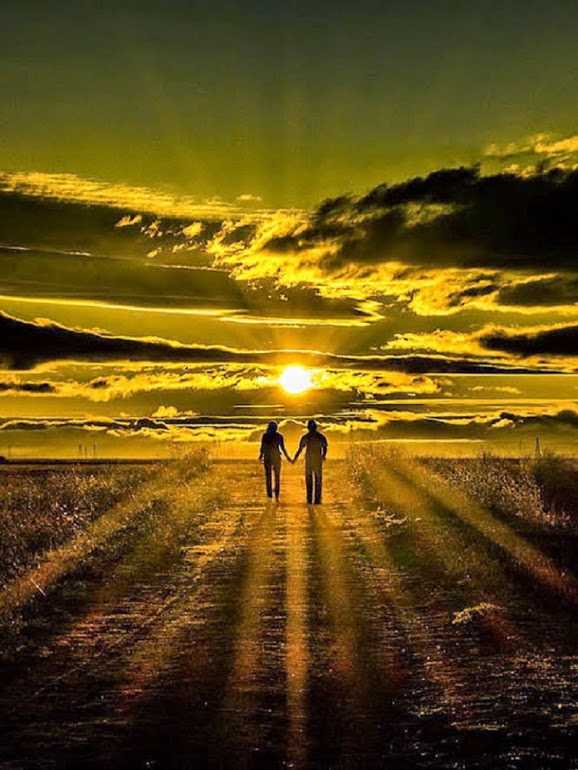
To strengthen the muscles of your heart, the best exercise is lifting someone else’s spirit whenever you can.
 Welina mai a Hau’oli Aloha Po’aha kākou. Ō ka maluhia no me ʻoe.
Warmest greetings and a Happy Aloha Thursday to you all. Peace be with you.
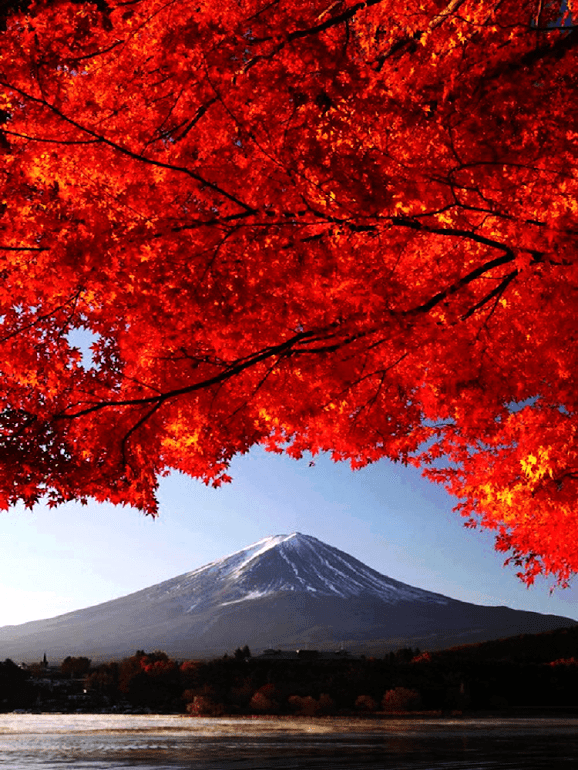 Aloha a me ka maikai o ka kakahiaka, i na mea a pau ia oukou kanaka a maika’i. Kakou no ma ka hana hebedoma hapalua ala. Malama neʻe i mua, hula manawa ua aneane ʻaneʻi. I ka maika’i o ka lā. Nui ke aloha.
Hello and good morning to all you good people. We are half way through the work week. Keep moving forward, play time is almost here. Have a beautiful day.

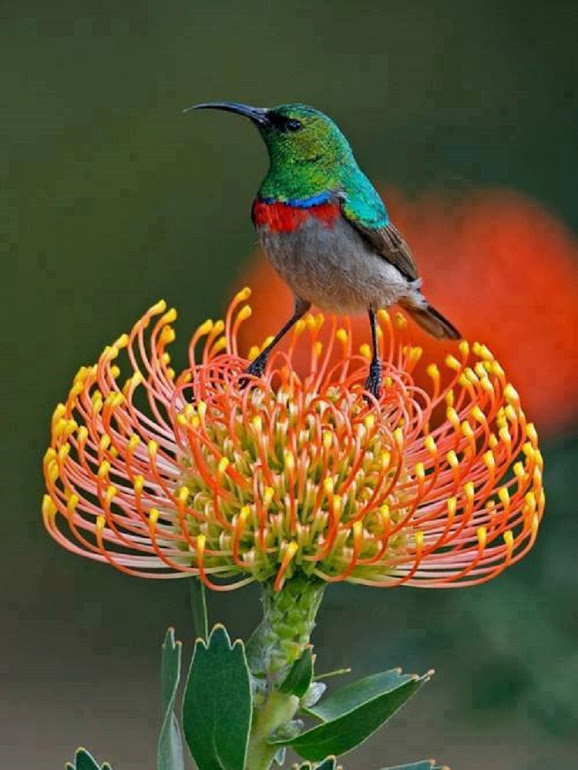 Aloha kākahiāka a Hauʻoli Aloha Pō’akahi kākou. Aloha ke lā me aloha ʻole kou puʻuwai. Ō kā maluhīa nō me ʻoe.
Good morning and a Happy Aloha Monday to you all! Greet this day with aloha in your heart. Peace be with you.
 Aloha kākahiāka a Hauʻoli Aloha Pō’alima kākou. Aloha ke lā me aloha ʻole kou puʻuwai. Ō kā maluhīa nō me ʻoe.
 Aloha kākahiaka kākou a Hauʻoli Aloha Po’aha. Ō ka maluhīa no me ʻoe.
Good morning to you all and a Happy Aloha Thursday. Peace be with you.
Aloha kākahiaka kākou a Hauʻoli Aloha Po’akolu. Ō ka maluhīa no me ʻoe.
Good morning to you all and a Happy Aloha Wednesday. Peace be with you.
 Aloha kakahiaka oukou. I lā āwaiwa Poʻalua. Mahalo Ke Akua no keia nani lā.
Good morning and have a fantastic Tuesday. Thank God for this beautiful day.
 Aloha kākou e hauʻoli aloha Pōʻakahi. Ī lā nani nou. Ō kā maluhia nō me ʻoe.
Find Your Magic
Tarot Readings, Inspiration, and Self-Empowerment
Making life on earth magick one moon phase at a time.
Astrologer ~ Mystic ~ Writer
of the Collegium Spiritus Sancti, a Golden Dawn Society
An affiliate of the Alpha et Omega Order of Melchizedek
All Knowledge Is Not Contained In Only One School
Connecting the grant community to #LearnGrants
Channelings & Articles
Magic Spell Books & Grimoires
Native Hawaiian Language Revitalization
Poetry & Tales of Love, Mystery, Magic and Spirituality
Organic Herbs, Herbals, Sustainable Gardening
Mother Nature: Feeding The Mind, Body & Soul, with Food, Medicine & Skincare.
"Inheritor of a Dying World, we call thee to the Living Beauty. Wanderer in the Wild Darkness, we call thee to the Gentle Light..."
Time is the most important thing we've been given
Embracing the Divine Within.
"...That I should bear witness to the truth." - John 18:37 // David E. Robinson, Publisher

