How does coffee affect your brain and sleep if you consume it in the evening hours or shortly before going to bed?
Coffee is one of the most popular beverages in the country, with 7 in 10 Americans consuming the drink every week, according to the National Coffee Association.
While most people would probably associate coffee drinking with the daytime hours, some individuals consume the caffeinated beverage at night. This could lead to potentially negative effects when it comes to sleep quality, experts said. Caffeine is a compound found in coffee that stimulates the central nervous system. […]
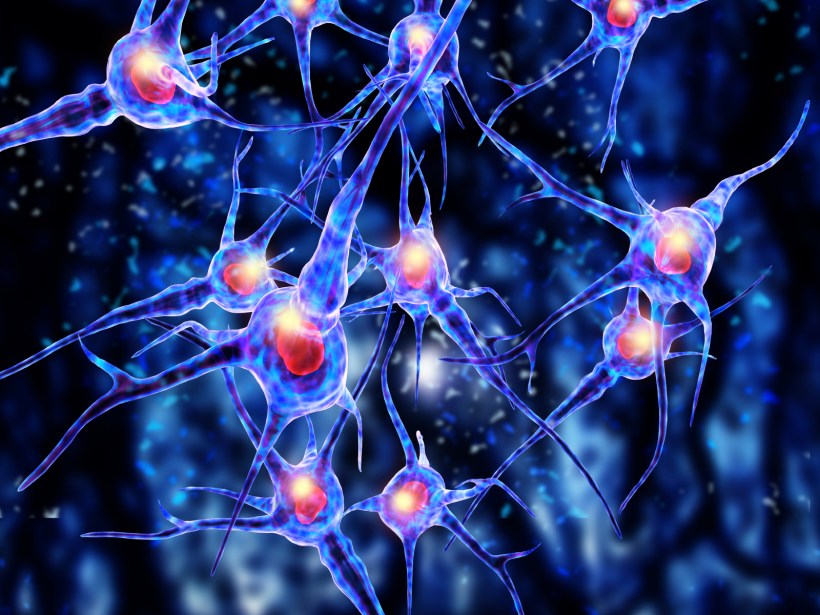
Scientists have discovered a new type of brain cell that promises to shake up the field of neuroscience.
The discovery brings an end to a decades-old controversy and may pave the way for new targeted treatments for a range of health conditions.
The results, from neuroscientists at the University of Lausanne in Switzerland and the Wyss Center for Bio and Neuroengineering in Geneva, were published on September 6 in the journal Nature.
To understand the relevance of the study, let’s first establish what we already know about brain cells. […]
My beloved child, you are the vehicle for love’s expression. Your body and your life are graced by love, not solely your mind and spirit. Infinite love is what you are destined to experience in this life. It is a divine calling for you to feel my presence in your daily life.
I wish you to know that miracles are destined to manifest in your life. Fear of not understanding how things will turn out might lead you to worry about your lack of power. However, you can be humble and trusting and submit to my mercy. You have nothing to lose or fear and everything to potentially gain.
What you need to know
Throughout history, there have been accounts of regular individuals who were instructed by Mother Mary to fulfil some crucial earthly work on her behalf. Even while these challenges she set were not insurmountable, each individual was required to have more confidence in Our Lady’s will than in their own. These persons loved the Holy Mother and wanted to be open to the extraordinary in their everyday lives hence she invited them to carry out her work.
It’s true that you’ll need strength to complete the duty that Our Lady asks of you, whether or not you realise what it is right now. Confidence and commitment will help you to trust in your heart’s mission. Be aware that this work may be a big task. Alternatively, it may be small and modest, such as establishing a flower bed in your front yard that will have a positive impact on everyone who sees it. Have faith that you will know what to do when the time is right!
Prayer for healing
Visualise a carpet of crimson flowers at your feet. They have a delicate scent as well as beautiful luscious velvety petals. Brilliant energy is released as a beautiful light sparkles in the core of each red bloom. Our Lady performs miracles with every flash of this intense energy. Emotional and physical healing, windfalls, a miraculous revelation, a finding of what had been lost and the chance to meet one’s soul mate are all examples of her miracles that amaze everyone who loves her!
As you sit in silence, the following prayer can be said, “Our Lady of Miracles Manifesting, I yield to your compassion, will and heavenly design of love. Thank you for everything that you have given me. Thank you for giving me the opportunity to serve as a conduit for your compassion and healing. So that I might spread more of your illumination over the world, may my life be filled with spiritual fulfilment. So be it, by the power of your holy goodness.”
We are already in the second Full Moon of this month, a phenomenon we call Blue Moon. Of course, the Moon is not going to turn blue, nor will you see it in this color. The only color change you wil […]
August 30, 2023 at 6:35 pm PDT is a full Moon in Pisces. This full Moon is the 3rd of four Super Moons in a row. And it’s a Blue Moon, the 2nd full Moon in one month. No need to be blue! Wate […]
If we trace the English term ‘soul’ to its Greek antecedents and equivalents, we soon find a wide variety of meanings. Even before the time of Socrates, many accretions and materializations had already gathered around the concept. It was compared to the wind. It was also supposed to mean ‘that which breathes,’ ‘that which is alive.’ And it was given many other meanings and often couched in metaphorical terms through analogy with sparks and a central fire. It became crucially significant for Plato to enrich the notion of ‘soul’ and to give it an existentially human meaning to do with the very act of search, the very desire to know the good, the hunger to make distinctions — not only between the good and the bad but between the good and the attractive, not only between the true and the false but between the true and the plausible. The desire to make noetic discriminations becomes the basis for a functional definition of the soul. Plato taught that, metaphysically, the soul may be seen either as perpetual motion or as a self-moving agent. In one passage he refers to a particular kind of motion which is not visible in the material realm but may be properly ascribed to the hidden Logos, the invisible deity. Elsewhere, what he identifies as the soul is connected with volition. What would it avail a man who uses the word in a Socratic sense but does not come to terms with his own will-problem, or worse still, becomes identified intellectually with his weak-willed self?
Language is very important here. The prolonged abuse of the term ‘soul’ in the Middle Ages resulted from a decisive shift in meaning. An active agent was replaced by something passive, something created. In a corruption of the Socratic-Platonic meaning, the ‘soul’ became merely something acted upon, a passive agent receiving reward or punishment. The term ‘soul’ almost became unusable, so that in the Renaissance humanists had to assert the dignity and divinity of man in ways that did not involve them once again in the debased coinage of the terminology of the past. In the twentieth century the term ‘self’ is coming into wide circulation, recovering some of the dignity of the classical conception of the soul.
A person brought up in a corrupt language system could receive tremendous help by borrowing a term from Sanskrit and trying to recognize its open texture. The compassionate Teachers of the Theosophical Movement chose to introduce from that sacred language terms like Manas — the root of the word ‘man,’ from man, ‘to think’ — into the languages of the West. When Emerson eulogizes “man thinking” he is using two English words in a manner that confirms exactly the full glory of the idea of Manas. Yet we also know that both the words ‘man’ and ‘thinking’ can be so degraded in everyday usage that they do not convey the glory of manhood implied by Manas. The term Manas in Sanskrit means not only ‘to think,’ but also ‘to ideate,’ ‘to contemplate.’ To contemplate in this classical sense is to create, to sustain a continuous and controlled act of creative imagination enveloping more and more of the whole, while retaining that core of individuality which signifies responsibility for the consequences of all thoughts, all feelings, all words, and all acts. This is a kingly conception.
It is often advantageous for a person to go outside his particular prison-house of debased language and explore classical concepts. As we grow in our awareness, we may make the beautiful discovery that even in the accents of common speech there are echoes of those pristine meanings. The literal meaning of words is less important than the tone of voice in which we use them. It is possible for a man in the street to say to another, “Hi, man” with unconscious contempt, and for a traveller in the Sierras to say, “Hi, man,” in a manner that expresses genuine fellow-feeling. Miranda in The Tempest, seeing human beings for the first time, exclaims:
O, wonder! How many goodly creatures are there here! How beauteous mankind is! O brave new world, That has such people in’t!
Every word has a depth and beauty of feeling that makes ordinary English words rise like wingèd skylarks into the universal empyrean — generous, cosmic and free. Beyond all languages and concepts, the very act of articulation is of immense importance. Perhaps the most beautiful passage on the subject of reincarnation is to be found in The Human Situation by Macneile Dixon. This great lover of the literatures of the world, of Plato and Shakespeare, dared to suggest:
What a handful of dust is man to think such thoughts! Or is he, perchance, a prince in misfortune, whose speech at times betrays his birth? I like to think that, if men are machines, they are machines of a celestial pattern, which can rise above themselves, and, to the amazement of the watching gods, acquit themselves as men. I like to think that this singular race of indomitable, philosophising, poetical beings, resolute to carry the banner of Becoming to unimaginable heights, may be as interesting to the gods as they to us, and that they will stoop to admit these creatures of promise into their divine society.
By speech a man can betray his divine birth, and just as this is true of speech in its most sacred and profound sense, it is also true of human gestures. The simple mode of salutation in the immemorial land of Aryavarta is filled with this beauty. When the two hands come together, they greet another human being in the name of that which is above both, which brings the two together, and includes all others. There is something cosmic, something that has built into it a calculation of the infinite in the expedient, even in this gesture.
But what is true of gestures could be even more true of human utterance. The surest proof of the divinity and immortality of man is that through the power of sound he can create something that is truly magical. He can release vibrations that either bless or curse, heal or hinder other beings. This is determined by motivation, intensity of inmost feeling, and the degree of individual and universal self-consciousness, nurtured and strengthened through constant meditation and self-study.
Suppose one were to ask of the gods, “Give me one of two gifts for all men. Give me first that gift which will suddenly enable all men to say that they know about reincarnation and the soul, and that they believe in immortality. Second, give me that gift which enables all men to help babies to grow with a feeling of dignity, deliberation, beauty and sanctity in regard to human speech.” The wise would know that the latter gift is much more valuable than the former, because mere beliefs will not save human beings even though truly philosophical reflection upon alternatives is part of the prerogative of a Manasic being, a man in Emerson’s sense. These beliefs can only be made to come alive through the exercise of conscious and deliberate speech, with a delicate sensitivity for the existence of other beings, and an immense inner compassion for all that is alive. If human speech were not constantly wasted and made into something so excessive and destructive, so mean and niggardly, we would not find so much of the self-hatred, mutual distrust, pessimism and despair that characterize our lot. We would not find ourselves in a society which is free but where, alas, the loudest voice is the most feared and tends to have the widest impact.
Anyone who can existentially restore the alchemical and healing qualities of sound, speech and silence, to some limited extent, in the smallest contexts — in relations with little children, with all he encounters even in the most trivial situations — does a great deal for the Bodhisattvas. Those Illuminated Men, by their very power of thought and ceaseless ideation, continually benefit humanity by quickening any spark of authentic aspiration in every human soul into the fire which could help others to see. The truth of reincarnation requires much more than a casual scrutiny of our external lives and our spoken language. It must be pondered upon in the very silence of our souls. It is a theme for daily meditation. In the Bhagavad Gita Lord Krishna tells Arjuna that true wisdom is a meditation upon birth, death, decay, sickness, and error. To meditate upon each of these and all of these together is to begin to know more about the cosmic and the human significance of the truth of reincarnation.
A family recipe for our favorite blueberry lemon bread. No mixer required! Like most sweet loaves, it tastes best when allowed to sit for a day, wrapped in plastic wrap.
This Lemon Blueberry Bread recipe produces a perfectly moist, flavorful and delicious loaf of quick bread! Topped with a lemon glaze this easy bread recipe is a classic combination of tart, sweet, and bright flavors! Sure to be a new favorite! […]
Let one guard oneself against irritability in thought;
let one be controlled in mind.
Abandoning mental misconduct,
let one practice good conduct in thought.
Dhammapada 17.233
The Dhammapada: The Buddha’s Path of Wisdom, translated from Pāli by Acharya Buddharakkhita
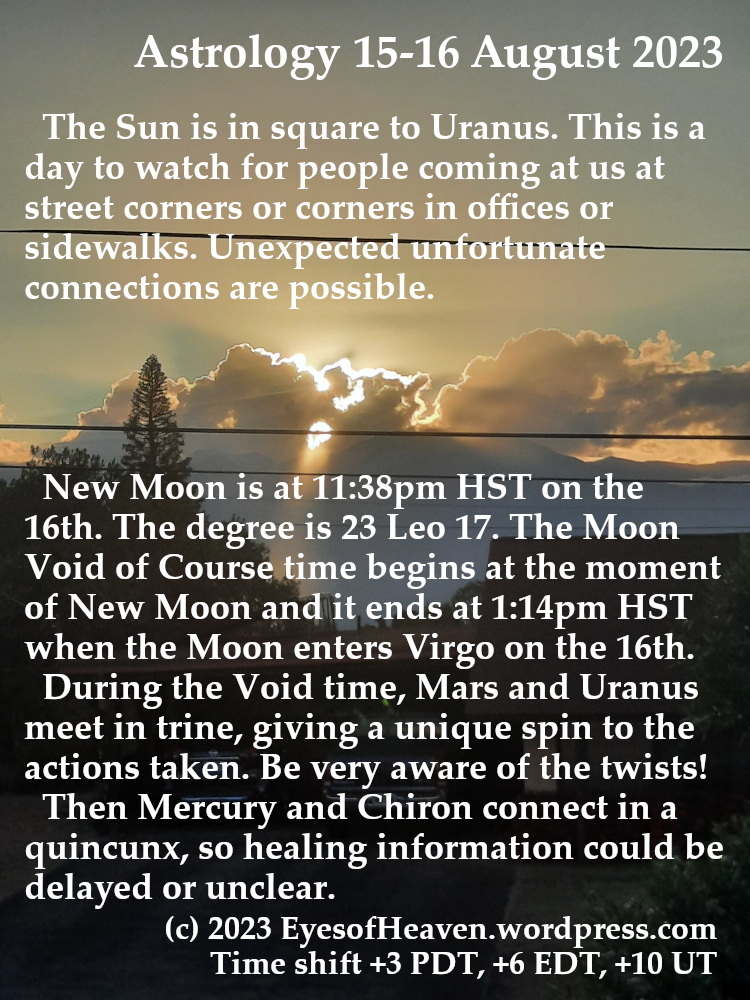
Sun Mars and Uranus are all at 22 degrees Leo, Virgo and Taurus August 15. 22 reduces 4 which is the Emperor/King archetype. Donald Trump numerology he is a 22/4/0 the King and The Fool.
Let one guard oneself against irritability in speech;
let one be controlled in speech.
Abandoning verbal misconduct,
let one practice good conduct in speech.
Dhammapada 17.232
The Dhammapada: The Buddha’s Path of Wisdom, translated from Pāli by Acharya Buddharakkhita
Haupia, also known as Hawaiian coconut pudding, is a sweet, cool, refreshing treat. This easy recipe only uses 4 ingredients and is perfect to share. […]
@FreeHawaiiNews – With Hosts Hinaleimoana Wong & Leon Siu Giving The Kanaka Perspective On Issues In Hawaii. Our August Show Reports On The Hawaiian National Soccer Team, Also Mauna Kea Protectors Oppose TMT Construction Permit Extension, Amazing Discoveries In Bern, Switzerland About The Hawaiian Kingdom, Kumu Hinaʻs Mana`o About The Many Meanings Of The Word Lahui, A Report On The “Pacific Way” – A New Movement, Plus Much More.
Yogā ve jāyatī bhūri,
ayogā bhūrisaṅkhayo.
Etaṃ dvedhāpathaṃ ñatvā bhavāya vibhavāya ca,
tathāttānaṃ niveseyya yathā bhūri pavaḍḍhati.
Wisdom springs from meditation;
without meditation wisdom wanes.
Having known these two paths of progress and decline,
let one so conduct oneself that one’s wisdom may increase.
Dhammapada 20.282
The Dhammapada: The Buddha’s Path of Wisdom, translated from Pāli by Acharya Buddharakkhita
Aunty Nona Beamer tells her own story along with family members, and describes the very best of all things Hawaiian: the people, their knowledge, culture, wisdom and aloha.
















 Hālau 'Aha Hui Lānākila