The process of obtaining self-awareness … according to Alan Watts.
Theosophy | THE SENSE OF SELF – II
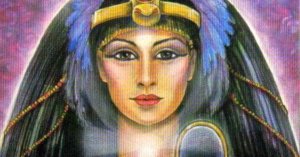
The critical fact for any human being as a self-conscious agent is the capacity of objectivizing, of putting upon a mental screen as an object of reflection anything, in principle, that one wishes. A human being recognizes the range of self-consciousness through a process of progressive abstraction. This includes familiarization with what looks initially like mental blankness – like pitch-black night, where there are no conventional signs, no contours or landmarks, no north or south, east or west. A person who begins to sense the depths of subtle matter will discover that what seems to be a void or darkness is in fact a rich, pulsating light-substance that is porous to the profoundest thought. Then one realizes what initially was simply a bald fact about human beings – taken for granted and therefore forgotten – that all things are mutually and vitally interrelated. Human beings are generally so conditioned by mechanical responses to the ordinary calendar and clock-time that they can hardly apprehend the immensity of the doctrine of relationality, which presupposes that the visible world is a vast psychological field of awareness. The universe exists because there are minds capable of generating conceptions that have points of common contact and thereby an outwardness and extension sustaining an entire field of consciousness. As one cannot set any limit in advance to the range and development, the potency and the scope of all the minds that exist, one cannot readily imagine what it is like to negate everything that exists, to stand totally outside it.
Initially, it is extremely difficult to imagine all of this, so the whole world is at first apprehended as so unfathomably mysterious as to engender a feeling of alienation and fear. But why should moving into more expanded states of consciousness make one afraid? Who is afraid, and afraid for what? At any given time there is a film or shadowy image that is one’s false self between one’s inherent capacity to make a vaster state of consciousness come alive and one’s captivity to the familiar array of objects and opinions. One is like the fabled monkey which, in trying to collect nuts from a jar, held onto them so tightly that he was not able to open his hands and get any. There is an impersonal, impartial sweep to the mental vision of a Man of Meditation that simply cannot correlate and connect with, or take at face value, the common concerns of the world. It is necessary to grasp the strength and richness of viewing the universe as an interior object of intense thought which could be expanded indefinitely, eliminating self-imposed and narrow notions of identity and embracing vaster conceptions of the Self. The significance of this standpoint lies in that continuity is upheld but not formulated. Herein is the basis of indefinite expansion, of growth without hindrance. Existing frontiers of knowledge cannot provide the basis of judgement of the potential realm of the knowable. What is now known is meagre in relation to the immensity of the unknown. It is meaningful to relinquish the delusive sense of certainty to which so many people cling at the expense of an ever-deepening apprehension of relationality.
In general, human beings seem to need the illusions that sustain them. There is something self-protective in relation to all illusions. At least people are thereby helped from becoming fixated on obsessional delusions. There is even something enigmatic about why particular persons are going through whatever they endure. A great deal of human frustration, pain and anxiety, fear and uncertainty, arises from the desperate attempt to keep alive a puny sense of self in an alien world. Individuality arises only through the act of making oneself responsible for the consequences of choices, of seeing the world as capable of being affected by one’s attitudes and, above all, as an opportunity for knowing and rejoicing in wisdom and for rising to the levels of awareness of higher beings. The plane of consciousness on which such beings exist is accessible to all those who are willing to stretch themselves, patiently persist in going through the abyss of gloom, and endure all trials. Infallibly, they can enter those exalted planes and experience a strong sense of fellowship with beings who at one time would have seemed inaccessible. This ancient teaching is worthy of deep reflection. Its abstract meaning pertains to the elastic relation between subject and object, subjectivity and objectivity, and their mutual relativity as illustrated in one’s daily experience. A vast freedom is implicit in this no-ownership theory of selfhood. It is helpful to break up one’s life into periods and patterns, to note one’s most persistent ideas, ambitions and illusions, as well as those points on which one’s greatest personal sensitivity lies, and to make of these an object of calm and dispassionate study, to be able to see by questioning and tracing back what would be the assumptions which would have to be true for all of these to exist. To do this is to engage in what Plato calls dianoia, ‘thinking things through’, whereby in one day a person could wipe out what otherwise would hang like a fog over many lives. There is a fusion of philosophical penetration and oceanic devotion which is characteristic of high states of consciousness. There is no separation between thought and feeling – between Manas and Buddhi – such as is ordinarily experienced.
At one time a natural reverence existed in all cultures in ritual forms which eventually became empty of significance or could no longer be made meaningful when languages were lost or philosophical conceptions were neglected. Individuals today cannot force themselves to be able to feel any of the traditional emotional responses to any single system or ritual. Human beings should creatively find their own ways of making sacred whatever it is that comes naturally to them. What is sacred as an external object to one person need not be to another. The forms of ritualization have all become less important than they were, and that is not only due to the rapid pace of change but also because of the volatile mixture of concepts and of peoples all over the world, together with a growing awareness of the psychological dimension of seemingly objective conceptions of reality. But even though there is a pervasive desacralization of outward forms, the deepest feelings of souls are unsullied by doubt. It is only by arousing the profoundest heart-feelings that one can open the door to active spiritual consciousness. There is in the heart of every person the light of true devotion, the spontaneous capacity to show true recognition and reverence. To do this demands a greater effort for some people than for others. When human beings come to understand the law of interdependence that governs all states of consciousness, their impersonal reason as well as their intense feelings will point in the same direction. It is only this single-minded and whole-hearted mode of devotion which will endure, but its focus must be upon universal well-being.
It is not the individual and determined purpose of attaining Nirvana – the culmination of all Knowledge and wisdom, which is after all only an exalted and glorious selfishness – but the self-sacrificing pursuit of the best means to lead on the right path our neighbour, to cause to benefit by it as many of our fellow creatures as we possibly can, which constitutes the true Theosophist.
Raghavan Iyer
The Gupta Vidya II
Matt Kahn | In this moment, the Universe wants you to know …
To be kind to those who are unkind in return only seems one-sided to the one ‘keeping score’. When reciprocity doesn’t come from people around you, but from the will of the Universe moving through a depiction of characters, you will come to realize how people’s behavior is more reflective of where they are in their journey and never a reflection of your intention or self-worth. While you certainly don’t have to be best friends or lovers with those who ‘take’ with nothing else to ‘give’, because you are serving the will of the Universe, you are always being celebrated by the loving intelligence of divinity for all that you do– even when received by people solely designed to reflect your progress out of the plight of unfairness and into the light of eternal faith.
Na Pohaku La’au | HOW TO IDENTIFY TURQUOISE JEWELRY – IS IT REAL OR FAKE?
In today’s video Mike sits down with Wild Bill to learn how to identify Turquoise Sterling Silver Jewelry along with how to determine if it is real or fake. Wild Bill also shows us some of his personal native turquoise sterling silver jewelry.
Daily Words of the Buddha for July 10, 2021

Uṭṭhahatha! nisīdatha!
Daḷhaṃ sikkhatha santiyā.
Mā vo pamatte viññāya,
maccurājā amohayittha vasānuge.
Rouse yourself! Sit up!
Resolutely train yourself to attain peace.
Do not let the king of death, seeing you are careless,
lead you astray and dominate you.
Sutta Nipāta 2.334
The Discourse Collection: Selected Texts from the Sutta Nipāta, translated by John D. Ireland
Hauʻōli Aloha Pō’aōno
Aloha kākahiāka a me Hauʻōli Aloha Pō’aōno ‘ōukōu. Ī hopenapule maikāʻi kākou. Ō kā maluhia nō me ʻoe.
Good morning and a Happy Aloha Saturday, everyone! Have a nice weekend. Peace be with you.
Hawaii: The Stolen Paradise (Full Documentary) | TRACKS
Hawai’i was an independent nation until January 17, 1893. That day, the archipelago and its monarchical government were overthrown illegally by the United States. Since then, the USA has taken over Hawai’i illegitimately, turning the island into a military base that threatens world peace, while sovereignty groups organize to rescue its legitimacy.
A Void Moon time starts these three days; Mercury enters Cancer for 30 days; Then a very long Void Moon time – stay present/grounded as the time drags on; Have a party and chat for hours (C19 protocols, please)!


Daily Words of the Buddha for July 09, 2021
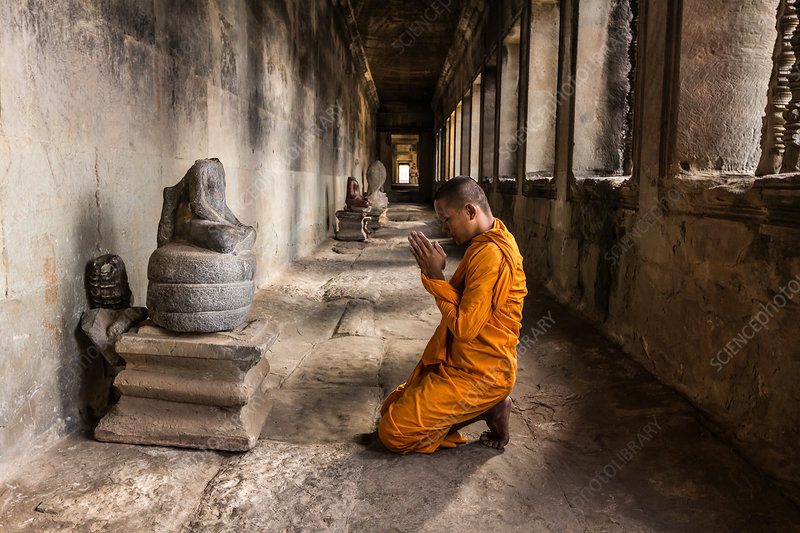
Appampi ce saṃhita bhāsamāno,
dhammassa hoti anudhammacārī,
rāgañca, dosañca, pahāya mohaṃ,
sammappajāno suvimuttacitto,
anupādiyāno idha vā huraṃ vā,
sa bhāgavā sāmaññassa hoti.
Little though one recites the sacred texts,
but puts the Teaching into practice,
forsaking lust, hatred, and delusion,
with true wisdom and emancipated mind,
clinging to nothing of this or any other world —
one indeed partakes of the blessings of a holy life.
Dhammapada 1.20
The Dhammapada: The Buddha’s Path of Wisdom, translated from Pāli by Acharya Buddharakkhita
Hau’olu aloha Pō’aha

Aloha a me ka maikāʻi oʻ kā kākahiāka, ī nā mea a pau ʻia ‘ōukōu kanaka a maikāʻi. Kākou nō ma ka hānā hebedoma hapalua ʻala. Mālāma nēʻe ‘īmua, hula manāwa ʻua ʻaneane ʻaneʻi. Ī kā maikāʻi oʻ kā lā. Nūi ke aloha.
Hello and good morning to all you good people. We are half way through the work week. Keep moving forward, play time is almost here. Have a beautiful day.
Energy Update | July 8, 2021

2021 Cancer New Moon begins Sheep Lunar Month


July 9, 2021 at 6:16 pm PDT is a new Moon in Cancer. Water sign Cancer rules the 4th house of family, home, and heritage. This new Moon begins Sheep lunar month through August 8. The gentle summer month of Sheep is time for healing, cultivating kindness, and to focus on home and family. Therefore, this lunar month is an opportunity for you to re-feather your nest this summer, especially after Covid stay at home.
The new Moon and Sun in Cancer trine Neptune in Pisces. It’seasier to follow your intuition or gut feelings, with empathy and sensitivity to the energy around you. If you are feeling stuck emotionally or spiritually, schedule time toclear out old belongings and make way for Neptune inspiration and creativity this summer. Contact me for your tarot reading, astrology forecast, or feng shui consultation for guidance.
Venus conjunct Mars in Fire sign Leo brings increased…
View original post 179 more words
Daily Words of the Buddha for July 07, 2021

Bahumpi ce saṃhita bhāsamāno,
na takkaro hoti naro pamatto,
gopova gāvo gaṇayaṃ paresaṃ,
na bhāgavā sāmaññassa hoti.
Much though one recites the sacred texts,
but acts not accordingly,
that heedless one is like a cowherd
who only counts the cows of others —
one does not partake of the blessings of the holy life.
Dhammapada 1.19
The Dhammapada: The Buddha’s Path of Wisdom, translated from Pāli by Acharya Buddharakkhita
Hauʻōli lā Pōʻakolu

Aloha kākahiaka e hauʻoli lā Pōʻakolu kākou. E hiki ia oukou a pau i ka pomaika’i ō ka lā. Ō kā malukhia no me ʻoe.
Good morning and Happy Wednesday, everyone. May you all have a blessed day. Peace be with you.
Pāli Word a Day for July 07, 2021

jātimant — of good birth, having natural or genuine qualities, noble, excellent
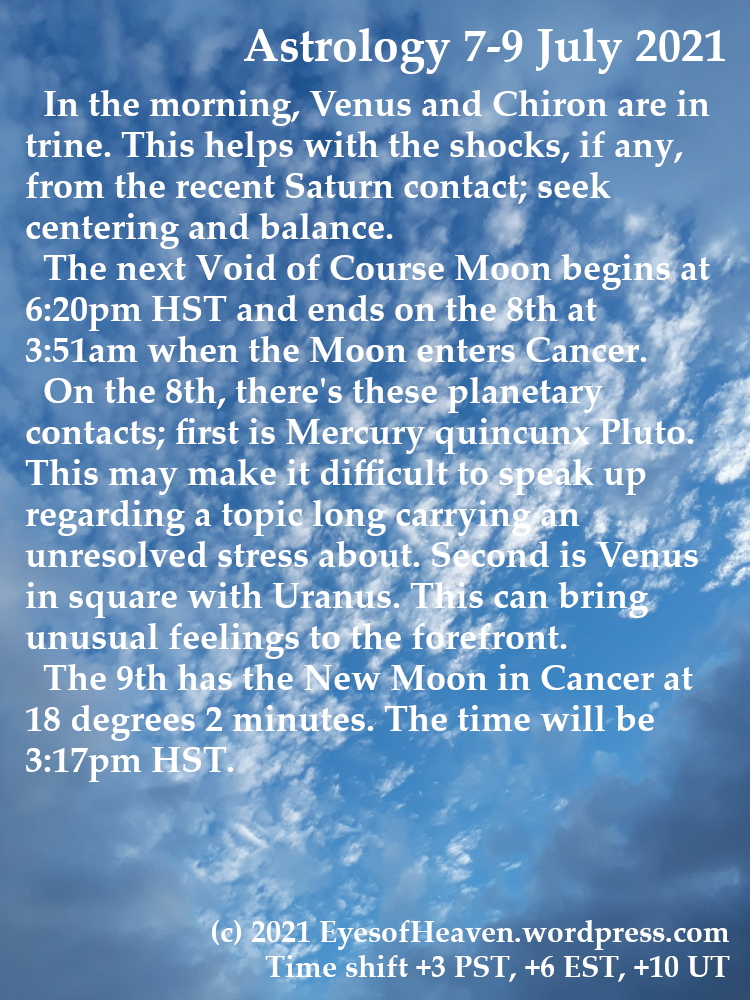
Venus receives healing from Chiron; Void Moon of Course; Mercury may not be able to talk about an issue; Venus’ turn to tangle with Uranus; New Moon in Cancer on the 9th
Daily Words of the Buddha for July 05, 2021
Tato adinnaṃ parivajjayeyya
kiñci kvaci sāvako bujjhamāno.
Na hāraye harataṃ nānujaññā.
Sabbaṃ adinnaṃ parivajjayeyya.
A disciple should avoid taking
anything from anywhere knowing it (to belong to another).
One should not steal nor incite another to steal.
One should completely avoid theft.
Sutta Nipāta 2.397
The Discourse Collection: Selected Texts from the Sutta Nipāta, translated by John D. Ireland
THEOSOPHY | SPIRITUAL WILL – I
The vital interrelationship of Nature and of humanity, as well as the complex process of evolution and of history, is essentially the manifestation of unity in diversity. Every human being is a compact kingdom with manifold centres of energy that are microcosmic foci connected with macrocosmic influences. There is a fundamental logic to the vast unfolding from One Source through rays of light in myriad directions into numerous centres that are all held together by a single Fohatic force, an ordering principle of energy. The logic of emanation is the same for the cosmos and for the individual. The arcane teaching of the divine Hierarchies, of Dhyani Buddhas, of the three sets of Builders and of the mysterious Lipika conveys intimations of invisible, ever-present, noumenal patterns that underlie this immense cosmos of which every human being is an integral part. The ordered movement of the vast whole is also mirrored in the small, in all the atoms, and is paradigmatically present in the symmetries and asymmetries of the human form with its differentiated and specialized organs of perception and of action.
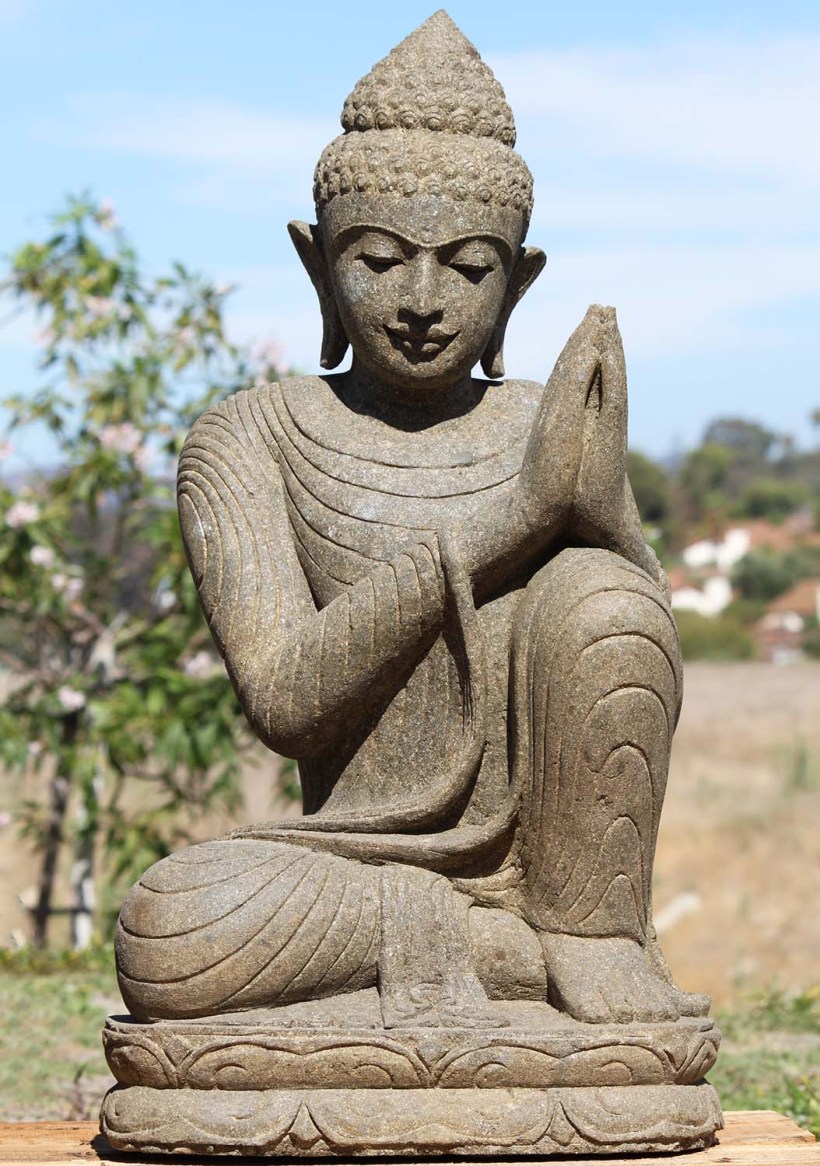
Modern man, burdened by irrelevant and chaotic cerebration, often fails to ask the critical, central questions: What does it mean to have a human form? Why does the face have seven orifices? What does it mean to have a hand with five fingers? Why is one finger called the index finger and what is the purpose of pointing in human life? What is the significance of the thumb and what is its connection with will and determination, which must be both strong and flexible? Can flexibility and fluidity be combined in human life in ways analogous to what is exemplified in the physical world by all the lunar hierarchies impressed with the intelligence that comes from higher planes? What is the function of the little finger, which is associated with Mercury? What is the connection between speech and this seemingly unimportant digit which is important for those who have skill in the use of hands, whether in instrumental music or in craftsmanship? When one is ready to ask questions of this kind, taking nothing for granted, then one can look at statues of the Buddha and of various gods in many traditions, where the placement of the hand is extraordinarily significant: whether it is pointing above, pointing below, whether it is extended outwards, whether it is in the form of an oblation or receiving an offering, or in the familiar mudra of the hand that blesses. What is the meaning of joining the thumb and the central finger, which is given great importance in mystical texts like the Hymn to Dakshinamurti?
The moment one begins to raise such innocent questions about the most evident aspects of human existence, it immediately becomes clear that pseudo-sophisticated people are prisoners of the false idea that they already know. And yet self-reliance and spontaneous trust are so scarce in the world of the half-educated. Many people are so lacking in elementary self-knowledge that when a person meets another, instead of a natural response of receptivity and trust, there is an entrenched bias engendered by fear and suspicion. This has been consolidated through the establishment of a Nietzschean conceptual framework in which all human relationships are viewed simply in terms of domination and being dominated. This obsessive standpoint drains human relationships of deeper content, of spiritual meaning and moral consciousness. All moral categories and considerations become irrelevant when one entirely focuses upon an ethically neutral and colourless conception of the will. To assume and act as if everything turns upon the master-slave relation is a major block to the development of self-consciousness, as Hegel recognized. Humanity has left behind its feverish preoccupation with false dominance in formal structures. The seventeenth and eighteenth centuries witnessed the emergence of a higher plateau of individual and collective self-consciousness. All men and women are the inheritors of the Enlightenment, with its unequivocal affirmation of the inalienable dignity of the individual, who can creatively relate to other human beings in meaningful dialogue and constructive cooperation.
Rooted in a simplistic but assertive mentality, dissolving all moral issues, the language of confrontation and of submission is irrelevant to the universal human condition and to the hierarchical complexity of Nature. Any person with a modicum of thought who begins to ask questions about the marvellous intricacy and dynamic interrelationships of Nature – questions about the sun and the stars, the trees and forests, the rivers and oceans, and above all about human growth – will readily recognize that no real understanding of the organic processes of Nature can be properly expressed in terms of such jejune categories as dominance and submission. Nor can any meaningful truths about the archetypal relations between teachers and disciples, parents and children, friends and companions, be apprehended through the truncated notion of an amoral will. Human life is poetic, musical and poignant. It has an open texture, with recurrent rhythms, and it continuously participates in concurrent cycles. To know this is to recognize, when viewing the frail fabric of modern societies, that human evolution has not abrogated the primordial principles of mutuality and interdependence, but indeed abnormal human beings and societies have become alienated from their inner resources of true strength and warmth, trust and reciprocity. The Golden Rule remains universal in scope and significance. There is not a culture or portion of the human race, not an epoch in history, in which the Golden Rule was not understood. Without this awareness there would be no social survival, let alone its translation into the language of roles and obligations and into the logic of markets. Reciprocity is intrinsic to the human condition.
Raghavan Iyer
The Gupta Vidya III
Daily Words of the Buddha for July 02, 2021

Yadā have pātubhavanti dhammā
Ātāpino jhāyato brāhmaṇassa,
Athassa kaṅkhā vapayanti sabbā
Yato pajānāti sahetudhammaṃ.
When things become manifest
To the ardent meditating brahmin,
All one’s doubts then vanish since one understands
Each thing along with its cause.
Udāna 1.1
The Udāna and the Itivuttaka, trans. John D. Ireland
July Astrology and Tarot Guide Horoscope

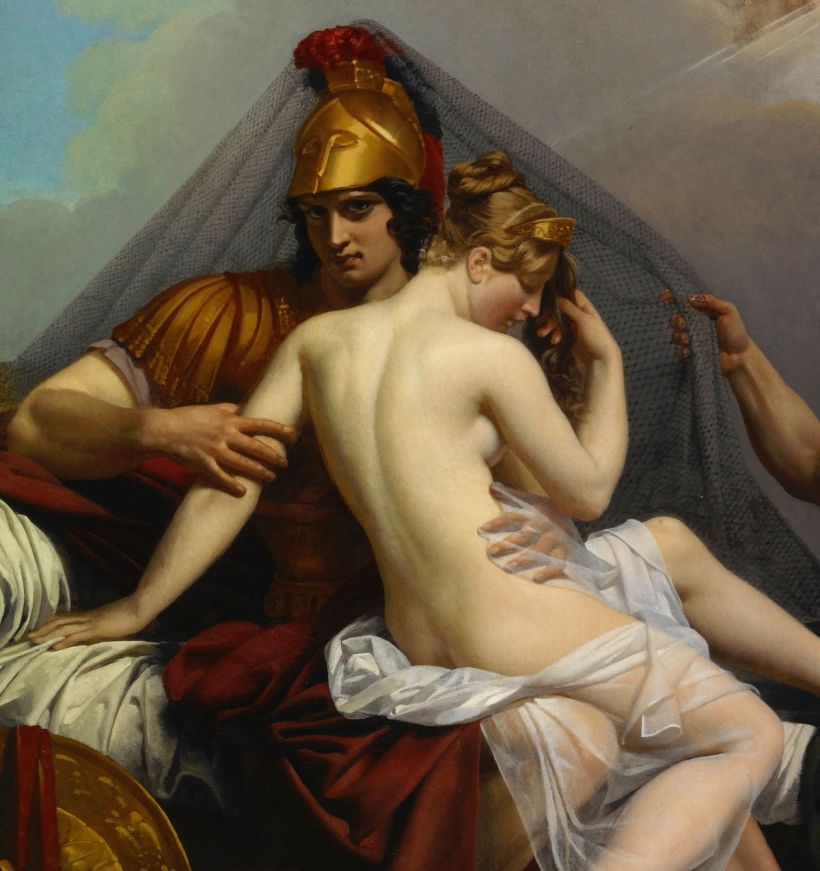
July is going to be major intense month, it starts with a bang and so much is going on. Watch the video of the Live July Astrology and tarot card preview below-
JULY ASTROLOGY ASPECTS
OVERVIEW
July starts off very intensely, MARS/SATURN opposition which lasts till July 4.
JULY 11 MERCURY changes sign twice from CANCER JULY 27 to LEO.
July 15 CHIRON turns RETROGRADE in ARIES.
July 21 VENUS enters VIRGO.
JULY 30 MARS enters VIRGO.
JULY 9 NEW MOON in CANCER
July 23 FULL MOON in AQUARIUS
July 28 JUPITER re-enters AQUARIUS
July 1 MARS in LEO / SATURN in AQUARIUS opposition at 12 degrees a RED-LETTER DAY also T-square URANUS in TAURUS
This is a passionately hot intense month for Fixed signs.
July 1 MARS in LEO opposes SATURN in AQUARIUS T-square URANUS in TAURUS at 12 degrees which completes on July ¾.
This is a…
View original post 1,332 more words
The Buddhic Mind

There is something wonderful in reality.
-The Zen Mind 2021
✿⊱╮✿⊱╮ ✿⊱╮✿⊱╮✿⊱╮
Theosophy | THE SENSE OF SELF – I

Feeling, while going about, that he is a wave of the ocean of self; while sitting, that he is a bead strung on the thread of universal consciousness; while perceiving objects of sense, that he is realizing himself by perceiving the self; and, while sleeping, that he is drowned in the ocean of bliss; he who, inwardly constant, spends his whole life thus is, among all men, the real seeker of liberation.
Shankaracharya
All the varied vestures of the incarnated human being are distinct sheaths on adjoining planes of consciousness, each with its own rates of vibration, all participating in the potency of ideation and mirroring archetypal relations. What is implied in the Vedantin association of the lower vestures with unwisdom is the false sense of separateness, the illusory stability and entitative existence that we ascribe to a form. What is the significance of the seven orifices in the human face and the thirty-three vertebrae of the spine? What is to be understood from the varying textures of the different layers of skin? Is the physical body to be analysed in terms of its constituent elements, or is it to be viewed in relation to the pulsating rhythmic movement in the heart? Such questions are rarely asked. Most human beings take for granted a haphazardly acquired and habitually retained assemblage of sensory perceptions and residues identified with a name and form which is really a static mind-image of the body. Individuals deny themselves the possibility of direct experience without the mediation of routinized anticipations or of frozen images projected upon objects. Anyone may learn to discern and comprehend the recurring patterns, resistances and responses of the body. Even more, a person may come to view the body, as the Gita depicts, as a nine-gated city. A person can learn to use the body as a musician wields a musical instrument, self-consciously impressing energy upon its myriad life-atoms caught up in chains of interconnected intelligence.
The body is a vast and complex matrix of interdependent centres of energy, each of which puts a human being in touch potentially, and therefore in many cases unconsciously, with everything else that exists on the physical plane. The body exists at a certain level of material density, with a biological entropy built into it, as well as a degree of homeostatic resistance to the atmosphere around. This level of resistance in the physical body enables it to maintain itself and is the basis of physical survival. Those who truly reflect upon this could make a significant difference by the deliberate and creative interaction of their own ideas and feelings. For example, while eating food, a person’s thoughts, emotional states, magnetic field and inward reverence to the invisible elements of food can make a fundamental difference to the qualitative osmosis of energies transmitted to the organism. The body can be seen as a sacred instrument in rethinking one’s entire relationship with the world. There is reflective intelligence at the lunar level and the astral and physical vestures are subject to various cycles and different rates of motion. These cycles are mathematical equations and patterns at the cellular level. The mathematics of the complex system that is the physical body, with all its cycles, corresponds closely to the mathematics of the galaxies and the vast cosmos. One could come to learn from the natural cycles and then from the particular bent given to them by one’s own emanations, thus gaining some grasp of one’s dominant anticipations and typical responses. Whoever engages in daily self-study could come to discern the distinct ways in which the body affects the mind during different portions of the day and the week, as well as the succeeding phases of the lunar month.
Shankaracharya lived at a time when ritualistic practices were widely prevalent, and many had become blindly dependent upon detailed and complex knowledge of what to do, when, during each of the many subdivisions of the day. All of this knowledge would not enable a person to get to the core of the causal body – the delusive identification through an ‘I’ with limiting conceptions of space and time, together with the persisting notion of oneself as the actor. Shankara taught that one must get to the root of the ‘I-making’ tendency – the illusory sense in which one is separate from the world which is supposed to exist as clay material for one’s purpose. This false conception of selfhood becomes deeply rooted because it is pleasurable, owing to passive identification with those sensations that have pleasing responses in different parts of the body. It is reinforced in the language and the milieu of those valuations of segmented aspects of conduct which tend to routinize, making a person take experience totally for granted, just as the physical senses can lead an unthinking person to take for granted that the more solid a thing seems to the tactile sense, the more it is solid in reality. There is a radical failure to understand that the whole visible world is like a screen, hiding a vast mathematical activity, and that for all its bewildering complexity, this phenomenal realm may be reduced to certain primary relationships that archetypally correspond to the numbers between zero and ten.
By rethinking much of what one took for granted before, one could come to conceive of an exalted state such as Shankara conveyed in The Crest Jewel of Wisdom. In this serene state an individual would be devoid of all sense of psychological involvement in any of the desires and aims, any of the obsessions, passions, infatuations and concerns of the world, in any of the criteria of success and failure or pseudo-valuations of people generally. Furthermore, having no sense of tightness, of excessive anxious-ridden involvement in the activities of the body, such a person begins to experience a tremendous exhilaration, a rhythmic breathing and a profound peace. It is like seeing a part of oneself carry out its natural functions, and yet remaining totally outside every kind of manifestation in which any single portion of oneself is involved. A person who reaches this stage can combine with this detachment a deep gratitude, a joyous affirmation that there is a certain value to the body as a pristine vesture. At the causal level – in what is called the karana sarira or causal body – fundamental ideas prevail which are often hidden to most human beings but which, if they were examined, would wipe out whole chains of thinking, complex patterns of activity over many years. They would all be eradicated by getting to the core of a fundamental idea. A person who steadily works on the plane of ideation so renovates the thought-body that it becomes possible to release self-consciously the inexhaustible potentiality of divine energy. The entry points between the causal body and the astral vesture are made more porous and, in time, the physical body may reflect and transmit the radiant joy of universal ideation.
A person may learn to live in attunement to the plane of those enlightened free men who are not captive even to the vast conceptions of space and time associated with the universe as a whole. Such a person will be ever engaged in intense meditation upon the Unmanifest, which increasingly becomes the only reality. A person who begins to see through the eyes and with the help of the illumination of the Guru finds that the physical body is only a dim reflector of light-energy and also provides a means of shielding the divine radiance. By extending the possibilities of human excellence to the uttermost heights of control, purification, refinement and plasticity that can be brought about by the deliberate impact of disciplined thought upon gross matter, one can revolutionize one’s conception of matter. Einstein pointed out in the twenties that a lot of what is called matter simply dissolves into a prior, primordial notion of space. The body can become an architectonic pattern in space which has within its own intricate symmetry an inherent intelligence that is not transparent at the level of image and form. It has the capacity of holding, releasing and reflecting the highest elemental associations that accompany the profoundest thoughts. Nature is the great magician and alchemist. The wise man is an effortless master of lunar forces, correlations, patterns and potencies.
Raghavan Iyer
The Gupta Vidya II
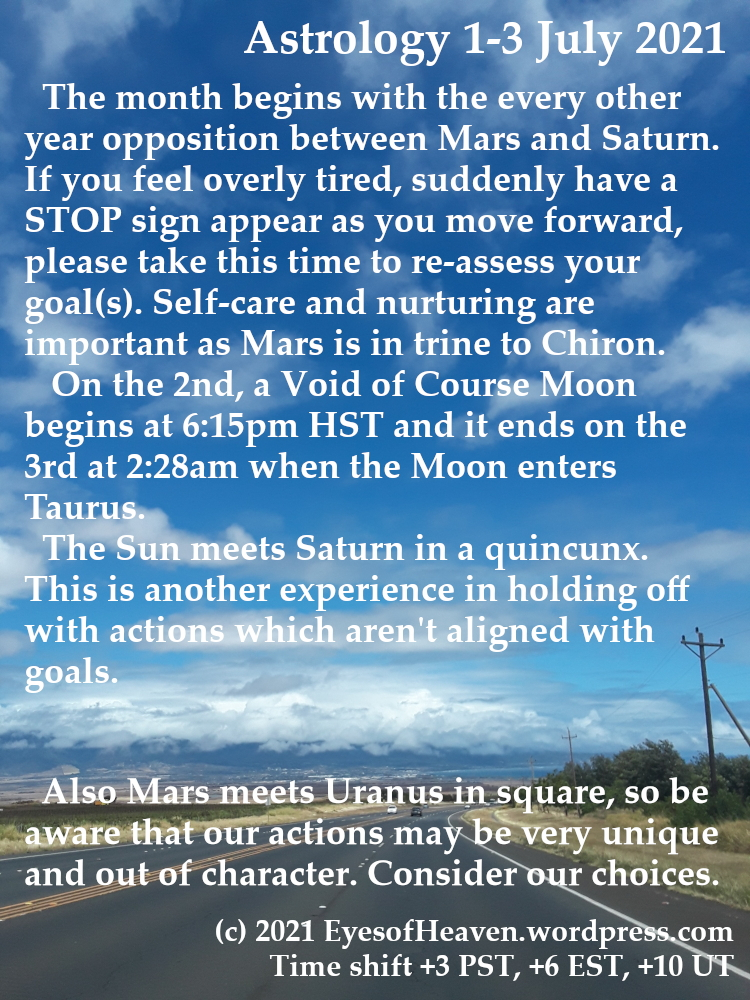
First three days of July – have patience with yourself; Void Moon time is about 8 hours long; Mars and Uranus can have us second guessing weird decisions
Hau’ōli la Pō’akōlu
Daily Words of the Buddha for June 30, 2021
Asāre sāramatino
sāre cāsāradassino,
te sāraṃ nādhigacchanti,
micchāsaṅkappagocarā.
Those who mistake the unessential to be essential
and the essential to be unessential,
dwelling in wrong thoughts,
never arrive at the essential.
Dhammapada 1.11
The Dhammapada: The Buddha’s Path of Wisdom, translated from Pāli by Acharya Buddharakkhita
Energy Update | June 30, 2021


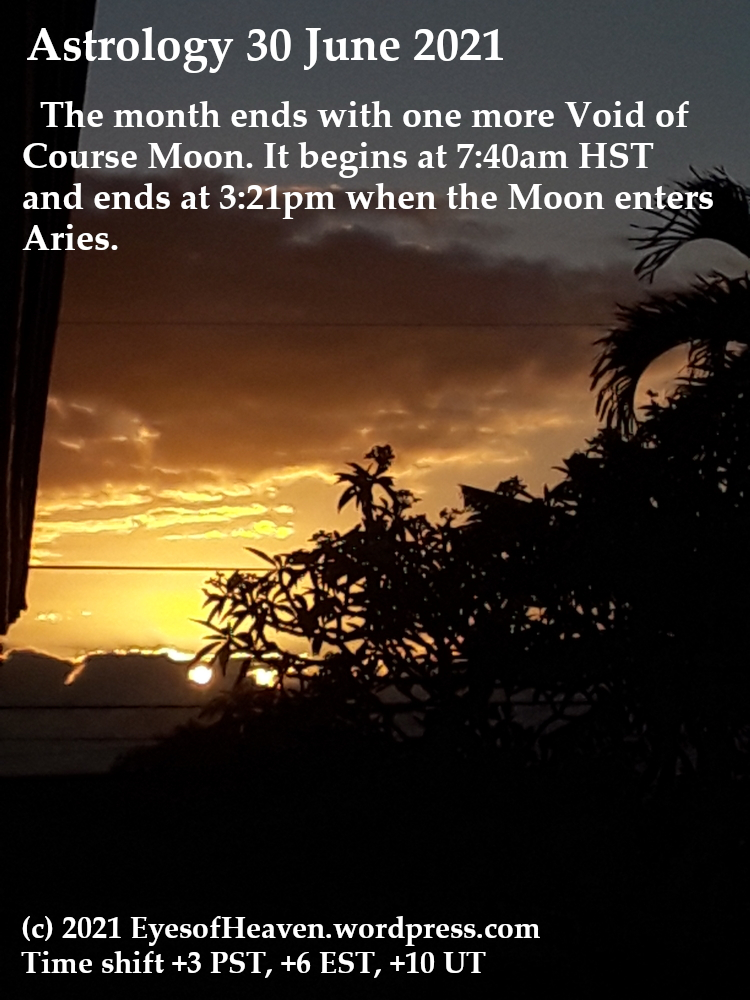
Last Void of Course Moon in June
Hau’ōli aloha Pō’alua

ʻAhuwale kā pōʻokela ī kau hānā ʻia hāʻi. Ī lā maikāʻi nōu. Maluhia a me aloha mau lōa nā hōaloha a me ʻŌhana.
It is through the way you serve others that your greatness will be felt. Have a nice day. Peace and love always, my friends and family.
Daily Words of the Buddha for June 29, 2021

Atītaṃ nānusocanti,
nappajappanti nāgataṃ,
paccuppannena yāpenti,
tena vaṇṇo pasīdati.
They do not lament over the past,
they yearn not for what is to come,
they maintain themselves in the present,
thus their complexion is serene.
Saṃyutta Nikāya 1.10
Gemstones of the Good Dhamma, compiled and translated by Ven. S. Dhammika

Honey Nut Granola

This past week we were gifted SOOOOO many bulk ingredients from our new lifelong friend and baker supreme, Alexis. Among the hundreds of ingredients were quick oats, honey, cinnamon, chopped nuts, flake coconut and a nice 50/50 blend of sunflower and grapeseed oil. So I guess it’s granola time! This recipe is simple and keeps well for a very long time in an airtight container.
Thanks, Alexis!!!! All of your gifts are truly appreciated!

HONEY NUT GRANOLA
42 oz container of oats (quick or rolled is fine)
4 cups chopped and/or slivered and/or sliced nuts (I like the blend of almond an pecan but whatever will do)
3 cups toasted coconut
1 1/3 cup vegetable oil
2 cups honey
¼ Teaspoon kosher salt
2 Tablespoons vanilla extract
¼ cup ground cinnamon
Preheat oven to 275 degrees. In a very large bowl combine oats, nuts and coconut. Set aside. In a…
View original post 41 more words
Theosophy | THE VERBUM – I

When our Soul (mind) evokes a thought, the representative sign of that thought is self-engraved upon the astral fluid, which is the receptacle and, so to say, the mirror of all the manifestations of being.
The sign expresses the thing: the thing is the (hidden or occult) virtue of the sign.
To pronounce a word is to evoke a thought, and make it present: the magnetic potency of the human speech is the commencement of every manifestation in the Occult World. To utter a Name is not only to define a Being (an Entity), but to place it under and condemn it through the emission of the Word (Verbum), to the influence of one or more Occult potencies. Things are, for every one of us, that which it (the Word) makes them while naming them. The Word (Verbum) or the speech of every man is, quite unconsciously to himself, a BLESSING or a CURSE; this is why our present ignorance about the properties or attributes of the IDEA as well as about the attributes and properties of MATTER, is often fatal to us.
Yes, names (and words) are either BENEFICENT or MALEFICENT; they are, in a certain sense, either venomous or health-giving, according to the hidden influences attached by Supreme Wisdom to their elements, that is to say, to the LETTERS which compose them, and the NUMBERS correlative to these letters.
The Secret Doctrine, i 93-94
Those who have had the resplendent karma of receiving this sacred teaching should move rapidly from the state of irresponsibility into the realm of responsibility in the gestation of sound associated with thought. This is a practical teaching that can be used even if one has yet to acquire a detailed knowledge of the hidden properties of matter on subtle planes of existence. Anyone may make a true beginning by trying to conserve speech-energy, by becoming more deliberate and careful in the choice of thoughts and words. Calmly sitting down in the privacy of one’s own solitude to read aloud The Voice of the Silence, or excerpts from The Secret Doctrine, one can make a radical change in one’s magnetic field. Infusing this endeavour with a profound sense of the sacred, a vital depth is touched in one’s daily awareness of the invisible centres of consciousness and in one’s capacity to direct benevolently different groupings of life-atoms, to purify and render them worthy of the divine temple of the human form in which there burns the flame of self-consciousness kindled by the Sons of Fire. The priceless gift of noetic self-awareness can be brought to bear upon each of the different centres of consciousness. Even though in its spiritual essence Manas is entirely disconnected from the discordant sensorium, it effectively can, through the pristine radiation of its own potent light, magnetize, consecrate and intensify as well as make precise and benevolent the organs of perception. Those who value this immense privilege seriously enough to carry out a series of initial experiments with truth within themselves will gain a greater awareness through deliberation of the dignity and the divinity of being human. They will discover what it means to reverse the current of negative thought, centered upon the sense of futility of the personal self, and they will lighten the load of dead-weight elementals impressed with past pretences, desperation and despair.
The orbit of the sacred is revolutionary; it is subversive to the status quo of one’s previous somnambulic existence. Lest one cultivate the fatal craft of becoming schizoid, one must assiduously practise the arcane teaching of the Verbum by consciously choosing and assuming full responsibility for one’s thought-currents. Instead of excusing one’s passive tendencies, one must learn to direct one’s attention to what one deliberately intends, to sublime themes that elevate the mind, to daily exercises in spiritual alchemy. Individuals must think to the core the quintessential prerogative of being human. Rather than irresponsibly pretending that the whole of life is episodic, they must acknowledge that days make up weeks, weeks make up months, months make up years, years make up decades in a lifetime, and each incarnation is an integral part of a long series of lives. In a universe where sowing and reaping are inextricably interwoven, human beings have to do what agriculturists know and gardeners practise: preparing the soil, pulling out weeds, planting at the right time and patiently cooperating with the seasons and cycles of nature. If some are afraid to do this, it is because they mistakenly believe that they are infallible experts on the subject of themselves. This is a fundamental error. When a person gains glimpses of self-knowledge, a sure sign of growth is the increased willingness to breathe the refreshing air of agnosticism. One is ready to recognize that there is a profound mystery to every human being, that the last person one knows is oneself. Not until the bonds of personality are loosened can that self be truly known. The soul abides in the Silence, and when the restless mind ceases from thoughts and words, it may be merged into the inmost shrine of the heart, so that when one opens the eyes and utters a sound, one feels it is a sacred privilege to breathe as the votary of the Logos, of Brahma Vach.
If a person ventured to make daily experiments with truth, it would be helpful to formulate some working rules which make due allowance for the plastic potency of one’s own vestures. After all, different people have different propensities. Some are very vocal on worldly matters but they are utterly unable to speak about the spiritual. Others speak endlessly about the spiritual until words lose all meaning. Still others speak as if they already know what they have only remotely glimpsed. Others mix vibrations, speaking of the sacred and then lapsing into the profane. Sacred language cannot be properly enunciated if one inserts into it a sense of the separative ‘I’ because the kamamanasic ‘I’ has to vacate its false authority within the human being so that the immortal individuality may affirm spiritual truths through an invulnerable personality. The metaphysical basis of this process lies in the fact that the more indivisible the mental energy involved in universal, abstract, impersonal ideas, the more rarefied and homogeneous is the matter within which these ideas clothe themselves. As divine ideation draws the mind to a still centre, through deep meditation upon boundless duration, abstract space and pure being, one approaches a plane of consciousness where matter is radically different from what is normally understood. Matter becomes light-energy. It is cool Akashic fire which has a distinctive texture, a peculiar tensility and volatility, ethereal properties for which there are no adequate analogues on the physical plane.
A person sitting for long hours by a log fire may start to see behind and around the flames a noumenal light and may begin to have an inkling of the invisible fire behind the veil of the visible. It is possible for any person to arouse the subtler senses by reaching towards universal ideas, and through intense ideation one may become conscious of noumenal matter. This arcane teaching rests upon the presupposition that what is called knowing or interacting is an imperfect experience of consubstantiality. One only knows what is on the grosser planes through the grossness in oneself. Any suggestion that it is outside is misleading, for if it were not in oneself it could not be seen. A highly evolved being may be able to take the most mundane of subjects and see it from the standpoint of the subtlest abstraction, thus elevating the entire field. On the other hand, most human beings only too often do the opposite. They may even take a sublime conception and drag it down to the densest plane of sensory awareness.
Control of thought and speech is an essential ingredient of soul etiquette and spiritual discrimination. It represents good taste at the highest level, where one may enrich a spontaneous longing for Brahma Vach, the Agathon, the Ineffable Good. Out of repeated meditation one must gain such a strong, lively and self-perpetuating sense of the Ineffable Good at the core of the Divine Darkness behind the shimmering veils of the universe, that one is securely anchored in that state of spiritual awareness. And therefore, as Plato suggested in the Allegory of the Cave, when seemingly descending into the world of heterogeneity, one is able to use wisely one’s eyes and ears and above all, one’s tongue, so that one is acutely conscious of every available opportunity to give a forward impulse to human evolution. Where one encounters anything meretricious on the lower planes, it will roll off like water off a duck’s back. It simply will not inhere because of the intense activation and vigilant preservation of one’s noetic awareness. The importance of this mental discipline will soon become evident to those who are courageous enough to become steadfast in its practice, not for their protection, but for the sake of universal enlightenment. Not only can they begin to discharge their debt to the sacred Teaching by converting it into what they could use, but they could actively contribute to the generation of the magnetic field in which spiritual instruction could be integrated into new modes of secular monasticism.
Hermes, June 1980
Raghavan Iyer
The Sun gets charged by Jupiter; Venus and Pluto oppose; Void Moon; Saturn and Chiron work on issues; Neptune Retrograde begins

How to better your Hawaiian accent when speaking Hawaiian – Olelo Hawaii – Hawaiian language lessons
Hau’ōli aloha Pō’alima

Ahuwale kā po ʻokela ī kau hānā ʻia hāʻi. Ī lā hōʻokamahāʻo nōu ʻōukōu. ʻO kā maluhia nō me ʻoe.
It is through the way you serve others that your greatness will be felt. Everyone have a wonderful day. Peace be with you.
 Hālau 'Aha Hui Lānākila