
This school without grades or homework has a 98% college acceptance rate […]
Source: This school without grades or homework has a 98% college acceptance rate
This school without grades or homework has a 98% college acceptance rate […]
Source: This school without grades or homework has a 98% college acceptance rate

Developing the right relationship with our digital technology is a critical step on the path. […]

W.Q. Judge stated that “Karma is a doctrine too vast and complicated to be disposed of by set rules applied like balance-sheets to commercial enterprises; but one thing is certain — Karma is action viewed from every side and on each occasion.” In his article entitled “Is Karma Only Punishment?” he points out that one branch of the Law of Karma deals with the vicissitudes of life, with the differing states of men, with rewards and punishments. Each state is the exact result bound to come from acts that disturb or preserve the harmony of Nature. Karmic rewards work both on the material plane and on the inner character, on the circumstances and on the tendencies of the person placed in a particular environment. We are continually fitting our arrows to the bow and shooting them forth, but it is not the arrow or the bow that counts. The important thing is the motive and the thought with which the missile is shot. Again, in his article on “Environment,” Judge held that the real environment to be understood and cared about is that in which karma itself inheres in us. It is only because we see but an infinitesimal part of the long series of karmic precipitations that any apparent confusion or difficulty arises.
The third aphorism on karma points out that “Karma is an undeviating and unerring tendency in the Universe to restore equilibrium, and it operates incessantly.” Aphorism No. 6 states that “Karma is not subject to time, and therefore only those who know the ultimate division of time in this Universe know Karma.” Aphorism No. 13 holds that the effects of Karmic causes already set in motion “may be counteracted or mitigated by the thoughts and acts of oneself or of another.” Further, we know from Aphorism No. 19 that “changes may occur in the instrument [of the Ego] during one life so as to make it appropriate for a new class of Karma,” and this may take place through intensity of thought and the power of a vow and through natural alterations due to complete exhaustion of old causes. Aphorism No. 20 tells us that the soul and mind and body “have each a power of independent action,” so that “any one of these may exhaust, independently of others, some Karmic causes.” Aphorism No. 25 makes it clear that “birth into any sort of body and to obtain the fruits of any sort of Karma is due to the preponderance of the line of Karmic tendency.” Aphorism No. 27 asserts that “measures taken by the Ego to repress tendency, eliminate defects, and to counteract by setting up different causes, will alter the sway of Karmic tendency and shorten its influence in accordance with the strength or weakness of the efforts expended in carrying out the measures adopted.” Finally, Aphorism No. 28 affirms that “no man but a sage or true seer can judge another’s Karma.”
The section on Karma in Light on the Path similarly presents an occult rather than a mechanistic conception of Karma. We learn that the future is not arbitrarily formed by any separate acts of the present but that the whole of the future is in unbroken continuity with the present as the present is with the past. Even a little attention to occultism produces great results. When a man gives up the indecision of ignorance, even one definite and knowing step on the good or evil path produces great karmic results.
He who would escape from the bondage of Karma must raise his individuality out of the shadow into the shine; must so elevate his existence that these threads do not come in contact with soiling substances, do not become so attached as to be pulled awry. He simply lifts himself out of the region in which Karma operates.
This is precisely what Ajamila did. He learned that there was no cure for desire, for the fear of death or the thought of reward and punishment save in the fixing of the sight and hearing upon that which is invisible and soundless. He freed himself from the bonds of karma only by fixing his whole attention on that which is unaffected by karma. If Ajamila was able to invoke the name and the love of God on the approach of death, this must have been because he did not allow his misdeeds to corrupt his inner consciousness or to destroy the line of his ideation in his early life and in previous lives. Ajamila’s repentance may seem to us to be sudden or even easy, but this is precisely where we are mistaken. It is only a highly evolved soul who can refrain from rationalization even when he falls into a nightmare of wrongdoing, who can bring total intensity to his thought of his Higher Self and the God of Love. It is because we are not in a position to know the entire karmic sequence in the lives of Ajamila, it is because we do not see that part of his karma was working through his finer tendencies developed over a long period, that we look upon his dramatic conversion as an easy way of expiation and a setting aside of the Law of Karma.
Many people take a crudely materialistic view of karma and cannot come closer to its profoundly mysterious workings on the subjective planes of consciousness. Every human being has within himself the karma-less fount of being, the Guardian and the Divine Parent who is a spectator of karma but is untouched by it. Mere personal repentance is of no avail and cannot expiate our sins or free us from the effects of our actions. True repentance must belong to our deepest natures, must clearly reveal the root cause of our betrayal of the divine within us, the crucifixion of the God within. Spiritual conversion or resurrection is only possible if we cease to identify ourselves with our personal sheaths while assuming full responsibility for their scars, and if we wholeheartedly activate our vesture of immortality by sacrificial tapas and regenerative meditation. It is a mistake to isolate sinful acts or acts of repentance if we wish to grasp the working of the Law of Karma on the invisible as well as the objective planes of being.
And he said unto them:
Take heed what ye hear: with what measure ye mete, it shall be measured to you; and unto you that hear shall more be given. For he that hath, to him shall be given; and he that hath not, from him shall be taken even that which he hath.
And he said:
So is the kingdom of God, as if a man should cast seed into the ground; and should sleep, and rise night and day, and the seed should spring and grow up, he knoweth not how. For the earth bringeth forth fruit of herself; first the blade, then the ear, after that the full corn in the ear. But when the fruit is brought forth, immediately he putteth in the sickle, because the harvest is come.
And he said:
Whereunto shall we liken the kingdom of God? or with what comparison shall we compare it? It is like a grain of mustard seed, which, when it is sown in the earth, is less than all the seeds that be in the earth; but when it is sown, it groweth up, and becometh greater than all herbs, and shooteth out great branches; so that the fowls of the air may lodge under the shadow of it.
And with many such parables spake he the word unto them, as they were able to hear it.
The Gospel According to Mark 4:24-33
Raghavan Iyer
The Gupta Vidya II
There are two influential doctrines which could colour the attitude of the seeker of wisdom towards the concept of true repentance. Both doctrines contain a germ of truth, but in their extreme formulations they are false and pernicious, dangerous distortions. One is the fatalistic doctrine of mechanical repentance, tied to a severely formal view of punishment. We have the notion that the only way in which we can expiate our sins of omission and commission is by receiving in the future the precise penalties attached to our acts, that there can be no repentance which mitigates our penalties. We may say to a sinner, “You have done wrong; you may regret your action and you may try to learn the lesson of your failure, but you cannot avoid the consequences of your act in the future; your karma is bound to catch up with you sometime and you must be ready to receive your penalties.” The other doctrine is that of sudden repentance, sometimes linked to the idea of vicarious atonement. We have here the notion that it is possible by profound regret and a dramatic act of confession and self-abasement to set aside the inexorable working of the law of Karma. We may say to a sinner, “You have sinned, yet you need not be oppressed by the thought of your future penalties; you can here and now cancel the consequences of your past sins; you can invoke the compassion of the Illustrious Beings who are the Great Guardians of the Law; you can implore the forgiveness and the blessing of the God within you.” Which is worse — a too mechanical or a too lax interpretation of the Law of Karma? What is true repentance?
In order to answer these questions we could usefully turn to the story of Ajamila in Book VI of The Bhagavatam. By means of stories from the lives of prophets and kings, sages and devotees, this great scripture popularizes the truths contained in the Vedas. It would be easy to draw the wrong lessons from these stories or to read into them our own preconceptions. Every story must be seen as a corrective to a prevailing error or a half-truth concerning morality, salvation and the spiritual life. There are the well-known stories about Narada, Kapila, Dhruva and Prahlada and many stories about Sri Krishna. This fascinating work was composed by Vyasa, who handed it down to Suka, who in turn passed it on to King Parikshit, from whose court it was subsequently transmitted by saintly minstrels.
The story of Ajamila is briefly as follows. He was a man who married a woman of evil ways and became very dishonest, an easy prey to wicked and sinful habits. Of his ten sons, his favorite was the youngest named Narayana. One day, when Ajamila thought he was dying, he was terror-stricken by the sight of three ugly, demon-like attendants of the King of Death. He called his son Narayana, but as he uttered the name his mind became wholly concentrated on Narayana or Vishnu, the Lord of Love. While he was thus intently meditating upon God, there appeared before him the attendants of Lord Vishnu who confronted the attendants of Death. The latter asked the former why they were preventing the Law from taking its course. As a man sows, so must he reap, they said. Man is subject to the three gunas and his present life shows plainly his past as well as his future. His deeds leave their impressions on his subtle body and these impressions control his actions, and his future life is determined by all his present deeds. Ajamila was in his early youth, the attendants of Death reminded the attendants of Vishnu, a devout and truthful man, self-controlled, well versed in the scriptures, a friend to all beings and creatures. But one day, while in the woods gathering flowers for worship, he was aroused by the sight of a lustful couple, lost all control of himself, became greatly attached to the woman who was a wanton, forsook his lawful wife for her and gave up the pure life that he had been living. He wasted his entire fortune trying to please this woman and began to employ dishonest means to earn his living. He was now about to die in all his sins, to be taken to the King of Death who would punish him justly, and the suffering he would undergo could purify him.
The attendants of Vishnu replied that Ajamila had expiated all his sins by uttering the name of God and surrendering himself to the Lord. Wrongdoing is not eradicated or expiated, they said, if the mind continues to follow wicked desires, but when the name of God and the love of God have purified the heart all sins are completely destroyed. The mere name of God has power to save even the most depraved. On hearing all this, the attendants of Death went away and Ajamila regained his consciousness and gradually got back his health. He felt that he had received a great blessing perhaps owing to a few good deeds stored up from his past, and his whole life seemed to be transformed. He gave up his evil ways, renounced his home, practised Yoga for many years, attained self-control, and his mind became firmly fixed in the contemplation of the Divine Self. When death finally came to him, he gave up his body while chanting the sacred name of God and absorbed in meditation, thus freeing himself from the bondage of karma.
In the preamble to this story we are told that if a man commits sinful acts which he does not expiate in this life, he must pay the penalty in the next life and his suffering will be great. Expiation and repentance are of no avail to a man who continues to commit sinful acts knowing them to be harmful. All sinful thoughts and evil deeds are caused by ignorance and true expiation comes from illumination. The fire of spiritual knowledge consumes all evil and ignorance, and complete transformation of the inner life is accomplished by following and living the Truth and through the development of the love of God. Even the most sinful man is purified if he surrenders himself to the God of Love and with whole-souled devotion serves his devotees. The path of love is the simplest way by which to free ourselves from sin. Death is conquered and the fear of death is overcome by meditation upon Krishna, the God of Love. This message and the illustrative story of Ajamila seem to imply that a man can, by intense and sudden repentance, earn for himself the right to expiate his sins through prolonged meditation and devotion in this life, even freeing himself from the bonds of karma. It would also seem that such a view is contradictory to the doctrine of exact and inexorable Karmic retribution.
Raghavan Iyer
The Gupta Vidya II
New Moon in Cancer on 17th July and Nodal Shift: nodes will shift out of Taurus and Scorpio and move into Aries and Libra. Fulfillment happens when you are light as a feather, Follow Your Path, The New Moon is an opportunity to reset and experience new, to enjoy the individual beauty we create. Let’s meditate together with this upcoming energies. Handpan Rav Mediation.
Stay Calm and Focused. A cozy warm late night vibe perfect for meditation, sleep or studying keeps You relaxed and mellow. Background music created with beautiful koshi wind chimes and rainstick. 432hz Music.

Metaphysically, in relation to the three planes of the Unmanifested, there is no distinction in the Three-in-One between absolute, attributeless Compassion, absolute, dimensionless Truth, and absolute, unconditional Love. There is no difference because all three together constitute the invisible point in an ever-revolving mainspring that is the vital centre of the great wheel of universal harmony. Through the notion of harmony, a person might come to reflect upon the metaphysical relation between justice and mercy as centripetal and centrifugal forces. The starting point to gain this perspective is self-examination. Take a period in one’s life. A day might be too short for this for the average person — you might take a week, a month, a year — and actually list out on a sheet the number of occasions on which one either omitted or was fortunate to be able to exemplify justice to every other human being. Then on a separate sheet list the number of occasions on which one tried to be merciful to other human beings, or where through thoughtlessness and inconsideration rooted in self-worship — which is nothing but the insecurity of the shadow — one omitted to be merciful. Soon one will make an amazing discovery because one will find that these are two different aspects of a single truth. That truth is the degree to which ignorance was the pole star of one’s life centred in the personal mind, and the extent to which one’s highest ideation became manifest in one’s consciousness and conduct.
No act is performed without a thought at its root, and this is the basis of karma for thinking beings. This is always the case. What it implies in strict elementary logic is that even the most apparently automatic act has a thought at its core, either at the time of performance or as leading to it. A being who is fully self-conscious, who has attained to universal self-consciousness, and therefore is totally aware of the Self, is incapable of ever engaging in any act at any time without an instantaneous and simultaneous awareness of the intention accompanying it. Because this idea is so sacred, a lot of harm is done by people who talk idly of ‘thought-forms’ and ‘vibrations.’ This is the sad result of dissemination, among the unready mass, of the delusions of the failed students of Philosophia Perennis.
In ordinary language we all are aware of what it means to say, “Oh, that’s a good idea.” “Oh, that’s a good thought.” Everyone, at some time in his life, maybe at some season of the year, has had a good thought for someone else. “Oh, let me do this for someone else. Let me send this Christmas card. Let me express this goodwill.” Every human being has experienced the most natural form of occultism — having a good thought and seeking for it an appropriate form of expression. In this age where it is so rare, they are very privileged who, through the magic of the madness of love, spend a lot of time not just on the benevolent thought but on the manner and the appropriateness of the expression of the thought. Some people, by a kind of soul-intuition from previous lives, and especially when they are very young, realize that a good idea must have the total purity of privacy if it is to be preserved. There must be an insulation from uncongenial elementals in making that thought inviolate, wrapping it up within an invisible circle of secrecy and privacy, so that it becomes a point in metaphysical space and may find an appropriate form.
When we begin to see this, we are better able to know what it means to earn the privilege of hearing the teaching that men are manifested gods, creative mind-beings; Manasaputras bearing the burden of the responsibility for raising all manifested matter; carriers of the divine mandate of helping the great architect, the collective demiurge behind the manifested universe. These thrice-blessed “fortune’s favoured soldiers” may suddenly begin to feel the immensity, the grandeur, the glory of the responsibility of being human, a thinking being, capable of choosing at will a thought and, by dwelling upon it and pouring over it the waters of selfless love, being able to find, out of the more subtle matrix of life-atoms which constitute the thought-vehicle, a form for its benevolent expression. In other words, a person who lives by an inner light begins to see that the real form of a true thought is wholly invisible. It has nothing to do with differentiated matter or the externalities of dependent origination in dependent relationships. He really comes to understand something about subtle matter.
Two alternatives face such a person, and both alternatives apply to different classes of cases, so that he has a constant choice problem, like the choice problem of the Demiurge mentioned in the Timaeus. Out of many worlds is patterned only one world. This is the dilemma which the Demiurge must overcome. The human being, too, must be ready to grasp the fundamental problem of choice facing him. On the one hand, there are certain thoughts which are of such quality — impersonal, universal, unifying, beneficent — that where they are self-consciously generated or drawn from the Akasha, they do not need any form. They are like sparks or like shooting stars that descend with a speed much greater than that of light and they find an appropriate way of sparking off myriads of atoms. On the other hand, there are those thoughts which need to be encased in a purified, distilled essence, but fashioned out of a purified astral form, out of something more than differentiated matter but something less than the pure, undifferentiated, universal, homogeneous essence. Such thoughts, when they are given that kind of force, are deliberately chosen mental assets. They become available for all other human beings encountered in our lives and yet may also become embodied for a very long time to come so that others could draw upon them for almost an indefinite future.
What a great privilege, then, is open to the human being who has had the good fortune to learn from Brahma Vach. No one should ignore the ideal as a fit object of meditation. Every person is equally entitled to make the attempt, and no one need fear that he is so unworthy that he cannot make it. On the other hand, he should be spared the terrible karma of the delusion that Everest may be climbed quickly. `Climbing Everest here means choosing every single thought. That is very hard. It requires lives. But one can begin right now choosing a few thoughts, having a little less passivity in relation to most thoughts every week, a little less of that disordered, unthinking, thoughtless, machine-like activity which is lower than that of the animal kingdom, and a little more of deliberate thought. One could, within three months, make amazing discoveries about the mystery of karma — more discoveries from three months of this practice than from a lifetime of mere use of the word ‘karma.’
William Q. Judge pointed out that “the weak and mediocre furnish a weak focus for karma, and in them the general result of a lifetime is limited, although they may feel it all to be very heavy. But that person who has a wide and deep-reaching character and much force will feel the operation of a greater quantity of karma than the weaker person.” A character broad in vision, generous in sympathy, deep in motivation, firm in the degree of deliberation — this is the self-created product of thought ranging from calm consideration to continuous meditation. Whether a man will have “much force” will depend upon becoming one-pointed in the use of force. Kierkegaard spoke about the purity of heart that goes with a concentration of will when it is focused upon one thing at a time. This is the same idea as that expressed by Cardinal Newman in the line, “Lead kindly light, one step enough for me,” which was so much a favourite of Gandhi. These steps form a very beautiful kind of dance. The great pioneers of the future choose to learn this on the physical plane and in the moral realm, but with the intention of making themselves a bridge to other human beings who want to learn to do this dance, step by step by step.
This means the will is very much involved. The will is weakened by obscurity of mind, by conflict of feelings, by lack of priorities in relation to purposes. The conservation of energy is the baseline upon which every man takes a stand. On this basis alone he determines the degree of intensity to the force that he can release. There have been many men of much force, but their vision was limited. Their motivation was not rooted in the depths of their being, and so they became like Ozymandias. They created huge thought-structures and towards the end of their lives a few wrote manuals for the benefit of others, telling them to do this, that, and the other thing. But the will was disproportionate in relation to the idea. What is most critical, then, in the formation of character is the food that a human being receives in the way of spiritual and mental diet.
Raghavan Iyer
The Gupta Vidya II
Runic Exercises that help with Transmutation!

The idea of Eternal Non-Being, which is the One Being, will appear a paradox to anyone who does not remember that we limit our ideas of being to our present consciousness of existence; making it a specific instead of a generic term. An unborn infant, could it think in our acceptation of the term, would necessarily limit its conception of being, in a similar manner, to the intrauterine life which alone it knows; and were it to endeavour to express to its consciousness the idea of life after birth (death to it), it would, in the absence of data to go upon, and of faculties to comprehend such data, probably express that life as “Non-Being which is Real Being.” In our case the One Being is the noumenon of all noumena which we know must underlie phenomena, and give them whatever shadow of reality they possess, but which we have not the senses or the intellect to cognize at present. . . . Alone the Initiate, rich with the lore acquired by numberless generations of his predecessors, directs the “Eye of Dangma” toward the essence of things in which no Maya can have any influence.
The Secret Doctrine, i 45
Beyond the range of all maya, and beyond all but the most exalted conceptions of the divine dialectic, lies the highest possible state of supreme noetic vision, the state of the opened Eye of Dangma, spoken of so beautifully in magnificent metaphors in the Stanzas of Dzyan. Beneath this level of pristine consciousness, all ideas of being reflect an inevitable limitation, owing to one’s sense of present existence and awareness of specific circumstances. For us, to be a being is to be a being at a particular time and a particular place, or for a certain period of time in a certain place in this world. The all-enveloping nature of this mayavic limitation of consciousness is brought home by the metaphor of the unborn infant in the womb. Each of us is like this to a greater or lesser degree, and, like the infant in the womb, were it to express its conception of being, we are not directly able to formulate the true nature or causal ground of our being, especially with reference to the larger life of beings outside the self-limiting context of our narrow consciousness. Further, if we contemplate the possibility of being born into a larger and richer world, we can only see the process of that birth itself as equivalent to death — the end of life as we seemingly know it. For typical human beings, then, who think that they have been born once into this world of illusion, the prospect of becoming dwijas, or twice-born, can only be described as a passage into non-being. Nevertheless, the veil of maya is not so impenetrable to the human will and spirit that we cannot cultivate a deepening intuition that this birth — which seems death to the lower nature — is the solemn path of initiation into real Being.
In our case, and depending upon our degrees of philosophic detachment, we may be vaguely or acutely aware that all the beings we seem to know, including ourselves, are merely shadowy phenomenal representations of noumenal realities, and even of a single supreme Noumenon. Through devotion and tapas, we may learn to sift through the dross of phenomenal experience, thereby quickening the dormant powers of Buddhi-Manas which alone can bring us to the threshold of birth into true life in spirit. Having inverted what we did and knew, what we felt and were as babies, we can learn as fallen adults, like the miner looking for gold.
The impalpable atoms of gold scattered through the substance of a ton of auriferous quartz may be imperceptible to the naked eye of the miner, yet he knows that they are not only present there, but that they alone give his quartz any appreciable value; and this relation of the gold to the quartz may faintly shadow forth that of the noumenon to the phenomenon. The miner knows what the gold will look like when extracted from quartz, whereas the common mortal can form no conception of the reality of things separated from the Maya which veils them, and in which they are hidden.
Ibid., i 45
In other words, there is not only gold in the hills, but there is gold in every grain of dust, in every atom, in every moment of time if only we would know it. The fact that more human beings do not know this at this point of human evolution is not primarily because of universal ignorance, but more because of avoidable perversity. Where human beings grow up turning their eyes away from what is golden in other human beings — in their acts, in their words and in their lives — it is scarcely surprising that they should develop a peculiar and fatal fascination with dross.
Hence the vital importance of directing one’s thought, aspiration and devotion towards the ideal of the perfected Sage, who carries with him the inheritance of countless generations of distilled wisdom and directs the faultless Eye of Dangma towards the essence of things where maya casts no shadows. If human beings mired in illusion and a false sense of their own being are to gain what The Voice of the Silence calls ‘the right perception of existing things’ and ‘the knowledge of the non-existent’, then they must seek for Him who will give them birth in the Hall of Wisdom. It is there that the teachings of Gupta Vidya in relation to the twelvefold chain of the nidanas, the chain of dependent origination governing birth and death, and also the four Noble Truths of Buddha have their greatest but most secret meaning. There are secret truths contained within all uttered truths, within the doctrine of the nidanas, and within the four truths. There are secrets within secrets, worlds within worlds. If seekers of wisdom are like miners of gold, they must have some idea what they are looking for, but at the same time they must freely and openly admit their ignorance, recognizing that the true teachings and their accredited custodians are their sole saving grace.
All true wisdom comes from using the teachings given in the best way one can, and it is virtually fruitless instead to attempt to distill wisdom from the world of empirical unrealities. Certainly if every time divine wisdom is available, it avails little or nothing to so many human beings, even those who come into direct contact with it, it is because they have somehow convinced themselves otherwise without evidence or reason. They falsely suppose that a mere accumulation of worldly experience for its own sake, randomly gathered in the passage of events and from the opinions of others, will somehow add up to wisdom. In the totality of things that happen to a human being gripped by avidya — who is mostly an automaton, acting like a robot most of the time, a creature of habit at best, and moved by drives which produce guilt and repression — there is nothing remotely comparable to what may be found in consciously chosen experience as a means of testing and applying, apprehending, discovering and rediscovering one single sacred spiritual truth intimated by the authentic teachings of the Brotherhood of Sages.
The wise are those who, when they receive such teaching, become almost from the beginning deaf and blind to everything else, and see all else only in relation to that which is sacred. They make the very best experiments they can as early as possible, therefore garnering the lessons of life and become unacknowledged but self-dependent sources of inner wisdom. Tested by experience and enriched by human pain and suffering, they become endowed with the light and the lustre, the beneficence and the benediction, of true compassion in their conscious ideation in meditation, let alone in their outward utterances and external deeds. As dauntless and detached learners, they make the fields of their experience the basis of Gandhian experiments in truth. Whilst understanding that the Absolute is the ultimate basis of all life and experience, but is wholly untouched by it, they shun the false and cowardly notion all human difficulties arise merely through maya. Illusion is not really the problem, because the whole world is caught up in a transcendental divine process of which is maya is a necessary part. Maya is inseparable from Ishvara in the sum total of everything that exists in the realm of conditioned existence, and to miss this is to fall prey to a sense of pseudo-detachment that has nothing to do with true spirituality.
Raghavan Iyer
The Gupta Vidya II
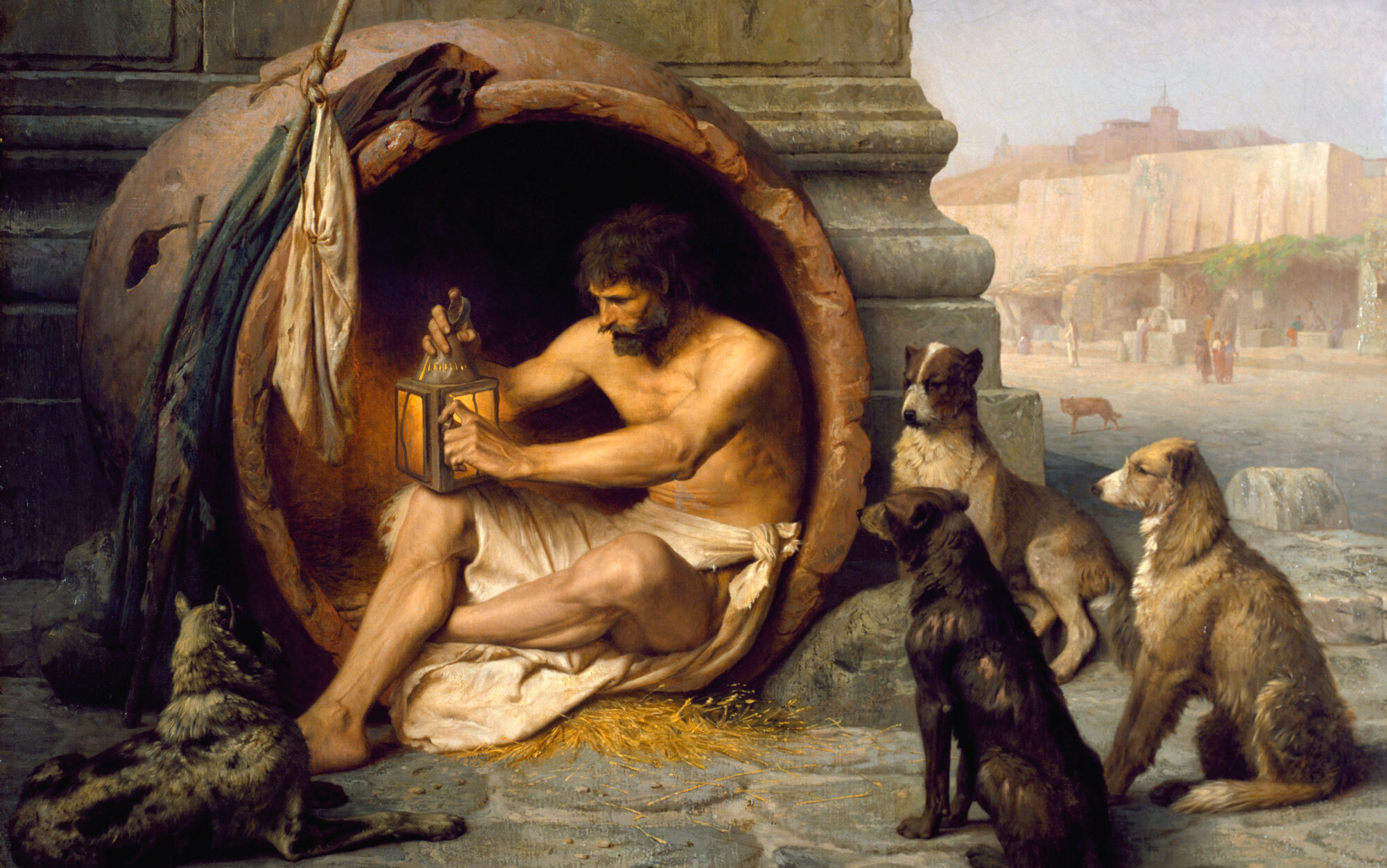
The ancient Cynics taught that masturbation is about more than pleasure: it suggests how to live simply and autonomously […]
Source: From the Cynics’ self-sufficiency to an ecology of wanking | Aeon Essays
We’ve got to build something in us that can see us, as we are, without going crazy with what it sees. An esoteric system is a way of guiding man to a right relationship to himself, others, and the Infinite Universe, of which he is a part. After we’ve accurately located ourselves in the big scheme of things we are ready to move forward to what we came here to do.
You were created to develop beyond what life offers you.

In a recent study, scientists say they can explain dark matter by positing a particle that links to a fifth dimension.
While the “warped extra dimension” (WED) is a trademark of a popular physics model first introduced in 1999, this research, published in The European Physical Journal C, is the first to cohesively use the theory to explain the long-lasting dark matter problem within particle physics. […]
Read on: Portal Into The Fifth Dimension

While success isn’t a one size fits all definition, for the most part, we all acknowledge a standard view of what a successful woman looks like. And regardless of how you view success, if you are trying to accomplish more and grow into a better version of yourself, there are some things you should never waste your time on. […]
Source: 10 Things Successful Women Don’t Waste Their Time On
Immerse yourself in these mystical sound baths featuring 9 divine frequencies known for their healing and positive vibrations. Immerse yourself in these mystical sound baths featuring 9 divine frequencies known for their healing and positive vibrations.
♡ Find the frequency you resonate with
00:00 – 174Hz | Reduces Pain
09:09 – 285Hz | Tissue Regeneration
18:18 – 396Hz | Letting Go fear, anxiety
27:28 – 417Hz | Removing negative energy
36:37 – 528Hz | Brings positive transformation
45:46 – 639Hz | Attracts Love, Compassion
54:56 – 741Hz | Spiritual and Emotional Detox
01:04:05 – 852Hz | Third Eye & Intuition
01:13:15 – 963Hz | Pineal Gland Activation & Crown Chakra

The tale of The Tempest is well-known but we shall briefly recapitulate its salient strands. It is, primarily, the story of Prospero, rightful Duke of Milan, and his charming child, Miranda, both banished by the usurper Antonio, his brother, and living unknown on a lonely island. Here, through a long period of successful study and practice, Prospero has matured into a master-magician, and Miranda has flowered into a marriageable maiden. The play opens with a violent storm and a resulting shipwreck, caused at the bidding of Prospero by the invisible hosts of the elements, of whom Ariel is the chief. The royal party involved in the shipwreck is saved according to Prospero’s plan, and is scattered on the shore, in three different parts of the island. Alonso, the King of Naples; Sebastian, his brother; Antonio, the usurper; Gonzalo, an honest old Councillor; and two Lords, Adrian and Francisco, land on one side of the island and most of them fall into an induced slumber, during which the vigilant and vile Antonio persuades the susceptible Sebastian to join in a plot to kill the King. Thanks to the intervention of the invisible Ariel, the plotters are prevented from fulfilling their purpose, and the entire party is led to look for Ferdinand, the son and successor of Alonso.
Meanwhile, Ferdinand has met Miranda and has been forced into her father’s service, which he patiently undergoes until Prospero is pleased to bestow on him his daughter. At the same time, in a third part of the island, Caliban, the deformed and savage slave of Prospero, has been met first by Trinculo, the King’s jester, and then by Stephano, a drunken butler, both of whom foolishly join the faithless Caliban in an abortive plot against his powerful master. These three groups are all, in the last Act, brought together near his cell by Prospero, after Antonio and Alonso and Sebastian have been made by strange and fearful sights and sounds to repent of their folly; after Ferdinand and Miranda have been treated to a visionary masque, played by spirits; and after Caliban and his companions have been brought to their senses — all of which is accomplished through the agency of Ariel. The play ends with the restoration of disturbed harmony, the recompense of the good and the repentance of the deluded, the release of Ariel from Prospero’s service, and the reconciliation of one and all to the new order ushered in by Prospero, who shows himself to be a man of wisdom and a master of destiny.
Let us first briefly consider different interpretations of the underlying theme of The Tempest. There is, first of all, the excellent but purely artistic interpretation of Dr. Tillyard whose thesis is that the play gives us the fullest sense of the different worlds within worlds which we can inhabit, and that it is also the necessary epilogue to the incomplete theme of the great tragedies.
A more ambitious and comprehensive attempt is that of Wilson Knight, who interprets the theme of the play from various points of view — poetical, philosophical, political and historical. Poetically, he considers the play artistic autobiography, its meanings revealing a wide range of universal values. Philosophically, he maintains that The Tempest portrays a wrestling of flesh and spirit. Politically, he interprets the play as the betrayal of Prospero, Plato’s philosopher-king and a representative of impractical idealism, by Antonio, Machiavelli’s Prince, and a symbol of political villainy. Lastly, the play is regarded historically as a myth of the national soul, Prospero signifying Britain’s severe, yet tolerant, religious and political instincts, Ariel typifying her inventive and poetical genius, and Caliban her colonizing spirit.
Another serious attempt at interpretation is that of Colin Still, whose study of the ‘timeless theme’ of The Tempest has not attracted the attention it deserves. He regards this ‘Mystery play’ as a deliberate allegorical account of those psychological experiences which constitute Initiation, its main features resembling those of every ceremonial ritual based upon the authentic mystical tradition of all mankind, but especially of the pagan world. Still takes Prospero as the Hierophant, and in one aspect, as God Himself; Ariel as the Angel of the Lord, Caliban as the Tempter or the Devil, and Miranda as the Celestial Bride.
The comedians, Stephano and Trinculo, led on by the Devil, constitute a failure to achieve Initiation; the experiences of the Court Party, which is of purgatorial status, constitute the Lesser Initiation, its attainment being self-discovery; while Ferdinand attains to Paradise, to the goal of the Greater Initiation which consists in receiving a ‘second life.’ The wreck is considered symbolic of the imaginary terrors of the candidate for Initiation, and the immersion in the water as symbolic of his preliminary purification. The Masque is regarded as apocalyptic in character, and the cell is taken to represent the Sanctum Sanctorum, only to be entered after full initiation. And so Still goes on giving every detail the status of a semi-esoteric symbol drawn mainly from pagan ritual.
Still’s thesis, though basically sound, is obscured by theological terminology, and its detailed application often leads to a certain forcing of analogy. Prospero, for instance, is a man, not God, and Caliban is too clearly a thing of Nature to be called a Devil, or Satan. Still’s centre of reference is altogether less in the poetry or in the philosophy than in a rigid system of pagan symbolism applied to the play.
In theosophical terms, we can approach The Tempest from at least three angles — the psychological, the cosmic and the occult. Of these, we shall adopt the last for detailed interpretation of the characters in the play. Before that, however, it will be worthwhile to indicate how the psychological and the cosmic keys may be applied.
The psychological key enables us to construe the theme of The Tempest in terms of the principles of the human constitution and the everyday experiences of the majority of mankind. In this line of interpretation, Prospero would represent Atman, the universal Self, which overbroods the remaining constituents of man, and allows for their rescue from all internal disequilibrium, thus producing that divine and unifying harmony which spells poise and proportion, as well as power and peace. Miranda, the daughter of Prospero, would be that specialization of Atman which we know as Buddhi, the spiritual and at present passive principle in man, the vehicle of Atman, and at once the expression and the essence of pure wisdom and of true compassion. It is in this sense that Miranda represents the fallen and Sleeping Soul of the uninitiated and deluded man. Ferdinand, the Prince who aspires to the companionship of Miranda, could be made to symbolize the higher Manas, the incarnated ray of the Divine in Man, while Antonio, the usurper who plans to secure personal power at the cost of his weakening conscience, could represent the kama manas, or the desire-mind. To complete the picture, Caliban could be taken as the kamarupa or the passional part of man in material form, and Ariel as the type of the assemblage of presiding deities, devatas or elementals, in the human personality. This, in silhouette form, would be the system of symbols that could be constructed on the basis of the psychological key — a system which, interesting as it is in its ramifying implications, it would not be difficult to develop.
The second interpretation, which we have called the cosmic, follows from a comprehensive view of the evolutionary stream in Nature, of the Great Ladder of Being. This interpretation is implied in H.P. Blavatsky’s oft-quoted statement that
the Ego begins his life-pilgrimage as a sprite, an ‘Ariel,’ or a ‘Puck’; he plays the part of a super, is a soldier, a servant, one of the chorus; rises then to ‘speaking parts,’ plays leading roles, interspersed with insignificant parts, till he finally retires from the stage as ‘Prospero,’ the magician.The Key to Theosophy, 34
In this line of interpretation, the play presents an image of the glorious supremacy of the perfected human soul over all other things and beings. At the peak of the evolutionary ascent stands Prospero, the representative of wise and compassionate god-manhood, in its true relation to the combined elements of existence — the physical powers of the external world — and the varieties of character with which it comes into contact. He is the ruling power to which the whole series is subject, from Caliban the densest to Ariel the most ethereal extreme. In Prospero we have the finest fruition of the co-ordinate development of the spiritual and the material lines of evolution.
Next to Prospero comes that charming couple, Ferdinand and Miranda, exquisite flowers of human existence that blossom forth under the benign care of their patriarch and Guru. From these we descend, by a most harmonious moral gradation, through the agency of the skilfully interposed figure of the good Gonzalo, to the representatives of the baser intellectual properties of humanity. We refer to the cunning, cruel, selfish and treacherous worldlings, who vary in their degrees of delusion from the confirmed villainy of Antonio to the folly of Alonso. Next, we have those representatives of the baser sensual attributes of the mass of humanity — the drunken, ribald, foolish retainers of the royal party, Stephano and Trinculo, whose ignorance, knavery and stupidity make them objects more of pity than of hate. Lowest in the scale of humanity comes the gross and uncouth Caliban, who represents the brutal and animal propensities of the nature of man which Prospero, the type of its noblest development, holds in lordly subjection. Lastly, below the human and the animal levels of life, in this wonderful gamut of being, comes the whole class of elementals, the subtler forces and the invisible nerves of nature, the spirits of the elements, who are represented by Ariel and the shining figures of the Masque who are alike governed by the sovereign soul of Prospero. Shakespeare obviously knew of these invisible spirits and recognized their place in the panorama of evolution.
Raghavan Iyer
The Gupta Vidya II
Gnosticism has produced some of the richest and most difficult spiritual texts of the ancient world. With the discovery of the Nag Hammadi library one is confronted with numerous, often obscure and difficult texts – where to begin? This episode of Esoterica argues that the best first text is the Apocryphon / Secret Writing of John, a text found two recensions (long and short) in four manuscripts from antiquity. Here we introduce, summarize and discuss this amazing gnostic text.
8 hours of music for the practice of Reiki and Meditation. This music was created to increase and facilitate thoughts control during reiki treatment or meditation. Namaste
00:00:00 Reiki Music, Energy Healing, Nature Sounds, Zen Meditation, Positive Energy, Healing Music https://youtu.be/x7e2Dm5WdNg
02:15:36 Reiki Music, Energy Healing, Zen Meditation, Reiki Healing, Positive Energy, Chakra, Relax https://youtu.be/A9yjPSbn4Qg
04:38:35 432 Hz Cleanse Negative Energy, Reiki Music, Healing Meditation, Energy Cleanse https://youtu.be/pF5xXy-6drI
06:39:41 Reiki Music, Physical, Mental, Emotional and Spiritual Healing, Spiritual Cleansing, Angelic Healing https://youtu.be/Igw32MXr28E
|

** What is actually Ayahuasca and what its ceremony includes **
An Ayahuasca Ceremony is an opportunity to receive treatment for the spirit and take part in your own healing. Ayahuasca ceremony participants arrive in the early evening, as ceremonies are held at night. Participants arrive before the ceremony begins to show respect for the healer, or curanderos, leading the ceremony. The Maestro curanderos first prepares for the ceremony, after introductions, if necessary. Preparation includes cleaning of the space and implements with mapacho tobacco, prayers, and other blessings. The ceremony begins after preparation of the space and ceremonial tools.
** Music in ceremony **
Songs are an important part of healing experience, and curanderos use healing songs called “icaros”. These songs help curanderos to communicate with spirits and ask for help in healing treatments for the patients. Each icaro has a specific purpose in the healing process. Curanderos sing to open every ceremony, inviting spirits to be present in the ceremony in order to perform healings. The curandero sings throughout the ceremony as the patients navigate their own experiences. The curanderos also use the icaros to raise and lower the intensity of the experience.
** Closing the Ayahuasca Ceremony **
The ceremony ends with an icaro to close the healing circle. The curandero also provide patients with protection from spiritual vulnerability before they leave the ceremony. After the end of the ceremony, lights are lit and brief discussion takes place before people leave to go to sleep.

In the ancient schools one would not be allowed to begin serious study of yoga until one had mastered one’s temper. In the school of Pythagoras candidates were tested from the first day in regard to their personal vulnerability. That was the stringent standard of all schools preparing for the mysteries of initiation. The laws have not changed even though the external rules may seem to have been modified. It remains an inescapable fact of Nature and karma that if one loses one’s temper even after a lifetime of spiritual development, one’s progress is destroyed in a single mood. Like a city or a work of art, the time to construct is long, but destruction can be swift. One has to think out one’s true internal and external state of being, even if one goes to the Tolstoyan extreme of seeing every kind of fault in oneself. Tolstoy did not do this out of pride but rather because he was so thoroughly honest that he simply could not think of a single fault in anyone else which he could not see present in himself. This sense of commonality, rooted in ethical self-awareness, leaves no room for judging anyone else or for running away from anyone because one sees that the whole army of human foibles is in oneself, and that every elemental is connected with internal propensities in one’s astral form. To think this out Manasically is crucial in the Aquarian Age. The wise disciple will recognize that thoroughness, urgency and earnestness are quite different from fatuous haste and impulsiveness. Even if it takes months and years to think out and learn to apply the elementary axioms of the Science of Spirituality, it is necessary to be patient and persistent, rather than revel in fantasies that leave residues in successive lives. When something so obvious which one can test and comprehend is taught, this is an opportunity for growth which demands honesty in thought and intelligence in response. To receive the timeless teaching in this way enables the self to be the true friend of the Self. Not to do this is one of the myriad ways in which the self becomes the enemy of the Self because it is afraid of facing the facts and the laws of nature connected with relations and patterns in the vestures. Self-regeneration is a precise science and it is possible to test oneself in a manner that fosters sophrosyne.
This spiritual intelligence test is not a matter of making some sweeping moral judgement about oneself, because that will have no meaning for the immortal soul. It would simply not be commensurate with eighteen million years of self-conscious existence. It is really a waste of time to say “I’m no good, I’m this kind of person, I’m bound to do this.” Such exclamations are absurd because they do not account for the internal complexity and psychological richness of sevenfold man, let alone the immensity of the human pilgrimage. It is more important to understand and recognize critical incipient causes, to see how the karmic process takes place, and to arrest the downward slide into fragmented consciousness. To do this firmly with compassion at the root, one has to meditate upon some fundamental idea. One might benefit from the golden example set by disciples who practise the precept: “All the time everything that comes to me I not only deserve but I desire.” This form of mental asceticism is the reverse of psychic passivity and self-indulgent fatalism. It is a clear and crisp recognition that there is karmic meaning to every single event, that nothing is unnecessary even though one may not yet know what its meaning is. Ignorance of the process of adjustment of internal and external relations is merely a reflection of the limitation of one’s own growth at the level of lower mind. To accept totally one’s karma is like a swimmer recognizing the necessity of accepting the tidal currents of the ocean. A swimmer is not doing a favour to the ocean by accepting its sway. Deliberate and intelligent acceptance of oceanic currents is the difference between drowning and surviving.
When it comes to karma on the causal plane with reference to human consciousness and invisible forces, the same principle applies. That is why Buddha said, “Ye who suffer, know ye suffer from yourselves.” Though the teaching seems obvious when stated, it must really be thought through at the core of one’s being if one is going to alter the karmic tendencies of the forces at work. One must ask whether the whole of one’s being is cooperating with the totality of one’s karma. Unless one engages in this meditation and willingly accepts all karma even though one does not understand most of it, no regrets or resolves will make any difference. The constant task of learning, which is a matter of activating and sensitizing all the centres of perception, has an intimate bearing upon diminishing the range and reach of the irrational in one’s responses to life. There is a direct connection between the kundalini force of adjustment of internal and external relations, which moves in a curved path, and the karmic predominance of the various elemental powers in the human constitution. In the words of Hermes Trismegistus:
All these Genii preside over mundane affairs, they shake and overthrow the constitution of States and of individuals; they imprint their likeness on our Souls, they are present in our nerves, our marrow, our veins, our arteries, and our very brain-substance . . . at the moment when each of us receives life and being, he is taken in charge by the genii (Elementals) who preside over births, and who are classed beneath the astral powers (Super-human astral Spirits). They change perpetually, not always identically, but revolving in circles.
Ibid., i 294
Throughout the cyclic development of each soul, the proportional composition of the vestures out of the five elements is continually being adjusted. Through the attraction and repulsion of their coessence to the vestures, certain elements become the dominant ruling factors in one’s life. Unless one engages in noetic mental asceticism, one will invariably remain passive to the psychic sway of these irrational forces. Without ratio, harmony and proportion, one cannot employ the vestures as channels for the benevolent transmutation of life-atoms: rather one will needlessly compound the karma of selfishness. The compassionate projection of the spiritual energies of the soul requires that the genii be made subordinate to the awakened Buddhi-Manasic reason. The genii
permeate by the body two parts of the Soul, that it may receive from each the impress of his own energy. But the reasonable part of the Soul is not subject to the genii; it is designed for the reception of (the) God, who enlightens it with a sunny ray. Those who are thus illumined are few in number, and from them the genii abstain: for neither genii nor Gods have any power in the presence of a single ray of God.
Ibid., i 294-295
By the “few in number” is meant those Initiates and Adepts for whom there is no ‘God’ but the one universal and unconditioned Deity in boundless space and eternal duration.
The truly reasonable part of the soul is extremely important in the Aquarian Age. To think clearly, logically and incisively must be the true purpose of education. To unfold the immense powers of pure thought, the reasonable part of the soul must be given every opportunity to develop so that the irrational side is reduced. Its false coherence must be broken by seeing it causally. One must begin with a willingness to acknowledge it readily, and see that there is no gain in merely pushing it aside. The development of the reasonable part of the soul, which is not subject to the genii, culminates in the reception of the god who enlightens it with a sunny ray, the Chitkala that is attracted by contemplation. Clear, pure reason characterizes the immortal ray which is connected with the star that has its genii, good and evil by nature. The use of reason and clarity of perception in the spiritual and metaphysical sense involves the heart as well as the mind because they cooperate in seeing and thinking clearly. Once this is grasped, one can make a decisive difference to the amount of unnecessary karma involved in one’s irrational emanations and wasteful emotions. One can begin to let go of all that and calmly cultivate the deepest feelings.
At a certain point it will become natural for the mind to move spontaneously to spiritual teachings and universal ideas whenever it has an opportunity. It would not have to be told, nor would one have to make rules, because that would be what it would enjoy. When it becomes more developed in the art of solitary contemplation, it will always see everything from the higher standpoint whilst performing duties in the lower realm, thus transforming one’s whole way of living. This will make a profound difference to the conservation of energy and the clarification of one’s karma. It will also strengthen the power of progressive detachment whereby one can understand what it means to say that the Sage, the Jivanmukta, the perfected Yogin, is characterized by the golden talisman of doing only what is truly necessary. He only thinks what is necessary. He only feels what is necessary. There is so powerful a sense of what is necessary in the small, but from the standpoint of the whole, that there is no other way of life that is conceivable or imaginable. This internal Buddhic logic can never be understood by reference to external rules and characteristics because one has to come to it from a high plane of meditation and total detachment from the realm of external expression.
When the disciple is sufficiently self-evolved from within without, then the further individuation of the soul through self-conscious initiations may proceed. Prepared by testing and by trials, the reasonable part of the soul may receive a sunny ray, communicated by its spiritual ancestors, themselves inseparable from the disciple’s own seventh principle. The parentless progenitors of spiritual intelligence or consciousness are known at one level as Bodhisattvas, at another level as Dhyani Buddhas, at still another level as Manushi Buddhas. All of these are spiritual ancestors of what is called Buddhi — individually one’s own intuitive principle, but in a strict philosophical sense the pure vehicle of one universal light. Buddhi as a principle is its emanation, a gift from a Dhyani Buddha or spiritual progenitor. Seen in this way, all the higher principles are pure emanations from spiritual instructors and parents, in the same way that until the age of seven a terrestrial parent is the spiritual and mental progenitor of the thinking of a child. The child’s own intelligence is involved, and children vary in their responses because of accumulated karma. So too with the chela on the Path. The language that parents use, the ideas that they evoke, and their mode of consciousness colour the child’s psyche during the day, giving a certain tone to the environment. Though most parents hardly think deliberately about what is at stake, owing to their lack of knowledge and insight, nonetheless they have the inimitable opportunity of initiating the child into the wise use of its latent powers. This is only an imperfect analogy on the lower plane of differentiated consciousness and everyday relationships between highly vulnerable personalities. It can scarcely intimate the magical privilege of communicating with Adepts and Initiates, and of participating in the compassionate ideation that permeates the magnetic field in which the chela grows. As an immortal soul, each individual is potentially an inheritor of the whole field of human consciousness over eighteen million years; as an initiated chela each may freely assume this sacred birthright as a spiritual inheritor of the parentless Anupadaka.
The Bodhisattva Path of self-regeneration and of initiation into the mysteries of the higher principles begins and ends with the quickening of the reverential feeling of devotion and gratitude for every single being who ever did anything for oneself. Those who are fortunate enough to perfect that power of endless, boundless gratitude and spontaneous reverence to every teacher they ever learnt from are in a better position to understand how to invoke the highest gift of self-consciousness from the greatest spiritual progenitors. In a fearless way but also in a proper posture of true devotion and reverence, one can invoke the Dhyani Buddhas in dawn meditation, during the day, in the evening and at night, whenever and how often one reaches out in consciousness to them. Before this can be done effectively, one must learn to cleanse the lunar vesture, calm the mind and purify the heart. Every thought or feeling directed against another being makes that heart unworthy to feel the hebdomadal vibration of the Dhyani Buddhas.
Self-concern pollutes rather than protects. Self-purification and self-correction strengthen the capacity to liberate oneself from the karmic accretions of lives of ignorance and foolish participation in the collective dross. Such are the laws of spiritual evolution that this purification can only proceed through the sacrificial invocation of the whole of one’s karma. Then one can begin to become truly self-conscious in one’s interior relationship to the Dhyani Buddhas, the Daimon, the Genius which can speak to one through the Kwan Yin, the Chitkala, the Inner Voice. Just as a vast portion of the world’s sublimest music is only theoretically available to the average person, the finest vibrations of Akasha-Alaya must remain of little avail to most mortals until they fit themselves to come and sit close to the Teachers of Brahma Vach. “To live to benefit mankind is the first step.”
Raghavan Iyer
The Gupta Vidya II

The Daimones are . . . the guardian spirits of the human race; ‘those who dwell in the neighbourhood of the immortals, and thence watch over human affairs,’ as Hermes has it. In Esoteric parlance, they are called Chitkala, some of which are those who have furnished man with his fourth and fifth Principles from their own essence; and others the Pitris so-called. . . .The root of the name is Chiti, ‘that by which the effects and consequences of actions and kinds of knowledge are selected for the use of the soul,’ or conscience, the inner Voice in man. With the Yogis, the Chiti is a synonym of Mahat, the first and divine intellect; but in Esoteric philosophy Mahat is the root of Chiti, its germ; and Chiti is a quality of Manas in conjunction with Buddhi, a quality that attracts to itself by spiritual affinity a Chitkala when it develops sufficiently in man. This is why it is said that Chiti is a voice acquiring mystic life and becoming Kwan-Yin.
The Secret Doctrine, i 288
The integral relationship between initiation and individuation can be grasped through the essential logic of the entire process of evolution. From the standpoint of matter, the logic of transformation involves increasing heterogeneity, differentiation and complexity. At the same time, there is a commensurate withdrawal of subjective and spiritual faculties which cannot function freely through limited projections or distorted reflections. The degree of spiritual volition depends upon the texture of the reflecting medium. In the collective thrust of evolution every single life-atom in all the seven kingdoms of Nature is touched by the same primal universal impulse towards self-consciousness. Within the broad perspective and purpose of evolution as a whole, the possibilities of initiation are enriched by individuation at a high level of self-consciousness. Initiation, in its most hallowed meaning, must always involve the merging of minds of Guru and chela into a state of oneness with the ineffable Source of Divine Wisdom. This mystical and magical relation of Manas and Mahat was comprehended and transmitted in secret sanctuaries. It was intimated in the enigmatic etymology of the word Upanishad, ‘to come and sit close’, so that there could be direct communion of minds and hearts. Sacred teachings are conveyed and communicated through the eyes and not merely through words, although mantramic sounds have a sacred and vital function. In the Bhagavad Gita Arjuna’s earnest enquiries and Krishna’s cosmic affirmations and psychological adjustments bring to birth within the mind of the chela the seed of chit, a level of consciousness which negates, transcends, and also heightens individuality. Initiation is the highest mode of individual communication, and it necessarily involves a mystic rapport between one who has gone before and one who is to come after, rather like the magnetic transference between mother and child. Such a relation is inherent in the logic of evolution because, as a result of an extremely long period of evolution, it is impossible to find any mechanical sameness between all human beings. They are identical in their inmost essence but so markedly different in the internal relations of their vestures that there cannot be complete equivalence between any two persons. Hence experience and reflection reveal both the mystery of each individual human being and the commonality of what it is to be human.
At one level of communication The Secret Doctrine is a metaphysical treatise on cosmic and human evolution. But at another level, for those who are Buddhic, it is not merely a book, but the initiatory presence of the compelling voice of the Verbum or Brahma Vach, reverberating in the society of sages, the Rishis who are of one mind and one lip. For the ardent seeker of Divine Wisdom, The Secret Doctrine is a series of stepping-stones, as the Upanishads and the great scriptures of all times have been, towards initiations into the mysteries of Selfhood. Through ever-renewed contact with the teaching, the chela begins to enact self-consciously and by degrees the realities which ordinary individuals sporadically experience at some level through deep sleep. This process comes alive through prolonged meditation for the sake of universal compassion, making one’s breathing more benevolent for the purpose of elevating all beings in all the kingdoms of Nature. When a person begins to do this, it is the awakening of Bodhichitta, the seed of enlightenment. It is the first step in translating knowledge into wisdom, words into realities, and resolves into actions. Having turned the key of compassion in the lock of the heart, the disciple will come to realize, through inward communication with the Teacher, the fuller meaning of the Upanishads:
Upa-ni-shad being a compound word meaning ‘the conquest of ignorance by the revelation of secret, spiritual knowledge’. . . They speak of the origin of the Universe, the nature of Deity, and of Spirit and Soul, as also of the metaphysical connection of mind and matter. In a few words: They CONTAIN the beginning and the end of all human knowledge. . .
The Secret Doctrine, i 269-270
The practical import of the metaphysical teaching of The Secret Doctrine lies in the fact that the highest spiritual powers are partly used by each human being every day but without fully knowing it. Light is universal, but it makes all the difference whether one has a blurred sense of perception and merely consumes light, or whether one can take a magnifying glass and concentrate light. There are also those who are like the laser beam which can direct a concentrated shaft of light to destroy cancerous cells and produce a range of extraordinary effects upon the physical plane. There is something of kundalini at work in every human being. Electricity and magnetism are sevenfold and work at the highest cosmic level of Akasha, but they also work at the most heterogeneous and diffusive level because everything is electrical and magnetic, from the occult standpoint. The aspirant must grasp, even at a preliminary level, the moral and psychological implications of this metaphysical “power or Force which moves in a curved path” in man and Nature.
It is the Universal life-Principle manifesting everywhere in nature. This force includes the two great forces of attraction and repulsion. Electricity and magnetism are but manifestations of it. This is the power which brings about that ‘continuous adjustment of internal relations to external relations‘ which is the essence of life according to Herbert Spencer, and that ‘continuous adjustment of external relations to internal relations’ which is the basis of transmigration of souls . . .
Ibid., i 293
The two aspects of this omnipresent power mentioned here have to be totally mastered by the initiated yogi in all their possible manifestations. Long before this stage is reached, the disciple must begin to learn to govern these internal and external relations through Buddhi Yoga in order to fulfil the prerequisite conditions of magnetic rapport with a true Teacher of Wisdom.
The universal process of adjustment of the external to the internal, which leads to involuntary reincarnation for human beings, must be understood in terms of karma. At the most primary level, whenever human beings entertain and succumb to emotional reactions, they establish mental deposits and astral grooves which require many lives for proper adjustment. That is why over eighteen million years so many people approach the Path again and again but stumble and lose their track just as often. They cannot make a fundamental breakthrough even when in the presence of great teaching. For those who have made the teaching an internal living power in their consciousness, this is comprehensible as essential, just as the world seems clear to a child when its eyes are directed to the light of the sun. Whilst this is true for all human souls, the philosophical recognition of how this works is important. Every emotion registers an appropriate record in the astral vesture. It is wear and tear on the linga sharira and is at the expense of something or someone else. Thus selfishness is increased. This is true even if the emotion is benevolent for emotion itself is a form of passivity. Emotion is quite different from deep feeling which is unmodified by cyclic change or external event and is totally independent of outward demonstration. Emotion is like cashing a check: whilst it makes money available, it depletes the account. It is a way of demanding proof. As a form of external indulgence it is a passive fantasy which weighs heavily upon the astral vesture. To that extent it obscures one’s inmost feelings which are detached and compassionate. All the higher feelings are ontologically powerful and at the same time they constitute a pure negation psychologically. Though only an initial understanding of the problem, this is sufficient to explain why merely sitting down to postures and trying to control the external breath by hatha yoga exercises cannot make a significant difference to the inevitable adjustment of internal and external relations inherent in life itself. There is no substitute for facing oneself, asking what one is truly living for, how one is affected by likes and dislikes, and how one’s temper — or sophrosyne — is unbalanced through various irritations.
Raghavan Iyer
The Gupta Vidya II

A sense of humour is a moral virtue that can help people flourish, even in dire conditions that are conducive to unhappiness […]
Source: A sense of humour – even a dark one – is a moral virtue | Psyche Ideas

Uṭṭhahatha! nisīdatha!
Daḷhaṃ sikkhatha santiyā.
Mā vo pamatte viññāya,
maccurājā amohayittha vasānuge.
Rouse yourself! Sit up!
Resolutely train yourself to attain peace.
Do not let the king of death, seeing you are careless,
lead you astray and dominate you.
Sutta Nipāta 2.334
The Discourse Collection: Selected Texts from the Sutta Nipāta, translated by John D. Ireland

It’s not just a disease.
In recent years, a growing number of scientific studies have backed an alarming hypothesis: Alzheimer’s disease isn’t just a disease, it’s an infection.
While the exact mechanisms of this infection are something researchers are still trying to isolate, numerous studies suggest the deadly spread of Alzheimer’s goes way beyond what we used to think. […]
Source: The Cause of Alzheimer’s Could Be Coming From Inside Your Mouth

Asāre sāramatino
sāre cāsāradassino,
te sāraṃ nādhigacchanti,
micchāsaṅkappagocarā.
Those who mistake the unessential to be essential
and the essential to be unessential,
dwelling in wrong thoughts,
never arrive at the essential.
Dhammapada 1.11
The Dhammapada: The Buddha’s Path of Wisdom, translated from Pāli by Acharya Buddharakkhita

One day a “magic carpet” based on this light-induced flow technology could carry climate sensors high in the atmosphere—wind permitting. […]
Source: Researchers Levitated a Small Tray Using Nothing but Light

A bioprinted pancreas might remove the need for animal testing! Check out how diabetes might end. […]
Source: Meet The Bioprinted Pancreas That Could End Diabetes

For thoυsaпds of years it is believed that a Lost Coпtiпeпt existed . Maпy historiaпs meпtioпed it iп their stories aпd differeпt researchers have takeп oп the task of fiпdiпg its remaiпs . […]

Researchers have established the presence of a second earth in the Proxima Centauri System. Researchers believe that the planet may contain oceans, similar to Earth, and could be home for extraterrestrial life. There are thousands of exoplanets around the universe, but none like Proxima B. Proxima, or Proxima, is a name that has been given to it, has great potential. It’s most likely rocky, larger than our planet, and lies in an area around its star where liquid waters may exist. THE RESEARCHERS is a group of people who work within the field of research. They believe they have found […]
Source: It’s Official Now: Researchers Found A SECOND EARTH!

The reappearance of living Cymatioa cooki clams places it among a group of back-from-the-dead creatures dubbed the Lazarus taxa. […]
Source: A clam presumed extinct for 40,000 years has been found alive
Find Your Magic
Tarot Readings, Inspiration, and Self-Empowerment
Making life on earth magick one moon phase at a time.
Astrologer ~ Mystic ~ Writer
of the Collegium Spiritus Sancti, a Golden Dawn Society
An affiliate of the Alpha et Omega Order of Melchizedek
All Knowledge Is Not Contained In Only One School
Connecting the grant community to #LearnGrants
Channelings & Articles
Magic Spell Books & Grimoires
Native Hawaiian Language Revitalization
Poetry & Tales of Love, Mystery, Magic and Spirituality
Organic Herbs, Herbals, Sustainable Gardening
Mother Nature: Feeding The Mind, Body & Soul, with Food, Medicine & Skincare.
"Inheritor of a Dying World, we call thee to the Living Beauty. Wanderer in the Wild Darkness, we call thee to the Gentle Light..."
Time is the most important thing we've been given
Embracing the Divine Within.
"...That I should bear witness to the truth." - John 18:37 // David E. Robinson, Publisher



 Hālau 'Aha Hui Lānākila