Handwrite A Letter To A Dear One:
There are boundless ways to correspond with loved ones. Whether by phone or social media, email or video call, a 30-minute catch-up with an old friend has become as effortless as a few taps of fingers on keypad. Yet, such ease and convenience leaves little room for the quality and care that gets conveyed through an artfully compiled package, or a keepsake letter that conjures up snapshots of one’s week or month or year.
Today, take the time to indulge in the slow, classic art of pen on paper: hand-write a letter to someone you hold dear. Relish the reflective process and stir your creative muscles with a doodle here or a brush of poetry there. Or, for an alternative twist, write a letter to your future self. Years from now, you or your friend may stumble upon the very letter you so lovingly crafted today– a provocative reminder of the progression of life, and powerful artifact of the impact of one’s life on another.
“Life is available only in the present. That is why we should walk in such a way that every step can bring us to the here and the now.” — Thich Nhat Hanh
Reduce Your Phone Use:
The cellular phone is an invention that has added much to our lives. It’s enabled us to communicate on-the-go, plan for change, and pass along short messages when talking is not possible. In recent years, smartphones have created exponential new uses out of our cellular devices. From alarm clock to calculator, web browser to camera to GPS navigator, it has become a handy toolbox of modern life. Whether walking down the street, on the subway, or in the office building, no one is phased at the sound of the buzz or ding signaling an incoming message, calendar notification, or missed phone call. More people in the world today have mobile phones than toilets. With such ease and utility, cell phones have literally become attached at our hips– sitting on constant standby in our pockets and purses, boardroom tables and bedside nightstands. One phone app reports its 4.5K+ users check their phones 2-3 times every waking hour.
Today, reduce your phone use. Keep it powered off or on silent, and check it briefly for limited intervals throughout the day. Leave it in your desk drawer, tucked away in your car, or at home altogether, and notice how many times you feel compelled to reach for and check it.
“Nature does not hurry, yet everything is accomplished.” — Lao Tzu
Replace Screen Time With A Walk Outdoors —
Between 2012 and 2013, mobile screen time increased by 50 percent. In parallel, research has revealed that a walk can drastically transform a cognitively-fatigued mind: “You come back and you repeat the cognitive testing and whether it’s memory recall, target identification, or your attention overall, it’s consistently far better after having taken a nature walk.” Children who take a break from technology to play outside can better understand nonverbal cues. Today, substitute 15 minutes of screen time with a walk in the open air. Take time to look up at the sky, and tune in to all the elements of nature around you. Notice the wind, sun, trees and sky. Notice how your breath and body feel as you move. Witness how the change of scenery and pace impacts your energy, morale, and efficiency.
It’s how we spend our time here and now, that really matters. If you are fed up with the way you have come to interact with time, change it. — Marcia Wieder
Track Your Screen Time —
With much of our work and personal hours taking place on computers, smartphones, and tablets, it can be easy to lose track of how much of the day actually unfolds in front of a screen. Today, keep a record of how much time you spend on digital devices. Time each session you find yourself in front of a screen, and track it on a spreadsheet, document, or slip of paper. Dig even deeper, by taking a minute every hour to categorize your plugged-in activities for that period: work, study, personal, and random. At the end of the day, add up your screen time. Do your results surprise or meet your expectations? Brainstorm three ways you can adjust your use of screen time to align with your values, health, and preferences. To step things up, make tracking your screen time a family endeavor, and post a log sheet (like this) in an easy-to-view place at home.
Relationships are built on small, consistent deposits of time. –Andy Stanley Reconnect In Person With Someone: The jury is still out– and will be for a long time– on whether constant, instant connectivity is a net gain or loss for society. But on a personal level, most of us have had our share of online insults, whether intentionally or accidentally. How many of us still regret that slip of the finger that led to hitting ‘send’ instead of ‘save’ on an email? If you’ve developed etiquette for such incidents, do share. :)) Yet perhaps the greatest cause of e-pain is omission, not commission. That is, being inattentive or missing in action from those around us. Today, think of 3 people who are really close to you. Do a silent inventory to see if you have short-changed any of them of the pleasure of your company. Reach out to at least one of them today to schedule quality time together. On the flip-side, step-it-up by inviting those who have e-dropped out of your life to reconnect. Their absence from you was probably no more intentional than your absence from them.
The story of evolution unfolds with increasing levels of abstraction. –Ray Kurzweil
Dig Deeper Into Artificial Intelligence — Artificial Intelligence (AI) was once a far-fetched figment of our collective imagination. But technology has come a long way since then, and now we have devices that can answer questions about everything from where to eat dinner, and how to get to the nearest gas station, to what books we should read. As our technology grows more refined the line between artificial and real continues to blur. In January 2015, experts in the field signed an open letter to protect mankind from machines, reminding humanity to tread lightly while developing really smart machines. Today, read up on artificial intelligence. Learn about the exciting possibilities and the sobering edges around them. Share your findings with others, and keep an eye out for developments in the coming years. The more informed we are, the more we can collectively make thoughtful decisions on the direction of intelligent machines for a long time to come.
What is infant circumcision? Why is the practice common in U.S. hospitals and not in other countries? What does it remove and how does that affect the child? Does scientific data suggest that circumcision has benefits? What are the potential complications? How does it affect sexuality? Is it a medical procedure or a social surgery? If it’s unnecessary surgery, what about contemporary bioethics principles?
Through both a review of scientific literature and a discussion of the human cost of the procedure, this presentation explores these questions from the perspectives of the child, the adult survivor, the parent, and the practitioner.
Ryan is a parent, a biophysicist, an Assistant Professor of Physics and Oncology at Georgetown University, and also a volunteer who supports parents and families. Over the last 10 years he has been studying the medicalization of childbirth in U.S. hospitals.
“It is not a daily increase, but a daily decrease. Hack away at the inessentials.” –Bruce Lee
Prioritize Your Online Time — A signal-to-noise ratio is the power ratio between a signal of meaningful information and the background noise of useless information. That’s the technical definition. On a day-to-day basis, it can also refer to the ratio of really profound content to really unnecessary cat videos on Facebook. Today, pay attention to meaningful pieces of communication, and filter out all other background noise and distractions. Delete the promotional ads in your inbox, and unsubscribe from newsletters or magazines that distract you from what’s really important. Refrain from participating in idle gossip, and aimless browsing online. By prioritizing what streams of information to focus on, you are de-cluttering your mind space, which ultimately leverages your energy to address what really matters.
A doctor in Indonesia recently came up with an idea that can help to provide healthcare to the needy and put a dent in garbage pollution as well.
Dr. Gamal Albinsaid recognized that many people in his country had severe health problems with no insurance, and no money to pay for medicine or medical care. He also noticed that many rural villages nearby were filled with garbage.
Thinking on how to solve both problems, Gamal eventually decided that he would provide free health care to people who turned in their garbage.
“You have people who can’t go to the hospital because they don’t have money. So I started thinking, if you don’t have money, what do you have?” Gamal said.
“There’s garbage everywhere on the ground. So we decided to use garbage as a financial resource,” he continued.
He then created a company called Garbage Clinical Insurance which collects the trash that is given to him by his patients and then sells it to recycling companies. The money earned from the recycled garbage is then used to pay for medicine and health care for the people who turned in the trash.
“As the parlor awakens social consciousness, the library fosters reading consciousness, and the bedroom suggest sleeping, so everyone should have a room or screened off corner, or a well ventilated closet, used exclusively for the purpose of silent meditation. Traditional homes in India always have such a shrine for daily worship.
“A sanctuary in one’s home is very effective in fostering spirituality, because unlike a place of public worship it becomes personalized, and also because it is accessible for spontaneous devotional expressions throughout the day. The children in India are not forced to frequent the shrine, but are inspired to do so by the parents’ example.
“In these home temples, families learn to find the soul peace hidden behind the veil of silence. Here they introspect, and in prayer and meditation recharge themselves with the inner power of the soul, and in divine communion attune themselves to discriminative wisdom by which they may govern their lives according to the dictates of conscience and right judgment.
“Interiorized prayer brings forth the realization that peace and service to divine ideals are the goal of life, without which no amount of material acquisition can assure happiness.”
Why is there a sudden push by the FDA to label homeopathic remedies as dangerous? Why is there a need to regulate substances that have been used for hundreds of years with out any issues? What does the FDA have to gain?
The FDA has published two documents recently, which suggest that WAR is being declared on the profession of homeopathic medicine – or at least on the manufacture of homeopathic remedies, which comes to the same thing in the end. What is a homeopath without homeopathic remedies?
The FDA has since that date scheduled public hearings on
“the current use of human drug and biological products labeled as homeopathic, as well as the Agency’s regulatory framework for such products. These products include prescription drugs and biological products labeled as homeopathic and over-the-counter (OTC) drugs labeled as homeopathic.”
“If you follow your bliss, you put yourself on a kind of track that has been there all the while, waiting for you, and the life that you ought to be living is the one you are living. Wherever you are — if you are following your bliss, you are enjoying that refreshment, that life within you, all the time.”
Click on the image to read this all-important article!
DO YOU have the courage to stand up and Live Free? The majority of America refuses to fight what the rest of the world sees … Silence to all the wrongs we all know about (from FB, among other places) means CONSENT, i.e., tacit agreement, to continued poisoning of our food, water and air; poisoning via vaccine; and corporate enslavement via RFID chips, outrageous taxation, licensing fees, insurance, mortgages, bank fees and real-time police harassment. If you’ve given your permission to continue the present status quo through your tacit agreement to all of these wrongdoings, your head remains in the sand by helping the Cabal keep their systems intact … and that keeps the misery going for us all. Take responsibility and BE PRESENT NOW … Read on, if you’ve got the guts TO BE.
“The more clearly you understand yourself and your emotions, the more you become a lover of what it is.”- Baruch Spinoza
“Eunoia” is a performance that uses my brainwaves — collected via EEG sensor– to manipulate the motions of water. It derives from the Greek word “ey” (well) + “nous” (mind) meaning “beautiful thinking”. EEG is a brainwave detecting sensor. It measures frequencies of my brain activity (Alpha, Beta, Delta, Gamma, Theta) relating to my state of consciousness while wearing it. The data collected from EEG is translated in realtime to modulate vibrations of sound with using software programs. EEG sends the information of my brain activity to Processing, which is linked with Max/MSP to receive data and generate sound from Reaktor.” – Lisa Park
“Eunoia II is outfitted with 48 vibration pools, inspired by the 48 emotions philosopher Baruch Spinoza outlined in his book, Ethica, like frustration, excitement, engagement, and meditation. Each speaker vibrates according to Park’s brain wave-interpreting algorithm, which tranforms intense signals from Park’s Emotiv EEG headset into intense vibrations in the pools of water atop speakers. The modulation of the sound (volume, speed, panning) occurs in real-time in response to her emotional values detected by EEG headset. Here, Park is literally putting her inner struggles on display, and the whole show depends on how she deals with her feelings. The calmer she is, the less vibrations of the sound happen.”
The ultimate goal of humanity is to ascend into the crystalline Light body, a state of true immortality.
Evolution does not stop there, but continues beyond fifth density into sixth and finally, seventh, the original level of the soul.
At some point, your soul’s journey through the lower worlds will be complete and you will return to the seventh plane where you will reunite with your soul family.
Whether this happens in 100 years or a million does not matter, for what is in front of you now is what matters.
This is the most exciting time in the history of your soul’s journey.
Even though most of you have had numerous incarnations in fourth and fifth density worlds before, never have you moved directly into the higher dimensions in the manner set before you now.
Planets evolve through the lower densities, taking approximately 108 million years to complete one density level.
In the case of your Earth, which is approximately 4.5 billion years old, it took most of that time to get established on the path of ascension.
Now that Earth is moving into fourth density, we anticipate that she will remain a fourth density world for the next 108 million years, although souls will be able to reside upon her that are fifth density.
In your fifth density state, you will not be subject to the same laws and principles as fourth density humans.
You will be walking in two worlds, or rather, two different levels of Gaia, the conscious being you called Earth.
If there was ever a year to commemorate Pi Day in a big way, this is it. The date of this Saturday—3/14/15—gives us not just the first three digits (as in most years) but the first five digits of pi, the famous irrational number 3.14159265359… that expresses the ratio of a circle’s circumference to its diameter.
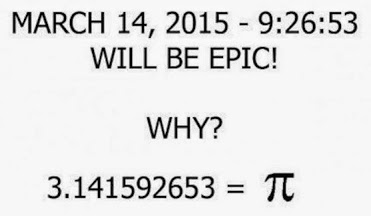
For an extra thrill, be sure to observe Pi Day on 3/14/15 at 9:26:53 (A.M. and/or P.M.!), which will give you a full 10 digits of pi—an occurrence that will not roll around for another century. (Of course, the specialness of this year really only works in the U.S. and other places that commonly put the month before the day, rather than in Europe, say, where they would note the date as 14/3/15.) And if this Saturday is not already special enough, it is also Albert Einstein’s birthday, giving math and science enthusiasts even more reason to revel.
Pi fans can celebrate this weekend with a wealth of math- (and baked goods–) related opportunities. Traditionalists will of course bake pies, both because of the pun and because of their circular nature (not to mention their tastiness). For the sugar-averse, pizzas have the right shape, and the right first two letters as well.
Science museums around the country are also planning live events. The National Museum of Mathematics in New York City, for example, will gather people in Madison Square Park to light up a circle around the central fountain and compare its circumference with the distance across it—accompanied by free hot chocolate and pie. Other festivities are being held at Exploratorium in San Francisco, the Air Force Research Laboratory in Dayton, Ohio, Princeton University (which is having a pie-eating contest, among other activities) and the National Cryptologic Museum near Washington, D.C., among many more.
If you bake a pie, eat a pizza or party with other pi fans, please send us a picture and description of how you observed the Pi Day of the Century for a gallery we plan to post next week.
If you’ve ever dreamed of owning a historic bed and breakfast in Maine, that’s an oddly specific dream. But good news! Now’s your chance to fulfill it, as long as you have $125, a postage stamp, and a gift for words.
Okay, so I knew moving to Hawaii would cost a lot but you don’t really get a grasp of it until you start getting quotes. (Just wait till I write out those checks, tear*) I knew my dogs would cost more than moving a kid but it didn’t hit me until I filled out all the paperwork and talked to the airline. I am mentally preparing myself to spend about half the money we saved (in a year in a half) on the move alone!
Just so you can wrap your head around this, here are some quotes we got:
Pod to move our crap: $7,400 (I would now rather sell all my stuff and start over!)
Cars: $1,100 each (we were going to take both and now we are debating)
Dogs: $319 each for flight, $165 each to pick up from airport, $325 each rabies titer, not to mention…
Here’s Father O’Neal … click here to read the article
A Catholic priest from Massachussetts was officially dead for more than 48 minutes before medics were able to miraculously re-start his heart has revealed a shocking revelation that will change everything you once believed.
The 71 years old cleric Father John Micheal O’neal claims he went to heaven and met God, which he describes as a warm and comforting motherly figure.
Here’s a new way to make fuel from sunlight: starve a microbe nearly to death, then feed it carbon dioxide and hydrogen produced with the help of voltage from a solar panel. A newly developed bioreactor feeds microbes with hydrogen from water split by special catalysts connected in a circuit with photovoltaics. Such a batterylike system may beat either purely biological or purely technological systems at turning sunlight into fuels and other useful molecules, the researchers now claim.
The process started in 2009 with the cheap, water-splitting catalysts developed by chemist Daniel Nocera, now at Harvard University. These cobalt–phosphate catalysts use electricity to make hydrogen out of ordinary water. But hydrogen has not caught on as an alternative fuel. So when Nocera arrived at Harvard, he partnered with biochemist Pamela Silver of Harvard Medical School, her then-graduate student Torella and others to build a hybrid system that could make a more useful fuel.
By pairing machine and microbe, this new “bionic leaf” gains the best features of both. Photovoltaics can turn much more incoming sunlight into electric current than the photosynthesis employed by bacteria or plants—and the new catalysts can split ordinary water, even the dirty stuff from the Charles River in Boston. But microbes, photosynthetic or otherwise, are good at turning incoming energy into useful molecules, whether food, fuel or even pharmaceuticals. So, Torella and the rest of the team paired the photovoltaic water-splitting wafer with Ralstonia eutropha, a soil bacteria that can use the split hydrogen to power the building of molecules out of carbon, in a jar. Using a genetically engineered variant of R. eutropha, the team made isopropanol (C3H8O), an alcohol molecule that can be used as fuel like ethanol or gasoline and can be easily separated from water with salt.
The bionic leaf can pump out 216 milligrams of isopropanol per liter of water—an efficiency that rivals that of a corn plant making starch-rich kernels out of sunlight. The key is using the specially tweaked R. eutropha and putting them in a sealed jar filled with nutrient-free liquid plus hydrogen and dissolved CO2. A few transfers from jar to jar mixed with vigorous stirrings plus time cause the R. eutropha to switch from normal growth to panic mode, inducing the microbes to feed directly on the hydrogen. The resulting colony was placed in the jar with the water splitter and a stainless steel electrode connected to a photovoltaic array to provide current and, after a lag of a few days, the new bionic leaf began to grow—and spit out isopropanol.
This is not the first time R. eutropha has been used to make fuel from solar electricity but the new work is the first to put the unique microbe in the same chamber as the water-splitting, electrically driven chemistry rather than separating the living from the nonliving to prevent the nonliving chemistry from killing off the life. The new work also heralds engineering progress for the dream of electrofuels — liquid fuels made using electricity, an innovative program that ran from 2008 to 2012 as part of the Advanced Research Projects Agency for Energy, or ARPA–E, which helped inspire this work.
The idea is to reverse combustion and use the waste product of fossil-fuel burning—CO2—to build fuels as well, just as plants do. “Oil and gas are not sustainable sources of fuel, plastic, fertilizer or the myriad other chemicals produced with them,” Torella says. “The next best answer after oil and gas is biology, which in global numbers produce[s] 100 times more carbon per year via photosynthesis than humans consume from oil.”
Improved, the bionic leaf could enable production of fuel, pharmaceuticals or other useful molecules wherever there is sunlight and CO2. “Imagine a system that can be created in a glass of water to produce new and useful chemicals,” Silver says. “Efficiency will be our primary goal for the bionic leaf.”
That improvement could come in the form of mutant R. eutropha that might be better at this job or more tolerant of harsh conditions, which could help produce more fuel. Or an entirely different microbe might more easily divert most of the CO2 to useful molecules. Or, conversely, the electrode materials could be tweaked to minimize or remove the challenges they present to the microbe.
The trick to making the bionic leaf work best is to operate at the high voltages that help the R. eutropha cells thrive while also producing lots of the desired molecule. But low voltages enable extra production of the desired molecules, with the signal disadvantage of killing the cells via toxic oxygen by-products from unwanted reactions at the electrode. Oxygen also poses challenges to life in photosynthesis and that may ultimately mean that the bionic leaf is surpassed by nonliving chemistry. “What if we took that hydrogen and thermally reacted it with [carbon monoxide] or CO2 itself?” asks chemist Andrew Bocarsly of Princeton University, who has worked on electrochemical cells that can turn CO2 into fuels. Building molecules out of such syngas using heat is already used in industry so “how do the energy efficiencies now compare? I don’t know the answer.”
Regardless of which method wins, reversing combustion could help solve the problem of global warming. In fact, the final product of the bionic leaf need not be isopropanol but could be many different carbon-based molecules in principle—even, perhaps someday, the hydrocarbons more commonly known as oil or natural gas. “The pathway that was modified to create isopropanol is one with tremendous carbon flux,” Silver notes of the bionic leaf. “In theory other fuel molecules can be made.”
The Earth is Flat and Concave, not Round or GLOBAL. The Sun and Moon are not in outer-space, but close by, right here under the Flat/Concave/Circular Earth’s Dome … FIRMAMENT.
The Awakening has Begun! Will You be part of it?
——-
The Flat Earth Conspiracy Documentary
In this 90 minute documentary I have compiled and condensed all the most compelling video evidence that we are living on a motionless, flat Earth. Please take the time to do yourself and humanity a favor by watching this most important, mind-blowing and entertaining film!
“Thanks Dr. Melanie Joy for this powerful presentation. It brought tears to my eyes thinking that how I could be an accomplice in murderer of so many innocent beings throughout my life by simply born into a society that being carnivorous was a normal way of life. I have tried twice being a vegetarian in my life due to philosophical reasons and failed to stay away from eating meat since it was hard for me to put up with inconvenience of remaining a vegetarian. But now I am more determined than ever to put an end to an awful practice and move toward being a better human being.”
“From this distant vantage point, the Earth might not seem of any particular interest. But for us, it’s different. Consider again that dot. That’s here. That’s home. That’s us. On it everyone you love, everyone you know, everyone you ever heard of, every human being who ever was, lived out their lives. The aggregate of our joy and suffering, thousands of confident religions, ideologies, and economic doctrines, every hunter and forager, every hero and coward, every creator and destroyer of civilization, every king and peasant, every young couple in love, every mother and father, hopeful child, inventor and explorer, every teacher of morals, every corrupt politician, every “superstar,” every “supreme leader,” every saint and sinner in the history of our species lived there – on a mote of dust suspended in a sunbeam.
The Earth is a very small stage in a vast cosmic arena. Think of the rivers of blood spilled by all those generals and emperors so that in glory and triumph they could become the momentary masters of a fraction of a dot. Think of the endless cruelties visited by the inhabitants of one corner of this pixel on the scarcely distinguishable inhabitants of some other corner. How frequent their misunderstandings, how eager they are to kill one another, how fervent their hatreds. Our posturings, our imagined self-importance, the delusion that we have some privileged position in the universe, are challenged by this point of pale light. Our planet is a lonely speck in the great enveloping cosmic dark. In our obscurity – in all this vastness – there is no hint that help will come from elsewhere to save us from ourselves.
The Earth is the only world known, so far, to harbor life. There is nowhere else, at least in the near future, to which our species could migrate. Visit, yes. Settle, not yet. Like it or not, for the moment, the Earth is where we make our stand. It has been said that astronomy is a humbling and character-building experience. There is perhaps no better demonstration of the folly of human conceits than this distant image of our tiny world. To me, it underscores our responsibility to deal more kindly with one another and to preserve and cherish the pale blue dot, the only home we’ve ever known.”
Your mind creates beliefs that manifest into your perceptions, which means beliefs limit your world. Your perceptions color your world … imposing those perceptions on others is called Judgment. Not caring that you are judging others based on your perceptions is called cognitive dissonance.
















 Hālau 'Aha Hui Lānākila