Tag: Meditation

Stop and Fall In Love With This Moment …

Fall in love with this moment, my friend. Anything less than this creates suffering.
Stop arguing with what is, my friend. This argument is the root cause of all conflict, within you and within the world.
This moment cannot be changed, controlled, improved, or made to vanish. It is as it is, and it cannot be any other way. It is a fact of reality.
This moment is in love with you, exactly as you are. It doesn’t care whether you resist or argue or turn away, it doesn’t try to change you, it doesn’t try to make you respond with open arms, and neither does it leave you when you reject it. Whatever your state of mind, this moment is still here, right up close and absolutely naked, as it is.
This moment gives itself to you wholeheartedly, in all its glory and all its horror. This moment is your most faithful friend, totally devoted to you.
When it hurts, when your mind contorts in agony, when you strive to make this moment conform to your idea of how it should be, it is you that suffers. This moment is untouched by your suffering.
If you really want freedom, then stop the fight, stop the argument, simply stop. In stopping, there is a surrender of the mind. And in this surrender there is a relaxation, an opening. And in this opening, there is a clear seeing of the fact of reality. It has nothing to do with liking or disliking, nothing to do with pleasure or pain. It has everything to do with intimacy. Simply being intimate with what is.
So, fall in love with this moment, my friend. It is the only freedom available to you.
Thought For The Day

Your innermost … the depth of You … is already radically free!
BlogTalkRadio ~ This Week on Da Coconut Wireless Show
 I’m broadcasting “This Week’s Energies Counsel Stillness and Inner Reflection” at 2:30 pm PDT TODAY on http://tobtr.com/s/7700067.#BlogTalkRadio
Seeds for Meditation
 ADORNING …
Fire adorns the mountain.
The highest standards
Are quietly revealed.
Success is achieved without litigation.
The mountain is still.
It is your symbol for this moment.
The mountain attempts to change nothing,
Yet its form and strength of presence
Brings awe with no effort
Seeds for Meditation

On the idea that balance can unbalance us:
“Something is always born of excess … Great art was born of great terrors, great loneliness, great inhibitions, instabilities, and it always balances them.”
~ Anaïs Nin
We ought not, perhaps, underestimate our wish to lose our balance, even though it’s often easier to get up than to fall over. Indeed, the sign that something does matter to us is that we lose our steadiness.
Image: Rainbow at the bottom of the Firefalls, Yosemite National Park
Seeds for Meditation
 You might think that divine sparks are meted out by simple protocol: The lowlier the creation, the lowlier the divine spark it holds.
Just the opposite: Only the highest sparks could descend to the lowest places and retain their power to sustain a being.
Those are the sparks remaining to be rescued today.
Seeds for Meditation
 All things change.
The root of the situation is in decay.
This is in the natural order;
No blame, no fear.
There is a great work before you
A path you have dreamed of and desired
The key to unlock the gates of your abundance is held by you
Unlock the gate by discharging fear and doubt
Gratitude is the elixir.
Look into the past
And examine what has
Led to this period of dissolution.
Liberate negative emotions by simply acknowledging them.
Changing your inner attitude does the repair.
Weekly Haiku

Bright layers of sound
Herald dancing summer rains
The season is here
Seeds for Meditation … Empty and Full

To fill yourself with wisdom, you must proceed with wisdom.
To fill yourself with wisdom, you must empty yourself of all wise thoughts.
To receive blessings from Above, you must do all those things that draw blessings.
To receive anything from Above, you must be still and quiet.
In Praise of Darkness: Henry Beston on How the Beauty of Night Nourishes the Human Spirit

“Our fantastic civilization has fallen out of touch with many aspects of nature, and with none more completely than night. Primitive folk, gathered at a cave mouth round a fire, do not fear night; they fear, rather, the energies and creatures to whom night gives power; we of the age of the machines, having delivered ourselves of nocturnal enemies, now have a dislike of night itself. With lights and ver more lights, we drive the holiness and beauty of night back to the forests and the sea; the little villages, the crossroads even, will have none of it. Are modern folk, perhaps, afraid of the night? Do they fear that vast serenity, the mystery of infinite space, the austerity of the stars? Having made themselves at home in a civilization obsessed with power, which explains its whole world in terms of energy, do they fear at night for their dull acquiescence and the pattern of their beliefs? Be the answer what it will, to-day’s civilization is full of people who have not the slightest notion of the character or the poetry of night, who have never even seen night. Yet to live thus, to know only artificial night, is as absurd and evil as to know only artificial day.”
~ writer and naturalist Henry Beston (June 1, 1888–April 15, 1968)
Seeds for Meditation
 ON REPRESENTATION ~ We are representatives of the One Above. And as such, we live as two opposites at once:
We are not beings for ourselves. We are but agents of that which is beyond us.
Yet we must be free-thinking, independent beings—because to represent the One Above, we must have our own will and our own sense of being as the One does.
And if you should say, “But this is an impossibility! Two opposites in a single being!”
Yes, you are correct, it is an impossible paradox without resolution.
Which is why this renders us representatives of the Impossible One Above.
Weekly Inspiration

The spirit of the Joyous Dancer has arrived.
It has come to support you
As you enter a cycle
Of strength and correctness.
Fear not the thunder.
The great force of nature is wise.
Pay attention to the thunder in your life;
It is your wake-up call.
Daily Inspiration
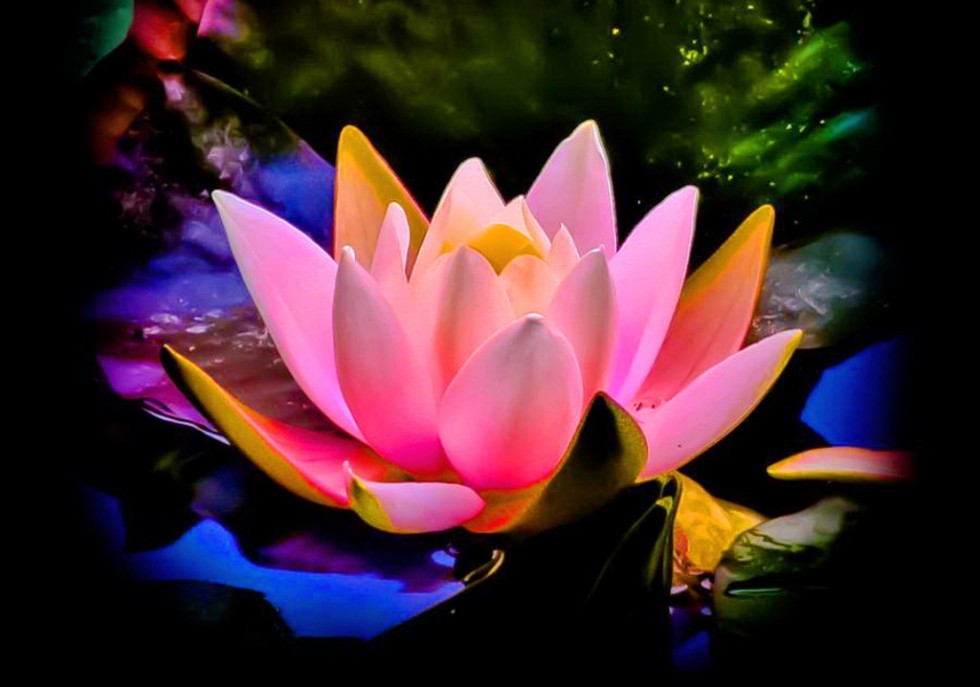 Loving kindness reaches out and touches everyone, gently healing mind, body, and spirit.
Seeds for Meditation

Embolden your awe of heaven and you will diminish your fear of human beings.
Seeds for Meditation

Consciously join with your fellows
With that joining set goals
Coming together is the natural way
Intimacy is the fuel for the journey
Consciously join with your fellows
With that joining set goals
Coming together is the natural way
Intimacy is the fuel for the journey
Union can bring happiness and form.
As the waters join together they create new pathways.
When people are brought together
Through love, trust, and compassion
They too create new pathways
For the highest good of all.
When water flows across the earth
Their union creates fecundity.
Join together now while the flow is here;
Do not get left behind;
You may not recover.
Write down your dreams; if you don’t have a dream
How will you have dreams come true?
Weekly Haiku

Carribean dreams
Her steps turn sand to diamonds
Blinded by the light
Seeds for Meditation

“We live in an age in which ideas, important ideas, are worn like articles of fashion.” — Tom Wolfe
Seeds For Meditation

A world without a friend is like a heaven without a sun … like a body without eyes.
Seeds for Meditation

“What should young people do with their lives today? Many things, obviously. But the most daring thing is to create stable communities in which the terrible disease of loneliness can be cured.” — Kurt Vonnegut
Seeds for Meditation

As the complications of life start to build — whether it is health issues, financial concerns, or relationship problems — it’s important to find resources that enable you to skillfully navigate these challenges. And some of the best resources — like mindfulness, compassion and determination — are ones that already lie within you.
“Calm mind brings inner strength and self-confidence, so that’s very important for good health.” — Dalai Lama
Theosophy ~ THE MAHAMUDRA OF VOIDNESS – II

In describing the preparation for mahamudra meditation, Geshe Rabten compares these negative tendencies to seeds. It is as if one wished to build a beautiful building, but could not do so without preparing clean ground for its foundations. Before laying the foundations, one must clear away rocks and weeds, cleansing the ground of all obstructions and removing seeds that spring up and interfere with the building. At the same time, this work of purification must be coupled with the collection of materials that will be helpful in setting up the foundations. In the long run, one’s fundamental attention must be directed towards the constructive end of serving universal enlightenment. There is little or no essential interest in the obstructions and tendencies that come in the way of the release of this higher motivation. All these tendencies can be classified into certain broad types which are, in the end, both banal and boring. Most of them have to do with attraction and aversion, anger and pride, greed and delusion, and, above all, a false conception of the self. Owing to this false conception of a fake ego, reinforcing it through unconscious habit and semi-conscious patterns of reaction, a persistent aggregate of tendencies has originated.
Instead of becoming preoccupied with the melodramatic history of this aggregate of tendencies, one should merely note them as they arise and mark them for elimination. They will inevitably appear when one starts to engage in meditation, and one should note them only with a view to removing them through the setting up of counter-tendencies drawn from positive efforts to visualize spiritual strengths. Hence the connection, in the Tibetan practice, between the visualization of vajrasattva and the elimination of negative tendencies. Each individual must learn to select the appropriate counter-forces necessary to negate the particular strong negative tendencies that arise. In drawing upon these counter-forces from within, one will discover that one can bring to one’s aid many an element in one’s own being that can serve to one’s spiritual advantage. Every human being has a number of elements which represent a certain ease, naturalness, decency and honesty as a human being. Sometimes there is a debilitating tendency to overlook these or take them for granted. The spiritual path requires a progressively heightened degree of self-awareness. One should give oneself full credit for whatever positive tendencies one has, whether they have to do with outward energies on the physical plane, mental energies, moral tenacity or metaphysical insight. In order to find that in oneself which can work in one’s favour, and can help in counteracting negative tendencies, one should engage in regular recitation and frequent reflection upon sacred scriptures. Thus one will discover points of resonance in one’s individual karmic inheritance that can help release purifying energies flowing from the ideation of Buddhas and Bodhisattvas.
If this practice is going to prosper, one must bring to it a moral insight rooted in an understanding of metaphysics. The mind must be focussed upon general ideas. One must reflect upon the relationship of insight and compassion. Insight is not merely intellectual, but rather arises through the recognition of what skill in action means in specific contexts. Insight involves a perception of how wisdom is reflected within action, and which can come about only through a deep reflection upon the process of how such insight is released. On the other side, before one can truly generate a conscious current of compassion, one must create a state of calm abiding. One must find out one’s resources and potentials for calmness and for generating the maximum field of patience, peacefulness, gentleness and steadfastness. Then one must combine in practice one’s capacity for calmness with one’s capacity for discerning what is essential. Inevitably, this will involve a protracted study lasting over lifetimes, and include enquiry into the fundamental propositions of Gupta Vidya, the study of karma and the study of what Buddhist thought refers to as the chain of dependent origination.
In essence, this entire course of study is aimed at bringing about a meta-psychological encounter with a false view of the self that must be confronted and dispelled. Ultimately, this complex matter goes to the core of the mahamudra meditation. But at a preliminary level and in the course of preparation for that meditation, one must come to grips with the confused notion of oneself that is identified with bodily desire, proclivities towards pleasure and avoidance of pain. At subtler levels one must confront one’s conception of oneself that is bound up with the entire chaotic series of thoughts, all of which have particular histories and form associative chains of memory that have been built up over lifetimes of indulgence. All take a variety of forms and leave discernible tracks, all are connected with certain fantasies, wishes, hopes and expectations. They are designated in various ways in different analytic traditions, but always at the root there is the protean force of self-grasping. It is not easy either to confront or to abandon, and hence The Voice of the Silence warns that even when one is very close to attaining dhyana, one may be completely disrupted by a sudden eruption of self-grasping.
“Ere the gold flame can burn with steady light, the lamp must stand well-guarded in a spot free from all wind.” Exposed to shifting breeze, the jet will flicker and the quivering flame cast shades deceptive, dark and ever-changing, on the Soul’s white shrine.
And then, O thou pursuer of the truth, thy Mind-Soul will become as a mad elephant, that rages in the jungle. Mistaking forest trees for living foes, he perishes in his attempts to kill the ever-shifting shadows dancing on the wall of sunlit rocks.
Beware, lest in the care of Self thy Soul should lose her foothold on the soil of Deva-knowledge.
Beware, lest in forgetting SELF,thy Soul lose o’er its trembling mind control, and forfeit thus the due fruition of its conquests.
Beware of change! For change is thy great foe. This change will fight thee off, and throw thee back, out of the Path thou treadest, deep into viscous swamps of doubt.
The Voice of the Silence
This passage from The Voice of the Silence refers primarily to an extremely high state of consciousness and an advanced stage along the Path. It refers to a point at which the very core of self-grasping must be let go. Long before one has earned the privilege of such an archetypal confrontation with the false self, one will have to win many minor skirmishes with the force of self-grasping. For this purpose, The Voice of the Silence gives a specific recipe that is indispensable. It is emphasized in every authentic spiritual tradition and it is central to the New Cycle and the Aryanization of the West. It is put in terms of the metaphor of the mango fruit. One must become as tender as the pulp of the mango towards the faults of others, feeling with them their suffering and pain. Yet one must also learn to be as hard as the mango stone towards one’s own faults. One must give no quarter to excuse-making or shilly-shallying. Instead, one must fully accept what one thinks to be one’s own particular pain, while recognizing that it is, at its core, nothing but a manifestation of delusive self-grasping.
The mango metaphor sums up all the elements involved in the preparation for deep dhyana – continuous, uninterrupted meditation. Geshe Rabten points to a specific preparatory exercise called “taking and giving”, which is a beautiful and profound instantiation of the mango metaphor. One begins by visualizing all the ignorance and all the suffering of the world. Then one must consciously take in with every inhalation of breath everything that is ugly, unsatisfactory, violent and disturbing. For the purpose of understanding and contemplation, the world’s mess may be thought of as sticks of fuel burning with a thick black smoke. One must inhale this dense black smoke and let it flow through one’s body, permeating every nerve and cell, penetrating to the centre of one’s heart, where it destroys all traces of self-concern. Then as one exhales, one should visualize sending out light-energy towards all beings, acting through one’s positive tendencies and serving to eliminate their sufferings.
This exercise of taking and giving should be conjoined with one’s adoration and prostration before the Buddhas and before one’s Ishtaguru. Indeed, Guru Yoga is the fifth and quintessential element of the preparation for mahamudra meditation. One may, at first, contemplate theIshtaguru as a drop of light, or, at a more advanced stage, one may actually contemplate the essential form of the Ishtaguru in the space before one’s mind. It is implicit in the very conception of the Ishtaguru that the individual must choose whichever form of contemplation will be most beneficial. Once a choice is made, however, it is crucial that one persistently and with full fidelity bring the distracted mind back, again and again, to the object of its contemplation. The test of this devotion is that one will find a deepening, and yet spontaneous, longing to be of service to others. More and more, one’s motivation will be that the black smoke of human ignorance and suffering should pass through oneself and become converted, through persistence in dhyana, into a healing light that will radiate, brightening and helping the lives of others. In other words, one will become an instrument through which a great sacrifice is made consciously, a channel through which a great redemptive force can proceed. At that point, of course, there can be no separative self.
Hermes, May 1985
Raghavan Iyer
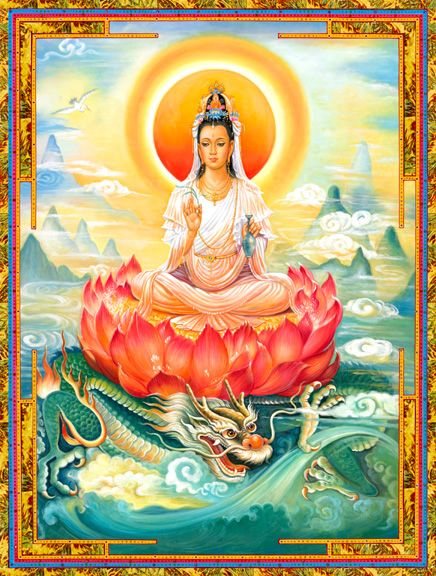
Free abundance, water ceremony, from Tara Greene

May 16 VENUS in Cancer WILL TRINE NEPTUNE in PISCES @ 9+ degreees! –
that is one sweet, sweet creative romantic flowy, spiritual day. O Happy Day!
Let your creative side out, buy art, make music, make tantric love, smell the flowers, go for a boat ride.
I will be doing this Water Blessing ceremony myself on May 16 at 11:48 am PDT/ 2:48 pm EDT/ 6:48 pm GMT/ May 17 @ 2:49 am Beijing Time.
send me your email if you want me to include you or anyone you love in this healing/wealth abundance ceremony.
DO a water ceremony for WEALTH and fertility with Venus is in Cancer for your family, children, home and most of all for the precious waters of the earth.
Just take some water in a beautiful vase or cup, close your eyes,
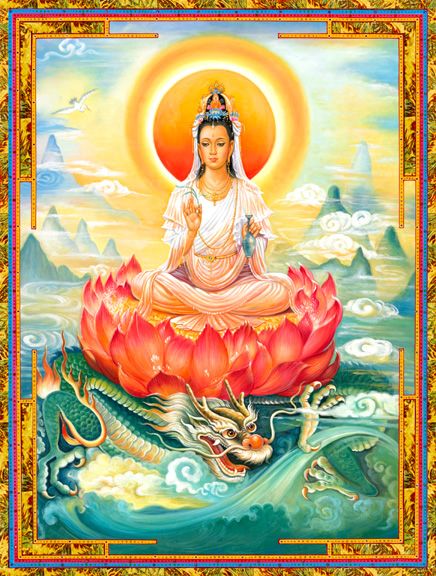
Kwan Yin, Goddess of compassion with dragon
call upon Venus…
View original post 384 more words
Seeds for Meditation
 WORKING LESSONS
If all the world is a classroom and all of life is a lesson, then certainly your profession and workplace are included.
After all, you as Creator have unlimited ways to provide your livelihood—why are you directed to this way of life?
What sparks of the divine await you here?
Meditation ~ Priorities

The natural tendency is to treat matters of the spirit as luxury items—sort of an appendage to life.
Eating, sleeping, making money—these things are given priority and the time dedicated to them is sacrosanct.
But prayer, meditation and study fit in only when you feel like it, and are pushed aside on the slightest whim.
You’ve got to make your priorities faithful to your inner self. You’ve got to ask yourself if this is what your life is all about.
Set a schedule for spiritually enriching activities.
Be as tough with that schedule as a workaholic would be with his business.
Seeds for Meditation … Inherited Faith

Our job is not to have faith. We have faith already, whether we want it or not. It comes in our blood from our ancestors, who gave their lives for it.
Our job is to transport that higher vision that gave them their faith down into our minds, into our personalities, into our words, into our actions in daily life. To make it part of our selves and of our world.
MEDITATION (8 MINS.) ~ LAW OF ATTRACTION MEDITATION FOR ABUNDANCE AND PROSPERITY
Weekly Haiku
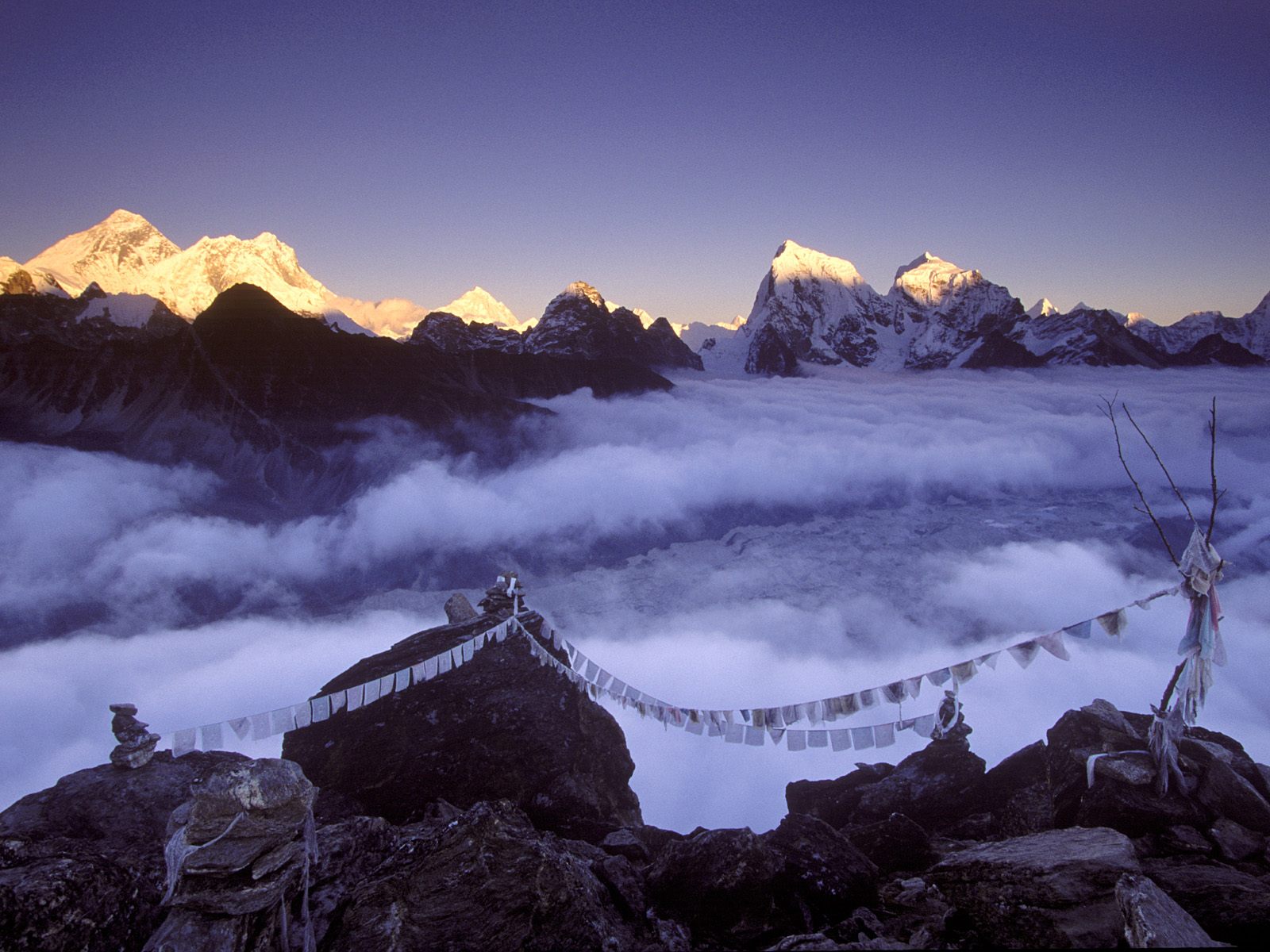
Embrace compassion
In the face of disaster
Send light to Nepal
Theosophy ~ Dhayana Marga — III
One must be willing to become fearless in the spirit of virya, the dauntless energy and unwavering courage to enter into the realm of unconditional Truth – SAT. The root teaching of voidness has to do with the emptiness of the notion of self-sufficiency and independence, the falsity of the notion that there is anything that is disconnected from the entire chain. All of this has got to be negated. It is a delusion that arises from linguistic tricks and convention, lax mental habits, refusal to confront the fact of death, unwillingness to confront the life process as it works in Nature. Ultimately, it is a refusal to recognize that conscious immortality means entering the light beyond all forms and conditions. It is, as The Secret Doctrine shows, a fundamental abrogation of one’s destiny as an evolving human being:
… as long as we enjoy our five senses and no more, and do not know how to divorce our all-perceiving Ego (the Higher Self) from the thraldom of these senses – so long will it be impossible for the personal Ego to break through the barrier which separates it from a knowledge of things in themselves (or Substance). That Ego, progressing in an arc of ascending subjectivity, must exhaust the experience of every plane. But not till the Unit is merged in the ALL, whether on this or any other plane, and Subject and Object alike vanish in the absolute negation of the Nirvanic State (negation, again, only from our plane), is scaled that peak of Omniscience – the Knowledge of things-in-themselves; and the solution of the yet more awful riddle approached, before which even the highest Dhyan Chohan must bow in silence and ignorance – the unspeakable mystery of that which is called by the Vedantins, the PARABRAHMAM.
The Secret Doctrine i 329-330
Only when one can prepare oneself through degrees of dhyana rooted in supreme detachment – vairagya – can one enter the light of unconditioned Truth or SAT and remain there in ceaseless contemplation. Wherever there is conditionality, there is the inevitability of discontinuity. Conditionality and discontinuity go together. Instead of becoming disturbed by them, however, one should rejoice in the lesson. The more one becomes unconditional, the more one can confront latent conditionality. Thus, one may begin to discern the persistent origins and causes of distortion, discontinuity and tension. The neophyte should understand at the outset that even when one attains to dhyana in its true sense, as a confirmed chela on the Path, there are still seven lives of the most vigorous self-training yet ahead. Once one understands this, one can let go of all the tension that comes from taking on false burdens. Instead of cluttering the mind with mere words and shadows, the undigested cuds of unchewed ideas, one should learn how to take a phrase, a sentence, an idea from the Teaching, and chew on it as thoroughly as possible. In every ancient tradition of dhyana, it is impossible to dispense with higher analysis. Skill lies in striking the right balance – neither too much nor too little. As one engages in the process of dhyana, various hard knots will emerge. It is necessary to stand back and subject them to analysis. One must see the components, the causes, the combinations that form the knot. Along Dhyana Marga there will be a periodic need for such analysis – a kind of self-administered open mind and open heart surgery. It can be done when the need arises if one has prepared adequately and honestly and if one is surcharged by a tremendous love of one’s fellow beings and an ardent desire to become a meditator.
In time, one will begin to generate a continuous rhythm of meditation, broken occasionally by passing thoughts, but fundamentally flowing as ceaselessly as a current in the heart. When it is interrupted in a more serious way, one will immediately strive to repair one’s foundations through some detailed analysis of the problem so that one may be purged and freed of a particular impediment. Once a momentum of meditation is established, these interruptions become a much rarer occurrence than expected. Depending upon one’s earnestness in meditation, which can only be understood in relation to love of the whole human race, one’s own so-called pain and difficulties will become trifling in relation to the world’s pain. Unless one gets these balances right early on, one will have a distorted importance of the preparatory phase of one’s own quest. That could stall the whole voyage. But once one is truly moved by that fire of universal feeling that exists in everyone, one will find the courage needed to maintain the quest. Taking advantage of the rhythms of the seasons, of Nature, of the Teachings and the Cycle, one will become more assured and so more able to stay, for longer periods, in an uninterrupted state of meditation.
One will probably not attain the higher stages of dhyana in waking meditation for quite a while, perhaps a lifetime. Nonetheless, one is invited to think about these stages, to visualize and resonate to them. This is extremely important and has to do with the release of the powers of the soul. One should completely forget about whether one can or cannot do some particular thing right now. One should not be afraid to contemplate any of the glorious possibilities of the very greatest human beings and Masters of meditation. One should take every opportunity to adore perfected human beings; in adoring them one will give life to the seeds and germs of dhyana in oneself. This does not amount to some mechanical and harsh doctrine of pseudo-equality. Rather, it depends upon recognizing that every human being has an exact karmic degree in relation to dhyana and prajna. Paradoxically, it is only by recognizing this that one can truly understand what it means to say that all human beings stand in the same sacred unmanifest ground of the unmodified, impartite Divine Spirit. Thus, as one grows in understanding of these soul powers, one may enjoy reflecting upon higher states of meditation, as represented by the portraits of perfected beings in the sacred texts and scriptures of all traditions. It is irrelevant and counter-productive to be bothered by the inevitable fact that one will not immediately experience these high states of consciousness.
One may, for example, reflect upon that state of dhyana likened to the calm depths of the ocean, recognizing in the metaphor the freedom of the universal Self. To abide in that is like remaining in the Egg of Brahma. Though this high state of true self-government may seem very distant, one may nevertheless deeply reflect upon it. One may ask what it would be like to have a mind that is so oceanic and so cosmic, so profoundly expansive and inclusive of all things in all minds, that it is capable of reverberating to everything in the mind of Nature. Certainly one should include such lofty thoughts in one’s horizon. In this way, one will come to recognize that what at first seemed a burdensome and laborious task is in fact a joyous working out, stage by stage, of clusters of karma. It is also a lightening and a loosening, in each context, so that there may be a flow from the subtler ethereal vestures into the grosser vestures. How this will actually affect the visible vesture in this life will vary from one individual to the next. Many meditators become wizened, but they have no regrets because they have no attachment to the external skin and shell. Instead, they rejoice in the inner purification that has taken place. Even one’s perspective changes in regard to what is truly helpful to the immortal soul and what is harmful. Once one touches the current of this supreme detachment and begins to enter the light of the void through efforts atdhyana, one may begin to make one’s own honest and yet heroic, courageous and cheerful way towards gaining greater continuity, control and proficiency in meditation. Blending the mind and heart, one may enter the way that leads to the dhyana haven:
The Dhyana gate is like an alabaster vase, white and transparent; within there burns a steady golden fire, the flame of Prajna that radiates from Atma.
Thou art that vase.The Voice of the Silence
What is it the aspirant of Yoga Vidya strives after if not to gain Mukti by transferring himself gradually from the grosser to the next more ethereal body, until all the veils of Maya being successively removed, his Atma becomes one withParamatma? Does he suppose that this grand result can be achieved by a two or four hours” contemplation? For the remaining twenty or twenty-two hours that the devotee does not shut himself up in his room for meditation – is the process of the emission of atoms and their replacement by others stopped? If not, then how does he mean to attract all this time – only those suited to his end? From the above remarks it is evident that just as the physical body requires incessant attention to prevent the entrance of a disease, so also the inner man requires an unremitting watch, so that no conscious or unconscious thought may attract atoms unsuited to its progress. This is the real meaning of contemplation. The prime factor in the guidance of the thought is WILL.D.K. Mavalankar
Hermes, April 1985
Raghavan Iyer
Chop Wood, Carry Water

To pray is to
pay attention
to something
or someone
other than oneself.
Whenever a man
so concentrates
his attention —
on a landscape,
a poem,
a geometrical problem,
an idol,
or the True God —
that he completely forgets
his own
ego and desires,
he is praying.
– W. H. Auden

Weekly Haiku

Welcoming new buds
Flowering on a dead branch
Life sometimes hidden
Morning Zen Meditation ~ Master Amon
“We do all things better if we are peaceful.
Will you take a little time now to join me in the temple? I invite you to relax and be “an individual unit of happiness” even if just for a little while.
Let the music play inside of you. Listen to the crickets, feel everything. Keep a little smile and let go…everything is alright.”
Let’s try it – for 10 minutes…the temple bells will let you know when meditation is over.
Da Coconut Wireless Show
Listen in to my show, Da Coconut Wireless, on BlogTalkRadio and Learn How To Activate Zero Point Energy for yourself within yourself … and check out my reprise of my 2009 message called “The Final Chapter” #BlogTalkRadio

Seeds for Meditation
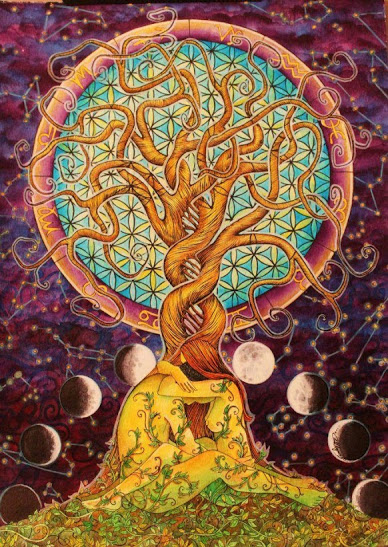
There is compassion that feeds the ego
and there is compassion that humbles it.
Compassion that feeds the ego
is a sense of pity for those who stand beneath you.
Compassion that humbles
is born of a deeper understanding of the order of things:
When you understand that your fellow man is suffering
in order that you may be privileged to help him
—then you are truly humbled.
 Hālau 'Aha Hui Lānākila