A Simple Magical Ritual To Live Your Dreams

inner_outer_Isaac Gautschi
Creating Future Memories
Once we have put out to the Universe what it is we want, the Universe starts working on delivering it. Many manifestations don’t appear because either we aren’t ready to receive them or we get in the way somehow of them being delivered. Our job is to clearly state exactly what we want to have happen and then it is up to us to let it go and give the Universe room to work its magic and deliver. This is sometimes very difficult for people, especially those movers and shakers that believe they have to “do” something or be in control. One daily ritual you can do to help stay out of the way, build energy and force into what you are manifesting and let you feel like you are still playing a part is creating future memories. We usually think of memories as coming from past experiences, but you can also create memories of future events. By adding specific thoughts, emotions, and physical actions into memories we create, we make them real and create them in our lives. The more energy put into creating these memories, the greater likelihood of them manifesting in our lives.

We sometimes refer to this daily ritual as the “Pack Your Bags” ritual because if you are for example working on manifesting a great vacation for yourself, one of the actions you can do while waiting for the Universe to deliver is to pack your suitcase acting as if your dream vacation is already a reality. For this example, here’s how you would do the future memory ritual.

1. Sit in a quiet space relaxing your mind and body.

2. Envision the future situation as if it has come to fruition already. For this example you might see yourself on the beach reclining in a beach chair.

3. See as many details as you can – smell the ocean, feel the sand between your toes, experience the joy of relaxing with a cool drink taking in the spectacular view, and so on.

4. Sit this way for at least 3 minutes a day adding more textures, feelings and sensations each time.

You’ll find that the more time you spend creating these type of future memories, the faster they will manifest in your life. You can use this type of ritual for making changes to negative things in your life too. Just start envisioning the goal that you have not been able to accomplish and see yourself changing the actions you do. For example, if you are trying to lose weight, but can’t keep away from the cookies, see yourself starting to reach for the cookies and instead reaching for an apple or for the phone to call someone for support or getting up and going for a walk. Add in the sensations, sounds, emotions and as many details into the new memory as you can. Creating future memories gives you a way to influence and help create your own future magically.

‘What Oysters Reveal About Sea Change’, by Mark Bittman

In years past, when Lana lived in the San Francisco Bay Area, she enjoyed the oysters offered at the Hog Island Oyster Company restaurant at the San Francisco Ferry Terminal.  This is the third in a series of videos about sustainable agriculture and healthy eating. The series was produced in collaboration with the Global Food Initiative at the University of California.

New York Times  | This is kind of the good news/bad news department, as so many things are:  The good news is that terrific oysters are being farmed in several locations in California; the bad news is that ocean acidification — the absorption of carbon dioxide into the sea, a direct result of high levels of carbon in the atmosphere — is a direct threat to that industry.

I saw both when I visited Hog Island Oyster Co. in Marshall, an operation north of San Francisco on Tomales Bay. (Actually, I’ve eaten at and of Hog Island dozens of times, and even shot video there for a PBS series more than 10 years ago.)

I went with Tessa Hill, who’s been researching ocean acidification at Bodega Marine Laboratory for eight years. Hill studies how changes in marine chemistry impact a variety of marine animals, including oysters, whose shells are getting thinner, smaller and more susceptible to predators. Her research looks at current conditions and develop a baseline for tracking the effects of climate change going forward.

This isn’t theoretical: Hog Island had noticed that its oysters (which arrive as babies “imported” from Oregon and Washington) grow less reliably, more slowly, and with a higher mortality rate than they did several years ago. The business and Hill have since formed a partnership, and Hill’s team dropped instruments monitoring temperature, salinity, pH and oxygen among the oyster beds to see what, if anything, can be done to help the company plan for the future.

Ocean acidification, like everything associated with climate change, is probably going to get worse before it gets better. But in addition to gathering data that Hog Island can use to protect their crop, understanding the impact of climate change and ocean acidification — in this case, oysters that will most likely become more expensive — can help us make those connections less theoretical and more real.

Back to the good news:  I got to go on a cool boat ride and eat a couple of dozen oysters. A slight mitigation of the bad news.

That ‘Useless’ Liberal Arts Degree Has Become Tech’s Hottest Ticket

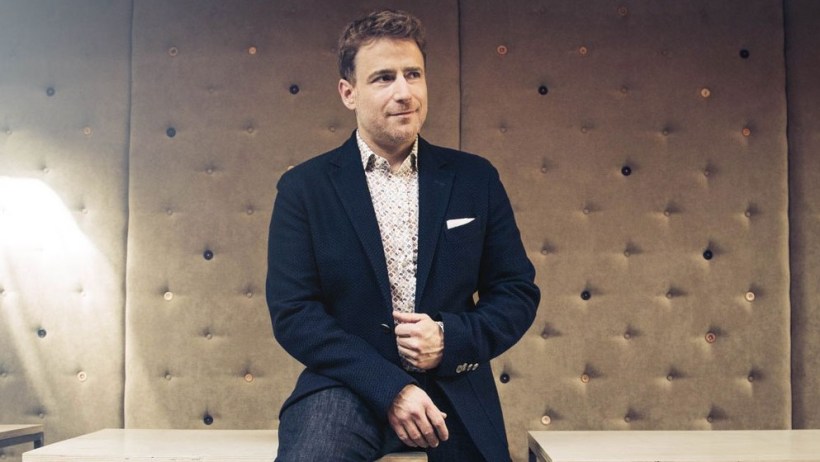
Slack CEO Stewart Butterfield (Photo credit: Carlo Ricci for Forbes)

Forbes |  In less than two years Slack Technologies has become one of the most glistening of tech’s ten-digit “unicorn” startups, boasting 1.1 million users and a private market valuation of $2.8 billion. If you’ve used Slack’s team-based messaging software, you know that one of its catchiest innovations isSlackbot, a helpful little avatar that pops up periodically to provide tips so jaunty that it seems human.

Such creativity can’t be programmed. Instead, much of it is minted by one of Slack’s 180 employees, Anna Pickard, the 38-year-old editorial director. She earned a theater degree from Britain’s Manchester Metropolitan University before discovering that she hated the constant snubs of auditions that didn’t work out. After dabbling in blogging, videogame writing and cat impersonations, she found her way into tech, where she cooks up zany replies to users who type in “I love you, Slackbot.” It’s her mission, Pickard explains, “to provide users with extra bits of surprise and delight.” The pay is good; the stock options, even better.

What kind of boss hires a thwarted actress for a business-to-business software startup? Stewart Butterfield, Slack’s 42-year-old cofounder and CEO, whose estimated double-digit stake in the company could be worth $300 million or more. He’s the proud holder of an undergraduate degree in philosophy from Canada’s University of Victoria and a master’s degree from Cambridge in philosophy and the history of science.

“Studying philosophy taught me two things,” says Butterfield, sitting in his office in San Francisco’s South of Market district, a neighborhood almost entirely dedicated to the cult of coding. “I learned how to write really clearly. I learned how to follow an argument all the way down, which is invaluable in running meetings. And when I studied the history of science, I learned about the ways that everyone believes something is true–like the old notion of some kind of ether in the air propagating gravitational forces–until they realized that it wasn’t true.”


Slack’s core business benefits from the philosopher’s touch. Hard-core engineers have been trying to build knowledge-management software for at least 15 years. Most of their approaches are so cumbersome that corporate users can’t wait to quit. Slack makes everything simple. It bridges everything from Dropbox to Twitter, helping users organize documents, photos and data files into streamlined channels for easy browsing. Considering that Butterfield spent his early 20s trying to make sense of Wittgenstein’s writings, sorting out corporate knowledge might seem simple.

And he’s far from alone. Throughout the major U.S. tech hubs, whether Silicon Valley or Seattle, Boston or Austin, Tex., software companies are discovering that liberal arts thinking makes them stronger.  Engineers may still command the biggest salaries, but at disruptive juggernauts such as Facebook and Uber, the war for talent has moved to nontechnical jobs, particularly sales and marketing. The more that audacious coders dream of changing the world, the more they need to fill their companies with social alchemists who can connect with customers–and make progress seem pleasant.

Think of the ways the automobile revolution of the 1920s created enormous numbers of jobs for people who helped fit cars into everyday life: marketers, salesmen, driving instructors, road crews and so on. Something similar is afoot today. MIT professors Erik Brynjolfsson and Andrew McAfee argue in a recent book, The Second Machine Age, that today’s tech wave will inspire a new style of work in which tech takes care of routine tasks so that people can concentrate on what mortals do best: generating creative ideas and actions in a data-rich world.

The Bureau of Labor Statistics predicts that by 2022 some 1 million more Americans will enter the workforce as educators. Another 1.1 million newcomers will earn a living in sales. Such opportunities won’t be confined to remedial teaching or department store cashiers. Each wave of tech will create fresh demand for high-paid trainers, coaches, workshop leaders and salespeople. By contrast, software engineers’ ranks will grow by 279,500, or barely 3% of overall job growth. Narrowly defined tech jobs, by themselves, aren’t going to be the answer for long-term employment growth, says Michael Chui, a partner at McKinsey Global Institute.

Click here to read the entire article.

How Long To Nap For The Biggest Brain Benefits

Napping can be great! But sometimes when you wake up after a nap, you feel groggy, almost as if you are more tired than you were before taking the nap. Why does this happen? According to Dr. Michael Breus, “If you take it longer than 30 minutes, you end up in deep sleep. Have you ever taken a nap and felt worse when you woke up? That’s what’s happening — you’re sleeping too long and you’re going into a stage of sleep that’s very difficult to get out of.”[1]

nap_biggest_brain_benefits

Benefits of Naps

So what are the most ideal ways to nap? Napping can be seen as a quick reboot or boost for the brain. Think of when your computer is starting to perform slowly and things aren’t responding up to par, after you shut everything down and do a reboot, things are back up to speed. The brain is quite similar in that as you nap, even for very short periods of time, benefits can be seen in a number of areas.

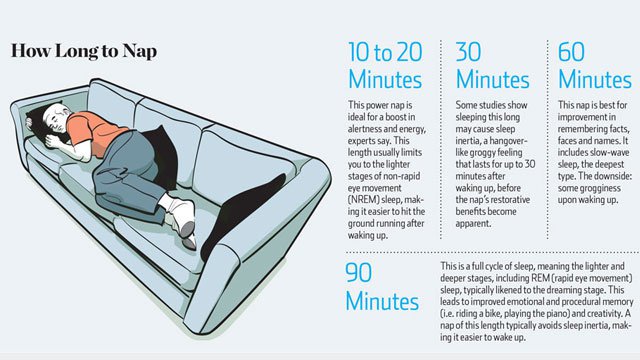
Sleep experts suggest that taking a 10-to-20-minute power nap can give you a quick burst of alterness and mental clarity when you don’t have much time. This can be used throughout the day, late at night, before something important, or right before you are trying to beat the final boss of a video game you’ve been playing all night and you know you’ll need the extra quickness.

When I was interested in trying to maximize my time awake (which I still am, but haven’t tried much lately) I did some research into sleeping cycles and how to minimize the amount of sleep you need while still being able to function well. I ended up choosing a cycle that gave me a core sleep and then several naps throughout the day that lasted about 20 minutes. I found that after the 20 minute naps, I felt great – I was very alert, my mental clarity was high, and I was ready to go for the next 3 or 4 hours easily.[2]

I found though, that near the beginning of my experiment with cycles, I would start to lose cognitive clarity as I got closer to the end of the day. While this was part of the transition portion of the cycle, I got to feel what it’s like when the brain just isn’t getting enough deep sleep. According to Dr. Mednick, this is where longer naps of 60 minutes or so are said to be good for increasing that cognitive power again. [1] Mednick also states that the 90-minute nap will likely involve a full cycle of sleep, which aids creativity and emotional and procedural memory, such as learning how to ride a bike. Waking up after REM sleep usually means a minimal amount of sleep inertia.

Naps Summarized

A study evaluating the recuperative effects of short and ultra short naps found that napping for 5-10 minutes can create a heightened sense of alertness and increase cognitive ability when compared to not taking a nap at all.

If you are looking for a quick recharge: nap for 5 – 20 minutes.

If you are looking for deeper sleep rejuvenation: nap for 60 – 90 minutes.

Final tip: When you take your shorter naps, sit up slightly, as it will allow you to avoid falling into a deeper sleep. If you dream during these power naps, it could be a sign that you are sleep deprived.

The Scientific Power of Naps:

Sources:

1.http://online.wsj.com/news/articles/SB10001424127887323932604579050990895301888

2. http://www.collective-evolution.com/2013/07/13/alternative-sleep-cycles-7-10-hours-is-not-needed/

http://www.spiritscienceandmetaphysics.com/how-long-to-nap-for-the-biggest-brain-benefits/


Mercury Opposite Neptune 2015-08-12

Grandtrines's avatarGrandtrines

Mercury Opposite Neptune 2015-08-12

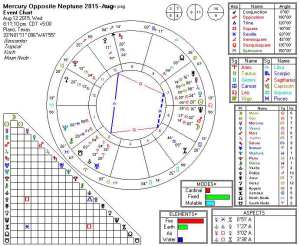
Mercury opposes Neptune on August 12, 2015.  This is reputed to be a very good time for writing poetry, playing music, and making photographs and video.  It is likely a very bad time for drafting or signing contracts are making lasting commitments.

This particular Merc Opp Neptune contains a Rosetta, a pattern we believe is evident of short lived alliances and sometimes treachery.  The Rosetta itself contains Mercury (communications and transportation) along with Pallas (sudden insights, often of a military nature), Vesta (traditions), and Astraea (law and the legal system).  This is a particularly bad night for parties that involve alcohol or other drugs.  (Do not be surprised if the police show and make arrests.)

Here is the chart, filtered for the Rosetta:

2015-08-12 Merc Opp Neptune

[Click Image to Enlarge]

Again, we encourage you to use this as a period for introspection and “housecleaning” and wait to launch major…

View original post 26 more words

The Law of God Action: Creating From The Highest Level

white_lions

There is a law in conscious creation of reality that is even higher than the Law of Attraction. It is the Law of God Action. It is The Secret Above The Secret. When you operate with the Law of God Action, you are operating at the highest level of all things, which is the level of spirit. It is the highest level governs that all other levels. When you work with the Law of God Action, you’re not trying to create anything but you are simply allowing the universe to create through you. You are co-creating with God himself.

The Law of God Action states that God is the one who is acting through you. Therefore there is nothing for you to do, but simply for you to allow God to do everything though you. It doesn’t mean you do not take any action, but it means you do not take action that you are not naturally guided from within to do. When you try to do things that you’re not inspired to do, you are forcing action. The way of God Action is to do non-doing action. It is to allow yourself to do what is seeking expression through you.

Mastery of the world is achieved by letting things take their natural course. You can not master the world by changing the natural way. The Law of God action is to go with the flow in every moment. When you follow your heart in every moment, you are connecting to the essence of who you really are, which is the power and the presence of God. The best action to do is non-doing action, which is doing things the natural way. You are doing God’s work. The Law of God Action is creating from the highest level.

Paradigm Shift ~ Moving Overseas With Pets, by Dan Prescher

Owl and Kitty

Pets are a big concern for many potential expats.

While the financial and personal advantages of retiring abroad are obvious, it’s not so obvious how to fit four-legged family members into the mix.

The mechanics and paperwork for getting Fido or Fluffy from your old home to your new overseas location aren’t overwhelming, but they differ from country to country…and even from season to season.

Also, some of the paperwork requirements, like a valid international health certificate, can be time-sensitive and need to be properly planned for in your relocation timeline.

In most cases, for the countries most expats consider, quarantines aren’t an issue. But like visa and other relocation issues, that can change, and current information is essential.

Another consideration is the cultural norms of the destination country. For example, throughout much of Latin America and Asia, dogs and cats aren’t viewed as the cherished family members they’ve become in North America. The treatment of stray animals and guard dogs can shock some North Americans who consider their own animals to be almost like children. Knowing beforehand how personal pets are viewed in a particular culture can be an important part of acclimating to that culture.

My wife, Suzan, and I traveled for years throughout Mexico, Panama, Ecuador, and Nicaragua with our dog, Jack. Not only did paperwork requirements and timelines change depending on what country we were leaving and going to, but they also changed over time, and varied between airlines.

But we were happy to tackle the learning curve of traveling the world with Jack, because leaving him behind was simply not an option. He was a rescue puppy who never, as long as he lived, forgot what Suzan did for him by adopting him from the pound. He lived to be close to Suzan, and he was only sad when she wasn’t around or he thought he’d disappointed her. He didn’t particularly enjoy travel…he topped out at about 90 pounds, so he rode in the cargo hold, and the look on his face when we brought out his travel kennel said it all. But he’d endure anything to stay close to Suzan. And we’d endure any amount of paperwork and travel logistics to make that happen.

He finally passed away while we were living in Merida, Mexico, and by that time he was better traveled than most of our human friends. He was a dog of the world, and he taught Suzan and I the ropes of living and traveling with a beloved pet.

Jack contributed greatly to what we included in the section on traveling and relocating with pets in The Dream Retirement Project. This is the place to find these tips and tricks, along with practical advice on every other aspect of choosing and moving to the best retirement destinations in the world.

Just For Today

Earth in handAt the dinner table today, recount a story of how compassion has touched your life.

We may imagine love to be quite utopian, but consider the alternatives. In not choosing love we are left with law and the prospect of global bureaucratic stagnation. In not choosing law we are left with force and the prospect of either global devastation or global domination. If we value our freedom and vitality as a species, we are obliged to do no less than learn to love one another as a human family. And it start with the stories we tell — because those stories shape our view of ourselves and the path we take through this time of collective awakening and global turning. To achieve authentic and lasting reconciliation as the foundation for our future, we can conscisouly choose narrative that require the power of love and compassion as a practical basis for organizing human affairs.


As I get older, I realize that the thing I value the most is good-heartedness.

– Alice Walker

Paradigm Shift ~ The Unmasking


http://www.holographic-disclosure.com/
The ancient Egyptians understood harmonics and the wave form universe.Temples and chambers were built by the ancient brotherhoods, in order to amplify the lights, sounds and frequencies.
This was to manipulate the vibratory resonance within the temples.
DMT -:The PLANTS OF THE GODS or Teacher plants Opens your 3rd eye …
Let’s quickly look at the word GOD…
In the disclosure series it claimed, there is no God, and off course there isn’t.
We are talking about the GOD of dogma, the revengeful; blood thirsty and racist God that was created in the minds of men to control the docile masses.
•Let’s look at the word GOD spelled backwards, it spells Dog ,referring to the dog star, Sirius, in the constellation Canis Major.  (The Greater Dog or the top dog)
Secret Key Activator Production

© All rights Reserved.

Paradigm Shift — Create The Space For Faster Integration of 5D Consciousness

Energy_Chi_Ball

However we have come together, thank you for being here just as you are. Perhaps you’re feeling excited and peaceful in knowing you are in the good company of so many other soul family members who see, feel, and experience the same things you do (the emotional, mental, physical, and spiritual “symptoms” of awakening). Or, maybe through these heart-centered teachings, you have a familiar feeling of being “home,” or a deep recognition that has awoken something that was once slumbering in you. However you are moving through these times, we share excitement with you for the flowering of consciousness that is taking place like no other time in human history.

As we encounter the various people, places, and things in our day-to-day reality:

May what moves us energetically-sensitive ones emotionally, serve to further awaken consciousness in action so we can contribute to the peaceful, loving planet we wish to live on.

May the appearance of opposing forces, and “light and dark” duality serve to only unify humanity and wake us up to new paradigm of heart-centered consciousness for the well-being of all.

May we love our own hearts and our own innocence deeper and more intimately than ever before, in this breath, and the next.

Integrating into the 5th dimension is where all the shifts, clearings, and inner work you’ve been doing over the past many years (and lifetimes) can synthesize higher frequencies of light into your cells, which brings to life a greater spiritual reality on an emotional and physical level. While so many of you have been frustrated by the amount of personal growth you’ve done, and wonder why it doesn’t seem to make a difference in your reactions and responses to the world around you, it is because the true freedom and relief you seek occurs throughout the integration process.

When integration occurs, you will transition from being exhausted by life, to then be inspired and energized by your new reality of heart-centered consciousness. During this stage of integration, a wellspring of passion and intuitive direction divinely guides you forward into the opportunities, environments, and relationships of a new spiritual paradigm. As you integrate, the physical body is able to maintain your expanded vibration to uplift others, instead of feeling pulled down by the unresolved energies of those around you.

Integration also moves you beyond many self-defeating and compulsive patterns you may have been surprised to revisit over the past few years, ushering in a renewed sense of health, harmony, balance, fulfillment, and vitality throughout your life. As you integrate, your point of attraction begins shifting in your favor to reveal the resources, synchronicities and abundance that you no longer have to work so hard to discover.

Spirituality ~ How Long to Meditate & How Often to Meditate?

“How long to meditate?” and “How often to meditate?” are two of the most commonly asked questions about meditation.

Perhaps you’ve heard stories of Eastern mystics who meditate ceaselessly for weeks on end. Perhaps you have a friend who meditates for an hour every day. Or maybe you came across some sort of “instant meditation” program than promised you results at the touch of a button.

So what is the truth? Will it take minutes, hours or days for you to experience the benefits of meditation? Sometimes it is not so easy to find time to meditate, so will you be able to fit meditation into your schedule? When will you be ready for a longer meditation?

Let’s get right into the answers!

How-Long-To-Meditate
Read the entire article here.

Food ~ 15 Foods You Aren’t Eating But Should Be (# 4 is Really Good!)

Read the entire article here.

Ok, so you eat kale, drink bone broth, and brew your own kombucha, but there are some super healthy foods you never give a second thought to- but you should!

There are plenty of healthy foods that probably never see your shopping cart, others that you may never have heard of, or some of these you might have simply forgotten about. So keep reading and find out the 15 super nutritionally dense foods you probably aren’t eating but that you will be after you read this list!

Paradigm Shift ~ Harvard Study Reveals What Meditation Literally Does To Gastrointestinal (Bowel) Disorders

Read the entire article here.

The hits just keep on coming when it comes to the health benefits of meditation. Research is now emerging that would justify implementing this practice within hospitals and schools (some already do) as well as including it in treatment recommendations for various diseases.

Not long ago, an eight week study conducted by Harvard researchers at Massachusetts General Hospital (MGH) determined that meditation literally rebuilds the brains grey matter in just eight weeks. It was the very first study to document that meditation produces changes over time in the brain’s grey matter. Now, they’ve released another study showing that meditation can have a significant impact on clinical symptoms of gastrointestinal disorders, irritable bowel syndrome (IBS) and inflammatory bowel disease (IBD).  The study showed that elicitation of the relaxation response (a physical state of deep rest that changes the physical and emotional responses to stress) is a very big help.

The study comes out of the Benson-Henry Institute for Mind Body Medicine at Massachusetts General Hospital (MGH) and Beth Israel Deaconess Medical Center (BIDMC). This is the very first study where the use of the “relaxation response” was examined in these disorders, and the first to investigate the genomic effects of the relaxation response in individuals with any disorder. The report was published in the journal PLOS-ONE. (source)

Given the two studies cited above, and all of the other documented health benefits of meditation, this should open the door for more studies to examine the benefits of meditation for a wide range of diseases.

“Our results suggest exciting possibilities for further developing and implementing this treatment in a wider group of patients with gastrointestinal illness. Several studies have found that stress management techniques and other psychological interventions can help patients with IBS, at least in the short term; and while the evidence for IBD is less apparent, some studies have suggested potential benefits. What is novel about our study is demonstration of the impact of a mind/body intervention on the genes controlling inflammatory factors that are known to play a major role in IBD and possibly in IBS.” – Brandon Kuo of the gastrointestinal unit in the MGH Department of Medicine, co-lead author of the report. (source)


(Click on the image, above, to read the entire article.)


Health ~ A Million Ways That Lemons Can Save Your Life

Read the entire article here.

America has known about lemons since at least the 16th century, when Christopher Columbus brought them to what is now Florida. Lemons (and limes) were very valuable at the time for the protection they offered against scurvy. During the Gold Rush in California, lemons were so popular and in such unbelievably high demand that people were willing to pay the unheard price of $1 each. This would be expensive even for today, but imagine that in the 1800’s!

Although high levels of vitamin C and alkalizing effects on the body are no doubt among the great reasons to always keep lemons around (or to plant your own tree) these sour fruits have a type of antioxidant known as flavonoids that can fight inflammation, heart disease, and cancer, according to the Journal of Agricultural and Food Chemistry.

The Ancient Egyptians thought that drinking the juice or eating lemons would protect you from poison. Although there are many health benefits to lemons and their juice, protection from poison might not be one of them, but they will certainly help to protect you from disease and infection, which can save your life. They are also powerful cleaning and beauty agents, which are almost as important, right?!

Well, although we might not have quite a million things listed here, it might seem like it. This list contains valuable information about how you can use lemons for your health, for cleaning, for beauty treatments, and more!

Keep reading to find out just how valuable lemons actually are and why people would pay a buck a piece for one!

Venus is Retrograde in Leo – What Does that Mean, Exactly?

Aiyanna Lynn - Inspired Life's avatarAiyanna Lynn - Inspired Life | Welcome to Avalon

Venus is retrograde until September 6. So what does that mean? Is it like Mercury retrograde?

Not exactly. To understand Venus retrograde, we first have to look at what Venus astrological stands for:

Love
Attraction
Beauty
Balance
Harmony

Our urge to relate and connect, and the quality of our connections

When a planet is retrograde, it’s energies are turned inward, like we were looking in a mirror and seeing yourself through your own eyes rather than through the eyes of others. When a planet is retrograde, it doesn’t function “normally.” The things that it stands for can go a little haywire. In the case of Venus, we might do things and make choices related to the list of items above that we wouldn’t ordinarily.   We might be attracted to things and people that we aren’t normally attracted to. This could be a good thing, but it could also be a…

View original post 187 more words

Recipe: Italian Panzanella

Panzanella is an Italian dish that is traditionally made with day old bread. It is a great summer recipe because it uses delicious, fresh summer produce like tomatoes and cucumbers.

For the Vinaigrette
2 cloves garlic (minced)
2 Tablespoons red wine vinegar
1 teaspoon spicy or Dijon mustard
1/2 cup olive oil
1 teaspoon Kosher salt
1/2 teaspoon black pepper

For the Salad
1 hot house cucumber
2 tomatoes
20 – 30 basil leaves
This depends on the size of the leaves, I used 30 medium leaves.
1/2 – 1 small red onion
I use a whole one, but I love red onions 🙂
1 teaspoon Kosher salt
3 cups homemade croutons
3 cups of day old bread (cubed)
or
6 cups of day old bread (cubed)

Instructions
1. Combine the garlic, red wine vinegar and mustard into a bowl, whisk in the olive oil. Then add the salt and pepper. Do a taste test and decide if you want to add more salt or pepper.

2. Cut the cucumber long ways and remove the seeds. Then cut it into bite size pieces. Place into a large bowl.

3. Remove the core of the tomato and quarter it. Remove the seeds. Dice the tomato and and add it to the bowl with the cucumbers.

4. Chiffonade your basil but do thicker slices then you normally would. (To chiffonade, stack several basil leaves and roll them into a tight roll, slice them starting at one end. Normally you would do thin “little” ribbons which is what chiffonade means but, in this case, I sliced my ribbons thicker). Add it to the tomato and cucumbers.

5. Slice the red onion into thin slices. Add them into the bowl along with another teaspoon of Kosher salt and the vinaigrette. Stir.

6. Cover the bowl and refrigerate for 2-3 hours.

7. Remove from the refrigerator and add the croutons and day old bread. Stir. Allow this to set for 30 minutes to an hour before serving.
Enjoy!