“Every Sensation Comes to an End”, by J. Krishnamurti

STOP WISHING.I wonder if you know what it means to be aware of something? Most of us are not aware because we have become so accustomed to condemning, judging, evaluating, identifying, choosing. Choice obviously prevents awareness because choice is always made as a result of conflict. To be aware … just to see it, to be aware of it all without any sense of judgment.

Just be aware, that is all what you have to do, without condemning, without forcing, without trying to change what you are aware of. If you are aware choicelessly, the whole field of consciousness begins to unfold. So you begin with the outer and move inwardly. Then you will find, when you move inwardly that the inward and the outward are not two different things, that the outward awareness is not different from the inward awareness, and that they are both the same.

Everything about us, within as well as without — our relationships, our thoughts, our feelings — is impermanent, in a constant state of flux. But is there anything which is permanent? Is there? Our constant desire is to make sensation permanent, is it not? Sensation can be found again and again, for it is ever being lost. Being bored with a particular sensation, I seek new sensation. Every sensation comes to an end, and so we proceed from one sensation to another and every sensation strengthens the habit of seeking further sensation. My mind is always experiencing in terms of sensation. There is perception, contact, sensation and desire and the mind becomes the mechanical instrument of all this process. With the arising of sensation comes the urge to possess; and so begins the turmoil of desire. And the habit of seeking further sensation.

And is there an end to sorrow? Is it possible to live a daily life with death, which is the ending of the self? There is only one fact — impermanence: every sensation comes to an end. Can the mind, the brain remain absolutely with that feeling of suffering and nothing else? There is no movement away from that moment, that thing called suffering. Is there an action in which there is no motive; no cause — the self does not enter into it at all? Thought identifies itself with that sensation and through identification the ‘I’ is built up. Identification with sensation makes the self. If there is no identification; is there a self?

So is it possible not to identify with sensation? So we are asking, is there a holistic awareness of all the senses? Just be aware … effortless observation … choiceless observation … and to learn, to find out whether it is possible to allow sensation to flower and not let thought interfere with it — to keep them apart. Will you do it?

===========

DISCUSSION:

What do you understand from “outward awareness is not different from the inward awareness?”

Can you share a story of a time that you were aware “choicelessly”?

How can we develop the ability to be “aware of it all without any sense of judgment”?


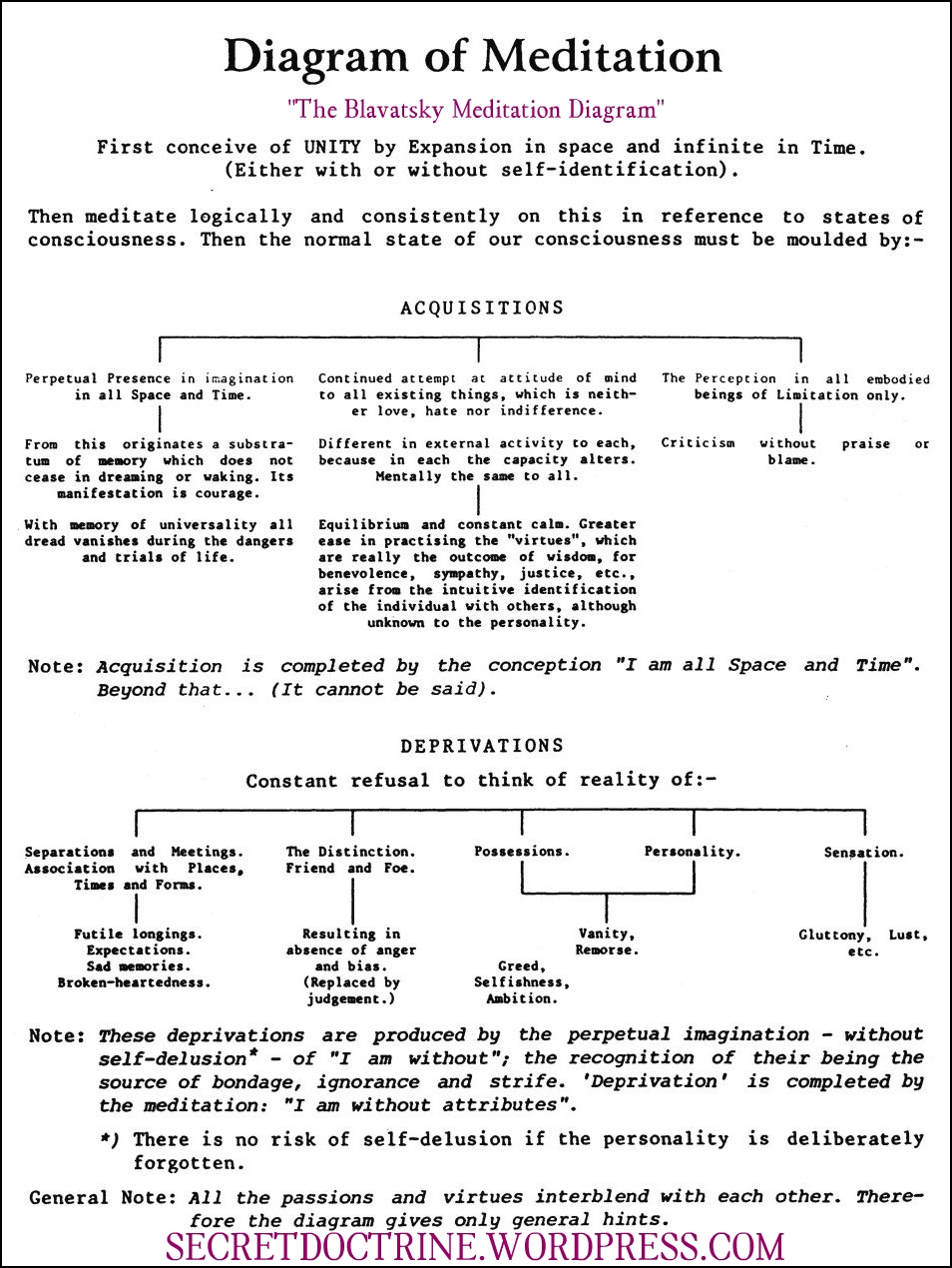
Theosophy ~ H.P. Blavatsky’s “Diagram Of Meditation”

blavatskymeditationdiagram

Not long before she died H.P.B. dictated to a Mr Sturdy, one of the members of her Inner Group, the material for what has now become known as her Meditation Diagram.  This has been reproduced in The Theosophist before but perhaps a repetition of its inclusion as part of this article is justified.

This Diagram if used intently and persistently can yield some very significant results, the chief of which is the reorientation of attention from the personal to the impersonal self, even to the liberation of consciousness from the limitations of personal mind thinking and from the identification of consciousness with the personality.

Geoffrey Farthing (1909-2004), prominent English Theosophist and founder of the Blavatsky Trust – www.blavatskytrust.org.uk. One of his books is “Deity, Cosmos & Man – An Outline of Esoteric Science,” a clear explanatory introduction to the teachings of Theosophy.
Geoffrey Farthing (1909-2004), prominent English Theosophist and founder of the Blavatsky Trust – http://www.blavatskytrust.org.uk. One of his books is “Deity, Cosmos & Man – An Outline of Esoteric Science,” a clear explanatory introduction to the teachings of Theosophy.

The Diagram of Meditation is really in two parts.

(1) To start, H.P.B. says, ‘First conceive of UNITY by Expansion in Space and infinite in Time (either with or without self-identification)’. Here again we have a technique which is ‘consciousness-raising’ in itself. It relates us to the cosmic ‘whole’ and lifts our attention out of the realms of limitation. If we imagine ourselves ‘.. in Space and infinite in Time’, we cease to be in relation with anything we normally know or can conceive of. Space here does not relate to physical 3-D extension but to subjective space, that space ‘we’ (as a unit of bare subjectivity) are in when we close our eyes. Normally we fill it with mind images and thought symbols, but in this instruction we are to think of Unity, in the abstract, by expansion in space. This removes our attention, from the familiar to the ‘boundless’. It is a way of helping us realize the ‘inner divine man’ as the point of reference for all experience and mental activity. In this exercise that point of consciousness becomes our inner Self, our real single Self as opposed to the multitude of ‘selves’ which make up our personality.

We are then told to ‘meditate logically and consistently on this (Unity, etc.) in reference to states of consciousness’. Normally these are the four: waking, dreaming, deep sleep and the transcendental state of Turiya. This exercise must be done to be appreciated. There is much information on the states in Subba Rao’s Esoteric Writings, pp 133 (fn), and 311 (an interesting explanation).

All that he says can be summarised as follows, the four states are:-
1) Jagrat – the normal Waking State
2) Swapna – Dreaming
3) Sushupti – Dreamless Sleep
4) Turiya – Transcendental Conscious Union with one’s Ego.

The Vedanta Philosophy teaches as much as Occult Philosophy that our Monad during its life on earth as a Triad (7th, 6th and 5th principles) has, besides the condition of pure intelligence, three conditions, namely waking, dreaming and sushupti – a state of dreamless sleep – from the standpoint of terrestrial conceptions; of real, actual, soul life – from the occult standpoint, while man is either dreamlessly profoundly asleep or in a trance state, the Triad (spirit, soul, mind) enters into perfect union with the para-atma, the supreme universal soul. The Turiya state is a kamaless one and cannot be obtained by the Yogi unless the Higher Triad is separated from the Lower Quaternary (see S.D.III, 540). The higher spiritual consciousness is described in C.W.XII, 711.

(2) The second part of the Diagram of Meditation consists of important aids prefaced by ‘Then the normal state of our consciousness must be moulded by:-’. Then there are two headings: ‘Acquisitions’ and ‘Deprivations’ summarised briefly in what follows. Under ‘Acquisitions’ there are three main elements: i) ‘Perpetual presence in imagination in all space and time’; ii) Continued attempt at attitude of mind to all existing things, which is neither love, hate nor indifference’; iii) ‘The perception in all embodied beings of limitation only’. For meditation purposes these are extended and illustrated. Time spent in meditation on the ‘Acquisitions’ establishes a point of view (centre of awareness) which becomes distinct from whatever one is thinking about. The content of our thought becomes objective to us, as subject, the point of awareness. These Acquisitions, she says, are completed by the thought ‘I am all Space and Time.’

In the middle leg of Acquisitions, H.P.B. refers to the six virtues set out in verses 207 to 213 of The Voice of the Silence. For would-be meditators there is no better material for contemplation than that little book. In the Preface to it H.P.B. explains that the treatises she selected for translation from the original, ‘will best suit the few real mystics in the Theosophical Society, and (which) are sure to answer their needs’. Much of what she says about the practice of meditation she prefaces with the necessity for high morality and purity, the theme of much of the book.

Under the heading of ‘Deprivations’ we are instructed to steadily deny reality to: i) Separations and meetings, explained as association with places, times and forms; ii) The distinction, friend and foe; iii) Possessions; iv) Personality; v) Sensation. Each of these is illustrated and explained for meditation purposes, in a very illuminating and meaningful way.

A note summarizes the importance of our reviewing the ‘Deprivations’ in the light of ‘the inner divine man’. Our unit of consciousness (now free in space and time and the conditioning of the personality) is the nearest most of us will be able to get to ‘the inner divine man’ to begin with. The note says, we should cultivate the perpetual imagination – without self delusion – of ‘I am without’; the recognition of their being the source of bondage, ignorance and strife. ‘Deprivation’ is completed by the meditation ‘I am without attributes’.

An immediate difficulty arises when we think about these ‘Deprivations’ and identify ourselves with them. This note helps correct that attitude and see that we ourselves as freed units of consciousness, i.e. our inner divine selves, do not have these attributes. We are ‘deprived’ of them. We, our proper Selves, are never so conditioned, hence the injunction to meditate with the words ‘I am without attributes’. To start with and to realize the truth of this can be somewhat frightening. However, if we succeed, we have entered into a state of real freedom which can never again be lost completely. Yet somehow or other our real identity has not been lost although we then could not say what precisely we were. In other words we now, as ‘inner divine Beings’, have broken the habitual identity in consciousness with our personalities. A note on the Diagram says, ‘There is no risk of self-delusion if the personality is deliberately forgotten’.

Having achieved this initial stage of liberation we have to train our lower selves in the practice of the virtues, and H.P.B. says that now there will be ‘greater ease’ in practising them. Quoting The Voice of the Silence, the virtues (Paramitas) are i) Charity and love immortal; ii) Harmony in word and act; iii) Patience sweet; iv) Indifference to pleasure and pain; v) Dauntless energy; vi) Dhyana, whose golden gate once opened leads the Narjol (a saint or adept) towards the realm of Sat eternal and its ceaseless contemplation; vii) Prajna, the key to which makes of man a god, creating him a Bodhisattva. This is the end result of all meditation and spiritual development.

H.P. BlavatskyIt may be a long time before most of us can achieve, to a significant degree, the sixth and seventh virtues but the first five have some immediate reality for us and the persistent practice of them certainly changes us and our lives greatly to their benefit: then all those with whom we associate, and our environment, benefit accordingly.

There are many references in the classical H.P.B. literature to Hatha Yoga and mostly they are warnings against its practice. For example,

Pranayama … without the previous acquisition of or at least full understanding of the two higher senses, of which there are seven … pertains to the lower yoga [Hatha Yoga]. The Hatha so-called was and still is discountenanced by the Arhats. It is injurious to the health and alone can never develop into Raja Yoga.
[S.D.I, 95 (orig. ed.), 121 (3rd ed.), 157 (4th ed.)]

Again the two highest tattvas were ignored by exoteric yoga philosophy and Hatha Yoga, but these two are the chief factors in Raja Yoga. No spiritual or intellectual phenomena of a high nature can take place without them, they being the Adi tattva (first Logos, corresponding to Atma) and Anupadaka tattva (second Logos, corresponding to Buddhi). The other tattvas mentioned are Akasa (as Ether), Vayu (Air), Tejas (Fire), Apas (Water) and Prithivi (Earth). Note that akasa is Ether and corresponds to mind, Tejas is luminosity in the atmosphere. Another warning, ‘the Hatha Yogi uses powers only on the material plane’, and then there is a dissertation on the use of will power which specifically states that it does not involve the suppression of breath (see S.D.III, 503, C.W.XII, 616).

There is further instruction by H.P.B. to her Inner Group (see end of S.D.III, which is also in ‘The Inner Group Teachings of H.P. Blavatsky’ reconstructed by H.J. Spierenburg), most of it of an advanced and technical nature not touched on here.

~ from Geoffrey Farthing’s article “HPB on Meditation and Yoga” in “The Theosophist,” December 1992 (http://www.blavatskytrust.org.uk)

* For less complex information about the Raja Yoga of Theosophy and its practical and perpetual application in everyday life, please see the article “The Esoteric Raja Yoga of Theosophy” on this site at http://secretdoctrine.wordpress.com/2013/01/01/the-esoteric-raja-yoga-of-theosophy/.

Always Include Yourself In The Dialogue of Unconditional Love and Unity Consciousness!

ONE

Loving and honouring others while berating and judging yourself is still practicing separation consciousness.  Unconditional love and unity consciousness means seeing the beauty and divinity of ALL, and that MUST include yourself.  Simply put, to deny yourself is to deny an aspect of God, as you are all part of the greater whole of the divine.


Discussion ~ “The Nature of Consciousness”, by Alan Watts

“To go out of your mind once a day is tremendously important, because by going out of your mind you come to your senses. And if you stay in your mind all of the time, you are over rational, in other words you are like a very rigid bridge which because it has no give; no craziness in it, is going to be blown down by the first hurricane.”  ~Alan Watts


In order to come to your senses, Alan Watts often said, you sometimes need to go out of your mind. Perhaps more than any other teacher in the West, this celebrated author, former Anglican priest, and self-described spiritual entertainer was responsible for igniting the passion of countless wisdom seekers to the spiritual and philosophical delights of Asia and India.

H.P. Blavatsky ~ THE SEVEN SOULS OF THE EGYPTOLOGISTS

TS logo

THE SEVEN SOULS OF THE EGYPTOLOGISTS


If one turns to those wells of information, “The Natural Genesis” and the Lectures of Mr. Gerald Massey, the proofs of the antiquity of the doctrine under analysis become positively overwhelming. That the belief of the author differs from ours can hardly invalidate the facts. He views the symbol from a purely natural standpoint, one perhaps a trifle too materialistic, because too much that of an ardent Evolutionist and follower of the modern Darwinian dogmas. Thus he shows that “the student of Böhme’s books finds much in them concerning these Seven Fountain Spirits and primary powers, treated as seven properties of nature in the alchemistic and astrological phase of the mediæval mysteries;” 1 and adds:

“The followers of Böhme look on such matter as divine revelation of his inspired Seership. They know nothing of the natural genesis, the history and persistence of the Wisdom 2 of the past (or of the broken links), and are unable to recognise the physical features of the ancient Seven Spirits beneath their modern metaphysical or alchemist mask. A second connecting link between the Theosophy of Böhme and the physical origins of Egyptian thought, is extant in the fragments of Hermes Trismegistus. 3 No matter whether these teachings are called Illuminatist, Buddhist, Kabalist, Gnostic, Masonic, or Christian, the elemental types can only be truly known in their beginnings. 4 When the prophets or visionary showmen of cloudland come to us claiming original inspiration, and utter something new, we judge of its value by what it is in itself. But if we find they bring us the ancient matter which they cannot account for, and we can, it is natural that we should judge it by the primary significations rather than the latest pretensions. 5 It is useless for us to read our later thought into the earliest types of expression, and then say the ancients meant that. 6 Subtilized interpretations which have become doctrines and dogmas in theosophy have now to be tested by their genesis in physical phenomena, in order that we may explode their false pretensions to supernatural origin or supernatural knowledge. 7

But the able author of the “Book of the Beginnings” and of “The Natural Genesis“does – very fortunately, for us – quite the reverse. He demonstrates most triumphantly our Esoteric (Buddhist) teachings, by showing them identical with those of Egypt. Let the reader judge from his learned lecture on “The Seven Souls of Man.” 8 Says the author:

   “The first form of the mystical SEVEN was seen to be figured in heaven by the Seven large stars of the great Bear, the constellation assigned by the Egyptians to the Mother of Time, and of the Seven Elemental Powers.”

Just so, for the Hindus place in the great Bear their seven primitive Rishis and call this constellation the abode of the Saptarishi, Riksha and Chitra-Sikhandinas. But whether it is only an astronomical myth or a primordial mystery, having a deeper meaning than it bears on its surface, is what their adepts claim to know. We are also told that “the Egyptians divided the face of the sky by night into seven parts. The primary Heaven was seven-fold.” So it was with the Aryans. One has but read the Purânas about the beginnings of Brahmâ, and his “Egg” to see it. Have the Aryans taken the idea from the Egyptians?  “The earliest forces,” proceeds the lecturer, “recognized in nature were reckoned as seven in number. These became seven elementals, devils (?) or later, divinities. Seven properties were assigned to nature, as matter, cohesion, fluxion, coagulation, accumulation, station, and division and seven elements or souls to man.

All this was taught in the esoteric doctrine, but it was interpreted and its mysteries unlocked, as already stated, with seven, not two, or at the utmost, three keys; hence the causes and their effects worked in invisible or mystic as well as psychic nature, and were made referable to metaphysics and psychology as much as to physiology. “The principle of seveningas the author says – “was introduced, and the number seven supplied a sacred type that could be used for manifold purposes; and it was so used. For “the seven Souls of the Pharaoh are often mentioned in the Egyptian texts. . . . Seven Souls or principles in man were identified by our British Druids. . . . . The Rabbins also ran the number of souls up to seven; so, likewise, do the Karens of India. . . .”

And then, the author tabulates the two teachings – the Esoteric and the Egyptian, – and shows that the latter had the same series and in the same order.

(Esoteric) Indian                                                    Egyptian
1.  Rupa, body or element of form.        1.   Kha, body.
2.  Prana, the breath of life.                     2.   Ba, the Soul of Breath.
3.  Astral body.                                           3.   Khaba, the shade.
4.  Manas–or Intelligence. 9                    4.  Akhu, Intelligence or Perception.
5.  Kama–rupa, or animal soul.              5.  Seb, ancestral Soul.
6.  Buddhi, Spiritual Soul.                       6.   Putah, the first intellectual father.
7.  Atma, pure spirit. . . .                          7.   Atmu, a divine or eternal soul.

Further on, the lecturer formulates these seven (Egyptian) souls, as (1) The Soul of Blood – the formative; (2)The Soul of Breath – “that breathes“; (3)The Shade or Covering Soul – “that envelopes“; (4) The Soul of Perception – “that perceives;” (5)The Soul of Pubescence “that procreates“; (6) The Intellectual Soul – “that reproduces intellectually“; and (7) The Spiritual Soul – “that is perpetuated permanently.

From the exoteric and physiological standpoint this may be very correct; it becomes less so from the esoteric point of view. To maintain this, does not at all mean that the “Esoteric Buddhists” resolve men into a number of elementary Spirits, as Mr. G. Massey, in the same lecture, accuses them of maintaining. No “Esoteric Buddhist” has ever been guilty of any such absurdity. Nor has it been ever imagined that these shadows “become spiritual beings in another world,” or “seven potential spirits or elementaries of another life.” What is maintained is simply that every time the immortal Ego incarnates it becomes, as a total, a compound unit of Matter and Spirit, which together act on seven different planes of being and consciousness. Elsewhere, Mr. G. Massey adds:  “The seven souls (our “Principles”) are often mentioned in the Egyptian texts. The moon god, Taht-Esmun, or the later sun god, expressed the seven nature-powers that were prior to himself, and were summed up in him as his seven souls (we say “principles”) . . . . The seven stars in the hand of Christ in the Revelation, have the same significance,” etc.

And a still greater one, as these stars represent also the seven keys of the Seven Churches or the SODALIAN MYSTERIES, cabalistically. However, we will not stop to discuss, but add that other Egyptologists have also found out that the septenary constitution of man was a cardinal doctrine with the old Egyptians. In a series of remarkable articles in the “Sphinx” (Munich) Herr Franz Lambert gives incontrovertible proof of his conclusions from the “Book of the Dead” and other Egyptian records. For details the reader must be referred to the articles themselves, but the following diagram, summing up the author’s conclusions, is demonstrative evidence of the identity of Egyptian psychology with the septenary division in “Esoteric Buddhism.”
—–

1 The Natural Genesis, Vol. I, pp 318-319.

2 Yet there are some who may know something of these, even outside the author’s lines, wide as they undeniably are.

3 This connecting link, like others, was pointed out by the present writer nine years before the appearance of the work from which the above is quoted, namely, in Isis Unveiled, a work full of such guiding links between ancient, mediæval, and modern thought, but, unfortunately, too loosely edited.

4 Ay; but how can the learned writer prove that these “beginnings” were precisely in Egypt, and nowhere else, and only 50,000 years ago?

5 Precisely, and this is just what the Theosophists do. They have never claimed, “original inspiration,” not even as mediums, but have always pointed, and do now point, to the “primary signification” of the symbols, which they trace to other countries older even than Egypt; significations, moreover, which emanate from a hierarchy (or hierarchies, if preferred) of living wise men, mortals, notwithstanding that Wisdom, who reject every approach to supernaturalism.

6 But where is the proof that the ancients did not mean precisely that which the Theosophists claim? Records exist for what they say, just as other records exist for what Mr. G. Massey says. His interpretations are very correct, but equally one-sided. Surely nature has more than one physical aspect,for astronomy, astrology, and so on, are all on the physical, not the spiritual plane.

7 It is to be feared that Mr. Massey has not succeeded. We have our followers as he has his followers, and materialistic Science steps in and takes little account of both his and our speculations!

8 The fact that this learned Egyptologist does not recognise in the doctrine of the “Seven Souls,” as he terms our principles, or “metaphysical concepts,” but “the primitive biology or physiology of the Soul,” does not invalidate our argument. The lecturer touches on only two keys, those that unlock the astronomical and the physiological mysteries of esotericism, and leaves out the other five. Otherwise he would have promptly understood that what he calls the physiological divisions of the living Soul of man, are regarded by Theosophists as also psychological and spiritual.

9 This is a great mistake made in the Esoteric enumeration. Manas is the fifth, not the fourth, and Manas corresponds precisely with Seb, the Egyptian fifth principle, for that portion of Manas, which follows the two higher principles, is the ancestral soul; indeed, the bright, immortal thread of the higher Ego, to which clings the Spiritual aroma of all the lives or births.


The Secret Doctrine, ii 630–633
H. P. Blavatsky


Module ~ Spiritual Roundtable Discussions

beachwalk

In today’s world, attempting to live a spiritual life can be demanding and confusing. Gone are the days when one can retreat to the cave or forest. In the midst of job, family, finance and a host of other obligations is where we must develop our spiritual practice.

All are welcome to participate in this topic-based discussion group exploring teachings common to all religions and spiritual traditions.  Length of discussion varies, from one hour to three hours, whether online or in a live group setting.  Contact The Halau for more details and to sign up.

Topics of discussion may include, for example, the following subject matter:

  • The Significance of Now
  • Plato: The True, The Good & The Beautiful
  • Spiritual Awakening and Relationships
  • Affirmations and Manifestation
  • What is a Human Being?
  • Defining Compassion
  • Spiritual Evolution of Society
  • Triggers of Awakening
  • Spiritual Clichés
  • Is Time an Illusion?
  • The Spiritual Meaning of Spring
  • Duality: Live It or Leave It
  • The Rules & Codes We Live By
  • Spiritual Forks, Detours, and Roadblocks
  • Is Less More, More or Less?
  • Where to from Here?

H.P. Blavatsky ~ The Number Seven In Chemistry

Image

To demonstrate more clearly the seven in Nature, it may be added that not only does the number seven govern the periodicity of the phenomena of life, but that it is also found dominating the series of chemical elements, and equally paramount in the world of sound and in that of colour as revealed to us by the spectroscope. This number is the factor, sine qua non, in the production of occult astral phenomena.

Thus, if the chemical elements are arranged in groups according to their atomic weights, they will be found to constitute a series of groups of seven; the first, second, etc., members of each group bearing a close analogy in all their properties to the corresponding members of the next group. The following table, copied from Hellenbach’s Magie der Zahlen, exhibits this law and fully warrants the conclusion he draws in the following words: “We thus see that chemical variety, so far as we can grasp its inner nature, depends upon numerical relations, and we have further found in this variety a ruling law for which we can assign no cause; we find a law of periodicity governed by the number seven.”

chem table

The eighth column in this list is, as it were, the octave of the first, containing elements almost identical in chemical and other properties with those in the first; a phenomenon which accentuates the septenary law of periodicity. For further details the reader is referred to Hellenbach’s work, where it is also shown that this classification is confirmed by the spectroscopic peculiarities of the elements.

It is needless to refer in detail to the number of vibrations constituting the notes of the musical scale; they are strictly analogous to the scale of chemical elements, and also to the scale of colour as unfolded by the spectroscope, although in the latter case we deal with only one octave, while both in music and chemistry we find a series of seven octaves represented theoretically, of which six are fairly complete and in ordinary use in both sciences. Thus, to quote Hellenbach:    “It has been established that, from the standpoint of phenomenal law, upon which all our knowledge rests, the vibrations of sound and light increase regularly, that they divide themselves into seven columns, and that the successive numbers in each column are closely allied; i.e., that they exhibit a close relationship which not only is expressed in the figures themselves, but also is practically confirmed in chemistry as in music, in the latter of which the ear confirms the verdict of the figures. . . . . . The fact that this periodicity and variety is governed by the number seven is undeniable, and it far surpasses the limits of mere chance, and must be assumed to have an adequate cause, which cause must be discovered.”

Verily, then, as Rabbi Abbas said: “We are six lights which shine forth from a seventh (light); thou (Tetragrammaton) art the seventh light (the origin) of us all;” (V. 1,160) and – “For assuredly there is no stability in those six, save what they derive from the seventh. For ALL THINGS DEPEND FROM THE SEVENTH.” (V. 1,161. Kabala, “The Greater Holy Assembly.”)

The (ancient and modern) Western American Zuñi Indians seem to have entertained similar views. Their present-day customs, their traditions and records, all point to the fact that, from time immemorial, their institutions – political, social and religious – were (and still are) shaped according to the septenary principle. Thus all their ancient towns and villages were built in clusters of six, around a seventh. It is always a group of seven, or of thirteen, and always the six surround the seventh. Again, their sacerdotal hierarchy is composed of six “Priests of the House” seemingly synthesized in the seventh, who is a woman, the “PRIESTESS MOTHER.” Compare this with the “seven great officiating priests” spoken of in Anugîtâ, the name given to the “seven senses,” exoterically, and to the seven human principles, esoterically. Whence this identity of symbolism? Shall we still doubt the fact of Arjuna going over to Pâtâla (the Antipodes, America) and there marrying Ulûpi, the daughter of the Nâga (or rather Nargal) King? But to the Zuñi priests.

These receive an annual tribute, to this day, of corn of seven colours. Undistinguished from other Indians during the whole year, on a certain day, they come out (the six priests and one priestess) arrayed in their priestly robes, each of a colour sacred to the particular God whom the priest serves and personifies; each of them representing one of the seven regions, and each receiving corn of the colour corresponding to that region. Thus, the white represents the East, because from the East comes the first Sun-light; the yellow, corresponds to the North, from the colour of the flames produced by the aurora borealis; the red, the South, as from that quarter comes the heat; the blue stands for the West, the colour of the Pacific Ocean, which lies to the West; black is the colour of the nether underground region – darkness; corn with grains of all colours on one ear represents the colours of the upper region – of the firmament, with its rosy and yellow clouds, shining stars, etc. The “speckled” corn – each grain containing all the colours – is that of the “Priestess-Mother”: woman containing in herself the seeds of all races past, present and future; Eve being the mother of all living.

Apart from these was the Sun – the Great Deity – whose priest was the spiritual head of the nation. These facts were ascertained by Mr. F. Hamilton Cushing, who, as many are aware, became an Indian Zuñi, lived with them, was initiated into their religious mysteries, and has learned more about them than any other man now living.

Seven is also the great magic number. In the occult records the weapon mentioned in the Purânas and the Mahabhârata – the Agneyâstra or “fiery weapon” bestowed by Aurva upon his chela Sagara – is said to be built of seven elements. This weapon – supposed by some ingenious Orientalists to have been a “rocket” (!) – is one of the many thorns in the side of our modern Sanskritists. Wilson exercises his penetration over it, on several pages in his Specimens of the Hindu Theatre, and finally fails to explain it. He can make nothing out of the Agneyâstra.

“These weapons,” he argues, “are of a very unintelligible character. Some of them are wielded as missiles; but, in general, they appear to be mystical powers exercised by the individual – such as those of paralysing an enemy, or locking his senses fast in sleep, or bringing down storm, and rain, and fire, from heaven. (Vide supra, pp. 427 and 428.) . . . . They assume celestial shapes, endowed with human faculties. . . . . The Râmâyana calls them the Sons of Krisâswa” (p. 297).

The Sastra-devatâs, “gods of the divine weapons,” are no more Agneyâstra, the weapon, than the gunners of modern artillery are the cannon they direct. But this simple solution did not seem to strike the eminent Sanskritist. Nevertheless, as he himself says of the armiform progeny of Krisâswa, “the allegorical origin of the (Agneyâstra)  weapons is, undoubtedly, the more ancient.” 1 It is the fiery javelin of Brahmâ.

The seven-fold Agneyâstra, like the seven senses and the “seven principles,” symbolized by the seven priests, are of untold antiquity. How old is the doctrine believed in by Theosophists, the following section will tell.
—-

1 It is. But Agneyâstra are fiery “missile weapons,” not “edged” weapons, as there is some difference between Sastra and Astra in Sanskrit.

—-

The Secret Doctrine, ii 627–630
H. P. Blavatsky


JIVA AND SELF-GENERATION – I

Image


THE ONE RAY MULTIPLIES THE SMALLER RAYS. LIFE PRECEDES FORM, AND LIFE SURVIVES THE LAST ATOM (of Form, Sthula-sarira, external body). THROUGH THE COUNTLESS RAYS THE LIFE-RAY, THE ONE, LIKE A THREAD THROUGH MANY BEADS (pearls).  ~ The Secret Doctrine, i 222


The archaic Stanzas of Dzyan present a symbolic statement of the archetypal process of becoming throughout all planes and in all spheres of manifestation. It is none other than that through which the One becomes the many while remaining the One within the many. At the highest level of abstraction, surpassing both subtle and sensory perceptions, as well as all the conceptions of the materializing mind, the one pure Ray of primordial Light out of the absolute Darkness is said to multiply the smaller rays. This is a symbolic representation of the quintessential logic of differentiation, the logic of divine descent and manvantaric manifestation. There is in this fundamental logic a mirroring of the miraculous nature of birth on every plane. Gestation and growth on every plane is rooted in the universal solidarity of all life. That solidarity is much more than a physical fact or a psychic sentiment. It is a moral and metaphysical framework within which takes place all transformation of form and consciousness.

The symbolic code language of Gupta Vidya contains the fundamental challenge of Divine Wisdom to modern thought. Through elaboration and ramification, modern thought has created a vast conceptual structure of explanation and thus unravelled many secondary processes of causation. Yet, at the same time, modern thought cannot explain so basic a phenomenon as how a foetus emerges and develops from a single minute cell. Despite all the popular cliches about the extension of life through genetic engineering, the fundamental mystery of the embryo remains. Similarly, modern thought has little to say about the metaphysical mystery of the One or the psychological mystery of the Ego. In all three, there is the same challenge. The mystery of the One is a challenge of metaphysics and meditation. In meditating, one gathers within oneself all the many rays, archetypally collected into the primary seven and then merged into one central invisible point. Through repeated effort, one can thus experience something of that state of consciousness which is prior to differentiation. This is an experience of the metaphysical Void, but it is different from the experience of deep sleep because one retains full self-consciousness.

The challenge is to imagine what it would be like in the Divine Darkness, where there is no thing and no forms. Then one must imagine that within the germ of divine thought within the Divine Darkness there may arise one ray of ideational energy which contains the potentiality of the entire cosmos. From that one ray one must imagine an entire ordered array of progressive elaborations and manifestations. This is symbolized in the language of the Kabbalah by the phrase “thrones, powers and principalities”. These refer to all the subtle hosts of invisible Nature. In meditation one must reach beyond all of them to the One. Then one will be able to accommodate all these thrones and powers and principalities, the manifold hierarchies involved in multiplication of the one ray, within the folds of hebdomadic and unitary life. Although this is a challenge to metaphysics, it can only be met through deep meditation.

The mystery of the one Ego was intimated by Plato, who said that the human soul was a compound of the same and the other. This is the mystery of that which is different from, yet consubstantial with, that which it reflects. This mystery poses a profound challenge to one’s deepest sense of “I-am-I” consciousness. At the root, “I-am-I” consciousness involves a total negation of all time and form, and of all identification with memories, sensations, expectations and anticipations. It can also abstract from all that exists in the realm of appearances and thus experience pure being, which is indivisible and universal. How, then, is “I-am-I” consciousness different from Deity itself? That is, one might say, the ultimate mystery of the Sphinx, the riddle that has to be unravelled by each human soul, not in sleep or dreams and not after death, but through intense reflection in waking consciousness. This abstraction of meaning from experience must be achieved through introspection, through identification with other hearts and minds and souls, and also through the intimate knowledge of all the life-atoms that ceaselessly circulate between all beings. The soul must acquire a working acquaintance with the pantheistic conception of Deity in Nature. To solve the problem of the Ego in its entirety is the fundamental challenge of meta-psychology.

Both of these problems – the problem of the One in relation to the many and the problem of the same and the other in relation to the “I-am-I” consciousness – are replicated and reflected within the mystery of the embryo, the foetus and the germinal cell. H.P. Blavatsky posed the challenge to biological thought by asking

whether it seems unnatural, least of all “supernatural”, to any one of us, when we consider that process known as the growth and development of a foetus into a healthy baby weighing several pounds – evolves from what? From the segmentation of an infinitesimally small ovum and a spermatozoon; and afterwards we see that baby develop into a six-foot man!

Ibid., 222

The mysteries of embryology are inseparable from those of cosmology. The philosophy of Gupta Vidya is fundamentally based upon the ultimate analogy in every process of manifestation between the most cosmic and the most atomic, between the divine and the human. Hence, the Stanzas of Dzyan, in depicting the origin of the cosmos, contain innumerable references to Hiranyagarbha – the cosmic egg. They speak of the primeval gestation within the waters of space, and explain how the entire spectrum of worlds emerges from a point in the germ to yield manifestation as we know it. These cosmological processes are truly difficult to comprehend, for they raise fundamental questions which cannot be answered merely through some pious reference to the heavens or through intellectual imagery. Unfortunately, this is all that pseudo-religious and pseudo-philosophic traditions have done, and they have therefore failed to answer the challenges of universal cosmogenesis and anthropogenesis. If one grasped the integrity of the universal processes that give rise both to Nature and Man, then one would understand that these questions are no easier to answer than parallel questions about the human body and physical birth. Since Deity, Man and Nature are philosophically inseparable, one cannot comprehend the origin of the cosmos, the origin of humanity or the birth of a single baby independently of each other. One needs to regain a sense of wonder that something so infinitesimally small as an initial germinal cell can give rise to a full-grown human being.

H.P. Blavatsky proceeded to develop and sharpen the mysteries which embryology poses by crediting modern thought with an approximate understanding of

the atomic and physical expansion from the microscopically small into something very large, from the – to the naked eye – unseen, into the visible and objective. Science has provided for all this; and, I dare say, her theories, embryological, biological, and physiological, are correct enough so far as exact observation of the material goes. Nevertheless, the two chief difficulties of the science of embryology – namely, what are the forces at work in the formation of the foetus, and the cause of “hereditary transmission” of likeness, physical, moral or mental – have never been properly answered; nor will they ever be solved till the day when scientists condescend to accept the Occult theories.

Ibid., 222-223

If, in other words, one wishes to give a systematic account of the process of immense expansion that goes on in the development of the foetus, one must have a knowledge of different planes and subplanes of matter, mind and consciousness. One must also develop an account of the interactions of these agencies and forces during the different stages of the development of the foetus, and give a philosophically coherent account of the processes of transmission of likeness, through which active forces promote actual growth. In commenting upon one of the more intuitive developments of nineteenth century biology, H.P. Blavatsky praised Professor Weissmann and his view of the ancestral germ-cell operating on the physical plane. She made a vital distinction between this physical plasm and a spiritual plasm. If one accepts the notion of an ancestral germinal cell which is through its very substance the agent of transmission over an immense period of time, then one must ask at what point man becomes endowed with that cell. Suggesting the metaphysical mystery of Jiva or cosmic life-energy, she stated:

Complete the physical plasm…the “Germinal Cell” of man with all its material potentialities, with the “spiritual plasm”, so to say, or the fluid that contains the five lower principles of the six-principled Dhyan – and you have the secret, if you are spiritual enough to understand it.

Ibid., 224

Such fundamental questions cannot be answered on the basis of inductive methods and within the confining categories of modern thought. No experimental science, however systematic and complicated, can penetrate the ontology of the process of becoming. A poet or mystic, using metaphors, can often come much closer to invoking a sense of the mystery of that process, as, for example, when Rupert Brooke wrote, “Dateless and deathless…the intricate impulse works its will.” Poetic intuition intimates something intrinsic and inherent to the life process, something that is extremely fertile, extremely complex and intelligent, yet unerringly precise. The vision of mystics and poets touches that which is beginningless and endless in life, that which eludes all categories, formulas and equations.

Hermes, June 1984
by Raghavan Iyer

==================

Glossary

Let us use with care those living messengers called words.
W. Q. JUDGE

JIVA (Sk.). Life, as the Absolute; the Monad also or Atma-Buddhi.

JIVANMUKTA (Sk.). An Adept or Yogi who has reached the ultimate state of holiness and separated himself from matter; a Mahatma, or Nirvanee, a “dweller in bliss” and emancipation. Virtually one who has reached Nirvana during life.

JIVATMA (Sk.). The ONE Universal Life, generally; but also the Divine Spirit in man.

WILL. In metaphysics and occult philosophy, Will is that which governs the manifested universes in eternity. Will is the one and sole principle of abstract eternal MOTION, or its ensouling essence. “The will”, says Van Helmont, “is the first of all powers…. The will is the property of all spiritual beings and displays itself in them the more actively the more they are freed from matter.” And Paracelsus teaches that “determined will is the beginning of all magical operations. It is because men do not perfectly imagine and believe the result, that the (occult) arts are so uncertain, while they might be perfectly certain.” Like all the rest, the Will is septenary in its degrees of manifestation. Emanating from the one, eternal, abstract and purely quiescent Will (Atma in Layam), it becomes Buddhi in its Alaya state, descends lower as Mahat (Manas), and runs down the ladder of degrees until the divine Eros becomes, in its lower, animal manifestation, erotic desire. Will as an eternal principle is neither spirit nor substance but everlasting ideation. As well expressed by Schopenhauer in his Parerga, “In sober reality there is neither matter nor spirit.

The entire article can be found at Theosophytrust.org and Theosophytrust.mobi.


Sri Raghavan Iyer ~ THE ZERO PRINCIPLE – II

Image

  Before one can begin to understand the possibilities of universal self-consciousness, one must grasp in principle and at a simpler level what is logically involved in the transcendence of any pair of opposites. Take, for example, any two points and draw intersecting lines through them that meet at an apex. Then draw a third line horizontally connecting the two original points. In relation to these two points on the base line – which is analogous to substance – the apex represents that which enables one to transcend a particular field, which is represented by the enclosed triangle formed by the three points. This is a simple enough idea but it must be applied to those five pairs of opposites, cited by the Maha Chohan, which are so perplexing to human beings. To take the simplest, consider pain and pleasure. Most human beings are stuck in the basement of human evolution, wrestling with the pain-pleasure principle. Yet it is possible to overcome the oscillation of the two opposites and to move to a point of balance, indifference or neutralization between them. If one is really willing to think it out, one will be amazed to discover the degree to which one can neutralize one’s propensity towards pleasurable sensations and thereby one’s corresponding aversion to painful sensations.

Moving to the moral plane, the neutralization and transcendence of egotism and altruism is the toughest challenge for those high souls truly struggling in spiritual mountain climbing. As soon as these souls take birth, they are burdened with the obligation and the temptation of taking on the karma of others, the problem of wise non-interference. They are also stuck with the principle of self-assertion for the sake of self-preservation. Though a difficult dichotomy, this is, in principle, no different from any other pair of opposites. Ethical dichotomy, having to do with right and wrong, must be understood in terms of metaphysical distinctions between good and evil. These, in turn, have their application in all relationships, social, political and otherwise, which give rise to the dichotomy of liberty and despotism. It is possible, with each of these dichotomies, to find a mode of neutralization. One may take as a starting point the simplest mode of neutralization, which is to find the mid-point between the extremes. In Buddhist terms one should seek out the Middle Way. If one can discover a moderating principle within oneself, one may begin to moderate one’s preoccupation with right or wrong, good or evil, pleasure or pain, one’s tendency to dominate or to be submissive. By continually engaging in self-correction, guided by the principle of the Middle Way, one may avoid both pitfalls and extremes.

This teaching of Buddha is accessible to all human beings. It is always possible for anyone to slow down, to cut down, to moderate. But in doing so one must avoid any tendencies to become passive, escapist or vague. To fall into these traps is not to follow the Middle Way but merely to flee reality. Thus, while remaining fully engaged in the field of dharma, one must also learn to moderate. One should begin with an appreciation of the principle of the Middle Way – lying between the extremes of unedifying self-indulgence and equally unedifying self- mortification. Then through meditation one must go beyond this initial point of departure, taking advantage of the teaching of the Aryan eightfold path as a bridge between metaphysics and ethics. One must, in practice, come to experience through meditation neutral states. The entire cycle of the eightfold path, beginning in right views and concluding in right meditation, requires a continual process of formation and dissolution of perspectives and assumptions. Whatever one’s present mode of perception of the Dharma, whatever one’s present practice of the Dharma, one must be prepared both to affirm and negate this framework. Only so can one pass through a neutral condition to a renewed and regenerated understanding of the Dharma. Whilst this will be understood at first in terms of one’s solemn perspective and strenuous actions, owing to the salvationist tendency to project the idea of a path outside oneself, in time there will dawn a sobering realization that in fact this process of formation and neutralization is occurring within one’s faculties of perception, within the substance of one’s vestures.

It is not easy to master this mature understanding of the path, wherein there is no external travelling and the aspirant becomes one with the path itself. There is no room for haste or pretense. Rather, one should approach the task a day at a time. Those who attempt to jump ahead at the start, because they know nothing better, will quickly despair and abandon the path. That opens up the even worse risk of making judgements about the path and about those who authentically are attempting to follow it. Anyone finding himself or herself in this self-begotten predicament should immediately stop engaging in such self-destructive behaviour and try to make a fresh beginning. They should get back to the basics, find a different rhythm, follow it out each day and each week, learn to act incrementally as Nature does. Then they may discover that though the process of enlightenment and self-transcendence is slow, it is authentic. There will be moments of exhilaration and joy, moments of freedom and beautiful insight, as well as moments of pure love and true compassion. Above all, there will be moments of true selflessness when, in thinking of other beings, one reduces oneself to a zero. One’s eventual goal must be to thread one’s life together out of such moments, learning how, through daily meditation and right mental posture, one can be of service to humanity.

If this is the immediate and existential meaning of the teaching regarding transcendence as well as the significance of the zero principle, the ultimate metaphysical meaning of the idea lies in the unfathomable bosom of the unmanifest. The mysterious neutral axis within the cosmos and within man, around which coil the diverse powers of dual manifestation, is also a luminous thread leading to the core of the mystery of the individuality. By discovering the more and more abstract aspects of the zero within Nature and Man, one may draw closer and closer to the universal basis of spiritual immortality. All the hosts of spiritual monads on all the many planes of existence in the manifested cosmos derive from a single hebdomadic Logoic source. Preceding the differentiations of consciousness and form in the solar and terrestrial worlds, that fount of immortality radiates through seven centres from one eternity to another.


         The seven Laya centres are the seven Zero points, using the term Zero in the same sense that Chemists do, to indicate a point at which, in Esotericism, the scale of reckoning of differentiation begins. From the Centres – beyond which Esoteric philosophy allows us to perceive the dim metaphysical outlines of the ‘Seven Sons’ of Life and Light, the Seven Logoi of the Hermetic and all other philosophers – begins the differentiation of the elements which enter into the constitution of our Solar System.

  The Secret Doctrine, i 138–139


At this level the degrees of plenitude, self-sufficiency and self-regeneration connected with the laya principle are so profound that they have no comprehensible analogue within human life. This is the realm of Initiates. Nevertheless, every human being, as an immortal ray of the Central Spiritual Sun, has the opportunity and privilege of meditating upon the idea of Fohat, which is an emanation of the Seven Sons of Light. Whatever plane of self-consciousness a being inhabits, it is always helpful to a group of monads held together by an irresistible ideal and an overarching transcendental vision of the good to come together and strengthen their collective capacity to reduce themselves to zeros in the service of their common ideal. Training in this magical power of transmission is the essential meaning of the Sangha. When people come together, truly forgetting themselves and united by the magnetic attraction of the good, they emulate and serve in some small measure the Teachers of Humanity, the great galaxy of Buddhas and Bodhisattvas.

The highest beings learn to do this ceaselessly, invoking the Fohatic principle which is present potentially at every point in space. Even at the level of ordinary, unenlightened human beings, it is possible to take advantage of the zero principle at some elementary level. The integrity of human nature itself assures that every human being can mirror the transcendental beneficence of the highest beings. Ultimately, all the potentiality of the zero, of shunyata or the void, is present throughout the plenum. The void is the plenum. All of Nature stands as an open invitation to every group of human beings to take conscious advantage of the Fohatic potential that exists everywhere throughout the body of Nature, but which is most powerful in the realm of ideation, the realm of Mahat, universal mind or Aether-Akasha. This is an invaluable lesson for any group of pilgrim souls to learn if they would constitute themselves true helpers of the servants of humanity in the coming decades and in the dawn of the Aquarian Age. In all relationships – in one’s household, at work and in the greater society – one may participate in the unfoldment of the ascending cycle that will stretch right into the next century.

To ally oneself truly with other human beings on behalf of the cause of humanity is to touch upon a much greater richness in human nature than can ever be experienced otherwise. Apart from the activation of the germ of spiritual self-consciousness, human beings are mostly semi-conscious, unconscious in relation to themselves and the potential in humanity. Once one learns to neutralize the lower self to some degree, thus transcending the opposites at a preliminary level, one will immediately discover what a fruitful diversity there is within oneself, between any two human beings, much less amongst larger groups. One will begin to see the profound importance of the plane of mentality – the plane of intellection – which is broader in its scope than any other plane. One will also begin to grasp the grandeur and magnitude of the vast inheritance of all human beings over eighteen million years.

Access to the plane of Chit – the vast and inexhaustible realm of boundless possibilities – inevitably depends upon self-conscious assimilation of the Law of Sacrifice. Within the planes of manifest existence there is a continual giving and receiving between all atoms, monads and beings. One may view all of this in terms of a calculus that seeks to measure how much one is getting in relation to how much one is giving. But the arithmetic of the marketplace is not easily applied to human affairs; moral calculus is tricky. It would be most unwise to perform this moral arithmetic inefficiently and on behalf of one’s ego. When human beings edit, forget and fall prey to ingratitude, they generate a tragic inversion of the principles of karma and justice. They think that whatever good they experience is self-generated, whilst whatever is bad comes from outside. In the end this amounts to a denial of the compassion at the core of the cosmos. In effect, by becoming obsessed with personal ratios of giving and receiving, one cuts oneself off entirely from the well-spring of one’s own true being. Instead of succumbing to such a tragic fate, it is far healthier and much more human to learn to enjoy giving generously and wisely at all times. By stepping outside the realm of petty calculation, one becomes a creative participant in the universal wisdom-sacrifice, the jnana yajna, of the cosmos.

Each breath is a sign of involvement in the Great Sacrifice. Each thought is itself a part of that sacrifice. How, then, can human beings impose some narrow view, whether egotistic or bilateral, upon the boundless stream of universal sacrifice? Instead of ensnaring oneself in the unnecessary tensions of a pseudo-sense of justice, which is merely a noisy mass of humbug that will leave, at death, an ugly rupa, one should reduce oneself to a zero. No amount of self-inflation and fearful grasping, no adherence to concretized images of oneself and one’s possessions – physical, mental or even spiritual – can contribute one iota to one’s well being as a soul. It is not prudence but folly that leads human beings to store up treasures in the realm of manifestation. From instant to instant the entire cosmos passes through a neutral point, a metaphysical zero point, and instantly and effortlessly it is regenerated in all its vastness. If the universe itself continually depends upon the mystery of All and Nothing within the Zero, there can be no greater wisdom for human beings than to cooperate self-consciously with the zero principle. Living from day to day and moment to moment in calm assurance of the ontologically boundless plenty of the Great Sacrifice, the neophyte can learn to rest upon the bosom of the infinite waters of Truth.


Hermes, February 1986
Raghavan Iyer

—-

The entire article can be found at Theosophytrust.org and Theosophytrust.mobi.