 Aloha kakahiaka oukou. Hau’oli aloha Po’alua. I lā nani nou.
Good morning and Happy Aloha Tuesday, everyone … Enjoy a wonderful day!
Seeds for Meditation ~ Illuminations …

As we grow older, what is truly important in life becomes more apparent.
What is ultimately important is that we gain a living awareness that we are only here for a very temporary amount of time. An awareness of your finite existence acts as a guiding torch, illuminating the real from the unreal.
Through the darkness of normal thinking, we mistakenly find value in things that are actually empty of any real substance. We unconsciously connect our life-force to such things, until one day they are ripped away from us, painfully disrupting our sense of satisfaction and contentment.
A genuine experience of that which is infinite, that which is non-dying, becomes a brilliant light within us, a guiding torch revealing the real truth of who we are and what we are here to do.
This ‘yogic discovery’ is what activates our happiness, it gives us vitality and strength, and ultimately it brings us into an unspeakable bliss.
“Mindfulness of death is a nectar-like medicine that restores you to health and a sentinel that watches over the discipline of your practice, never letting it stray into distractions.” -Dilgo Khyentse Rinpoche
It is not important what clothes you wear, the culture you come from, the belief system you subscribe to. It is not important how long you’ve practiced or how much experience you have.
What is important is that you enliven your body and mind so that you are no longer weighted by the negative gravity of the environment around you. It is important that the vitality inside of you is more powerful than the pressure outside of you.
It is important that you gain enough positive momentum that allows you to easily do what you need to do in order to consistently feel good, to smile, and to uplift those around you.
It is important that you enjoy your life and thus move swiftly in the direction of what you came here to do…and that requires powerful energy.
Your internal energy and outward projection must be stronger than any adversity, any stress, any depression, any insecurity. This is why group energy and immersions are so very important. They are significant enough in time and powerful enough in impact to completely shift the dominant energy in ones life.
What is difficult and seemingly impossible to do alone, becomes completely attainable together. We elevate ourselves above our obstacles and excel forward with smiles on our faces, brightness in our eyes.
Autumnal Equinox, September 2014: the First Day of Fall
Coming up next week is the Autumnal Equinox and New Moon … what a powerful combination of energies that you can use to begin manifesting as a co-creator of Heaven on Earth.

The Autumnal Equinox of 2014 occurs on September 22nd at 9:29 CDT this year (Plano, TX). (In other areas, such as the United Kingdom, it will occur on September 23rd in the early morning hours (0229 GMT)). It is followed two days later by a new moon (Libra / Aries). We will cover both in this entry.
First, the chart (set in Plano TX):
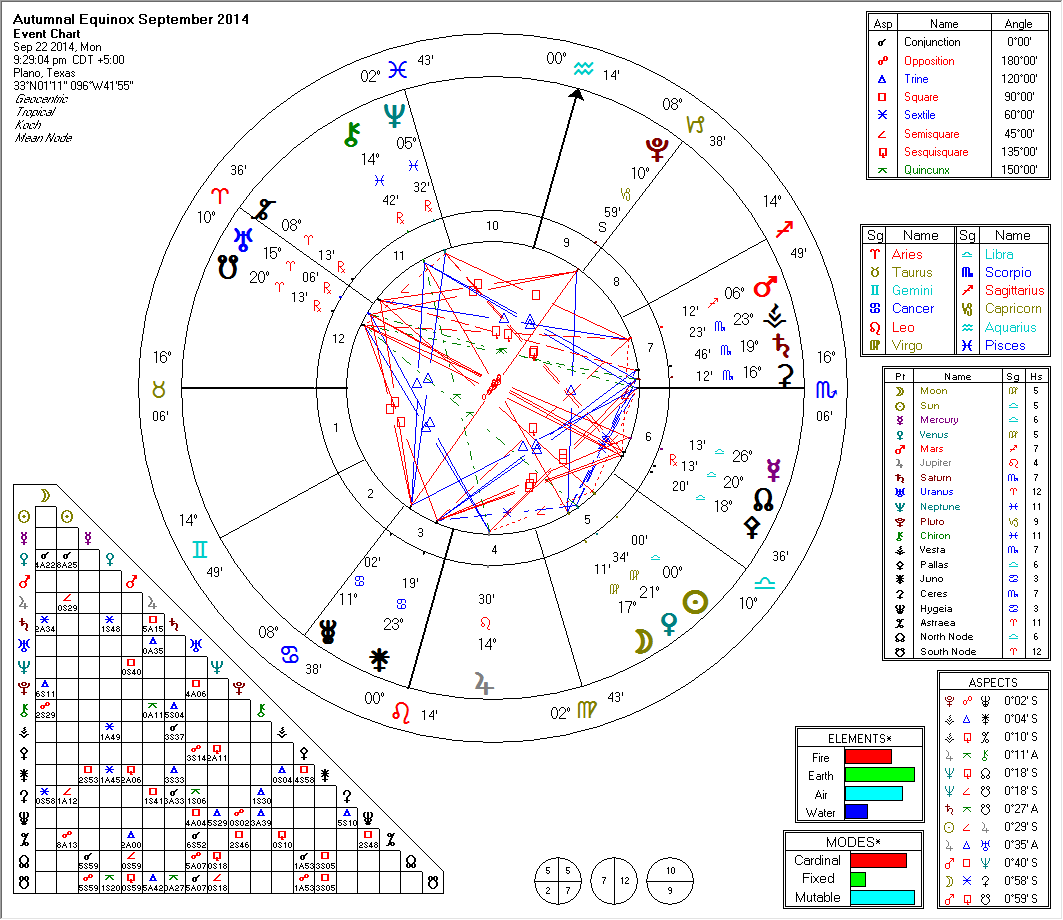
[Click to Enlarge]
We note that the Moon is very old and (predictably) near the Sun. Venus is between them and would be “besieged” if the Sun and Moon were malefics (which they are not). This places Venus on or near the mid-point of Sun and Moon and is arguably a favorable placement. Moon is slightly past an opposition to Chiron and and an earlier opposition to Neptune (both in Pisces) earlier than that.
Before we go further with our analysis, let us make…
View original post 680 more words
Middle East Transmission ~ Children of The Sun Foundation

ONE WEEK UNTIL TRANSMISSION TIME!
The Middle East Transmissions
Beginning on the Equinox
Sept 23, 28 & October 5, 12
REGISTER HERE – it’s FREE to participate:
http://childrenofthesun.org/middle-east-transmissions-registration/
The Middle East transmission team is building strong! There is still time to get more people linked in though, so let’s keep the publicity energy really high!
Thank you in advance for liking and sharing our campaign posts on Facebook and Twitter. This is very helpful and appreciated.
Starting on September 23, our group force field will deliver a transference to the entire Middle Eastern region, likened to a walloping love vaccine, purposed to trigger eradication of a most deadly, hate empowered virus and its contagious influence.
If you haven’t signed up yet, please take a moment to complete the free registration process. Everyone of us is needed to make a transforming difference.
Let’s show the world what the power of unified love can do!
OUR GROUP LOVE IS A KEY TO PLANETARY PEACE
Just for Today ~ Reconnect With Home
 Call your mother and tell her you love her. If she’s no longer alive, do something positive in her honor today.
Pāli Word a Day ~ September 15, 2014
 anamatagga — without beginning or end, epithet of saṃsāra
“whose beginning and end are alike unthinkable”
Daily Words of the Buddha ~ September 15, 2014
 Yo imasmiṃ dhammavinaye
Appamatto vihassati!
Pahāya jātisaṃsāraṃ dukkhassantaṃ karissatī.
With firm resolve, guard your own mind!
Who so untiringly pursues the Dhamma and the Discipline
Shall go beyond the round of births and make an end of suffering.
Dīgha Nikāya 2.185
Last Days of the Buddha: The Maha-parinibbana Sutta (revised edition),
translated from the Pali by Sister Vajira & Francis Story
Hau’oli La Po’akahi

Kāleo says …
Aloha kakahiaka oukou.
Hauʻoli aloha Poʻakahi. I la nani nou.
Good morning and Happy Aloha Monday … Enjoy a great day!
Just For Today ~ EVOLVE!

Begin to break the tyranny of consensus being to gain freedom from the addiction of duality and ascend back to your Source. In Lak’ech ~ HPS OSM
Alan Watts ~ The Ego Illusion
“Ego is a social institution with no physical reality. The ego is simply your symbol of yourself. Just as the word “water” is a noise that symbolizes a certain liquid without being it, so too the idea of ego symbolizes the role you play, who you are, but it is not the same as your living organism.” ~ Alan Watts
Hau’oli Aloha Lapule
 Aloha Kakahiaka oukou … Hau’oli aloha Lapule … I lā nani nou oukou
Good morning and Happy Aloha Sunday, everyone … Enjoy a beautiful day!
Daily Words of the Buddha September 13, 2014

Chandā dosā bhayā mohā,
Yo dhammaṃ ativattati,
Nihīyati yaso tassa
Kāḷapakkheva candimā.
Chandā dosā bhayā mohā,
Yo dhammaṃ nātivattati,
Āpūrati yaso tassa
Sukkapakkheva candimā.
Whoever through desire, hate or fear,
Or ignorance should transgress the Dhamma,
All one’s glory fades away
Like the moon during the waning half.
Whoever through desire, hate or fear,
Or ignorance never transgresses the Dhamma,
All one’s glory ever increases
Like the moon during the waxing half.
Dīgha Nikāya 3.246
Everyman’s Ethics: Four Discourses by the Buddha (WH 14),
translated by Narada Thera
DAILY CHABAD ~ Knowing That Which You Know

A creature born without parents can never know what it means to cry for his father and mother.
A being with no sense of the transcendent can never know what is G‑d and what is divine.
The words, the explanations, we hear them through our minds, but they speak to our souls.
For the soul already knows.
—
Based on letters and talks of the Rebbe, Rabbi M. M. Schneerson
Hau’oli la Po’aono
 Aloha Kakahiaka oukou. Hau’oli aloha Poʻaono.
He ‘olina ka leo ke aloha
I lā nani nou oukou
Good morning and Happy Aloha Saturday, folks!
Joy is in the voice of love.
Have a beautiful day, Everyone!
Meditation ~ Brainwave Entrainment Relaxation Meditation
Can’t seem to find time to meditate? How about squeezing 12 minutes and feel like you’ve been meditating for hours? Listen to this clip, relax and enjoy.
Pāli Word a Day ~ September 12, 2014
 atituṭṭhi — extreme joy
Daily Words of the Buddha ~ September 12, 2014
Upakāro ca yo mitto,
sukhe dukkhe ca yo sakhā,
atthakkhāyī ca yo mitto,
yo ca mittānukampako —
etepi mitte cattāro iti viññāya paṇḍito
sakkaccaṃ payirupāseyya
mātā puttaṃ va orasaṃ.
The friend who is a helpmate,
the friend in happiness and woe,
the friend who gives good counsel,
the friend who sympathises too —
these four as friends the wise behold
and cherish them devotedly
as does a mother her own child.
Dīgha Nikāya 3.265
Everyman’s Ethics: Four Discourses by the Buddha (WH 14),
translated by Narada Thera
Hau’oli la Po’alima
 Aloha Kakahiaka oukou … Hau’oli la Po’alima … I lā nani nou oukou
Good morning and Happy Aloha Friday, everyone … Enjoy a wonderful day!
Seminary ~ What Is Divine Light?

In Theology, Divine Light, also called Divine Radiance or Divine Refulgence, is an aspect of Divine Presence, specifically an unknown and mysterious ability of God, Angels, or Human Beings to express themselves communicatively through spiritual means, rather than through physical capacities.
Spirituality
The term Light has been used in Spirituality, Vision, Enlightenment, Darshan, Tabor Light. Bible commentators such as Ritenbaugh see the presence of light as a metaphor of truth, good and evil, knowledge and ignorance. In the first Chapter of the Bible, Elohim is described as creating light by fiat and seeing the light to be good. In Hinduism, Diwali the festival of lights is a celebration of the victory of light over darkness. A Mantra in Bṛhadāraṇyaka Upaniṣad (1.3.28) urges God to ‘from darkness, lead us unto Light’.
Various local Religious concepts exist:
Inner Light – Christian concept and Quaker doctrine
An Noor – Islamic term and concept
Ein Sof – in Rabbinic Judaism
Tabor Light – in Eastern Orthodox theology
Theoria – in Christian theology, illumination on the path to theosis
Ayat an-Nur – in Arabic, the Sign of Light
Zoroastrianism
Light is the core concept in Iranian Mysticism. The main roots of this thought is in the Zoroastrian beliefs, which defines The supreme God Ahura Mazda as the source of light. This very essential attribute is manifested in various schools of thought in the Iranian Religions and philosophy. Latter this notion has been dispensed into the whole Middle East, having a great effect of shaping the paradigms of different religions and philosophies emerging one after another in the region. After the Arab invasion, this concept has been incorporated into the Islamic teachings by Iranian thinkers, most famous of them Shahab al-Din Suhrawardi, who is the founder of the illumination philosophy.
Although this school had stemmed from the Iranian culture and beliefs, it has spread far into Europe and can be seen and traced in the teachings of the Enlightenment era, Renaissance movement, and even the secret cults as early Illuminati.
Sant Mat
In the terminology of Sant Mat Light and Sound are the two main and expressions of God and from them all the creation comes into existence. Inner Light (and Inner Sound) can be experienced with and after an initiation by a competent Guru during meditation, and are considered the better way to reach Enlightenment.
Eastern Orthodox Church
In the Eastern Orthodox tradition, the Divine Light illuminates the intellect of man through ‘theoria’ or contemplation. In the Gospel of John, the first few verses describe God as Light. “In Him was life and the life was the light of men. And the light shines in the darkness and the darkness did not comprehend it.” John 1:5 Christ also professes to bring the Divine Light to mankind. “I am the light of the world” John 8:12 The Divine Light is also called the Tabor Light which the apostles witnessed at the Transfiguration.
Meditation ~ Types of Meditation

There are so many different types of Meditation. You can find the one that’s right for you. To get your search started, here are six types of meditation you can try.
1. Breath Watching Meditation: Can meditating be as simple as paying attention to your breath for a few minutes? You bet. Relax in whatever position works best for you, close your eyes and start to pay attention to your breathing. Breathing through your nose gets your diaphragm involved and gets oxygen all the way to the bottom of your lungs. As your mind wanders, just re-focus your attention on the air going in and out of your nose. Just do this for several minutes, or longer as you get used to it.
2. An Empty Mind Meditation: Meditating can create a kind of “awareness without object,” an emptying of all thoughts from your mind. The techniques for doing this involve sitting still, often in a “full lotus” or cross-legged position, and letting the mind go silent on its own. It can be difficult, particularly since any effort seems to just cause more business in the mind.
3. Walking Meditations: This one gets the body involved. It can be outside or simply as a back and forth pacing in a room. Pay attention to the movement of your legs and breathing and body as you walk, and to the feeling of your feet contacting the ground. When your mind wanders, just keep bringing it back to the process of walking and breathing. Meditating outside in this way can be difficult because of the distractions. If you do it outside, find a quiet place with level ground.
4. Mindfulness Meditation: A practice Buddhists call Vipassana or Insight Meditation, mindfulness is the art of becoming deeply aware of what is here right now. You focus on what’s happening in and around you at this very moment, and become aware of all the thoughts and feelings that are taking your energy from moment to moment. You can start by watching your breath, and then move your attention to the thoughts going through your mind, the feelings in your body, and even the sounds and sights around you. The key is to watch without judging or analyzing.
5. Simple Mantra Meditation: Many people find it easier to keep their mind from wandering if they concentrate on something specific. A mantra can help. This is a word or phrase you repeat as you sit in meditation, and is chosen for you by an experienced master in some traditions. If you are working on this alone, you can use any word or phrase that works for you, and can choose to either repeat it aloud or in your head as you meditate.
6. Meditating on a Concept: Some meditative practices involve contemplation of an idea or scenario. An example is the “meditation on impermanence,” in which you focus on the impermanent nature of all things, starting with your thoughts and feelings as they come and go. In the Buddhist “meditation on the corpse,” you think about a body in the ground, as it slowly rots away and is fed on by worms. The technique is used to guide you to an understanding that your rationalizing mind might not bring you to.
There are many other meditations you can try, such as the “meditation on loving-kindness” or “object” meditation, and even meditating using brain wave entrainment products. Each type has its own advantages and effects. For this reason, you may find that at different times and for different purposes you want to use several different types of meditation.
Paradigm Shift ~ On Having and Giving
Why do those with less always give more? This video shows what generosity truly is. When asked if they would share their food and money, those who can afford it say no. While those who desperately need what they have will gladly give it away. A bittersweet look at the human spirit.
9/11/01 ~ We Remember You

Hau’oli la Po’aha
 Aloha kakahiaka oukou. Hauʻoli aloha Poʻaha. Maikaʻi iā oukou.
Good morning and Happy Aloha Thursday, everyone. Enjoy your day!
Paradigm Shift ~ Make Your Workplace A Happy Place

Happiness is more than just a bubble-gum outlook on life, but instead revolves around finding meaning in whatever we are doing, and bringing the intention with us everyday to do what we do well. Using mindfulness and meditation time helps bring those intentions to the foreground of your mind, and can significantly improve your ability to stay calm and communicate better with your co-workers, improving your relationships and your overall feeling about your job.
When you prioritize happiness in the present moment, you see this incredible ripple effect in the future in terms of your levels of success and connectedness to others. The bottom line, using mindful actions and the intention to be happy at work, can improve your performance and help you enjoy your job and be more successful too!
“There are five key researched habits we recommend people try practicing to improve their happiness at work,” explained Michelle Gielan of Good Think Inc., in an interview (http://youtu.be/JbywKN0wrko?list=UUAP3YnM3zDBh3fi8jUJZQCQ). She recommends:
Counting Gratitude – Write down three new and unique things your grateful for each day. This will help train your brain to constantly scan your environment looking for new and good things.
Journaling – Each day spend two minutes writing down everything you can remember about the most meaningful moment you’ve had in the last 24 hours. Relive this moment in detail noting down what you saw, heard and felt. By really savoring this experience you can essentially double the number of meaningful moments in your day.
Mindful Activity – Spend 15 minutes each day exercising. Studies suggest this can be the equivalent of taking an anti-depressant. (http://www.unc.edu/peplab/publications/Fredrickson%201998.pdf)
Commit A Conscious Act Of Kindness – Reach out to someone new and different each day in your social circle by taking two-minutes to praise or thank them by email or phone. This activates your social network and reminds your brain of the support you have around you. This is particularly helpful on more stressful days at work.
Attention Training – Practice taking your hands off your keyboard and for two minutes just watch your breath go in and out. This trains your brain to have laser-like focus on one activity when you return to your work, rather than slipping into a multi-tasking mindset that wears you out and slows you down.
“Try each of these brain training approaches for positivity for at least 21 days to get started, but persist with whatever works best for you to build the neural wiring that supports these behaviors through both the good and challenging times at work,” suggests Michelle. “Have patience it does take time.”
GLOBALLY SYNCHRONIZED RAINBOW BRIDGE MEDITATION

“There will come a time when the birds will fall from the trees, the rivers will be poisoned and the wolves will die in the forests. But then the warriors of the rainbow will appear and save the world.” — Cree Indian saying
What: Create a circumpolar rainbow bridge around the Earth.
Who: Everyone (all are included in the rainbow!)
Why? To generate a world-wide telepathic wave of love that encompasses the whole Earth and all sentient beings, creating an interdimensional bridge and opening the stargate to other world systems.
How? Through a rolling wave of synchronized global meditations, we can connect our collective mind and electromagnetic field with that of the Earth.
When: Meditation Days on these Fridays — September 12, 19 and 26, with fully amplified meditation on October 3, 2014 — This meditation is globally synchronized every seven days (days 7, 14, and 21 of the 13 Moon calendar, with a fully-amplified meditation on day 28 of every Moon) to build a rolling wave of unity that culminates in the manifestation of the circumpolar rainbow bridge! On every 28th day of the 13 Moon calendar we practice a more detailed meditation.
Let’s focus our mind for these days on the image of the rainbow bridge. Wherever we may find ourselves, whether it be at home or at a sacred site, let’s unify our mind to create a permanent positive thought vibration around the planet by visualizing the rainbow bridge as the sign of Earth’s return to Her original state of pristine harmony and peace!!
“I am one with the Earth, the Earth and myself are one mind.”
Globally Synchronized Rainbow Bridge Meditation
Before the meditation it is good to take a few moments to clear your mind, dissolving all thoughts as they arise. Also focus on feeling love arise in your heart. When you feel your mind clear, then begin the visualization.
Visualize yourself inside the Earth’s octahedron crystal core. Feel your heart at the center of this crystal core generating an intensely blazing point of white light.
This light from your heart core creates an etheric column that extends to the North and South poles from the blazing center to the tips of the octahedron.
Now visualize a great stream of multicolored plasma-filled light emanating from your heart core and flowing along the central axis toward both of Earth’s poles, shooting out from them, to become two rainbow bands 180 degrees apart.
As Earth revolves on its axis, this rainbow bridge remains steady and constant, unmoving. Feel the two streams of rainbow light rushing through your central column, shooting out from above your head and beneath your feet to create a rainbow bridge around your body.
Now you and the rainbow bridge are one. The rainbow bridge of world peace is real. Visualized by enough people in a telepathic wave of love the rainbow bridge will become a reality.
ALOHA KE AKUA!
MEDITATION FOR CESSATION OF THE FLOOD AND ASSISTANCE FOR THE PEOPLE OF JAMMU AND KASHMIR …

We are chanting the Green Tara mantra for the people of India and Pakistan and for the region …
In Tibetan, we chant “Om Tare Tuttare Ture Soha” … In Sanskrit, it is “Oṃ Tāre Tuttāre Ture Svāhā”.
Tibetan culture, and some others, green is considered to include all the other colors.
The practice of Green Tara helps to overcome fear and anxiety, but devotees also believe that she can grant wishes, eliminate suffering of all kinds and bring happiness.
When called upon, she instantaneously saves us from eight specific calamities. (Another lineage describes 16.) The First Dalai Lama lists the 8, and interprets them as representative of corresponding defects, flaws, or obscurations: 1) lions and pride 2) wild elephants and delusions 3) forest fires and hatred 4) snakes and envy 5) robbers and fanatical views 6) prisons and avarice 7) floods and lust 8) demons and doubt.
MANTRA:
OM TARE TUTTARE TURE SOHA
OM represents Tara’s sacred body, speech and mind.
TARE means liberating from all discontent.
TUTTARE means liberating from the eight fears, the external dangers, but mainly from the internal dangers, the delusions.
TURE means liberating from duality; it shows the true cessation of confusion.
SOHA means “may the meaning of the mantra take root in my mind.”
—–
PLEASE JOIN US … Namaste’
Hau’oli la Po’akolu
 Aloha Kakahiaka oukou. Hau’oli la Po’akolu. Maikaʻi lā ia oukou
Good morning and Happy Aloha Wednesday, everyone
Enjoy a wonderful day!
Pāli Word a Day ~ September 10, 2014
 aññātar — one who knows, a knower of dhamma
Daily Words of the Buddha ~ September 10, 2014
 Pahūtavitto puriso
sahirañño sabhojano,
eko bhuñjati sādūni —
taṃ parābhavato mukhaṃ.
To have much wealth
and ample gold and food,
but to enjoy one’s luxuries alone —
this is a cause of one’s downfall.
Sutta Nipāta 1.102
Everyman’s Ethics: Four Discourses by the Buddha (WH 14),
translated by Narada Thera
Congratulations, Joseph Mata!

Introducing Our Own Reiki Family ~ Jules Starr and Harmony Blossom-Starr


Seeds for Meditation ~ “A Newly Rich Life With Yourself,” by Martha Nussbaum
 Do not despise your inner world. That is the first and most general piece of advice I would offer. Our society is very outward-looking, very taken up with the latest new object, the latest piece of gossip, the latest opportunity for self-assertion and status. But we all begin our lives as helpless babies, dependent on others for comfort, food, and survival itself. And even though we develop a degree of mastery and independence, we always remain alarmingly weak and incomplete, dependent on others and on an uncertain world for whatever we are able to achieve.
As we grow, we all develop a wide range of emotions responding to this predicament: fear that bad things will happen and that we will be powerless to ward them off; love for those who help and support us; grief when a loved one is lost; hope for good things in the future; anger when someone else damages something we care about. Our emotional life maps our incompleteness: A creature without any needs would never have reasons for fear, or grief, or hope, or anger. But for that very reason we are often ashamed of our emotions, and of the relations of need and dependency bound up with them. […] People don’t know how to deal with their own emotions, or to communicate them to others. When they are frightened, they don’t know how to say it, or even to become fully aware of it. Often they turn their own fear into aggression. Often, too, this lack of a rich inner life catapults them into depression in later life. We are all going to encounter illness, loss, and aging, and we’re not well prepared for these inevitable events by a culture that directs us to think of externals only, and to measure ourselves in terms of our possessions of externals.
What is the remedy of these ills? A kind of self-love that does not shrink from the needy and incomplete parts of the self, but accepts those with interest and curiosity, and tries to develop a language with which to talk about needs and feelings. Storytelling plays a big role in the process of development. As we tell stories about the lives of others, we learn how to imagine what another creature might feel in response to various events. At the same time, we identify with the other creature and learn something about ourselves. As we grow older, we encounter more and more complex stories — in literature, film, visual art, music — that give us a richer and more subtle grasp of human emotions and of our own inner world.
So my second piece of advice, closely related to the first, is: Read a lot of stories, listen to a lot of music, and think about what the stories you encounter mean for your own life and lives of those you love. In that way, you will not be alone with an empty self; you will have a newly rich life with yourself, and enhanced possibilities of real communication with others.
—–
Discussion about enjoying A Newly Rich Life With Yourself:
1 – What do you understand by a self-love that does not shrink from the needy and incomplete parts of the self?
2 – Can you share a personal experience of a time when you discovered a newly rich life with yourself?
3 – What works for you in relating to yourself at a deeper level?
Hau’oli Aloha Po’alua
 Aloha kakahiaka kakou. Hau’oli la Po’alua. I lā nani nou.
Hello good morning, Everyone. Happy Aloha Tuesday. Enjoy a beautiful day.
Pāli Word a Day ~ September 09, 2014

sukhādhivahaṃ — brings happiness, bliss
Daily Words of the Buddha ~ September 09, 2014
 Paṇḍito sīlasampanno,
Saṇho ca paṭibhānavā,
Nivātavutti atthaddho,
Tādiso labhate yasaṃ.
Who is wise and virtuous,
Gentle and keen-witted,
Humble and amenable,
Such a one to honour may attain.
Dīgha Nikāya 3.273
Everyman’s Ethics: Four Discourses by the Buddha (WH 14),
translated by Narada Thera
 Hālau 'Aha Hui Lānākila