Just For Today

reflecting backTake a moment and think back to when you were half your current age. What advice would you have given yourself, and how can this inform the way you move through life today?

“Parents can only give good advice or put them on the right paths, but the final forming of a person’s character lies in their own hands.” ~ Anne Frank


Full Moon November 2014

Grandtrines's avatarGrandtrines

Here is the basic chart for the Full Moon of November 2014:

Full Moon November 2014 (Beginners)

[Click to Enlarge]

We see some indication that we may be entering a period of austerity (or a cold winter?) as Venus is between the Sun and Saturn (all in Scorpio) with Mars applying to conjoin Saturn (both in Capricorn).  Saturn and Pluto continue in mutual reception, as has been true since 2012.  Will be interesting to see what the financial markets do.  We note that Mars and Vesta are semi-octile, and that might be the most important aspect during this full moon.  (More discussion on this below after the Modulus Sort Strips.)  We also note a Huber triangle involving Sun / Moon / Chiron (as shown in the next version of the chart).

Full Moon November 2014 (Huber)

[Click to Enlarge]

Similarly important, Astraea (at 29 Pisces) is semi-square the Moon and Sesquisquare the Sun (in a pattern we have not…

View original post 749 more words

Astrological Charts for Virgin Galactic crash Halloween 2014

Grandtrines's avatarGrandtrines

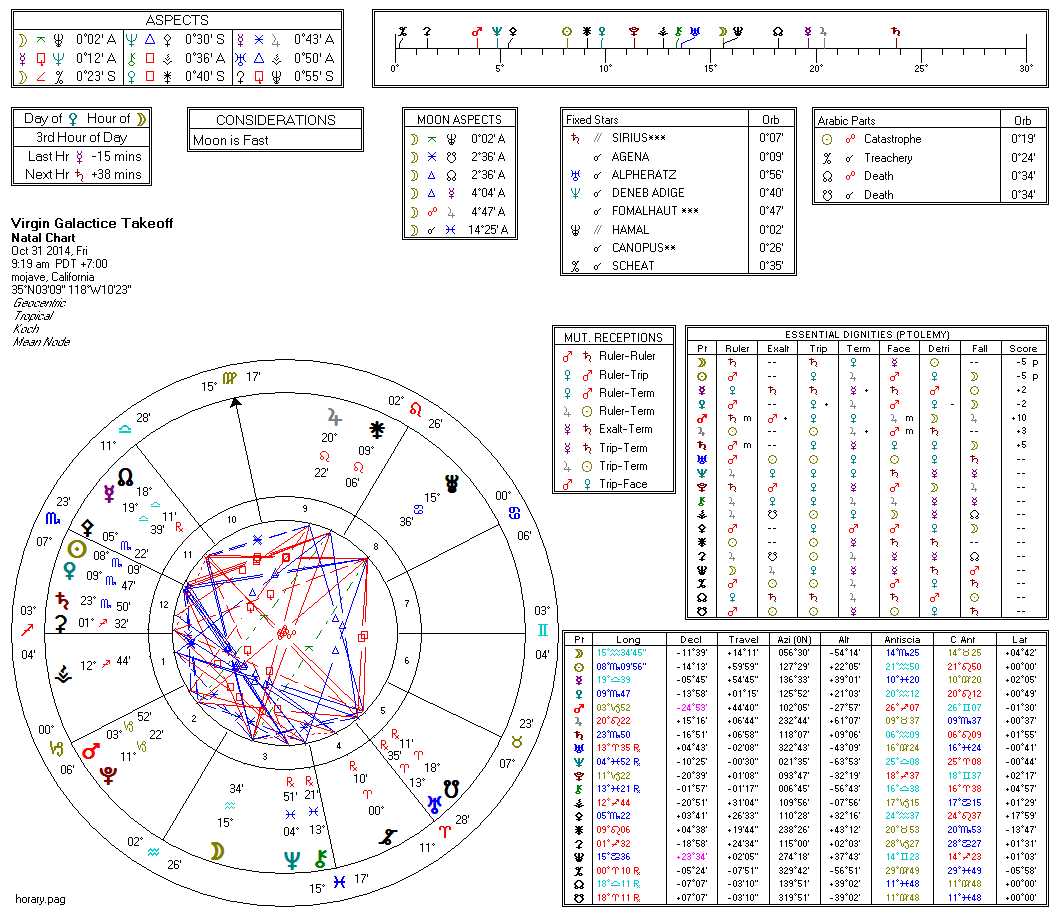
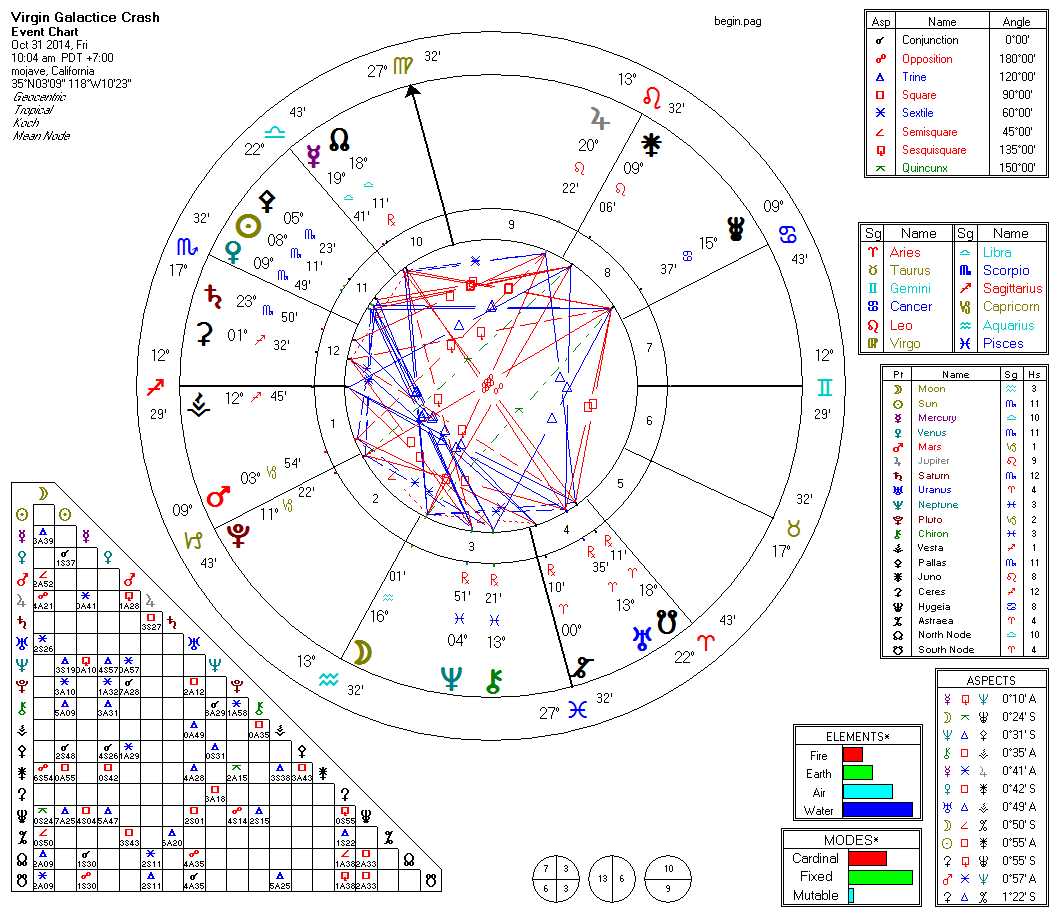
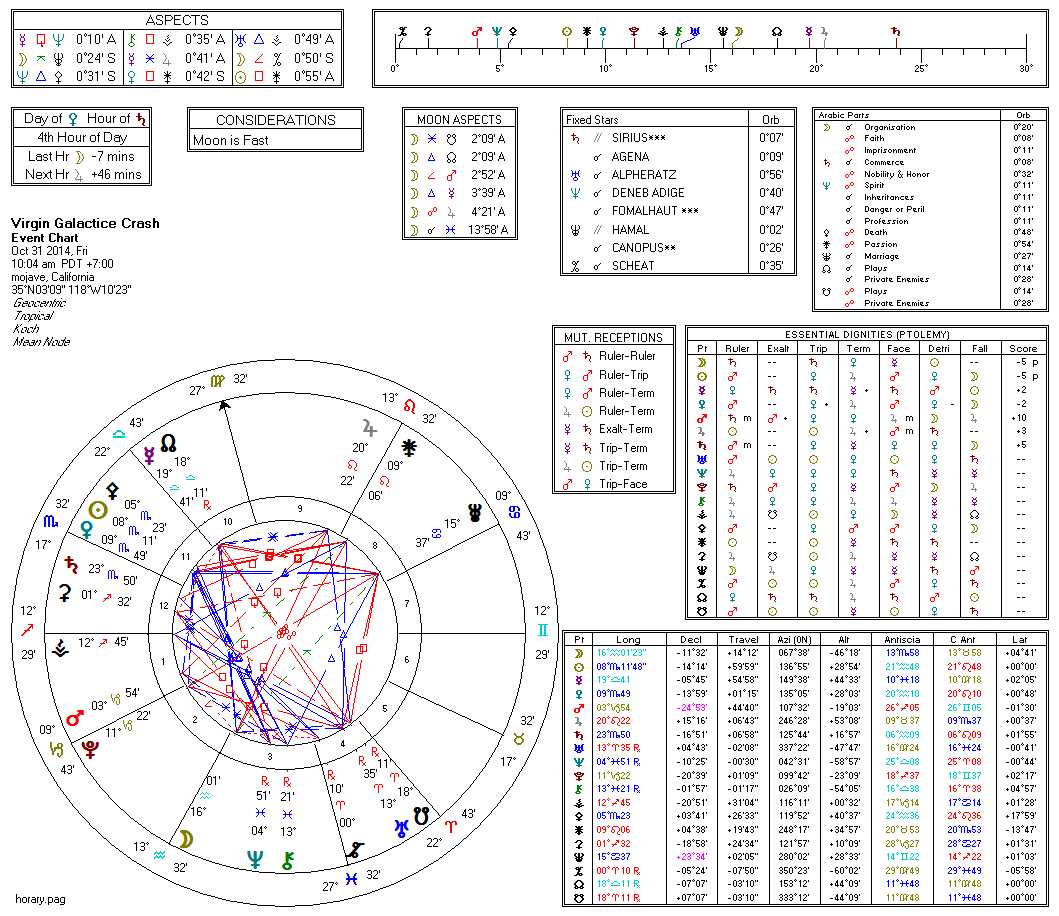
In keeping with our production of charts for catastrophes happening in late October of 2014, here are the charts for the Virgin Galactic crash of Halloween 2014.  The crash happened near the Mojave Air and Space Port near Mojave CA.

Virgin Galactic Takeoff (Beginners) 2014-10-31

[Click to Enlarge]

We note that this chart most closely resembles the Wichita KS plane crash yesterday and the rectified chart for the Marysville school shootings.  (This chart more closely resembles those than it does the Orbital Sciences rocket explosion.)  The horary version of the chart contains Sun Opposite Part of Catastrophe, as did the Wichita KS plane crash.

Virgin Galactic Takeoff (Horary) 2014-10-31

[Click to Enlarge]

Here is the chart for the report of the explosion “45 minutes after takeoff.”

Virgin Galactic Reported Explosion (Beginners) 2014-10-31

[Click to Enlarge]

And here is the horary version of the same:

Virgin Galactic Reported Explosion (Horary) 2014-10-31

[Click to Enlarge]

A few points are noteworthy.  First of all, this chart resembles the chart of…

View original post 248 more words

Seeds for Meditation ~ What Does It Mean To Be Free? ~ Brad Austen

leap of faithLately I’ve been enjoying some time away from computers and technology. I came to the realization that in one sense technology liberates us but at the same time also can enslave us. The enslavement is the time it takes out of our days, where we could be enjoying the sunshine or a sunset. I started to think about freedom and what it really means to be free.

I identified that as a human being on earth at this time, we have conditional freedom but in many cases not absolute freedom. Conditional freedom means that we usually have to invest our time and energy into something, such as a job, to be rewarded with money to then spend as we see fit. This is a give and take system.

Absolute freedom is the freedom that is not bound by conditions or expectations. We often associate this freedom with our childhood, when we were innocent and without a care in the world. However, as we grow into adulthood, this usually becomes a scarcer experience. Many people associate freedom with financial freedom, because most things cost money in this world. However, there is that saying ‘the best things in life are free’. This got me pondering, what things do I enjoy that are free? Friendships and love are free. A walk outside, breathing the air, enjoying the sunshine and listening to the birds sing, are some examples.

Freedom is also a matter of perspective. Two people with the same circumstances can both have a different view on their personal freedom. One may feel a victim to circumstances or empowered by their circumstances. It can be easy to feel a victim in life, especially when things don’t go to plan. However what we often forget or don’t realize is that on a soul level we have chosen these experiences for our growth. Life doesn’t always go to plan or turn out as we hoped.

I think it is important to evaluate your life from time to time and ask yourself, what will it take to feel free and happy? There are some things in life we cannot change, but we can always change our perspective. Life is pretty short to feel trapped or unhappy. Sometimes we need to take that first step and everything begins to fall into place. Spirit is always working with you for your highest good. Trust the process of life and things will become easier and more enjoyable and you will also feel more freedom in your life.

~ Brad Austen

“Don’t Go Back to Sleep,” by Elizabeth Lesser

The Way HomeTo be human is to be lost in the woods. None of us arrives here with clear directions on how to get from point A to point B without stumbling into the forest of confusion or catastrophe or wrongdoing. Although they are dark and dangerous, it is in the woods that we discover our strengths. We all know people who say their cancer or divorce or bankruptcy was the greatest gift of a lifetime—that until the body, or the heart, or the bank was broken, they didn’t know who they were, what they felt, or what they wanted. Before their descent into the darkness, they took more than they gave, or they were numb, or full of fear or blame or self-pity. In their most broken moments they were brought to their knees; they were humbled; they were opened. And later, as they pulled the pieces back together, they discovered a clearer sense of purpose and a new passion for life. But we also know people who did not turn their misfortune into insight, or their grief into joy. Instead, they became more bitter, more reactive, more cynical. They shut down. They went back to sleep.

The Persian poet Rumi says, “The breeze at dawn has secrets to tell you. Don’t go back to sleep. You must ask for what you really want. Don’t go back to sleep. People are going back and forth across the doorsill, where the two worlds touch. The door is round and open. Don’t go back to sleep.”

I am fascinated by what it takes to stay awake in difficult times. I marvel at what we all do in times of transition — how we resist, and how we surrender; how we stay stuck, and how we grow. Since my first major broken-open experience — my divorce — I have been an observer and a confidante of others as they engage with the forces of their own suffering. I have made note of how fiasco and failure visit each one of us, as if they were written into the job description of being human. I have seen people crumble in times of trouble, lose their spirit, and never fully recover. I have seen others protect themselves fiercely from any kind of change, until they are living a half life, safe yet stunted.

But I have also seen another way to deal with a fearful change or a painful loss. I call this other way the Phoenix Process — named for the mythical phoenix bird who remains awake through the fires of change, rises from the ashes of death, and is reborn into his most vibrant and enlightened self.

I’ve tried both ways: I have gone back to sleep in order to resist the forces of change. And I have stayed awake and been broken open. Both ways are difficult, but one way brings with it the gift of a lifetime. If we can stay awake when our lives are changing, secrets will be revealed to us—secrets about ourselves, about the nature of life, and about the eternal source of happiness and peace that is always available, always renewable, already within us.


Questions to ponder after reading this piece:

What does it mean to stay awake and be broken open?
Can you share a personal story of a time you were broken open and felt reborn?
How do you practice staying awake when your life is changing immensely?


Seeds for Meditation … Be Present

be present


Be Present …..In the state of mindlessness, our mind is not free to think, focus and act. It is bound by images, thoughts, feelings and functions in a mechanical and repetitive manner. Each one of us at some point in life wishes to change either ourselves or others. However, we often remain stuck due to the all-pervasive impact of mindlessness that we are largely unaware of.

The first component of mindlessness is the desire to control. Everyone carries a fantasy of how they and the rest of the world should be. People are constantly putting intense pressure on their own selves as well as others to match up to this image.

Usually, there are reasons behind all negative and dysfunctional behaviours and these attributes cannot vanish until understood and dealt with systematically. If we try to suppress negativity, there is often a counterattack from negative forces. In our desire to control things, we forget this simple fact and end up creating more misery for ourselves and others. Mind power can be utilised only when we give up the wish to control and instead, work to build understanding.

Another element of mindlessness is our obsession with the past and future. There are individuals who relive memories of a happy past or mourn negative experiences. Some are petrified by possibilities of future uncertainty and focus their attention in fighting imaginary battles. There are still others who keep daydreaming about an ideal future. On the whole people spend a lot of their present time in either dissecting past baggage or imagining an ideal future. As a result, they are not anchored in their present and are unable to put it to good use. We need to understand that what really exists is neither the past nor future but the present. We can grow only when our complete attention is anchored in the present.

The third component of mindlessness is greed for quick enlightenment. Several people experience disillusionment because they commit themselves to superficial perspectives for instant nirvana. Another set of people are those who commit to a valid perspective but leave it halfway as they are unable to see the light at the end of the tunnel. Both types of individuals experience intense suffering due to their attitude.

It is important to remember that no one can give you enlightenment. The wise can guide you but enlightenment will come only gradually with your own consistent efforts. When even the most revered masters got enlightenment after years of hard work and patience how can there be a short cut?

In order to grow and blossom it is important to become aware of our mindlessness and gradually change it to mindfulness. Mindfulness is very liberating as it requires us to notice and understand all kinds of thoughts, feelings and actions without judgment or criticism.

We should try to keep our attention in the ‘here and now’ and observe all that is happening around us without clinging to either the past or future. In this journey, we need to move at our own natural pace with perseverance and without greed. Although mindfulness appears to be simple and trivial at the outset, it is,in fact, the essence. About mindfulness Buddha said-‘Mindfulness, I declare, is all-helpful.

All things can be mastered by mindfulness.’

ZuliMasih
  ~ Zuli Masih


Seeds for Meditation ~ “Don’t Go Back To Sleep,” by Elizabeth Lesser

dark angel warrior
To be human is to be lost in the woods. None of us arrives here with clear directions on how to get from point A to point B without stumbling into the forest of confusion or catastrophe or wrongdoing. Although they are dark and dangerous, it is in the woods that we discover our strengths. We all know people who say their cancer or divorce or bankruptcy was the greatest gift of a lifetime—that until the body, or the heart, or the bank was broken, they didn’t know who they were, what they felt, or what they wanted. Before their descent into the darkness, they took more than they gave, or they were numb, or full of fear or blame or self-pity. In their most broken moments they were brought to their knees; they were humbled; they were opened. And later, as they pulled the pieces back together, they discovered a clearer sense of purpose and a new passion for life. But we also know people who did not turn their misfortune into insight, or their grief into joy. Instead, they became more bitter, more reactive, more cynical. They shut down. They went back to sleep.

The Persian poet Rumi says, “The breeze at dawn has secrets to tell you. Don’t go back to sleep. You must ask for what you really want. Don’t go back to sleep. People are going back and forth across the doorsill, where the two worlds touch. The door is round and open. Don’t go back to sleep.”

I am fascinated by what it takes to stay awake in difficult times. I marvel at what we all do in times of transition — how we resist, and how we surrender; how we stay stuck, and how we grow. Since my first major broken-open experience — my divorce — I have been an observer and a confidante of others as they engage with the forces of their own suffering. I have made note of how fiasco and failure visit each one of us, as if they were written into the job description of being human. I have seen people crumble in times of trouble, lose their spirit, and never fully recover. I have seen others protect themselves fiercely from any kind of change, until they are living a half life, safe yet stunted.

But I have also seen another way to deal with a fearful change or a painful loss. I call this other way the Phoenix Process — named for the mythical phoenix bird who remains awake through the fires of change, rises from the ashes of death, and is reborn into his most vibrant and enlightened self.

I’ve tried both ways: I have gone back to sleep in order to resist the forces of change. And I have stayed awake and been broken open. Both ways are difficult, but one way brings with it the gift of a lifetime. If we can stay awake when our lives are changing, secrets will be revealed to us—secrets about ourselves, about the nature of life, and about the eternal source of happiness and peace that is always available, always renewable, already within us.

What does it mean to stay awake and be broken open?
Can you share a personal story of a time you were broken open and felt reborn?
How do you practice staying awake when your life is changing immensely?


Meditate on Gratitude Today

dandylion_by_megancoffey-d4zwr34

Always start your day with gratitude.

Quite often we take our blessings for granted. Too often, we forget to appreciate the people or things we already have in our lives as we rush to strive for other things that we do not have. But, by doing so, we do not enjoy the beautiful people or things that are present in our lives NOW.

** So, take a moment of your busy schedule every day to be thankful for the countless blessings that God has showered on each of us. You will notice that it will bring you so much peace when you know that you already have so much blessing in your life.

Meditation ~ Soothing Tibetan Sounds for your Sacred Space

Bodymindzone’s selection of meditation music videos, with slow, beautiful, instrumental pieces, often using soothing sounds of piano, flute and acoustic guitar, will support your meditation practice. The sounds of nature, of the ocean, gently caressing and calming the mind provide the meditative space in which the beginner meditator or experienced practioner of mindfulness may further their meditative practice.

Whether your meditative practice focus is centered prayer, a yoga practice, walking or seated meditation, aided by a mantra, guided visualization, or using breath focused techniques, our lovingly composed songs playlist will relax mind and body and support your meditative spiritual search for relaxation, health and inner peace.

Meditation for beginners teaches that there is no right or wrong method. Whether using music for meditation, or music as a background for meditation, you will aim to bring your mind to focus. You may choose to focus on the instrumental music as a whole, bringing the mind back whenever you notice it has left it, or choose to focus on the movement of sound of the piano or guitar. If you choose your breath or a mantra as your focus, allow our meditative music to slowly pass by in the background, bringing your focused attention back to your breath or mantra if you find our heavenly music pulling the mind away from its focus.

As you use our music meditation playlists, and perhaps watch the inspiring beautiful images, become aware too, of listening and watching. Watch the watcher, watch the listener. Who is aware of the listener? Who is aware of the watcher? Has that awareness ever not been there, the silent ever-present Witness of all that you do?

As you become more mindful, you will find that you become more mindful not just of your own needs but also the needs of the people around you and the world as a whole. Finding compassion, positivity and mindfulness in relation to the world around you can be a starting place for a more productive and creative life in all areas, including relationships, work and your own spiritual journey of growth.

Relax, focus, love, accept.


JUST FOR TODAY … A Lesson in Empathy

empathyOur lives intersect with others all day, everyday. Sometimes we know these other lives well; frequently, though, the points of connection are brief and transient. Who are these people? How might they tell their own stories? What thoughts preoccupy their minds? What joys and troubles are coursing through their feelings?

“Could a greater miracle take place than for us to look through each other’s eyes for an instant?”  ~ Henry David Thoreau

If we could catch a glimpse of others’ stories … If you could stand in someone else’s shoes … hear what they hear … see what they see … feel what they feel … would YOU treat them differently?

All Are One … Live in Peace and Aloha


Daily Words of the Buddha for October 20, 2014

3 LotusSabbe saṅkhārā aniccā.
Yadā paññāya passati,
atha nibbindati dukkhe;
esa maggo visuddhiyā.

Impermanent are all compounded things.
When one perceives this with true insight,
then one becomes detached from suffering;
this is the path of purification.

Dhammapada 20.277

The Discourse Summaries by S.N. Goenka

Seeds for Meditation ~ Lessons from Geese

geese1034-800Fact:
As each goose flaps it’s wings, it creates uplift for the bird following.
By flying in a ‘V’ formation, the whole flock adds 71% greater flying range than if the bird flew alone

Lesson:
People who share a common direction and sense of community can get where they are traveling quicker and easier, because they are traveling on the thrust of one another.

Fact:
Whenever a goose falls out of formation, it suddenly feels the drag and resistance of trying to fly alone and quickly gets back into formation to take advantage of the lifting power of the bird immediately in front.

Lesson:
If people have as much sense as geese, they will stay in formation with those who are headed where we want to go and be willing to accept their help as well as give help to others.

Fact:
When the lead goose gets tired, it rotates back into the formation and another goose flies the point position.

Lesson:
It pays to take turns doing the hard tasks and sharing leadership with people as, with geese, we are interdependent on each other.

Fact:
The geese in formation honk from behind to encourage those
up front to keep their speed.

Lesson:
People need to make sure honking from behind is
encouraging – and not something else.

Fact:
When a goose becomes sick or wounded, two geese drop out of formation and follow it down to help protect it. They stay with it until it dies or is able to fly again. Then they launch out on their own to try and catch up with their flock or they join another formation.

Lesson:
If people have as much sense as geese, they too will stand by each other in difficult times as well as when they are strong.

Just for Today … Wonder

colorful scarfWonder

curiosity: a state in which you want to learn more about something

When you look with wonder at the stars
don’t wonder where I’ve been
or where you’ve been

When you look with wonder at the world
don’t wonder how I got here
or how you got here

When you look with wonder at the clouds
don’t wonder where I’ve drifted
or where you’ve floated

When you look with wonder at the seas
don’t wonder how many gulps I gasped
or how deep you may sink

When you look with wonder at yourself
don’t wonder how I see you
or how you might appear

Simply look with wonder.

October 2014 Rosetta, Mystic Rectangle and Thor’s Hammer

Grandtrines's avatarGrandtrines

These aspects (the Rosetta, Mystic Rectangle, and Thor’s Hammer) repeat several times in October 2014.  We have seen a similar pattern before: the Tokyo Earthquake of 2011.  If we will see some kind of earthquake or meltdown remains to be seen, but lately the NYSE seems to have been a bit shakey.

We omit the Rosettas of Oct 2nd and Oct 10th as being similar to that of Oct 24th and note that they are similar and that in some important way these dates are tied together.  (Hindsight will likely elucidate how.)  Instead, we begin with the Mystic Rectangle of October 12th (which began as the Kite described in a previous post broke formation).

Mystic Rectangle of 2014-10-12

[Click to Enlarge]

We note that Moon trines Venus and Mars trines Uranus.  Mars and the Sun are sextile as are the Moon and Uranus.  This is a powerful day for purposes of creativity for…

View original post 233 more words

Seeds For Meditation ~ Increase Self-Compassion To Eliminate Procrastination In Your Life


procrastination

What causes us to procrastinate, and how can we change our relationship with this tricky habit? Self-compassion — kindness and understanding toward one’s self in response to pain or failure — may be the key to addressing procrastination and its cycle of negativity. A study by Fuschia M. Sirois of Bishop’s University in Canada found that people prone to procrastination had lower levels of self-compassion and higher levels of stress, which effectively looped back to increase the stress and further lower a person’s self-compassion. “Self-compassion is an adaptive practice that may…provide a buffer against negative reactions to self-relevant events,” writes Sirois. The implication is that by interrupting the loop between negative self-talk and procrastination, self-compassion may help us avoid the stress associated with procrastination, extricate ourselves from that downward spiral, and help us change our behavior for the better.

“The curious paradox is that when I accept myself just as I am, then I can change.” ~ Carl Rogers

“You can search throughout the entire universe for someone who is more deserving of you love and affection than you are yourself, and that person is not to be found anywhere.” ~ The Buddha

Kite of October 5th through October 12th

Grandtrines's avatarGrandtrines

We have a kite in play from October 5th through the 12th.  This is an unusually long window, maintained by the fact that, as the Sun moves out of its place in the kite, Venus will move in to continue it.

Kites can be extremely “lucky” periods and Uranus (aka “Prometheus”) features prominently in this one.  Capture your best ideas, no matter how crazy they may sound, during this time period.  Some amazing gifts may come to you, and when you look back you may realize that those ideas were not so “crazy” after all.

Here is one variant of the chart (a number exist because the window is so large):

Kite of Oct 5 to 12 2014[Click to Enlarge]

If you can recall what you were doing between 3:57 CDT and 4:51 CDT (that is Plano time, please adjust for your Time Zone, of course), and what ideas came to you at that time…

View original post 96 more words

Daily Words of the Buddha ~ October 08, 2014

underwater statuePabbatassa suvaṇṇassa,
jātarūpassa kevalo
dvittāva nālamekassa:
iti vidvā samañcare.

Were there a mountain all made of gold,
doubled that would not be enough
to satisfy a single person:
know this and live accordingly.

Saṃyutta Nikāya 1.156

Gemstones of the Good Dhamma,
compiled and translated by Ven. S. Dhammika

Seeds for Meditation ~ “The Place That is Free of Suffering,” by Eckhart Tolle

water veilThe world promises fulfillment somewhere in time, and there is a continuous striving toward that fulfillment in time. Many times people feel, “Yes, now I have arrived,” and then they realize that, no, they haven’t arrived, and then the striving continues. It is expressed beautifully in A Course in Miracles, where it says that the dictum of the ego is “Seek but do not find.” People look to the future for salvation, but the future never arrives. So ultimately, suffering arises through not finding.

And that is the beginning of an awakening-when the realization dawns that “Perhaps this is not the way. Perhaps I will never get to where I am striving to reach; perhaps it’s not in the future at all.” After having been lost in the world, suddenly, through the pressure of suffering, the realization comes that the answers may not be found out there in worldly attainment and in the future. That’s an important point for many people to reach. That sense of deep crisis — when the world as they have known it, and the sense of self that they have known that is identified with the world, become meaningless.

That happened to me. I was just that close to suicide and then something else happened-a death of the sense of self that lived through identifications, identifications with my story, things around me, the world. Something arose at that moment that was a sense of deep and intense stillness and aliveness, beingness. I later called it “presence.” I realized that beyond words, that is who I am. But this realization wasn’t a mental process. I realized that that vibrantly alive, deep stillness is who I am. Years later, I called that stillness “pure consciousness,” whereas everything else is the conditioned consciousness. The human mind is the conditioned consciousness that has taken form as thought. The conditioned consciousness is the whole world that is created by the conditioned mind. Everything is our conditioned consciousness; even objects are. Conditioned consciousness has taken birth as form and then that becomes the world.

To be lost in the conditioned seems to be necessary for humans. It seems to be part of their path to be lost in the world, to be lost in the mind, which is the conditioned consciousness. Then, due to the suffering that arises out of being lost, one finds the unconditioned as oneself. And that is why we need the world to transcend the world. So I’m infinitely grateful for having been lost. The purpose of the world is for you to be lost in it, ultimately. The purpose of the world is for you to suffer, to create the suffering that seems to be what is needed for the awakening to happen. And then once the awakening happens, with it comes the realization that suffering is unnecessary now. You have reached the end of suffering because you have transcended the world. It is the place that is free of suffering.


Daily Words of the Buddha ~ October 06, 2014

myanmar-moine-bouddhisteDunniggahassa lahuno,
yatthakāmanipātino.
Cittassa damatho sādhu,
cittaṃ dantaṃ sukhāvahaṃ.

Wonderful it is to train the mind,
so swiftly moving, seizing whatever it wants.
Good is it to have a well-trained mind,
for a well-trained mind brings happiness.

Dhammapada 3.35

Gemstones of the Good Dhamma,
compiled and translated by Ven. S. Dhammika

Daily Words of the Buddha ~ October 05, 2014

2 lilypadsAtītaṃ nānvāgameyya,
nappaṭikaṅkhe anāgataṃ;
yadatītaṃ pahīnaṃ taṃ,
appattañca anāgataṃ

The past should not be followed after,
and the future not desired;
what is past is dead and gone,
and the future is yet to come.

Majjhima Nikāya 3.272

Gemstones of the Good Dhamma,
compiled and translated by Ven. S. Dhammika


Daily Words of the Buddha ~ October 04, 2014

aloha sunsetUpanīyati jīvitamappamāyu.
Jarūpanītassa na santi tāṇā.
Etaṃ bhayaṃ maraṇe pekkhamāno,
lokāmisaṃ pajahe santipekkho.

Life is swept along, next-to-nothing its span.
For one swept to old age no shelters exist.
Perceiving this danger in death,
one should drop the world’s bait and look for peace.

Saṃyutta Nikāya 1.100

Translated from the Pali by Thanissaro Bhikkhu


Seeds for Meditation ~ “Vibrations”, by Zuli Masih

PrismVibrations …..

you can call these frequencies or vibrations or any other name to signify movement..

all things manifested, including us, are these vibrations that form into atoms..

Thought causes these atoms of frequency to appear as objects..

This ‘Thought’ is called Consciousness..

We are this Consciousness that creates by Thought..

We also create the false belief that we are the manifestation that We have created..

This is called the ‘ego’ or false self..

This state of mind called ego creates the mental pain of Fear..

This is because it is a false belief and is absent of the Reality called Love..

Love is the state of non-fear..

Love is the nature of Reality that some call “God”..

Non-fear is the state of non-ego..

Non-ego is the state of “God”..

“God” is Love..

When You have awakened into the Truth that You are Love,

You will also Realize that You are “God”…

As Yeshua said; ” I and the Father, are One “…

ZuliMasih


~ Zuli Masih


Daily Words of the Buddha ~ October 02, 2014

frau nahKodhaṃ chetvā sukhaṃ seti.
Kodhaṃ chetvā na socati.
Kodhassa visamūlassa, madhuraggassa devate
vadhaṃ ariyā pasaṃsanti,
tañhi chetvā na socatī.

Having killed anger you sleep in ease.
Having killed anger you do not grieve.
The noble ones praise the slaying of anger
— with its honeyed crest & poison root —
for having killed it you do not grieve.

Saṃyutta Nikāya 1.71

Translated from the Pali by Thanissaro Bhikkhu


Just For Today … “Get a Life” ~ by Anna Quindlen

montage(5)
There are thousands of people out there with the same degree you have; when you get a job, there will be thousands of people doing what you want to do for a living. But you are the only person alive who has sole custody of your life. Your particular life. Your entire life. Not just your life at a desk, or your life on the bus, or in the car, or at the computer. Not just the life of your mind, but the life of your heart. Not just your bank account, but your soul.

People don’t talk about the soul very much anymore. It’s so much easier to write a résumé than to craft a spirit. But a résumé is cold comfort on a winter night, or when you’re sad, or broke, or lonely, or when you’ve gotten back the chest X ray and it doesn’t look so good, or when the doctor writes “prognosis, poor.”

You cannot be really first-rate at your work if your work is all you are.

So I suppose the best piece of advice I could give anyone is pretty simple: get a life. A real life, not a manic pursuit of the next promotion, the bigger paycheck, the larger house. Do you think you’d care so very much about those things if you developed an aneurysm one afternoon, or found a lump in your breast while in the shower?

Get a life in which you notice the smell of salt water pushing itself on a breeze over the dunes, a life in which you stop and watch how a red-tailed hawk circles over a pond and a stand of pines. Get a life in which you pay attention to the baby as she scowls with concentration when she tries to pick up a Cheerio with her thumb and first finger.

Turn off your cell phone. Turn off your regular phone, for that matter. Keep still. Be present.

Get a life in which you are not alone. Find people you love, and who love you. And remember that love is not leisure, it is work.

Get a life in which you are generous. Look around at the azaleas making fuchsia star bursts in spring; look at a full moon hanging silver in a black sky on a cold night. And realize that life is glorious, and that you have no business taking it for granted. Care so deeply about its goodness that you want to spread it around. Take the money you would have spent on beers in a bar and give it to charity. Work in a soup kitchen. Tutor a seventh-grader.

All of us want to do well. But if we do not do good, too, then doing well will never be enough.


Seeds For Meditation … Who Are You Listening To?

awesome-forest-natural-beautiful-hd-wallpapers-wallpaper-nature-beauty-dark-backgrounds-amazing-apartments-minneapolis-the-rainforest-pictures-awesome-126546048

Nothing can add more power to your life than concentrating all your energies on a limited set of targets.

Are you listening to your ‘false self’ or your ‘true self’?

Psychological research has found that you may be able to change significant features of your personality with conscious intent. In other words, meditation can help you strengthen the parts of yourself that have been lost.

Why do you meditate? Is it to be peaceful, joyful and happy? Is it to find the true self that has been obscured by your false self — those insecurities, fears, and feelings of uncertainty that build up over time? The only way to understand your true self is to begin the work of uncovering it. But first you must be able to distinguish between your false self and your true self.

When you are feeling secure, accepted, peaceful and certain, you are experiencing your true self. When you are overwhelmed by stress, crisis, doubts and insecurity, your false self has control. Today, use meditation to help find that peaceful and joyful person at your core. Relax, without judging or analyzing, and begin to see glimmers of your true self come shining through.

Happiness is not a reward, it is a consequence. Suffering is not a punishment, it is a result.


Seeds for Meditation … Audible Emotions

damsel muse
Have you ever noticed how certain songs are instant hits, loved by the masses; and other songs are complete duds?

The dud may have the same beat, tempo, and subject matter as the hit, but no one likes it. Haven’t you ever wondered what may be happening beneath the perceivable surface?

When you think about songs and what they really are … emotion … A song is an audible emotion!

So, the reason why particular songs appeal to the masses and others don’t is because of the emotion being projected by the musician.

Now, when you have some free time (but don’t put this off too long, else you’ll forget) listen to 4 or 5 songs and pay close attention to how each song makes you feel.

Pick different songs, not just hits.  Maybe there’s a song that you love, but most people don’t.  Notice the emotion that the particular song evokes in you and ask yourself why you can relate more to that song/emotion than others.

Enjoy this exercise!


Daily Words of the Buddha ~ September 27, 2014

little gold heartAnatthajanano doso,
doso cittappakopano;
bhayamantarato jātaṃ
taṃ jano nāvabujjhati.

Hate brings great misfortune,
hate churns up and harms the mind;
this fearful danger deep within
most people do not understand.

Itivuttaka 3.88

Gemstones of the Good Dhamma,
compiled and translated by Ven. S. Dhammika


The Importance of Mindfulness In Children — by Carolyn Gregoire

n-CHILD-MEDITATE-large570

“Tell me and I forget. Teach me and I remember. Involve me and I learn.”  ~ Benjamin Franklin


While meditation practices are usually associated with adults, there is a growing movement focused on implementing mindfulness practices to optimize the health, well-being and happiness of children. From helping kids thrive in school, to being an effective intervention with autism, to even serving kids that are suffering from cancer and other serious health conditions, meditation is showing that it can have a significant long-term positive affect on child development.

In the growing conversation around mindfulness, we’re constantly hearing about meditation in the workplace and tech CEOs who swear by the practice. But less attention is being paid to the quietly growing movement for mindfulness in the family, and the use of meditation to optimize the health, well-being and happiness of children.

It’s not just adults that can stand to benefit from cultivating a focused awareness on the present moment. Research is beginning to shed light on the power of mindfulness as an intervention for a number of behavioral challenges that children face. We’re also starting to recognize that mindfulness practices could be beneficial for children for the same reasons it helps adults, contributing to reduced stress, improved sleep quality and heightened focus.

At increasingly younger ages, kids are facing higher levels of stress, and it may be taking a significant toll on their health. Stressful events in childhood can increase the risk of developing health problems as an adult, but the impact may hit much earlier. A recent University of Florida study found that stressful events can impact a child’s health and well-being almost immediately, and can contribute to the development of physical and mental health problems and learning disabilities.

Sonia Sequeira, Ph.D., a clinical researcher specialized in Investigational Therapies and director of the Institute for Meditation Sciences, has been practicing yoga and meditation for nearly 20 years, and has practiced with her own children for years. Now in her work as a mindfulness researcher, she’s brought contemplative practices to children ages 3-18 who are struggling with autism, cancer, and other physical and mental health problems. Currently, she’s using meditation and chanting to help relieve pain in children with cancer.

It may seem like a tall order to ask your kid to meditate — given that it can be a struggle just to get a child to sit down or eat breakfast — but Sequeira insists that in her years of working with children, she’s found just the opposite.

“There’s an initial resistance, which I think is cultural, and usually it occurs in the presence of the parent,” Sequeira told The Huffington Post. “But it extinguishes very quickly. Teaching mindfulness to children has always been the easiest for me because there’s no set patterns, or at least they’re not set in stone yet. With adults its much more difficult.”

Learning mindfulness practices — including meditation, breathing exercises, yogaasana (postures) and chanting — can have a significant long-term affect on a child’s development.

“[In my research], what really mattered was finding practical tools that were not an on-off or intermittent practice for children, but something they could really grow with and that could affect their physiology as they grow from their young childhood into adolescence,” says Sequeira.

Here’s proof that children need mindfulness just as much as adults do.

 

Mindfulness-in-Schools-Meditation-Pohle-1

Mindfulness can help kids to thrive at school.

Most of the research on mindfulness for children has been conducted in the school setting. Recent studies have shown school mindfulness programs to be effective in reducing symptoms of depression, stress and anxiety among secondary-school children for up to six months after the program. Such programs can also help students focus during exams, as well as reducing stress and boosting happiness among high school students.

Susan Kaiser Greenland, author of The Mindful Child, is one of increasingly many parents fighting for a “mindful revolution in education,” explaining mindfulness programs can aid kids in developing good habits that will help make them happier and more compassionate.

More and more of these programs are beginning to crop up. The Mindful Moment program in Maryland high schools has students start and end each day with a 15-minute yoga and meditation session, and provides a mindfulness room available for personal use throughout the day. The program aims to reduce stress among students and teachers, and to increase four-year graduation rates.


It can be an effective intervention for autism.

Recent research, conducted by Sequeira and colleagues and published in the journal Autism Research and Treatment, has suggested that meditation has a great deal of potential as a treatment option for children with autism.

“Meditation is one of a few interventions that have been shown to effectively strengthen self-control and character development simultaneously,” the researchers write in a report. “There is much to be gained by exploring meditation as a strategy to override impaired brain synchronicity and debilitating symptoms arising in early years of persons with autism.”

In autism and many other psychological imbalances, the connecting thread is a lack of rhythm, says Sequeira. There’s a challenge of balancing the inner and outer world, and this can distort relationships and interactions with others. In the case of autism, environmental cues become so augmented that the child shuts down from the world to protect themselves. Mantra meditation in particular (a type of meditation that involves the repetition of a word or sound) can help restore a sense of rhythm.

“When you create internal rhythm, there’s a harmonizing and balancing effect,” explains Sequeira. “It facilitates communication, incubation of thoughts… it tells you that you’re in a safe environment and there’s no threat.” “It truly is a top-to-bottom response, and with the children, it restores a natural ability to respond inside to rhythm.”

Children with autism respond well to mantra because it facilitates response, she says.


It can help kids with ADD and ADHD

Being mindful is, at its core, the ability to sustain a focused awareness on the present moment, and practicing mindfulness has been proven to help boost our powers of focus and attention. And it may be just as effective for children as it is for adults.

A 2011 study published in the Journal of Child and Family Studies demonstrated the effectiveness of an eight-week mindfulness program for children ages 8-12 with ADHD, along with a mindful parenting program for their parents. The researchers found that the program reduced parent-reported ADHD behavior. It also increased mindful awareness among both parents and children, and reduced parental stress.

Such programs may be a highly effective intervention either alongside or in the place of traditional ADD and ADHD medications, which come with side effects and may lose their effectiveness over time.

“There are no long-term, lasting benefits from taking A.D.H.D. medications,” James M. Swanson, a psychologist at the University of California, Irvine, told the New York Times. “But mindfulness seems to be training the same areas of the brain that have reduced activity in A.D.H.D… “That’s why mindfulness might be so important. It seems to get at the causes.”


It can help children with cancer and other serious health conditions

Sequeira has been hard at work for over a year now on a pilot program bringing mantra meditation to children with cancer as a way to reduce pain. While the study is still underway and the results have not yet been finalized, she’s seen an overwhelming positive reaction from both the children and their parents.

“Frequently the children remark that they want to continue beyond the time that’s scheduled, even beyond the point where they had heightened pain,” says Sequeira. “They wanted us to stay there chanting with them for a while. Parents from all over the world speaking different languages are united by mantra that doesn’t have a language meaning but that touches their heart. They felt an enormous sense of peace and did feel that they were contributing to the healing of their children.”

The kids Sequeira works with at Sloan-Kettering also use what she calls a “worrywart waste basket,” in which they make a practice of writing down their concerns on a piece of paper and throwing them away. “They know to do that, and to chant and resolve some of the tension that arises,” says Sequeira.

mother_daughter_meditating
A mindful family upbringing encourages children to self-actualize

Mindful parenting, as defined by Mindfulness-Based Stress Reduction founder Jon Kabat-Zinn, consists of “paying attention to your child and your parenting in a particular way: intentionally, here and now, and non-judgmentally.” As Sequeira puts it, creating a mindful family is about “healing the environment and healing the relationships.”

To begin to create a more mindful family and incorporate mindfulness into their children’s lives, parents can start with a daily meditation, yoga or breathing practice. Family dinners can also become mindful by not allowing phones at the table and having a moment of gratitude for the food. Even simple things like positive affirmations and encouraging children to think before they speak can foster an environment of calmness, presence and compassion.

“A child is imprinted with many influences… and all of this shapes a personality” says Sequeira. “When there’s a mindfulness approach to living, it ultimately becomes the personality of the child to truly manifest and become who they are — not trying to become a doctor or a lawyer, but trying to discover their gifts. At the same time, it allows the parents to wean themselves from this very analytical, competitive, linear thinking in life, trying to carry children towards certain goals, which ultimately is stressful for the parent.”

This “group healing,” says Sequeira, will hopefully one day become the basis for a more mindful society.

—–
Syndicated from huffingtonpost.com, Sep 21, 2014


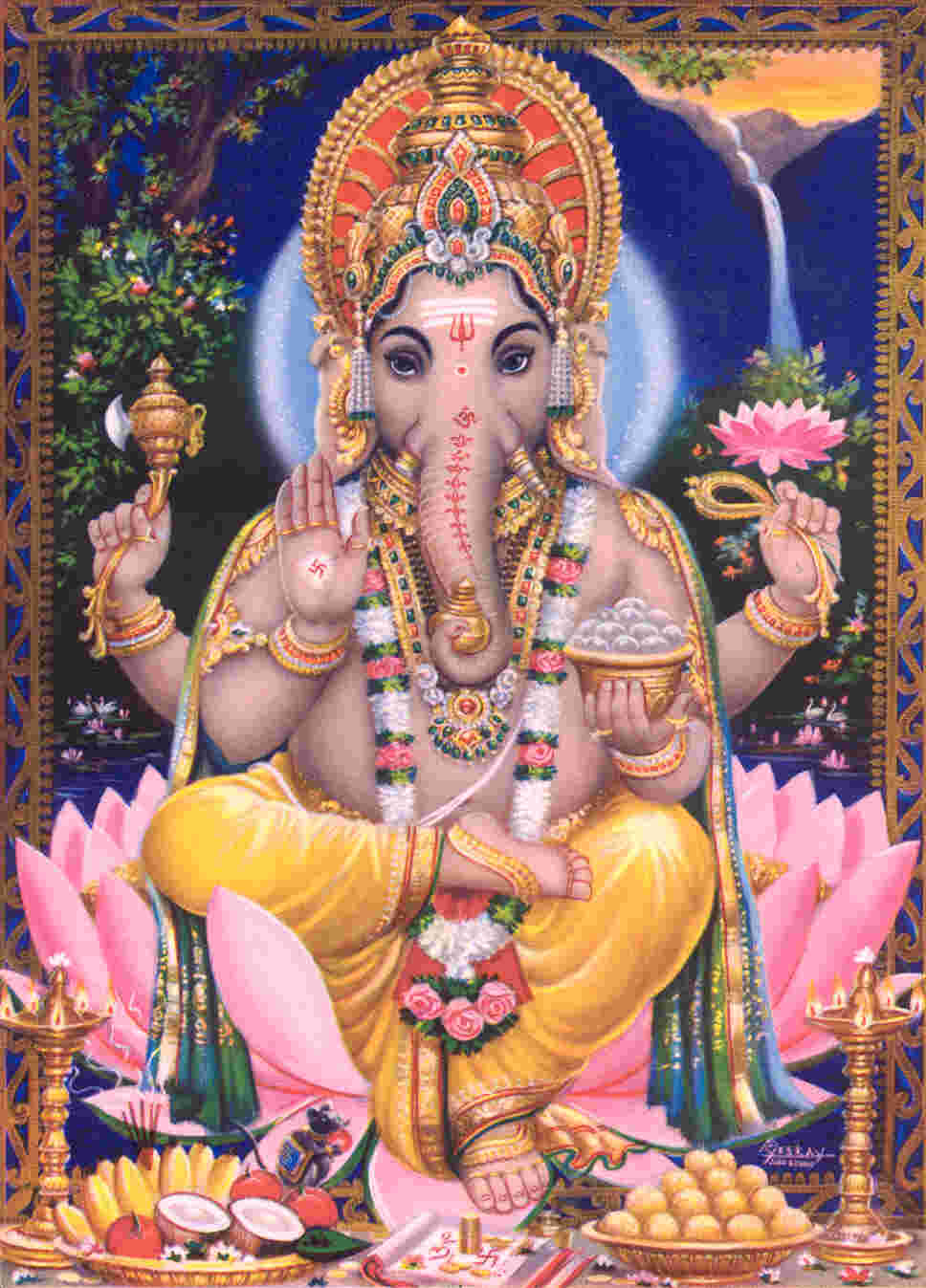
Seminary ~ Invoking Ganesha, Remover of Obstacles

Ganesh Ji
Ganesh Ji

Yoga philosophy is often fleshed out with characters from Hindu mythology. Some people find this off-putting as it rings a distant note of religiosity. This often happens because these colorful characters and stories are viewed as concrete deities, rather than as representations of different aspects of ourselves. Of course, there are sectors of society that regard these archetypes as material divinities, but it is also possible to separate Hindu mythology from a particular religious view point and to use it to illuminate deep seated aspects of ourselves.

One of the most well-known figures in Hindu mythology is Ganesha, the elephant god. His anthropomorphic image is widespread in India, its prominence dating back to the 6th century AD. He is portrayed in a wide variety of situations, from valiantly fighting demons to domestic portraits invoking a sense of familial harmony. While Ganesha is also known as a patron of the arts and sciences, he is most widely revered as the remover of obstacles and the symbol of wisdom. However, Ganesha is also thought to place obstacles in the path of those that need to learn a particular lesson. In this sense, obstacles are regarded as positive forces fostering new perspectives. This encapsulates the deeper sense of wisdom which Ganesha represents.

A traditional way of invoking the Ganesha archetype is through mantra. In many yoga schools, mantras are chanted as a way of getting in touch with those aspects of ourselves we need most in our journey of spiritual realization. The Ganesha mantra translates as the following:

O Mighty Ganesha of Large body, curved trunk, with the brilliance of a million suns, please make all my work free of obstacles, always.

Our internal Ganesha oversees obstacles on material and spiritual planes. Obstacles in our lives occur on many levels, and often simultaneously, from the grossest manifestations of the body to the subtlest impressions of the mind. Yoga philosophy does not differentiate between these levels of being as body is regarded merely as gross mind and mind as subtle body.

This becomes an interesting perspective when we consider the compound ways in which obstacles often seem to manifest in our lives. When we are dealing with extreme mental issues, such as obstacles in our professional lives or relationship dynamics, we often experience concurrent physical ailments. Similarly, serious health problems deeply impact our state of mind. Obstacles resonate on all our levels of being in chorus. To truly start removing these obstacles requires a deeper and more inclusive concept of wisdom – which Ganesha represents.

This sort of wisdom occurs when we manage, through practice, to align our rational faculties with our intuitive ones. Yoga and meditation techniques all aid the process of achieving a state of balance in which this true sense of wisdom becomes more accessible. In this sense, we are all Ganesha’s capable of removing the obstacles in our lives. It is this wisdom which gives birth to the creative insights that resolve our problems.

So next time you are faced with what feels like an insurmountable obstacle, smile as you call to mind the image of the wise and powerful elephant god. Know that he resides within you and that through practice, whichever form works for you, you can achieve the sort of balanced insight that enables you to remove any obstacle in your path. Furthermore, by invoking Ganesha’s wisdom, be reminded that all obstacles are teachers on your journey toward yourself and are in fact your biggest opportunities for growth.


When Two Become One …

flamingcoupleLove one another, but make not a bond of love
Let it rather be a moving sea between the shores of your souls.

Fill each other’s cup, but drink not from one cup.
Give one another of your bread, but eat not from the same loaf.

Sing and dance together and be joyous,
but let each one of you be alone,
Even as the strings of a lute are alone
though they quiver with the same music.

Give your hearts, but not into each other’s keeping;
For only the hand of Life can contain your hearts.

And stand together yet not too near together;
For the pillars of the temple stand apart,
And the oak tree and the cypress grow not in each other’s shadow.

~ Khalil Gibran


Seeds For Meditation … The Magical Ones

momentintime

“The earth recognizes people whom Source flowers. There is a sensuousness, a centeredness, a grace to their movement. There is a relaxed gentility of power flowing quietly within and beneath their action. There is a humble assuredness about them, a reverence, a sense of humor and a sense of the sacred entwined. They are the magical people, for whom the earth has longed.” ~ Ken Carey

Artwork: “A Moment In Time”, by John Kolenberg